


 |
市場調查報告書
商品編碼
2119072
膜:市場佔有率分析、產業趨勢和統計數據、成長預測(2026-2031)Membranes - Market Share Analysis, Industry Trends & Statistics, Growth Forecasts (2026 - 2031) |
||||||

※ 本網頁內容可能與最新版本有所差異。詳細情況請與我們聯繫。
據 Mordor Intelligence 稱,2025 年膜市值為 112.4 億美元,預計到 2031 年將達到 158.4 億美元,而 2026 年為 119.7 億美元,預測期(2026-2031 年)的複合年成長率為 5.76%。
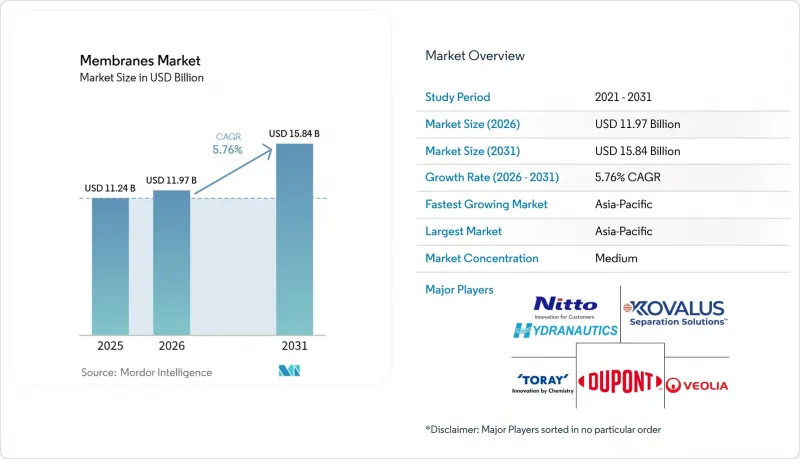
本報告按材料(例如,聚合物薄膜)、技術(例如,逆滲透(RO))、組件結構(例如,螺旋纏繞)、應用(例如,水和廢水處理、食品和飲料加工)、終端用戶行業(例如,上下游污水處理)以及地區(例如,亞太地區、北美地區)進行細分。市場預測以美元 (USD) 為單位。
全球膜市場趨勢與洞察
水資源短缺日益嚴重,海水淡化基礎設施不斷擴張
到2025年,全球177個國家運作的22,000多座海水淡化廠的日處理能力將超過1.3億立方米,但仍有超過20億人無法取得安全飲用水。這種供需失衡進一步加劇了對大規模海水淡化計畫和長期膜供應合約的需求。沙烏地阿拉伯、伊拉克和埃及規劃的新設施正在為膜市場創造多年的採購管道。水安全正從一項有限的公共產業議題轉變為一項國家基礎設施議題。當專案業主優先考慮交付確定性時,擁有本地製造和服務能力的供應商更具競爭力。此外,選擇節能型薄膜具有重要的經濟和氣候意義,尤其是在海水淡化對水安全至關重要的地區。
對污水處理、水資源再利用和環境合規有嚴格的規定。
監管要求正在縮短整個膜處理市場的設備更換週期。在印度,關鍵工業部門強制要求使用膜基零液體排放系統,而2024年水質淨化淨化計畫則支持在農村污水處理設施中引入逆滲透和超過濾。中國的污染防治計畫也支持更廣泛地利用超過濾和逆滲透對工業污水進行再利用。歐盟也不斷加強對污水處理和新興污染物去除的要求。一旦規範的處理流程實施,安裝後就需要定期購買膜設備。與在資本投資低迷時期往往會推遲的設備採購相比,這為膜市場創造了更穩定的需求基礎。
膜污染、結垢和生物污染會影響系統性能
生物污染仍然是逆滲透海水淡化系統運作中的一個主要限制因素。 2025年發表的一項研究表明,即使經過標準預處理,耐氯細菌仍能在海水逆滲透膜上形成結構化的生物膜。污染會增加所需的壓力,導致能耗增加,並可能加速膜的劣化。此外,由於合成給水無法完美模擬實際運作條件,實驗室模型可能低估了運作中工廠中污染的嚴重性。這促使人們對膜的解剖和現場表徵產生了濃厚的興趣。杜邦公司在其於2026年3月發布的NF270-400/34更新版中解決了這個問題,透過降低初始壓力損失和提高生物污染預防性能來實現。
細分市場分析
到2025年,聚合物薄膜將佔薄膜市場銷售額的62.83%。這一地位反映了其加工柔軟性、成本競爭力以及在都市污水處理和製藥行業過濾領域的廣泛應用。聚中空聚二氟亞乙烯纖維膜因其耐化學性和機械強度,在工業污水回用領域中越來越廣泛的應用。在易結垢的流體中,這些膜的性能優於醋酸纖維素膜。憑藉這一穩固的基礎,聚合物產品在薄膜市場的主要應用整體繼續佔據核心地位。
預計到2031年,碳基和石墨烯基膜的複合年成長率將達到8.61%。一項2025年的研究表明,利用低成本的銅箔基板可以製備500平方厘米的多孔石墨烯膜,據報道其成本為每平方米10美元。陶瓷膜在化學、石油化學和食品加工等對溫度和化學條件要求苛刻的行業中應用日益廣泛。金屬膜在能源和化學產業的特殊高溫分離應用中繼續發揮著至關重要的作用。沸石膜、複合膜和混合膜則適用於氣體分離、脫水、藥物澄清和食品級濃縮等早期或特殊應用。
到2025年,逆滲透將佔據34.61%的市場佔有率,成為最大的技術領域。高效去除、低能耗的組件正依照標準更換週期逐步取代老舊設備。超過濾和微過濾繼續作為逆滲透和奈米過濾的預處理系統發揮作用。 2026年5月,東麗公司推出了孔徑為0.005µm的「F-HFUG系列」超過濾組件,並宣稱其能夠減少下游逆滲透膜的生物污染。奈米過濾、膜蒸餾、電滲析和薄膜生物反應器等技術則滿足了飲用水、濃鹽水處理、海水淡化和城市水回用等領域的需求。
預計到2031年,正向滲透技術將以9.27%的複合年成長率成長。與壓力驅動的替代技術相比,正向滲透技術能耗更低,因此在零液體排放預處理和濃縮液領域得到了廣泛應用。在相關應用中,此技術可降低30%至50%的能耗。 2025年在印度進行的一項工業初步試驗表明,奈米選擇性正向滲透技術在每平方公尺1 LMH的通量下,實現了99.5%的染料去除率。這些結果表明,該技術的應用範圍已超越了早期應用案例中常見的緊急和軍事用途。
區域分析
預計到2025年,亞太地區將佔全球膜市場佔有率的42.27%,並在2031年之前以6.52%的複合年成長率成長。中國的需求主要得益於其大規模的逆滲透膜生產能力以及政府的水資源相關項目。中國逆滲透膜元件的年產量超過1000萬片。在印度,恆河清潔計畫(Namami Gange)、工業部門的零液體排放政策以及沿海海水淡化計畫的擴張正在推動市場需求。然而,印度國內產量僅能滿足部分需求,進口需求依然存在,為全球供應商創造了合作機會。
北美是一個成熟的地區,其發展受到監管要求和系統現代化的限制。美國地方政府正在升級其系統,以滿足去除全氟烷基和多氟烷基物質 (PFAS)、飲用水標準和基礎設施預算的需求。加拿大市政和工業部門對水處理的需求穩定,而墨西哥的製造地正在推動製程用水處理需求的成長。歐洲的發展受到《水框架指令》和《都市廢水處理指令》的驅動。德國、法國和英國在製藥、食品飲料和市政應用領域主導超純水膜技術的應用。德國、荷蘭和愛爾蘭的半導體計畫正在為超純水膜創造新的需求。
中東和非洲是膜市場資本最密集的地區之一。沙烏地阿拉伯的拉斯莫海森海水淡化計畫預計2025年完成融資,投資額達6.86億美元,並於2030年全面運作,日產量達30萬立方公尺。在該地區,本地生產在海水淡化競標供應商的選擇中變得越來越重要。巴西和阿根廷透過城市用水和工業污水處理來滿足南美洲的需求。宏觀經濟波動和基礎設施資金短缺阻礙了該地區部分地區的專案活動。這些地區膜市場的規模很大程度上受到公共產業投資時機和工業廢水回用計畫實施的影響。
其他好處:
- Excel格式的市場預測(ME)表
- 3個月的分析師支持
目錄
第1章:引言
- 市場分析與定義的前提條件
- 分析範圍
第2章 分析方法
第3章執行摘要
第4章 市場狀況
- 市場概覽
- 市場促進因素
- 水資源短缺日益嚴重,海水淡化基礎設施不斷擴張
- 對廢水處理、水資源再利用、遵守環境法規有嚴格的規定。
- 快速的工業化和都市化正在推動對先進水處理解決方案的需求。
- 藥品和生物製藥生產對純度的要求越來越高。
- 半導體製造和電子設備生產導致用水需求增加。
- 市場限制因素
- 膜污染、結垢和生物污染會影響系統性能
- 壓力驅動膜過程的高能耗
- 大量資本投資和膜更換成本
- 價值鏈分析
- 波特五力分析
第5章:預測市場規模與成長率
- 材料
- 聚合物薄膜
- 陶瓷膜
- 金屬膜
- 碳石墨烯薄膜
- 沸石膜
- 複合膜和混合膜
- 透過技術
- 逆滲透(RO)
- 正向滲透(FO)
- 超過濾(UF)
- 微過濾(MF)
- 奈米過濾(NF)
- 膜蒸餾(MD)
- 電滲析/逆電透析(ED/EDR)
- 滲透蒸發
- 膜生物反應器(MBR)
- 其他技術
- 透過模組配置
- 螺旋纏繞
- 中空纖維
- 管狀
- 板框
- 微血管
- 透過使用
- 水和污水處理
- 食品/飲料加工
- 藥品和醫療加工
- 化學和石油化學工藝
- 電子和半導體加工
- 紙漿和造紙加工
- 石油和天然氣加工
- 其他用途
- 按最終用途行業分類
- 用水和污水
- 食品/飲料
- 藥品和醫療保健
- 化工/石油化工
- 電子和半導體
- 發電
- 石油和天然氣
- 紙漿和造紙
- 其他終端用戶產業
- 按地區
- 亞太地區
- 中國
- 印度
- 日本
- 韓國
- 其他亞太國家
- 北美洲
- 美國
- 加拿大
- 墨西哥
- 歐洲
- 德國
- 英國
- 法國
- 義大利
- 俄羅斯
- 其他歐洲國家
- 南美洲
- 巴西
- 阿根廷
- 其他南美國家
- 中東和非洲
- 沙烏地阿拉伯
- 南非
- 其他中東和非洲國家
- 亞太地區
第6章 競爭情勢
- 市場集中度
- 策略趨勢
- 市佔率和排名分析
- 公司簡介
- Alfa Laval
- Applied Membranes, Inc.
- DuPont
- GEA Group Aktiengesellschaft
- Hydranautics-A Nitto Group Company
- Kovalus Separation Solutions
- MANN+HUMMEL
- Nanostone Water, Inc.
- Pall Corporation
- Pentair
- Sterlitech Corporation
- Synder Filtration, Inc.
- Thermo Fisher Scientific Inc.
- TORAY INDUSTRIES, INC.
- TOYOBO CO., LTD.
- Veolia
- Xylem
第7章 市場機會與未來展望
According to Mordor Intelligence, the membranes market was valued at USD 11.24 billion in 2025 and is estimated to grow from USD 11.97 billion in 2026 to reach USD 15.84 billion by 2031, at a CAGR of 5.76% during the forecast period (2026-2031).
This report is Segmented by Material (Polymeric Membranes, and More), Technology (Reverse Osmosis (RO), and More), Module Configuration (Spiral Wound, and More), Application (Water and Wastewater Treatment, Food and Beverage Processing, and More), End-Use Industry (Municipal Water and Wastewater, and More), and Geography (Asia-Pacific, North America, and More). The Market Forecasts are Provided in Terms of Value (USD).
Global Membranes Market Trends and Insights
Increasing Water Scarcity and Expansion of Desalination Infrastructure
Global desalination capacity exceeded 130 million m3 per day in 2025 across more than 22,000 operating plants in 177 countries, while more than 2 billion people still lacked safely managed drinking water. This imbalance is strengthening the case for large-scale desalination projects and long-term membrane supply agreements. New facilities planned in Saudi Arabia, Iraq, and Egypt create a multi-year procurement pipeline for the membranes market. Water availability is becoming a national infrastructure issue rather than a limited utility concern. Suppliers with local manufacturing and service capabilities can become more competitive when project owners prioritize delivery certainty. Energy-efficient membrane selection also carries fiscal and climate importance, particularly where desalination is central to water security.
Stringent Regulations for Wastewater Treatment, Water Reuse, and Environmental Compliance
Regulatory requirements are shortening replacement cycles for treatment equipment across the membranes market. India requires membrane-based zero-liquid-discharge systems in critical industrial sectors, while its 2024 clean-water program supported reverse osmosis and ultrafiltration in rural treatment plants. China's water pollution plan also supports broader industrial wastewater reclamation using ultrafiltration and reverse osmosis. The European Union continues to raise requirements for wastewater treatment and removal of emerging contaminants. A regulated treatment step creates recurring membrane purchases once it is installed. This supports a more stable demand base for the membranes market than equipment purchases that can be deferred during periods of weaker capital spending.
Membrane Fouling, Scaling, and Biofouling Affecting System Performance
Biofouling remains a major operating constraint in reverse osmosis desalination systems. Research published in 2025 found that chlorine-resistant bacteria can form structured biofilms on seawater reverse osmosis membranes after standard pretreatment. Fouling raises pressure requirements, which increases energy use and can speed membrane aging. Laboratory models can also understate the severity of fouling in operating plants because synthetic feedwater does not fully reproduce field conditions. This has increased interest in membrane autopsies and site-specific characterization. DuPont's March 2026 NF270-400/34 update addressed this issue with lower initial pressure drop and improved biofouling protection.
Other drivers and restraints analyzed in the detailed report include:
- Rapid Industrialization and Urbanization Driving Demand for Advanced Water Treatment Solutions
- Growing Purity Requirements in Pharmaceutical and Biopharmaceutical Manufacturing
- High Energy Consumption Associated with Pressure-Driven Membrane Processes
For complete list of drivers and restraints, kindly check the Table Of Contents.
Segment Analysis
Polymeric membranes held 62.83% of the membranes market revenue in 2025. Their position reflects processing flexibility, cost competitiveness, and extensive use in municipal water treatment and pharmaceutical filtration. Polyvinylidene fluoride hollow fiber membranes are gaining use in industrial wastewater reuse because of their chemical resistance and mechanical strength. They can perform better than cellulose acetate alternatives in high-fouling streams. This established base keeps polymeric products central to the membranes market industry across major applications.
Carbon and graphene-based membranes are forecast to grow at an 8.61% CAGR through 2031. Research from 2025 demonstrated porous graphene membrane production at 500 cm2 using low-cost copper foil substrates with a reported cost of USD 10 per m2. Ceramic membranes are gaining use in chemical, petrochemical, and food processing settings with demanding temperature and chemical conditions. Metallic membranes remain relevant for specialized high-temperature separations in energy and chemical applications. Zeolite, composite, and hybrid membranes support earlier-stage or specialized uses in gas separation, dehydration, pharmaceutical clarification, and food-grade concentration.
Reverse osmosis was the largest technology segment in 2025 with a 34.61% share. High-rejection and lower-energy elements are replacing older units during standard replacement cycles. Ultrafiltration and microfiltration continue to serve as pretreatment systems for reverse osmosis and nanofiltration. Toray introduced the F-HFUG Series ultrafiltration module in May 2026, with a 0.005 µm pore size and a stated reduction in downstream reverse osmosis biofouling. Nanofiltration, membrane distillation, electrodialysis, and membrane bioreactors serve drinking water, brine management, desalination, and municipal reuse needs.
Forward osmosis is projected to expand at a 9.27% CAGR through 2031. Its use in zero-liquid-discharge pretreatment and brine concentration reflects lower energy use than pressure-driven alternatives. The technology can reduce energy consumption by 30% to 50% in relevant applications. A 2025 industrial pilot in India achieved 99.5% dye rejection at 10 liters per square meter per hour (LMH) flux with nano-selective forward osmosis technology. These results indicate progress beyond the emergency and military uses that characterized earlier installations.
Complete Report Scope:
- By Material
- Polymeric Membranes
- Ceramic Membranes
- Metallic Membranes
- Carbon and Graphene-Based Membranes
- Zeolite Membranes
- Composite and Hybrid Membranes
- By Technology
- Reverse Osmosis (RO)
- Forward Osmosis (FO)
- Ultrafiltration (UF)
- Microfiltration (MF)
- Nanofiltration (NF)
- Membrane Distillation (MD)
- Electrodialysis and Electrodialysis Reversal (ED/EDR)
- Pervaporation
- Membrane Bioreactors (MBR)
- Other Technologies
- By Module Configuration
- Spiral Wound
- Hollow Fiber
- Tubular
- Plate and Frame
- Capillary
- By Application
- Water and Wastewater Treatment
- Food and Beverage Processing
- Pharmaceutical and Medical Processing
- Chemical and Petrochemical Processing
- Electronics and Semiconductor Processing
- Pulp and Paper Processing
- Oil and Gas Processing
- Other Applications
- By End-Use Industry
- Municipal Water and Wastewater
- Food and Beverage
- Pharmaceuticals and Healthcare
- Chemical and Petrochemical
- Electronics and Semiconductors
- Power Generation
- Oil and Gas
- Pulp and Paper
- Other End-Use Industries
- By Geography
- Asia-Pacific
- China
- India
- Japan
- South Korea
- Rest of Asia-Pacific
- North America
- United States
- Canada
- Mexico
- Europe
- Germany
- United Kingdom
- France
- Italy
- Russia
- Rest of Europe
- South America
- Brazil
- Argentina
- Rest of South America
- Middle-East and Africa
- Saudi Arabia
- South Africa
- Rest of Middle-East and Africa
- Asia-Pacific
Geography Analysis
Asia-Pacific commanded 42.27% of the membranes market share in 2025 and is forecast to grow at a 6.52% CAGR through 2031. China's demand is supported by large reverse osmosis manufacturing capacity and government water programs. Its production base exceeds 10 million reverse osmosis elements annually. In India, demand is supported by the Namami Gange program, industrial zero-liquid-discharge mandates, and coastal desalination expansion. Domestic production meets only a portion of Indian demand, maintaining the need for imports and creating partnership opportunities for global suppliers.
North America is a mature region shaped by regulatory requirements and system modernization. U.S. municipal utilities are upgrading systems in response to per- and polyfluoroalkyl substances (PFAS) remediation needs, drinking water standards, and infrastructure allocations. Canada supplies stable municipal and industrial treatment demand, while Mexico's manufacturing base supports greater process-water treatment needs. Europe is driven by the Water Framework Directive and the Urban Wastewater Treatment Directive. Germany, France, and the United Kingdom lead adoption in pharmaceutical, food and beverage, and municipal applications. Semiconductor projects in Germany, the Netherlands, and Ireland are adding a newer demand base for ultrapure water membranes.
The Middle-East and Africa is among the most capital-intensive regions for the membranes market. Saudi Arabia's Ras Mohaisen desalination project reached financial close in 2025 with an investment of USD 686 million and is planned to produce 300,000 m3 per day at full capacity by 2030. Local production is becoming more relevant in supplier selection for regional desalination tenders. Brazil and Argentina anchor South American demand through municipal water and industrial effluent treatment. Macroeconomic volatility and infrastructure finance gaps moderate project activity in parts of the region. The membranes market size across these regions depends heavily on the timing of utility investment and industrial water reuse projects.
- Alfa Laval
- Applied Membranes, Inc.
- DuPont
- GEA Group Aktiengesellschaft
- Hydranautics - A Nitto Group Company
- Kovalus Separation Solutions
- MANN+HUMMEL
- Nanostone Water, Inc.
- Pall Corporation
- Pentair
- Sterlitech Corporation
- Synder Filtration, Inc.
- Thermo Fisher Scientific Inc.
- TORAY INDUSTRIES, INC.
- TOYOBO CO., LTD.
- Veolia
- Xylem
Additional Benefits:
- The market estimate (ME) sheet in Excel format
- 3 months of analyst support
TABLE OF CONTENTS
1 Introduction
- 1.1 Study Assumptions and Market Definition
- 1.2 Scope of the Study
2 Research Methodology
3 Executive Summary
4 Market Landscape
- 4.1 Market Overview
- 4.2 Market Drivers
- 4.2.1 Increasing Water Scarcity and Expansion of Desalination Infrastructure
- 4.2.2 Stringent Regulations for Wastewater Treatment, Water Reuse, and Environmental Compliance
- 4.2.3 Rapid Industrialization and Urbanization Driving Demand for Advanced Water Treatment Solutions
- 4.2.4 Growing Purity Requirements in Pharmaceutical and Biopharmaceutical Manufacturing
- 4.2.5 Rising Water Demand from Semiconductor Manufacturing and Electronics Production
- 4.3 Market Restraints
- 4.3.1 Membrane Fouling, Scaling, and Biofouling Affecting System Performance
- 4.3.2 High Energy Consumption Associated with Pressure-Driven Membrane Processes
- 4.3.3 High Capital Investment and Membrane Replacement Costs
- 4.4 Value Chain Analysis
- 4.5 Porter's Five Forces Analysis
- 4.5.1 Threat of New Entrants
- 4.5.2 Bargaining Power of Suppliers
- 4.5.3 Bargaining Power of Buyers
- 4.5.4 Threat of Substitutes
- 4.5.5 Competitive Rivalry
5 Market Size and Growth Forecasts (Value)
- 5.1 By Material
- 5.1.1 Polymeric Membranes
- 5.1.2 Ceramic Membranes
- 5.1.3 Metallic Membranes
- 5.1.4 Carbon and Graphene-Based Membranes
- 5.1.5 Zeolite Membranes
- 5.1.6 Composite and Hybrid Membranes
- 5.2 By Technology
- 5.2.1 Reverse Osmosis (RO)
- 5.2.2 Forward Osmosis (FO)
- 5.2.3 Ultrafiltration (UF)
- 5.2.4 Microfiltration (MF)
- 5.2.5 Nanofiltration (NF)
- 5.2.6 Membrane Distillation (MD)
- 5.2.7 Electrodialysis and Electrodialysis Reversal (ED/EDR)
- 5.2.8 Pervaporation
- 5.2.9 Membrane Bioreactors (MBR)
- 5.2.10 Other Technologies
- 5.3 By Module Configuration
- 5.3.1 Spiral Wound
- 5.3.2 Hollow Fiber
- 5.3.3 Tubular
- 5.3.4 Plate and Frame
- 5.3.5 Capillary
- 5.4 By Application
- 5.4.1 Water and Wastewater Treatment
- 5.4.2 Food and Beverage Processing
- 5.4.3 Pharmaceutical and Medical Processing
- 5.4.4 Chemical and Petrochemical Processing
- 5.4.5 Electronics and Semiconductor Processing
- 5.4.6 Pulp and Paper Processing
- 5.4.7 Oil and Gas Processing
- 5.4.8 Other Applications
- 5.5 By End-Use Industry
- 5.5.1 Municipal Water and Wastewater
- 5.5.2 Food and Beverage
- 5.5.3 Pharmaceuticals and Healthcare
- 5.5.4 Chemical and Petrochemical
- 5.5.5 Electronics and Semiconductors
- 5.5.6 Power Generation
- 5.5.7 Oil and Gas
- 5.5.8 Pulp and Paper
- 5.5.9 Other End-Use Industries
- 5.6 By Geography
- 5.6.1 Asia-Pacific
- 5.6.1.1 China
- 5.6.1.2 India
- 5.6.1.3 Japan
- 5.6.1.4 South Korea
- 5.6.1.5 Rest of Asia-Pacific
- 5.6.2 North America
- 5.6.2.1 United States
- 5.6.2.2 Canada
- 5.6.2.3 Mexico
- 5.6.3 Europe
- 5.6.3.1 Germany
- 5.6.3.2 United Kingdom
- 5.6.3.3 France
- 5.6.3.4 Italy
- 5.6.3.5 Russia
- 5.6.3.6 Rest of Europe
- 5.6.4 South America
- 5.6.4.1 Brazil
- 5.6.4.2 Argentina
- 5.6.4.3 Rest of South America
- 5.6.5 Middle-East and Africa
- 5.6.5.1 Saudi Arabia
- 5.6.5.2 South Africa
- 5.6.5.3 Rest of Middle-East and Africa
- 5.6.1 Asia-Pacific
6 Competitive Landscape
- 6.1 Market Concentration
- 6.2 Strategic Moves
- 6.3 Market Share (%)/Ranking Analysis
- 6.4 Company Profiles (includes Global Overview, Market Overview, Core Segments, Financials as available, Strategic Information, Products and Services, and Recent Developments)
- 6.4.1 Alfa Laval
- 6.4.2 Applied Membranes, Inc.
- 6.4.3 DuPont
- 6.4.4 GEA Group Aktiengesellschaft
- 6.4.5 Hydranautics - A Nitto Group Company
- 6.4.6 Kovalus Separation Solutions
- 6.4.7 MANN+HUMMEL
- 6.4.8 Nanostone Water, Inc.
- 6.4.9 Pall Corporation
- 6.4.10 Pentair
- 6.4.11 Sterlitech Corporation
- 6.4.12 Synder Filtration, Inc.
- 6.4.13 Thermo Fisher Scientific Inc.
- 6.4.14 TORAY INDUSTRIES, INC.
- 6.4.15 TOYOBO CO., LTD.
- 6.4.16 Veolia
- 6.4.17 Xylem
7 Market Opportunities and Future Outlook
- 7.1 White-Space and Unmet-Need Assessment

 全球膜市場(至2031年):依材料(聚合物和陶瓷)、技術(逆滲透、超過濾、微過濾、奈米過濾)、應用(水和污水處理、工業製程)和地區分類
 氧氣濃縮膜市場規模、佔有率和成長分析:按膜材料、組件類型、應用、最終用戶和地區分類-2026-2033年產業預測
 超過濾組件市場規模、佔有率和成長分析:按組件類型、材料、應用、最終用戶和地區分類-2026-2033年產業預測
 單層膜:市場佔有率分析、產業趨勢與統計、成長預測(2026-2031)
 膜市場:全球市場預測,2026-2032年
 2026年全球氧氣擴散器市場報告膜接觸器市場:全球預測,2026-2032年不織布工業薄膜市場-全球市場預測(2026-2032年)
 食品飲料加工膜技術市場規模:按膜類型、技術、應用、地區和預測分類。
 全球膜市場
全球膜市場