


 |
市場調查報告書
商品編碼
2114281
單層膜:市場佔有率分析、產業趨勢與統計、成長預測(2026-2031)Single Ply Membrane - Market Share Analysis, Industry Trends & Statistics, Growth Forecasts (2026 - 2031) |
||||||

※ 本網頁內容可能與最新版本有所差異。詳細情況請與我們聯繫。
根據 Mordor Intelligence 估計,2026 年單層薄膜市值為 204 億美元,預計在預測期(2026-2031 年)內將以 5.88% 的複合年成長率成長,到 2031 年達到 271.5 億美元。
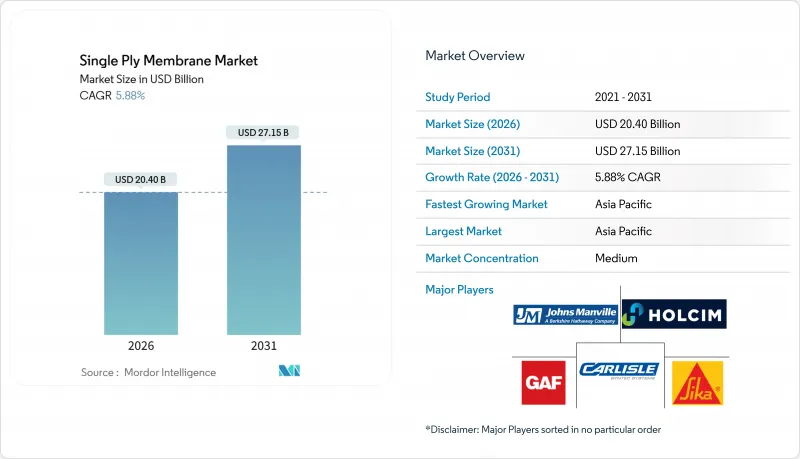
本報告按「類型」(乙丙橡膠 (EPDM)、熱塑性聚烯(TPO)、聚氯乙烯(PVC)、改性瀝青及其他)、「應用」(住宅、商業、公共及基礎設施)、「施工類型」(新建及維修)和「地區」(亞太及其他)對產業進行分類。市場預測以美元計價。
全球單層膜市場趨勢及洞察
對節能冷屋頂系統的需求日益成長
冷屋頂膜符合冷冷屋頂評級委員會嚴格的長期反射率標準,同時也能獲得能源之星認證和LEED v4積分。加州第24號建築規範現已強制要求所有低坡度商業建築使用冷屋頂,到2024年底,白色TPO和PVC承包商的工期將超過八週。美國環保署(EPA)計畫於2026年將其熱島效應減排計畫擴展到15個新的都會區,該計畫將為政府設施的反射維修工程提供市政補貼。大型太陽能發電開發商傾向於使用淺色膜材以減少太陽能組件的熱應力,卡萊爾公司的SeamShield塗層正是滿足這一需求的,它結合了高反射率和感應焊接接縫。
北美商業屋頂更換熱潮
2024年,美國非住宅屋頂產業經歷了顯著成長,主要得益於老舊低坡度屋頂的大量湧現。承包商主要青睞單層屋頂,這類屋頂佔據了絕大多數專案。在這一類別中,TPO(熱塑性聚苯乙烯)的市佔率最大,其次是PVC(聚氯乙烯)和EPDM(三元乙丙橡膠)。凱雷集團建築材料部門的銷售成長,這得益於較高的EBITDA獲利率,同時分銷商庫存趨於正常化,承包商的訂單依然強勁。 GAF公司於2024年3月宣布將在堪薩斯州牛頓市新建一座屋頂工廠,並計劃於2025年6月開工建設,這進一步增強了該公司對屋頂更換市場持續需求的信心。然而,由於自動化程度的提高,此次新增員工僅限於少數職位類別。
聚合物和添加劑的價格波動
2025年6月,美國PVC樹脂價格較去年同期下降。同時,歐洲價格上漲,對全球生產商的利潤率帶來壓力。丙烯(TPO的原料)價格在2024年全年波動,原因是墨西哥灣沿岸地區煉油廠的計畫性維護。乙烯(EPDM的原料)價格也出現波動,主要原因是運作停產。二氧化鈦價格在2023年達到高峰後,於2025年趨於穩定。然而,由於供應集中在三家全球供應商手中,寡占定價權依然存在。主要膜材製造商正積極簽訂多年期樹脂採購合約。這些合約包含最低和最高價格條款,可以對沖大部分原物料價格波動風險,但也限制了現貨價格下跌時的潛在利潤。
細分市場分析
熱塑性聚烯(TPO)預計在2026年至2031年間將以7.01%的複合年成長率成長,成為所有材料類別中成長最快的,這主要得益於節省人工成本的16英尺卷材以及更嚴格的冷屋頂法規。聚氯乙烯(PVC)憑藉其優異的耐化學性和防火性,在2025年仍保持著單層薄膜市場36.39%的佔有率,但由於德國、法國和北歐國家地方政府的禁令,其在歐洲的市場佔有率正在萎縮。乙丙橡膠(EPDM)在倉庫屋頂領域仍然很受歡迎,因為在這些領域,成本比反射率更為重要,但其深色使其無法獲得許多電力公司的補貼。隨著承包商轉向熱風焊接TPO解決方案以縮短施工時間,改質瀝青的重要性持續下降。
創新再次蓬勃發展。西卡(Sika)的毛氈背襯自黏PVC專為低於40華氏度(約4攝氏度)的環境而設計,而傳統的溶劑型黏合劑在這種環境下難以發揮作用。同時,卡萊爾(Carlisle)的「Sure-Weld TPO」的拉伸強度超過了ASTM標準。 KEE等特殊混合材料和複合板材雖然市場佔有率不大,但由於其卓越的抗穿刺性和電絕緣性,正擴大應用於綠色屋頂和整合式太陽能發電系統。隨著FM Global 90級認證成為颶風易發地區設施的強制性要求,對縫焊和剝離測試能力的投資正在顯著增加。
區域分析
預計到2025年,亞太地區將佔全球銷售額的33.97%,並將在2031年之前以6.55%的複合年成長率成長,超過其他所有地區。跨國投資在電子、電動車和製藥業推動了工廠建設,而工廠建設越來越傾向於PVC屋頂系統。同時,資料中心容量正在顯著成長,這些設施需要堅固耐用、坡度低的屋頂來支撐重型空調設備。印度前所未有的基礎設施投資,以及高溫地區強制採用冷屋頂的規定,進一步推動了該地區對PVC屋頂系統的應用。儘管中國房地產行業正在經歷一些調整,但大量現有建築的維修仍在繼續,這支撐了市場需求,尤其是對經濟實惠的EPDM防水卷材的需求。
北美在單層屋頂材料市場佔有第二大佔有率。美國非住宅屋頂產業持續成長,層級構造在專案組合中扮演核心角色。受「Title 24」冷屋頂強制令和「FORTIFIED」颶風防護標準的推動,TPO和PVC屋頂材料的普及速度正在加快。加拿大受益於聯邦政府的基礎設施投資,而墨西哥汽車和電子產業的近岸外包熱潮正在推動新萊昂州和瓜納華托州等省份物流園區的建設。然而,人手不足導致前置作業時間延長和人事費用飆升,尤其是在亞伯達、不列顛哥倫比亞省和美國陽光地帶地區。
歐洲面臨一種矛盾的局面。歐盟委員會第2023/923號條例對聚氯乙烯(PVC)中的鉛含量實施了更嚴格的規定,一些市政當局也禁止在公共建築中使用PVC屋頂,這促使市場轉向TPO和EPDM等替代材料。同時,歐盟的「零排放建築」政策導致維修項目激增,尤其是在德國、法國和英國。在這些國家,業主為了達到碳減排目標,正用反光TPO覆蓋現有屋頂。然而,德國學徒人數的減少以及英國脫歐後的勞動力短缺,都延長了計畫的工期。在俄羅斯,由於制裁帶來的市場限制,本地生產的EPDM和瀝青更受歡迎。同時,巴西、沙烏地阿拉伯和南非等國則經歷了選擇性成長,這主要得益於機場、體育場館和公共產業項目的推動。
其他好處:
- Excel格式的市場預測(ME)表
- 3個月的分析師支持
目錄
第1章:引言
- 研究假設和市場定義
- 調查範圍
第2章:調查方法
第3章執行摘要
第4章 市場狀況
- 市場概覽
- 市場促進因素
- 對節能冷屋頂系統的需求日益成長
- 北美商業屋頂更換熱潮
- 亞太地區都市化進程帶動建設業蓬勃發展。
- 政府激勵措施和更嚴格的綠建築標準
- 使用 16 英尺寬的 TPO 捲材,可減少 15-20% 的人工成本。
- 市場限制因素
- 聚合物和添加劑的價格波動
- 合格的單層建築承包商短缺
- 歐盟部分地區的市政當局已禁止使用聚氯乙烯(PVC)。
- 價值鏈分析
- 波特五力模型
第5章 市場規模與成長預測
- 按類型
- 乙丙橡膠(EPDM)
- 熱塑性聚烯(TPO)
- 聚氯乙烯(PVC)
- 改性瀝青
- 其他類型
- 透過使用
- 住宅
- 商業
- 對機構而言
- 基礎設施
- 依建築類型
- 新建工程
- 維修/改造
- 按地區
- 亞太地區
- 中國
- 印度
- 日本
- 韓國
- 東南亞國協
- 其他亞太國家
- 北美洲
- 美國
- 加拿大
- 墨西哥
- 歐洲
- 德國
- 英國
- 義大利
- 法國
- 西班牙
- 俄羅斯
- 北歐國家
- 其他歐洲國家
- 南美洲
- 巴西
- 阿根廷
- 其他南美國家
- 中東和非洲
- 沙烏地阿拉伯
- 南非
- 其他中東和非洲國家
- 亞太地區
第6章 競爭情勢
- 市場集中度
- 策略趨勢
- 市佔率和排名分析
- 公司簡介
- Bauder GmbH
- BMI Group(Icopal)
- Carlisle SynTec Systems
- Dow
- Duro-Last Inc.
- Firestone Building Products Company LLC
- GAF
- Godfrey Roofing Inc.
- Holcim Elevate(Firestone)
- IKO Industries
- Johns Manville
- Kingspan Group
- Owens Corning
- Protan AS
- RENOLIT SE
- Seaman Corporation
- Sika AG
- Soprema Group
- Versico Roofing Systems
第7章 市場機會與未來展望
According to Mordor Intelligence, the single ply membrane market size is estimated at USD 20.40 billion in 2026, and is expected to reach USD 27.15 billion by 2031, at a CAGR of 5.88% during the forecast period (2026-2031).
This report Segments the Industry Into Type (Ethylene Propylene Diene Monomer (EPDM), Thermoplastic Polyolefin (TPO), Poly Vinyl Chloride (PVC), Modified Bitumen, and Other Types), Application (Residential, Commercial, Institutional, and Infrastructural), Construction Type (New Construction and Refurbished), and Geography (Asia-Pacific, and More). Market Forecasts are Provided in Terms of Value (USD).
Global Single Ply Membrane Market Trends and Insights
Rising Demand for Energy-Efficient and Cool-Roof Systems
Cool-roof membranes enable ENERGY STAR certification and LEED v4 points, all while meeting the Cool Roof Rating Council's stringent aged-reflectance standards. California's Title 24 code now mandates cool roofs on every low-slope commercial building, pushing contractor lead times for white TPO and PVC beyond eight weeks in late 2024. The U.S. EPA is expanding its Heat-Island Reduction Program to 15 new metro areas in 2026, triggering municipal subsidies for reflective retrofits on government facilities. Large-scale solar developers favor bright membranes that limit thermal stress on photovoltaic modules, a requirement addressed by Carlisle's SeamShield coating that pairs high albedo with induction-welded seams.
Commercial Reroofing Boom in North America
In 2024, the U.S. nonresidential roofing sector experienced significant growth, supported by aging low-slope stock. Contractors predominantly favor single-ply membranes, which constitute the majority of their project mix. Within this category, TPO holds the largest share, followed by PVC and EPDM. Carlisle's construction-materials revenue was bolstered by a strong EBITDA margin, thanks to normalized distributor inventories and robust contractor backlogs. GAF's upcoming shingle plant in Newton, Kansas, announced in March 2024 and set to break ground in June 2025, underscores the company's faith in sustained reroofing demand. However, with automation in play, the workforce expansion is limited to a modest number of roles.
Polymer and Additive Price Volatility
In June 2025, PVC resin prices in the U.S. declined year over year. Meanwhile, European prices increased, tightening the margins for global producers. Propylene, the feedstock for TPO, experienced fluctuations throughout 2024, influenced by turnarounds at Gulf Coast refineries. Ethylene prices for EPDM also varied, primarily due to outages at crackers. After peaking in 2023, titanium-dioxide costs stabilized in 2025. However, with supply concentrated among just three global vendors, an oligopoly pricing power remains intact. In a strategic move, major membrane producers are securing multi-year resin contracts. These contracts, featuring floor-and-ceiling clauses, shield a significant portion of their feedstock exposure but cap potential gains when spot prices dip.
Other drivers and restraints analyzed in the detailed report include:
- Urbanization-Led Construction Up-Cycle in Asia-Pacific
- Government Incentives and Stricter Green-Building Codes
- Shortage of Certified Single-Ply Installers
For complete list of drivers and restraints, kindly check the Table Of Contents.
Segment Analysis
Thermoplastic Polyolefin is projected to post a 7.01% CAGR from 2026-2031, the fastest rate among material classes, buoyed by labor-saving 16-foot rolls and stricter cool-roof codes. Poly Vinyl Chloride retained a 36.39% single ply membrane market share in 2025, protected by strong chemical resistance and fire-safety credentials, yet municipal bans in Germany, France, and Nordic countries are eroding its European footprint. Ethylene Propylene Diene Monomer remains popular for warehouse roofs where capital cost eclipses reflectivity, although EPDM's darker color disqualifies it from many utility rebates. Modified bitumen continues to lose relevance as contractors migrate toward hot-air-welded TPO solutions that cut installation schedules.
Innovation is witnessing a resurgence. Sika's felt-back self-adhered PVC is designed for sub-40 °F applications, where traditional solvent-based adhesives falter. Meanwhile, Carlisle's Sure-Weld TPO boasts tensile strengths exceeding ASTM standards. While specialty blends like KEE and composite sheets command a modest share, they're increasingly chosen for green roofs and photovoltaic-integrated setups due to their puncture resistance and electrical insulation properties. With FM Global Class 90 ratings becoming essential for facilities in hurricane-prone areas, there's a noticeable uptick in investments towards seam-welding and uplift-test capabilities.
Complete Report Scope:
- By Type
- Ethylene Propylene Diene Monomer (EPDM)
- Thermoplastic Polyolefin (TPO)
- Poly Vinyl Chloride (PVC)
- Modified Bitumen
- Other Types
- By Application
- Residential
- Commercial
- Institutional
- Infrastructure
- By Construction Type
- New Construction
- Refurbished/Renovation
- By Geography
- Asia-Pacific
- China
- India
- Japan
- South Korea
- ASEAN Countries
- Rest of Asia-Pacific
- North America
- United States
- Canada
- Mexico
- Europe
- Germany
- United Kingdom
- Italy
- France
- Spain
- Russia
- NORDIC Countries
- Rest of Europe
- South America
- Brazil
- Argentina
- Rest of South America
- Middle-East and Africa
- Saudi Arabia
- South Africa
- Rest of Middle-East and Africa
- Asia-Pacific
Geography Analysis
Asia-Pacific controlled 33.97% of global revenue in 2025 and is expected to outpace every other region with a 6.55% CAGR to 2031. Cross-border investments in electronics, electric vehicles (EVs), and pharmaceuticals are driving the construction of factories that increasingly favor clean-roof PVC systems. Concurrently, data centers have boosted their capacity significantly, each requiring sturdy low-slope roofs to support heavy HVAC equipment. India's unprecedented infrastructure allocations, coupled with mandatory cool-roof initiatives in hotter regions, are further propelling regional adoption. Despite a pullback in China's real estate sector, the ongoing renovation of its vast existing stock continues to bolster demand, particularly for cost-effective EPDM overlays.
North America stands as the second-largest market for single-ply membranes. The U.S. nonresidential roofing sector is experiencing growth, with single-ply assemblies taking center stage in project portfolios. The push from Title 24 cool-roof mandates, alongside FORTIFIED hurricane standards, is accelerating the adoption of TPO and PVC. While Canada reaps the benefits of federal infrastructure investments, Mexico's automotive and electronics near-shoring boom is driving the construction of logistics parks in states like Nuevo Leon and Guanajuato. However, labor shortages are extending lead times and inflating labor costs, particularly in Alberta, British Columbia, and the U.S. Sunbelt.
Europe is navigating a landscape of contradictions. The tightening of lead limits in PVC by Commission Regulation 2023/923, along with bans on PVC roofs for public buildings in several municipalities, is pushing the market towards TPO and EPDM alternatives. On the other hand, the EU's zero-emission-building mandate is spurring a surge in retrofit activities, especially in Germany, France, and the U.K. Here, property owners are overlaying existing roofs with reflective TPO to align with carbon reduction targets. However, declining apprenticeship rates in Germany and labor shortages post-Brexit in the U.K. are extending project timelines. In Russia, due to market constraints from sanctions, there's a preference for locally produced EPDM and bitumen. Meanwhile, countries like Brazil, Saudi Arabia, and South Africa are witnessing selective growth, driven by projects in airports, stadiums, and utilities.
- Bauder GmbH
- BMI Group (Icopal)
- Carlisle SynTec Systems
- Dow
- Duro-Last Inc.
- Firestone Building Products Company LLC
- GAF
- Godfrey Roofing Inc.
- Holcim Elevate (Firestone)
- IKO Industries
- Johns Manville
- Kingspan Group
- Owens Corning
- Protan AS
- RENOLIT SE
- Seaman Corporation
- Sika AG
- Soprema Group
- Versico Roofing Systems
Additional Benefits:
- The market estimate (ME) sheet in Excel format
- 3 months of analyst support
TABLE OF CONTENTS
1 Introduction
- 1.1 Study Assumptions and Market Definition
- 1.2 Scope of the Study
2 Research Methodology
3 Executive Summary
4 Market Landscape
- 4.1 Market Overview
- 4.2 Market Drivers
- 4.2.1 Rising demand for energy-efficient and cool-roof systems
- 4.2.2 Commercial reroofing boom in North America
- 4.2.3 Urbanisation-led construction up-cycle in Asia-Pacific
- 4.2.4 Government incentives and stricter green-building codes
- 4.2.5 Adoption of 16-ft wide TPO rolls cuts labour 15-20%
- 4.3 Market Restraints
- 4.3.1 Polymer and additive price volatility
- 4.3.2 Shortage of certified single-ply installers
- 4.3.3 Municipal PVC bans in parts of EU
- 4.4 Value Chain Analysis
- 4.5 Porter's Five Forces
- 4.5.1 Bargaining Power of Suppliers
- 4.5.2 Bargaining Power of Buyers
- 4.5.3 Threat of New Entrants
- 4.5.4 Threat of Substitutes
- 4.5.5 Degree of Competition
5 Market Size and Growth Forecasts (Value)
- 5.1 By Type
- 5.1.1 Ethylene Propylene Diene Monomer (EPDM)
- 5.1.2 Thermoplastic Polyolefin (TPO)
- 5.1.3 Poly Vinyl Chloride (PVC)
- 5.1.4 Modified Bitumen
- 5.1.5 Other Types
- 5.2 By Application
- 5.2.1 Residential
- 5.2.2 Commercial
- 5.2.3 Institutional
- 5.2.4 Infrastructure
- 5.3 By Construction Type
- 5.3.1 New Construction
- 5.3.2 Refurbished/Renovation
- 5.4 By Geography
- 5.4.1 Asia-Pacific
- 5.4.1.1 China
- 5.4.1.2 India
- 5.4.1.3 Japan
- 5.4.1.4 South Korea
- 5.4.1.5 ASEAN Countries
- 5.4.1.6 Rest of Asia-Pacific
- 5.4.2 North America
- 5.4.2.1 United States
- 5.4.2.2 Canada
- 5.4.2.3 Mexico
- 5.4.3 Europe
- 5.4.3.1 Germany
- 5.4.3.2 United Kingdom
- 5.4.3.3 Italy
- 5.4.3.4 France
- 5.4.3.5 Spain
- 5.4.3.6 Russia
- 5.4.3.7 NORDIC Countries
- 5.4.3.8 Rest of Europe
- 5.4.4 South America
- 5.4.4.1 Brazil
- 5.4.4.2 Argentina
- 5.4.4.3 Rest of South America
- 5.4.5 Middle-East and Africa
- 5.4.5.1 Saudi Arabia
- 5.4.5.2 South Africa
- 5.4.5.3 Rest of Middle-East and Africa
- 5.4.1 Asia-Pacific
6 Competitive Landscape
- 6.1 Market Concentration
- 6.2 Strategic Moves
- 6.3 Market Share(%)/Ranking Analysis
- 6.4 Company Profiles (includes Global level Overview, Market level overview, Core Segments, Financials as available, Strategic Information, Products and Services, and Recent Developments)
- 6.4.1 Bauder GmbH
- 6.4.2 BMI Group (Icopal)
- 6.4.3 Carlisle SynTec Systems
- 6.4.4 Dow
- 6.4.5 Duro-Last Inc.
- 6.4.6 Firestone Building Products Company LLC
- 6.4.7 GAF
- 6.4.8 Godfrey Roofing Inc.
- 6.4.9 Holcim Elevate (Firestone)
- 6.4.10 IKO Industries
- 6.4.11 Johns Manville
- 6.4.12 Kingspan Group
- 6.4.13 Owens Corning
- 6.4.14 Protan AS
- 6.4.15 RENOLIT SE
- 6.4.16 Seaman Corporation
- 6.4.17 Sika AG
- 6.4.18 Soprema Group
- 6.4.19 Versico Roofing Systems
7 Market Opportunities and Future Outlook
- 7.1 White-space and Unmet-need Assessment

 全球膜市場(至2031年):依材料(聚合物和陶瓷)、技術(逆滲透、超過濾、微過濾、奈米過濾)、應用(水和污水處理、工業製程)和地區分類
 膜:市場佔有率分析、產業趨勢和統計數據、成長預測(2026-2031)
 氧氣濃縮膜市場規模、佔有率和成長分析:按膜材料、組件類型、應用、最終用戶和地區分類-2026-2033年產業預測
 超過濾組件市場規模、佔有率和成長分析:按組件類型、材料、應用、最終用戶和地區分類-2026-2033年產業預測
 膜市場:全球市場預測,2026-2032年
 2026年全球氧氣擴散器市場報告膜接觸器市場:全球預測,2026-2032年不織布工業薄膜市場-全球市場預測(2026-2032年)
 食品飲料加工膜技術市場規模:按膜類型、技術、應用、地區和預測分類。
 全球膜市場
全球膜市場