


 |
市場調查報告書
商品編碼
2119067
汽車OEM塗料:市場佔有率分析、產業趨勢與統計、成長預測(2026-2031年)Automotive OEM Coatings - Market Share Analysis, Industry Trends & Statistics, Growth Forecasts (2026 - 2031) |
||||||

※ 本網頁內容可能與最新版本有所差異。詳細情況請與我們聯繫。
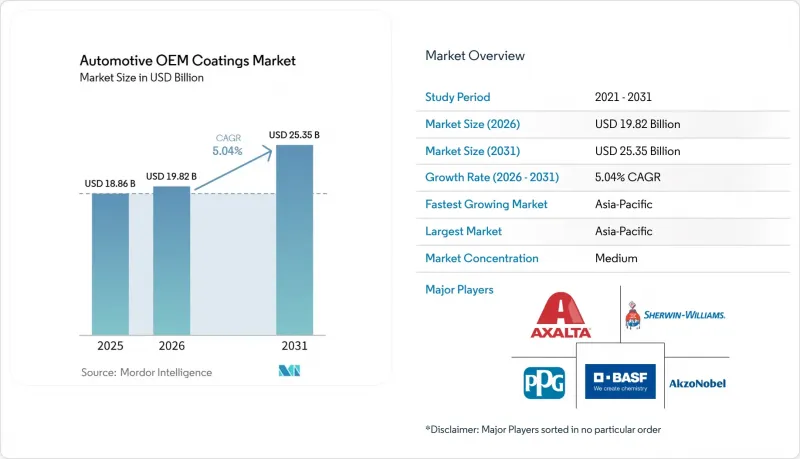
據 Mordor Intelligence 稱,汽車 OEM 塗料市場預計在 2025 年達到 188.6 億美元,預計在預測期(2026-2031 年)內將以 5.04% 的複合年成長率成長,從 2026 年的 198.2 億美元成長到 2031 年的 2531 年的 2531 億美元。
本報告按樹脂類型(環氧樹脂、丙烯酸樹脂等)、工藝(水性、溶劑型等)、塗層類型(電塗裝、底漆等)、車輛類型(乘用車、商用車等)和地區(亞太地區、北美地區、歐洲地區、南美地區、中東和非洲地區)進行細分。市場預測以美元計價。
全球汽車OEM塗料市場趨勢及洞察
全球汽車產量增加與車型陣容擴大
汽車產量的成長是汽車OEM塗料市場最直接的促進因素。受供應狀況改善的推動,預計2024年全球輕型汽車產量將恢復至9,250萬輛,並在2026年超過9,500萬輛。每輛車都需要完成一套完整的塗裝工藝,包括電塗裝、底漆、底塗層和透明塗層。印度35億美元的「生產連結獎勵計畫計畫」預計將透過OEM產能擴張,到2027年每年額外推動18萬噸塗料需求。車型陣容的擴展需要新的核准流程,並刺激了各組裝廠的供應商活動。此外,在印度和東南亞地區開展新的組裝業務,有助於供應商建立本地配方能力,從而降低關稅和前置作業時間,但同時也增加了物流管理的要求。
嚴格的法規旨在促進低揮發性有機化合物和低碳塗料技術的發展
由於排放法規的限制,OEM廠商正在轉向低排放塗料系統。在美國,自2025年1月起,底漆和表面處理漆的VOC(揮發性有機化合物)限值將設定為每公升420克,面漆的VOC限值將設定為每公升250克。中國的GB 24409-2020標準要求國內塗料生產商重新設計其樹脂體系。生態環境部的「雙碳」目標導致山東省和河北省暫停發放溶劑型塗料的新生產許可證,並將投資轉向水性塗料和粉末塗料的生產能力。這些法規在美國、歐洲和中國實施的時間並不統一。因此,供應商必須並行維護產品線,而客戶則在不同的時間進行調整,這增加了中小塗料生產商的營運資金需求。
樹脂、顏料、溶劑和能源價格的波動。
對於汽車OEM塗料市場的複合材料生產商而言,投入成本的波動仍然是最大的利潤率風險。 2026年初,受石化供應鏈中斷的影響,環氧樹脂價格一週內上漲超過12%。與原油價格相關的原料佔塗料總生產成本的40%。儘管OEM供應鏈中合約調整條款的修訂可能需要90至180天,但原物料價格波動對利潤率的影響似乎要快得多。由於客戶抵制價格上漲,沒有樹脂生產設備的中小型複合材料生產商被迫在合約期間承擔這些成本。這種供需不匹配正在加速二線供應商之間的整合。
細分市場分析
到2025年,環氧樹脂將佔汽車OEM塗料市場需求的29.86%,並持續維持其核心地位。這些樹脂能夠在複雜的3D部件(例如電池機殼、車門腔和底盤結構)上形成均勻的塗層。憑藉其優異的性能,環氧樹脂被廣泛用作OEM組裝廠的電塗裝底漆。丙烯酸樹脂因其與顏料的相容性和良好的耐候性,可用於配製底塗層。醇酸樹脂和聚酯樹脂則用於對成本要求較高的內裝和商用車應用,在這些應用中,對外部耐久性和抗紫外線性能的要求相對較低。
聚氨酯預計將成為成長最快的樹脂類型,到2031年年複合成長率(CAGR)將達到5.14%。它被用於電池式電動車的透明塗層,這些塗層需要在不增加重量的情況下提供高硬度、高光澤度和抗刮性。水性聚氨酯分散體在歐洲和中國的汽車製造商(OEM)工廠中越來越受到關注。它們有助於實現排放氣體減排目標,同時保持脂肪族異氰酸酯塗料的表面防護性能。中國汽車製造商正在更快地部署這些系統,因為他們新建的塗裝工廠的基礎設施與水性塗料相容。同時,傳統的歐洲工廠在改造現有的溶劑型生產線時可能會面臨更高的成本。
至2025年,水性塗料將佔汽車OEM塗料市場48.61%的佔有率。這一佔有率反映了成熟市場中向低排放底塗層體系的長期轉變。溶劑型塗料系統在商用車和重型機械應用中仍然被廣泛應用,這些應用需要固化柔軟性和對基材的適應性。粉末塗料在電塗裝和底盤塗裝應用中的市場佔有率正在不斷成長。其零VOC特性在電動車電池外殼中尤為重要。技術選擇取決於塗層類型和組裝廠的運作條件。
預計到2031年,紫外光固化和低溫固化技術將以7.13%的複合年成長率成長。這些技術透過以低能耗固化方法取代高溫固化,降低了噴漆車間的能耗,有助於實現節能減排目標。套模塗覆技術在某些汽車零件的生產中無需噴漆室和塗層後乾燥箱。這些技術使得製程設計在汽車OEM塗料市場中與塗料的化學成分同等重要。
區域分析
預計到2025年,亞太地區將佔全球塗料需求的52.44%,並將在2031年之前以5.89%的複合年成長率成長。 2024年,中國輕型汽車產量達3,128萬輛。隨著監管要求的不斷變化,該地區正從溶劑型塗料轉向水性塗料和粉末塗料。中國「達峰和碳中和」的目標導致山東省和河北省暫停發放溶劑型塗料許可證。印度的「生產連結獎勵計畫計畫(PLI)」預計到2027年將新增18萬噸塗料需求。
在整車製造商(OEM)業務擴張和電動巴士採購的推動下,印度正崛起為亞太地區第二大成長中心。日本和韓國則透過低溫固化和高階塗裝系統做出貢獻,這些系統可適應東南亞及其他地區的組裝流程。中國的GB 24409-2020標準和日本的碳中和路線藍圖正在影響供應商的研發重點。結合汽車產量、監管要求和技術能力,亞太地區在汽車OEM塗料市場保持核心地位。
北美和歐洲是成熟的市場,擁有完善的工廠和更嚴格的合規要求。美國揮發性有機化合物 (VOC) 法規正在加速密西根州、俄亥俄州和田納西州等地的汽車原廠配套 (OEM) 工廠向水性塗料的轉型。BASF於 2025 年 11 月在德國明斯特運作了一家新的汽車 OEM 塗料工廠。雖然南美洲、中東和非洲的市場規模仍然較小,但巴西擁有穩定的市場基礎,投資新建組裝廠預計將進一步刺激需求。南非和摩洛哥由於其成熟的出口導向 OEM組裝業務,很可能成為理想的切入點。
其他好處:
- Excel格式的市場預測(ME)表
- 3個月的分析師支持
目錄
第1章:引言
- 市場分析與定義的前提條件
- 分析範圍
第2章 分析方法
第3章執行摘要
第4章 市場狀況
- 市場概覽
- 市場促進因素
- 全球汽車產量成長與車型陣容擴大
- 嚴格的法規旨在促進低VOC和低碳塗料技術的發展
- 電動車電池組和電動車零件對特種塗料的需求不斷成長。
- 擴大輕量化、多材料車輛結構的採用範圍
- 消費者越來越偏好選擇高檔汽車內裝和先進的表面美學設計。
- 市場限制因素
- 樹脂、顏料、溶劑和能源的價格波動
- 先進汽車塗料系統的認證和檢驗成本很高。
- 多材料汽車製造中基板相容性和維修面臨的挑戰。
- 價值鏈分析
- 波特五力分析
- 監理情勢
第5章:預測市場規模與成長率
- 依樹脂類型
- 環氧樹脂
- 丙烯酸纖維
- 阿爾基多
- 聚氨酯
- 聚酯纖維
- 其他類型的樹脂
- 透過技術
- 水溶液
- 溶劑型
- 粉末型
- 紫外光固化型/低溫燒結型
- 其他技術
- 按塗層類型
- 電塗裝塗層(e-coat)
- 底漆
- 底塗層
- 透明塗層
- 預處理
- 按車輛類型
- 搭乘用車
- 商用車輛
- 摩托車
- 按地區
- 亞太地區
- 中國
- 印度
- 日本
- 韓國
- 其他亞太國家
- 北美洲
- 美國
- 加拿大
- 墨西哥
- 歐洲
- 德國
- 英國
- 法國
- 義大利
- 俄羅斯
- 其他歐洲國家
- 南美洲
- 巴西
- 阿根廷
- 其他南美國家
- 中東和非洲
- 沙烏地阿拉伯
- 南非
- 其他中東和非洲國家
- 亞太地區
第6章 競爭情勢
- 市場集中度
- 策略趨勢
- 市佔率和排名分析
- 公司簡介
- Akzo Nobel NV
- Asian Paints Limited
- Axalta Coating Systems, LLC
- BASF
- Beckers Group
- Berger Paints India Limited
- Covestro AG
- Hempel
- Jotun
- Kansai Paint Co., Ltd.
- KCC Corporation
- Nippon Paint Holdings Co., Ltd.
- PPG Industries, Inc.
- RPM International Inc.
- The Sherwin-Williams Company
- TOA Paint(Thailand)Public Company Limited
第7章 市場機會與未來展望
According to Mordor Intelligence, the automotive OEM coatings market size was estimated at USD 18.86 billion in 2025 and is estimated to grow from USD 19.82 billion in 2026 to USD 25.35 billion by 2031, at a CAGR of 5.04% during the forecast period (2026-2031).
This report is Segmented by Resin Type (Epoxy, Acrylic, and More), Technology (Waterborne, Solventborne, and More), Coat Type (E-Coat, Primer, and More), Vehicle Type (Passenger Cars, Commercial Vehicles, and More), and Geography (Asia-Pacific, North America, Europe, South America, and Middle-East and Africa). The Market Forecasts are Provided in Terms of Value (USD).
Global Automotive OEM Coatings Market Trends and Insights
Growth in Global Vehicle Production and Expansion of Vehicle Model Portfolios
Rising vehicle production is the most direct driver for the automotive OEM coatings market. Global light-vehicle production recovered to 92.5 million units in 2024 and surpassed 95 million units in 2026 as supply conditions improved. Each vehicle requires a complete sequence of electrocoat, primer, basecoat, and clearcoat applications. India's USD 3.5 billion Production-Linked Incentive scheme is expected to generate 180,000 metric tons of incremental annual coating demand by 2027 through OEM capacity expansion. A wider range of vehicle models requires new approval cycles and increases supplier activity at each assembly plant. New assembly activity in India and Southeast Asia is also encouraging suppliers to establish local blending capacity, which reduces tariffs and lead times but adds logistics management requirements.
Stringent Regulations Promoting Low-VOC and Low-Carbon Coating Technologies
Emission requirements are moving OEM programs toward low-emission coating systems. U.S. regulations set VOC limits of 420 grams per liter for primer surfacers and 250 grams per liter for topcoats, effective January 2025. China's GB 24409-2020 standard requires domestic formulators to redesign resin systems. The Ministry of Ecology and Environment's dual-carbon objectives have halted new solventborne production permits in Shandong and Hebei, shifting investment toward waterborne and powder capacity. Regulations do not follow the same schedule across the United States, Europe, and China. As a result, suppliers need to maintain parallel product lines while customers adjust at different times, which increases working-capital requirements for smaller formulators.
Volatility in Prices of Resins, Pigments, Solvents, and Energy
Input-cost instability remains the largest margin risk for formulators in the automotive OEM coatings market. Epoxy resin prices rose by more than 12% in one week during early 2026, following disruptions to petrochemical supply chains. Crude oil-linked feedstocks account for 40% of total coating production costs. Contract adjustment clauses in the OEM supply chain can take 90 to 180 days to revise, while raw material price movements affect margins much sooner. Smaller formulators without resin-production assets must absorb these costs while customers resist price increases during a contract period. This mismatch is driving consolidation among second-tier suppliers.
Other drivers and restraints analyzed in the detailed report include:
- Increasing Demand for Specialized Coatings for EV Battery Packs and Electric Vehicle Components
- Rising Adoption of Lightweight and Multi-Material Vehicle Structures
- High Qualification and Validation Costs for Advanced Automotive Coating Systems
For complete list of drivers and restraints, kindly check the Table Of Contents.
Segment Analysis
Epoxy accounted for 29.86% of demand in 2025 and remains central to the automotive OEM coatings market. It provides uniform deposition on complex three-dimensional parts, including battery enclosures, door cavities, and underbody structures. This performance supports its widespread use in electrocoat primers throughout OEM assembly facilities. Acrylic resins support basecoat formulations through pigment compatibility and outdoor weathering performance. Alkyd and polyester resins serve cost-sensitive interior and commercial vehicle applications where exterior durability and UV resistance are less critical.
Polyurethane is forecast to be the fastest-growing resin type, with a CAGR of 5.14% through 2031. It is used in clearcoat applications that require hardness, gloss retention, and scratch resistance without added mass for battery-electric vehicles. Waterborne polyurethane dispersions are gaining interest at European and Chinese OEM plants. They support lower-emission coating objectives while retaining the surface protection associated with aliphatic isocyanate-based layers. Chinese automakers have adopted these systems more quickly because newer paint shops were designed for waterborne infrastructure. Traditional European plants can face higher costs when converting legacy solventborne lines.
Waterborne coatings accounted for 48.61% of the automotive OEM coatings market in 2025. Their position reflects the long-term shift toward lower-emission basecoat systems in mature markets. Solventborne systems continue to be used in commercial vehicle and heavy equipment applications that require cure flexibility and substrate tolerance. Powder coatings are gaining ground in electrocoat and underbody applications. Their zero-VOC profile is particularly relevant for EV battery housings. Technology choice depends on both the coating layer and the operating conditions of the assembly plant.
UV-curable and low-bake technologies are forecast to grow at a CAGR of 7.13% through 2031. They reduce paint shop energy use by replacing high-temperature baking with lower-energy curing methods, supporting plants in reducing energy consumption and meeting carbon commitments. In-mold coating technology can eliminate the application booth and post-coating drying oven for some automotive components. Such approaches make process design as important as coating chemistry in the automotive OEM coatings market.
Complete Report Scope:
- By Resin Type
- Epoxy
- Acrylic
- Alkyd
- Polyurethane
- Polyester
- Other Resin Types
- By Technology
- Waterborne
- Solventborne
- Powder-Based
- UV-Curable and Low-Bake
- Other Technologies
- By Coat Type
- E-Coat
- Primer
- Basecoat
- Clearcoat
- Pretreatment
- By Vehicle Type
- Passenger Cars
- Commercial Vehicles
- Two-Wheelers
- By Geography
- Asia-Pacific
- China
- India
- Japan
- South Korea
- Rest of Asia-Pacific
- North America
- United States
- Canada
- Mexico
- Europe
- Germany
- United Kingdom
- France
- Italy
- Russia
- Rest of Europe
- South America
- Brazil
- Argentina
- Rest of South America
- Middle-East and Africa
- Saudi Arabia
- South Africa
- Rest of Middle-East and Africa
- Asia-Pacific
Geography Analysis
Asia-Pacific accounted for 52.44% of demand in 2025 and is projected to grow at a 5.89% CAGR through 2031. China produced 31.28 million light vehicles in 2024. The region is shifting from solventborne products to waterborne and powder alternatives as compliance requirements evolve. China's dual-carbon objectives have halted solventborne permits in Shandong and Hebei. India's Production Linked Incentive (PLI) scheme is expected to generate an additional 180,000 metric tons of coating demand by 2027.
India is emerging as a second regional growth center, driven by OEM expansion and electric bus procurement. Japan and South Korea contribute through low-temperature cure and premium finish systems, which can be transferred to assembly operations in Southeast Asia and other regions. China's GB 24409-2020 standard and Japan's carbon-neutrality roadmap influence supplier research and development priorities. The combination of vehicle production volume, regulatory requirements, and technology capacity keeps Asia-Pacific central to the automotive OEM coatings market.
North America and Europe are mature regions with established plants and stricter compliance requirements. U.S. Volatile Organic Compound (VOC) limits are accelerating the shift to waterborne coatings at OEM facilities in Michigan, Ohio, and Tennessee. BASF commissioned a new automotive OEM coatings plant in Munster, Germany, in November 2025. South America, the Middle East, and Africa remain smaller in value, though Brazil provides a stable base and new assembly investments could generate further demand. South Africa and Morocco are likely entry points due to their established OEM assembly operations for export.
- Akzo Nobel N.V.
- Asian Paints Limited
- Axalta Coating Systems, LLC
- BASF
- Beckers Group
- Berger Paints India Limited
- Covestro AG
- Hempel
- Jotun
- Kansai Paint Co., Ltd.
- KCC Corporation
- Nippon Paint Holdings Co., Ltd.
- PPG Industries, Inc.
- RPM International Inc.
- The Sherwin-Williams Company
- TOA Paint (Thailand) Public Company Limited
Additional Benefits:
- The market estimate (ME) sheet in Excel format
- 3 months of analyst support
TABLE OF CONTENTS
1 Introduction
- 1.1 Study Assumptions and Market Definition
- 1.2 Scope of the Study
2 Research Methodology
3 Executive Summary
4 Market Landscape
- 4.1 Market Overview
- 4.2 Market Drivers
- 4.2.1 Growth in Global Vehicle Production and Expansion of Vehicle Model Portfolios
- 4.2.2 Stringent Regulations Promoting Low-VOC and Low-Carbon Coating Technologies
- 4.2.3 Increasing Demand for Specialized Coatings for EV Battery Packs and Electric Vehicle Components
- 4.2.4 Rising Adoption of Lightweight and Multi-Material Vehicle Structures
- 4.2.5 Growing Consumer Preference for Premium Vehicle Finishes and Advanced Surface Aesthetics
- 4.3 Market Restraints
- 4.3.1 Volatility in Prices of Resins, Pigments, Solvents, and Energy
- 4.3.2 High Qualification and Validation Costs for Advanced Automotive Coating Systems
- 4.3.3 Substrate Compatibility and Repair Challenges in Multi-Material Vehicle Manufacturing
- 4.4 Value Chain Analysis
- 4.5 Porter's Five Forces Analysis
- 4.5.1 Threat of New Entrants
- 4.5.2 Bargaining Power of Suppliers
- 4.5.3 Bargaining Power of Buyers
- 4.5.4 Threat of Substitutes
- 4.5.5 Competitive Rivalry
- 4.6 Regulatory Landscape
5 Market Size and Growth Forecasts (Value)
- 5.1 By Resin Type
- 5.1.1 Epoxy
- 5.1.2 Acrylic
- 5.1.3 Alkyd
- 5.1.4 Polyurethane
- 5.1.5 Polyester
- 5.1.6 Other Resin Types
- 5.2 By Technology
- 5.2.1 Waterborne
- 5.2.2 Solventborne
- 5.2.3 Powder-Based
- 5.2.4 UV-Curable and Low-Bake
- 5.2.5 Other Technologies
- 5.3 By Coat Type
- 5.3.1 E-Coat
- 5.3.2 Primer
- 5.3.3 Basecoat
- 5.3.4 Clearcoat
- 5.3.5 Pretreatment
- 5.4 By Vehicle Type
- 5.4.1 Passenger Cars
- 5.4.2 Commercial Vehicles
- 5.4.3 Two-Wheelers
- 5.5 By Geography
- 5.5.1 Asia-Pacific
- 5.5.1.1 China
- 5.5.1.2 India
- 5.5.1.3 Japan
- 5.5.1.4 South Korea
- 5.5.1.5 Rest of Asia-Pacific
- 5.5.2 North America
- 5.5.2.1 United States
- 5.5.2.2 Canada
- 5.5.2.3 Mexico
- 5.5.3 Europe
- 5.5.3.1 Germany
- 5.5.3.2 United Kingdom
- 5.5.3.3 France
- 5.5.3.4 Italy
- 5.5.3.5 Russia
- 5.5.3.6 Rest of Europe
- 5.5.4 South America
- 5.5.4.1 Brazil
- 5.5.4.2 Argentina
- 5.5.4.3 Rest of South America
- 5.5.5 Middle-East and Africa
- 5.5.5.1 Saudi Arabia
- 5.5.5.2 South Africa
- 5.5.5.3 Rest of Middle-East and Africa
- 5.5.1 Asia-Pacific
6 Competitive Landscape
- 6.1 Market Concentration
- 6.2 Strategic Moves
- 6.3 Market Share (%)/Ranking Analysis
- 6.4 Company Profiles (includes Global Overview, Market Overview, Core Segments, Financials as available, Strategic Information, Products and Services, and Recent Developments)
- 6.4.1 Akzo Nobel N.V.
- 6.4.2 Asian Paints Limited
- 6.4.3 Axalta Coating Systems, LLC
- 6.4.4 BASF
- 6.4.5 Beckers Group
- 6.4.6 Berger Paints India Limited
- 6.4.7 Covestro AG
- 6.4.8 Hempel
- 6.4.9 Jotun
- 6.4.10 Kansai Paint Co., Ltd.
- 6.4.11 KCC Corporation
- 6.4.12 Nippon Paint Holdings Co., Ltd.
- 6.4.13 PPG Industries, Inc.
- 6.4.14 RPM International Inc.
- 6.4.15 The Sherwin-Williams Company
- 6.4.16 TOA Paint (Thailand) Public Company Limited
7 Market Opportunities and Future Outlook
- 7.1 White-Space and Unmet-Need Assessment
- 7.2 Low-Carbon and Bio-Based Resin Platforms

 印度汽車OEM塗料:市場佔有率分析、產業趨勢與統計及成長預測(2026-2031年)
 全球OEM塗料市場
 汽車OEM塗料市場報告:按類型、層數、車輛類型、應用和地區分類(2026-2034年)
 汽車OEM塗料市場:依產品類型、技術、樹脂類型和車型分類-2026-2032年全球市場預測
 全球OEM塗料市場規模、佔有率、趨勢和成長分析報告(2026-2034年)
 2026年全球OEM塗料市場報告
 OEM塗料市場-全球產業規模、佔有率、趨勢、機會、預測:按類型、應用、地區和競爭格局分類,2021-2031年
 亞洲汽車OEM塗料市場(2025)歐洲汽車OEM塗料市場(2025)汽車OEM塗料:全球市場概況(2025)