


 |
市場調查報告書
商品編碼
2117303
印度汽車OEM塗料:市場佔有率分析、產業趨勢與統計及成長預測(2026-2031年)India Automotive OEM Coatings - Market Share Analysis, Industry Trends & Statistics, Growth Forecasts (2026 - 2031) |
||||||

※ 本網頁內容可能與最新版本有所差異。詳細情況請與我們聯繫。
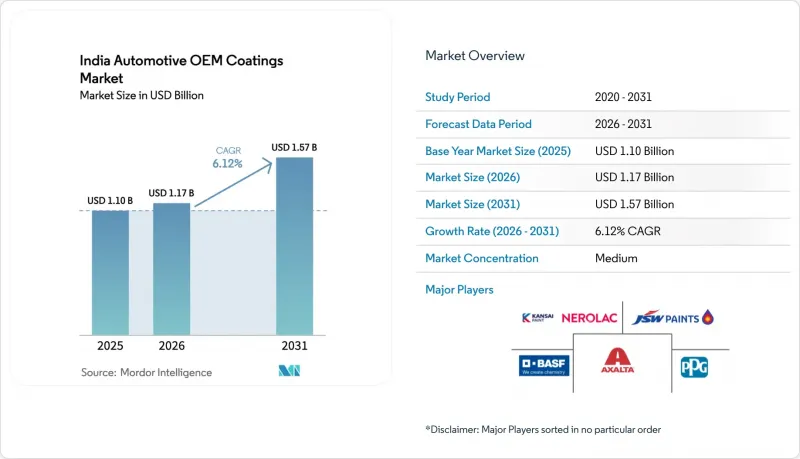
據 Mordor Intelligence 稱,印度汽車 OEM 塗料市場預計到 2026 年價值 11.7 億美元,高於 2025 年的 11 億美元,預計到 2031 年將達到 15.7 億美元。
預計從 2026 年到 2031 年,其複合年成長率將達到 6.12%。
本報告按樹脂類型(環氧樹脂、丙烯酸樹脂、醇酸樹脂、聚氨酯樹脂、聚酯樹脂及其他)、工藝(水性、溶劑型及其他)、塗料類型(電著底漆、底漆、底塗層、透明塗層)和車輛類型(乘用車、商用車、摩托車)進行分類。市場預測以美元計價。
印度汽車OEM塗料市場趨勢及洞察。
從 2024 年開始,SUV 和高階車型市場將出現新車上市激增的趨勢。
高階SUV需要多層高光澤、耐刮擦的塗層,從而提升車輛的附加價值。 2024年,南印度豪華車註冊量成長了19.3%,促使汽車製造商投資研發能夠處理雙色車頂設計的先進噴塗機器人。本土品牌目前正引進數位噴漆單元,實現以往只有進口豪華車才能實現的微妙色彩點綴。隨著SUV車身面板尺寸的增加,噴漆面積也隨之增加,導致透明塗層和底塗層層的消耗量增加。汽車研究協會(ARAI)標準的認證能夠明確產品規格,並為新供應商設定較高的進入門檻。
與生產連結獎勵計畫(PLI) 相關的樹脂和顏料供應鏈本地化
生產連結獎勵計畫計劃(PLI)鼓勵了國內對丙烯酸、聚氨酯和顏料工廠的投資,從而降低了外匯風險和運輸延誤的影響。政府數據顯示,已撥款35億美元作為汽車產業的獎勵,促進了多個州的樹脂項目發展。早期本地化縮小了長期存在的二氧化鈦供應缺口,為大規模一體化供應商創造了利潤空間。然而,依賴進口的小型申請者在過渡期內面臨營運資金短缺的問題。
半導體短缺導致油漆廠新投資項目延遲。
汽車製造商優先將稀缺的半導體資源分配給生產,並推遲了對自動化噴漆生產線的資本投資。先進的機器人和線上品質感測器需要與車載資訊娛樂系統相同的微控制器。專案延期導致短期內對新型噴漆房的需求下降,雖然為現有噴漆工提供了更多訂單,但也限制了整體產能的擴張。原始設備製造商(OEM)傾向於使用可在現有控制平台上運行的設備,這阻礙了數位化防過噴技術的應用。
細分市場分析
在印度汽車OEM塗料市場,預計到2025年,丙烯酸樹脂將佔41.15%的銷售額。丙烯酸樹脂在底塗層和透明塗層應用方面的多功能性以及成本優勢,確保其繼續成為乘用車的標準選擇。同時,聚氨酯的複合年成長率(CAGR)最高,達6.41%,反映市場對更輕、柔軟性的需求日益成長。環氧樹脂在承受化學和熱應力的電動車機殼重新受到關注。實驗室測試表明,用埃洛石奈米管增強的環氧丙烯酸酯乳液在鹽霧試驗中的耐久性提高了一倍,這表明其在下一代防腐蝕解決方案方面具有巨大潛力。 「其他」類別包括一些小眾的生物基化學品,這些化學品正吸引OEM廠商的關注,以期在未來的零異氰酸酯計畫中得到應用。
整合樹脂製造商的崛起,以及利用生產連結獎勵計畫(PLI) 獲得的自主顏料合成能力,正在改變競爭格局。儘管印度汽車OEM塗料市場丙烯酸樹脂的絕對市場規模預計仍將擴大,但其佔有率可能會逐漸轉移到高固態含量聚氨酯樹脂。擁有均衡樹脂產品組合的供應商可以減輕單一化學品領域的週期性波動影響。 ISO 12944認證流程兼顧了實驗性和可靠性,維持了樹脂快速替代的高門檻,並確保市場佔有率的漸進式而非突發性變化。
溶劑型體系,尤其是在透明塗層,因其優異的性能而廣受認可,預計到2025年將保持44.62%的市場佔有率。然而,在印度VI法規和碳排放減排目標的推動下,水性體系的銷售量正以6.55%的複合年成長率穩定成長。注重永續性的產品已佔全球領先供應商銷售額的近一半。研發重點在於將疏水鏈段包裹在聚合物殼層內的樹脂,以在較低的烘烤溫度下達到高光澤度。
在印度中部投資建造一條專用塗料生產線的公告,將縮短原始設備製造商 (OEM) 向水性塗料平台過渡的交貨週期。如果目前的趨勢持續下去,預計到 2029 年,印度汽車 OEM 塗料市場中水性塗料的市場規模將超過溶劑型塗料。粉末塗料和紫外光固化技術被歸類為“其他”。粉末透明塗層正在等待最終的戶外應用認證,但其不含揮發性有機化合物 (VOC) 的特性預計將推動長期需求。紫外光固化系統正被應用於塑膠外飾件的特定領域,其快速乾燥、不黏手的固化特性提高了生產效率。
其他好處
- Excel格式的市場預測(ME)表
- 3個月的分析師支持
目錄
第1章:引言
- 研究假設和市場定義
- 調查範圍
第2章:調查方法
第3章執行摘要
第4章 市場狀況
- 市場概覽
- 市場促進因素
- 從 2024 年開始,SUV 和高階車型市場將出現新車上市激增的趨勢。
- 為了遵守印度的 VI VOC 法規(2025 年),OEM 廠商正在轉向水性塗料生產線。
- 與生產連結獎勵計畫(PLI) 相關的樹脂和顏料供應鏈本地化
- 汽車輕量化推動了對高固態含量聚氨酯系統的需求。
- 由於電動車電池組的防腐蝕要求,對環氧樹脂產生了小眾需求。
- 市場限制因素
- 半導體短缺導致油漆廠新投資項目延遲。
- 二氧化鈦價格波動給二層塗層公司帶來了壓力。
- 戶外粉末透明塗層。
- 價值鏈分析
- 波特五力模型
第5章 市場規模與成長預測
- 依樹脂類型
- 環氧樹脂
- 丙烯酸纖維
- 阿爾基多
- 聚氨酯
- 聚酯纖維
- 其他
- 透過技術
- 水溶液
- 溶劑型
- 其他
- 按外套類型
- 電著底漆
- 底漆
- 底塗層
- 透明塗層
- 按車輛類型
- 搭乘用車
- 商用車輛
- 摩托車
第6章 競爭情勢
- 市場集中度
- 策略趨勢
- 市佔率和排名分析
- 公司簡介
- Asian Paints
- Axalta Coating Systems LLC
- BASF
- Beckers Group
- Berger Paints India
- Jotun
- JSW Paints
- Kansai Nerolac Paints Limited
- Nippon Paint Holdings Co. Ltd
- PPG Industries, Inc.
- RPM International Inc.
- Teknos Group
- The Sherwin-Williams Company
第7章 市場機會與未來展望
According to Mordor Intelligence, India automotive OEM coatings market size in 2026 is estimated at USD 1.17 billion, growing from 2025 value of USD 1.10 billion with 2031 projections showing USD 1.57 billion, growing at 6.12% CAGR over 2026-2031.
This report is Segmented by Resin Type (Epoxy, Acrylic, Alkyd, Polyurethane, Polyester, and Others), Technology (Water-Borne, Solvent-Borne, and Others), Coat Type (E-Coat, Primer, Basecoat, and Clearcoat), Vehicle Type (Passenger Cars, Commercial Vehicles, and Two-Wheelers). The Market Forecasts are Provided in Terms of Value (USD).
India Automotive OEM Coatings Market Trends and Insights
Surge in SUV and Premium-Segment Launches Post-2024
Premium SUVs require multi-layer, high-gloss coatings with scratch resistance, driving higher value per vehicle. Luxury registrations in South India climbed 19.3% in 2024, prompting OEM investments in advanced spray robots that support two-tone roof designs. Domestic brands now deploy digital paint cells that enable fine color accents once limited to luxury imports. Larger body panels on SUVs expand the coated surface area and raise the consumption of clearcoat and basecoat layers. Certification under the Automotive Research Association of India standards anchors product specifications and keeps the barrier-to-entry high for new suppliers.
PLI-Linked Localization of Resin and Pigment Supply Chains
The Production-Linked Incentive program unlocks domestic investment in acrylic, polyurethane, and pigment plants, trimming currency exposure and shipping delays. Government data show USD 3.5 billion allocated to auto incentives, sparking multi-state resin projects. Early localization narrows the historic titanium-dioxide supply gap, giving large integrated suppliers a margin buffer. Smaller import-dependent applicants, however, face working-capital strain during the transition.
Semiconductor Shortages Delay New Paint-Shop Investments
Vehicle makers channel scarce chips to production, postponing capital for automation in coating lines. Advanced robots and inline quality sensors require the same microcontrollers that power infotainment systems. Project deferrals compress short-term demand for new spray booths, giving incumbent applicators extra volume but limiting overall capacity growth. OEMs favor equipment that operates on existing control platforms, restraining rollout of digital overspray-free technologies.
Other drivers and restraints analyzed in the detailed report include:
- Automotive Lightweighting Drives High-Solid PU Demand
- EV Battery-Pack Corrosion Requirements Create Niche Epoxy Demand
- Volatile Titanium-Dioxide Prices Squeeze Tier-2 Applicators
For complete list of drivers and restraints, kindly check the Table Of Contents.
Segment Analysis
Acrylic resins commanded 41.15% of 2025 revenue in the India automotive OEM coatings market. Their versatility across basecoat and clearcoat roles and cost advantage keep them the default choice for passenger cars. Polyurethanes, however, post the highest 6.41% CAGR, reflecting lightweighting and flexibility imperatives. Epoxy grades re-emerge for electric-vehicle enclosures that face chemical and thermal stress. Halloysite nanotube-reinforced epoxy-acrylate emulsions doubled salt-spray endurance in lab work, hinting at next-generation corrosion solutions. Niche bio-based chemistries occupy the "Others" bucket, gaining OEM attention for future zero-isocyanate programs.
Competitive positioning shifts as integrated resin makers leverage in-house pigment synthesis secured under PLI benefits. The India automotive OEM coatings market size tied to acrylics should still rise in absolute terms, though the share migrates incrementally to high-solid PU. Suppliers with balanced resin portfolios cushion against cyclical swings in any single chemistry. Certification processes under ISO 12944 balance experimentation with reliability, keeping barriers to rapid resin substitution high and ensuring gradual, not abrupt, share shifts.
Solvent-borne systems retained a 44.62% share in 2025, thanks to performance familiarity, especially for clearcoats. Yet water-borne volumes climb steadily with a CAGR of 6.55%, propelled by India-VI rules and carbon-reduction targets. Sustainability-led products already account for nearly half of a leading global supplier's sales. Development focus centers on resins that trap hydrophobic segments within polymer shells, delivering high gloss at lower bake temperatures.
Investment announcements for dedicated water-based paint lines in central India shorten delivery cycles for OEMs shifting platforms. The India automotive OEM coatings market size allocated to water-borne solutions is projected to surpass solvent-borne by 2029 if current trajectories hold. Powder and UV-cure technologies reside in the "Others" category. Although powder clearcoats await final exterior certification, their zero-VOC profile ensures long-term relevance. UV systems find niche use on plastic exterior parts where fast tack-free cure enhances throughput.
Complete Report Scope:
- By Resin Type
- Epoxy
- Acrylic
- Alkyd
- Polyurethane
- Polyester
- Others
- By Technology
- Water-borne
- Solvent-borne
- Others
- By Coat Type
- E-coat
- Primer
- Basecoat
- Clearcoat
- By Vehicle Type
- Passenger Cars
- Commercial Vehicles
- Two-Wheelers
List of Companies Covered in this Report:
- Asian Paints
- Axalta Coating Systems LLC
- BASF
- Beckers Group
- Berger Paints India
- Jotun
- JSW Paints
- Kansai Nerolac Paints Limited
- Nippon Paint Holdings Co. Ltd
- PPG Industries, Inc.
- RPM International Inc.
- Teknos Group
- The Sherwin-Williams Company
Additional Benefits:
- The market estimate (ME) sheet in Excel format
- 3 months of analyst support
TABLE OF CONTENTS
1 Introduction
- 1.1 Study Assumptions and Market Definition
- 1.2 Scope of the Study
2 Research Methodology
3 Executive Summary
4 Market Landscape
- 4.1 Market Overview
- 4.2 Market Drivers
- 4.2.1 Surge in SUV and Premium Segment Launches Post-2024
- 4.2.2 OEM Shift to Water-Borne Lines to Meet India-VI VOC Caps (2025)
- 4.2.3 PLI-Linked Localisation of Resin and Pigment Supply Chains
- 4.2.4 Automotive Lightweighting Drives Demand for High-Solid PU Systems
- 4.2.5 EV Battery-Pack Corrosion Requirements Create Niche Epoxy Demand
- 4.3 Market Restraints
- 4.3.1 Semiconductor Shortages Delaying New Paint-Shop Investments
- 4.3.2 Volatile Titanium-Dioxide Prices Squeezing Tier-2 Applicators
- 4.3.3 Slow Regulatory Approval of Powder Clearcoats for Exterior Use
- 4.4 Value Chain Analysis
- 4.5 Porter's Five Forces
- 4.5.1 Threat of New Entrants
- 4.5.2 Bargaining Power of Buyers
- 4.5.3 Bargaining Power of Suppliers
- 4.5.4 Threat of Substitutes
- 4.5.5 Degree of Competition
5 Market Size and Growth Forecasts (Value)
- 5.1 By Resin Type
- 5.1.1 Epoxy
- 5.1.2 Acrylic
- 5.1.3 Alkyd
- 5.1.4 Polyurethane
- 5.1.5 Polyester
- 5.1.6 Others
- 5.2 By Technology
- 5.2.1 Water-borne
- 5.2.2 Solvent-borne
- 5.2.3 Others
- 5.3 By Coat Type
- 5.3.1 E-coat
- 5.3.2 Primer
- 5.3.3 Basecoat
- 5.3.4 Clearcoat
- 5.4 By Vehicle Type
- 5.4.1 Passenger Cars
- 5.4.2 Commercial Vehicles
- 5.4.3 Two-Wheelers
6 Competitive Landscape
- 6.1 Market Concentration
- 6.2 Strategic Moves
- 6.3 Market Share (%)/Ranking Analysis
- 6.4 Company Profiles (includes Global level Overview, Market level overview, Core Segments, Financials as available, Strategic Information, Market Rank/Share for key companies, Products and Services, and Recent Developments)
- 6.4.1 Asian Paints
- 6.4.2 Axalta Coating Systems LLC
- 6.4.3 BASF
- 6.4.4 Beckers Group
- 6.4.5 Berger Paints India
- 6.4.6 Jotun
- 6.4.7 JSW Paints
- 6.4.8 Kansai Nerolac Paints Limited
- 6.4.9 Nippon Paint Holdings Co. Ltd
- 6.4.10 PPG Industries, Inc.
- 6.4.11 RPM International Inc.
- 6.4.12 Teknos Group
- 6.4.13 The Sherwin-Williams Company
7 Market Opportunities and Future Outlook
- 7.1 White-space and Unmet-Need Assessment

 汽車OEM塗料:市場佔有率分析、產業趨勢與統計、成長預測(2026-2031年)
 全球OEM塗料市場
 汽車OEM塗料市場報告:按類型、層數、車輛類型、應用和地區分類(2026-2034年)
 汽車OEM塗料市場:依產品類型、技術、樹脂類型和車型分類-2026-2032年全球市場預測
 全球OEM塗料市場規模、佔有率、趨勢和成長分析報告(2026-2034年)
 2026年全球OEM塗料市場報告
 OEM塗料市場-全球產業規模、佔有率、趨勢、機會、預測:按類型、應用、地區和競爭格局分類,2021-2031年
 亞洲汽車OEM塗料市場(2025)歐洲汽車OEM塗料市場(2025)汽車OEM塗料:全球市場概況(2025)