


 |
市場調查報告書
商品編碼
2119048
固態替代燃料和原料(AFR)共處理系統:市場佔有率分析、行業趨勢和統計數據、成長預測(2026-2031 年)Solid Alternate Fuel and Raw Materials (AFR) Co-Processing Systems - Market Share Analysis, Industry Trends & Statistics, Growth Forecasts (2026 - 2031) |
||||||

※ 本網頁內容可能與最新版本有所差異。詳細情況請與我們聯繫。
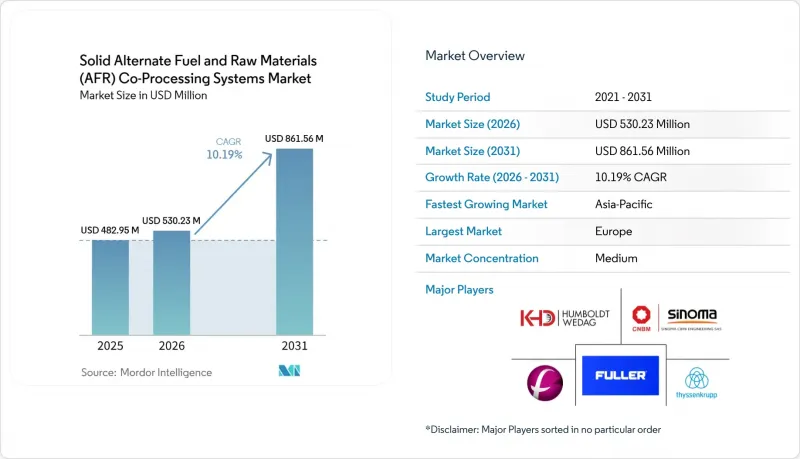
根據 Mordor Intelligence 預測,固態替代燃料和原料 (AFR) 共處理系統的市場規模預計將在 2025 年達到 4.8295 億美元,在 2026 年達到 5.3023 億美元,在 2031 年達到 8.6156 億美元,從 2026 年到 2031% 2031%。
本報告按系統類型(機械輸送、氣動輸送、混合輸送、重力稱重、其他)、燃料類型(RDF、SRF、生質能、其他)、終端用戶產業(水泥、石灰、廢棄物處理設施、紙漿和造紙、其他窯爐)以及地區(北美、歐洲、亞太、南美、中東和非洲)進行細分。市場預測以美元計價。
固態替代燃料和原料(AFR)共加工系統的全球市場趨勢和見解。
避免碳成本和石化燃料成本
在碳定價機制下,燃料替代已成為水泥廠在碳排放交易市場的關鍵投資因素。以RDF或SRF取代煤炭可以降低排放權交易成本,並減少對石化燃料的依賴。如果這些經濟優勢能夠支持燃料製備和窯爐設備升級的投資,那麼固態的AFR(活性燃料再生材料)供應體系市場將從中受益。一項發表於2025年的研究表明,使用RDF可減少20%的二氧化碳排放,而以生質能替代則可減少30%至50%的淨排放量,具體比例取決於燃料類型和物流情況。在中國,天津金宇佳環保有限公司報告稱,其在2024年實現了25.1%的燃料替代率,使用了廢棄纖維和生質能。這項措施每年可減少17,400噸二氧化碳排放,節省燃料成本700萬元人民幣(約100萬美元)。在巴西,Votorantim 的目標是到 2030 年將其 50% 的熱能替換為可再生能源,而 Cimento Itambe 已實現了 67% 的試行替換率,這表明類似的成本邏輯正在南美洲蔓延。
關於減少掩埋廢棄物和循環經濟的法規
廢棄物政策正在支持固態再生燃料(AFR)供應系統市場中燃料的上游供應。歐盟規定,成員國到2025年需將55%的都市垃圾再利用或回收,2030年需將此比例提高到60%,2035年掩埋目標為10%。這些法規引導不可回收部分用於生產垃圾衍生燃料(RDF)和固體再生燃料(SRF),而不是作為廢棄物處理。由此產生的物料流動增加了水泥廠和石灰廠對接收、儲存、萃取和機械處理設備的需求。不斷提高的掩埋稅也促使加工商在燃料進入窯爐前改善分類、破碎和密度控制。這些改進使得人們更加關注確保交付時燃料規格和已調整的材料穩定供應所需的設備。印尼2025年關於將廢棄物可再生為再生能源的法規表明,對穩定廢棄物供應的政策支持正在歐洲以外地區擴展。
原料品質和熱值的變化
原料的差異仍然是固態替代燃料供應系統市場的主要營運限制因素。雖然替代燃料的淨熱值範圍為10至25兆焦/公斤,但其水分含量、粒徑和密度會因收集方法和預處理質量的不同而有所差異。因此,即使燃料的標稱分類保持不變,輸送到工廠的燃料的燃燒特性也可能有所不同。 2025年的一項研究表明,最佳化上游工程中的燃料品質對於實現超過80%的熱替代率至關重要,即使粒徑的微小變化也會降低煅燒爐的燃燒效率。纖維狀和複合燃料組分在通過輸送機和鍊式輸送機時可能會出現不可預測的運動。這會導致磨損加劇、窯爐供料中斷,並削弱設備核准過程中用於評估生命週期成本的基礎。在廢棄物分類和燃料製備系統不發達的地區,這種限制更為突出。
細分市場分析
截至2025年,機械輸送系統將佔固態AFR供應系統市場規模的35.8%,而機械-氣動混合系統預計到2031年將以11.1%的複合年成長率成長。機械設備仍然是燃料接收、密封儲存、提取、中間輸送以及窯爐製程控制供應的基礎系統。本系統適用於大型水泥廠中形狀不規則、含水量不同、堆積密度波動較大的粗粒異質物料的處理。此外,已安裝的設備能夠適應營運商不斷提高的熱力更換目標,從而進行定期更換、維護和升級。在固態AFR供應系統市場,由於可靠的物料處理和資本效率是關鍵的採購因素,因此這種配置仍然備受青睞。
混合系統將機械輸送和氣動輸送的優勢整合到單一製程中,即使燃料成分發生變化,也能為操作人員提供更大的柔軟性。大塊的碎料可透過皮帶輸送機、鍊式輸送機或螺旋輸送機輸送機,而細小的RDF(垃圾衍生燃料)在不適合直接機械輸送的情況下,可透過氣動輸送輸送到煅燒爐的供料點。蒂森克虜伯Polysius在其「預堆積階梯燃燒器」配置中,採用輸送機作為承載元件,並在高溫區進行空氣噴射。氣動輸送系統仍是垂直輸送和可控頂部進料的必要條件,科倍隆的AF吹通式旋轉閥專為處理壓力高達350毫巴的非均勻燃料而設計。隨著EN 15359標準對燃料一致性要求的提高,重量稱重的重要性日益凸顯。同時,儲料倉、起重機、移動地板和拖車卸料系統有助於工廠應對季節性供應波動。
區域分析
預計到2025年,歐洲將佔據固態替代燃料(AFR)供應系統市場38.2%的佔有率。這得益於歐洲長期以來推行的廢棄物利用政策、成熟的水泥協同加工技術以及完善的垃圾衍生燃料(RDF)和固體回收燃料(SRF)供應網。德國水泥生產中替代燃料的比例將在2024年達到77%,並計劃在2045年達到90%。這種營運水準的轉變正推動採購從初始安裝轉向能夠進行維修、氯氣旁路、精確重量稱重以及滿足更嚴格燃料規格的設備。 TEC公司在Vicat公司Peyre工廠進行的氯氣旁通改造工程,體現了在不改變窯爐基本功能的前提下,升級現有窯爐生產線以實現更高替代燃料利用率的必要性。在波蘭和羅馬尼亞,隨著歐洲回收和掩埋目標的生效,RDF供應基礎設施正在建設中。
預計到2031年,亞太地區將以11.6%的複合年成長率成長,成為固態替代燃料供應系統市場中成長最快的區域。印度的聯合處理指南、《2026年固態廢棄物管理條例》以及印度國家轉型委員會(NITI Aayog)的藍圖表明,該國的供熱替代率將在六年內從7%提高到8%,最終達到15%。中國的平均燃料替代率為5%,其節能行動計畫的目標是到2025年底在30%的水泥生產線上實施替代燃料技術。中國建材協會記錄了一次技術交流,其中提到德國在替代燃料實施方面的經驗可作為中國長期發展的標竿。中材國際計畫在2024年底在中國建成11個替代燃料加工中心,年總加工能力達120萬噸,建造了支援工廠級聯合處理設施升級的燃料供應基礎設施。
北美地區正經歷溫和成長,目前大部分訂單活動都集中在維修項目上。例如,Eagle Materials公司的拉勒米計畫將採用全套替代燃料系統,預計於2026年下半年完工。該地區水泥產業的成熟以及升級現有窯爐生產線而非新建產能的優勢,促使企業傾向於現代化改造。南美洲地區正在加速發展,以巴西的計畫為中心,例如Cimento Itambe公司在巴拉那州新建的窯爐。該窯爐在2025年的試運轉中實現了67%的替代燃料熱能替代率。 Votorantim公司斥資9.2億美元的設備升級專案也有助於其實現2030年50%的熱能替代率目標。在中東和非洲地區,待開發區案更為普遍。例如,中材集團(Sinoma CBMI)在肯亞簽署的價值2.5億美元的Bambury水泥契約,該項目允許利用當地生質能和城市固態廢棄物。
其他好處:
- Excel格式的市場預測(ME)表
- 3個月的分析師支持
目錄
第1章:引言
- 市場分析與定義的前提條件
- 分析範圍
第2章 分析方法
第3章執行摘要
第4章 市場狀況
- 市場概覽
- 市場促進因素
- 避免碳成本和石化燃料成本
- 減少掩埋廢棄物和促進循環經濟的強制性要求。
- 水泥脫碳和熱替代目標
- 對現有窯爐用AFR系統進行改造
- SRF 和 RDF 的品質已調整的定價
- 整合本地廢棄物燃料轉化生態系統
- 市場限制因素
- 原料品質和熱值的變化
- 排放法規的授權和合規性非常複雜
- 氯、鹼和微量金屬的積累
- 廢物流的季節性和合約可靠性
- 價值鏈分析
- 監理情勢
- 技術展望
- 波特五力分析
第5章:預測市場規模與成長率
- 依系統類型
- 機械輸送系統
- 氣動輸送系統
- 混合式(機械和氣動相結合)輸送系統
- 重力稱重和導軌送料系統
- 儲存、運輸和接收系統
- 其他
- 按燃料類型
- 廢棄物衍生燃料(RDF)
- 固態回收燃料(SRF)
- 生質能和農業殘餘物
- 廢棄塑膠絨毛
- 輪胎衍生燃料(TDF)
- 其他
- 按最終用戶行業分類
- 水泥業
- 石灰產業
- 垃圾焚化發電發電廠
- 紙漿和造紙業
- 其他工業窯爐和熔爐
- 按地區
- 北美洲
- 美國
- 加拿大
- 墨西哥
- 歐洲
- 德國
- 法國
- 義大利
- 西班牙
- 英國
- 波蘭
- 俄羅斯
- 其他歐洲國家
- 亞太地區
- 中國
- 印度
- 日本
- 韓國
- 澳洲
- 印尼
- 越南
- 泰國
- 其他亞太國家
- 南美洲
- 巴西
- 阿根廷
- 智利
- 其他南美國家
- 中東和非洲
- 沙烏地阿拉伯
- 阿拉伯聯合大公國
- 埃及
- 南非
- 摩洛哥
- 其他中東和非洲國家
- 北美洲
第6章 競爭情勢
- 市場集中度
- 策略趨勢
- 市佔率分析
- 公司簡介
- A TEC Production & Services GmbH
- Beijing Triumph International Engineering Co., Ltd.
- BMH Technology Oy
- CNBM International Engineering Co., Ltd.
- Dynamis Ltd.
- Fives FCB SA
- Fuller Technologies, Inc.
- KHD Humboldt Wedag International AG
- SATAREM SA
- Sinoma International Engineering Co., Ltd.
- thyssenkrupp Polysius GmbH
- Unitherm Cemcon Feuerungsanlagen GmbH
第7章 市場機會與未來展望
According to Mordor Intelligence, the solid alternate fuel and raw materials co-Processing systems market size is projected to be USD 482.95 million in 2025, USD 530.23 million in 2026, and reach USD 861.56 million by 2031, growing at a CAGR of 10.19% from 2026 to 2031.
This report is Segmented by System Type (Mechanical Conveying, Pneumatic Conveying, Hybrid, Gravimetric Dosing, Others), Fuel Type (RDF, SRF, Biomass, Others), End-User Industry (Cement, Lime, Wte Plants, Pulp & Paper, Other Kilns), and Geography (North America, Europe, Asia-Pacific, South America, and Middle East and Africa). The Market Forecasts are Provided in Terms of Value (USD).
Global Solid Alternate Fuel and Raw Materials (AFR) Co-Processing Systems Market Trends and Insights
Carbon and Fossil-Fuel Cost Avoidance
Carbon pricing has made fuel substitution a material investment consideration for cement plants in emissions-trading markets. Replacing coal with RDF or SRF can reduce exposure to allowance costs and reduce dependence on fossil fuel purchases. The Solid AFR feeding systems market benefits when this financial case supports both fuel-preparation investment and kiln-side equipment upgrades. Research published in 2025 found that RDF use can reduce carbon dioxide emissions by 20%, while biomass substitution can reduce net emissions by 30% to 50%, depending on fuel type and logistics. In China, Tianjin Jinyujia Huanbao reported a 25.1% fuel replacement rate using waste textiles and biomass in 2024. The operation avoided 17,400 tonnes of carbon dioxide annually and reduced fuel costs by CNY 7 million, equivalent to USD 1 million . In Brazil, Votorantim's target of 50% thermal substitution by 2030 and Cimento Itambe's 67% test substitution rate show that the same cost logic is extending into South America.
Landfill Diversion and Circular-Economy Mandates
Waste policy supports the upstream supply of fuels used by the Solid AFR feeding systems market. The European Union requires member states to prepare 55% of municipal waste for reuse or recycling by 2025 and 60% by 2030, while its landfill target is limited to 10% by 2035. These rules direct nonrecyclable fractions toward RDF and SRF preparation instead of disposal. The resulting material flow creates demand for reception, storage, extraction, and mechanical conveying equipment at cement and lime plants. Higher landfill taxes also encourage processors to improve sorting, shredding, and density control before fuel reaches the kiln. That improvement shifts more attention to fuel specifications at the point of delivery and to the equipment needed to dose prepared material consistently. Indonesia's 2025 regulation on waste processing into renewable energy indicates that policy support for dependable waste volumes is expanding beyond Europe.
Feedstock Quality and Calorific-Value Variability
Feedstock inconsistency remains the main operating constraint for the Solid AFR feeding systems market. Alternative fuels can range from 10 to 25 MJ/kg in net calorific value, while moisture, particle size, and density can change with collection patterns and pre-processing quality. A plant may therefore receive fuel with different combustion behavior even where nominal fuel categories remain unchanged. A 2025 study found that thermal substitution rates above 80% require optimized upstream fuel quality, and small deviations in particle size can reduce burnout efficiency in calciners . Fibrous and composite fuel fractions can move unpredictably through belt and chain conveyors. This can increase wear, interrupt kiln feeding, and weaken the lifecycle cost case used for equipment approvals. The constraint is more pronounced where waste sorting and fuel preparation systems remain immature.
Other drivers and restraints analyzed in the detailed report include:
- Cement Decarbonization and Thermal Substitution Targets
- AFR System Retrofits for Existing Kilns
- Permitting and Emissions-Compliance Complexity
For complete list of drivers and restraints, kindly check the Table Of Contents.
Segment Analysis
Mechanical conveying systems accounted for 35.8% of the Solid AFR feeding systems market size in 2025, while hybrid mechanical-pneumatic systems are forecast to grow at 11.1% CAGR through 2031. Mechanical equipment remains the base system for fuel reception, enclosed storage, extraction, intermediate transfer, and controlled delivery to the kiln process. It is well-suited to coarse and heterogeneous materials that may contain irregular shapes, different moisture levels, and variable bulk density at high-volume cement plants. The installed base also supports recurring replacement, maintenance, and upgrade work when operators raise their thermal substitution objectives. The Solid AFR feeding systems market continues to favor these configurations where reliable material movement and capital efficiency are primary procurement factors.
Hybrid systems combine the strengths of mechanical and pneumatic transport in one process flow, which gives operators more flexibility when their fuel mix changes. Bulky shredded materials can move through belt, chain, or screw conveyors, while fine RDF can move pneumatically to calciner feed points where direct mechanical transport is less suitable. thyssenkrupp Polysius uses screw conveyors as the load-bearing element within its prepol Step Combustor configuration, with air-blast injection at the hot zone. Pneumatic systems remain necessary for vertical transport and controlled top feeding, and Coperion's AF blow-through rotary valve is designed for nonhomogeneous fuels at pressures up to 350 mbar. Gravimetric dosing is becoming more relevant as EN 15359 raises expectations for fuel consistency, while storage halls, cranes, moving floors, and trailer unloading systems help plants buffer seasonal supply variation.
Complete Report Scope:
- By System Type
- Mechanical Conveying Systems
- Pneumatic Conveying Systems
- Hybrid Mechanical-Pneumatic Conveying Systems
- Gravimetric Dosing and Weighfeeder Systems
- Storage, Extraction, and Receiving Systems
- Others
- By Fuel Type
- Refuse-Derived Fuel (RDF)
- Solid Recovered Fuel (SRF)
- Biomass and Agricultural Residues
- Waste Plastics and Fluff
- Tire-Derived Fuel (TDF)
- Others
- By End-User Industry
- Cement Industry
- Lime Industry
- Waste-to-Energy Plants
- Pulp & Paper Industry
- Other Industrial Kilns and Furnaces
- By Geography
- North America
- United States
- Canada
- Mexico
- Europe
- Germany
- France
- Italy
- Spain
- United Kingdom
- Poland
- Russia
- Rest of Europe
- Asia-Pacific
- China
- India
- Japan
- South Korea
- Australia
- Indonesia
- Vietnam
- Thailand
- Rest of Asia-Pacific
- South America
- Brazil
- Argentina
- Chile
- Rest of South America
- Middle East and Africa
- Saudi Arabia
- United Arab Emirates
- Egypt
- South Africa
- Morocco
- Rest of Middle East and Africa
- North America
Geography Analysis
Europe held 38.2% of the Solid AFR feeding systems market share in 2025, supported by long-standing waste valorization policies, mature cement co-processing practices, and established RDF and SRF supply networks. Germany reached a 77% alternative fuel share in cement production during 2024 and is targeting 90% by 2045 . This operating level shifts procurement from initial installations toward retrofits, chlorine bypasses, precise gravimetric dosing, and equipment that can manage stricter fuel specifications. A TEC's chlorine bypass work at Vicat's Peille plant reflects the need to upgrade legacy kiln lines for higher substitution rates without changing the role of the underlying kiln. Poland and Romania are developing RDF supply infrastructure as European recycling and landfill targets take effect.
Asia-Pacific is forecast to grow at 11.6% CAGR through 2031, the fastest regional rate in the Solid AFR feeding systems market. India's co-processing guidance, Solid Waste Management Rules 2026, and NITI Aayog road map point to a rise in the national thermal substitution rate from 7% to 8% toward 15% within 6 years. China had an average fuel substitution rate of 5%, and its energy-conservation action plan targeted alternative fuel technology at 30% of cement production lines by the end of 2025. The China Building Materials Federation recorded technical exchanges that used Germany's substitution performance as a reference point for China's longer-term progress. Sinoma International had built 11 alternative fuel processing centers in China by the end of 2024, with combined annual capacity of 1.2 million tonnes, creating fuel supply infrastructure that can support plant-level co-processing upgrades.
North America is a moderate-growth region where retrofit projects account for much of the current order activity, including the Eagle Materials Laramie project with a full alternative fuel system that is scheduled for completion in the second half of 2026. The preference for modernization reflects the mature regional cement base and the opportunity to improve existing kiln lines rather than build new capacity. South America is accelerating through Brazilian projects, including Cimento Itambe's new kiln in Parana, which reached a 67% alternative-fuel thermal substitution rate in testing during 2025. Votorantim's USD 920 million upgrade program also supports a 50% thermal substitution target by 2030. The Middle East and Africa are more exposed to greenfield projects, including Sinoma CBMI's USD 250 million Bamburi Cement contract in Kenya, which includes capacity to use local biomass and municipal solid waste.
- A TEC Production & Services GmbH
- Beijing Triumph International Engineering Co., Ltd.
- BMH Technology Oy
- CNBM International Engineering Co., Ltd.
- Dynamis Ltd.
- Fives FCB S.A.
- Fuller Technologies, Inc.
- KHD Humboldt Wedag International AG
- SATAREM S.A.
- Sinoma International Engineering Co., Ltd.
- thyssenkrupp Polysius GmbH
- Unitherm Cemcon Feuerungsanlagen GmbH
Additional Benefits:
- The market estimate (ME) sheet in Excel format
- 3 months of analyst support
TABLE OF CONTENTS
1 INTRODUCTION
- 1.1 Study Assumptions and Market Definition
- 1.2 Scope of the Study
2 RESEARCH METHODOLOGY
3 EXECUTIVE SUMMARY
4 MARKET LANDSCAPE
- 4.1 Market Overview
- 4.2 Market Drivers
- 4.2.1 Carbon and Fossil-Fuel Cost Avoidance
- 4.2.2 Landfill Diversion and Circular-Economy Mandates
- 4.2.3 Cement Decarbonization and Thermal Substitution Targets
- 4.2.4 AFR System Retrofits for Existing Kilns
- 4.2.5 Quality-Adjusted Pricing of SRF and RDF
- 4.2.6 Local Waste-to-Fuel Ecosystem Integration
- 4.3 Market Restraints
- 4.3.1 Feedstock Quality and Calorific-Value Variability
- 4.3.2 Permitting and Emissions-Compliance Complexity
- 4.3.3 Chlorine, Alkali, and Trace-Metal Accumulation
- 4.3.4 Seasonal and Contractual Reliability of Waste Streams
- 4.4 Value Chain Analysis
- 4.5 Technology Outlook
- 4.6 Regulatory Landscape
- 4.7 Porter's Five Forces Analysis
- 4.7.1 Bargaining Power of Suppliers
- 4.7.2 Bargaining Power of Buyers
- 4.7.3 Threat of New Entrants
- 4.7.4 Threat of Substitutes
- 4.7.5 Competitive Rivalry
5 MARKET SIZE AND GROWTH FORECASTS
- 5.1 By System Type
- 5.1.1 Mechanical Conveying Systems
- 5.1.2 Pneumatic Conveying Systems
- 5.1.3 Hybrid Mechanical-Pneumatic Conveying Systems
- 5.1.4 Gravimetric Dosing and Weighfeeder Systems
- 5.1.5 Storage, Extraction, and Receiving Systems
- 5.1.6 Others
- 5.2 By Fuel Type
- 5.2.1 Refuse-Derived Fuel (RDF)
- 5.2.2 Solid Recovered Fuel (SRF)
- 5.2.3 Biomass and Agricultural Residues
- 5.2.4 Waste Plastics and Fluff
- 5.2.5 Tire-Derived Fuel (TDF)
- 5.2.6 Others
- 5.3 By End-User Industry
- 5.3.1 Cement Industry
- 5.3.2 Lime Industry
- 5.3.3 Waste-to-Energy Plants
- 5.3.4 Pulp & Paper Industry
- 5.3.5 Other Industrial Kilns and Furnaces
- 5.4 By Geography
- 5.4.1 North America
- 5.4.1.1 United States
- 5.4.1.2 Canada
- 5.4.1.3 Mexico
- 5.4.2 Europe
- 5.4.2.1 Germany
- 5.4.2.2 France
- 5.4.2.3 Italy
- 5.4.2.4 Spain
- 5.4.2.5 United Kingdom
- 5.4.2.6 Poland
- 5.4.2.7 Russia
- 5.4.2.8 Rest of Europe
- 5.4.3 Asia-Pacific
- 5.4.3.1 China
- 5.4.3.2 India
- 5.4.3.3 Japan
- 5.4.3.4 South Korea
- 5.4.3.5 Australia
- 5.4.3.6 Indonesia
- 5.4.3.7 Vietnam
- 5.4.3.8 Thailand
- 5.4.3.9 Rest of Asia-Pacific
- 5.4.4 South America
- 5.4.4.1 Brazil
- 5.4.4.2 Argentina
- 5.4.4.3 Chile
- 5.4.4.4 Rest of South America
- 5.4.5 Middle East and Africa
- 5.4.5.1 Saudi Arabia
- 5.4.5.2 United Arab Emirates
- 5.4.5.3 Egypt
- 5.4.5.4 South Africa
- 5.4.5.5 Morocco
- 5.4.5.6 Rest of Middle East and Africa
- 5.4.1 North America
6 COMPETITIVE LANDSCAPE
- 6.1 Market Concentration
- 6.2 Strategic Moves
- 6.3 Market Share Analysis
- 6.4 Company Profiles (includes Global Level Overview, Market Level Overview, Core Segments, Financials as available, Strategic Information, Market Rank/Share, Products and Services, Recent Developments)
- 6.4.1 A TEC Production & Services GmbH
- 6.4.2 Beijing Triumph International Engineering Co., Ltd.
- 6.4.3 BMH Technology Oy
- 6.4.4 CNBM International Engineering Co., Ltd.
- 6.4.5 Dynamis Ltd.
- 6.4.6 Fives FCB S.A.
- 6.4.7 Fuller Technologies, Inc.
- 6.4.8 KHD Humboldt Wedag International AG
- 6.4.9 SATAREM S.A.
- 6.4.10 Sinoma International Engineering Co., Ltd.
- 6.4.11 thyssenkrupp Polysius GmbH
- 6.4.12 Unitherm Cemcon Feuerungsanlagen GmbH
7 MARKET OPPORTUNITIES AND FUTURE OUTLOOK
- 7.1 White-Space and Unmet-Need Assessment


