


 |
市場調查報告書
商品編碼
2119012
固體冷卻:市場佔有率分析、產業趨勢與統計、成長預測(2026-2031 年)Solid State Cooling - Market Share Analysis, Industry Trends & Statistics, Growth Forecasts (2026 - 2031) |
||||||

※ 本網頁內容可能與最新版本有所差異。詳細情況請與我們聯繫。
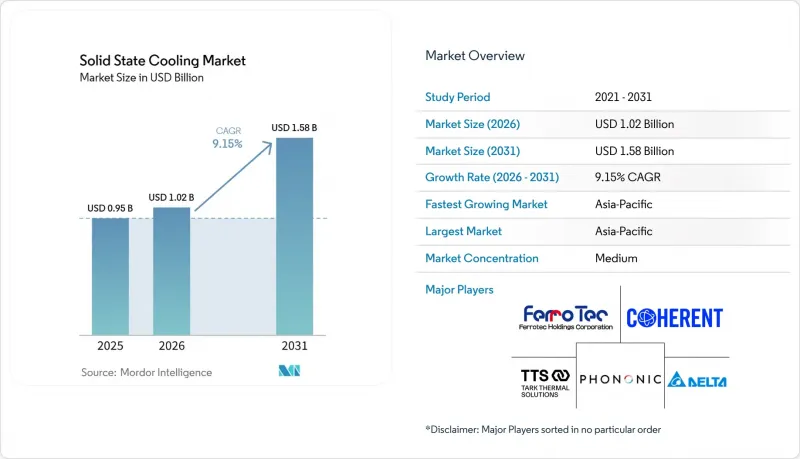
據 Mordor Intelligence 稱,固體冷卻市場預計到 2025 年將達到 9.5 億美元,並預計將從 2026 年的 10.2 億美元成長到 2031 年的 15.8 億美元,在預測期(2026-2031 年)內複合年成長率為 9.15%。
本報告按產品類型(冷卻系統、冷凍系統)、技術(熱電冷卻、磁熱冷卻等)、終端用戶產業(家用電子電器、醫療等)和地區(亞太、北美、歐洲、南美、中東和非洲)進行細分。市場預測以美元計價。
全球固體冷卻市場趨勢與洞察
電子和醫療設備。
歐盟的氟化氣體法規將於2026年1月1日起禁止在家用冷凍設備中使用氟化氣體,而美國的《創新與製造法案》(AIM)則制定了分階段減少氫氟碳化合物(HFC)使用的架構。這些要求迫使原始設備製造商(OEM)縮短使用傳統冷媒的冷凍設計的評估週期。這是因為產品團隊需要避免認證延誤、冷媒維護義務、文件負擔以及法規變更帶來的風險,尤其對於那些預期運作較長的產品而言。醫療設備製造商在選擇溫度控管系統時也需要考慮漫長的核准流程。熱電裝置無需冷媒充填或處理,使用時全球暖化潛勢值(GWP)為零。如果製造商將熱設計架構整合到設計週期長達數年的產品平台中,固體冷卻市場將從中受益。由於永續性要求,即使現有設備仍在繼續使用,這一趨勢在新產品中也得到了進一步加強。這是因為無冷媒設計簡化了產品文檔,降低了未來冷媒供應變化帶來的風險,並為製造商提供了一個通用的熱力平台,用於在多個監管區域銷售的產品。
電動汽車電池和電力電子產品的溫度控管要求日益提高。
固態電池設計需要在低溫環境下精確加熱,而逆變器、車用充電器和馬達控制器則會在模組層面產生集中熱量。傳統的液冷迴路仍然適用於從整車中移除大量熱量。然而,熱電元件透過管理電池介面、功率結和充電觸點附近的局部熱點來滿足不同的需求。在這些區域,溫度梯度會影響組件的可靠性、充電穩定性以及敏感電子元件的使用壽命。 2026 年的一篇綜述指出,熱電冷卻技術在管理固態電池模組中的局部溫度梯度方面應用日益廣泛。 2026 年發表的一項研究也表明,透過對氮化鎵功率裝置進行熱電主動溫度控管,可以提高其性能和可靠性。這種分工有利於固體冷卻市場的發展,因為精確的熱控制可以作為車輛中液冷系統的補充,而不是替代品。這使得車輛設計人員可以將液冷系統專門用於大面積散熱,而僅在局部溫度精度比散熱容量更重要的部位引入小型固體單元。
高昂的材料成本、能源效率限制以及早期製造階段
碲化鉍模組的成本是同等容量蒸氣壓縮式組件的3到5倍。隨著容量的增加,這種成本差異會更加顯著。這是因為,隨著規模的擴大,熱電係數(COP)的下降速度比壓縮機效率的下降速度更快。 2025年的一項研究報告稱,一種水冷式整合式熱電冷卻器在80瓦功率下實現了3.26的COP,但其設計仍局限於特定應用。碲是提煉的原料,中國佔全球產量的40%。這使得模組製造商難以在訂單增加或現有貿易格局因地緣政治局勢而中斷時迅速擴大供應。這種集中化為模組製造商帶來了成本的不確定性,並限制了熱電模組在暖通空調和商用冷凍領域的應用。利用磁效應和電熱效應的解決方案也受到進一步的限制,因為其商業性生產仍處於早期階段,儘管它們作為未來的替代技術具有潛力。
細分市場分析
截至2025年,冷卻系統佔固體冷卻市場的64.22%。此細分市場涵蓋科學儀器、醫療診斷設備、半導體儀器設備以及需要主動式局部熱控制的家用電子電器。其主導地位反映了珀爾帖效應模組及其供應商體系的成熟,其中包括Ferrotec、Cryotherm、Crystal和TE Technologies等公司。這些模組已工業化生產超過40年,為設備製造商提供了豐富的性能數據、成熟的認證標準、已知的故障模式以及能夠支援產品開發週期的多家供應商。其良好的口碑為設備設計人員提供了一系列熟悉的精密冷卻組件。由於產品認證需要時間,歐盟法規(EU) 2024/573在2025年的銷售中尚未完全體現,但其方向推動了新產品開發中非冷媒熱設計的應用。
預計2026年至2031年間,冷凍系統市場將以9.83%的複合年成長率成長。這一成長反映了磁製冷和電冷卻技術在食品零售和製藥行業冷鏈中的早期商業化應用。分析顯示,在REWE進行的為期11週的初步試驗中,Magnotherm公司的「Eclipse」冷藏櫃的能源效率比丙烷冷藏櫃高出15%,顯示無冷媒冷凍技術在營運成本和環保要求方面都具有競爭力。現有的熱電迷你冷藏櫃、攜帶式疫苗冷藏庫和車載飲料隔間構成了現有市場需求,而電動車的普及和離網醫療冷鏈的需求進一步推動了這一成長。在固體冷卻市場,局部冷卻仍然是主導產品類型,而冷凍領域預計將從小規模的基數開始成長。實現商業規模部署將取決於成本降低以及在更廣泛的安裝環境中證明其性能,包括環境條件、維護能力、負載曲線、產品配置以及食品保鮮和能源使用方面的區域要求各不相同的商店。
區域分析
預計到2025年,亞太地區將佔據固體冷卻市場42.53%的佔有率,並在2031年之前以9.73%的複合年成長率成長。該地區是全球最大的消費電子和半導體製造中心。中國佔亞太地區銷售額的39%,這主要得益於半導體自給自足計畫、電動車(EV)生產以及向綠色技術的轉型。韓國透過生產記憶體和顯示器來滿足需求,這些產品需要對溫度控制有嚴格要求的製程設備。日本則憑藉精密光學、科學儀器和汽車電力電子等高附加價值產品的需求做出貢獻。印度正在透過與生產連結獎勵計畫計劃擴大其在電子產品製造和醫療診斷領域的產能。該地區以中國、俄羅斯和日本製造商為中心的模組供應鏈為亞太地區的原始設備製造商(OEM)提供了採購優勢,並促進了本地設計訂單的成長。此供應鏈也為市場提供了廣泛的製造基礎,包括易於接觸零件供應商、設備製造商和模組製造商之間順暢的協調,以及對電子和半導體客戶需求的熟悉程度。
北美是第二大區域市場,人工智慧超大規模資料中心業者、國防電子、半導體測量和醫療診斷是主要需求來源。雖然隨著美國晶圓廠的建設,用於晶圓檢測和品管的新型製程冷卻器不斷湧現,但傳統方案仍受到振動和污染控制要求的限制。 2026年3月,Phononic宣布擴展其人工智慧資料中心產品線,並將其系統部署到領先的超大規模資料中心業者。這確立了該地區在基於工作負載的熱控制技術方面的領先地位。歐洲是第三大區域市場,德國和英國是汽車工程、工業自動化和醫療技術領域的主要需求驅動力。歐盟的氟化氣體(F-gas)法規為歐洲冷凍設備原始設備製造商(OEM)考慮無冷媒替代方案提供了明確的短期理由。
南美洲和中東及非洲仍然是相對較小的區域市場。巴西正在推動對藥品冷鏈、通訊設備冷卻和工業監控的需求,而阿根廷的電子製造業正處於起步階段。沙烏地阿拉伯和阿拉伯聯合大公國透過國防現代化、石油和天然氣相關電子產品以及智慧城市計畫來支撐需求。南非對遠端醫療診斷和離網測試設備的需求正在成長。在壓縮機維護困難且缺乏集中式冷凍基礎設施的地區,熱電設備的免維護特性是一項優勢。儘管固體冷凍市場在這些地區仍有很長的路要走,但其應用與模組化和分散式熱控制相契合。這尤其適用於需要在空間有限、服務網路不均衡且營運商希望避免依賴冷凍基礎設施的偏遠使用點進行冷卻的情況。
其他好處:
- Excel格式的市場預測(ME)表
- 3個月的分析師支持
目錄
第1章:引言
- 市場分析與定義的前提條件
- 分析範圍
第2章 分析方法
第3章執行摘要
第4章 市場狀況
- 市場概覽
- 市場促進因素
- 電子和醫療設備。
- 電動車電池和電力電子產品對溫度控管的要求日益提高。
- 資料中心機櫃和局部冷卻應用中固體冷卻技術的廣泛應用。
- 工業自動化領域對低維護成本冷卻系統的需求不斷成長。
- 半導體製造和實驗室設備對精密冷卻的需求日益成長。
- 高全球暖化潛勢冷媒的永續性替代品
- 市場限制因素
- 與傳統冷卻技術相比,它的材料成本更高,能源效率更低。
- 與現有暖通空調和傳統冷凍系統整合面臨的挑戰
- 電熱和磁熱技術的商業化和大規模生產尚不充分。
- 價值鏈分析
- 波特五力分析
第5章:預測市場規模與成長率
- 依產品類型
- 冷卻系統
- 冷凍系統
- 透過技術
- 熱電冷卻
- 磁熱冷卻
- 電熱冷卻
- 其他固體冷卻技術
- 按最終用戶行業分類
- 家用電子電器
- 醫療保健
- 車
- 食品/飲料
- 航太/國防
- 半導體製造
- 其他終端用戶產業
- 按地區
- 亞太地區
- 中國
- 印度
- 日本
- 韓國
- 其他亞太國家
- 北美洲
- 美國
- 加拿大
- 墨西哥
- 歐洲
- 德國
- 英國
- 法國
- 義大利
- 俄羅斯
- 其他歐洲國家
- 南美洲
- 巴西
- 阿根廷
- 其他南美國家
- 中東和非洲
- 沙烏地阿拉伯
- 南非
- 其他中東和非洲國家
- 亞太地區
第6章 競爭情勢
- 市場集中度
- 策略趨勢
- 市佔率和排名分析
- 公司簡介
- Coherent Corp.
- Crystal Ltd.
- Delta Electronics, Inc.
- Ferrotec Corporation
- Gentherm Incorporated
- Komatsu Ltd.
- Kryotherm
- Laird Thermal Systems, Inc.
- Micropelt GmbH
- Phononic
- Solid State Cooling Systems
- Tark Thermal Solutions
- TE Technology, Inc.
- TEC Microsystems GmbH
- Thermion Company
第7章 市場機會與未來展望
目錄
第1章:引言
- 市場分析與定義的前提條件
- 分析範圍
第2章 分析方法
第3章執行摘要
第4章 市場狀況
- 市場概覽
- 市場促進因素
- 電子和醫療設備。
- 電動車電池和電力電子產品對溫度控管的要求日益提高。
- 資料中心機櫃和局部冷卻應用中固體冷卻技術的廣泛應用。
- 工業自動化領域對低維護成本冷卻系統的需求不斷成長。
- 半導體製造和實驗室設備對精密冷卻的需求日益成長。
- 高全球暖化潛勢冷媒的永續性替代品
- 市場限制因素
- 與傳統冷卻技術相比,它的材料成本更高,能源效率更低。
- 與現有暖通空調和傳統冷凍系統整合面臨的挑戰
- 電熱和磁熱技術的商業化和大規模生產尚不充分。
- 價值鍊和供應鏈分析
- 波特五力分析
第5章:預測市場規模與成長率
- 依產品類型
- 冷卻系統
- 冷凍系統
- 透過技術
- 熱電冷卻
- 磁熱冷卻
- 電熱冷卻
- 其他固體冷卻技術
- 按最終用戶行業分類
- 家用電子電器
- 醫療保健
- 車
- 食品/飲料
- 航太/國防
- 半導體製造
- 其他終端用戶產業
- 按地區
- 亞太地區
- 中國
- 印度
- 日本
- 韓國
- 其他亞太國家
- 北美洲
- 美國
- 加拿大
- 墨西哥
- 歐洲
- 德國
- 英國
- 法國
- 義大利
- 俄羅斯
- 其他歐洲國家
- 南美洲
- 巴西
- 阿根廷
- 其他南美國家
- 中東和非洲
- 沙烏地阿拉伯
- 南非
- 其他中東和非洲國家
- 亞太地區
第6章 競爭情勢
- 市場集中度
- 策略趨勢
- 市佔率和排名分析
- 公司簡介
- Coherent Corp.
- Crystal Ltd.
- Delta Electronics, Inc.
- Ferrotec Corporation
- Gentherm Incorporated
- Komatsu Ltd.
- Kryotherm
- Laird Thermal Systems, Inc.
- Micropelt GmbH
- Phononic
- Solid State Cooling Systems
- Tark Thermal Solutions
- TE Technology, Inc.
- TEC Microsystems GmbH
- Thermion Company
第7章 市場機會與未來展望
According to Mordor Intelligence, the solid state cooling market size was estimated at USD 0.95 billion in 2025 and is estimated to grow from USD 1.02 billion in 2026 to USD 1.58 billion by 2031, at a CAGR of 9.15% during the forecast period (2026-2031).
This report is Segmented by Product Type (Cooling Systems and Refrigeration Systems), Technology (thermoelectric Cooling, Magnetocaloric Cooling, and More), End-User Industry (Consumer Electronics, Healthcare, and More), and Geography (Asia-Pacific, North America, Europe, South America, and Middle-East and Africa). The Market Forecasts are Provided in Terms of Value (USD).
Global Solid State Cooling Market Trends and Insights
Increasing Demand for Refrigerant-Free Cooling in Electronics and Medical Devices
The EU F-gas Regulation prohibits F-gases in domestic refrigeration from January 1, 2026, while the US American Innovation and Manufacturing (AIM) Act establishes a phasedown framework for hydrofluorocarbons. These requirements compress OEM evaluation schedules for cooling designs that use conventional refrigerants, as product teams must avoid delayed qualification, refrigerant servicing obligations, documentation burdens, and exposure to changing regulations in products intended for long operating lives. Medical device manufacturers must also account for lengthy authorization cycles when selecting thermal systems. Thermoelectric equipment carries no refrigerant charge, requires no refrigerant handling, and has zero global warming potential at the point of use. The solid-state cooling market can benefit when manufacturers incorporate thermal architecture into product platforms with multiyear design cycles. Sustainability requirements reinforce this preference for new products, even where existing equipment remains in service, because a refrigerant-free design can simplify product documentation, reduce exposure to future changes in refrigerant availability, and provide manufacturers with a common thermal platform for products sold across multiple regulated regions.
Growing Thermal Management Requirements for Electric Vehicle (EV) Batteries and Power Electronics
Solid-state battery designs require precise heating in cold conditions, while inverters, onboard chargers, and motor controllers generate concentrated heat at the module level. Conventional liquid loops remain appropriate for removing bulk heat from the vehicle. Thermoelectric devices address a different need by managing local hot spots near cell interfaces, power junctions, and charging contacts, where temperature gradients can affect component reliability, charging consistency, and the usable life of sensitive electronics. A 2026 review described the growing application of thermoelectric cooling to localized temperature-gradient management in solid-state battery modules. Research published in 2026 also documented improved performance and reliability from thermoelectric active thermal management in gallium nitride power devices. The solid-state cooling market benefits from this division of roles, as precision thermal control can complement, rather than replace, vehicle liquid cooling. This allows vehicle designers to direct liquid systems toward broad heat removal and deploy small solid-state units only at locations where local temperature accuracy is more critical than capacity.
High Material Costs, Energy Efficiency Constraints, and Early-Stage Manufacturing
Bismuth telluride modules cost 3-5 times as much as equivalent-capacity vapor-compression components. The cost difference becomes more pronounced at larger capacities because the thermoelectric coefficient of performance declines faster with scale than compressor efficiency. A 2025 study reported a water-cooled integrated thermoelectric cooler with a COP of 3.26 at 80 W, but the design remained application-specific. Tellurium is a byproduct of copper refining, and China accounts for 40% of global production, limiting module producers' ability to quickly increase supply when new orders rise or when geopolitical conditions disrupt established trading patterns. This concentration creates cost uncertainty for module manufacturers and limits the use of thermoelectric modules in HVAC and commercial refrigeration applications. Magnetocaloric and electrocaloric solutions present an additional constraint, as their commercial manufacturing remains in early stages despite their potential as future alternatives.
Other drivers and restraints analyzed in the detailed report include:
- Rising Adoption for Data Center Rack and Localized Cooling Applications
- Growing Demand for Precision and Low-Maintenance Cooling in Semiconductor and Industrial Equipment
- Integration Challenges with Existing HVAC and Refrigeration Infrastructure
For complete list of drivers and restraints, kindly check the Table Of Contents.
Segment Analysis
Cooling Systems accounted for 64.22% of the Solid State Cooling Market in 2025. This segment includes scientific instruments, medical diagnostics, semiconductor metrology, and consumer electronics that require active, localized thermal control. Its dominant position reflects the maturity of Peltier-effect modules and a supplier base that includes Ferrotec, Kryotherm, Crystal Ltd., and TE Technology. These modules have been manufactured at an industrial scale for more than 4 decades, providing equipment makers with extensive performance data, established qualification practices, known failure modes, and multiple suppliers capable of supporting product development cycles. Their established use provides equipment designers with familiar component options for precise cooling. Regulation (EU) 2024/573 was not fully reflected in 2025 revenue due to the time required for product qualifications, but its direction encouraged the adoption of refrigerant-free thermal designs in new product development.
Refrigeration Systems are forecast to expand at a 9.83% CAGR from 2026 to 2031. This growth reflects early commercial use of magnetocaloric and electrocaloric refrigeration in food retail and pharmaceutical cold chains. The supplied analysis described Magnotherm's Eclipse cabinet as achieving 15% higher energy efficiency than propane cases during an 11-week REWE pilot, indicating that refrigerant-free refrigeration could compete on both operating costs and environmental requirements. Established thermoelectric mini-coolers, portable vaccine refrigerators, and automotive beverage compartments provide an existing demand base, supported further by Electric Vehicle (EV) adoption and off-grid medical cold-chain needs. The Solid State Cooling Market is likely to see refrigeration expand from a smaller base while localized cooling remains the larger product category. Commercial scale will depend on cost reduction and proven performance across a wider set of installations, including stores with varying ambient conditions, maintenance capabilities, load profiles, product configurations, and local requirements for food preservation and energy use.
Complete Report Scope:
- By Product Type
- Cooling Systems
- Refrigeration Systems
- By Technology
- Thermoelectric Cooling
- Magnetocaloric Cooling
- Electrocaloric Cooling
- Other Solid-State Cooling Technologies
- By End-User Industry
- Consumer Electronics
- Healthcare
- Automotive
- Food and Beverage
- Aerospace and Defense
- Semiconductor Manufacturing
- Other End-user Industries
- By Geography
- Asia-Pacific
- China
- India
- Japan
- South Korea
- Rest of Asia-Pacific
- North America
- United States
- Canada
- Mexico
- Europe
- Germany
- United Kingdom
- France
- Italy
- Russia
- Rest of Europe
- South America
- Brazil
- Argentina
- Rest of South America
- Middle-East and Africa
- Saudi Arabia
- South Africa
- Rest of Middle-East and Africa
- Asia-Pacific
Geography Analysis
Asia-Pacific accounted for 42.53% of the solid state cooling market in 2025 and is forecast to grow at a 9.73% CAGR through 2031. The region has the largest consumer electronics and semiconductor manufacturing base. China accounted for 39% of regional revenue, driven by semiconductor self-sufficiency programs, electric vehicle (EV) production, and green technology transitions. South Korea supports demand through memory and display production, where process tools require stable temperatures. Japan contributes high-value demand from precision optics, scientific instruments, and automotive power electronics. India is expanding electronics manufacturing and medical diagnostics capacity under production-linked incentive programs. The regional module supply chain, centered on Chinese, Russian, and Japanese producers, provides Asia-Pacific OEMs with procurement advantages that support local design wins. This supply chain also gives the market a broad manufacturing base, including closer access to component suppliers, shorter coordination between equipment makers and module producers, and familiarity with the requirements of electronics and semiconductor customers.
North America is the second-largest regional segment, with AI hyperscalers, defense electronics, semiconductor metrology, and medical diagnostics as major sources of demand. U.S. fabrication construction supports new installations of process chillers for wafer inspection and quality control, where vibration and contamination requirements limit conventional options. In March 2026, Phononic expanded its AI data center portfolio and announced that its systems were deployed across major hyperscalers, positioning the region as an early adopter of workload-aware thermal control. Europe is the third-largest region, with Germany and the United Kingdom contributing demand for automotive engineering, industrial automation, and medical technology. The EU fluorinated gas (F-gas) regulations give European refrigeration OEMs a clear near-term reason to evaluate refrigerant-free alternatives.
South America and the Middle-East & Africa remain smaller regional segments. Brazil leads demand in pharmaceutical cold-chain, telecom cooling, and industrial monitoring, while Argentina is developing early electronics manufacturing activity. Saudi Arabia and the UAE support demand through defense modernization, oil and gas electronics, and smart-city projects. South Africa requires remote medical diagnostics and off-grid laboratory equipment. The maintenance-free nature of thermoelectric equipment is an advantage where compressor servicing is difficult and centralized refrigerant infrastructure is unavailable. The solid state cooling market faces a longer adoption path in these regions; however, its applications align with modular and distributed thermal control, particularly where cooling must operate at a remote point of use, space is limited, service networks are uneven, and operators seek to avoid dependence on refrigerant-handling infrastructure.
- Coherent Corp.
- Crystal Ltd.
- Delta Electronics, Inc.
- Ferrotec Corporation
- Gentherm Incorporated
- Komatsu Ltd.
- Kryotherm
- Laird Thermal Systems, Inc.
- Micropelt GmbH
- Phononic
- Solid State Cooling Systems
- Tark Thermal Solutions
- TE Technology, Inc.
- TEC Microsystems GmbH
- Thermion Company
Additional Benefits:
- The market estimate (ME) sheet in Excel format
- 3 months of analyst support
TABLE OF CONTENTS
1 Introduction
- 1.1 Study Assumptions and Market Definition
- 1.2 Scope of the Study
2 Research Methodology
3 Executive Summary
4 Market Landscape
- 4.1 Market Overview
- 4.2 Market Drivers
- 4.2.1 Increasing Demand for Refrigerant-Free Cooling Solutions in Electronics and Medical Devices
- 4.2.2 Growing Thermal Management Requirements for Electric Vehicle Batteries and Power Electronics
- 4.2.3 Rising Adoption of Solid-State Cooling for Data Center Rack and Localized Cooling Applications
- 4.2.4 Increasing Preference for Low-Maintenance Cooling Systems in Industrial Automation
- 4.2.5 Growing Demand for Precision Cooling in Semiconductor Manufacturing and Laboratory Equipment
- 4.2.6 Sustainability-Led Replacement of High-GWP Refrigerants
- 4.3 Market Restraints
- 4.3.1 High Material Costs and Lower Energy Efficiency Compared to Conventional Cooling Technologies
- 4.3.2 Integration Challenges with Existing HVAC and Conventional Refrigeration Systems
- 4.3.3 Limited Commercialization and Large-Scale Manufacturing of Electrocaloric and Magnetocaloric Technologies
- 4.4 Value Chain Analysis
- 4.5 Porter's Five Forces Analysis
- 4.5.1 Threat of New Entrants
- 4.5.2 Bargaining Power of Suppliers
- 4.5.3 Bargaining Power of Buyers
- 4.5.4 Threat of Substitutes
- 4.5.5 Competitive Rivalry
5 Market Size and Growth Forecasts (Value)
- 5.1 By Product Type
- 5.1.1 Cooling Systems
- 5.1.2 Refrigeration Systems
- 5.2 By Technology
- 5.2.1 Thermoelectric Cooling
- 5.2.2 Magnetocaloric Cooling
- 5.2.3 Electrocaloric Cooling
- 5.2.4 Other Solid-State Cooling Technologies
- 5.3 By End-User Industry
- 5.3.1 Consumer Electronics
- 5.3.2 Healthcare
- 5.3.3 Automotive
- 5.3.4 Food and Beverage
- 5.3.5 Aerospace and Defense
- 5.3.6 Semiconductor Manufacturing
- 5.3.7 Other End-user Industries
- 5.4 By Geography
- 5.4.1 Asia-Pacific
- 5.4.1.1 China
- 5.4.1.2 India
- 5.4.1.3 Japan
- 5.4.1.4 South Korea
- 5.4.1.5 Rest of Asia-Pacific
- 5.4.2 North America
- 5.4.2.1 United States
- 5.4.2.2 Canada
- 5.4.2.3 Mexico
- 5.4.3 Europe
- 5.4.3.1 Germany
- 5.4.3.2 United Kingdom
- 5.4.3.3 France
- 5.4.3.4 Italy
- 5.4.3.5 Russia
- 5.4.3.6 Rest of Europe
- 5.4.4 South America
- 5.4.4.1 Brazil
- 5.4.4.2 Argentina
- 5.4.4.3 Rest of South America
- 5.4.5 Middle-East and Africa
- 5.4.5.1 Saudi Arabia
- 5.4.5.2 South Africa
- 5.4.5.3 Rest of Middle-East and Africa
- 5.4.1 Asia-Pacific
6 Competitive Landscape
- 6.1 Market Concentration
- 6.2 Strategic Moves
- 6.3 Market Share (%)/Ranking Analysis
- 6.4 Company Profiles (includes Global Overview, Market Overview, Core Segments, Financials as available, Strategic Information, Products and Services, and Recent Developments)
- 6.4.1 Coherent Corp.
- 6.4.2 Crystal Ltd.
- 6.4.3 Delta Electronics, Inc.
- 6.4.4 Ferrotec Corporation
- 6.4.5 Gentherm Incorporated
- 6.4.6 Komatsu Ltd.
- 6.4.7 Kryotherm
- 6.4.8 Laird Thermal Systems, Inc.
- 6.4.9 Micropelt GmbH
- 6.4.10 Phononic
- 6.4.11 Solid State Cooling Systems
- 6.4.12 Tark Thermal Solutions
- 6.4.13 TE Technology, Inc.
- 6.4.14 TEC Microsystems GmbH
- 6.4.15 Thermion Company
7 Market Opportunities and Future Outlook
- 7.1 White-Space and Unmet-Need Assessment

 固態冷卻市場報告:趨勢、預測與競爭分析(至2035年)
 熱能冷卻材料和系統的商業機會:磁熱能、彈熱能、壓熱能和電熱能冷卻的市場和技術(2027-2047 年)
 固體冷卻材料及系統市場與技術(2027-2047):被動輻射冷卻、PDRC、熱釋光冷卻、熱電冷卻、超材料、導體、多模、多用途
 固態冷卻市場:2026-2032年全球市場預測(按技術類型、產品類型、材料、冷卻能力、散熱方式、安裝類型、應用和分銷管道分類)
 2026年全球固體冷卻市場報告
 全球主動式、被動式和固態冷卻市場(2026-2036)
 固體冷卻市場規模、佔有率及成長分析(按應用、技術、最終用戶和地區分類)-產業預測(2026-2033)固態冷卻市場規模、佔有率、成長及全球產業分析:依類型、應用和地區劃分的洞察與預測(2026-2034 年)
 2026-2030年全球固體冷卻市場
 固體冷卻市場:冷卻系統、冷卻系統、熱電冷卻、電熱冷卻、磁熱冷卻、冷卻器、空調、空調、冰箱、冷凍庫- 預測至 2030 年