


 |
市場調查報告書
商品編碼
2118978
橡膠加工化學品:市場佔有率分析、產業趨勢與統計、成長預測(2026-2031)Rubber Processing Chemicals - Market Share Analysis, Industry Trends & Statistics, Growth Forecasts (2026 - 2031) |
||||||

※ 本網頁內容可能與最新版本有所差異。詳細情況請與我們聯繫。
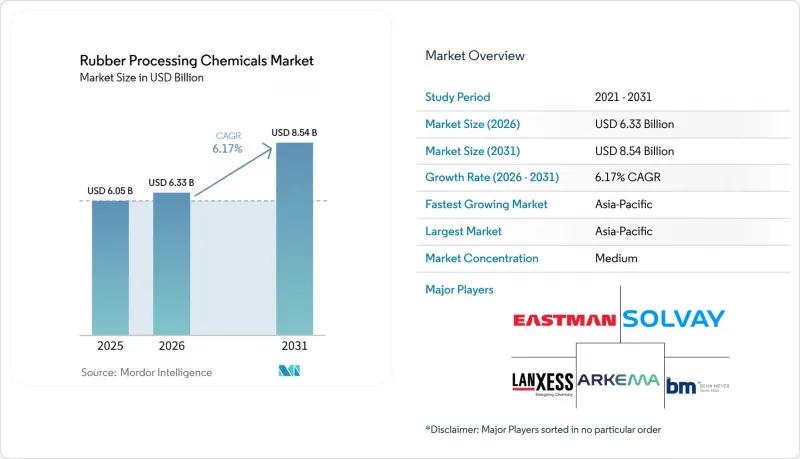
預計到 2025 年,橡膠加工化學品市場規模將達到 60.5 億美元,到 2031 年將達到 85.4 億美元,而 2026 年為 63.3 億美元,預測期(2026-2031 年)複合年成長率為 6.17%。
本報告按產品類型(劣化抑制劑、硫化促進劑等)、配方類型(固體和液體)、應用領域(輪胎、非輪胎產品等)、終端用戶產業(汽車和交通運輸、建築等)以及地區(亞太地區、北美地區、歐洲地區、南美地區、中東和非洲)進行細分。市場預測以美元計價。
全球橡膠處理化學品市場趨勢及洞察
全球輪胎生產和汽車製造的擴張
輪胎製造仍是橡膠加工化學品市場需求的重要支柱。輪胎的混煉和硫化過程需要劣化抑制劑、硫化促進劑、硫化劑和其他添加劑。中國、印度、日本和韓國的汽車生產支撐著整個區域供應鏈的化學品需求。印度的生產連結獎勵計畫計畫鼓勵了阿波羅輪胎、MRF和JK輪胎等公司提高輪胎產能,從而增加了對化學品的需求。印度標準局(BIS)的認證要求延長了進口橡膠化學品的批准週期,有利於擁有認證混煉資格的加工商。這個框架表明,隨著國內產能的發展,印度的商業機會可能會逐漸轉向前驅原料和特殊添加劑。
電動車和高性能輪胎對先進橡膠化合物的需求不斷成長。
電動車輪胎需要能夠承受電池重量、瞬時扭矩、降低滾動阻力並減少車廂噪音的橡膠配方。這些要求推動了二氧化矽填充型和溶液型丁苯橡膠 (SBR) 配方系統的應用。這種日益成長的需求也帶動了對加工助劑(用於提高二氧化矽分散性)和劣化抑制劑(用於控制熱應力)的需求增加。供應商還需開發出既能滿足不斷變化的環境要求又不影響輪胎性能的配方。因此,技術服務和應用工程在橡膠加工化學品市場中正成為越來越重要的競爭優勢。
嚴格的環境法規和合規要求,涉及化學物質的安全
化學品安全法規可能會減緩新配方的研發,強制要求進行測試,並增加供應商的認證成本。歐盟的《化學品註冊、評估、授權和限制法規》(REACH) 框架對於向歐洲輪胎和工業橡膠製造商提供產品的供應商尤其重要。苯二胺類抗氧化劑和臭氧抑制劑的限制評估給一種廣泛使用的劣化抑制劑帶來了不確定性。供應商在更改配方之前,必須評估替代方案、準備技術文件並獲得客戶的批准。這些要求可能有利於擁有註冊材料和檢驗性能數據的現有供應商。但對於依賴向歐洲市場出口通用產品的製造商而言,這些要求也可能延遲其進入市場。
細分市場分析
至2025年,劣化抑制劑將佔橡膠加工化學品市場的35.82%。這一地位反映了它們在保護輪胎和工業橡膠免受熱、氧、臭氧和疲勞損害方面的重要作用。這些產品有助於延長嚴苛工況下所應用的橡膠製品的使用壽命。硫化促進劑包括磺醯胺、噻唑和胍類化合物。這些物質會影響輪胎和非輪胎橡膠製品的硫化速率和交聯密度。
硫化劑,包括元素硫、硫供體和不溶性硫,仍是交聯過程中不可或缺的成分。雖然這項化學技術已經成熟,但其產量與橡膠製品的整體產量密切相關。緩凝劑和膠溶劑在高溫混煉和天然橡膠再生中發揮特殊作用。預計到2031年,加工助劑和促進劑的年複合成長率將達到6.83%。這一成長與二氧化矽填充的低滾動阻力輪胎配方和連續混煉系統密切相關。朗盛於2026年推出了用於二氧化矽填充配方的“Aflux SD”,這標誌著橡膠產品正朝著兼具性能和柔順性特點的加工產品方向發展。
截至2025年,固體製劑佔橡膠加工化學品市場規模的56.44%。顆粒狀、預分散型和粉末狀產品適用於輪胎和橡膠廠現有的大量生產處理系統。這些劑型也便於採用常用的計量方法,並且具有較低的單位活性成分成本。固體母粒有助於確保計量一致性,並有助於最大限度地減少生產環境中的粉塵。預分散固體製劑在需要可靠分散的精密混煉中繼續發揮至關重要的作用。
預計到2031年,液體配方將以6.52%的複合年成長率成長。當需要二氧化矽填料均勻分散並與閉迴路連續混合機相容時,混煉商會採用液體系統。在這些生產線中,液體注射比粉末計量能實現更精確的配料控制。液體促進劑也有助於以更少的機械混合能量將二氧化矽偶聯劑融入其中。朗盛公司於2025年在南卡羅來納州擴大了Aflux 37、Aflux 42、Aktiplast PP和Aktiplast 44的產能,以供應美國客戶。與單一固體袋相比,散裝液體供應還能減少包裝廢棄物。
區域分析
到2025年,亞太地區將佔橡膠加工化學品市場46.84%的佔有率,預計到2031年將以7.02%的複合年成長率成長。中國憑藉其輪胎生產基地以及在促進劑和抗氧化劑供應方面的重要地位,成為推動市場需求成長的主要力量。中國製造商在通用促進劑和抗氧化劑領域競爭激烈。印度由於其國內輪胎產能的不斷擴大,也成為一個重要的成長市場。由於需要獲得認證的產品和供應商,印度標準局(BIS)的認證要求正在影響採購。
日本和韓國供應高附加價值化學產品,如劣化抑制劑和促進劑。該地區還支持用於先進輪胎配方的特殊橡膠材料的供應。泰國和印尼透過出口導向生產手套、軟管和工業橡膠製品,進一步刺激了市場需求。北美市場正經歷穩定成長,這得益於汽車產業的需求以及加工促進劑本地供應的擴大。朗盛公司於2025年擴建了位於南卡羅來納州布希帕克的工廠,降低了對德國和中國進口產品的依賴。
在歐洲,由於監管合規成本和汽車產量波動影響購買決策,需求成長正在放緩。儘管如此,低揮發性有機化合物(VOC)且不含高度關注物質(SVHC)的特種化學品市場依然存在機會。德國、英國和法國仍然是高階輪胎和特殊工業橡膠製品的重要樞紐。南美洲、中東和非洲受益於基礎設施、採礦業、農業和工業的發展。巴西和阿根廷的需求主要來自輪胎更換和工業橡膠。沙烏地阿拉伯正在擴大下游製造業產能,作為其工業化計畫的一部分;南非則透過汽車組裝和採礦業來支持區域需求。
其他好處:
- Excel格式的市場預測(ME)表
- 3個月的分析師支持
目錄
第1章:引言
- 研究假設和市場定義
- 調查範圍
第2章:調查方法
第3章執行摘要
第4章 市場狀況
- 市場概覽
- 市場促進因素
- 全球輪胎生產和汽車製造的擴張
- 對高性能、耐用橡膠製品的需求日益成長。
- 擴大低VOC、環保化學品在橡膠加工的應用。
- 電動車和高性能輪胎對先進橡膠化合物的需求不斷成長。
- 人們越來越關注永續橡膠加工和循環經濟措施。
- 市場限制因素
- 嚴格的環境法規和合規要求,涉及化學物質的安全
- 生物基和永續橡膠加工化學品的性能局限性
- 與有害橡膠添加劑相關的職業安全與健康挑戰
- 價值鏈分析
- 波特五力分析
第5章 市場規模與成長預測
- 依產品類型
- 劣化抑制劑
- 加速器
- 硫化劑
- 加工助劑和增稠劑
- 其他產品類型
- 依配方類型
- 固體的
- 液體
- 透過使用
- 胎
- 除了輪胎以外
- 皮帶和軟管
- 電線電纜
- 鞋類
- 工業橡膠製品
- 其他用途
- 按最終用途行業分類
- 汽車和運輸業
- 建築/施工
- 工業製造
- 消費品
- 衛生保健
- 其他終端用戶產業
- 按地區
- 亞太地區
- 中國
- 印度
- 日本
- 韓國
- 其他亞太國家
- 北美洲
- 美國
- 加拿大
- 墨西哥
- 歐洲
- 德國
- 英國
- 法國
- 義大利
- 俄羅斯
- 其他歐洲國家
- 南美洲
- 巴西
- 阿根廷
- 其他南美國家
- 中東和非洲
- 沙烏地阿拉伯
- 南非
- 其他中東和非洲國家
- 亞太地區
第6章 競爭情勢
- 市場集中度
- 策略趨勢
- 市佔率和排名分析
- 公司簡介
- Arkema
- BEHN MEYER
- China Petrochemical Corporation
- Eastman Chemical Company
- Kemai Chemical Co., Ltd.
- Kumho Petrochemical
- LANXESS
- OUCHI SHINKO CHEMICAL INDUSTRIAL CO., LTD.
- PMC Rubber Chemicals
- Shandong Yanggu Huatai Chemical Co., Ltd.
- SI Group, Inc.
- Solvay
- Sumitomo Chemical Co., Ltd.
- Wacker Chemie AG
- Willing New Materials Technology Co., Ltd.
第7章 市場機會與未來展望
According to Mordor Intelligence, the rubber processing chemicals market was valued at USD 6.05 billion in 2025 and is estimated to grow from USD 6.33 billion in 2026 to reach USD 8.54 billion by 2031, at a CAGR of 6.17% during the forecast period (2026-2031).
This report is Segmented by Product Type (Antidegradants, Accelerators, and More), Formulation Type (Solid and Liquid), Application (Tires, Non-Tire, and More), End-Use Industry (Automotive and Transportation, Building and Construction, and More), and Geography (Asia-Pacific, North America, Europe, South America, and Middle-East and Africa). The Market Forecasts are Provided in Terms of Value (USD).
Global Rubber Processing Chemicals Market Trends and Insights
Expansion of Global Tire Production and Automotive Manufacturing
Tire manufacturing remains the structural demand anchor for the rubber processing chemicals market. Tires require antidegradants, accelerators, vulcanizing agents, and other additives during compounding and curing. Automotive production in China, India, Japan, and South Korea supports continuing chemical demand across the regional supply chain. India's production-linked incentive program encouraged tire capacity additions by Apollo Tyres, MRF, and JK Tyre, which increased chemical procurement needs. Bureau of Indian Standards (BIS) certification requirements lengthen approval cycles for imported rubber chemicals and favor processors with qualified formulations. This framework may gradually shift India's opportunity toward precursor feedstocks and specialty additives as domestic capabilities develop.
Rising Demand for Advanced Rubber Compounds in Electric Vehicle (EV) and High-Performance Tires
Electric vehicle tires require compounds that can handle battery weight, instant torque, lower rolling resistance, and lower cabin noise. These requirements support silica-filled and solution styrene-butadiene rubber compound systems. This expansion increases demand for processing aids that improve silica dispersion and for antidegradants that manage thermal stress. Suppliers also need formulations that meet changing environmental requirements without compromising tire performance. Technical service and application engineering, therefore, become more important competitive tools in the rubber processing chemicals market.
Stringent Environmental Regulations and Chemical Safety Compliance Requirements
Chemical safety rules can delay new formulations, require testing, and raise qualification costs for suppliers. The European Union's Registration, Evaluation, Authorisation and Restriction of Chemicals (REACH) framework is especially important for suppliers that serve European tire and industrial rubber customers. The restriction assessment for phenylenediamine antioxidants and antiozonants created uncertainty for a widely used antidegradant class. Suppliers must evaluate alternatives, prepare technical dossiers, and maintain customer approvals before changing a compound package. These requirements can benefit established suppliers with registered materials and verified performance data. They can also slow entry by producers that rely on commodity exports to the European market.
Other drivers and restraints analyzed in the detailed report include:
- Growing Adoption of Low-VOC and Environmentally Friendly Rubber Processing Chemicals
- Increasing Demand for High-Performance and Durable Rubber Products
- Occupational Health and Safety Challenges Associated with Hazardous Rubber Additives
For complete list of drivers and restraints, kindly check the Table Of Contents.
Segment Analysis
Antidegradants held 35.82% of the rubber processing chemicals market share in 2025. Their position reflects their role in protecting tires and industrial rubber against heat, oxygen, ozone, and fatigue. They help extend service life in applications with demanding operating conditions. Accelerators include sulfenamide, thiazole, and guanidine compounds. These materials influence vulcanization speed and crosslink density across tire and non-tire rubber goods.
Vulcanizing agents, including elemental sulfur, sulfur donors, and insoluble sulfur grades, remain essential to crosslink formation. Their chemistry is mature, but their volumes closely follow total rubber goods production. Retarders and peptizers serve specialized functions in high-temperature mixing and natural rubber reclaiming. Processing aids and promoters are projected to grow at a 6.83% CAGR through 2031. Their growth is tied to silica-filled, low-rolling-resistance tire compounds and continuous mixing systems. LANXESS introduced Aflux SD in 2026 for silica-filled compounds, illustrating the shift toward processing products that combine performance and compliance features.
Solid formulations accounted for 56.44% of the rubber processing chemicals market size in 2025. Pelletized, pre-dispersed, and powder formats fit established handling systems in high-volume tire and rubber plants. They also offer familiar dosing practices and a favorable cost per active unit. Solid masterbatches support dosing consistency and help minimize airborne dust in production settings. Pre-dispersed solid formats remain important in precision compounding where reliable distribution is required.
Liquid formulations are forecast to grow at a 6.52% CAGR through 2031. Compounders use liquid systems when they need uniform dispersion in silica-filled materials and compatibility with closed continuous mixers. Liquid injection can give more controlled delivery than powder dosing in these lines. Liquid promoters also help introduce silica coupling agents with lower mechanical mixing energy. LANXESS expanded production of Aflux 37, Aflux 42, Aktiplast PP, and Aktiplast 44 in South Carolina during 2025 to serve U.S. customers. Bulk liquid delivery can also reduce packaging waste compared with individual solid bags.
Complete Report Scope:
- By Product Type
- Antidegradants
- Accelerators
- Vulcanizing Agents
- Processing Aids and Promoters
- Other Product Types
- By Formulation Type
- Solid
- Liquid
- By Application
- Tires
- Non-Tire
- Belts and Hoses
- Wires and Cables
- Footwear
- Industrial Rubber Goods
- Other Applications
- By End-Use Industry
- Automotive and Transportation
- Building and Construction
- Industrial Manufacturing
- Consumer Goods
- Healthcare
- Other End-Use Industries
- By Geography
- Asia-Pacific
- China
- India
- Japan
- South Korea
- Rest of Asia-Pacific
- North America
- United States
- Canada
- Mexico
- Europe
- Germany
- United Kingdom
- France
- Italy
- Russia
- Rest of Europe
- South America
- Brazil
- Argentina
- Rest of South America
- Middle-East and Africa
- Saudi Arabia
- South Africa
- Rest of Middle-East and Africa
- Asia-Pacific
Geography Analysis
Asia-Pacific accounted for 46.84% of the rubber processing chemicals market share in 2025 and is forecast to grow at a 7.02% CAGR through 2031. China is driving demand because of its tire production base and its position in accelerator and antioxidant supply. Chinese producers compete strongly in the commodity accelerator and antioxidant categories. India is an important growth market as domestic tire capacity expands. BIS certification requirements influence procurement by requiring approved products and suppliers.
Japan and South Korea contribute higher-value antidegradant and accelerator chemistries. The region also supports specialty rubber materials used in advanced tire compounds. Thailand and Indonesia provide additional demand through export-oriented production of gloves, hoses, and industrial rubber goods. North America is growing steadily, supported by automotive demand and more local supply of processing promoters. LANXESS expanded its Bushy Park facility in South Carolina during 2025, reducing dependence on imports from Germany and China.
Europe faces a slower demand environment because compliance costs and uneven automotive production affect purchasing decisions. It still offers opportunities for low-VOC and Substances of Very High Concern (SVHC)-free specialty chemicals. Germany, the United Kingdom, and France remain important centers for premium tires and specialty industrial rubber goods. South America and Middle-East, and Africa benefit from infrastructure, mining, agriculture, and industrial development. Brazil and Argentina support tire replacement and industrial rubber demand. Saudi Arabia is expanding downstream manufacturing capacity under industrialization programs, while South Africa supports regional demand through automotive assembly and mining.
- Arkema
- BEHN MEYER
- China Petrochemical Corporation
- Eastman Chemical Company
- Kemai Chemical Co., Ltd.
- Kumho Petrochemical
- LANXESS
- OUCHI SHINKO CHEMICAL INDUSTRIAL CO., LTD.
- PMC Rubber Chemicals
- Shandong Yanggu Huatai Chemical Co., Ltd.
- SI Group, Inc.
- Solvay
- Sumitomo Chemical Co., Ltd.
- Wacker Chemie AG
- Willing New Materials Technology Co., Ltd.
Additional Benefits:
- The market estimate (ME) sheet in Excel format
- 3 months of analyst support
TABLE OF CONTENTS
1 Introduction
- 1.1 Study Assumptions and Market Definition
- 1.2 Scope of the Study
2 Research Methodology
3 Executive Summary
4 Market Landscape
- 4.1 Market Overview
- 4.2 Market Drivers
- 4.2.1 Expansion of Global Tire Production and Automotive Manufacturing
- 4.2.2 Increasing Demand for High-Performance and Durable Rubber Products
- 4.2.3 Growing Adoption of Low-VOC and Environmentally Friendly Rubber Processing Chemicals
- 4.2.4 Rising Demand for Advanced Rubber Compounds in Electric Vehicle (EV) and High-Performance Tires
- 4.2.5 Growing Focus on Sustainable Rubber Processing and Circular Economy Initiatives
- 4.3 Market Restraints
- 4.3.1 Stringent Environmental Regulations and Chemical Safety Compliance Requirements
- 4.3.2 Performance Limitations of Bio-Based and Sustainable Rubber Processing Chemicals
- 4.3.3 Occupational Health and Safety Challenges Associated with Hazardous Rubber Additives
- 4.4 Value Chain Analysis
- 4.5 Porter's Five Forces Analysis
- 4.5.1 Threat of New Entrants
- 4.5.2 Bargaining Power of Suppliers
- 4.5.3 Bargaining Power of Buyers
- 4.5.4 Threat of Substitutes
- 4.5.5 Competitive Rivalry
5 Market Size and Growth Forecasts (Value)
- 5.1 By Product Type
- 5.1.1 Antidegradants
- 5.1.2 Accelerators
- 5.1.3 Vulcanizing Agents
- 5.1.4 Processing Aids and Promoters
- 5.1.5 Other Product Types
- 5.2 By Formulation Type
- 5.2.1 Solid
- 5.2.2 Liquid
- 5.3 By Application
- 5.3.1 Tires
- 5.3.2 Non-Tire
- 5.3.3 Belts and Hoses
- 5.3.4 Wires and Cables
- 5.3.5 Footwear
- 5.3.6 Industrial Rubber Goods
- 5.3.7 Other Applications
- 5.4 By End-Use Industry
- 5.4.1 Automotive and Transportation
- 5.4.2 Building and Construction
- 5.4.3 Industrial Manufacturing
- 5.4.4 Consumer Goods
- 5.4.5 Healthcare
- 5.4.6 Other End-Use Industries
- 5.5 By Geography
- 5.5.1 Asia-Pacific
- 5.5.1.1 China
- 5.5.1.2 India
- 5.5.1.3 Japan
- 5.5.1.4 South Korea
- 5.5.1.5 Rest of Asia-Pacific
- 5.5.2 North America
- 5.5.2.1 United States
- 5.5.2.2 Canada
- 5.5.2.3 Mexico
- 5.5.3 Europe
- 5.5.3.1 Germany
- 5.5.3.2 United Kingdom
- 5.5.3.3 France
- 5.5.3.4 Italy
- 5.5.3.5 Russia
- 5.5.3.6 Rest of Europe
- 5.5.4 South America
- 5.5.4.1 Brazil
- 5.5.4.2 Argentina
- 5.5.4.3 Rest of South America
- 5.5.5 Middle-East and Africa
- 5.5.5.1 Saudi Arabia
- 5.5.5.2 South Africa
- 5.5.5.3 Rest of Middle-East and Africa
- 5.5.1 Asia-Pacific
6 Competitive Landscape
- 6.1 Market Concentration
- 6.2 Strategic Moves
- 6.3 Market Share (%)/Ranking Analysis
- 6.4 Company Profiles (includes Global Overview, Market Overview, Core Segments, Financials as available, Strategic Information, Products and Services, and Recent Developments)
- 6.4.1 Arkema
- 6.4.2 BEHN MEYER
- 6.4.3 China Petrochemical Corporation
- 6.4.4 Eastman Chemical Company
- 6.4.5 Kemai Chemical Co., Ltd.
- 6.4.6 Kumho Petrochemical
- 6.4.7 LANXESS
- 6.4.8 OUCHI SHINKO CHEMICAL INDUSTRIAL CO., LTD.
- 6.4.9 PMC Rubber Chemicals
- 6.4.10 Shandong Yanggu Huatai Chemical Co., Ltd.
- 6.4.11 SI Group, Inc.
- 6.4.12 Solvay
- 6.4.13 Sumitomo Chemical Co., Ltd.
- 6.4.14 Wacker Chemie AG
- 6.4.15 Willing New Materials Technology Co., Ltd.
7 Market Opportunities and Future Outlook
- 7.1 White-Space and Unmet-Need Assessment

 橡膠加工化學品市場:依產品類型、應用、銷售管道、國家及地區分類-全球產業分析、市場規模、市場佔有率及2026年至2033年預測
 橡膠促進劑市場預測至2034年—按類型、應用和地區分類的全球分析
 橡膠加工化學品市場:按產品、應用和地區分類
 橡膠硫化:市場佔有率分析、產業趨勢與統計、成長預測(2026-2031)
 橡膠加工化學品市場報告:按類型、應用、最終用途和地區分類(2026-2034 年)
 橡膠加工化學品市場:依產品類型、原料來源、形態、應用、最終用途產業及通路分類-2026-2032年全球預測
 全球橡膠加工化學品市場規模、佔有率、趨勢和成長分析報告(2026-2034年)
 2026年全球橡膠加工化學品市場報告
 2025-2029年全球橡膠加工化學品市場
 橡膠加工化學品市場規模、佔有率及成長分析(按產品、應用、最終用途及地區分類)-2026-2033年產業預測