


 |
市場調查報告書
商品編碼
2118967
牙科手用器材:市場佔有率分析、產業趨勢與統計、成長預測(2026-2031)Dental Hand Tools - Market Share Analysis, Industry Trends & Statistics, Growth Forecasts (2026 - 2031) |
||||||

※ 本網頁內容可能與最新版本有所差異。詳細情況請與我們聯繫。
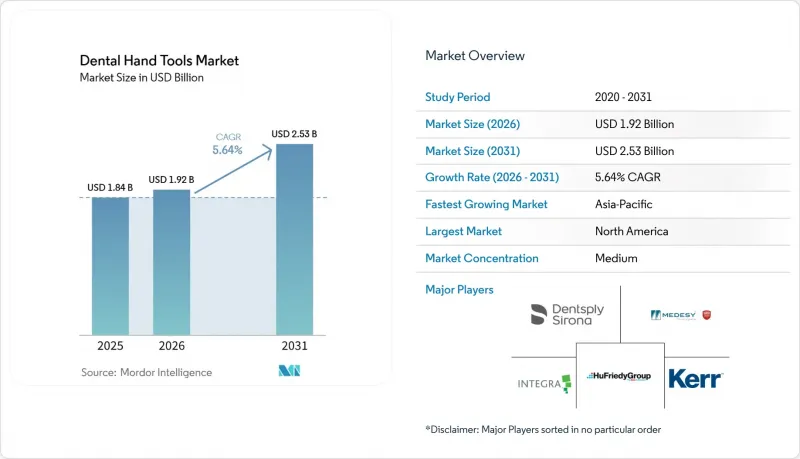
預計牙科手用器械的市場規模將從 2025 年的 18.4 億美元成長到 2026 年的 19.2 億美元,到 2031 年將達到 25.3 億美元,2026 年至 2031 年的複合年成長率預計為 5.64%。
本報告依產品類型(檢查器材、切割器材、牙周器材、修復器材、拔牙器材、矯正器材、根管治療器材)、可重複使用性(可重複使用、一次性使用)、最終用戶(牙科診所、醫院、檢查室、其他)和地區(北美、歐洲、亞太地區、中東和非洲、南美洲)進行細分。市場預測以美元計價。
全球牙科手用器械市場趨勢與洞察
全球齲齒和牙周疾病負擔日益加重
根據2026年的一項分析,隨著人口成長和老化,齲齒和牙周疾病預計將持續增加至2035年。因此,牙科器材市場擁有強大的臨床基礎,涵蓋診斷和牙周治療器材。在南亞和東南亞,高疾病負擔和不斷擴大的牙科基礎設施共同推動了對入門級診斷套裝和常規牙周護理器材的需求。世界衛生組織(世衛組織)的《2023-2030年全球口腔健康行動計畫》也鼓勵各國政府努力減少未治療的齲齒並擴大口腔健康服務。
人口老化和重建治療的增加
截至2025年,65歲及以上成年人將占美國人口的16.5%,預計到2034年將達到21.6%。老年患者通常需要在一次就診中使用多種器械進行修復治療、拔牙和植入相關手術。因此,一套完整的治療工具包可能需要用到切割器材、拔牙鉗和植入維護工具。截至2026年1月,美國牙科消費者支出成長了4%。由於植入修復的日益普及,牙科手用器械產業也從中受益,對鈦探針、塑膠刮器和鄰面清潔工具的需求不斷成長。這些類別的器械需要採購傳統拔牙工具包以外的其他產品,從而增加了診所擁有的專用產品數量。
高階設備的高昂價格和總擁有成本
高階人體工學刮器、精密切割套裝和整合式牙周治療套裝的價格高於標準不銹鋼產品。在患者承擔大部分牙科治療費用的地區,這種價格差異構成了一大障礙。成本還包括消毒耗材、生物標記檢測、盒式器械維護以及因合金疲勞而需要更換等費用。對於未參與團購計畫的獨立牙醫診所而言,規劃這些支出可能十分困難。雖然數位化工作流程和CAD/CAM技術可以提高效率,但購買高階產品的益處在大規模醫療網路中比在單一診所中更為顯著。因此,牙科手用器械市場很可能繼續存在高階系統需求與低成本可重複使用工具需求之間的缺口。
細分市場分析
預計到2025年,牙科檢查器械的市佔率將達到22.45%。在所有牙科專科中,患者就診初期都會使用牙鏡、探針和探條。這些器械在牙周疾病分期和邊緣評估中的作用,確保了它們即使在配備先進掃描系統的診所中也持續使用。經過校準的手動探針能夠提供數位成像無法複製的觸覺回饋。
預計到2031年,根管治療器材的複合年成長率將達到6.89%,在所有產品類型中成長率最高。這一品類受益於臨床醫生傾向於透過根管治療而非拔牙來保留牙齒。此外,鎳鈦銼系統需要定期更換,從而增加了重複購買的需求。隨著矯正診所網路的不斷發展,矯正器及配件市場也在擴張。 「微笑醫生」(Smile Doctors)到2025年將擁有超過580家診所,這將擴大對專業器械的需求。
區域分析
到2025年,北美市佔率將達到43.67%。 2024年,美國牙科總支出達到1,890億美元,截至2026年1月的一年中,消費者牙科支出增加了4%。牙科服務機構正在大規模的診所網路中規範品牌選擇和採購。到2025年,Heartland Dental將為超過1900家診所提供支援。加拿大聯邦牙科計劃正在擴大符合資格人群獲得預防性和基礎口腔保健服務的途徑。 FDA醫療設備法規為機構買家提供了所需的品質認證,同時也增加了合規要求。
歐洲是全球第二大牙科手用器材市場。德國、法國、義大利、西班牙和英國憑藉著完善的預防和修復護理體系,正大力推動高品質產品的採購。預計到2031年,亞太地區的複合年成長率將達到7.56%。區域診所網路的擴張推動了對耐用、經濟且可重複使用的器械套裝的需求成長。到2025年,Clove Dental將在印度營運超過650家診所,顯示正規診所的採購規模正在擴大。
其他好處:
- Excel格式的市場預測(ME)表
- 3個月的分析師支持
目錄
第1章:引言
- 研究假設和市場定義
- 調查範圍
第2章:調查方法
第3章執行摘要
第4章 市場狀況
- 市場概覽
- 市場促進因素
- 全球齲齒和牙周疾病負擔日益加重
- 人口老化和重建治療的增加
- 牙科診所和有組織的牙科服務網路的擴張
- 對預防性牙科、美容牙科和微創牙科治療的需求不斷成長。
- 設備追蹤與數位再處理工作流程
- 數位化規劃流程中對觸覺設備的需求
- 市場限制因素
- 高階產品的高成本和總擁有成本
- 滅菌、驗證和法規遵從的負擔。
- 分銷管道的碎片化導致假冒仿冒品產品氾濫。
- 特殊合金和替換頭的 SKU 供應波動情況。
- 供應鏈分析
- 監理情勢
- 技術展望
- 波特五力分析
第5章 市場規模與成長預測
- 依產品類型
- 檢測設備
- 切削刀具
- 牙周治療器械
- 維修工具
- 提取裝置
- 矯正器
- 根管治療器械
- 其他產品類型
- 重複使用性別
- 可重複使用設備
- 免洗設備
- 最終用戶
- 牙醫診所
- 牙科醫院
- 牙體技術所
- 其他(流動牙科服務和社區牙科服務、學術和研究機構)
- 按地區
- 北美洲
- 美國
- 加拿大
- 墨西哥
- 歐洲
- 德國
- 英國
- 法國
- 義大利
- 西班牙
- 其他歐洲國家
- 亞太地區
- 中國
- 印度
- 日本
- 澳洲
- 韓國
- 其他亞太國家
- 中東和非洲
- GCC
- 南非
- 其他中東和非洲國家
- 南美洲
- 巴西
- 阿根廷
- 其他南美國家
- 北美洲
第6章 競爭情勢
- 市場集中度
- 市佔率分析
- 公司簡介
- American Eagle Instruments, Inc.
- ASA Dental SpA
- B. Braun SE
- Brasseler USA
- Carl Martin GmbH
- COLTENE Holding AG
- Dentsply Sirona
- Harfins Instruments LLP
- Helmut Zepf Medizintechnik GmbH
- HuFriedyGroup
- Integra LifeSciences Corporation
- Jakobi Dental Instruments GmbH
- Kerr Corporation
- LM-Instruments Oy
- Medesy Srl
- Nordent Manufacturing, Inc.
- Power Dental Group
- Premier Dental Co.
- Young Innovations, Inc.
第7章 市場機會與未來展望
According to Mordor Intelligence, the dental hand tools market size is expected to increase from USD 1.84 billion in 2025 to USD 1.92 billion in 2026 and reach USD 2.53 billion by 2031, growing at a CAGR of 5.64% over 2026-2031.
This report is Segmented by Product Type (Examination, Cutting, Periodontal, Restorative, Extraction, Orthodontic, and Endodontic Instruments), Reusability (Reusable, Disposable), End User (Dental Clinics, Hospitals, Laboratories, Others), and Geography (North America, Europe, Asia-Pacific, Middle East and Africa, South America). The Market Forecasts are Provided in Terms of Value (USD).
Global Dental Hand Tools Market Trends and Insights
Rising Global Burden of Dental Caries and Periodontal Disease
A 2026 analysis projects continuing increases in dental caries and periodontal disease through 2035 as populations grow and age. The dental hand tools market, therefore, has a durable clinical base for diagnostic and periodontal instruments. South Asia and Southeast Asia combine a high disease burden with expanding dental infrastructure. This combination raises demand for both entry-level examination sets and instruments used in routine periodontal care. The World Health Organization's Global Oral Health Action Plan for 2023-2030 also supports government action to reduce untreated caries and expand oral health services.
Aging Population and Growth in Restorative Procedures
Adults aged 65 and older represented 16.5% of the U.S. population in 2025 and are projected to represent 21.6% by 2034. Older patients often need restorative, extraction, and implant-related care that uses several instrument types in one appointment. Cutting instruments, extraction forceps, and implant maintenance tools can therefore be required within the same practice kit. U.S. consumer dental spending rose 4% in the year ending January 2026. The dental hand tools industry also benefits as implant-supported restorations increase the need for titanium probes, plastic scalers, and interproximal cleaning instruments. These categories extend procurement beyond conventional extraction kits and increase the number of specialized products held by a practice.
High Cost of Premium Instruments and Total Cost of Ownership
Premium ergonomic curettes, precision cutting sets, and cassette-integrated periodontal kits cost more than standard stainless-steel alternatives. The price difference is a barrier in regions where patients pay directly for much of their dental care. Costs also include sterilization consumables, biological indicator testing, cassette maintenance, and replacement after alloy fatigue. Independent practices outside group purchasing arrangements may find these expenses difficult to plan for. Digital workflows and CAD/CAM can improve productivity, but the case for premium purchases is stronger in large networks than in single-practice settings. The dental hand tools market will therefore continue to show a difference between demand for premium systems and demand for lower-cost reusable tools.
Other drivers and restraints analyzed in the detailed report include:
- Expansion of Dental Clinics and Organized Dental Service Networks
- Growing Demand for Preventive, Cosmetic, and Minimally Invasive Dentistry
- Sterilization, Validation, and Regulatory Compliance Burden
For complete list of drivers and restraints, kindly check the Table Of Contents.
Segment Analysis
Examination instruments held 22.45% share in 2025. Mirrors, explorers, and probes are used at the start of every patient encounter across dental specialties. Their role in periodontal staging and margin evaluation supports steady use even in clinics with advanced scanning systems. A calibrated manual probe provides tactile feedback that a digital image does not replace.
Endodontic instruments are forecast to grow at a 6.89% CAGR through 2031, the fastest rate among product types. The category benefits when clinicians preserve teeth through root canal treatment rather than choose extraction. Nickel-titanium file systems also create repeat purchasing needs because they are replaced regularly. Orthodontic and accessory instruments are expanding alongside organized orthodontic practice networks. Smile Doctors had more than 580 locations in 2025, which broadened the institutional base for specialty tools.
Complete Report Scope:
- By Product Type
- Examination Instruments
- Cutting Instruments
- Periodontal Instruments
- Restorative Instruments
- Extraction Instruments
- Orthodontic Instruments
- Endodontic Instruments
- Other Product Types
- By Reusability
- Reusable Instruments
- Disposable Instruments
- By End User
- Dental Clinics
- Dental Hospitals
- Dental Laboratories
- Others (Mobile and Community Dental Services, Academic and Research Institutes)
- By Geography
- North America
- United States
- Canada
- Mexico
- Europe
- Germany
- United Kingdom
- France
- Italy
- Spain
- Rest of Europe
- Asia-Pacific
- China
- India
- Japan
- Australia
- South Korea
- Rest of Asia-Pacific
- Middle East and Africa
- GCC
- South Africa
- Rest of Middle East and Africa
- South America
- Brazil
- Argentina
- Rest of South America
- North America
Geography Analysis
North America held 43.67% share in 2025. U.S. national dental spending reached USD 189 billion in 2024, while consumer dental spending rose 4% in the year ending January 2026. Dental service organizations are standardizing brand selection and purchasing across large practice networks. Heartland Dental supported more than 1,900 practices in 2025. Canada's federal dental program is expanding access to preventive and basic oral health services for eligible residents. FDA device regulation adds compliance requirements and also provides quality credentials sought by institutional buyers.
Europe is the second-largest regional area for the dental hand tools market. Germany, France, Italy, Spain, and the U.K. support premium procurement through strong preventive and restorative care frameworks. Asia-Pacific is forecast to grow at a 7.56% CAGR through 2031. Regional clinic networks are expanding and increasing demand for durable, cost-effective reusable sets. Clove Dental operated more than 650 clinics in India in 2025, which illustrates the growing scale of organized clinic purchasing.
- American Eagle Instruments, Inc.
- ASA Dental S.p.A.
- B. Braun
- Brasseler USA
- Carl Martin
- Coltene Holding
- Dentsply Sirona
- Harfins Instruments LLP
- Helmut Zepf Medizintechnik GmbH
- HuFriedyGroup
- Integra LifeSciences
- Jakobi Dental Instruments GmbH
- Kerr
- LM-Instruments Oy
- Medesy S.r.l.
- Nordent Manufacturing, Inc.
- Power Dental Group
- Premier Dental
- Young Innovations, Inc.
Additional Benefits:
- The market estimate (ME) sheet in Excel format
- 3 months of analyst support
TABLE OF CONTENTS
1 Introduction
- 1.1 Study Assumptions & Market Definition
- 1.2 Scope of the Study
2 Research Methodology
3 Executive Summary
4 Market Landscape
- 4.1 Market Overview
- 4.2 Market Drivers
- 4.2.1 Rising Global Burden of Dental Caries and Periodontal Disease
- 4.2.2 Aging Population and Growth in Restorative Procedures
- 4.2.3 Expansion of Dental Clinics and Organized Dental Service Networks
- 4.2.4 Growing Demand for Preventive, Cosmetic, and Minimally Invasive Dentistry
- 4.2.5 Instrument Tracking and Digital Reprocessing Workflows
- 4.2.6 Demand for High-Tactility Instruments in Digitally Planned Procedures
- 4.3 Market Restraints
- 4.3.1 High Cost of Premium Instruments and Total Cost of Ownership
- 4.3.2 Sterilization, Validation, and Regulatory Compliance Burden
- 4.3.3 Counterfeit and Low-Quality Instrument Leakage Through Fragmented Distribution
- 4.3.4 SKU-Level Supply Volatility for Specialty Alloys and Replacement Tips
- 4.4 Supply-Chain Analysis
- 4.5 Regulatory Landscape
- 4.6 Technological Outlook
- 4.7 Porter's Five Forces Analysis
- 4.7.1 Threat of New Entrants
- 4.7.2 Bargaining Power of Suppliers
- 4.7.3 Bargaining Power of Buyers
- 4.7.4 Threat of Substitutes
- 4.7.5 Industry Rivalry
5 Market Size & Growth Forecasts (Value, USD)
- 5.1 By Product Type
- 5.1.1 Examination Instruments
- 5.1.2 Cutting Instruments
- 5.1.3 Periodontal Instruments
- 5.1.4 Restorative Instruments
- 5.1.5 Extraction Instruments
- 5.1.6 Orthodontic Instruments
- 5.1.7 Endodontic Instruments
- 5.1.8 Other Product Types
- 5.2 By Reusability
- 5.2.1 Reusable Instruments
- 5.2.2 Disposable Instruments
- 5.3 By End User
- 5.3.1 Dental Clinics
- 5.3.2 Dental Hospitals
- 5.3.3 Dental Laboratories
- 5.3.4 Others (Mobile and Community Dental Services, Academic and Research Institutes)
- 5.4 By Geography
- 5.4.1 North America
- 5.4.1.1 United States
- 5.4.1.2 Canada
- 5.4.1.3 Mexico
- 5.4.2 Europe
- 5.4.2.1 Germany
- 5.4.2.2 United Kingdom
- 5.4.2.3 France
- 5.4.2.4 Italy
- 5.4.2.5 Spain
- 5.4.2.6 Rest of Europe
- 5.4.3 Asia-Pacific
- 5.4.3.1 China
- 5.4.3.2 India
- 5.4.3.3 Japan
- 5.4.3.4 Australia
- 5.4.3.5 South Korea
- 5.4.3.6 Rest of Asia-Pacific
- 5.4.4 Middle East and Africa
- 5.4.4.1 GCC
- 5.4.4.2 South Africa
- 5.4.4.3 Rest of Middle East and Africa
- 5.4.5 South America
- 5.4.5.1 Brazil
- 5.4.5.2 Argentina
- 5.4.5.3 Rest of South America
- 5.4.1 North America
6 Competitive Landscape
- 6.1 Market Concentration
- 6.2 Market Share Analysis
- 6.3 Company Profiles {(includes Global level Overview, Market level overview, Core Segments, Financials as available, Strategic Information, Market Rank/Share for key companies, Products & Services, and Recent Developments)}
- 6.3.1 American Eagle Instruments, Inc.
- 6.3.2 ASA Dental S.p.A.
- 6.3.3 B. Braun SE
- 6.3.4 Brasseler USA
- 6.3.5 Carl Martin GmbH
- 6.3.6 COLTENE Holding AG
- 6.3.7 Dentsply Sirona
- 6.3.8 Harfins Instruments LLP
- 6.3.9 Helmut Zepf Medizintechnik GmbH
- 6.3.10 HuFriedyGroup
- 6.3.11 Integra LifeSciences Corporation
- 6.3.12 Jakobi Dental Instruments GmbH
- 6.3.13 Kerr Corporation
- 6.3.14 LM-Instruments Oy
- 6.3.15 Medesy S.r.l.
- 6.3.16 Nordent Manufacturing, Inc.
- 6.3.17 Power Dental Group
- 6.3.18 Premier Dental Co.
- 6.3.19 Young Innovations, Inc.
7 Market Opportunities & Future Outlook
- 7.1 White-space & unmet-need assessment

 全球組合扳手市場規模、佔有率、趨勢和成長分析報告(2026-2034)
 木工工具市場-2026-2032年全球市場預測粉筆捲筒與粉筆線市場:全球市場預測(2026-2032)
 組合扳手市場機會、成長要素、產業趨勢分析及2026-2035年預測。
 手動工具市場 - 全球產業規模、佔有率、趨勢、機會、預測:按類型、應用、分銷管道、地區和競爭格局分類,2021-2031年
 手動工具和木工工具市場分析與預測(至2035年):按類型、產品、技術、組件、應用、材料類型、製程、最終用戶和功能分類
 2026年全球釘錘市場報告
 手動工具市場規模、佔有率、趨勢和預測:按類型、分銷管道、最終用戶和地區分類,2026-2034年
 手動工具市場:按應用程式、產品類型、銷售管道和地區分類鑽井工具市場:2026-2032年全球市場預測(按工具類型、動力來源、材料、類別、應用和分銷管道分類)