


 |
市場調查報告書
商品編碼
2102004
組合扳手市場機會、成長要素、產業趨勢分析及2026-2035年預測。Combination Spanner Market Opportunity, Growth Drivers, Industry Trend Analysis, and Forecast 2026 - 2035 |
||||||

全球組合扳手市場預計到 2025 年價值 15.9 億美元,並將以 4.6% 的複合年成長率成長,到 2035 年達到 25.4 億美元。
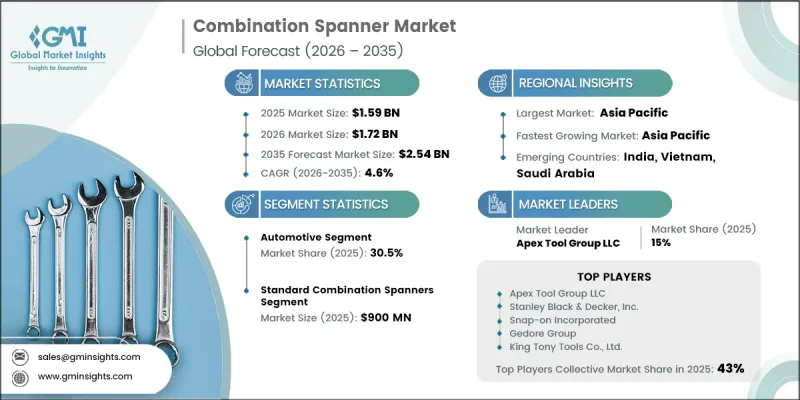
組合扳手市場涵蓋多種工具套裝,包括開口扳手和環形扳手,廣泛應用於全球工業、商業和消費領域。市場成長主要受汽車製造、設備維護、建設活動以及全球經濟中工業活動擴張等因素所推動。隨著企業加速向正規採購管道和品牌設備轉型,以及發展中地區工業化進程的推進和製造業投資的增加,對專業手動工具的需求持續增強。建築項目的復甦、基礎設施投資的增加以及製造工廠維護需求的上升,為市場擴張創造了穩定的機會。產品創新也推動產業成長,製造商不斷推出先進設計,提升專業應用的柔軟性、效率和便利性。此外,數位化採購平台的快速發展正在改變工業買家的採購行為,使各種規模的企業都能更有效率地採購高品質的組合扳手套裝,從而促進全球組合扳手市場的持續發展。
| 市場範圍 | |
|---|---|
| 開始年份 | 2025 |
| 預測期 | 2026-2035 |
| 初始市場規模 | 15.9億美元 |
| 預計金額 | 25.4億美元 |
| 複合年成長率 | 4.6% |
預計到2025年,汽車產業將佔據30.5%的市場。該領域的需求主要由汽車製造和服務業驅動,組合扳手套裝仍然是組裝、維護和維修應用中不可或缺的工具。汽車產量的持續成長、維護需求的不斷增加以及電動車的日益普及,都支撐著對精密手動工具的持續需求。隨著對能夠支持精確緊固和維護工作的可靠工具的需求不斷成長,汽車行業在市場上的主導地位也日益鞏固。
預計到2025年,標準組合扳手的銷售額將達到9億美元,成為組合扳手市場的領先產品類別。其廣泛應用得益於其在汽車製造、建築、工業維護和一般維修等領域的多功能性。標準組合扳手之所以備受青睞,是因為它們符合既定的緊固要求,並能柔軟性應對各種維護和組裝任務。其豐富的尺寸範圍和可靠的性能使其成為各行各業專業用戶和機構買家的首選。
美國組合扳手市場佔87.6%的市場佔有率,預計到2025年市場規模將達到3.76億美元。其主導地位得益於成熟的汽車服務業、廣泛的工業維護業務以及專業技術人員和商業用戶的強勁需求。對高品質手動工具的持續投資,以及成熟的維修保養體系,共同推動了市場的穩定成長。持續的更換需求以及消費者對高階品牌工具日益成長的偏好,預計將使美國在整個預測期內保持主導地位。
目錄
第1章:調查方法
第2章執行摘要
第3章 行業洞察
- 產業生態系與價值鏈分析
- 影響價值鏈的因素
- 利潤率分析
- 轉型與未來展望
- 製造商概覽
- 銷售代理概覽
- 影響產業的因素
- 市場促進因素
- 市場挑戰與陷阱
- 市場機遇
- 成長潛力分析
- 產業生態系分析
- 監理框架
- 產品安全與品質標準(ISO、DIN、ANSI/ASME)
- 符合環保和RoHS標準
- 進出口貿易法規及關稅政策
- 價格分析
- 對過去價格趨勢的分析
- 依球員類型分類的定價策略(高級球員、超值球員、成本加成球員)
- 技術與創新展望
- 材料科學的進展(鉻釩鋼、鈦合金)
- 表面處理和塗層技術
- 符合人體工學的智慧設計創新。
- 波特的分析
- PESTLE分析
- 貿易數據分析
- 進出口量及進口額趨勢
- 主要貿易路線及關稅的影響
- 人工智慧和生成式人工智慧對市場的影響
- 利用人工智慧改造現有經營模式(設計、品管、需求預測)
- 按細分市場分類的生成式人工智慧用例和部署藍圖
- 風險、限制和監管考量
- 生產能力和生產情況
- 設備產能:按地區和主要生產商分類
- 運轉率和擴張計劃
第4章 競爭情勢
- 介紹
- 企業市佔率分析
- 北美洲
- 歐洲
- 亞太地區
- LATAM
- 中東和非洲
- 企業矩陣分析
- 主要市場公司的競爭分析
- 競爭定位矩陣
- 主要進展
- 併購
- 夥伴關係和聯盟
- 新產品發布
- 業務拓展計劃
第5章 市場估計與預測:依類型分類,2022-2035年
- 標準組合扳手
- 棘輪式組合扳手
- 軟性頭組合扳手
- 偏移/曲柄式組合扳手
- 短組合扳手
- 其他
第6章 市場估計與預測:依材料分類,2022-2035年
- 碳鋼
- 鉻釩鋼
- 不銹鋼
- 其他
第7章 市場規模估算與預測(2022-2035年)
- 小號(12毫米或更小)
- 中等(13毫米至22毫米)
- 大號(23毫米或以上)
第8章 市場估計與預測:依應用領域分類,2022-2035年
- 車
- OEM汽車組裝
- 汽車售後市場與服務(MRO)
- 建築和基礎設施
- 一般製造業和工業組裝
- 重工業和機械維修
- 輕工業和生產線組裝
- 首頁/DIY
- 航太和國防領域的MRO(維修、修理和大修)
- 船舶維修
- 能源公用事業
- 石油和天然氣
- 可再生能源(風能和太陽能發電系統的安裝和維護)
- 其他
第9章 市場估價與預測:依通路分類,2022-2035年
- 線上
- 離線
第10章 市場估價與預測:依地區分類,2022-2035年
- 北美洲
- 美國
- 加拿大
- 歐洲
- 德國
- 英國
- 法國
- 義大利
- 西班牙
- 荷蘭
- 亞太地區
- 中國
- 印度
- 日本
- 澳洲
- 韓國
- 拉丁美洲
- 巴西
- 墨西哥
- 中東和非洲
- 南非
- 沙烏地阿拉伯
- UAE
第11章:公司簡介
- 第一梯隊:全球主要公司
- Snap-on Incorporated
- Stanley Black & Decker Inc.
- Wera Werkzeuge GmbH
- Gedore Group
- Klein Tools Inc.
- King Tony Tools Co., Ltd.
- Jonnesway Enterprise Co., Ltd.
- TOPTUL(ROTAR International Co., Ltd.)
- Apex Tool Group LLC.
- 第二梯隊:區域玩家
- Hazet-Werk Hermann Zerver GmbH & Co. KG
- Teng Tools AB
- KTC(Kyoto Tool Co., Ltd.)
- TONE Co., Ltd.
- Sunex Tools Inc.
- Wright Tool Company
- Beta Utensili SpA(Beta Tools)
- Unior dd
- Draper Tools Ltd.
- SK Professional Tools(SK Tools USA, LLC)
- TIER 3:Niche & Specialist Players
- Stahlwille Eduard Wille GmbH
- Proxxon GmbH
The Global Combination Spanner Market was valued at USD 1.59 billion in 2025 and is estimated to grow at a CAGR of 4.6% to reach USD 2.54 billion by 2035.
The combination spanner market includes multi-piece hand tool sets that combine an open-end wrench with a ring-end design, serving industrial, commercial, and consumer applications worldwide. Market growth is supported by rising demand from automotive manufacturing, equipment maintenance, construction activities, and expanding industrial operations across global economies. Increasing industrialization and manufacturing investments across developing regions continue to strengthen demand for professional-grade hand tools as businesses increasingly shift toward organized procurement channels and branded equipment. The recovery of construction projects, growing infrastructure investments, and rising maintenance requirements across manufacturing facilities are creating consistent opportunities for market expansion. Product innovation is further supporting industry growth as manufacturers introduce advanced designs that improve flexibility, efficiency, and user convenience for professional applications. In addition, the rapid expansion of digital procurement platforms is transforming purchasing behavior by improving product accessibility for industrial buyers, enabling businesses of all sizes to source high-quality combination spanner sets more efficiently while supporting the continued development of the global combination spanner market.
| Market Scope | |
|---|---|
| Start Year | 2025 |
| Forecast Year | 2026-2035 |
| Start Value | $1.59 Billion |
| Forecast Value | $2.54 Billion |
| CAGR | 4.6% |
The automotive segment accounted for 30.5% share in 2025. Demand from this segment is driven by both vehicle manufacturing operations and the automotive service industry, where combination spanner sets remain essential for assembly, maintenance, and repair applications. Continued growth in vehicle production, expanding maintenance requirements, and the increasing adoption of electric vehicles are supporting sustained demand for precision hand tools. The need for reliable tools capable of supporting accurate fastening and servicing operations continues to strengthen the automotive segment's leadership within the market.
The standard combination spanners segment generated USD 900 million in 2025, making them the leading product segment in the combination spanner market. Their widespread adoption is supported by their versatility across automotive manufacturing, construction, industrial maintenance, and general repair applications. Standard combination spanners continue to be preferred because they are compatible with established fastening requirements and provide the flexibility needed for a broad range of maintenance and assembly tasks. Their broad size availability and dependable performance make them a preferred choice for professional users and institutional buyers across multiple industries.
United States Combination Spanner Market held 87.6% share, generating USD 376 million in 2025. Market leadership is supported by a well-established automotive service industry, extensive industrial maintenance operations, and strong demand from professional technicians and commercial users. Continued investment in high-quality hand tools, supported by a mature repair and maintenance ecosystem, contributes to stable market growth. Ongoing replacement demand and increasing preference for premium branded tools are expected to sustain the country's leading position throughout the forecast period.
Major companies operating in the global combination spanner market include Apex Tool Group LLC, Snap-on Incorporated, Stanley Black & Decker Inc., Wera Werkzeuge GmbH, Gedore Group, Klein Tools Inc., King Tony Tools Co., Ltd., Jonnesway Enterprise Co., Ltd., TOPTUL (ROTAR International Co., Ltd.), Hazet-Werk Hermann Zerver GmbH & Co. KG, Teng Tools AB, KTC (Kyoto Tool Co., Ltd.), TONE Co., Ltd., Sunex Tools Inc., Wright Tool Company, Beta Utensili S.p.A. (Beta Tools), Unior d.d., Draper Tools Ltd., SK Professional Tools (SK Tools USA, LLC), Stahlwille Eduard Wille GmbH, and Proxxon GmbH. Companies operating in the combination spanner market are enhancing their competitive position through continuous product innovation, portfolio expansion, and investments in advanced manufacturing technologies. Industry participants are developing ergonomic, lightweight, and durable hand tools that improve user comfort, productivity, and long-term performance. Manufacturers are also strengthening their distribution networks by expanding digital sales channels and improving access to professional-grade tools across emerging markets. Strategic collaborations, acquisitions, and geographic expansion initiatives continue to support broader market penetration and customer acquisition.
Table of Contents
Chapter 1 Methodology
- 1.1 Research approach
- 1.2 Quality Commitments
- 1.2.1 GMI AI policy & data integrity commitment
- 1.2.1.1 Source consistency protocol
- 1.2.1 GMI AI policy & data integrity commitment
- 1.3 Research Trail & Confidence Scoring
- 1.3.1 Research Trail Components
- 1.3.2 Scoring Components
- 1.4 Data Collection
- 1.4.1 Partial list of primary sources
- 1.5 Data mining sources
- 1.5.1 Paid sources
- 1.5.1.1 Sources, by region
- 1.5.1 Paid sources
- 1.6 Base estimates and calculations
- 1.6.1 Base year calculation for any one approach
- 1.7 Forecast model
- 1.7.1 Quantified market impact analysis
- 1.7.1.1 Mathematical impact of growth parameters on forecast
- 1.7.1 Quantified market impact analysis
- 1.8 Research transparency addendum
- 1.8.1 Source attribution framework
- 1.8.2 Quality assurance metrics
- 1.8.3 Our commitment to trust
Chapter 2 Executive Summary
- 2.1 Industry snapshot
- 2.2 Business trends
- 2.3 Type trends
- 2.4 Material trends
- 2.5 Size trends
- 2.6 End use trends
- 2.7 Distribution channel trends
- 2.8 Regional trends
Chapter 3 Industry Insights
- 3.1 Industry ecosystem and value chain analysis
- 3.1.1 Factors affecting the value chain
- 3.1.2 Profit margin analysis
- 3.1.3 Disruptions & future outlook
- 3.1.4 Manufacturer landscape overview
- 3.1.5 Distributor landscape overview
- 3.2 Industry impact forces
- 3.2.1 Market Driver
- 3.2.2 Market challenges/pitfalls
- 3.2.3 Market opportunities
- 3.3 Growth potential analysis
- 3.4 Industry ecosystem analysis
- 3.5 Regulatory framework
- 3.5.1 Product safety & quality standards (ISO, DIN, ANSI/ASME)
- 3.5.2 Environmental & RoHS compliance
- 3.5.3 Import/export trade regulations & tariff policies
- 3.6 Pricing analysis (driven by primary research)
- 3.6.1 Historical price trend analysis (driven by primary research)
- 3.6.2 Pricing strategy by player type (premium / value / cost-plus) (driven by primary research)
- 3.7 Technology and innovation landscape
- 3.7.1 Material science advancements (chrome vanadium, titanium alloys)
- 3.7.2 Surface treatment & coating technologies
- 3.7.3 Ergonomic & smart design innovations
- 3.8 Porter's Analysis
- 3.9 PESTEL Analysis
- 3.10 Trade data analysis (driven by paid database) (HS Code: 82041110)
- 3.10.1 Import/export volume & value trends (driven by paid database)
- 3.10.2 Key trade corridors & tariff impact (driven by paid database)
- 3.11 Impact of AI and generative AI on the market
- 3.11.1 AI-driven disruption of existing business models (design, quality control, demand forecasting)
- 3.11.2 GenAI use cases & adoption roadmap by segment
- 3.11.3 Risks, limitations & regulatory considerations
- 3.12 Capacity & production landscape (driven by primary research)
- 3.12.1 Installed capacity by region & key producer (driven by primary research)
- 3.12.2 Capacity utilization rates & expansion pipelines (driven by primary research)
Chapter 4 Competitive Landscape, 2025
- 4.1 Introduction
- 4.2 Company market share analysis
- 4.2.1 North America
- 4.2.2 Europe
- 4.2.3 APAC
- 4.2.4 LATAM
- 4.2.5 MEA
- 4.3 Company matrix analysis
- 4.4 Competitive analysis of major market players
- 4.5 Competitive positioning matrix
- 4.6 Key developments
- 4.6.1 Mergers & acquisitions
- 4.6.2 Partnerships & collaborations
- 4.6.3 New product launches
- 4.6.4 Expansion plans
Chapter 5 Market Estimates and Forecast, By Type, 2022 - 2035 ($ Billion) (Thousand Units)
- 5.1 Key trends
- 5.2 Standard combination spanners
- 5.3 Ratchet combination spanners
- 5.4 Flex-head combination spanners
- 5.5 Offset/cranked combination spanners
- 5.6 Stubby combination spanners
- 5.7 Others
Chapter 6 Market Estimates and Forecast, By Material, 2022 - 2035 ($ Billion) (Thousand Units)
- 6.1 Key trends
- 6.2 Carbon steel
- 6.3 Chrome vanadium steel
- 6.4 Stainless steel
- 6.5 Others
Chapter 7 Market Estimates and Forecast, By Size, 2022 - 2035 ($ Billion) (Thousand Units)
- 7.1 Key trends
- 7.2 Small (up to 12 mm)
- 7.3 Medium (13 mm-22 mm)
- 7.4 Large (23 mm & above)
Chapter 8 Market Estimates and Forecast, By Application, 2022 - 2035 ($ Billion) (Thousand Units)
- 8.1 Key trends
- 8.2 Automotive
- 8.2.1 OEM vehicle assembly
- 8.2.2 Automotive aftermarket & service (MRO)
- 8.3 Construction & infrastructure
- 8.4 General manufacturing & industrial assembly
- 8.4.1 Heavy engineering & machinery maintenance
- 8.4.2 Light manufacturing & production line assembly
- 8.5 Home use/DIY
- 8.6 Aerospace & defense MRO
- 8.7 Marine MRO
- 8.8 Energy & utilities
- 8.8.1 Oil & gas
- 8.8.2 Renewable energy (wind, solar installation & maintenance)
- 8.9 Others
Chapter 9 Market Estimates and Forecast, By Distribution Channel, 2022 - 2035 ($ Billion) (Thousand Units)
- 9.1 Key trends
- 9.2 Online
- 9.3 Offline
Chapter 10 Market Estimates and Forecast, By Region, 2022 - 2035 ($ Billion) (Thousand Units)
- 10.1 Key trends
- 10.2 North America
- 10.2.1 US
- 10.2.2 Canada
- 10.3 Europe
- 10.3.1 Germany
- 10.3.2 UK
- 10.3.3 France
- 10.3.4 Italy
- 10.3.5 Spain
- 10.3.6 Netherlands
- 10.4 Asia Pacific
- 10.4.1 China
- 10.4.2 India
- 10.4.3 Japan
- 10.4.4 Australia
- 10.4.5 South Korea
- 10.5 Latin America
- 10.5.1 Brazil
- 10.5.2 Mexico
- 10.6 Middle East and Africa
- 10.6.1 South Africa
- 10.6.2 Saudi Arabia
- 10.6.3 UAE
Chapter 11 Company Profiles
- 11.1 TIER 1: Top Global Players
- 11.1.1 Snap-on Incorporated
- 11.1.2 Stanley Black & Decker Inc.
- 11.1.3 Wera Werkzeuge GmbH
- 11.1.4 Gedore Group
- 11.1.5 Klein Tools Inc.
- 11.1.6 King Tony Tools Co., Ltd.
- 11.1.7 Jonnesway Enterprise Co., Ltd.
- 11.1.8 TOPTUL (ROTAR International Co., Ltd.)
- 11.1.9 Apex Tool Group LLC.
- 11.2 TIER 2: Regional Players
- 11.2.1 Hazet-Werk Hermann Zerver GmbH & Co. KG
- 11.2.2 Teng Tools AB
- 11.2.3 KTC (Kyoto Tool Co., Ltd.)
- 11.2.4 TONE Co., Ltd.
- 11.2.5 Sunex Tools Inc.
- 11.2.6 Wright Tool Company
- 11.2.7 Beta Utensili S.p.A. (Beta Tools)
- 11.2.8 Unior d.d.
- 11.2.9 Draper Tools Ltd.
- 11.2.10 SK Professional Tools (SK Tools USA, LLC)
- 11.3 TIER 3: Niche & Specialist Players
- 11.3.1 Stahlwille Eduard Wille GmbH
- 11.3.2 Proxxon GmbH

 全球組合扳手市場規模、佔有率、趨勢和成長分析報告(2026-2034)
 牙科手用器材:市場佔有率分析、產業趨勢與統計、成長預測(2026-2031)
 木工工具市場-2026-2032年全球市場預測粉筆捲筒與粉筆線市場:全球市場預測(2026-2032)
 手動工具市場 - 全球產業規模、佔有率、趨勢、機會、預測:按類型、應用、分銷管道、地區和競爭格局分類,2021-2031年
 手動工具和木工工具市場分析與預測(至2035年):按類型、產品、技術、組件、應用、材料類型、製程、最終用戶和功能分類
 2026年全球釘錘市場報告
 手動工具市場規模、佔有率、趨勢和預測:按類型、分銷管道、最終用戶和地區分類,2026-2034年
 手動工具市場:按應用程式、產品類型、銷售管道和地區分類鑽井工具市場:2026-2032年全球市場預測(按工具類型、動力來源、材料、類別、應用和分銷管道分類)