


 |
市場調查報告書
商品編碼
2118939
媒體策劃:市場佔有率分析、行業趨勢和統計數據、成長預測(2026-2031 年)Media Planning - Market Share Analysis, Industry Trends & Statistics, Growth Forecasts (2026 - 2031) |
||||||

※ 本網頁內容可能與最新版本有所差異。詳細情況請與我們聯繫。
據 Mordor Intelligence 稱,2025 年媒體策劃市場價值為 59.9 億美元,預計到 2031 年將達到 113.5 億美元,而 2026 年為 66.4 億美元,2026 年至 2031 年預測期內的複合年成長率為 11.32%。
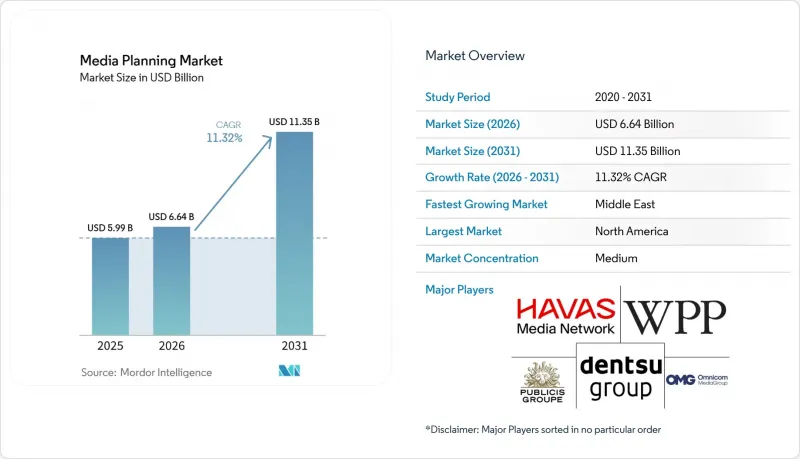
本報告按組織規模(大型企業、中小企業)、規劃目標(覆蓋率和頻率規劃、預算分配和情境規劃等)、終端用戶產業(零售和電子商務、媒體和娛樂、醫療保健和生命科學、旅遊和酒店等)以及地區進行細分。市場預測以美元(USD)計價。
全球媒體策劃市場趨勢與洞察
向演算法和程序化規劃的過渡
演算法決策不再是有限的實驗性功能,而是媒體規劃的核心要素。 IAB 的一份報告顯示,2026 年廣告主和代理商關注的六大關鍵領域中,有五個將與人工智慧相關,包括能夠以最小的人工干預完成宣傳活動策劃、執行和最佳化的系統。這種轉變促使策劃人員更加重視檢驗模型輸出、評估資料品質以及設定庫存和歸因規則。這對媒體策劃市場至關重要,因為策劃軟體的價值越來越取決於其自動化任務的能力,以及其管治。代理商集團正日益將策劃、策略和受眾開發整合到一個集中式的技術架構中。隨著媒體購買者越來越依賴基於代理的工作流程,能夠使自動化決策清晰可控的公司將擁有顯著優勢。
擴大零售媒體和電商媒體庫存
零售媒體結合了消費者資料、廣告資源和購買訊號,已成為規劃中不可或缺的要素。隨著規模的擴大,零售媒體不再只是通路多元化的工具,而是融入日常的規劃決策中。隨著異地廣告資源的日益普及,策劃人員必須將零售媒體應用於聯網電視、社群媒體和程式化管道。因此,媒體策劃人員不應僅將零售媒體視為零售商網站上的搜尋活動,而應將其視為一個完整的管道。業界努力將可衡量的零售和電商媒體與傳統貿易支出區分開來,為衡量和報告提供了更清晰的基礎。此外,隨著網路數量的不斷增加,對廣告資源品質、受眾覆蓋範圍以及跨平台效果對比的能力也需要進行更細緻的評估。
由於隱私法規和逐步淘汰 Cookie,訊號遺失。
隱私權要求持續限制可用於定向、效果衡量和頻次管理的資料。當使用者授權要求限制受眾配對和跨平台資料使用時,這種影響尤其顯著。對於媒體策劃市場的參與企業,較低的配對率會影響受眾估算的準確性,並降低頻率管理的精確度。此外,投資第一方資料和使用者授權系統也可能與媒體營運預算產生衝突。這些挑戰可能會延遲平台投資,直到買家建立起永續的數據權利和營運規則。對於需要在多個法規環境下比較宣傳活動的公司而言,這種限制尤其關鍵。
細分市場分析
到2025年,大型企業將佔媒體策劃市場佔有率的63.92%。如此龐大的規模使得它們能夠投資於企業級策劃系統、先進的測量套件和客製化的人工智慧整合。這些買家通常透過全球代理商網路或成熟的內部團隊來管理大規模的全通路預算。這種集中度持續推動對整合資料、策劃、執行和測量功能的系統的需求。 2026年1月,宏盟集團發布了下一代「Omni」平台,整合了數據、識別、人工智慧、媒體策劃、電商執行和測量功能。
預計中小企業 (SME) 將實現最高成長率,2026 年至 2031 年的複合年成長率 (CAGR) 將達到 12.41%。自助式程式化工具和人工智慧驅動的策劃服務正在減少日常宣傳活動策劃中對代理商的需求。這使得即使是以前依賴單一頻道工具的小規模廣告主也能更輕鬆地進行系統化規劃。能夠將簡報轉化為計劃並提供經濟實惠價格的軟體為媒體策劃市場的這一細分領域提供了支持。將清晰的工作流程與自助服務相結合的供應商可以滿足這一廣泛的買家群體的需求,而無需承擔企業級部署的成本結構。
區域分析
2025年,北美將佔據媒體策劃市場36.38%的佔有率。該地區擁有成熟的程序化購買生態系統和高度集中的全球媒體控股公司。 2025年11月,宏盟集團收購埃培智集團,促使媒體投資計畫更集中於大型企業。加拿大和墨西哥正透過拓展數位廣告業務來推動區域需求,而貨幣和關稅相關的不確定性則凸顯了情境規劃的重要性。對數據、人工智慧和聯網電視測量技術的持續投資,正在鞏固該地區媒體策劃市場的地位。
歐洲是一個穩定但又複雜的地區,因為用戶許可要求會影響數據的可用性,而行業範圍內的衡量機構仍然發揮著至關重要的作用。法國和德國正在加速採用人工智慧驅動的規劃基礎設施。 2026年2月,MiQ在法國推出了其「Sigma AI」工具,用於跨平台規劃,涵蓋線性電視、串流電視、YouTube和社群媒體。本地媒體規劃市場的系統需要在準確性和符合GDPR的資料管理之間取得平衡。在南美洲,尤其是巴西,數位廣告衡量正變得越來越系統化,隨著全球代理平台在當地擴張,程序化規劃也越來越受歡迎。
預計2026年至2031年,中東地區的複合年成長率將達到12.12%。根據IAB MENA的數據顯示,到2025年,中東和北非地區的數位廣告市場規模將達到81.85億美元,年增17.8%。隨著零售媒體成長40.5%,聯網電視成長31%,市場對能夠處理除社群媒體主導宣傳活動以外的其他廣告規劃工具的需求日益成長。在沙烏地阿拉伯和阿拉伯聯合大公國(阿拉伯聯合大公國),經濟多元化正在擴大廣告主群體,使其不再局限於石油業,從而支撐了市場需求。亞太地區蘊藏著巨大的機遇,中國、日本、印度、韓國和澳洲等各市場都有其獨特的廣告主需求。
其他好處:
- Excel格式的市場預測(ME)表
- 3個月的分析師支持
目錄
第1章:引言
- 研究假設和市場定義
- 調查範圍
第2章:調查方法
第3章執行摘要
第4章 市場狀況
- 市場概覽
- 市場促進因素
- 向演算法和程序化規劃的過渡
- 擴大零售和商業媒體的廣告空間。
- 聯網電視、音訊和創作者管道的去中心化
- 需要統一跨平台宣傳活動。
- 利用生成式人工智慧副駕駛壓縮媒體簡報
- 關稅導致需求波動,進而給預算修訂帶來壓力。
- 市場限制因素
- 由於隱私法規和逐步淘汰 Cookie,訊號遺失。
- 「圍牆花園」之間測量結果的碎片化
- 基於代理和增量式工作流程中規劃人員短缺
- 零售媒體和創作者市場中的庫存品質風險
- 宏觀經濟因素對市場的影響
- 產業價值鏈分析
- 科技趨勢
- 監理情勢
- 波特五力分析
第5章 市場規模與成長預測
- 按組織規模
- 大公司
- 小型企業
- 根據該計劃的目的
- 覆蓋率和頻次規劃
- 預算分配和方案製定
- 受眾規劃
- 建立客戶旅程
- 市場佔有率(SOV)的發展
- 按最終用戶行業分類
- 零售與電子商務
- 媒體與娛樂
- 醫療保健和生命科學
- 旅遊與飯店
- 消費品
- 其他終端用戶產業(銀行、金融服務與保險、教育、汽車、IT/電信等)
- 按地區
- 北美洲
- 美國
- 加拿大
- 墨西哥
- 南美洲
- 巴西
- 阿根廷
- 智利
- 其他南美國家
- 歐洲
- 德國
- 英國
- 法國
- 義大利
- 西班牙
- 其他歐洲國家
- 亞太地區
- 中國
- 日本
- 印度
- 韓國
- 澳洲
- 其他亞太國家
- 中東
- 阿拉伯聯合大公國
- 沙烏地阿拉伯
- 卡達
- 其他中東國家
- 非洲
- 南非
- 埃及
- 奈及利亞
- 其他非洲國家
- 北美洲
第6章 競爭情勢
- 市場集中度
- 策略趨勢
- 市佔率分析
- 公司簡介
- WPP plc
- Publicis Groupe SA
- Omnicom Group Inc.
- Dentsu Group Inc.
- The Interpublic Group of Companies, Inc.
- Havas NV
- Stagwell Inc.
- Hakuhodo DY Holdings Inc.
- Horizon Media, Inc.
- Mediaocean LLC
- Nielsen Holdings plc
- Kantar Group Limited
- Comscore, Inc.
- Basis Global Technologies, Inc.
- The Trade Desk, Inc.
- PubMatic, Inc.
- Magnite, Inc.
- GWI Ltd.
- Keen Decision Systems, Inc.
- Genidox Inc.
第7章 市場機會與未來展望
According to Mordor Intelligence, the media planning market size was valued at USD 5.99 billion in 2025 and is estimated to grow from USD 6.64 billion in 2026 to reach USD 11.35 billion by 2031, at a CAGR of 11.32% during the forecast period 2026-2031.
This report is Segmented by Organization Size (Large Enterprises, and Small and Medium-Sized Enterprises), Planning Objective (Reach and Frequency Planning, Budget Allocation and Scenario Planning, and More), End-User Industry (Retail and E-Commerce, Media and Entertainment, Healthcare and Life Sciences, Travel and Hospitality, and More), and Geography. The Market Forecasts are Provided in Terms of Value (USD).
Global Media Planning Market Trends and Insights
Shift Toward Algorithmic and Programmatic Planning
Algorithmic decision-making has become a central part of media planning rather than a limited trial capability. The IAB reported that AI-related priorities accounted for 5 of the 6 leading areas of focus for advertisers and agencies in 2026, including systems that can plan, activate, and optimize campaigns with limited human intervention. The change shifts planners toward reviewing model outputs, assessing data quality, and setting inventory and attribution rules. This is important for the Media Planning Market because the value of planning software increasingly depends on its governance rather than just its ability to automate tasks. Agency groups are increasingly combining planning, strategy, and audience development within centralized technology architectures. Companies that can make automated decisions understandable and controllable should be better positioned as media buyers rely more heavily on agent-based workflows.
Expansion of Retail Media and Commerce Media Inventories
Retail media has become a planning requirement because it combines consumer data, advertising inventory, and purchase signals. Its expansion has moved retail media beyond a narrow channel-diversification role and into routine planning decisions. The growing use of off-site inventory requires planners to consider retail media across connected TV, social media, and programmatic channels. Planners in the Media Planning Market, therefore, need to consider retail media as a full-funnel channel rather than just a search activity on a retailer's website. Industry efforts to distinguish measurable retail and commerce media from traditional trade spending provide a clearer basis for measurement and reporting. The growing number of networks also requires more careful evaluation of inventory quality, audience access, and the ability to compare results across platforms.
Signal Loss From Privacy Regulation and Cookie Deprecation
Privacy requirements continue to limit the data available for targeting, measurement, and frequency management. The impact is most visible where consent requirements limit audience matching and the use of data across platforms. For Media Planning Market participants, lower match rates can make audience estimates less certain and make frequency controls less precise. Investment in first-party data and consent systems can also compete with working media budgets. These issues can delay platform investments until buyers establish durable data rights and operating rules. The restraint is especially relevant for businesses that need to compare campaigns across several regulated environments.
Other drivers and restraints analyzed in the detailed report include:
- Fragmentation Across Connected TV, Audio, and Creator Channels
- Need for Unified Reach and Frequency Across Cross-Platform Campaigns
- Measurement Fragmentation Across Walled Gardens
For complete list of drivers and restraints, kindly check the Table Of Contents.
Segment Analysis
Large enterprises held 63.92% of the Media Planning Market share in 2025. Their scale supports investment in enterprise planning systems, advanced measurement suites, and custom AI integrations. These buyers often operate through global agency networks or mature in-house teams that manage extensive omnichannel budgets. This concentration sustains demand for systems that integrate data, planning, activation, and measurement. Omnicom introduced its next-generation Omni platform in January 2026 to integrate data, identity, AI, media planning, commerce activation, and measurement.
Small and medium-sized enterprises are projected to record the highest growth at a 12.41% CAGR from 2026 to 2031. Self-service programmatic tools and AI-supported planning services reduce the need for an agency intermediary for routine campaign construction. This makes structured planning more accessible to smaller advertisers that previously relied on separate channel tools. Software that turns a brief into a draft plan and offers accessible pricing supports this Media Planning Market buyer group. Providers that combine clear workflows with self-service access can address this broader buyer base without requiring the cost structure of an enterprise implementation.
Complete Report Scope:
- By Organization Size
- Large Enterprises
- Small and Medium-Sized Enterprises
- By Planning Objective
- Reach and Frequency Planning
- Budget Allocation and Scenario Planning
- Audience Planning
- Customer Journey Planning
- Share of Voice (SOV) Planning
- By End-User Industry
- Retail and E-commerce
- Media and Entertainment
- Healthcare and Life Sciences
- Travel and Hospitality
- Consumer Goods
- Other End-User Industries (BFSI, Education, Automotive and IT and Telecom amongst Others)
- By Geography
- North America
- United States
- Canada
- Mexico
- South America
- Brazil
- Argentina
- Chile
- Rest of South America
- Europe
- Germany
- United Kingdom
- France
- Italy
- Spain
- Rest of Europe
- Asia-Pacific
- China
- Japan
- India
- South Korea
- Australia
- Rest of Asia-Pacific
- Middle East
- United Arab Emirates
- Saudi Arabia
- Qatar
- Rest of Middle East
- Africa
- South Africa
- Egypt
- Nigeria
- Rest of Africa
- North America
Geography Analysis
North America held 36.38% of the Media Planning Market share in 2025. The region has a mature programmatic ecosystem and a high concentration of global media holding companies. The November 2025 Omnicom acquisition of Interpublic concentrated media investment planning within a smaller number of larger organizations. Canada and Mexico are adding to regional demand through expanding digital advertising activity, though currency and tariff-related uncertainty make scenario planning more relevant. Continuing investment in data, AI, and connected-TV measurement strengthens the Media Planning Market's role in the region.
Europe is a stable but complex region because consent requirements affect data availability, and joint industry measurement bodies remain important. France and Germany are adopting AI-supported planning infrastructure. MiQ deployed its Sigma AI tool in France in February 2026 for planning across linear TV, streaming TV, YouTube, and social media. Local Media Planning Market systems must combine precision with GDPR-compliant data practices. South America, led by Brazil, is seeing wider adoption of programmatic planning as digital advertising measurement becomes more formalized and global agency platforms expand locally.
The Middle East is projected to grow at a 12.12% CAGR from 2026 to 2031. The MENA digital advertising sector reached USD 8.185 billion in 2025, rising 17.8% year over year, according to IAB MENA. Retail media grew by as much as 40.5% in 2025, while connected TV grew 31%, raising the need for planning tools that support more than social-led campaigns. Saudi Arabia and the UAE are supporting demand as economic diversification expands the advertiser base outside oil-related activity. Asia-Pacific presents a major opportunity, with China, Japan, India, South Korea, and Australia each having distinct advertiser needs.
- WPP plc
- Publicis Groupe S.A.
- Omnicom Group Inc.
- Dentsu Group Inc.
- The Interpublic Group of Companies, Inc.
- Havas N.V.
- Stagwell Inc.
- Hakuhodo DY Holdings Inc.
- Horizon Media, Inc.
- Mediaocean LLC
- Nielsen Holdings plc
- Kantar Group Limited
- Comscore, Inc.
- Basis Global Technologies, Inc.
- The Trade Desk, Inc.
- PubMatic, Inc.
- Magnite, Inc.
- GWI Ltd.
- Keen Decision Systems, Inc.
- Genidox Inc.
Additional Benefits:
- The market estimate (ME) sheet in Excel format
- 3 months of analyst support
TABLE OF CONTENTS
1 INTRODUCTION
- 1.1 Study Assumptions and Market Definition
- 1.2 Scope of the Study
2 RESEARCH METHODOLOGY
3 EXECUTIVE SUMMARY
4 MARKET LANDSCAPE
- 4.1 Market Overview
- 4.2 Market Drivers
- 4.2.1 Shift Toward Algorithmic and Programmatic Planning
- 4.2.2 Expansion of Retail Media and Commerce Media Inventories
- 4.2.3 Fragmentation Across Connected TV, Audio, and Creator Channels
- 4.2.4 Need for Unified Reach and Frequency Across Cross-Platform Campaigns
- 4.2.5 Media Brief Compression from Generative AI Co-Pilots
- 4.2.6 Budget Reforecasting Pressure from Tariff-Driven Demand Volatility
- 4.3 Market Restraints
- 4.3.1 Signal Loss From Privacy Regulation and Cookie Deprecation
- 4.3.2 Measurement Fragmentation Across Walled Gardens
- 4.3.3 Planning Talent Shortage in Agentic and Incrementality-Based Workflows
- 4.3.4 Inventory Quality Risk Across Retail Media and Creator Marketplaces
- 4.4 Impact of Macroeconomic Factors on the Market
- 4.5 Industry Value-Chain Analysis
- 4.6 Technology Outlook
- 4.7 Regulatory Landscape
- 4.8 Porter's Five Forces Analysis
- 4.8.1 Threat of New Entrants
- 4.8.2 Bargaining Power of Suppliers
- 4.8.3 Bargaining Power of Buyers
- 4.8.4 Threat of Substitutes
- 4.8.5 Intensity of Competitive Rivalry
5 MARKET SIZE AND GROWTH FORECASTS (VALUE)
- 5.1 By Organization Size
- 5.1.1 Large Enterprises
- 5.1.2 Small and Medium-Sized Enterprises
- 5.2 By Planning Objective
- 5.2.1 Reach and Frequency Planning
- 5.2.2 Budget Allocation and Scenario Planning
- 5.2.3 Audience Planning
- 5.2.4 Customer Journey Planning
- 5.2.5 Share of Voice (SOV) Planning
- 5.3 By End-User Industry
- 5.3.1 Retail and E-commerce
- 5.3.2 Media and Entertainment
- 5.3.3 Healthcare and Life Sciences
- 5.3.4 Travel and Hospitality
- 5.3.5 Consumer Goods
- 5.3.6 Other End-User Industries (BFSI, Education, Automotive and IT and Telecom amongst Others)
- 5.4 By Geography
- 5.4.1 North America
- 5.4.1.1 United States
- 5.4.1.2 Canada
- 5.4.1.3 Mexico
- 5.4.2 South America
- 5.4.2.1 Brazil
- 5.4.2.2 Argentina
- 5.4.2.3 Chile
- 5.4.2.4 Rest of South America
- 5.4.3 Europe
- 5.4.3.1 Germany
- 5.4.3.2 United Kingdom
- 5.4.3.3 France
- 5.4.3.4 Italy
- 5.4.3.5 Spain
- 5.4.3.6 Rest of Europe
- 5.4.4 Asia-Pacific
- 5.4.4.1 China
- 5.4.4.2 Japan
- 5.4.4.3 India
- 5.4.4.4 South Korea
- 5.4.4.5 Australia
- 5.4.4.6 Rest of Asia-Pacific
- 5.4.5 Middle East
- 5.4.5.1 United Arab Emirates
- 5.4.5.2 Saudi Arabia
- 5.4.5.3 Qatar
- 5.4.5.4 Rest of Middle East
- 5.4.6 Africa
- 5.4.6.1 South Africa
- 5.4.6.2 Egypt
- 5.4.6.3 Nigeria
- 5.4.6.4 Rest of Africa
- 5.4.1 North America
6 COMPETITIVE LANDSCAPE
- 6.1 Market Concentration
- 6.2 Strategic Moves
- 6.3 Market Share Analysis
- 6.4 Company Profiles (includes Global Level Overview, Market Level Overview, Core Segments, Financials as available, Strategic Information, Market Rank/Share, Products and Services, Recent Developments)
- 6.4.1 WPP plc
- 6.4.2 Publicis Groupe S.A.
- 6.4.3 Omnicom Group Inc.
- 6.4.4 Dentsu Group Inc.
- 6.4.5 The Interpublic Group of Companies, Inc.
- 6.4.6 Havas N.V.
- 6.4.7 Stagwell Inc.
- 6.4.8 Hakuhodo DY Holdings Inc.
- 6.4.9 Horizon Media, Inc.
- 6.4.10 Mediaocean LLC
- 6.4.11 Nielsen Holdings plc
- 6.4.12 Kantar Group Limited
- 6.4.13 Comscore, Inc.
- 6.4.14 Basis Global Technologies, Inc.
- 6.4.15 The Trade Desk, Inc.
- 6.4.16 PubMatic, Inc.
- 6.4.17 Magnite, Inc.
- 6.4.18 GWI Ltd.
- 6.4.19 Keen Decision Systems, Inc.
- 6.4.20 Genidox Inc.
7 MARKET OPPORTUNITIES AND FUTURE OUTLOOK
- 7.1 White-Space and Unmet-Need Assessment

 2026-2030年全球媒體企劃與採購市場2026-2030年全球醫療保健專業人員媒體企劃與購買市場
 社群媒體行銷服務:市場佔有率分析、產業趨勢與統計、成長預測(2026-2031)社群媒體廣告:市場佔有率分析、產業趨勢與統計、成長預測(2026-2031)
 2026年全球社群媒體廣告市場報告
 社群媒體廣告市場-全球產業規模、佔有率、趨勢、機會和預測(按廣告形式、平台、地區和競爭格局分類,2021-2031年)
 企業社群媒體行銷服務市場按服務類型、管道、公司規模、部署類型、產業垂直領域和最終用途分類,全球預測 - 2026-2032 年企業行銷行事曆軟體市場:依整合架構、團隊結構模型、部署模型、組織規模與產業垂直領域分類-全球預測,2026-2032年社群媒體推廣市場:依平台、定價模式、宣傳活動目標、產業、形式、性別和年齡層分類-2026-2032年全球預測