


 |
市場調查報告書
商品編碼
2099294
社群媒體廣告:市場佔有率分析、產業趨勢與統計、成長預測(2026-2031)Social Media Advertising - Market Share Analysis, Industry Trends & Statistics, Growth Forecasts (2026 - 2031) |
||||||

※ 本網頁內容可能與最新版本有所差異。詳細情況請與我們聯繫。
據 Mordor Intelligence 稱,2025 年社群媒體廣告市場價值 2,029.3 億美元,預計到 2031 年將達到 4,225.8 億美元,而 2026 年為 2,278.8 億美元,預測期(2026-2031 年)的複合成長率為 13.15%。
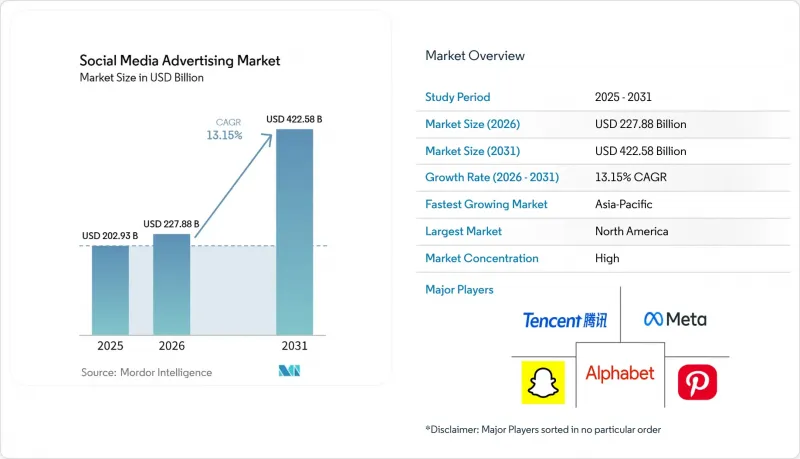
本報告依廣告形式(影片廣告、圖片廣告、輪播廣告、贊助內容等)、平台(社群網路平台、影片共用平台、通訊平台、專業社群平台等)、最終用戶(零售、汽車、醫療保健、金融服務、娛樂媒體等)及地區細分。市場預測以美元計價。
全球社群媒體廣告市場趨勢與洞察
擴大「行動優先」社交電商的市場佔有率。
在社群媒體廣告市場,從廣告發現到購買的整個流程正在迅速整合,那些能夠在應用程式內提供完整購物體驗的平台從中獲益最大。這種轉變促使廣告支出更加重視轉換率,因為廣告曝光的價值如今與最終成交的金額更加緊密相關,而不僅僅是覆蓋率。零售商也在增加對原生電商宣傳活動的預算投入,這表明在銷售漏斗的下游進行社交購買正逐漸成為常規策略的一部分,而不再只是有限的測試項目。擁有強大的視覺搜尋和產品發現功能的平台更具優勢,因為它們能夠在購買流程早期捕捉用戶的購買意向,並將用戶留在可獲利的環境中。 Pinterest 預測,到 2025 年,其每月有效用戶將達到 6.19 億,月搜尋將達到 800 億次,這充分展現了電商整合形式能夠實現的龐大產品發現行為規模。因此,零售商與平台之間合作的加強、行動原生創新週期的縮短以及廣告投放與銷售業績之間更清晰的關聯性,都在推動著社群媒體廣告市場的發展。
不斷擴大短影片廣告庫存
社群媒體廣告市場持續成長,主要得益於各大平台短影片廣告庫存的快速擴張。儘管預計到2025年影片將佔據最大的市場佔有率,但Reels和Shorts等短影片廣告形式的出現進一步鞏固了其地位,使廣告主能夠在同一購買環境下大規模、高頻地投放廣告,並進行更快速的創新測試。此外,這種將故事敘述與清晰的績效指標相結合的廣告形式,正吸引更多先前依賴電視和靜態數位廣告庫存的行業的預算。根據Meta預測,其「應用程式家族」的廣告展示量在2025年成長了12%,平均單次廣告成本增加了9%。這表明,新增的廣告庫存並未降低價格。 Alphabet宣布,YouTube的總合和訂閱收入總和首次突破600億美元,凸顯了以影片主導的平台生態系統的商業性深度。隨著這個廣告領域的基礎不斷擴大,社群媒體廣告市場越來越依賴創新的速度、廣告的相關性和排名的質量,而不是單純的受眾成長。
平台政策變化與競標複雜性
社群媒體廣告市場持續面臨諸多壓力,例如政策的突然變動、審核政策的調整、所有權的變更以及競標環境的波動,這些都給廣告主的預算規劃帶來了挑戰。雖然這些變動通常不會導致廣告主大規模撤出社交平臺,但卻促使他們將廣告支出分散到更多管道和合作夥伴。即使整體廣告支出正在成長,此趨勢也限制了單一平台擴大市場佔有率的幅度。此外,競標環境對中小廣告主而言依然充滿挑戰,因為在競爭激烈的時期,價格可能會出現劇烈波動。這降低了預測的可靠性,也讓宣傳活動投放節奏的把控更加複雜。因此,即使廣告主的整體需求強勁,社群媒體廣告市場仍對平台聲譽的變化十分敏感。在日益自動化的市場中,這項限制尤其顯著,因為廣告主在將更大比例的預算委託給自動化管理之前,仍然需要對平台規則和投放條件充滿信心。
細分市場分析
預計到2025年,影片廣告將佔據39.11%的市場佔有率,並繼續在社群媒體廣告市場佔據核心地位,2026年至2031年的複合年成長率預計為14.52%。這一主導地位源自於用戶在主流應用程式上觀看短影片的習慣,以及廣告商如今將影片廣告作為擴大覆蓋率和提升用戶回應率的雙重手段。在社群媒體廣告產業,隨著Reels、Shorts等短影片廣告形式在同一宣傳活動週期內佔據品牌廣告和成效廣告預算的更多佔有率,短視訊格式的影響力正在進一步增強。 2025年10月,Instagram和Facebook Reels的年收入合計突破500億美元。此外,2025年全年,超過一半的Instagram廣告都透過Reels投放,高於2024年的35%。同時,用戶在Instagram上花費的時間有46%用於觀看Reels,高於前一年的37%。這一成長動能也得益於對人工智慧(AI)幕後投入的增加,而影片產生工具的總合收入預計在2025年第四季達到100億美元,成長速度約為整體廣告業務成長速度的三倍。此外,廣告排名模型的擴展顯著提升了Facebook和Instagram的廣告點擊量和轉換率,顯示在用戶參與度不斷提高的前提下,短影片領域的獲利模式正在快速發展。
廣告形式遠不止影片。這種平衡對社群媒體廣告市場至關重要,因為當創新成本、產品深度或連續的故事敘述比影片動態效果更重要時,廣告商仍然會使用圖片廣告和輪播廣告。圖片廣告仍然是確保在行銷漏斗上游有效觸達目標受眾的有效方式,尤其適用於缺乏資源製作大型影片素材的品牌。輪播廣告單元持續支援零售和金融服務業的宣傳活動,這些活動需要在單一廣告位中展示多個產品、步驟或功能。贊助內容和原生廣告形式也繼續發揮重要作用,它們能夠無縫融入資訊流環境,並且與打斷式廣告單元相比,更不容易被用戶忽略。隨著人工智慧驅動的創新工具降低了製作門檻,社群媒體廣告市場的廣告形式選擇將越來越取決於每種形式在「發現」、「認知」和「轉換」階段所扮演的角色,而不是預算限制。
區域分析
預計到2025年,北美將維持40.45%的社群媒體廣告市場佔有率,其主導地位得益於數位廣告的高滲透率、廣告商的先進知識和經驗,以及作為擁有多個主流平台的本土市場優勢。該地區人均社交廣告收入最高,反映出消費者數位化程度的提高以及以結果為導向的購買模式的廣泛應用。美國仍然是全球最大的社群媒體廣告市場。預計到2026年,美國社群網路廣告支出將超過1,210億美元,反映出自動化廣告工具的持續普及降低了中小企業進行大規模宣傳活動的門檻。 Meta公司公佈的2026年第一季營收為423億美元,凸顯了大規模數位廣告需求的持續強勁。
歐洲是全球第二大社群媒體廣告區域市場。該地區的廣告格局受到嚴格的隱私和數位監管法規的影響,基於用戶許可的定向投放和第一方資料策略在德國、法國和英國等主要市場的重要性日益凸顯。儘管監管要求日益嚴格,英國仍是歐洲最強勁的社群廣告市場之一,廣告主持續加強投入。
亞太地區是社群媒體廣告成長最快的地區。在日本,預計2025年,社群媒體廣告支出將達到約1.31兆日圓(約87億美元),其中影片廣告佔比高達39.2%,顯示市場正持續向影片優先模式轉變。印度也正經歷快速成長,這主要得益於短影片、創作者主導行銷和數位廣告的日益普及。中國仍然是該地區最大的市場,這得益於抖音、微信、微博和快手等國內主流平台的支撐。
南美洲、中東和非洲目前在全球社群媒體廣告支出中所佔佔有率較小,但這些地區的廣告支出持續穩定成長。智慧型手機普及率的提高、行動網際網路成本的降低以及數位參與度的提升,正推動廣告商加強對巴西、沙烏地阿拉伯、阿拉伯聯合大公國、奈及利亞、南非和埃及等市場的投入。
其他好處:
- Excel格式的市場預測(ME)表
- 3個月的分析師支持
目錄
第1章:引言
- 研究假設和市場定義
- 調查範圍
第2章:調查方法
第3章執行摘要
第4章 市場狀況
- 市場概覽
- 市場促進因素
- 擴大「行動優先」社交電商的市場佔有率。
- 創作者主導效果廣告的擴展
- 第一方受眾定向的成長
- 更完善的增量效應測量與歸因工具
- 擴大影片廣告位
- 零售媒體向社交平臺的傳播
- 市場限制因素
- 平台政策波動性與競標複雜性
- 隱私法規造成的衡量差距
- 創新枯竭和單位成本上升
- 品牌安全與內容審核風險
- 產業價值鏈分析
- 供應鏈分析
- 監理情勢
- 技術展望
- 宏觀經濟因素對市場的影響
- 波特五力分析
第5章 市場規模與成長預測
- 廣告格式
- 影片廣告
- 圖片廣告
- 旋轉廣告
- 贊助內容
- 其他廣告形式
- 按平台
- 社群網路平台
- 影片共用平台
- 通訊平台
- 專業社群平台
- 其他平台
- 最終用戶
- 零售
- 車
- 衛生保健
- 金融服務
- 娛樂與媒體
- 教育
- 其他最終用戶
- 按地區
- 北美洲
- 美國
- 加拿大
- 墨西哥
- 南美洲
- 巴西
- 阿根廷
- 智利
- 其他南美國家
- 歐洲
- 德國
- 英國
- 法國
- 義大利
- 西班牙
- 其他歐洲國家
- 亞太地區
- 中國
- 日本
- 印度
- 韓國
- 澳洲
- 其他亞太國家
- 中東
- 沙烏地阿拉伯
- 阿拉伯聯合大公國
- 卡達
- 其他中東國家
- 非洲
- 南非
- 埃及
- 奈及利亞
- 其他非洲國家
- 北美洲
第6章 競爭情勢
- 市場集中度
- 策略趨勢
- Vendor Positioning Analysis
- 公司簡介
- Meta Platforms, Inc.
- Alphabet Inc.
- TikTok Pte. Ltd.
- Snap Inc.
- X Corp.
- Pinterest, Inc.
- Reddit, Inc.
- LinkedIn Corporation
- Tencent Holdings Limited
- Kuaishou Technology
- Kakao Corporation
- Naver Corporation
- LINE Yahoo Corporation
- Weibo Corporation
- Bumble Inc.
- Match Group, Inc.
- Discord Inc.
- Telegram Messenger LLP
- Quora, Inc.
- Nextdoor Holdings, Inc.
第7章 市場機會與未來展望
According to Mordor Intelligence, the social media advertising market size was valued at USD 202.93 billion in 2025 and estimated to grow from USD 227.88 billion in 2026 to reach USD 422.58 billion by 2031, at a CAGR of 13.15% during the forecast period (2026-2031).
This report is Segmented by Ad Format (Video Ads, Image Ads, Carousel Ads, Sponsored Content, and More), Platform (Social Networking Platform, Video-Sharing Platforms, Messaging Platforms, Professional Networking Platforms, and More), End User (Retail, Automotive, Healthcare, Financial Services, Entertainment and Media, and More), and Geography. The Market Forecasts are Provided in Terms of Value (USD).
Global Social Media Advertising Market Trends and Insights
Rising Share of Mobile-First Social Commerce
The social media advertising market is seeing faster convergence between ad discovery and purchase activity, and platforms that keep the full shopping journey inside the app are benefiting the most. This shift is making ad spending more conversion-focused because the value of an impression is now tied more closely to a completed transaction than to reach alone. Retailers are also moving more budget into native commerce campaigns, which shows that lower-funnel social buying has become part of regular planning rather than a limited test program. Platforms with strong visual search and product discovery features are in a favorable position because they can capture planning intent earlier in the purchase process and keep users inside a monetizable environment. Pinterest reported 619 million monthly active users and 80 billion monthly searches in 2025, which points to the scale of product discovery behavior that commerce-linked formats can monetize. The social media advertising market is therefore gaining support from stronger retailer-platform alignment, faster mobile-native creative cycles, and a clearer link between ad delivery and sales outcomes.
Short-Form Video Ad Inventory Expansion
The social media advertising market continues to gain momentum from the rapid expansion of short-form video inventory across major platforms. Video already held the largest format share in 2025, and its position is being reinforced because Reels, Shorts, and similar placements give advertisers large scale, high frequency, and faster creative testing in the same buying environment. This format is also attracting more budgets from categories that once relied on television or static digital placements because it combines storytelling with clear performance signals. Meta reported that ad impressions across its Family of Apps grew 12% in 2025 and that average price per ad rose 9%, which shows that additional inventory is being absorbed without weakening pricing. Alphabet stated that YouTube surpassed USD 60 billion in combined advertising and subscription revenue for the first time, which underscores the commercial depth of video-led platform ecosystems. As this inventory base keeps widening, the social media advertising market is becoming more dependent on creative speed, AD relevance, and ranking quality than on pure audience growth.
Platform Policy Volatility and Auction Complexity
The social media advertising market still faces pressure from sudden policy changes, moderation shifts, ownership changes, and unstable auction conditions that make budget planning harder for advertisers. These disruptions do not usually lead to a broad exit from social platforms, but they do encourage spending diversification across more channels and partners. That pattern limits how much any single platform can increase its share even when total category spending is rising. Auction conditions also remain difficult for smaller advertisers because pricing can move quickly during competitive periods, which reduces forecasting confidence and makes campaign pacing more complicated. The social media advertising market therefore remains sensitive to platform-specific reputation changes, even when overall advertiser demand stays intact. This restraint matters most in a market where automation is increasing, because advertisers still need confidence in platform rules and delivery conditions before they allow larger shares of budget to be managed automatically.
Other drivers and restraints analyzed in the detailed report include:
- Expansion of Creator-Led Performance Advertising
- Growth in First-Party Audience Targeting
- Measurement Gaps from Privacy Restrictions
For complete list of drivers and restraints, kindly check the Table Of Contents.
Segment Analysis
Video ads held 39.11% share in 2025, and the segment is also expected to post the fastest 2026-2031 CAGR at 14.52%, which keeps it at the center of the social media advertising market. The segment leads because short-form viewing behavior has become embedded across major apps, and advertisers now treat video as both a reach format and a response format. The social media advertising industry is seeing short-form video formats strengthen further, as Reels, Shorts, and similar placements absorb more brand and performance budgets within the same campaign cycle. Combined Instagram and Facebook Reels crossed a USD 50 billion annual revenue run rate in October 2025, and more than half of all ads on Instagram ran in the Reels placement throughout 2025, up from 35% in 2024, while users spent 46% of their time on Instagram in Reels, up from 37% the previous year. This momentum has been reinforced by heavier AI investment behind the scenes, with video generation tools reaching a combined revenue run-rate of USD 10 billion in Q4 2025, growing nearly three times faster than the overall ads business alongside a scaled-up ads ranking model that drove measurable lifts in ad clicks and conversions across Facebook and Instagram, showing how quickly monetization has followed user engagement into short-form environments.
The format mix remains broader than video alone, and that balance is important for the social media advertising market because advertisers still use image and carousel ads where creative cost, product depth, or sequential storytelling matters more than motion. Image ads remain relevant for efficient upper-funnel reach, especially for brands that do not have the resources to produce large volumes of video assets. Carousel units continue to support retail and financial services campaigns where multiple products, steps, or features need to be presented in one placement. Sponsored content and native formats also keep a clear role because they fit more naturally into feed environments and are often less exposed to AD avoidance behavior than interruptive units. As AI-based creative tools reduce production barriers, format choice in the social media advertising market is likely to depend less on budget constraints and more on the role each format plays across discovery, education, and conversion.
Complete Report Scope:
- By Ad Format
- Video Ads
- Image Ads
- Carousel Ads
- Sponsored Content
- Other Ad Formats
- By Platform
- Social Networking Platforms
- Video-Sharing Platforms
- Messaging Platforms
- Professional Networking Platforms
- Other Platforms
- By End User
- Retail
- Automotive
- Healthcare
- Financial Services
- Entertainment and Media
- Education
- Other End Users
- By Geography
- North America
- United States
- Canada
- Mexico
- South America
- Brazil
- Argentina
- Chile
- Rest of South America
- Europe
- Germany
- United Kingdom
- France
- Italy
- Spain
- Rest of Europe
- Asia-Pacific
- China
- Japan
- India
- South Korea
- Australia
- Rest of Asia-Pacific
- Middle East
- Saudi Arabia
- United Arab Emirates
- Qatar
- Rest of Middle East
- Africa
- South Africa
- Egypt
- Nigeria
- Rest of Africa
- North America
Geography Analysis
North America maintained a 40.45% share of the social media advertising market in 2025, and that lead was supported by high digital advertising penetration, strong advertiser sophistication, and the home-market advantage of several dominant platforms. The region generates the highest social ad revenue per capita, which reflects both consumer digital maturity and the heavy use of performance-oriented buying models. The United States remains the world's largest social media advertising market. U.S. social network advertising spending is projected to exceed USD 121 billion in 2026, reflecting continued adoption of automated advertising tools that lower the barrier for small and medium-sized businesses to run campaigns at scale. Meta reported USD 42.3 billion in revenue in Q1 2026, highlighting the continued strength of large-scale digital advertising demand.
Europe is the second-largest regional market for social media advertising. The region's advertising environment is shaped by stringent privacy and digital regulations, making consent-based targeting and first-party data strategies increasingly important across major markets such as Germany, France, and the United Kingdom. Despite stricter regulatory requirements, the UK continues to rank among Europe's strongest social advertising markets, demonstrating sustained advertiser investment.
Asia-Pacific is the fastest-growing region for social media advertising. In Japan, social media advertising expenditure reached approximately JPY 1.31 trillion (USD 8.7 billion) in 2025, with video advertising accounting for 39.2% of social advertising spending, reflecting the continued shift toward video-first formats. India is also experiencing rapid expansion, driven by short-form video, creator-led marketing, and increasing digital advertising adoption. China remains the region's largest market, supported by major domestic platforms including Douyin, WeChat, Weibo, and Kuaishou.
South America, the Middle East, and Africa currently account for a smaller share of global social media advertising expenditure but continue to record steady growth. Expanding smartphone penetration, improving mobile internet affordability, and rising digital engagement are supporting increased advertiser investment across markets such as Brazil, Saudi Arabia, the United Arab Emirates, Nigeria, South Africa, and Egypt.
- Meta Platforms, Inc.
- Alphabet Inc.
- TikTok Pte. Ltd.
- Snap Inc.
- X Corp.
- Pinterest, Inc.
- Reddit, Inc.
- LinkedIn Corporation
- Tencent Holdings Limited
- Kuaishou Technology
- Kakao Corporation
- Naver Corporation
- LINE Yahoo Corporation
- Weibo Corporation
- Bumble Inc.
- Match Group, Inc.
- Discord Inc.
- Telegram Messenger LLP
- Quora, Inc.
- Nextdoor Holdings, Inc.
Additional Benefits:
- The market estimate (ME) sheet in Excel format
- 3 months of analyst support
TABLE OF CONTENTS
1 INTRODUCTION
- 1.1 Study Assumptions and Market Definition
- 1.2 Scope of the Study
2 RESEARCH METHODOLOGY
3 EXECUTIVE SUMMARY
4 MARKET LANDSCAPE
- 4.1 Market Overview
- 4.2 Market Drivers
- 4.2.1 Rising Share of Mobile-First Social Commerce
- 4.2.2 Expansion of Creator-Led Performance Advertising
- 4.2.3 Growth in First-Party Audience Targeting
- 4.2.4 Better Incrementality Measurement and Attribution Tools
- 4.2.5 Short-Form Video Ad Inventory Expansion
- 4.2.6 Retail Media Spillover Into Social Platforms
- 4.3 Market Restraints
- 4.3.1 Platform Policy Volatility and Auction Complexity
- 4.3.2 Measurement Gaps From Privacy Restrictions
- 4.3.3 Creative Fatigue and Rising Cost Per Outcome
- 4.3.4 Brand Safety and Content Moderation Risk
- 4.4 Industry Value Chain Analysis
- 4.5 Supply Chain Analysis
- 4.7 Regulatory Landscape
- 4.8 Technological Outlook
- 4.9 Impact of Macroeconomic Factors on the Market
- 4.10 Porter's Five Forces Analysis
- 4.10.1 Bargaining Power of Buyers
- 4.10.2 Bargaining Power of Suppliers
- 4.10.3 Threat of New Entrants
- 4.10.4 Threat of Substitutes
- 4.10.5 Competitive Rivalry
5 MARKET SIZE AND GROWTH FORECASTS (VALUE)
- 5.1 By Ad Format
- 5.1.1 Video Ads
- 5.1.2 Image Ads
- 5.1.3 Carousel Ads
- 5.1.4 Sponsored Content
- 5.1.5 Other Ad Formats
- 5.2 By Platform
- 5.2.1 Social Networking Platforms
- 5.2.2 Video-Sharing Platforms
- 5.2.3 Messaging Platforms
- 5.2.4 Professional Networking Platforms
- 5.2.5 Other Platforms
- 5.3 By End User
- 5.3.1 Retail
- 5.3.2 Automotive
- 5.3.3 Healthcare
- 5.3.4 Financial Services
- 5.3.5 Entertainment and Media
- 5.3.6 Education
- 5.3.7 Other End Users
- 5.4 By Geography
- 5.4.1 North America
- 5.4.1.1 United States
- 5.4.1.2 Canada
- 5.4.1.3 Mexico
- 5.4.2 South America
- 5.4.2.1 Brazil
- 5.4.2.2 Argentina
- 5.4.2.3 Chile
- 5.4.2.4 Rest of South America
- 5.4.3 Europe
- 5.4.3.1 Germany
- 5.4.3.2 United Kingdom
- 5.4.3.3 France
- 5.4.3.4 Italy
- 5.4.3.5 Spain
- 5.4.3.6 Rest of Europe
- 5.4.4 Asia-Pacific
- 5.4.4.1 China
- 5.4.4.2 Japan
- 5.4.4.3 India
- 5.4.4.4 South Korea
- 5.4.4.5 Australia
- 5.4.4.6 Rest of Asia-Pacific
- 5.4.5 Middle East
- 5.4.5.1 Saudi Arabia
- 5.4.5.2 United Arab Emirates
- 5.4.5.3 Qatar
- 5.4.5.4 Rest of Middle East
- 5.4.6 Africa
- 5.4.6.1 South Africa
- 5.4.6.2 Egypt
- 5.4.6.3 Nigeria
- 5.4.6.4 Rest of Africa
- 5.4.1 North America
6 COMPETITIVE LANDSCAPE
- 6.1 Market Concentration
- 6.2 Strategic Moves
- 6.3 Vendor Positioning Analysis
- 6.4 Company Profiles (includes Global Level Overview, Market Level Overview, Core Segments, Financials as available, Strategic Information, Products and Services, Recent Developments)
- 6.4.1 Meta Platforms, Inc.
- 6.4.2 Alphabet Inc.
- 6.4.3 TikTok Pte. Ltd.
- 6.4.4 Snap Inc.
- 6.4.5 X Corp.
- 6.4.6 Pinterest, Inc.
- 6.4.7 Reddit, Inc.
- 6.4.8 LinkedIn Corporation
- 6.4.9 Tencent Holdings Limited
- 6.4.10 Kuaishou Technology
- 6.4.11 Kakao Corporation
- 6.4.12 Naver Corporation
- 6.4.13 LINE Yahoo Corporation
- 6.4.14 Weibo Corporation
- 6.4.15 Bumble Inc.
- 6.4.16 Match Group, Inc.
- 6.4.17 Discord Inc.
- 6.4.18 Telegram Messenger LLP
- 6.4.19 Quora, Inc.
- 6.4.20 Nextdoor Holdings, Inc.
7 MARKET OPPORTUNITIES AND FUTURE OUTLOOK
- 7.1 White-Space and Unmet-Need Assessment

 2026-2030年全球媒體企劃與採購市場2026-2030年全球醫療保健專業人員媒體企劃與購買市場
 社群媒體行銷服務:市場佔有率分析、產業趨勢與統計、成長預測(2026-2031)媒體策劃:市場佔有率分析、行業趨勢和統計數據、成長預測(2026-2031 年)
 2026年全球社群媒體廣告市場報告
 社群媒體廣告市場-全球產業規模、佔有率、趨勢、機會和預測(按廣告形式、平台、地區和競爭格局分類,2021-2031年)
 企業社群媒體行銷服務市場按服務類型、管道、公司規模、部署類型、產業垂直領域和最終用途分類,全球預測 - 2026-2032 年企業行銷行事曆軟體市場:依整合架構、團隊結構模型、部署模型、組織規模與產業垂直領域分類-全球預測,2026-2032年社群媒體推廣市場:依平台、定價模式、宣傳活動目標、產業、形式、性別和年齡層分類-2026-2032年全球預測