


 |
市場調查報告書
商品編碼
2118895
混凝土纖維:市場佔有率分析、產業趨勢與統計、成長預測(2026-2031)Concrete Fiber - Market Share Analysis, Industry Trends & Statistics, Growth Forecasts (2026 - 2031) |
||||||

※ 本網頁內容可能與最新版本有所差異。詳細情況請與我們聯繫。
根據 Mordor Intelligence 預測,混凝土纖維市場在 2025 年的價值將達到 29.1 億美元,在 2026 年將達到 31.9 億美元,到 2031 年將成長到 42.1 億美元,在預測期(2026-2031 年)內的複合成長率為 5.71%。
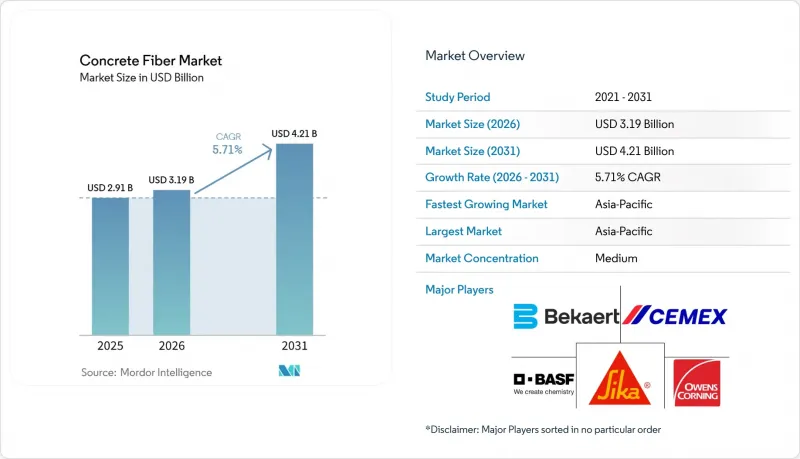
本報告按產品類型(鋼纖維、合成纖維、玻璃纖維等)、形態(單絲、多絲纖維等)、終端應用產業(交通基礎設施、住宅建築、商業建築等)和地區(亞太地區、北美地區、歐洲地區、南美地區、中東和非洲地區)進行細分。市場預測以美元計價。
全球混凝土纖維市場趨勢與洞察
擴大混凝土纖維的使用範圍,以抑制裂縫並提高耐久性。
基礎設施業主擴大將纖維增強作為設計要素之一,而非僅在出現裂縫後才將其作為補救措施。業主利用纖維增強來控制裂縫並提高在惡劣環境下運作的設施的耐久性。這推動了混凝土纖維市場的發展,因為業主不僅可以從初始材料成本的角度評估材料,還可以將其與維護成本進行比較。歐洲一些地方政府道路管理部門已開始強制要求使用纖維增強混凝土,以此作為承包商提供長期免維護保固的條件,這可能使纖維的使用成為長期採購要求的一部分。此外,隨著專案經驗的積累,諮詢工程師對規範風險的感知將會降低,使纖維增強更容易融入標準專案模板。由此產生的需求將比僅基於維修工作的需求更不易受原料價格短期波動的影響。
對高性能鋪路和工業地板材料解決方案的需求日益成長
在成熟的建築市場中,鋼纖維增強混凝土被用於建造高耐用性的工業地坪。在德國,根據德國混凝土協會的指南,每年約有1000萬平方公尺的工業地板採用鋼纖維增強或混合增強系統。資料中心也是需求來源,無縫混凝土板能夠滿足高密度伺服器機架的荷載要求。無縫地坪系統指南規定鋼纖維含量為40-45公斤/立方米,滿足了每平方公尺成品地坪的纖維需求。印度的「Ghati Shakti」國家總體規劃也支持道路和貨運走廊的建設,從而推動了對鋼纖維和聚丙烯纖維的需求。因此,混凝土纖維市場既服務於大規模鋪路項目,也服務於具有結構需求的高價值地板材料應用。這也促使製造商開發混合料,並為需要可靠鋪設、接縫控制和長使用壽命的專案提供技術支援。這些應用仍然十分重要,因為即使混合比例的微小變化也會影響大面積地板或鋪路所需的纖維量。
與傳統加固方法相比,初始材料成本較高
在同等結構應用中,摻入20-40 kg/m³的鋼纖維會導致材料成本比焊接金屬網格高出15-30%。在公共工程項目中,由於合約主要依據最低初始競標授予,因此這種成本差異仍然是一個重要的考慮因素。纖維增強工業板可以透過在20年內將接縫維修量減少30-40%來抵消初始成本差異,而這些減少量是鋼絲網增強板所無法比擬的。然而,許多新興市場的採購體系在競標評估中對全生命週期成本降低的重視程度有限。儘管世界銀行在基礎設施採購指南方面所做的努力旨在鼓勵更廣泛地考慮價值和全生命週期成本,但這些指南的實施情況因市場而異。在這些做法得到更廣泛的認可之前,較高的初始成本可能會限制對價格敏感的纖維增強混凝土市場的轉型,並阻礙整個市場的普及。
細分市場分析
2025年,鋼纖維佔總銷售額的44.51%。其在混凝土纖維市場的地位反映了其在工業地板材料、隧道襯砌和高耐久性路面等領域的悠久應用歷史。儘管嚴苛的項目規範通常會對拉伸強度和長寬比提出具體要求,但鋼纖維能夠以較為合理的成本滿足這些要求。合成纖維,包括聚丙烯、尼龍、聚酯和其他聚合物等級,構成了第二大產品類型。這些纖維用於那些對耐腐蝕性要求高於最大結構加固的應用場合。由於傳統鋼筋容易腐蝕,因此蓄水結構和海岸工程是其典型應用領域。玻璃纖維在預製構件和帷幕牆結構中佔據特殊地位。天然纖維的市場規模仍然較小,且具有地域性集中,當地的供應和成本敏感性會影響混凝土配合比的選擇。
預計到2031年,玄武岩纖維的年複合成長率將達到7.44%。玄武岩纖維源自火山岩,因其耐腐蝕性和在700 度C左右的溫度下具有良好的熱穩定性而被選用。 2026年Springer Nature的一項研究表明,透過最佳化表面處理,單向玄武岩纖維增強的聚合物材料可將性能欠佳的結構構件的抗彎強度提高5.5%至26.8%。 2026年多學科數位出版機構(MDPI)的一項研究發現,添加2.5%(體積比)的玄武岩纖維可使再生骨材複合複合材料在經歷30次海水乾濕循環後,衝擊韌性提高高達83.7%。這些結果表明,在嚴苛的化學環境和沿海環境中,混凝土纖維的需求量很大。中國和俄羅斯佔據了全球玄武岩纖維產能的大部分,這使得這兩個國家的供應商具有成本優勢。另一方面,這種集中可能會對歐洲和北美買家的供應鏈連續性構成風險,這可能會促使這些地區的生產投資增加。
區域分析
預計到2025年,亞太地區將佔總營收的43.57%,並在2031年之前以6.34%的複合年成長率成長。亞太地區在纖維增強混凝土市場佔據如此重要的地位,主要得益於東南亞的大規模建設需求以及東北亞對高性能規範的追求。中國的需求主要由高鐵、城市地鐵和水利工程項目驅動。印度是成長最快的各國市場,其成長動力來自「Ghati Shakti」計畫下的高速公路建設、一二線城市地鐵網路的擴建以及經濟適用住宅的建設。纖維增強混凝土板擴大應用於地面層和地下室。在日本和韓國,基礎設施更新而非大規模新建案是推動需求的主要因素。老化的橋面和隧道壁需要透過加鋪層和噴射混凝土進行修復。
北美和歐洲是成熟的需求中心,供應商之間的競爭側重於性能和永續性而非數量。北美的聯邦基礎設施支出支持高規格的路面和橋面項目。在歐洲,物流設施的建設持續推動無縫纖維增強地板材料的應用,這種地板已被證實能夠減少碳排放。 2024年,KrampeHarex公司根據BEG標準4的永續性要求,為德國博特羅普的Prologis物流園區供應了約5萬平方公尺的鋼纖維地板材料。法國、德國和英國是成熟的區域市場,擁有完善的鋼纖維增強工業地板材料標準和實施經驗。在義大利和俄羅斯,隨著隧道和預製構件建設的推進,需求也不斷成長。根據歐盟分類法和北美類似的框架,環境產品聲明(EPD)正逐漸成為高品質規範的必要條件。
南美洲和中東/非洲地區的需求模式截然不同。巴西和阿根廷是南美洲的主要需求中心。巴西的基礎設施特許經營經營和港口物流支撐著對中檔纖維的需求,而阿根廷的鋰礦開採計畫則需要在地下施工中使用噴射混凝土纖維。美國材料與試驗協會 (ASTM) 的合成纖維增強材料標準 C1116 正在影響中東和非洲的規範制定,國際開發商和工程承包商正在採用更正式的合規要求。沙烏地阿拉伯的大規模建設項目支持對道路基礎設施、公用設施隧道和城市發展的需求。在南非,鉑金礦和金礦對噴混凝土混凝土的需求提供了穩定的基礎。
其他好處:
- Excel格式的市場預測(ME)表
- 3個月的分析師支持
目錄
第1章:引言
- 研究假設和市場定義
- 調查範圍
第2章:調查方法
第3章執行摘要
第4章 市場狀況
- 市場概覽
- 市場促進因素
- 擴大混凝土纖維的使用範圍,以抑制裂縫並提高耐久性
- 對高性能鋪路和工業地板材料解決方案的需求日益成長
- 擴大纖維增強混凝土在隧道襯砌和噴射混凝土應用中的使用。
- 預製混凝土和模組化建築技術的應用日益廣泛
- 在惡劣環境下,對耐腐蝕合成纖維和非金屬纖維的需求日益成長。
- 市場限制因素
- 與傳統加固方法相比,初始材料成本較高。
- 施工過程中纖維分散性和混凝土可加工性面臨的挑戰。
- 天然纖維和玄武岩纖維增強材料的標準化和產業接受度有限。
- 價值鏈分析
- 波特五力分析
第5章 市場規模與成長預測
- 依產品類型
- 鋼纖維
- 合成纖維
- 聚丙烯(PP)
- 尼龍
- 聚酯纖維
- 其他
- 玻璃纖維
- 玄武岩纖維
- 天然纖維
- 按形式
- 單絲
- 多絲纖維
- 切碎的纖維
- 連續纖維
- 按最終用途行業分類
- 交通基礎設施
- 住宅
- 商業建築
- 工業建築
- 採礦和隧道建設
- 石油和天然氣
- 水利基礎設施
- 農業
- 其他
- 按地區
- 亞太地區
- 中國
- 印度
- 日本
- 韓國
- 其他亞太國家
- 北美洲
- 美國
- 加拿大
- 墨西哥
- 歐洲
- 德國
- 英國
- 法國
- 義大利
- 俄羅斯
- 其他歐洲國家
- 南美洲
- 巴西
- 阿根廷
- 其他南美國家
- 中東和非洲
- 沙烏地阿拉伯
- 南非
- 其他中東和非洲國家
- 亞太地區
第6章 競爭情勢
- 市場集中度
- 策略趨勢
- 市佔率和排名分析
- 公司簡介
- BASF
- ABC Polymer Industries LLC
- Bekaert
- Belgian Fibers
- CEMEX SAB de CV
- Fibercon International Inc.
- Forta Corporation
- Ganzhou Daye Metallic Fibres Co.,Ltd
- KrampeHarex GmbH & Co. KG
- Nycon Corporation
- Owens Corning
- Propex Global
- Sika AG
- The Euclid Chemical Company
第7章 市場機會與未來展望
According to Mordor Intelligence, the concrete fiber market was valued at USD 2.91 billion in 2025 and is estimated to grow from USD 3.19 billion in 2026 to reach USD 4.21 billion by 2031, at a CAGR of 5.71% during the forecast period (2026-2031).
This report is Segmented by Product Type (Steel Fibers, Synthetic Fibers, Glass Fibers, and More), Form (Monofilament, Multifilament, and More), End-Use Industry (Transportation Infrastructure, Residential Construction, Commercial Construction, and More), and Geography (Asia-Pacific, North America, Europe, South America, and Middle-East and Africa). The Market Forecasts are in Terms of Value (USD).
Global Concrete Fiber Market Trends and Insights
Increasing Adoption of Concrete Fibers for Crack Control and Enhanced Durability
Infrastructure owners are increasingly specifying fiber reinforcement during design instead of using it as a corrective measure after cracking occurs. Owners use fiber reinforcement to manage cracking and increase durability in demanding assets. This supports the concrete fiber market because owners can evaluate the material against maintenance costs rather than initial material cost alone. Some European municipal road authorities have started to require fiber-reinforced concrete for extended maintenance-free contractor guarantees, which can make fiber use part of long-term procurement requirements. A longer project record also lowers the perceived specification risk for consulting engineers and makes fiber reinforcement easier to include in standard project templates. The resulting demand is less tied to short-term raw material price movements than demand based only on remedial repair work.
Growing Demand for High-Performance Pavements and Industrial Flooring Solutions
Steel fiber-reinforced concrete is used for heavy-duty industrial floors in mature construction markets. Germany installs around 10 million square meters of industrial floors each year, using steel fiber-reinforced or hybrid reinforcement systems in accordance with the guidance of the German Concrete Association. Data centers represent another source of demand, as jointless slabs can meet the load requirements of high-density server racks. Guidance for jointless floor systems sets steel fiber dosage at 40-45 kg/m3, supporting fiber demand per square meter of completed floor. India's Gati Shakti National Master Plan also supports pavement and freight-corridor construction, driving demand for steel and polypropylene fibers. As a result, the concrete fiber market serves both large-scale pavement projects and higher-value flooring applications with structural requirements. It also encourages producers to develop mixes and technical support for projects that require reliable placement, joint control, and long service life. These applications remain relevant because even a minor change in dosage can affect the required fiber quantity across a large floor or pavement area.
Higher Initial Material Costs Compared to Conventional Reinforcement Methods
Steel fiber dosages of 20-40 kg/m3 can result in a 15-30% premium in material cost over welded-wire mesh in comparable structural applications. This premium remains a key consideration in public programs that award contracts primarily on the basis of the lowest initial bid. Fiber-reinforced industrial slabs may require 30-40% fewer joint repairs over 20 years than mesh-reinforced alternatives, potentially offsetting the initial cost difference. However, many emerging-market procurement systems assign limited weight to lifecycle savings when assessing tenders. The World Bank's work on infrastructure procurement guidelines supports broader consideration of value and lifecycle cost, but adoption varies across markets. Until these practices become more established, the upfront price premium will limit conversion in price-sensitive parts of the concrete fiber market and constrain broader market adoption.
Other drivers and restraints analyzed in the detailed report include:
- Expanding Use of Fiber-Reinforced Concrete in Tunnel Lining and Shotcrete Applications
- Rising Adoption of Precast Concrete and Modular Construction Techniques
- Challenges Related to Fiber Dispersion and Concrete Workability During Installation
For complete list of drivers and restraints, kindly check the Table Of Contents.
Segment Analysis
Steel fibers held 44.51% of total revenue in 2025. Their position in the concrete fiber market reflects long-established use in industrial flooring, tunnel linings, and heavy-duty pavements. Specifications for demanding projects often define tensile strength and aspect-ratio requirements that steel fibers can meet at familiar cost levels. Synthetic fibers, including polypropylene, nylon, polyester, and other polymer grades, form the second-largest product category. They are used where corrosion resistance is more important than maximum structural reinforcement. Water-retaining structures and coastal projects are prominent applications because conventional steel reinforcement can face corrosion risk. Glass fibers retain a specialized place in architectural precast and curtain wall work. Natural fibers remain small and regionally concentrated, where local supply and cost sensitivity affect concrete mix choices.
The basalt fibers are forecast to expand at a 7.44% CAGR through 2031. Basalt fibers are made from volcanic rock and are selected for corrosion resistance and thermal stability at temperatures near 700 °C. A 2026 Springer Nature study reported that unidirectional basalt textile-reinforced polymer systems raised flexural capacity by 5.5-26.8% for deficient structural members when surface preparation was optimized. A 2026 Multidisciplinary Digital Publishing Institute (MDPI) study found that 2.5% vol. basalt fibers increased impact toughness by up to 83.7% in recycled aggregate concrete composite assemblies after 30 saltwater dry-and-wet cycles. These results support the concrete fiber market in aggressive chemical and coastal environments. China and Russia hold most global basalt fiber production capacity, creating a cost advantage for suppliers in those countries. The same concentration creates continuity risk for Western buyers and may support investment in European and North American production.
Complete Report Scope:
- By Product Type
- Steel Fibers
- Synthetic Fibers
- Polypropylene (PP)
- Nylon
- Polyester
- Other Synthetic Fibers
- Glass Fibers
- Basalt Fibers
- Natural Fibers
- By Form
- Monofilament
- Multifilament
- Chopped Fiber
- Continuous Fiber
- By End-Use Industry
- Transportation Infrastructure
- Residential Construction
- Commercial Construction
- Industrial Construction
- Mining and Tunneling
- Oil and Gas
- Water Infrastructure
- Agriculture
- Other End-Use Industries
- By Geography
- Asia-Pacific
- China
- India
- Japan
- South Korea
- Rest of Asia-Pacific
- North America
- United States
- Canada
- Mexico
- Europe
- Germany
- United Kingdom
- France
- Italy
- Russia
- Rest of Europe
- South America
- Brazil
- Argentina
- Rest of South America
- Middle-East and Africa
- Saudi Arabia
- South Africa
- Rest of Middle-East and Africa
- Asia-Pacific
Geography Analysis
Asia-Pacific held 43.57% of the total revenue in 2025 and is forecast to grow at a 6.34% CAGR through 2031. This concrete fiber market position combines high-volume construction in Southeast Asia with more advanced performance specifications in Northeast Asia. China's demand is supported by high-speed rail, urban metro, and water conservancy projects. India is the fastest-growing national market, driven by expressway construction under Gati Shakti, metro expansion in Tier 1 and Tier 2 cities, and affordable housing construction. Fiber-reinforced slabs are increasingly specified for ground-floor and basement applications. Japan and South Korea generate demand from infrastructure renewal rather than large greenfield programs. Aging bridge decks and tunnel linings create demand for repair overlays and sprayed concrete rehabilitation.
North America and Europe are established demand centers where suppliers compete more on performance and sustainability than volume. Federal infrastructure spending in North America supports high-specification pavement and bridge deck projects. In Europe, logistics construction continues to support jointless fiber-reinforced floors with documented carbon credentials. KrampeHarex supplied steel fibers for around 50,000 m2 of flooring at Prologis Logistics Parc in Bottrop, Germany, under BEG Standard 4 sustainability requirements in 2024. France, Germany, and the United Kingdom are mature regional markets with standards and installed bases of steel fiber-reinforced industrial floors. Italy and Russia add demand through tunneling and precast activity. Environmental Product Declarations are becoming a practical requirement for premium specifications under the EU Taxonomy and similar North American frameworks.
South America and Middle-East and Africa are regions with different demand conditions. Brazil and Argentina are the main South American demand centers. Brazil's infrastructure concessions and port logistics support mid-grade fiber demand, while Argentina's lithium mining projects require shotcrete fibers for underground work. American Society for Testing and Materials (ASTM) C1116 for synthetic fiber reinforcement is influencing specifications in the Middle-East and Africa, where international developers and engineering contractors are adopting more formal compliance requirements. Saudi Arabia's large construction programs support demand for road infrastructure, utility tunnels, and urban developments. South Africa provides a steady base of shotcrete demand from platinum and gold mining.
- BASF
- ABC Polymer Industries LLC
- Bekaert
- Belgian Fibers
- CEMEX S.A.B. de C.V.
- Fibercon International Inc.
- Forta Corporation
- Ganzhou Daye Metallic Fibres Co.,Ltd
- KrampeHarex GmbH & Co. KG
- Nycon Corporation
- Owens Corning
- Propex Global
- Sika AG
- The Euclid Chemical Company
Additional Benefits:
- The market estimate (ME) sheet in Excel format
- 3 months of analyst support
TABLE OF CONTENTS
1 Introduction
- 1.1 Study Assumptions and Market Definition
- 1.2 Scope of the Study
2 Research Methodology
3 Executive Summary
4 Market Landscape
- 4.1 Market Overview
- 4.2 Market Drivers
- 4.2.1 Increasing Adoption of Concrete Fibers for Crack Control and Enhanced Durability
- 4.2.2 Growing Demand for High-Performance Pavements and Industrial Flooring Solutions
- 4.2.3 Expanding Use of Fiber-Reinforced Concrete in Tunnel Lining and Shotcrete Applications
- 4.2.4 Rising Adoption of Precast Concrete and Modular Construction Techniques
- 4.2.5 Growing Preference for Corrosion-Resistant Synthetic and Non-Metallic Fibers in Aggressive Environments
- 4.3 Market Restraints
- 4.3.1 Higher Initial Material Costs Compared to Conventional Reinforcement Methods
- 4.3.2 Challenges Related to Fiber Dispersion and Concrete Workability During Installation
- 4.3.3 Limited Standardization and Industry Acceptance of Natural and Basalt Fiber Reinforcement
- 4.4 Value Chain Analysis
- 4.5 Porter's Five Forces Analysis
- 4.5.1 Threat of New Entrants
- 4.5.2 Bargaining Power of Suppliers
- 4.5.3 Bargaining Power of Buyers
- 4.5.4 Threat of Substitutes
- 4.5.5 Competitive Rivalry
5 Market Size and Growth Forecasts (Value)
- 5.1 By Product Type
- 5.1.1 Steel Fibers
- 5.1.2 Synthetic Fibers
- 5.1.2.1 Polypropylene (PP)
- 5.1.2.2 Nylon
- 5.1.2.3 Polyester
- 5.1.2.4 Other Synthetic Fibers
- 5.1.3 Glass Fibers
- 5.1.4 Basalt Fibers
- 5.1.5 Natural Fibers
- 5.2 By Form
- 5.2.1 Monofilament
- 5.2.2 Multifilament
- 5.2.3 Chopped Fiber
- 5.2.4 Continuous Fiber
- 5.3 By End-Use Industry
- 5.3.1 Transportation Infrastructure
- 5.3.2 Residential Construction
- 5.3.3 Commercial Construction
- 5.3.4 Industrial Construction
- 5.3.5 Mining and Tunneling
- 5.3.6 Oil and Gas
- 5.3.7 Water Infrastructure
- 5.3.8 Agriculture
- 5.3.9 Other End-Use Industries
- 5.4 By Geography
- 5.4.1 Asia-Pacific
- 5.4.1.1 China
- 5.4.1.2 India
- 5.4.1.3 Japan
- 5.4.1.4 South Korea
- 5.4.1.5 Rest of Asia-Pacific
- 5.4.2 North America
- 5.4.2.1 United States
- 5.4.2.2 Canada
- 5.4.2.3 Mexico
- 5.4.3 Europe
- 5.4.3.1 Germany
- 5.4.3.2 United Kingdom
- 5.4.3.3 France
- 5.4.3.4 Italy
- 5.4.3.5 Russia
- 5.4.3.6 Rest of Europe
- 5.4.4 South America
- 5.4.4.1 Brazil
- 5.4.4.2 Argentina
- 5.4.4.3 Rest of South America
- 5.4.5 Middle-East and Africa
- 5.4.5.1 Saudi Arabia
- 5.4.5.2 South Africa
- 5.4.5.3 Rest of Middle-East and Africa
- 5.4.1 Asia-Pacific
6 Competitive Landscape
- 6.1 Market Concentration
- 6.2 Strategic Moves
- 6.3 Market Share (%)/Ranking Analysis
- 6.4 Company Profiles (includes Global Overview, Market Overview, Core Segments, Financials as available, Strategic Information, Products and Services, and Recent Developments)
- 6.4.1 BASF
- 6.4.2 ABC Polymer Industries LLC
- 6.4.3 Bekaert
- 6.4.4 Belgian Fibers
- 6.4.5 CEMEX S.A.B. de C.V.
- 6.4.6 Fibercon International Inc.
- 6.4.7 Forta Corporation
- 6.4.8 Ganzhou Daye Metallic Fibres Co.,Ltd
- 6.4.9 KrampeHarex GmbH & Co. KG
- 6.4.10 Nycon Corporation
- 6.4.11 Owens Corning
- 6.4.12 Propex Global
- 6.4.13 Sika AG
- 6.4.14 The Euclid Chemical Company
7 Market Opportunities and Future Outlook
- 7.1 White-Space and Unmet-Need Assessment

 2026年全球環氧塗層銷釘市場報告2026年全球基礎設施混凝土纖維市場報告2026年全球混凝土纖維市場報告
 混凝土增強纖維市場規模、佔有率、成長及全球產業分析:按類型、應用和地區分類的洞察,2026-2034 年預測
 纖維增強混凝土市場:纖維類型、複合材料、增強形式、應用和最終用途—2026-2032年全球市場預測
 纖維增強混凝土市場:按類型、應用和地區分類混凝土纖維市場:依纖維類型、纖維長度、應用、最終用途及通路分類-2026-2032年全球市場預測
 全球混凝土增強纖維市場:市場規模、佔有率和趨勢分析(按產品、應用和地區分類),細分市場預測(2026-2033 年)全球混凝土增強纖維市場規模、佔有率、趨勢和成長分析報告(2026-2034)全球混凝土纖維市場規模、佔有率、趨勢和成長分析報告(2026-2034年)