


 |
市場調查報告書
商品編碼
2118249
蛋白質試劑:市場佔有率分析、產業趨勢與統計、成長預測(2026-2031)Protein Reagents - Market Share Analysis, Industry Trends & Statistics, Growth Forecasts (2026 - 2031) |
||||||

※ 本網頁內容可能與最新版本有所差異。詳細情況請與我們聯繫。
據 Mordor Intelligence 稱,2025 年蛋白質試劑市值為 104.2 億美元,預計到 2031 年將達到 142.8 億美元,而 2026 年為 110.2 億美元,預測期(2026-2031 年)的複合年成長率為 5.32%。
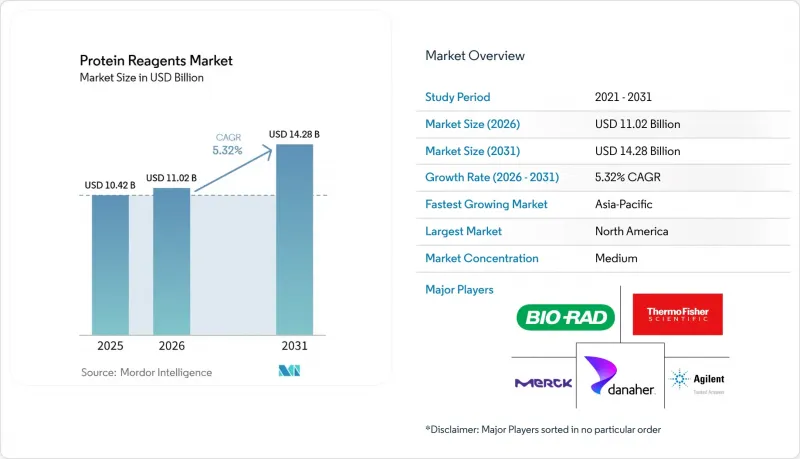
本報告按產品類型(蛋白質標記試劑、蛋白質純化試劑等)、技術(層析法試劑、電泳試劑等)、應用(蛋白質體學研究、藥物發現與開發等)以及地區(亞太地區、北美地區、歐洲地區及世界其他地區)進行細分。市場預測以美元計價。
全球蛋白質試劑市場趨勢及洞察
增加對生物製藥研發的投資
大型製藥和生技公司持續穩定的研發投入,為藥物發現、表徵和製程開發等各環節的蛋白質試劑市場提供了穩定的需求基礎。試劑消耗不僅限於初步篩檢,還會隨著專案推進,貫穿蛋白質表現、檢測方法開發、對照測試和分析驗證等各個階段。生物製藥研發管線的日益複雜也推動了蛋白質試劑市場的發展,因為這些項目需要在更長的研發週期內進行重複的蛋白質處理、更詳細的表徵和更嚴格的文件記錄。這一趨勢增加了每個在研項目的試劑用量,有助於緩解短期資金籌措波動對整體需求的影響。此外,隨著工作流程的建立,研究團隊更傾向於保持一致的檢測條件,這對擁有檢驗產品目錄的供應商來說也是一大利好。蛋白質試劑市場的繁榮不僅得益於在研項目的數量,也得益於每個項目技術複雜性的不斷提升。
擴大生物製藥產品線和生產能力
隨著生物製藥生產從臨床研究向商業化規模生產的過渡不斷推進,蛋白質樣品市場在純化、穩定化、製劑配製和運輸支援等工作流程中的應用也日益廣泛。 2024年5月,富士軟片和光純藥株式會社(FUJIFILM Wako Pure Chemical)將其大阪工廠符合良好生產規範(GMP)的原料產能提高了兩倍,直接滿足了抗體和基因療法日益成長的生產需求。蛋白質試劑市場也受益於此產能擴張,因為商業化生產對批次供應的穩定性、檢驗和製程重現性的要求遠高於早期研究階段。隨著生物製藥廠從試驗批次生產轉向持續生產,目錄級和生產級試劑的價值日益凸顯,而小規模客製化生產和交貨週期長則顯得尤為重要。這有利於那些能夠提供完善的文件、可靠的批次歷史記錄以及覆蓋多個生產基地的可靠分銷網路的供應商。隨著時間的推移,這種情況將導致蛋白質試劑市場不僅與上游研究預算聯繫更加緊密,而且與工業生物製藥生產活動聯繫更加緊密。
特殊蛋白質試劑高成本
蛋白質試劑市場受制於特種試劑和生產級材料的高成本,限制了小規模實驗室和價格敏感地區的採用。在2025年舉行的國際生物檢測試劑研討會上,高成本、進口流程複雜以及合格供應商數量有限被認為是主要障礙,尤其是在面臨物流壓力和資金限制的低收入國家。當實驗室在固定的津貼預算或創業投資計畫下運作時,飆升的試劑價格迫使它們在試劑品質、檢測範圍或實驗總量之間做出妥協。這雖然不會消除蛋白質試劑市場的需求,但會減緩基礎設施仍在發展中的地區對高品質產品的採用。當買家依賴進口產品且在溫度敏感材料的庫存管理方面缺乏柔軟性時,這種影響最為顯著。成本壓力將進一步擴大有能力標準化使用高規格產品的機構與被迫謹慎選擇的小規模買家之間的差距。
細分市場分析
截至2025年,蛋白質純化試劑將佔據最大的市場佔有率,達到27.44%,這反映了它們在生物製藥生產和蛋白質分離流程中的核心地位。它們的大規模應用體現了從早期收穫到層析法和最終製備的常規使用,因此短期內很難找到替代品。純化產品仍然是市場上的首選,因為許多實驗室和生產團隊都採用成熟的流程,這些流程依賴穩定的樹脂性能、緩衝系統和檢驗的製程化學。這構成了轉換的障礙,因為即使是微小的製程變更也可能需要在多個下游階段進行迭代最佳化。雖然萃取、定量和修飾產品仍然是重要的輔助產品,但它們通常是現有流程的補充,而不是流程的製定者。因此,純化試劑的地位與其在流程中的核心地位、重複使用以及流程變更相關的成本密切相關。
預計到2031年,蛋白質標記試劑的複合年成長率將達到6.44%,隨著蛋白質交互作用研究、應用流程和多重檢驗工具的日益普及,蛋白質標記試劑有望成為市場上成長最快的產品類別。在進階檢測中,由於買家對訊號品質和背景變異性的要求更高,市場需求正轉向位點特異性和應用驗證的標記形式。這在抗體藥物複合體(ADC)研究、基於鄰近性的檢測和活細胞研究中具有重要的實際意義,因為通用染料結合方法通常無法提供足夠的控制。蛋白質交聯試劑在結構蛋白質體學和相互作用組圖譜繪製中也日益重要,這些領域的研究人員需要在質譜分析之前使用穩定的方法來捕獲蛋白質之間的關係。蛋白質定量試劑在自動化篩檢環境中仍然被廣泛使用,因此與盤式分析儀工作流程的兼容性和抗干擾性仍然至關重要。蛋白質穩定劑代表治療製劑和冷鏈管理領域一個快速成長的細分市場,這顯示對高價值、特定應用產品的需求開闢了新的途徑。
區域分析
到2025年,北美將佔據蛋白質試劑市場44.73%的佔有率,成為全球最大的市場區域。該地區擁有強大的藥物研發能力,學術機構和醫院也具備完善的蛋白質體學基礎設施。美國是主要的需求中心,這得益於聯邦政府多年津貼的支持,這些撥款用於轉化醫學、腫瘤學、老化和運動相關蛋白質組學計畫的試劑採購。此外,該地區還受益於廣泛的商業生物製藥和先進治療活動,從而持續推動對符合良好生產規範(GMP)的蛋白質和分析蛋白質產品的需求。加拿大透過生物技術叢集,利用全球基因組學和治療研究目錄,進一步深化了該地區的市場基礎。北美是蛋白質試劑市場中最成熟的地區,其優勢源自於藥物研發活動和產業能力。
亞太地區是蛋白質試劑市場成長最快的地區,預計到2031年將以6.35%的複合年成長率成長。這一成長主要得益於各國國家科研體系的製度化、合約開發能力的提升以及治療藥物生產項目的推進。細胞和基因治療(CGT)計畫的擴展進一步推動了市場發展,隨著臨床和生產規模的擴大,對培養補充劑、細胞激素、純化試劑和蛋白質分析試劑的需求不斷成長。在韓國,由於生物相似藥和抗體藥物複合體(ADC)生產基地的擴張,對高純度試劑的需求也不斷增加。中國和印度憑藉其對生物技術政策的大力支持和強大的科學研究基礎,為市場做出了貢獻,而且與幾年前相比,終端用戶群更加多元化。各國檢驗的供應鏈和區域服務網路水準仍存在差異,這為本地供應鏈的進一步發展留下了空間。
歐洲是蛋白質試劑市場第三大區域市場,其中德國、英國和法國是主要需求中心。該地區受益於多體學和蛋白質組學研究項目,完善的臨床和生產環境也支持使用經過驗證和批次控制的產品。診斷和生技藥品領域更為嚴格的合規要求,使得擁有大規模品質文件的供應商能夠佔據高階市場地位。由於進口成本、冷鏈要求以及本地供應商數量有限(尤其是對溫度敏感和受監管的材料),全球其他區域市場的規模仍然較小。國際研討會的結果強調了在資源有限的環境中,區域分銷和供應協調對於生物檢測試劑的重要性。預計主要區域以外的市場將持續成長,但其基數仍將低於北美、亞太或歐洲。
其他好處:
- Excel格式的市場預測(ME)表
- 3個月的分析師支持
目錄
第1章:引言
- 研究假設和市場定義
- 調查範圍
第2章:調查方法
第3章執行摘要
第4章 市場狀況
- 市場概覽
- 市場促進因素
- 加大對蛋白質體學和蛋白質研究的投資
- 生物製藥和生物相似藥研發的擴展
- 對蛋白質表徵和分析的需求日益成長。
- 細胞和基因治療研究的擴展
- 蛋白質診斷技術的廣泛應用和生物標記的發現
- 市場限制因素
- 特殊蛋白質試劑高成本
- 嚴格的品質和監管要求
- 特定蛋白質試劑的穩定性和儲存限制
- 價值鏈分析
- 波特五力分析
第5章 市場規模與成長預測
- 依產品類型
- 蛋白質標記試劑
- 蛋白質純化試劑
- 蛋白質交聯劑
- 蛋白質穩定劑
- 蛋白質萃取和裂解試劑
- 蛋白質定量試劑
- 蛋白質修飾試劑
- 其他
- 透過技術
- 層析法試劑
- 電泳試劑
- 免疫檢測試劑
- 質譜分析試劑
- 螢光測量試劑
- 其他
- 透過使用
- 蛋白質體學研究
- 藥物發現和藥物開發
- 生物製藥生產
- 臨床診斷
- 學術和研究
- 細胞與基因治療研究
- 其他
- 按地區
- 亞太地區
- 中國
- 印度
- 日本
- 韓國
- 其他亞太國家
- 北美洲
- 美國
- 加拿大
- 歐洲
- 德國
- 英國
- 法國
- 義大利
- 俄羅斯
- 其他歐洲國家
- 世界其他地區
- 南美洲
- 中東和非洲
- 亞太地區
第6章 競爭情勢
- 市場集中度
- 策略趨勢
- 市佔率和排名分析
- 公司簡介
- Abcam Limited
- Agilent Technologies, Inc.
- Bio-Rad Laboratories, Inc.
- Bio-Techne Corporation
- Danaher Corporation
- FUJIFILM Wako Pure Chemical Corporation
- LGC Biosearch Technologies
- Merck KGaA
- PerkinElmer
- Promega Corporation
- Proteintech Group
- Rockland Immunochemicals
- Takara Bio Inc.
- Thermo Fisher Scientific Inc.
- Vector Laboratories
第7章 市場機會與未來展望
According to Mordor Intelligence, the protein reagents market size was valued at USD 10.42 billion in 2025 and is estimated to grow from USD 11.02 billion in 2026 to reach USD 14.28 billion by 2031, at a CAGR of 5.32% during the forecast period (2026-2031).
This report is Segmented by Product Type (Protein Labeling Reagents, Protein Purification Reagents, and More), Technology (Chromatography-Based Reagents, Electrophoresis Reagents, and More), Application (Proteomics Research, Drug Discovery and Development, and More), and Geography (Asia-Pacific, North America, Europe, and Rest of the World). The Market Forecasts are Provided in Terms of Value (USD).
Global Protein Reagents Market Trends and Insights
Rising Investments in Biopharmaceutical R&D
Steady research spending by large pharmaceutical and biotechnology companies continues to provide the protein reagents market with a dependable demand base across discovery, characterization, and process development activities. Reagent consumption does not stop at early screening; it continues through protein expression work, assay development, comparability studies, and analytical confirmation as programs advance. The protein reagents market also benefits when biologics pipelines become more complex, as those programs require repeated protein handling, deeper characterization, and stricter documentation across longer development cycles. This pattern extends reagent use per active program and helps reduce the effect of short-term funding changes on total demand. It also supports suppliers with validated catalogs, as research teams prefer continuity in assay conditions once a workflow is established. The protein reagents market draws strength not only from the number of programs in development but also from the rising technical intensity of each program.
Growing Biopharmaceutical Pipeline and Manufacturing Capacity
The shift from clinical research to commercial-scale biologics production continues to expand the operational role of the protein reagents market across purification, stabilization, formulation, and release-support workflows. FUJIFILM Wako Pure Chemical tripled Good Manufacturing Practice (GMP)-compliant raw material production capacity at its Osaka facility in May 2024, directly linking added capacity to growth in antibody and gene therapeutic production needs. The protein reagents market benefits from this kind of capacity expansion because commercial manufacturing requires recurring lots, validated performance, and stronger process reproducibility than early research settings typically demand. As more biologics plants move from pilot batches to sustained output, catalog-grade and manufacturing-grade reagents gain greater value over small custom runs with longer delivery schedules. This favors suppliers that can provide ready documentation, established lot history, and dependable distribution across multiple production sites. Over time, this makes the protein reagents market more closely tied to industrial biologics execution, rather than only to upstream research budgets.
High Cost of Specialty Protein Reagents
The protein reagents market is constrained by the high cost of specialty and manufacturing-grade materials, limiting adoption in smaller laboratories and price-sensitive geographies. A 2025 international workshop on biological testing reagents identified high costs, import complexity, and a limited pool of qualified suppliers as core barriers, particularly for lower-income settings that face logistical pressures and funding constraints. When laboratories operate within fixed grant budgets or venture-backed spending plans, higher reagent prices force tradeoffs between reagent quality, assay breadth, and total experiment volume. This does not remove demand from the protein reagents market, but it slows the adoption of premium formats in regions where infrastructure is still developing. The effect is most pronounced where buyers depend on imported products and have limited flexibility in stocking temperature-sensitive materials. Cost pressure may widen the gap between well-funded institutions that can standardize high-specification products and smaller buyers that remain selective in their usage.
Other drivers and restraints analyzed in the detailed report include:
- Increasing Demand for Proteomics-Driven Research Tools
- Expansion of Cell and Gene Therapy Clinical Programs
- Stringent Quality and Regulatory Compliance Requirements
For complete list of drivers and restraints, kindly check the Table Of Contents.
Segment Analysis
Protein Purification Reagents held the largest share at 27.44% in 2025, reflecting their central role in biologics production and protein isolation workflows. Their large installed base reflects routine use from early harvest steps through chromatographic processing and final preparation, making the category difficult to displace quickly. The market continues to favor purification products because many laboratories and manufacturing teams operate with established protocols that depend on consistent resin performance, buffer systems, and validated process chemistry. This creates switching friction, since even a modest process change can require repeat optimization across several downstream steps. Extraction, quantification, and modification products remain important supporting categories, yet they typically follow the broader installed workflow rather than defining it. As a result, the position of purification reagents remains linked to workflow centrality, repeat use, and the cost of protocol disruption.
Protein Labeling Reagents are forecast to grow at a 6.44% CAGR through 2031, making them the fastest-growing product group in the market as protein interaction studies, conjugation workflows, and multiplex discovery tools become more common. Demand is shifting toward site-specific and application-validated labeling formats, as buyers increasingly require tighter signal quality and lower background variation in advanced assays. This has practical importance for antibody-drug conjugate work, proximity-based assays, and live-cell studies where generic dye attachment methods often do not provide sufficient control. Protein Crosslinking Reagents are also gaining relevance in structural proteomics and interactome mapping, where researchers need stable methods to capture protein relationships before mass spectrometric analysis. Protein Quantification Reagents continue to see recurring use in automated screening environments, where consistent compatibility with plate-reader workflows and interference tolerance remain important. Protein Stabilization Reagents serve a growing niche in therapy formulation and cold-chain handling, representing another path toward higher-value, application-specific product demand.
Complete Report Scope:
- By Product Type
- Protein Labeling Reagents
- Protein Purification Reagents
- Protein Crosslinking Reagents
- Protein Stabilization Reagents
- Protein Extraction and Lysis Reagents
- Protein Quantification Reagents
- Protein Modification Reagents
- Other Protein Reagents
- By Technology
- Chromatography-Based Reagents
- Electrophoresis Reagents
- Immunoassay Reagents
- Mass Spectrometry Reagents
- Fluorescence-Based Reagents
- Other Technologies
- By Application
- Proteomics Research
- Drug Discovery and Development
- Biopharmaceutical Manufacturing
- Clinical Diagnostics
- Academic and Research
- Cell and Gene Therapy Research
- Other Applications
- By Geography
- Asia-Pacific
- China
- India
- Japan
- South Korea
- Rest of Asia-Pacific
- North America
- United States
- Canada
- Europe
- Germany
- United Kingdom
- France
- Italy
- Russia
- Rest of Europe
- Rest of the World
- South America
- Middle-East and Africa
- Asia-Pacific
Geography Analysis
North America held 44.73% of the protein reagents market in 2025, making it the largest region. The region has dense pharmaceutical research capacity and extensive academic and hospital proteomics infrastructure. The United States is the primary demand center, supported by multi-year federal awards that sustain reagent procurement across translational, cancer, aging, and exercise proteomics programs. The region also benefits from a broad base of commercial biologics and advanced therapy activity, which drives regular demand for Good Manufacturing Practice (GMP)-oriented and analytical protein products. Canada contributes to regional depth through biotechnology clusters that use distributed global catalogs for genomics and therapy-related work. North America is the most established geography in the protein reagents market, with strength derived from both discovery activity and industrial execution.
Asia-Pacific is the fastest-growing region in the protein reagents market and is projected to expand at a CAGR of 6.35% through 2031. Growth is driven by the institutionalization of domestic research systems, the development of contract development capacity, and therapy manufacturing programs across several countries. The Cell and Gene Therapy (CGT) program expansion further supports the market, as a larger clinical and manufacturing footprint increases demand for culture supplements, cytokines, purification inputs, and protein analytics. South Korea contributes to high-purity reagent demand, driven by its expanding biosimilar and antibody-drug conjugate manufacturing base. China and India contribute through broader biotechnology policy support and a larger installed research base, creating a more diversified set of end users compared to several years earlier. Validated availability and regional service depth remain uneven across countries, leaving room for further local supply development.
Europe is the third-largest regional segment in the protein reagents market, with Germany, the United Kingdom, and France as the primary demand centers. The region benefits from multi-omics and proteomics research programs, while regulated clinical and manufacturing environments support the use of validated and lot-controlled products. Stricter compliance requirements in diagnostics and biologics support premium positioning for suppliers that maintain quality documentation at scale. Rest of the World markets remain smaller due to import costs, cold-chain requirements, and a limited local supplier base, which restricts broader adoption, particularly for temperature-sensitive or regulated materials. International workshop findings have highlighted the importance of regional distribution and supply coordination for biological testing reagents in lower-access settings. Growth outside the major regions is expected to continue, but from a lower base than in North America, Asia-Pacific, or Europe.
- Abcam Limited
- Agilent Technologies, Inc.
- Bio-Rad Laboratories, Inc.
- Bio-Techne Corporation
- Danaher Corporation
- FUJIFILM Wako Pure Chemical Corporation
- LGC Biosearch Technologies
- Merck KGaA
- PerkinElmer
- Promega Corporation
- Proteintech Group
- Rockland Immunochemicals
- Takara Bio Inc.
- Thermo Fisher Scientific Inc.
- Vector Laboratories
Additional Benefits:
- The market estimate (ME) sheet in Excel format
- 3 months of analyst support
TABLE OF CONTENTS
1 Introduction
- 1.1 Study Assumptions and Market Definition
- 1.2 Scope of the Study
2 Research Methodology
3 Executive Summary
4 Market Landscape
- 4.1 Market Overview
- 4.2 Market Drivers
- 4.2.1 Rising Investments in Proteomics and Protein Research
- 4.2.2 Growing Biopharmaceutical and Biosimilar Development
- 4.2.3 Increasing Demand for Protein Characterization and Analysis
- 4.2.4 Expansion of Cell and Gene Therapy Research
- 4.2.5 Growing Use of Protein-Based Diagnostics and Biomarker Discovery
- 4.3 Market Restraints
- 4.3.1 High Cost of Specialty Protein Reagents
- 4.3.2 Stringent Quality and Regulatory Requirements
- 4.3.3 Limited Stability and Shelf Life of Certain Protein Reagents
- 4.4 Value Chain Analysis
- 4.5 Porter's Five Forces Analysis
- 4.5.1 Bargaining Power of Suppliers
- 4.5.2 Bargaining Power of Buyers
- 4.5.3 Threat of New Entrants
- 4.5.4 Threat of Substitutes
- 4.5.5 Competitive Rivalry
5 Market Size and Growth Forecasts (Value)
- 5.1 By Product Type
- 5.1.1 Protein Labeling Reagents
- 5.1.2 Protein Purification Reagents
- 5.1.3 Protein Crosslinking Reagents
- 5.1.4 Protein Stabilization Reagents
- 5.1.5 Protein Extraction and Lysis Reagents
- 5.1.6 Protein Quantification Reagents
- 5.1.7 Protein Modification Reagents
- 5.1.8 Other Protein Reagents
- 5.2 By Technology
- 5.2.1 Chromatography-Based Reagents
- 5.2.2 Electrophoresis Reagents
- 5.2.3 Immunoassay Reagents
- 5.2.4 Mass Spectrometry Reagents
- 5.2.5 Fluorescence-Based Reagents
- 5.2.6 Other Technologies
- 5.3 By Application
- 5.3.1 Proteomics Research
- 5.3.2 Drug Discovery and Development
- 5.3.3 Biopharmaceutical Manufacturing
- 5.3.4 Clinical Diagnostics
- 5.3.5 Academic and Research
- 5.3.6 Cell and Gene Therapy Research
- 5.3.7 Other Applications
- 5.4 By Geography
- 5.4.1 Asia-Pacific
- 5.4.1.1 China
- 5.4.1.2 India
- 5.4.1.3 Japan
- 5.4.1.4 South Korea
- 5.4.1.5 Rest of Asia-Pacific
- 5.4.2 North America
- 5.4.2.1 United States
- 5.4.2.2 Canada
- 5.4.3 Europe
- 5.4.3.1 Germany
- 5.4.3.2 United Kingdom
- 5.4.3.3 France
- 5.4.3.4 Italy
- 5.4.3.5 Russia
- 5.4.3.6 Rest of Europe
- 5.4.4 Rest of the World
- 5.4.4.1 South America
- 5.4.4.2 Middle-East and Africa
- 5.4.1 Asia-Pacific
6 Competitive Landscape
- 6.1 Market Concentration
- 6.2 Strategic Moves
- 6.3 Market Share (%)/Ranking Analysis
- 6.4 Company Profiles (includes Global Overview, Market Overview, Core Segments, Financials as available, Strategic Information, Products and Services, and Recent Developments)
- 6.4.1 Abcam Limited
- 6.4.2 Agilent Technologies, Inc.
- 6.4.3 Bio-Rad Laboratories, Inc.
- 6.4.4 Bio-Techne Corporation
- 6.4.5 Danaher Corporation
- 6.4.6 FUJIFILM Wako Pure Chemical Corporation
- 6.4.7 LGC Biosearch Technologies
- 6.4.8 Merck KGaA
- 6.4.9 PerkinElmer
- 6.4.10 Promega Corporation
- 6.4.11 Proteintech Group
- 6.4.12 Rockland Immunochemicals
- 6.4.13 Takara Bio Inc.
- 6.4.14 Thermo Fisher Scientific Inc.
- 6.4.15 Vector Laboratories
7 Market Opportunities and Future Outlook
- 7.1 White-Space and Unmet-Need Assessment

 全球穩定尿素市場規模、佔有率、趨勢和成長分析報告(2026-2034年)
 銣鹽:全球市場展望、詳細分析及至2032年預測
 三苯基膦(TPP)全球市場研究報告,2026年
 2,6-二叔丁基苯酚 (2,6-DTBP):2026年至2032年全球市場佔有率和排名、總銷售額和需求預測印度中間體化學品產業的成長機會,2025-2030年中東和北非地區氯衍生物的成長機會:2025-2030年
 PFAS吸附劑再生化學品:市場佔有率分析、產業趨勢與統計、成長預測(2026-2031年)
 五氟化磷:全球市佔率及排名、總收入及需求預測(2026-2032年)2026-2034年全球磷酸鉀市場規模、佔有率、趨勢和成長分析報告全球鹵化物燈市場規模、佔有率、趨勢和成長分析報告(2026-2034年)