


 |
市場調查報告書
商品編碼
2119318
PFAS吸附劑再生化學品:市場佔有率分析、產業趨勢與統計、成長預測(2026-2031年)PFAS Adsorbent Regeneration Chemicals - Market Share Analysis, Industry Trends & Statistics, Growth Forecasts (2026 - 2031) |
||||||

※ 本網頁內容可能與最新版本有所差異。詳細情況請與我們聯繫。
根據 Mordor Intelligence 預測,PFAS 吸附劑再生化學品市場規模預計將在 2025 年達到 1.7645 億美元,並從 2026 年的 1.8871 億美元成長到 2031 年的 2.6629 億美元。
預測期(2026-2031 年)的複合年成長率預計為 7.13%。
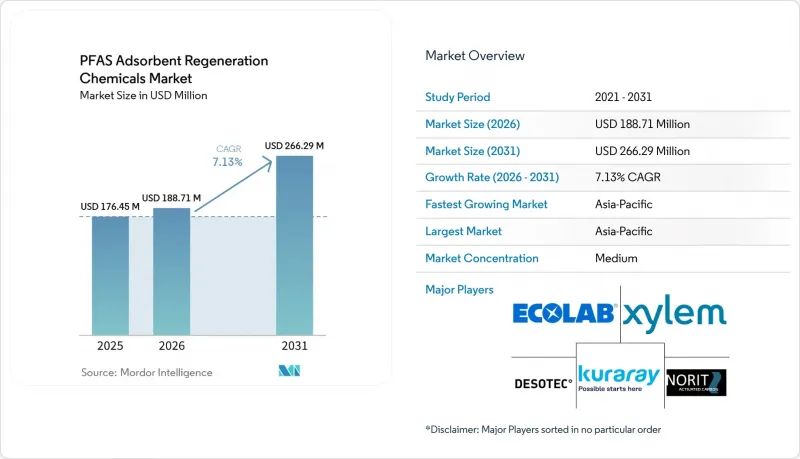
本報告按化學品類型(例如氫氧化鈉、醇類化學品)、吸附劑類型(例如顆粒活性碳)、終端應用產業(例如市政水處理、工業水處理)和地區(亞太地區、北美地區、歐洲地區、南美地區、中東和非洲地區)進行細分。市場預測以美元計價。
全球 PFAS 吸附劑再生化學品市場趨勢及洞察
由於法規要求,引入了“捕獲並銷毀”程序。
2024年4月,美國環保署(EPA)最終確定了《國家飲用水主要法規》(NPDR),規定全氟辛酸和磺酸鹽磺酸的最高濃度限值為4兆分之一。該法規也規定全氟己烷磺酸、全氟壬酸和六氟丙烯磺酸鹽二聚酸(通常稱為GenX化學物質)的濃度限值為1兆分之一。這些法規鼓勵供水事業考慮對廢棄顆粒活性碳進行回收和銷毀處理,而不是簡單地將其作為廢棄物處理。這透過將化學品的使用與已記錄的處理和廢棄物管理要求聯繫起來,從而支持了PFAS吸附劑回收化學品的市場。日本強制標準規定PFOS和PFOA的濃度不得超過50奈克/公升,該標準將於2026年4月生效,屆時將要求供水事業進行檢查、調查並公佈結果。歐洲計劃也受到化學品註冊、評估、授權和限制 (REACH) 框架下的一項綜合監管提案的影響,其科學評估預計將於 2026 年底完成。
對短鏈 PFAS 加工的需求日益成長
標準的顆粒活性碳過濾主要依賴疏水交互作用,但這種方法對於碳原子數少於六個的全氟烷基酸(PFAS)效果較差。離子交換樹脂在疏水鍵的基礎上增加了靜電相互作用,從而提高了長鏈和短鏈化合物的去除效率。由此產生的再生過程通常使用甲醇-鹽水或乙醇-鹽水混合物,這需要針對特定應用的化學試劑和濃縮液的處理方法。 2025年發表的一項研究表明,使用旋轉蒸發儀在50 度C下4小時內可以回收再生溶液中90%以上的甲醇,並且未觀察到PFAS殘留到回收的溶劑中。這種轉變有利於PFAS吸附劑再生化學品市場的發展,因為樹脂應用需要針對特定材料的再生方案,而不是標準的鹼洗循環。
含 PFAS 的再生溶液的危險物質處理要求
廢棄再生液是一種含有 PFAS 的濃縮液體,它是在使用鹼性顆粒活性碳進行溶劑型離子交換再生或解吸過程中產生的。其管理需要可追溯的處理和運輸,並送到獲得許可的廢棄物處理設施,這增加了處理業者的營運負擔。溶劑型廢物流也需要適當的儲存和安全措施,從而提高了現場再生系統的資本投資需求。中小型公共產業可能缺乏危險廢棄物處理方面的專業人員,或者可能沒有足夠的處理量來維護專用處理設施。這些限制迫使分散的場所依賴一次性介質,即使再生的生命週期成本很低。因此,PFAS 吸附劑再生化學品市場仍主要由能夠利用集中式基礎設施和完善的廢棄物物流的大型業者所佔據。
細分市場分析
2025年,氫氧化鈉佔市場佔有率的41.86%。它用於高pH值顆粒活性碳重新運作製程和離子交換樹脂的清洗循環中。鹼性條件會削弱PFAS與帶電吸附劑表面的結合,從而促進其解吸。醇類化學品,主要是甲醇和乙醇,用於離子交換樹脂的溶劑再生處理。它們的使用與樹脂的安裝容量以及處理後溶劑的回收和處理需求有關。
預計到2031年,專有化學配方市場將以8.57%的複合年成長率成長。這些應用主要得益於新型PFAS選擇性材料的出現,包括環糊精聚合物、氟聚合物吸附劑和分子印跡材料。這些材料需要根據其特定的吸附性能設計再生方案。 2024年發表在《自然通訊》上的一項研究表明,透過適當的解吸化學反應,氟聚合物吸附劑即使經過五個再生循環,仍能維持90%以上的PFAS吸附效率。隨著這些材料從先導計畫走向大規模應用,預計PFAS吸附劑再生化學品市場中,客製化混合物的使用將會增加。
區域分析
預計到2025年,亞太地區將佔全球市場收入的39.91%,並將在2031年之前以8.53%的複合年成長率持續成長。在日本,PFOS和PFOA的強制性標準(50納克/公升)將於2026年4月生效,屆時將對供水事業施加檢查、監測和資訊揭露要求。這將促進對顆粒活性碳重新運作和離子交換樹脂再生計畫的投資。韓國計劃在2025年中期前擴大對PFOS、PFOA和磺酸鹽磺酸的監管範圍。同時,台灣正面臨半導體製造相關的PFAS污水問題,而包括新加坡和泰國在內的東南亞國協正處於監管的早期階段,這使得它們成為PFAS吸附劑再生化學品市場未來潛在的需求來源。
北美地區的成長動力主要來自美國對2024年飲用水法規的合規要求以及對處理基礎設施的投資。 2026年2月,KURARAY CO. LTD.的子公司卡爾岡碳素公司宣布投資約1億美元擴建位於俄亥俄州哥倫布市的工廠,新增2,700萬英鎊的年重新運作能力。該廠計劃於2028年第一季投產。此次擴建旨在確保在2031年合規期限前達到國內產能要求。同時,亞利桑那州、紐約州和俄亥俄州半導體製造業的擴張也為PFAS吸附劑再生化學品市場創造了對短鏈PFAS再生化學品的特定需求。
在歐洲,歐盟法規正在影響市政和工業設施的處理方案。歐盟關於含全氟烷基和多氟烷基物質(PFAS)消防泡沫的法規將於2025年10月發布,而全氟己酸相關物質的法規將於2026年10月生效。 DESOTEC於2023年收購了Evoqua的活性碳回收業務,並於2025年與Sentinel Water Solutions建立了合作關係,從而擴大了其在美國的業務。儘管南美洲、中東和非洲仍處於發展初期,但採礦業的污染控制以及市政投資正在為PFAS吸附劑回收化學品市場創造一些特定的商機。
其他好處:
- Excel格式的市場預測(ME)表
- 3個月的分析師支持
目錄
第1章:引言
- 研究假設和市場定義
- 調查範圍
第2章:調查方法
第3章執行摘要
第4章 市場狀況
- 市場概覽
- 市場促進因素
- 由於法規要求,引入了“回收和破碎”工藝。
- 擴展集中式再生服務
- 對短鏈 PFAS 加工的需求日益成長
- 廢棄吸附劑處置成本增加
- 溶劑回收和閉合迴路回收
- 用於分散式處理設施的模組化回收系統
- 市場限制因素
- 處理含 PFAS 的再生劑的危險物質處理要求
- 專業運作能力的供應有限。
- PFAS分解產物的不確定性
- 高化學品回收率和廢水處理要求
- 價值鏈分析
- 波特五力分析
第5章 市場規模與成長預測
- 依化學物質類型
- 氫氧化鈉
- 醇類化學品
- 一種獨特的化學化合物混合物
- 其他化學物質(丙酮、鹽溶液、界面活性劑類化學物質)
- 按吸附劑類型
- 顆粒活性碳
- 離子交換樹脂
- 粉末活性碳
- 其他類型的吸附劑(改質黏土、生物基和混合吸附劑)
- 按最終用途行業分類
- 市政水處理
- 工業水處理
- 半導體製造
- 其他終端用途產業(掩埋滲濾液處理、國防和航太、採礦和金屬、化學和石化)
- 按地區
- 亞太地區
- 中國
- 印度
- 日本
- 韓國
- 東南亞國協
- 其他亞太國家
- 北美洲
- 美國
- 加拿大
- 墨西哥
- 歐洲
- 德國
- 英國
- 法國
- 義大利
- 北歐國家
- 其他歐洲國家
- 南美洲
- 巴西
- 阿根廷
- 其他南美國家
- 中東和非洲
- 沙烏地阿拉伯
- 南非
- 其他中東和非洲國家
- 亞太地區
第6章 競爭情勢
- 市場集中度
- 策略趨勢
- 市佔率和排名分析
- 公司簡介
- DESOTEC
- DuPont
- Ecolab Inc.
- Envirogen Group
- JACOBI CARBONS GROUP
- KURARAY CO., LTD.
- Kurita Water Industries Ltd.
- LANXESS
- Norit
- Onterris, Inc.
- Puraffinity
- Puragen
- ResinTech, Inc.
- Xylem
第7章 市場機會與未來展望
According to Mordor Intelligence, the PFAS adsorbent regeneration chemicals market was valued at USD 176.45 million in 2025 and is estimated to grow from USD 188.71 million in 2026 to reach USD 266.29 million by 2031, at a CAGR of 7.13% during the forecast period (2026-2031).
This report is Segmented by Chemical Type (Sodium Hydroxide, Alcohol-Based Chemicals, and More), Adsorbent Type (Granular Activated Carbon, and More), End-Use Industry (Municipal Water Treatment, Industrial Water Treatment, and More), and Geography (Asia-Pacific, North America, Europe, South America, and Middle-East and Africa). The Market Forecasts are Provided in Terms of Value (USD).
Global PFAS Adsorbent Regeneration Chemicals Market Trends and Insights
Regulatory-Driven Adoption of Capture-and-Destroy Treatment
The United States Environmental Protection Agency finalized the National Primary Drinking Water Regulation in April 2024 and set maximum contaminant levels of 4 parts per trillion for perfluorooctanoic acid and perfluorooctane sulfonic acid. The rule also set limits of 10 parts per trillion for perfluorohexane sulfonic acid, perfluorononanoic acid, and hexafluoropropylene oxide dimer acid, commonly called GenX chemicals. These obligations have encouraged utilities to assess regeneration and destruction pathways rather than treat spent granular activated carbon as a disposal-only material. This supports the PFAS adsorbent regeneration chemicals market by tying chemical use to documented treatment and waste-management requirements. Japan's mandatory standards for PFOS and PFOA at 50 nanograms per liter became effective in April 2026 and require water suppliers to test, inspect, and disclose results. European planning is also affected by the proposed universal restriction under the Registration, Evaluation, Authorisation and Restriction of Chemicals framework, whose scientific evaluation is expected to conclude by the end of 2026.
Rising Demand for Short-Chain PFAS Treatment
Standard granular activated carbon filtration relies heavily on hydrophobic interactions, which are less effective for perfluoroalkyl acids with chain lengths below 6 carbons. Ion exchange resins add electrostatic interactions to hydrophobic binding and can therefore improve the removal of both long-chain and short-chain compounds. The resulting regeneration process often uses methanol-brine or ethanol-brine mixtures, which creates demand for tailored chemical inputs and handling of the concentrated stream. Research published in 2025 found that more than 90% of methanol in regenerant solutions could be recovered by rotary evaporation within 4 hours at 50 °C, without detectable PFAS carryover into the recovered solvent. The PFAS adsorbent regeneration chemicals market gains from this transition because resin applications require material-specific regeneration protocols rather than a standard caustic cycle.
Hazardous Handling Requirements for PFAS-Loaded Regenerants
Spent regenerants are concentrated PFAS-bearing liquids produced during solvent-based ion exchange regeneration or alkaline granular activated carbon desorption. Their management requires traceable handling and transfer to facilities permitted to process the waste, which increases the operating burden on treatment providers. Solvent-based waste streams also require appropriate storage and safety controls, raising the capital requirement for on-site regeneration systems. Small and medium utilities may lack staff with hazardous waste expertise or the processing volumes needed to support dedicated handling equipment. These limitations can keep distributed sites reliant on single-use media even when regeneration has lower lifecycle costs. The PFAS adsorbent regeneration chemicals market, therefore, remains more accessible to large operators that can use centralized infrastructure and documented waste logistics.
Other drivers and restraints analyzed in the detailed report include:
- Expansion of Centralized Regeneration Services
- Increasing Cost of Spent Adsorbent Disposal
- Uncertainty Regarding PFAS Destruction Byproducts
For complete list of drivers and restraints, kindly check the Table Of Contents.
Segment Analysis
Sodium hydroxide held 41.86% of the market revenue in 2025. It is used in high-pH granular activated carbon reactivation protocols and during cleaning cycles for ion exchange resins. Alkaline conditions can weaken PFAS binding on charged adsorbent surfaces and support desorption. Alcohol-based chemicals, mainly methanol and ethanol, are used in solvent-based ion exchange regeneration. Their use is tied to installed resin capacity and the need to recover or manage the solvent after treatment.
Proprietary chemical blends are forecast to grow at an 8.57% CAGR through 2031. Their adoption is linked to newer PFAS-selective materials, including cyclodextrin polymers, fluoropolymer sorbents, and molecularly imprinted materials. These materials need regeneration protocols designed for their specific adsorption behavior. A 2024 Nature Communications study found that a fluoropolymer sorbent retained more than 90% PFAS sorption efficiency after 5 regeneration cycles when the appropriate desorption chemistry was used. The PFAS adsorbent regeneration chemicals market is likely to use more engineered blends as these materials progress from pilot projects to full-scale systems.
Complete Report Scope:
- By Chemical Type
- Sodium Hydroxide
- Alcohol-Based Chemicals
- Proprietary Chemical Blends
- Other Chemical Types (Acetone, Salt Solutions, Surfactant-Based Chemicals)
- By Adsorbent Type
- Granular Activated Carbon
- Ion Exchange Resins
- Powdered Activated Carbon
- Other Adsorbent Types (Modified Clay, Bio-Based and Hybrid Adsorbents)
- By End-Use Industry
- Municipal Water Treatment
- Industrial Water Treatment
- Semiconductor Manufacturing
- Other End-Use Industries (Landfill Leachate Treatment, Defense and Aerospace, Mining and Metals, Chemicals and Petrochemicals)
- By Geography
- Asia-Pacific
- China
- India
- Japan
- South Korea
- ASEAN Countries
- Rest of Asia-Pacific
- North America
- United States
- Canada
- Mexico
- Europe
- Germany
- United Kingdom
- France
- Italy
- NORDIC Countries
- Rest of Europe
- South America
- Brazil
- Argentina
- Rest of South America
- Middle-East and Africa
- Saudi Arabia
- South Africa
- Rest of Middle-East and Africa
- Asia-Pacific
Geography Analysis
Asia-Pacific held 39.91% of the market revenue in 2025 and is forecast to expand at an 8.53% CAGR through 2031. Japan's mandatory PFOS and PFOA standards at 50 nanograms per liter became effective in April 2026 and apply to water supply operators through testing, inspection, and disclosure requirements. This supports investment in granular activated carbon reactivation and ion exchange regeneration programs. South Korea extended restrictions on PFOS, PFOA, and perfluorohexane sulfonic acid by mid-2025, while Taiwan faces PFAS wastewater concerns associated with semiconductor operations, and ASEAN countries, including Singapore and Thailand, are at earlier regulatory stages that provide a future pipeline for the PFAS adsorbent regeneration chemicals market.
The North America region is anchored by the U.S. regulatory response to the 2024 drinking water rule and by investment in treatment infrastructure. In February 2026, Calgon Carbon Corporation, a subsidiary of KURARAY CO., LTD., announced a nearly USD 100 million investment in its Columbus, Ohio, plant to add 27 million pounds per year of reactivation capacity, with operations expected to begin in the first quarter of 2028. The expansion is intended to position domestic capacity before the 2031 compliance deadline, while semiconductor fabrication growth in Arizona, New York, and Ohio adds site-specific demand for short-chain PFAS regeneration chemistry in the PFAS adsorbent regeneration chemicals market.
In Europe, the European Union restriction is affecting treatment planning across municipal and industrial sites. The European Union restriction on PFAS-containing firefighting foams was published in October 2025, and the restriction on perfluorohexanoic acid-related substances takes effect in October 2026. DESOTEC expanded its U.S. position through the 2023 acquisition of Evoqua's carbon reactivation business and a 2025 partnership with Sentinel Water Solutions. South America, and Middle-East and Africa remain earlier-stage areas where mining contamination management and municipal investment create selective opportunities for the PFAS adsorbent regeneration chemicals market.
- DESOTEC
- DuPont
- Ecolab Inc.
- Envirogen Group
- JACOBI CARBONS GROUP
- KURARAY CO., LTD.
- Kurita Water Industries Ltd.
- LANXESS
- Norit
- Onterris, Inc.
- Puraffinity
- Puragen
- ResinTech, Inc.
- Xylem
Additional Benefits:
- The market estimate (ME) sheet in Excel format
- 3 months of analyst support
TABLE OF CONTENTS
1 Introduction
- 1.1 Study Assumptions and Market Definition
- 1.2 Scope of the Study
2 Research Methodology
3 Executive Summary
4 Market Landscape
- 4.1 Market Overview
- 4.2 Market Drivers
- 4.2.1 Regulatory-Driven Adoption of Capture-and-Destroy Treatment
- 4.2.2 Expansion of Centralized Regeneration Services
- 4.2.3 Rising Demand for Short-Chain PFAS Treatment
- 4.2.4 Increasing Cost of Spent Adsorbent Disposal
- 4.2.5 Regenerant Recycling and Closed-Loop Solvent Recovery
- 4.2.6 Modular Regeneration Systems for Distributed Treatment Sites
- 4.3 Market Restraints
- 4.3.1 Hazardous Handling Requirements for PFAS-Loaded Regenerants
- 4.3.2 Limited Availability of Specialized Reactivation Capacity
- 4.3.3 Uncertainty Regarding PFAS Destruction Byproducts
- 4.3.4 High Chemical Recovery and Wastewater Treatment Requirements
- 4.4 Value Chain Analysis
- 4.5 Porter's Five Forces Analysis
- 4.5.1 Bargaining Power of Suppliers
- 4.5.2 Bargaining Power of Buyers
- 4.5.3 Threat of New Entrants
- 4.5.4 Threat of Substitutes
- 4.5.5 Competitive Rivalry
5 Market Size and Growth Forecasts (Value)
- 5.1 By Chemical Type
- 5.1.1 Sodium Hydroxide
- 5.1.2 Alcohol-Based Chemicals
- 5.1.3 Proprietary Chemical Blends
- 5.1.4 Other Chemical Types (Acetone, Salt Solutions, Surfactant-Based Chemicals)
- 5.2 By Adsorbent Type
- 5.2.1 Granular Activated Carbon
- 5.2.2 Ion Exchange Resins
- 5.2.3 Powdered Activated Carbon
- 5.2.4 Other Adsorbent Types (Modified Clay, Bio-Based and Hybrid Adsorbents)
- 5.3 By End-Use Industry
- 5.3.1 Municipal Water Treatment
- 5.3.2 Industrial Water Treatment
- 5.3.3 Semiconductor Manufacturing
- 5.3.4 Other End-Use Industries (Landfill Leachate Treatment, Defense and Aerospace, Mining and Metals, Chemicals and Petrochemicals)
- 5.4 By Geography
- 5.4.1 Asia-Pacific
- 5.4.1.1 China
- 5.4.1.2 India
- 5.4.1.3 Japan
- 5.4.1.4 South Korea
- 5.4.1.5 ASEAN Countries
- 5.4.1.6 Rest of Asia-Pacific
- 5.4.2 North America
- 5.4.2.1 United States
- 5.4.2.2 Canada
- 5.4.2.3 Mexico
- 5.4.3 Europe
- 5.4.3.1 Germany
- 5.4.3.2 United Kingdom
- 5.4.3.3 France
- 5.4.3.4 Italy
- 5.4.3.5 NORDIC Countries
- 5.4.3.6 Rest of Europe
- 5.4.4 South America
- 5.4.4.1 Brazil
- 5.4.4.2 Argentina
- 5.4.4.3 Rest of South America
- 5.4.5 Middle-East and Africa
- 5.4.5.1 Saudi Arabia
- 5.4.5.2 South Africa
- 5.4.5.3 Rest of Middle-East and Africa
- 5.4.1 Asia-Pacific
6 Competitive Landscape
- 6.1 Market Concentration
- 6.2 Strategic Moves
- 6.3 Market Share (%)/Ranking Analysis
- 6.4 Company Profiles (includes Global Overview, Market Overview, Core Segments, Financials as available, Strategic Information, Products and Services, and Recent Developments)
- 6.4.1 DESOTEC
- 6.4.2 DuPont
- 6.4.3 Ecolab Inc.
- 6.4.4 Envirogen Group
- 6.4.5 JACOBI CARBONS GROUP
- 6.4.6 KURARAY CO., LTD.
- 6.4.7 Kurita Water Industries Ltd.
- 6.4.8 LANXESS
- 6.4.9 Norit
- 6.4.10 Onterris, Inc.
- 6.4.11 Puraffinity
- 6.4.12 Puragen
- 6.4.13 ResinTech, Inc.
- 6.4.14 Xylem
7 Market Opportunities and Future Outlook
- 7.1 White-Space and Unmet-Need Assessment

 全球穩定尿素市場規模、佔有率、趨勢和成長分析報告(2026-2034年)
 銣鹽:全球市場展望、詳細分析及至2032年預測
 三苯基膦(TPP)全球市場研究報告,2026年
 2,6-二叔丁基苯酚 (2,6-DTBP):2026年至2032年全球市場佔有率和排名、總銷售額和需求預測印度中間體化學品產業的成長機會,2025-2030年中東和北非地區氯衍生物的成長機會:2025-2030年
 五氟化磷:全球市佔率及排名、總收入及需求預測(2026-2032年)2026-2034年全球磷酸鉀市場規模、佔有率、趨勢和成長分析報告全球鹵化物燈市場規模、佔有率、趨勢和成長分析報告(2026-2034年)
 蛋白質試劑:市場佔有率分析、產業趨勢與統計、成長預測(2026-2031)