


 |
市場調查報告書
商品編碼
2118229
銀行、金融服務和保險 (BFSI) 企業內容管理 (ECM):市場佔有率分析、行業趨勢和統計數據、成長預測 (2026-2031)BFSI Enterprise Content Management (ECM) - Market Share Analysis, Industry Trends & Statistics, Growth Forecasts (2026 - 2031) |
||||||

※ 本網頁內容可能與最新版本有所差異。詳細情況請與我們聯繫。
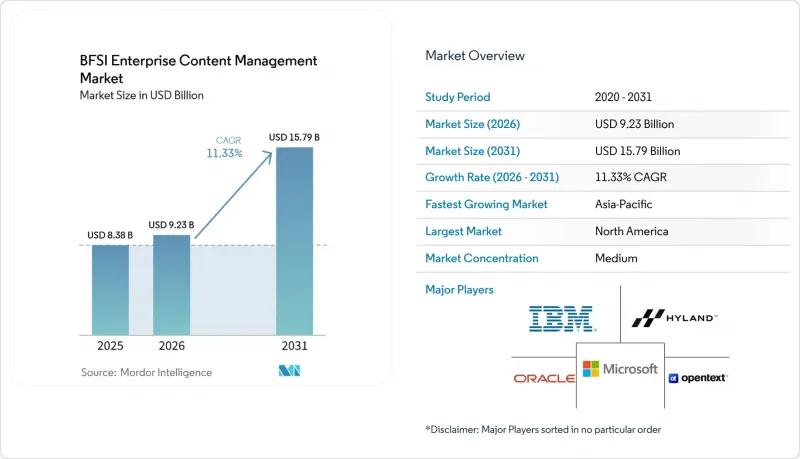
根據 Mordor Intelligence 預測,BFSI(銀行、金融和保險)行業的企業內容管理 (ECM) 市場預計將從 2025 年的 83.8 億美元成長到 2026 年的 92.3 億美元,然後在 2031 年達到 157.9 億美元,2026 年的複合年成長率為 1313%。
本報告按解決方案類型(文件管理、記錄管理、工作流程和業務流程管理、數位資產管理、Web內容管理等)、部署類型(本地部署、雲端部署、混合式部署)、企業規模(中小企業、大型企業)和地區進行細分。市場預測以美元計價。
全球銀行、金融服務和保險 (BFSI) 企業內容管理 (ECM) 市場趨勢與洞察
擴大數位化註冊和無紙化銀行服務的應用。
銀行業務正從以分店中心、以紙本文件為主的模式向數位轉型,這為金融服務業企業內容管理 (ECM) 市場帶來了持續的需求。銀行現在需要對已輸入的客戶檔案進行妥善分類,並確保這些檔案在整個客戶入職、審核和服務流程中可用,同時避免審計追蹤出現漏洞。金融市場標準委員會 (FMSB) 發布了 2025 年客戶入職文件和流程標準,該標準支持金融機構採用更嚴格的記錄收集、檢驗和保存方法。這正推動金融服務業企業內容管理 (ECM) 市場朝向整合資料擷取、檢驗和下游治理的平台發展,這些平台將資料收集、驗證和下游管治整合到一個統一的管理流程中。即使前端入職流程已數位化,尚未對其中台文件管理系統進行改造的金融機構仍面臨著諸如延遲、重複檢查和記錄碎片化等挑戰。
監管機構對保留符合審計要求的內容施加了越來越大的壓力。
監管壓力使得可審計內容的保存成為銀行、金融和保險 (BFSI) 企業內容管理 (ECM) 市場的核心採購因素。歐盟洗錢防制法規和資料保護條例 (DORA) 提高了金融機構在客戶審查文件、元資料、存取控制和基礎設施選擇方面的文件和管治標準。這種轉變不僅意味著更長時間地保留記錄;企業還需要能夠顯示文件處理者、文件位置以及核准流程的系統。因此,在 BFSI 企業內容管理 (ECM) 市場,能夠支援防篡改追蹤、更強力的策略執行以及符合特定司法管轄區操作規則的架構選項的供應商更受青睞。 ISO 27001 和 SOC 2 Type II 等認證不再只是差異化因素,而是被視為平台選擇的基本要求。
與傳統核心銀行系統整合的複雜性。
傳統的核心銀行系統仍然是銀行、金融服務和保險(BFSI)企業內容管理(ECM)市場的一大障礙。許多金融機構需要在傳統核心系統、新的數位層以及多年來建置的未公開介面之間處理內容。這迫使ECM程式同時在兩種環境中運行,導致部署延遲和測試困難。此外,BFSI ECM市場還面臨另一個挑戰:現代平台需要簡潔的API連接,而現有的記錄流仍然依賴批次和自訂映射。即使買家希望加快現代化進程,整合的複雜性也會減緩價值創造,並延長專案週期,超越中型金融機構的承受能力。
細分市場分析
到2025年,文件管理將佔據銀行、金融服務和保險(BFSI)企業內容管理(ECM)市場28.19%的佔有率,成為該市場中最大的解決方案類別。這一主導地位反映了BFSI企業內容管理(ECM)市場對將貸款檔案、開戶記錄、保險單、監管文件和其他資料集中到一個受控存儲庫中的根本需求。記錄管理和Web內容管理則針對更具體的用例,前者專注於管治和歸檔,後者則與面向客戶的數位通訊密切相關。對於需要跨多個管道管理品牌內容、多媒體文件和產品資料的保險公司和投資公司而言,數位資產管理也變得越來越重要。
預計到2031年,工作流程和業務流程管理將以12.41%的複合年成長率實現最快成長,這預示著BFSI企業內容管理產業的未來發展方向。隨著數位化入職工具的改進,BFSI企業內容管理(ECM)市場的關注點正轉向路由、核准、異常處理和審計追蹤的創建。 OracleOracle,其以金融服務為導向的企業案例管理平台支援跨各種警報的結構化調查工作流程,滿足了高度監管的金融營運中對強化個案管理的需求。 2026年6月,Hyland宣布其「代理銀行」解決方案可將額外文件請求減少高達50%,並將貸款申請的負責人時間從數週縮短至數天。這凸顯了以工作流程主導的產品在BFSI企業內容管理(ECM)市場的快速發展。
區域分析
預計到2025年,北美將佔據銀行、金融服務和保險(BFSI)企業內容管理(ECM)市場40.06%的佔有率,成為最大的區域貢獻者。該地區受益於大型金融機構的集中、強勁的IT支出以及將記錄管理置於投資首要位置的法規環境。儘管美國仍然是主要的需求來源,但隨著銀行對文件操作進行現代化改造以滿足開放銀行和跨境合規要求,加拿大和墨西哥的需求也在不斷成長。歐洲的BFSI企業內容管理(ECM)市場環境更為嚴格,因為DORA、歐盟反洗錢條例(EU AMLR)和人工智慧相關法規都會影響平台功能和部署選項。英國、德國和法國仍是歐洲BFSI企業內容管理(ECM)市場的主要需求中心。同時,以巴西和阿根廷為首的南美洲市場規模較小,但隨著電子文檔和公共部門數位轉型的推進,該市場正在蓬勃發展。
預計到2031年,亞太地區將以12.89%的複合年成長率成長,成為BFSI企業內容管理(ECM)市場成長最快的地區。興業銀行於2026年4月宣布,已在其46個業務部門部署了DeepSeek-V4,這表明該地區領先的金融機構正在直接投資於自身的內容智慧,作為BFSI企業內容管理(ECM)市場的一部分。隨著銀行拓展數位化服務、加強KYC(了解你的客戶)和記錄管理,並建立更有效率的文件工作流程,中國、印度、日本、韓國和澳洲正在推動市場成長。因此,能夠將區域客製化的合規性與擴充性的雲端和人工智慧功能相結合的供應商將在亞太BFSI企業內容管理(ECM)市場中佔據優勢。
儘管南美、中東和非洲在銀行、金融和保險(BFSI)企業內容管理(ECM)市場中所佔佔有率相對較小,但隨著金融機構不斷改進其記錄保存和案件工作流程,市場需求持續成長。 2025年11月,Newgen宣佈為阿布達比的Vision Bank實施其「人工智慧優先」的電子文檔和記錄管理系統,該系統實現了全生命週期自動化,並已整合到銀行的核心系統中。 2026年,Tiet宣布丹麥國家銀行已採用其「Public 360°」SaaS平台進行電子案件和文件管理。這顯示公共金融機構也在加強對受監管記錄的控制。在整個BFSI(銀行、金融和保險)企業內容管理(ECM)市場中,儘管各地區的採用率有所不同,但對內容、工作流程和保留規則進行可審計的控制是一項通用要求。
其他好處:
- Excel格式的市場預測(ME)表
- 3個月的分析師支持
目錄
第1章:引言
- 研究假設和市場定義
- 調查範圍
第2章:調查方法
第3章執行摘要
第4章 市場狀況
- 市場概覽
- 市場促進因素
- 數位化註冊和無紙化銀行服務正變得越來越普及。
- 監管機構對保留符合審計要求的內容施加了越來越大的壓力。
- 雲端原生企業內容管理現代化計畫的擴展
- 實現人工智慧驅動的文檔分類和智慧搜尋。
- 對跨管道整合客戶檔案和案例管理的需求。
- 跨國銀行跨境合規營運自動化的必要性
- 市場限制因素
- 整合傳統核心銀行體系的複雜性
- 大規模資料遷移和記錄標準化工作
- 公共雲端採用中的資料主權限制
- 擁有廣泛分店網路的金融機構在變革管理方面所面臨的摩擦
- 產業價值鏈分析
- 宏觀經濟因素對市場的影響
- 監理情勢
- 技術展望
- 波特五力分析
第5章 市場規模與成長預測
- 按解決方案類型
- 文件管理
- 記錄管理
- 工作流程和業務流程管理
- 個案管理
- 數位資產管理
- 網站內容管理
- 其他解決方案
- 部署模式
- 現場
- 雲
- 混合
- 按公司規模
- 小型企業
- 大公司
- 按地區
- 北美洲
- 美國
- 加拿大
- 墨西哥
- 南美洲
- 巴西
- 阿根廷
- 其他南美國家
- 歐洲
- 英國
- 德國
- 法國
- 其他歐洲國家
- 亞太地區
- 中國
- 日本
- 印度
- 韓國
- 澳洲
- 其他亞太國家
- 中東
- 阿拉伯聯合大公國
- 沙烏地阿拉伯
- 其他中東國家
- 非洲
- 南非
- 肯亞
- 其他非洲國家
- 北美洲
第6章 競爭情勢
- 市場集中度
- 策略趨勢
- 市佔率分析
- 公司簡介
- OpenText Corporation
- Hyland Software, Inc.
- M-Files Corporation
- DocuWare GmbH
- Laserfiche
- Box, Inc.
- Newgen Software Technologies Limited
- IBM Corporation
- Microsoft Corporation
- Oracle Corporation
- SAP SE
- Alfresco Software, Inc.
- SER Group Holding GmbH
- Canon Inc.
- Toshiba Tec Corporation
- Fujitsu Limited
- Kofax, Inc.
- Tungsten Automation Corporation
- Amazon Web Services, Inc.
- Google LLC
第7章 市場機會與未來展望
According to Mordor Intelligence, the BFSI enterprise content management (ECM) market size is expected to grow from USD 8.38 billion in 2025 to USD 9.23 billion in 2026 and is forecast to reach USD 15.79 billion by 2031 at 11.33% CAGR over 2026-2031.
This report is Segmented by Solution Type (Document Management, Records Management, Workflow and Business Process Management, Digital Asset Management, Web Content Management, and More), Deployment Mode (On-Premises, Cloud, and Hybrid), Enterprise Size (Small and Medium Enterprises, and Large Enterprises), and Geography. The Market Forecasts are Provided in Terms of Value (USD).
Global BFSI Enterprise Content Management (ECM) Market Trends and Insights
Rising Digital Onboarding and Paperless Banking Adoption
The move away from branch-heavy and paper-heavy banking is creating steady demand across the BFSI Enterprise Content Management (ECM) market. Banks now need customer files that can be captured once, classified correctly, and made available across onboarding, review, and service workflows without creating gaps in the audit trail. The Financial Markets Standards Board issued a 2025 standard on client onboarding documentation and processes, which supports a more disciplined approach to record collection, verification, and retention in financial institutions. This is pushing the BFSI Enterprise Content Management (ECM) market toward platforms that integrate intake, validation, and downstream governance into a single, managed flow. Institutions that digitize front-end onboarding without upgrading document control in the middle office still face delays, duplicate checks, and fragmented records.
Expanding Regulatory Pressure for Audit-Ready Content Retention
Regulatory pressure is making auditable content retention a core buying factor in the BFSI Enterprise Content Management (ECM) market. The EU Anti-Money Laundering Regulation and DORA are raising the standard for documenting and governing customer due diligence files, metadata, access controls, and infrastructure choices across financial institutions. This shift is no longer just about storing records for longer periods, because firms also need systems that can show who handled a file, where it resides, and how it moved through approval steps. The BFSI Enterprise Content Management (ECM) market is therefore favoring vendors that can support immutable trails, stronger policy enforcement, and architecture choices that align with jurisdiction-specific operating rules. Certifications such as ISO 27001 and SOC 2 Type II now matter less as a point of distinction and more as a minimum requirement for platform consideration.
Legacy Core Banking Integration Complexity
Legacy core banking environments remain a major barrier for the BFSI Enterprise Content Management (ECM) market. Many institutions still run content processes across legacy core systems, newer digital layers, and undocumented interfaces built over long periods. That forces ECM programs to operate across both old and new environments simultaneously, slowing implementation and making testing more difficult. The BFSI Enterprise Content Management (ECM) market also faces friction when modern platforms require clean API connections, while existing record flows still rely on batch logic and custom mappings. Even when buyers want faster modernization, integration complexity can delay value capture and extend project timelines beyond what mid-sized institutions are comfortable funding.
Other drivers and restraints analyzed in the detailed report include:
- Growth in Cloud-Native ECM Modernization Programs
- AI-Based Document Classification and Intelligent Search Adoption
- High Data Migration and Records Normalization Effort
For complete list of drivers and restraints, kindly check the Table Of Contents.
Segment Analysis
Document Management retained 28.19% of the BFSI Enterprise Content Management (ECM) market share in 2025, making it the largest solution category in this market. Its lead reflects the basic need to centralize loan files, account opening records, insurance policy documents, and regulatory correspondence in governed repositories across the BFSI Enterprise Content Management (ECM) market. Records Management and Web Content Management serve narrower use cases, with one focused more on retention and archiving, and the other more closely tied to customer-facing digital communication. Digital Asset Management is also becoming more relevant for insurers and investment firms that manage branded content, multimedia files, and product materials across several channels.
Workflow and Business Process Management is expected to post the fastest growth at a 12.41% CAGR through 2031, indicating where the BFSI enterprise content management industry is moving. As digital onboarding tools improve, attention is shifting to routing, approvals, exception handling, and audit trail creation inside the BFSI Enterprise Content Management (ECM) market. Oracle states that its Financial Services Enterprise Case Management platform supports structured investigation workflows across alert types, which fits the need for stronger case control in regulated financial operations. Hyland said in June 2026 that its Agentic Bank solution can reduce follow-up document requests by up to 50% and move loan applications to underwriter-ready status in days rather than weeks, highlighting how workflow-led products are expanding in the BFSI Enterprise Content Management (ECM) market.
Complete Report Scope:
- By Solution Type
- Document Management
- Records Management
- Workflow and Business Process Management
- Case Management
- Digital Asset Management
- Web Content Management
- Other Solutions
- By Deployment Mode
- On-Premises
- Cloud
- Hybrid
- By Enterprise Size
- Small and Medium Enterprises
- Large Enterprises
- By Geography
- North America
- United States
- Canada
- Mexico
- South America
- Brazil
- Argentina
- Rest of South America
- Europe
- United Kingdom
- Germany
- France
- Rest of Europe
- Asia Pacific
- China
- Japan
- India
- South Korea
- Australia
- Rest of Asia Pacific
- Middle East
- United Arab Emirates
- Saudi Arabia
- Rest of Middle East
- Africa
- South Africa
- Kenya
- Rest of Africa
- North America
Geography Analysis
North America held a 40.06% share of the BFSI Enterprise Content Management (ECM) market in 2025, making it the largest regional contributor. The region benefits from a concentration of large financial institutions, strong IT spending, and a regulatory environment that keeps record-keeping high on the investment agenda. The United States remains the main source of demand, while Canada and Mexico are also advancing as banks modernize document operations to meet open banking and cross-border compliance requirements. Europe is a more tightly constrained environment for the BFSI Enterprise Content Management (ECM) market, because DORA, the EU AMLR, and AI-related rules shape both platform features and deployment choices. Within the BFSI Enterprise Content Management (ECM) market, the United Kingdom, Germany, and France remain the main European demand centers, while South America, led by Brazil and Argentina, represents a smaller but developing opportunity linked to electronic documentation and public-sector digital reform.
Asia-Pacific is projected to grow at a 12.89% CAGR through 2031, making it the fastest-growing geography in the BFSI Enterprise Content Management (ECM) market. Industrial Bank said in April 2026 that it deployed DeepSeek-V4 across 46 business domains, which shows that leading institutions in the region are investing directly in proprietary content intelligence as part of the BFSI Enterprise Content Management (ECM) market. China, India, Japan, South Korea, and Australia are all contributing to momentum as banks expand digital services, strengthen KYC and recordkeeping, and seek more efficient document workflows. The BFSI Enterprise Content Management (ECM) market in Asia-Pacific, therefore, rewards vendors that can combine localized compliance support with scalable cloud and AI capabilities.
South America, the Middle East, and Africa are smaller parts of the BFSI Enterprise Content Management (ECM) market, but demand is still rising as institutions improve records handling and case workflows. Newgen announced in November 2025 that it had deployed an AI-first Electronic Document and Record Management System for Vision Bank in Abu Dhabi, with full lifecycle automation and integration into the bank's core systems. Tieto said in 2026 that Danmarks Nationalbank selected its Public 360° SaaS platform for electronic case and document management, indicating that public financial institutions are also upgrading their control over regulated records. Across the BFSI Enterprise Content Management (ECM) market, regional adoption is moving at different speeds, but the shared requirement is auditable control over content, workflows, and retention rules.
- OpenText Corporation
- Hyland Software, Inc.
- M-Files Corporation
- DocuWare GmbH
- Laserfiche
- Box, Inc.
- Newgen Software Technologies Limited
- IBM Corporation
- Microsoft Corporation
- Oracle Corporation
- SAP SE
- Alfresco Software, Inc.
- SER Group Holding GmbH
- Canon Inc.
- Toshiba Tec Corporation
- Fujitsu Limited
- Kofax, Inc.
- Tungsten Automation Corporation
- Amazon Web Services, Inc.
- Google LLC
Additional Benefits:
- The market estimate (ME) sheet in Excel format
- 3 months of analyst support
TABLE OF CONTENTS
1 INTRODUCTION
- 1.1 Study Assumptions and Market Definition
- 1.2 Scope of the Study
2 RESEARCH METHODOLOGY
3 EXECUTIVE SUMMARY
4 MARKET LANDSCAPE
- 4.1 Market Overview
- 4.2 Market Drivers
- 4.2.1 Rising Digital Onboarding and Paperless Banking Adoption
- 4.2.2 Expanding Regulatory Pressure for Audit-Ready Content Retention
- 4.2.3 Growth in Cloud-Native ECM Modernization Programs
- 4.2.4 AI-Based Document Classification and Intelligent Search Adoption
- 4.2.5 Demand for Unified Customer File and Case Management Across Channels
- 4.2.6 Need for Cross-Border Compliance Automation in Multinational Banks
- 4.3 Market Restraints
- 4.3.1 Legacy Core Banking Integration Complexity
- 4.3.2 High Data Migration and Records Normalization Effort
- 4.3.3 Data Sovereignty Constraints on Public Cloud Deployment
- 4.3.4 Change Management Friction in Branch-Heavy Institutions
- 4.4 Industry Value Chain Analysis
- 4.5 Impact of Macroeconomic Factors on the Market
- 4.6 Regulatory Landscape
- 4.7 Technological Outlook
- 4.8 Porter's Five Forces Analysis
- 4.8.1 Bargaining Power of Suppliers
- 4.8.2 Bargaining Power of Buyers
- 4.8.3 Threat of New Entrants
- 4.8.4 Threat of Substitutes
- 4.8.5 Competitive Rivalry
5 MARKET SIZE AND GROWTH FORECASTS (VALUE)
- 5.1 By Solution Type
- 5.1.1 Document Management
- 5.1.2 Records Management
- 5.1.3 Workflow and Business Process Management
- 5.1.4 Case Management
- 5.1.5 Digital Asset Management
- 5.1.6 Web Content Management
- 5.1.7 Other Solutions
- 5.2 By Deployment Mode
- 5.2.1 On-Premises
- 5.2.2 Cloud
- 5.2.3 Hybrid
- 5.3 By Enterprise Size
- 5.3.1 Small and Medium Enterprises
- 5.3.2 Large Enterprises
- 5.4 By Geography
- 5.4.1 North America
- 5.4.1.1 United States
- 5.4.1.2 Canada
- 5.4.1.3 Mexico
- 5.4.2 South America
- 5.4.2.1 Brazil
- 5.4.2.2 Argentina
- 5.4.2.3 Rest of South America
- 5.4.3 Europe
- 5.4.3.1 United Kingdom
- 5.4.3.2 Germany
- 5.4.3.3 France
- 5.4.3.4 Rest of Europe
- 5.4.4 Asia Pacific
- 5.4.4.1 China
- 5.4.4.2 Japan
- 5.4.4.3 India
- 5.4.4.4 South Korea
- 5.4.4.5 Australia
- 5.4.4.6 Rest of Asia Pacific
- 5.4.5 Middle East
- 5.4.5.1 United Arab Emirates
- 5.4.5.2 Saudi Arabia
- 5.4.5.3 Rest of Middle East
- 5.4.6 Africa
- 5.4.6.1 South Africa
- 5.4.6.2 Kenya
- 5.4.6.3 Rest of Africa
- 5.4.1 North America
6 COMPETITIVE LANDSCAPE
- 6.1 Market Concentration
- 6.2 Strategic Moves
- 6.3 Market Share Analysis
- 6.4 Company Profiles (includes Global Level Overview, Market Level Overview, Core Segments, Financials as available, Strategic Information, Market Rank/Share, Products and Services, Recent Developments)
- 6.4.1 OpenText Corporation
- 6.4.2 Hyland Software, Inc.
- 6.4.3 M-Files Corporation
- 6.4.4 DocuWare GmbH
- 6.4.5 Laserfiche
- 6.4.6 Box, Inc.
- 6.4.7 Newgen Software Technologies Limited
- 6.4.8 IBM Corporation
- 6.4.9 Microsoft Corporation
- 6.4.10 Oracle Corporation
- 6.4.11 SAP SE
- 6.4.12 Alfresco Software, Inc.
- 6.4.13 SER Group Holding GmbH
- 6.4.14 Canon Inc.
- 6.4.15 Toshiba Tec Corporation
- 6.4.16 Fujitsu Limited
- 6.4.17 Kofax, Inc.
- 6.4.18 Tungsten Automation Corporation
- 6.4.19 Amazon Web Services, Inc.
- 6.4.20 Google LLC
7 MARKET OPPORTUNITIES AND FUTURE OUTLOOK
- 7.1 White-Space and Unmet-Need Assessment

 無紙化解決方案市場:全球市場預測,2026-2032年文件外包市場:2026-2032年全球市場預測(依服務類型、文件類型、部署模式、組織規模和產業分類)
 2026年全球文件協作市場報告
 2026-2030年全球文件外包市場2026年全球文件掃描服務市場報告全球光學字元辨識掃描服務市場(按產業、應用、部署模式、類型和組織規模分類)預測(2026-2032年)
 文件外包服務市場分析及預測(至2035年):按類型、產品類型、服務、技術、組件、應用、部署類型、最終用戶、流程和解決方案分類
 文件外包服務市場-全球產業規模、佔有率、趨勢、機會和預測,按服務、類型、產業、企業規模、地區和競爭格局分類,2021-2031年預測
 文件外包:全球市場佔有率和排名、總收入和需求預測(2025-2031年)
 全球 SPECT 掃描服務市場:預測至 2032 年 - 按產品類型、放射性同位素類型、應用、最終用戶和地區進行分析