


 |
市場調查報告書
商品編碼
2118191
歐盟人工智慧審計追蹤軟體:市場佔有率分析、產業趨勢與統計及成長預測(2026-2031 年)EU AI Audit Trail Software - Market Share Analysis, Industry Trends & Statistics, Growth Forecasts (2026 - 2031) |
||||||

※ 本網頁內容可能與最新版本有所差異。詳細情況請與我們聯繫。
據 Mordor Intelligence 稱,歐盟人工智慧審計追蹤軟體市場在 2025 年的價值為 6.3 億美元,在 2026 年的價值為 7.9 億美元,預計從 2026 年到 2031 年將以 28.89% 的複合年成長率成長,到 2031 億美元。
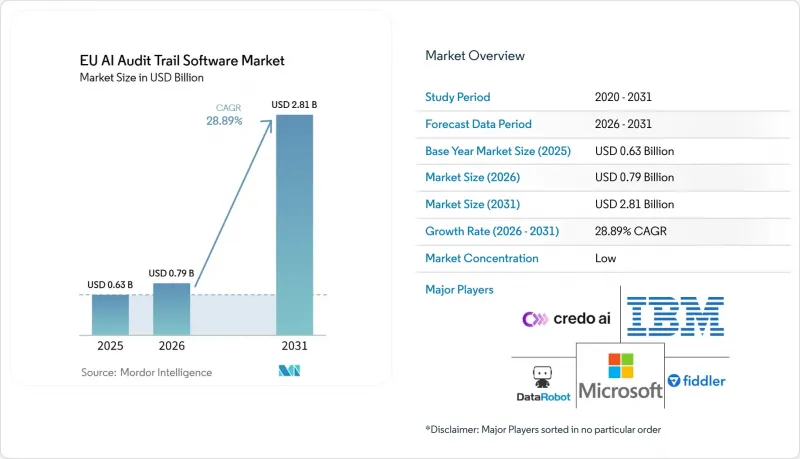
本報告按組件(軟體和服務)、合規能力(合規性證據和報告、模型和資料沿襲等)、部署模式(雲端、混合、本地部署)、企業規模(大型企業和中小企業)、最終用戶(IT 和電信等)以及地區進行細分。市場預測以價值(美元)表示。
歐盟人工智慧審計追蹤軟體市場趨勢與洞察
歐盟人工智慧法分階段實施,合規期限短
歐盟人工智慧審計追蹤軟體市場與(EU) 2024/1689號條例中明確的法律期限保持一致。通用人工智慧模型條例將於2025年8月2日生效,歐洲人工智慧秘書處將於2026年8月2日起承擔相關的執法職責。第50條規定的透明度要求也將於2026年8月2日生效,但根據《數位綜合法案》,附件三規定的義務將延後至2027年12月2日。德國聯邦委員會於2026年2月11日批准了「KI-MIG」法案。該法案指定聯邦網路管理局(Bundesnetzagentur)為國家人工智慧監管機構,並制定了國家製裁條款。基於這些日期,各組織必須保存帶有時間戳記的記錄、技術文件、模型卡、合格評定資料和上市後監測報告,而不能僅依賴政策文件。
域外申請和進入歐盟市場相關的風險
歐盟人工智慧法律適用於所有引入歐盟市場的人工智慧系統,即使供應商位於歐盟以外。這意味著歐盟合規要求將納入全球產品、合約和管治決策中。該法規對某些違規行為可處以最高 3,500 萬歐元(3,810 萬美元)或全球年銷售額 7% 的罰款。微軟於 2025 年 1 月簽署了歐盟人工智慧協議,並在歐盟委員會後續指南最終定稿前,使其產品配置和合約符合相關禁令。這表明,全球供應商並未將歐盟規則視為僅是區域性的附加要求,而是將其合規控制措施融入自身的營運模式中。歐盟人工智慧審計追蹤軟體市場將使那些需要為在多個司法管轄區銷售的產品建立通用證據管理架構的跨國供應商受益。
技術標準不明確,指南不一
歐盟人工智慧審計追蹤軟體市場面臨不確定性,因為詳細的標準體系仍在不斷改進。關於高風險人工智慧分類的指導草案已於2026年5月19日發布,公眾評議期於2026年6月23日結束。一旦指導文件和統一標準最終確定,買家可能被迫修改其配置。截至2026年中期,27個成員國中只有12個指定了國家主管機構,這可能導致各國執法預期有差異。此外,各組織也面臨著既了解人工智慧系統設計又熟悉歐盟法規解讀的人員短缺問題。這些情況可能會延遲採購決策,並增加部署階段的服務需求。
細分市場分析
預計到2025年,軟體收入將佔總收入的73.41%,使其成為人工智慧審計追蹤功能的主要支出類別。基於SaaS的管治平台使組織無需大量資本投入即可啟動分類、證據收集和報告工作流程。 IBM watsonx.governance、Credo AI、Holistic AI和Saidot均提供用於風險分類、證據收集和審計就緒報告的工具。這些平台已採取控制措施,以符合歐盟人工智慧法律、ISO/IEC 42001標準以及NIST人工智慧風險管理框架。微軟宣布,其Azure AI Foundry模型和Microsoft Security Copilot已於2025年獲得ISO/IEC 42001:2023認證。 IBM於2026年初發布了Sovereign Core,目標是在2026年中期全面上市,旨在將人工智慧審計日誌和遙測資料保留在國家/地區範圍內。這些特性表明,資料居住和第三方保障在軟體選擇中至關重要。
預計到2031年,服務市場將以30.82%的複合年成長率成長,成為該細分市場中成長最快的領域。具體任務包括配置日誌管道、映射資料處理歷程以及準備認證機構審核所需的文件。此外,各組織也需要協助將ISO/IEC 42001管理系統控制措施與人工智慧法律要求相協調。當多個供應商參與單一人工智慧部署時,這一需求尤為突出。 2025年4月,IBM和Credo AI宣佈建立OEM合作夥伴關係,將Credo AI的策略包作為「IBM合規加速器」整合到watsonx.governance平台中。此次合作展示如何將專業策略內容融入大規模平台服務。因此,歐盟人工智慧審計追蹤軟體市場既有可重複使用的平台軟體支持,也有專業的實施服務支援。
2025年,合規證據和報告佔收入的27.74%,成為最大的功能類別。需求始於附件四和第17條規定的文件義務,因為許多組織需要在2026年8月的最後期限前提交結構化記錄。模型和資料沿襲也是一個成熟的領域,因為第10條強制要求資料管治。運行時決策日誌支援第12條關於營運記錄的要求。偏見、公正性和可解釋性審計支持第9條規定的風險管理操作。這些功能反映了保證活動期間從一般政策聲明到檢驗控制的轉變。這種持續使用使得證據報告成為歐盟人工智慧審計追蹤軟體市場的關鍵基礎。
預計到2031年,事件調查和上市後監測將以29.94%的複合年成長率成長。第72條規定了監測框架,第73條要求快速通報重大事件。醫療保健產業對此類需求尤為迫切,因為醫療設備製造商必須根據《醫療器材法規》(MDR)第83-86條和《人工智慧法案》(AI Act)第72條的規定,持續進行上市後監測。 MDCG指南將這些框架內的文件記錄和監測要求連結起來。根據2026年發表在《數位健康前沿》(Frontiers in Digital Health)上的一篇報導,使用高風險人工智慧的醫療機構有義務維護全面的審計日誌。在這種環境下,人們對即使在系統部署後仍可存取的記錄的需求日益成長。此外,人們也越來越傾向於使用能夠將警報、調查、糾正措施和報告整合到單一管理流程中的平台。
其他好處:
- Excel格式的市場預測(ME)表
- 3個月的分析師支持
目錄
第1章:引言
- 研究假設和市場定義
- 調查範圍
第2章:調查方法
第3章執行摘要
第4章 市場狀況
- 市場概覽
- 市場促進因素
- 歐盟人工智慧法的分階段實施和短期合規期限
- 域外效力及進入歐盟市場的風險
- 受監管產業中高風險人工智慧應用案例的擴展
- 人工智慧整個生命週期中持續證據的需求
- 歐盟人工智慧法律、ISO/IEC 42001 和 NIST 人工智慧風險管理框架控制措施之間的一致性。
- 採購和董事會層級都要求提供可驗證且負責任的人工智慧解決方案。
- 市場限制因素
- 技術標準不明確,解釋指南不斷變化。
- 供應商、實施者和第三方模型供應商之間的責任分配。
- 缺乏人工智慧管治和合規性評估的專業知識。
- 多重雲端環境中的影子人工智慧、傳統 MLOps 和整合摩擦
- 宏觀經濟因素對市場的影響
- 產業價值鏈分析
- 科技趨勢
- 監理情勢
- 波特五力分析
第5章 市場規模與成長預測
- 按組件
- 軟體
- 服務
- 按功能合規
- 合規性證據和報告
- 模型和數據的譜系
- 運行時決策日誌
- 針對偏見、公平性和可解釋性的審計
- 事件調查及上市後監測
- 按部署模式
- 雲
- 混合
- 現場
- 按公司規模
- 大公司
- 小型企業
- 最終用戶
- 資訊科技/通訊
- BFSI
- 汽車和運輸業
- 醫療保健和生命科學
- 零售與電子商務
- 其他最終用戶
- 按地區
- 德國
- 英國
- 法國
- 俄羅斯
- 西班牙
- 其他歐洲國家
第6章 競爭情勢
- 市場集中度
- 策略趨勢
- 市佔率分析
- 公司簡介
- IBM Corporation
- Microsoft Corporation
- DataRobot, Inc.
- Credo AI, Inc.
- Fiddler Labs, Inc.
- ArthurAI, Inc.
- Protect AI, Inc.
- Lakera AI AG
- HiddenLayer, Inc.
- CalypsoAI Corp.
- WhyLabs, Inc.
- Arize AI, Inc.
- Robust Intelligence, Inc.
- Aporia Technologies Ltd.
- Monitaur, LLC
- Naaia
- EVE NeuroSystems LLC
- Trustible, Inc.
- Holistic AI Ltd.
- ModelOp, Inc.
- Saidot Oy
- ParityBit, Inc.
- Kindo AI, Inc.
- Fairly AI, Inc.
第7章 市場機會與未來展望
According to Mordor Intelligence, the EU AI audit trail software market was valued at USD 0.63 billion in 2025, USD 0.79 billion in 2026, and is forecast to reach USD 2.81 billion by 2031, at a CAGR of 28.89% over 2026-2031.
This report is Segmented by Component (Software and Services), Compliance Function (Compliance Evidence and Reporting, Model and Data Lineage, and More), Deployment Model (Cloud, Hybrid, and On-Premises), Enterprise Size (Large Enterprises and Small and Medium-Sized Enterprises), End User (IT and Telecommunication, and More), and Geography. The Market Forecasts are Provided in Terms of Value (USD).
EU AI Audit Trail Software Market Trends and Insights
Phased EU AI Act Enforcement and Near-Term Compliance Deadlines
The EU AI Audit Trail Software Market is responding to a clear sequence of legal deadlines under Regulation (EU) 2024/1689. Rules for general-purpose AI models applied from August 2, 2025, and the European AI Office gained related enforcement responsibilities from August 2, 2026. Article 50 transparency requirements also apply from August 2, 2026, while the Digital Omnibus defers Annex III obligations until December 2, 2027. Germany's Cabinet approved the KI-MIG on February 11, 2026, which designates Bundesnetzagentur as the national AI supervisory authority and sets national sanction provisions. These dates require organizations to maintain time-stamped records, technical documentation, model cards, conformity assessment materials, and post-market monitoring reports, rather than relying solely on policy documents.
Extraterritorial Reach and EU Market-Access Exposure
The EU AI Act applies when an AI system is placed on the EU market, even when the provider is based outside the EU. This exposure places EU compliance requirements within global product, contracting, and governance decisions. The regulation allows fines of up to EUR 35 million (USD 38.1 million) or 7% of worldwide annual turnover for certain violations. Microsoft signed the EU AI Pact in January 2025 and aligned product configurations and contracts with prohibited-use provisions before the Commission's later guidance was finalized. This response shows why global providers are building EU-ready controls into their operating models instead of treating the rules as a regional add-on. The EU AI Audit Trail Software Market benefits when multinational providers need a common evidence architecture across products sold in several jurisdictions.
Unsettled Technical Standards and Moving Interpretive Guidance
The EU AI Audit Trail Software Market faces uncertainty due to the ongoing development of the detailed standards environment. Draft guidance on high-risk AI classification was published on May 19, 2026, and consultation ran through June 23, 2026. Buyers may need to revise configurations when guidance or harmonized standards become final. Only 12 of the 27 Member States had designated national competent authorities by mid-2026, which can create different enforcement expectations across countries. Organizations also face a shortage of staff who understand both AI system design and EU regulatory interpretation. These conditions can delay buying decisions and increase the need for services during implementation.
Other drivers and restraints analyzed in the detailed report include:
- Expansion of High-Risk AI Use Cases in Regulated Industries
- Need for Continuous Evidence Across the AI Lifecycle
- Fragmented Accountability Across Providers, Deployers, and Third-Party Model Vendors
For complete list of drivers and restraints, kindly check the Table Of Contents.
Segment Analysis
Software accounted for 73.41% of revenue in 2025, making it the primary spending category for AI audit trail capabilities. SaaS governance platforms allow organizations to start classification, evidence collection, and reporting workflows without major capital expenditure. IBM watsonx.governance, Credo AI, Holistic AI, and Saidot offer tools for risk classification, evidence creation, and audit-ready reports. Their platforms map controls to the EU AI Act, ISO/IEC 42001, and the NIST AI Risk Management Framework. Microsoft reported that Azure AI Foundry Models and Microsoft Security Copilot achieved ISO/IEC 42001:2023 certification in 2025. IBM announced Sovereign Core in early 2026, with general availability targeted for mid-2026, to keep AI audit logs and telemetry within national boundaries. These features show why data residency and third-party assurance have become important in software selection.
Services are projected to grow at a 30.82% CAGR through 2031, the fastest rate in this segmentation. The work includes configuring logging pipelines, mapping data lineage, and preparing material for notified-body reviews. Organizations also need support in connecting ISO/IEC 42001 management system controls with AI Act requirements. This requirement is particularly pronounced when several suppliers contribute to a single AI deployment. IBM and Credo AI announced an OEM collaboration in April 2025 that incorporated Credo AI Policy Packs as IBM Compliance Accelerators within watsonx. governance. The arrangement demonstrates how specialized policy content can be brought into a larger platform offering. The EU AI Audit Trail Software Market industry, therefore, supports both reusable platform software and specialized implementation work.
Compliance evidence and reporting accounted for 27.74% of revenue in 2025, the largest functional category. Demand began with documentary obligations under Annex IV and Article 17 because many organizations needed structured records before the August 2026 deadlines. Model and data lineage are another established area, as Article 10 requires data governance. Runtime decision logging supports Article 12 requirements for operational records. Bias, fairness, and explainability audit supports Article 9 risk-management work. These functions reflect a move from general policy statements to controls that can be examined during assurance activity. Their continued use makes evidence reporting an important foundation for the EU AI Audit Trail Software Market.
Incident investigation and post-market monitoring are projected to grow at a 29.94% CAGR through 2031. Article 72 requires a monitoring framework, while Article 73 requires rapid reporting of serious incidents. The need is particularly strong in healthcare, as device manufacturers must maintain active post-market surveillance under both MDR Articles 83-86 and the AI Act Article 72. The MDCG guidance connects the documentation and surveillance expectations of these frameworks. A 2026 article in Frontiers in Digital Health stated that healthcare facilities using high-risk AI have mandatory deployment obligations for comprehensive audit log maintenance. This environment increases demand for records that remain usable after systems are deployed. It also favors platforms that integrate alerts, investigations, corrective actions, and reporting into a single control process.
Complete Report Scope:
- By Component
- Software
- Services
- By Compliance Function
- Compliance Evidence and Reporting
- Model and Data Lineage
- Runtime Decision Logging
- Bias, Fairness and Explainability Audit
- Incident Investigation and Post-Market Monitoring
- By Deployment Model
- Cloud
- Hybrid
- On-Premises
- By Enterprise Size
- Large Enterprises
- Small and Medium-Sized Enterprises
- By End User
- IT and Telecommunication
- BFSI
- Automotive and Transportation
- Healthcare and Life Sciences
- Retail and E-Commerce
- Other End Users
- By Geography
- Germany
- United Kingdom
- France
- Russia
- Spain
- Rest of Europe
List of Companies Covered in this Report:
- IBM Corporation
- Microsoft Corporation
- DataRobot, Inc.
- Credo AI, Inc.
- Fiddler Labs, Inc.
- ArthurAI, Inc.
- Protect AI, Inc.
- Lakera AI AG
- HiddenLayer, Inc.
- CalypsoAI Corp.
- WhyLabs, Inc.
- Arize AI, Inc.
- Robust Intelligence, Inc.
- Aporia Technologies Ltd.
- Monitaur, LLC
- Naaia
- EVE NeuroSystems LLC
- Trustible, Inc.
- Holistic AI Ltd.
- ModelOp, Inc.
- Saidot Oy
- ParityBit, Inc.
- Kindo AI, Inc.
- Fairly AI, Inc.
Additional Benefits:
- The market estimate (ME) sheet in Excel format
- 3 months of analyst support
TABLE OF CONTENTS
1 INTRODUCTION
- 1.1 Study Assumptions and Market Definition
- 1.2 Scope of the Study
2 RESEARCH METHODOLOGY
3 EXECUTIVE SUMMARY
4 MARKET LANDSCAPE
- 4.1 Market Overview
- 4.2 Market Drivers
- 4.2.1 Phased EU AI Act Enforcement and Near-Term Compliance Deadlines
- 4.2.2 Extraterritorial Reach and EU Market-Access Exposure
- 4.2.3 Expansion of High-Risk AI Use Cases in Regulated Industries
- 4.2.4 Need for Continuous Evidence Across the AI Lifecycle
- 4.2.5 Convergence of EU AI Act, ISO/IEC 42001, and NIST AI RMF Controls
- 4.2.6 Procurement and Board-Level Demand for Demonstrable Responsible AI
- 4.3 Market Restraints
- 4.3.1 Unsettled Technical Standards and Moving Interpretive Guidance
- 4.3.2 Fragmented Accountability Across Providers, Deployers, and Third-Party Model Vendors
- 4.3.3 Limited Availability of AI Governance and Conformity-Assessment Expertise
- 4.3.4 Integration Friction Across Shadow AI, Legacy MLOps, and Multi-Cloud Estates
- 4.4 Impact of Macroeconomic Factors on the Market
- 4.5 Industry Value-Chain Analysis
- 4.6 Technology Outlook
- 4.7 Regulatory Landscape
- 4.8 Porter's Five Forces Analysis
- 4.8.1 Threat of New Entrants
- 4.8.2 Bargaining Power of Suppliers
- 4.8.3 Bargaining Power of Buyers
- 4.8.4 Threat of Substitutes
- 4.8.5 Intensity of Competitive Rivalry
5 MARKET SIZE AND GROWTH FORECASTS (VALUE)
- 5.1 By Component
- 5.1.1 Software
- 5.1.2 Services
- 5.2 By Compliance Function
- 5.2.1 Compliance Evidence and Reporting
- 5.2.2 Model and Data Lineage
- 5.2.3 Runtime Decision Logging
- 5.2.4 Bias, Fairness and Explainability Audit
- 5.2.5 Incident Investigation and Post-Market Monitoring
- 5.3 By Deployment Model
- 5.3.1 Cloud
- 5.3.2 Hybrid
- 5.3.3 On-Premises
- 5.4 By Enterprise Size
- 5.4.1 Large Enterprises
- 5.4.2 Small and Medium-Sized Enterprises
- 5.5 By End User
- 5.5.1 IT and Telecommunication
- 5.5.2 BFSI
- 5.5.3 Automotive and Transportation
- 5.5.4 Healthcare and Life Sciences
- 5.5.5 Retail and E-Commerce
- 5.5.6 Other End Users
- 5.6 By Geography
- 5.6.1 Germany
- 5.6.2 United Kingdom
- 5.6.3 France
- 5.6.4 Russia
- 5.6.5 Spain
- 5.6.6 Rest of Europe
6 COMPETITIVE LANDSCAPE
- 6.1 Market Concentration
- 6.2 Strategic Moves
- 6.3 Market Share Analysis
- 6.4 Company Profiles (includes Global Level Overview, Market Level Overview, Core Segments, Financials as available, Strategic Information, Market Rank/Share, Products and Services, Recent Developments)
- 6.4.1 IBM Corporation
- 6.4.2 Microsoft Corporation
- 6.4.3 DataRobot, Inc.
- 6.4.4 Credo AI, Inc.
- 6.4.5 Fiddler Labs, Inc.
- 6.4.6 ArthurAI, Inc.
- 6.4.7 Protect AI, Inc.
- 6.4.8 Lakera AI AG
- 6.4.9 HiddenLayer, Inc.
- 6.4.10 CalypsoAI Corp.
- 6.4.11 WhyLabs, Inc.
- 6.4.12 Arize AI, Inc.
- 6.4.13 Robust Intelligence, Inc.
- 6.4.14 Aporia Technologies Ltd.
- 6.4.15 Monitaur, LLC
- 6.4.16 Naaia
- 6.4.17 EVE NeuroSystems LLC
- 6.4.18 Trustible, Inc.
- 6.4.19 Holistic AI Ltd.
- 6.4.20 ModelOp, Inc.
- 6.4.21 Saidot Oy
- 6.4.22 ParityBit, Inc.
- 6.4.23 Kindo AI, Inc.
- 6.4.24 Fairly AI, Inc.
7 MARKET OPPORTUNITIES AND FUTURE OUTLOOK
- 7.1 White-Space and Unmet-Need Assessment

 歐洲(歐盟)人工智慧法律人力資源合規平台:市場佔有率分析、產業趨勢與統計、成長預測(2026-2031 年)
 全球合規自動化市場(2025-2030 年)
 2026-2030年全球管治、風險與合規(GRC)平台市場以人力資源為中心的 GRC 平台:市場佔有率分析、行業趨勢和統計數據以及成長預測(2026-2031 年)
 合規軟體市場規模、佔有率和趨勢分析報告:按組件、應用、部署類型、企業規模、最終用途、地區和細分市場預測(2026-2033 年)
 管治、風險和合規 (GRC) 平台市場報告:按部署模式、解決方案、組件、服務、最終用戶、行業垂直領域和地區分類,2026-2034 年
 法律、風險和合規解決方案市場到 2035 年的分析和預測:按類型、產品、服務、技術、組件、應用、部署、最終用戶、模組和功能分類。
 2026年全球管治、風險與合規平台市場報告管治、風險和合規 (GRC) 平台市場分析及預測(至 2035 年):按類型、產品類型、服務、技術、組件、應用、最終用戶、模組和部署類型分類
 管治、風險和合規 (GRC) 平台:全球市場佔有率和排名、總收入和需求預測(2025-2031 年)