


 |
市場調查報告書
商品編碼
2097482
歐洲(歐盟)人工智慧法律人力資源合規平台:市場佔有率分析、產業趨勢與統計、成長預測(2026-2031 年)EU AI Act HR Compliance Platform - Market Share Analysis, Industry Trends & Statistics, Growth Forecasts (2026 - 2031) |
||||||

※ 本網頁內容可能與最新版本有所差異。詳細情況請與我們聯繫。
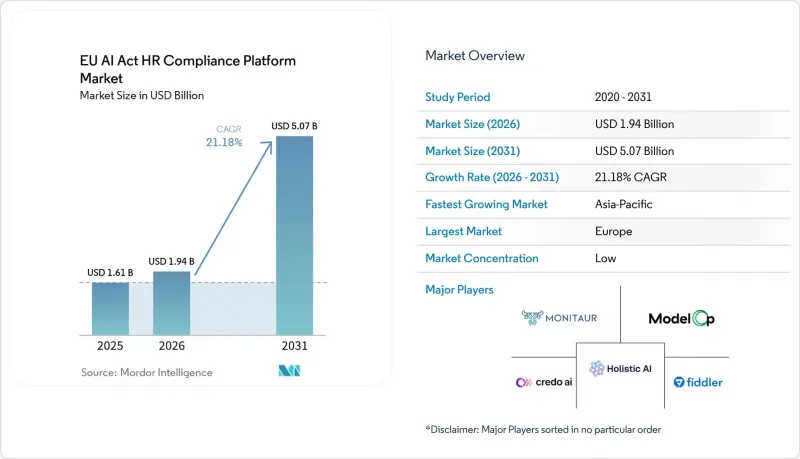
根據 Mordor Intelligence 預測,歐洲(歐盟)人工智慧法律人力資源合規平台市場規模預計將在 2025 年達到 16.1 億美元,2026 年達到 19.4 億美元,到 2031 年達到 50.7 億美元,2026 年至 2031 年的複合成長率為 21.18%。
本報告按組件(軟體和服務)、功能(例如人工智慧庫存和分類)、部署模式(雲端、本地部署和混合部署)、組織規模(大型企業和中小企業)、最終用戶行業(例如銀行、金融服務和保險)以及地區進行細分。市場預測以價值(美元)表示。
全球歐洲(歐盟)人工智慧法律人力資源合規平台市場趨勢與洞察
根據歐盟人工智慧法,高風險的人力資源相關義務需要正式設立專門的合規預算。
歐盟第2024/1689號條例附件三將用於招聘、候選人評估、晉升和解僱決策、基於行為分析的崗位分配以及績效監控的人工智慧系統歸類為高風險系統,對在人力資源領域實施這些工具的組織施加了直接的合規負擔。該條例的實施期限為2026年8月,違規者最高可被處以1,500萬歐元(1,635萬美元)或全球年銷售額3%的罰款。歐盟人工智慧法人力資源合規平台市場正從試點階段過渡到正式的預算週期。該條例對購買第三方人力資源人工智慧軟體的公司也具有重大影響,因為根據第26條及相關條款,實施公司仍需維護人工監督、日誌記錄、事件報告和員工通知記錄。這意味著市場需求將更多地取決於雇主能否證明其在日常營運中合規地使用該模型,而不是取決於模型的開發者是誰。歐盟委員會的最新指導和時間表資訊再次確認,一些義務(包括員工通知和人工智慧素養)已經生效,因此,等待未來實施里程碑的實際意義有所降低。
現成的管治套件正在取代基於電子表格的人力資源人工智慧管理。
仍在使用電子表格追蹤人力資源人工智慧系統的組織開始意識到,手動記錄無法滿足第 12 條日誌記錄、第 72 條上市後監控或第 73 條 15 天內重大事件報告的要求。正因如此,歐盟人工智慧法案 (EU AI Act) 的人力資源合規平台市場正轉向專門設計的軟體。這種轉變不僅僅是軟體偏好問題,因為買家現在需要結構化的證據追蹤、基於角色的工作流程以及可復現的控制措施,而這些通常是內部追蹤工具無法大規模提供的。 ISO/IEC 42001 標準是採購決策的一部分,微軟的合規文件表明,到 2025 年底,人工智慧管治將成為企業供應商調查問卷中的標準項目。買家越來越傾向於選擇能夠將歐盟人工智慧法案、ISO/IEC 42001 標準及相關框架中的控制措施整合到單一系統中的平台,因為這樣他們就可以用相同的管治投入支援多個合規項目。因此,歐洲(歐盟)人工智慧驅動的法律人力資源合規平台市場正受益於採購趨勢,其中自動化證據、框架映射和審計應對力正在取代低成本的人工管治方法。
各國對相關規定的解讀有差異,延緩了歐洲產品的標準化過程。
相關法規要求成員國建立國內監管體系,但歐洲各地的實施準備工作進展並不均衡。因此,歐盟人工智慧法律人力資源合規平台市場在短期內面臨標準化的挑戰。採購企業不僅需要符合監管要求的產品,還需要確保其證據文件和工作流程能夠被多個司法管轄區(這些司法管轄區擁有不同的操作規範)所接受。因此,供應商被迫維護特定國家的政策包、映射和文件模板,而不是單一的區域配置。在監管要求寬鬆的環境中,遵循嚴格通用標準的產品可能會增加採購方的成本和營運負擔;而在嚴格的監管環境中,功能有限的產品可能會使採購方面面臨風險。這種在地化負擔正在減緩產品標準化進程,並有利於那些能夠在不影響服務品質的前提下承擔持續監管解讀工作的供應商。
細分市場分析
2025年,軟體在歐洲(歐盟)人工智慧法案人力資源合規平台市場佔了67.39%的佔有率。這表明,買家仍然傾向於選擇現成的管治平台,而非自行開發,用於庫存管理、自動化策略映射和審計追蹤生成。這一領先地位反映了常用管治、風險和合規(GRC)工具的局限性,因為這些工具並非旨在捕獲人工智慧法案要求的結構化日誌、技術文件和偏差測試記錄。此外,許多買家在準備人工智慧法案的同時,也在關注ISO/IEC 42001認證,而這些認證需要能力框架、管理評審和糾正措施記錄,這些僅靠軟體無法實現,因此對相關服務的需求仍然強勁。實際上,能夠將軟體的強大功能與持續的實施和合規管理支援相結合的供應商最具競爭力,因此,對各個組件的需求比僅從2025年的市場佔有率分佈所推斷的更為均衡。
預計2026年至2031年間,服務市場將以23.49%的複合年成長率成長,超過整體市場成長率。這意味著,買家需要的不僅僅是軟體授權才能履行其在人力資源人工智慧方面的義務。主要挑戰在於執行,因為僅靠平台部署無法自動產生合規的證據文件,除非在整個人力資源技術堆疊中正確配置資料饋送、使用者權限、審核流程和文件工作流程。許多早期專案在專用管治平台成熟之前推出,因此企業目前面臨著應徵者追蹤系統、人力資源資訊系統、績效評估工具和監管要求的證據結構之間的整合差距。這推動了對實施、整合和合規管理服務的需求,尤其是在企業希望在多個國家和業務部門採用統一營運模式的情況下。
到2025年,政策管理和控制映射將佔35.19%。這反映出大多數組織首先會識別相關的AI用例,並將其與特定義務關聯起來,然後再投資於測試和事件回應工作流程。這種順序在歐洲(歐盟)AI法律人力資源合規平台市場很常見,因為企業需要了解自身正在使用的系統、這些系統為何可能受附件三約束,以及在實現證據收集自動化之前需要修改哪些內部政策。預計到2031年,歐盟AI企業人力資源合規平台市場規模中,偏見和公正性測試的複合年成長率將達到22.04%。這預示著一波支出浪潮即將到來,雖然會存在滯後,但勢頭會更加強勁,因為買家正從義務映射轉向技術合規性證明。這項轉變的驅動力來自學術界和法律界的論證,這些論證支持偏見評估,認為其比非正式的內部審查更可靠,更符合審計標準,尤其是在招聘決策影響受保護群體的情況下。
人工智慧清單和分類仍然是所有其他模組的實用基礎,因為沒有它們,組織就無法分配所有權、確定附件三的範圍或維護最新的受管系統登記冊。管理可解釋性和透明度也變得越來越重要,因為求職者和員工可能會尋求對人工智慧輔助決策的合理解釋,這既需要技術證據,也需要面向使用者的溝通工作流程。監控和事件管理旨在解決人力資源人工智慧工具部署到生產環境後出現的上市後監控和快速報告義務。隨著截止日期的臨近,其他功能(例如合規性協助、註冊工作流程和結構化提交創建)變得越來越重要,但策略映射在初始部署階段仍然至關重要,因為它為所有後續合規工作奠定了邏輯基礎。
區域分析
預計2025年,歐洲將佔據歐盟人工智慧法律人力資源合規平台市場38.71%的佔有率。這一領先地位歸功於該法規的歐洲起源,以及企業早期進行的準備性投資——這些企業預期人力資源人工智慧義務將從政策討論轉變為可執行的實踐。歐盟內部有針對性的部署對監督、日誌記錄、透明度和上市後監測等方面提出了直接的法律要求,這也對該地區市場構成利好,使買家更有理由儘早投資。各國實施速度的差異也鞏固了歐洲的地位,因為在多個成員國運營的企業正在尋求一個單一的平台來整理證據,以便在當地監督實踐形成穩定模式之前進行管理。儘管一些執法細節仍在不斷變化,但這一趨勢確保了該地區仍然是當前需求的中心。
預計到2025年,北美將成為第二大市場,這主要得益於跨國公司對其歐盟業務和國內人力資源人工智慧應用的需求,它們需要統一的管治方法。對這些買家而言,歐洲(歐盟)人工智慧法律人力資源合規平台市場的價值遠不止於歐洲,因為其日誌記錄、公正性審查和可解釋性管理功能可以滿足美國和加拿大在僱用和管治的重疊要求。因此,集中式人工智慧管治團隊越來越傾向於選擇允許在多個司法管轄區應用單一證據模型的平台,而不是為每個地區維護單獨的流程。墨西哥仍處於起步階段,其需求不僅受國內法規的驅動,而且與出口型企業和歐盟相關客戶的供應關係密切相關。
預計亞太地區在歐洲(歐盟)人工智慧法律人力資源合規平台市場中將以22.67%的複合年成長率成長,成為2026年至2031年間成長最快的區域市場。主要促進因素是,企業擴大透過與跨國供應商建立合作關係來採用符合歐盟標準的採購流程,而非僅僅依靠反映歐盟框架的單一國家法律。這在日本、韓國、印度、澳洲和紐西蘭等國家催生了需求。在這些國家,即使法律要求源自其他地方,雇主和軟體供應商也需要證明其管治結構。中東地區的需求主要來自於尋求跨框架管治支援的全球銀行、科技公司和公共機構。同時,非洲的需求則由金融服務業和跨國公司的企業發展所驅動。南美洲仍處於發展階段,市場活動主要集中在巴西,智利和阿根廷也有所涉及。在這些國家,合規證明要求正擴大被納入與歐盟的商業合約中。
其他好處:
- Excel格式的市場預測(ME)表
- 3個月的分析師支持
目錄
第1章:引言
- 研究假設和市場定義
- 調查範圍
第2章:調查方法
第3章執行摘要
第4章 市場狀況
- 市場概覽
- 市場促進因素
- 歐盟人工智慧法下的高風險人力資源義務:正式設立專門的合規預算
- 現成的管治套件正在取代基於電子表格的人力資源人工智慧管理。
- 在招募人工智慧領域,偏見測試和可解釋性正成為標準的採購標準。
- 基於雲端的交付方式加快了跨國人力資源系統部署中監管內容的更新速度。
- 供應商保固對實施方面帶來的負擔,催生了對共用證據中心的需求。
- 與工人協商的風險以及針對候選人提出的問題,正在推動可追溯監控日誌的需求。
- 市場限制因素
- 各國對相關規定的解讀存在差異,減緩了整個歐洲的產品標準化進程。
- 傳統的黑箱人力資源模型限制了可解釋性和對糾正措施的應對力。
- 獨立平台依賴上游人力資源技術供應商提供關鍵的技術基礎。
- 取得代表性的勞動力人口統計資料的管道有限,會削弱公平性檢驗的可靠性。
- 產業價值鏈分析
- 監理情勢
- 技術展望
- 宏觀經濟因素對市場的影響
- 波特五力分析
第5章 市場規模與成長預測
- 按組件
- 軟體
- 服務
- 實施和整合服務
- 託管合規服務
- 按功能
- 人工智慧驅動的庫存管理和分類。
- 政策管理與控制映射
- 偏見和公平性測試
- 管理可解釋性和透明度
- 監控和事件管理
- 其他功能
- 部署模式
- 雲
- 現場
- 混合
- 按組織規模
- 大公司
- 小型企業
- 產業最終用途
- 銀行業、金融服務業及保險業
- 醫療保健和生命科學
- 政府/公共部門
- 資訊科技/通訊
- 零售與電子商務
- 製造業
- 其他終端用戶產業
- 按地區
- 北美洲
- 南美洲
- 歐洲
- 德國
- 英國
- 法國
- 義大利
- 西班牙
- 俄羅斯
- 其他歐洲國家
- 亞太地區
- 中東
- 非洲
第6章 競爭情勢
- 市場集中度
- 策略趨勢
- 市佔率分析
- 公司簡介
- Credo AI, Inc.
- Holistic AI Limited
- Fiddler AI, Inc.
- Arthur AI, Inc.
- ModelOp, Inc.
- Monitaur, Inc.
- ValidMind Inc.
- Modulos AG
- 2021.AI ApS
- Enzai Ltd.
- Trustible, PBC
- Truyo, Inc.
- LatticeFlow AI AG
- Seldon Technologies Limited
- Fairly AI Inc.
- Aporia Technologies Ltd.
- Optro, Inc.
- DataRobot, Inc.
- Domino Data Lab, Inc.
- H2O.ai, Inc.
第7章 市場機會與未來展望
According to Mordor Intelligence, the EU AI act HR compliance platform market size is projected to be USD 1.61 billion in 2025, USD 1.94 billion in 2026, and reach USD 5.07 billion by 2031, growing at a CAGR of 21.18% from 2026 to 2031.
This report is Segmented by Component (Software, and Services), Function (AI Inventory and Classification, and More), Deployment Mode (Cloud, On-Premises, and Hybrid), Organization Size (Large Enterprises, and Small and Medium-Sized Enterprises), End-Use Industry (Banking, Financial Services, and Insurance, and More), and Geography. The Market Forecasts are Provided in Terms of Value (USD).
Global EU AI Act HR Compliance Platform Market Trends and Insights
EU AI Act High-Risk HR Obligations Formalize Dedicated Compliance Budgets
Annex III of Regulation (EU) 2024/1689 classifies AI systems used in recruitment, candidate evaluation, promotion and termination decisions, task allocation based on behavioral profiling, and performance monitoring as high-risk, placing a direct compliance burden on organizations that deploy these tools in HR settings. The August 2026 enforcement baseline, together with penalties of up to EUR 15 million (USD 16.35 million) or 3% of global annual turnover, has pushed the EU AI Act HR compliance platform market into formal budget cycles rather than pilot-stage experimentation. The regulation matters even for companies that buy third-party HR AI software, because deployers still must maintain human oversight, logging, incident reporting, and worker notification records under Article 26 and related provisions. That design makes demand less dependent on who built the model and more on whether the employer can prove the model is used compliantly in daily operations. The European Commission's guidance and timeline updates have reinforced that some obligations, including worker notification and AI literacy, already apply, thereby reducing the practical value of waiting for later enforcement milestones.
Off-the-Shelf Governance Suites Replace Spreadsheet-Based HR AI Controls
Organizations that still track HR AI systems through spreadsheets are finding that manual records do not satisfy Article 12 logging, Article 72 post-market monitoring, or the 15-day serious incident reporting window under Article 73, which is why the EU AI Act HR compliance platform market is shifting toward purpose-built software. This change is more than a software preference, because buyers now need structured evidence trails, role-based workflows, and repeatable controls that internal trackers usually cannot provide at scale. ISO/IEC 42001 has become part of that buying logic, and Microsoft's compliance documentation noted that AI governance had become a standard line item in enterprise vendor questionnaires by the second half of 2025. Buyers increasingly prefer platforms that map controls across the EU AI Act, ISO/IEC 42001, and related frameworks into a single system, because the same governance investment can support multiple compliance programs. The EU AI Act HR compliance platform market, therefore, benefits from a procurement shift in which evidence automation, framework mapping, and audit readiness are replacing low-cost manual governance approaches.
Fragmented National Interpretation Slows Product Standardization Across Europe
The regulation required member states to set up national supervisory structures, but enforcement readiness has not progressed at the same pace across Europe, which makes the EU AI Act HR compliance platform market harder to standardize in the near term. Buyers do not just need a compliant product; they need confidence that their evidence files and workflows will be accepted across several jurisdictions with different operating practices. That pushes vendors to maintain country-specific policy packs, control mappings, and document templates rather than a single regional configuration. A strict common-denominator product can raise costs and operational burdens for buyers in less demanding settings, while a lighter product can expose them in stricter settings. This localization burden slows product standardization and favors vendors that can absorb ongoing regulatory interpretation work without weakening service quality.
Other drivers and restraints analyzed in the detailed report include:
- Bias Testing and Explainability Become Standard Buying Criteria in Hiring AI
- Cloud Delivery Speeds Regulatory Content Updates Across Multi-Country HR Deployments
- Legacy Black-Box HR Models Limit Explainability and Remediation Readiness
For complete list of drivers and restraints, kindly check the Table Of Contents.
Segment Analysis
Software held 67.39% of the EU AI Act HR compliance platform market share in 2025, which shows that buyers still prefer pre-built governance platforms over internal development for inventory management, automated policy mapping, and audit trail generation. This lead reflects the limits of general governance, risk, and compliance tools, which were not designed to capture the structured logging, technical documentation, and bias-testing records required under the AI Act. Service demand also remains strong because many buyers pursue ISO/IEC 42001 readiness alongside AI Act preparation, and those programs require competency frameworks, management reviews, and corrective action records that software alone cannot create. In practice, the strongest vendors are those that can pair software depth with ongoing implementation and compliance management support, which makes component demand more balanced than the 2025 share split alone might suggest.
Services are projected to expand at a 23.49% CAGR from 2026 to 2031, putting this category ahead of the overall market pace and showing that buyers need more than software licenses to meet HR AI obligations. The main issue is execution, because platform deployment does not automatically produce compliant evidence files unless data feeds, user permissions, review steps, and documentation workflows are configured correctly across the HR technology stack. Many early programs were launched before dedicated governance platforms matured, so enterprises now face integration gaps between applicant tracking systems, HR information systems, performance tools, and the evidence structure required under the regulation. That has kept implementation, integration, and managed compliance work in demand, especially when companies want a single operating model across multiple countries and business units.
Policy management and controls mapping accounted for 35.19% in 2025, reflecting how most organizations start by identifying covered AI use cases and linking them to specific obligations before investing in testing or incident workflows. That sequence has been common in the EU AI Act HR compliance platform market because companies first need to know what systems they use, why those systems may fall under Annex III, and what internal policies need to change before they can automate evidence gathering. Bias and fairness testing is projected to expand at a 22.04% CAGR in the EU AI Act HR compliance platform market size outlook through 2031, reflecting a later but sharper wave of spending as buyers shift from mapping obligations to proving technical compliance. The push is reinforced by academic and legal discussions that favor a more credible, audit-grade bias assessment over informal internal reviews, especially when employment decisions affect protected groups.
AI inventory and classification remain the practical foundation for every other module, because organizations cannot assign ownership, determine Annex III exposure, or maintain a current register of governed systems without it. Explainability and transparency management are also gaining weight because candidates and workers may request meaningful explanations of AI-assisted decisions, which require both technical evidence and user-facing communication workflows. Monitoring and incident management serve the post-market monitoring and rapid reporting obligations that arise once HR AI tools move into live production use. Other functions, such as conformity support, registration workflows, and structured filing preparation, become more important as deadlines draw closer, but early deployment still centers on policy mapping because it sets the logic for all downstream compliance work.
Complete Report Scope:
- By Component
- Software
- Services
- Implementation and Integration Services
- Managed Compliance Services
- By Function
- AI Inventory and Classification
- Policy Management and Controls Mapping
- Bias and Fairness Testing
- Explainability and Transparency Management
- Monitoring and Incident Management
- Other Functions
- By Deployment Mode
- Cloud
- On-Premises
- Hybrid
- By Organization Size
- Large Enterprises
- Small and Medium-Sized Enterprises
- By End-Use Industry
- Banking, Financial Services, and Insurance
- Healthcare and Life Sciences
- Government and Public Sector
- Information Technology and Telecom
- Retail and eCommerce
- Manufacturing
- Other End-Use Industries
- By Geography
- North America
- South America
- Europe
- Germany
- United Kingdom
- France
- Italy
- Spain
- Russia
- Rest of Europe
- Asia-Pacific
- Middle East
- Africa
Geography Analysis
Europe accounted for 38.71% share of the EU AI Act HR compliance platform market size in 2025, and that lead came from the regulation's origin in the region and from earlier readiness spending among enterprises that expected HR AI obligations to move from policy debate into enforceable practice. The regional market also benefits from the fact that covered deployments within the European Union are subject to direct legal requirements for oversight, logging, transparency, and post-market monitoring, which gives buyers a stronger reason to invest earlier. The uneven pace of national implementation has also supported Europe's position, because companies operating across several member states want a single platform layer to organize evidence before local supervisory practices settle into a stable pattern. That dynamic keeps the region at the center of current demand even when some enforcement details remain in motion.
North America held the second-largest regional position in 2025, driven mainly by multinational employers that need a single governance approach for EU operations and domestic HR AI use. For these buyers, the value of the EU AI Act HR compliance platform market extends beyond Europe, as controls for logging, fairness review, and explainability can also support overlapping employment and governance expectations in the United States and Canada. This has encouraged centralized AI governance teams to choose platforms that can map a single evidence model across multiple jurisdictions rather than maintain separate local processes. Mexico remained earlier stage, with demand tied more closely to export-oriented businesses and supply relationships with EU-connected customers than to domestic regulation alone.
Asia-Pacific is projected to expand at a 22.67% CAGR in the EU AI Act HR compliance platform market, making it the fastest-growing regional segment from 2026 to 2031. The main driver is not a single local law that mirrors the EU framework, but the spread of EU-aligned procurement standards through multinational vendor and supplier relationships. That has created demand in countries such as Japan, South Korea, India, Australia, and New Zealand, where employers and software vendors need to demonstrate governance readiness even when the legal trigger originated elsewhere. Middle East demand is being shaped by global banks, technology firms, and public entities seeking cross-framework governance support, while financial services and multinational operating footprints are driving African demand. South America remains nascent, centered on Brazil, with additional activity in Chile and Argentina, where EU-facing commercial contracts increasingly include compliance attestation requirements.
- Credo AI, Inc.
- Holistic AI Limited
- Fiddler AI, Inc.
- Arthur AI, Inc.
- ModelOp, Inc.
- Monitaur, Inc.
- ValidMind Inc.
- Modulos AG
- 2021.AI ApS
- Enzai Ltd.
- Trustible, PBC
- Truyo, Inc.
- LatticeFlow AI AG
- Seldon Technologies Limited
- Fairly AI Inc.
- Aporia Technologies Ltd.
- Optro, Inc.
- DataRobot, Inc.
- Domino Data Lab, Inc.
- H2O.AI, Inc.
Additional Benefits:
- The market estimate (ME) sheet in Excel format
- 3 months of analyst support
TABLE OF CONTENTS
1 INTRODUCTION
- 1.1 Study Assumptions and Market Definition
- 1.2 Scope of the Study
2 RESEARCH METHODOLOGY
3 EXECUTIVE SUMMARY
4 MARKET LANDSCAPE
- 4.1 Market Overview
- 4.2 Market Drivers
- 4.2.1 EU AI Act High-Risk HR Obligations Formalize Dedicated Compliance Budgets
- 4.2.2 Off-the-Shelf Governance Suites Are Replacing Spreadsheet-Based HR AI Controls
- 4.2.3 Bias Testing and Explainability Are Becoming Standard Buying Criteria in Hiring AI
- 4.2.4 Cloud Delivery Speeds Regulatory Content Updates Across Multi-Country HR Deployments
- 4.2.5 Deployer-Side Vendor Assurance Burden Creates Demand for Shared Evidence Hubs
- 4.2.6 Worker Consultation and Candidate Challenge Risk Raise Demand for Traceable Oversight Logs
- 4.3 Market Restraints
- 4.3.1 Fragmented National Interpretation Slows Product Standardization Across Europe
- 4.3.2 Legacy Black-Box HR Models Limit Explainability and Remediation Readiness
- 4.3.3 Standalone Platforms Depend on Upstream HR Tech Vendors for Critical Technical Evidence
- 4.3.4 Limited Access to Representative Workforce Demographic Data Weakens Fairness Testing
- 4.4 Industry Value Chain Analysis
- 4.5 Regulatory Landscape
- 4.6 Technological Outlook
- 4.7 Impact of Macroeconomic Factors on the Market
- 4.8 Porter's Five Forces Analysis
- 4.8.1 Threat of New Entrants
- 4.8.2 Bargaining Power of Buyers
- 4.8.3 Bargaining Power of Suppliers
- 4.8.4 Threat of Substitutes
- 4.8.5 Intensity of Competitive Rivalry
5 MARKET SIZE AND GROWTH FORECASTS (VALUE)
- 5.1 By Component
- 5.1.1 Software
- 5.1.2 Services
- 5.1.2.1 Implementation and Integration Services
- 5.1.2.2 Managed Compliance Services
- 5.2 By Function
- 5.2.1 AI Inventory and Classification
- 5.2.2 Policy Management and Controls Mapping
- 5.2.3 Bias and Fairness Testing
- 5.2.4 Explainability and Transparency Management
- 5.2.5 Monitoring and Incident Management
- 5.2.6 Other Functions
- 5.3 By Deployment Mode
- 5.3.1 Cloud
- 5.3.2 On-Premises
- 5.3.3 Hybrid
- 5.4 By Organization Size
- 5.4.1 Large Enterprises
- 5.4.2 Small and Medium-Sized Enterprises
- 5.5 By End-Use Industry
- 5.5.1 Banking, Financial Services, and Insurance
- 5.5.2 Healthcare and Life Sciences
- 5.5.3 Government and Public Sector
- 5.5.4 Information Technology and Telecom
- 5.5.5 Retail and eCommerce
- 5.5.6 Manufacturing
- 5.5.7 Other End-Use Industries
- 5.6 By Geography
- 5.6.1 North America
- 5.6.2 South America
- 5.6.3 Europe
- 5.6.3.1 Germany
- 5.6.3.2 United Kingdom
- 5.6.3.3 France
- 5.6.3.4 Italy
- 5.6.3.5 Spain
- 5.6.3.6 Russia
- 5.6.3.7 Rest of Europe
- 5.6.4 Asia-Pacific
- 5.6.5 Middle East
- 5.6.6 Africa
6 COMPETITIVE LANDSCAPE
- 6.1 Market Concentration
- 6.2 Strategic Moves
- 6.3 Market Share Analysis
- 6.4 Company Profiles (includes Global Level Overview, Market Level Overview, Core Segments, Financials as available, Strategic Information, Market Rank/Share, Products and Services, Recent Developments)
- 6.4.1 Credo AI, Inc.
- 6.4.2 Holistic AI Limited
- 6.4.3 Fiddler AI, Inc.
- 6.4.4 Arthur AI, Inc.
- 6.4.5 ModelOp, Inc.
- 6.4.6 Monitaur, Inc.
- 6.4.7 ValidMind Inc.
- 6.4.8 Modulos AG
- 6.4.9 2021.AI ApS
- 6.4.10 Enzai Ltd.
- 6.4.11 Trustible, PBC
- 6.4.12 Truyo, Inc.
- 6.4.13 LatticeFlow AI AG
- 6.4.14 Seldon Technologies Limited
- 6.4.15 Fairly AI Inc.
- 6.4.16 Aporia Technologies Ltd.
- 6.4.17 Optro, Inc.
- 6.4.18 DataRobot, Inc.
- 6.4.19 Domino Data Lab, Inc.
- 6.4.20 H2O.ai, Inc.
7 MARKET OPPORTUNITIES AND FUTURE OUTLOOK
- 7.1 White-Space and Unmet-Need Assessment

 歐盟人工智慧審計追蹤軟體:市場佔有率分析、產業趨勢與統計及成長預測(2026-2031 年)
 全球合規自動化市場(2025-2030 年)
 2026-2030年全球管治、風險與合規(GRC)平台市場以人力資源為中心的 GRC 平台:市場佔有率分析、行業趨勢和統計數據以及成長預測(2026-2031 年)
 合規軟體市場規模、佔有率和趨勢分析報告:按組件、應用、部署類型、企業規模、最終用途、地區和細分市場預測(2026-2033 年)
 管治、風險和合規 (GRC) 平台市場報告:按部署模式、解決方案、組件、服務、最終用戶、行業垂直領域和地區分類,2026-2034 年
 法律、風險和合規解決方案市場到 2035 年的分析和預測:按類型、產品、服務、技術、組件、應用、部署、最終用戶、模組和功能分類。
 2026年全球管治、風險與合規平台市場報告管治、風險和合規 (GRC) 平台市場分析及預測(至 2035 年):按類型、產品類型、服務、技術、組件、應用、最終用戶、模組和部署類型分類
 管治、風險和合規 (GRC) 平台:全球市場佔有率和排名、總收入和需求預測(2025-2031 年)