


 |
市場調查報告書
商品編碼
2118171
離子耦合試劑:市佔率分析、產業趨勢與統計、成長預測(2026-2031)Ionic Coupling Reagents - Market Share Analysis, Industry Trends & Statistics, Growth Forecasts (2026 - 2031) |
||||||

※ 本網頁內容可能與最新版本有所差異。詳細情況請與我們聯繫。
據 Mordor Intelligence 稱,2025 年離子耦合試劑市值為 1.7842 億美元,預計到 2031 年將達到 2.2273 億美元,而 2026 年為 1.8591 億美元,預測期內(2026-2031 年)的複合年成長率為 3.68%。
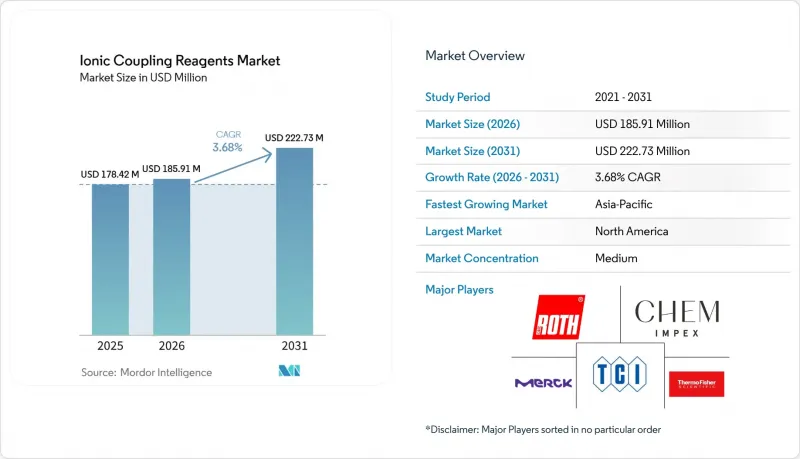
本報告按產品類型(脲基和胍基試劑、鏻基試劑)、形態(粉末和溶液)、應用(胜肽合成、藥物原料藥(API)合成等)和地區(亞太地區、北美地區、歐洲地區、南美地區、中東和非洲地區)進行細分。市場預測以美元計價。
全球離子耦合試劑市場趨勢及洞察
對肽類藥物的需求日益成長
離子耦合試劑市場直接受益於Glucagon-Like Peptide-1(GLP-1) 受體促效劑的商業性成功。這些藥物已推動肽合成從專案規模轉向工業規模生產。在固相胜肽合成 (SPPS) 中,合成30-40個胺基酸的胜肽鏈,偶聯步驟需要重複進行,如果反應效率降低,則每次循環的最終產率都會下降。因此,高反應活性的離子系統至關重要,因為即使每次偶聯步驟的微小改進也能降低雜質含量,並減輕整個大規模生產過程中的下游純化工作。 Bakem 在 2025 年指出,對 GLP-1 的需求正在推動胜肽生產向工業化平台模式發展。這意味著試劑的選擇不僅在各個研發階段至關重要,而且在整個合成過程中都至關重要。隨著新的 CDMO(合約開發和生產組織)胜肽生產線投入運作,離子耦合試劑市場也將受到正面影響。這是因為新設備的試運行為試劑的重新認證和供應商的更換創造了機會。默克在2025年也強調,胜肽片段的生物催化偶聯在複雜活性藥物成分(API)的合成中日益受到關注。這表明,儘管製造商正在結合不同的合成路線,但在標準的偶聯階段,他們仍然依賴離子試劑。
寡核苷酸藥物研發的拓展
離子耦合試劑市場正從核酸治療領域獲得新的需求,不再侷限於傳統的胜肽類藥物領域。在寡核苷酸合成流程中,離子偶聯化學被用於GalNAc連接子的偶聯、固相載體上的衍生化以及胜肽-寡核苷酸複合物的合成,其中精確的醯胺鍵形成至關重要。全球寡核苷酸合成市場預計到2026年將達到43.1億美元,這印證了相關合成需求對試劑供應商的重要性日益凸顯的觀點。隨著已通過核准和處於後期臨床階段的核酸藥物不斷推進GMP要求,包括高純度流程中使用的耦合試劑,這一轉變顯得尤為重要。因此,離子耦合試劑市場不僅將面臨來自寡核苷酸開發項目日益成長的需求,還將面臨更嚴格的品質標準,而這些標準將有利於那些在受監管的胜肽類藥物生產領域已站穩腳跟的成熟供應商。這一趨勢對於 GalNAc 標記的 siRNA 及相關療法中使用的產品尤其重要,因為對高純度的需求正在縮小合格供應商的選擇範圍。
先進離子耦合試劑高成本
離子耦合試劑市場面臨巨大的成本壁壘。這是因為高純度的HATU和COMU對生產和品管的要求比普通替代品更為嚴格。對於GLP-1和其他胜肽類藥物計畫而言,由於生產規模通常以公斤或噸為單位,試劑成本成為大量生產模式中最昂貴的經常性耗材之一。因此,採購團隊必須比較價格較低的選項,即使高品質的離子偶聯系統具有更高的偶聯效率或更低的雜質含量。學術機構和小規模生技公司感受到的壓力更為強烈,因為預算有限迫使他們選擇碳二亞胺類替代品,儘管這些替代品在處理複雜序列時表現較差。中國非專利級供應商與獲得GMP認證的歐美供應商之間,相同規格的試劑價格差異可能超過五倍,這導致受監管的客戶對供應商合格的審查更為嚴格。因此,儘管製藥業對離子耦合試劑的品質溢價較高,但成本敏感性仍然限制了它們在要求最苛刻的合成環境之外的廣泛應用。
細分市場分析
截至2025年,脲基和胍基試劑將佔離子耦合試劑市場58.21%的佔有率,成為製藥和研究領域整體需求的首選。這一主導地位源於它們在固相肽合成(SPPS)工作流程中的長期應用,其中HATU和HBTU的有效性已得到檢驗,並透過目錄和生產管道廣泛供應。這些試劑適用於具有挑戰性的偶聯反應,因為它們能夠形成高活性中間體,從而提高從標準到複雜胜肽序列的產率。離子耦合試劑市場繼續將此類試劑作為受監管胜肽合成的預設選擇,尤其是在製程重現性和反應動力學至關重要的情況下。目前,該類別正在發生顯著變化,因為新的良好生產規範(GMP)設施在合格過程中越來越關注包括HOBt在內的各種材料的安全性權衡。盧森堡生技公司已證明 COMU 是一種基於肟的替代品,具有低消旋化傾向和與微波輔助合成的兼容性,因此它在安全關鍵型工作流程中越來越受歡迎。
此外,預計到2031年,該類產品將以4.28%的複合年成長率成長,對於一個已佔據相當大佔有率的細分市場而言,這是一個值得關注的數字。這一趨勢反映了主要產品類別與成長最快的商業需求領域(尤其是在高規格藥物胜肽生產領域)的緊密契合。 TBTU和TOTU在對成本敏感的研究和合約合成中仍然發揮著至關重要的作用,這些領域序列複雜度較低,且不一定需要頂級性能。因此,儘管產品偏好已逐漸從傳統的HOBt體系轉向更安全的第三代鹽,但離子耦合試劑市場仍由脲基和胍基體系支撐。鏻基試劑在片段縮合和溶液相操作中仍然發揮著重要作用,但它們滿足的是更專業的需求,並且會受到注重安全性的客戶的嚴格審查。 Sigma-Aldrich 的胜肽偶聯選擇指南反映了這種二分法,PyBOP 和 PyAOP 定位於要求苛刻的偶聯反應,同時又不屬於以脲基系統為主導的更廣泛的銷售量基礎。
區域分析
到2025年,北美將佔據離子耦合試劑市場37.11%的佔有率,成為全球最大的區域銷售貢獻者。這一佔有率主要由美國推動,美國擁有密集的製藥設施以及大規模的合約研究組織(CRO)和合約開發與生產組織(CDMO)網路,這些機構對符合監管要求的試劑有著迫切的需求。美國FDA的GMP要求、ICH Q11要求以及美國危險物質處理法規,都對高品質的產品規格起到了保障作用,並限制了缺乏充分證明的替代品的使用。賽默飛世爾科技公司於2025年4月宣布將在美國投資20億美元用於生產製造和研發,這反映出供應商優先考慮國內製藥產能和相關試劑需求。加拿大學術界和中等規模的製藥合成企業的需求穩定,而墨西哥則憑藉其不斷成長的學名藥製造地為市場做出了貢獻,儘管其高規格原料仍依賴進口。
在德國、英國、法國和義大利的支持下,歐洲繼續保持其作為離子耦合試劑耦合試劑市場第二大地區的地位。該地區受益於強大的醫藥研發實力、成熟的特種化學品生產能力以及對標準和先進耦合試劑均有需求的科研生態系統。歐洲在產品創新方面也繼續發揮重要作用,Iris Biotech 和 Luxembourg Biotechnologies 等公司為特種試劑的開發和更安全替代品的提供做出了貢獻。歐盟的《化學品註冊、評估、授權和限制法規》(REACH) 以及與苯並三唑相關的日益成長的環境和處理問題影響了採購決策,尤其是在尋求更安全替代品的大規模合成工廠。這種壓力促使歐洲受監管的設施更加關注肟體系,儘管現有的實施流程仍減緩了轉型的步伐。
亞太地區預計到2031年將以4.93%的複合年成長率成長,主要得益於中國、印度、日本和韓國肽類和藥物化學能力的不斷增強,這四個國家在整個離子耦合試劑市場中代表著最高的成長率。中國作為不斷成長的需求中心和新興供應基地,表現尤為突出。 GL Biochem在中國經營一座佔地3.5萬平方公尺的胜肽類試劑生產設施,年產能達100噸。日本在高規格應用領域仍佔據重要地位,富士膠片和光純藥株式會社(FUJIFILM Wako)於2024年在大阪的擴建項目將進一步鞏固其在符合GMP規範的原料領域的地位。印度正在蓬勃發展,這得益於生產連結獎勵計畫(PLI)和CDMO市場的廣泛成長,預計將增加研發和商業採購的需求。韓國雖然在胜肽類原料藥的規模化生產方面比生物製藥領域更為先進,但隨著其製程化學能力的提升,預計未來全部區域韓國的需求也將不斷成長。雖然南美洲、中東和非洲仍然是相對小規模的市場,但巴西、阿根廷和沙烏地阿拉伯是重要的需求中心,未來應該密切關注。
其他好處:
- Excel格式的市場預測(ME)表
- 3個月的分析師支持
目錄
第1章:引言
- 研究假設和市場定義
- 調查範圍
第2章:調查方法
第3章執行摘要
第4章 市場狀況
- 市場概覽
- 市場促進因素
- 對高效肽耦合試劑的需求日益成長
- 基於胜肽的療法和基於寡核苷酸的藥物的研發正變得越來越活躍。
- 固相胜肽合成方法的日益普及
- 擴大製藥CDMO和CRO服務
- 人們對低消旋化和高產率偶聯化學方法的興趣日益濃厚。
- 市場限制因素
- 先進離子耦合試劑高成本
- 與某些苯並三唑試劑相關的安全性和穩定性問題
- 低成本碳二亞胺替代品的可用性
- 價值鏈分析
- 波特五力分析
第5章 市場規模與成長預測
- 依產品類型
- 鈾和胍基試劑
- 基於鏻的試劑
- 按形式
- 粉末
- 液體
- 透過使用
- 胜肽合成
- 原料藥(API)的合成
- 寡核苷酸合成
- 藥物化學
- 特種化學品和精細化學品的合成
- 學術研究
- 其他用途
- 按地區
- 亞太地區
- 中國
- 印度
- 日本
- 韓國
- 其他亞太國家
- 北美洲
- 美國
- 加拿大
- 墨西哥
- 歐洲
- 德國
- 英國
- 法國
- 義大利
- 俄羅斯
- 其他歐洲國家
- 南美洲
- 巴西
- 阿根廷
- 其他南美國家
- 中東和非洲
- 沙烏地阿拉伯
- 南非
- 其他中東和非洲國家
- 亞太地區
第6章 競爭情勢
- 市場集中度
- 策略趨勢
- 市佔率和排名分析
- 公司簡介
- AAPPTec
- Biosolve Chimie
- BLD Pharmatech Ltd.
- Carl Roth GmbH+Co. KG
- Chem-Impex
- Enamine Ltd.
- Fluorochem Ltd.
- FUJIFILM Wako Pure Chemical Corporation
- GL Biochem(Shanghai)Ltd.
- Iris Biotech GmbH
- Luxembourg Bio Technologies Ltd.
- Merck KGaA
- Santa Cruz Biotechnology, Inc.
- Suzhou Highfine Biotech Co., Ltd.
- Thermo Fisher Scientific Inc.
- Tokyo Chemical Industry Co., Ltd.
第7章 市場機會與未來展望
According to Mordor Intelligence, the ionic coupling reagents market size was valued at USD 178.42 million in 2025 and is estimated to grow from USD 185.91 million in 2026 to reach USD 222.73 million by 2031, at a CAGR of 3.68% during the forecast period (2026-2031).
This report is Segmented by Product Type (Uronium and Guanidinium-Based Reagent and Phosphonium-Based Reagents), Form (Powder and Solution), Application (Peptide Synthesis, Pharmaceutical API Synthesis, and More), and Geography (Asia-Pacific, North America, Europe, South America, and Middle-East and Africa). The Market Forecasts are Provided in Terms of Value (USD).
Global Ionic Coupling Reagents Market Trends and Insights
Growing Demand for Peptide-Based Therapeutics
The ionic coupling reagents market is receiving direct support from the commercial success of Glucagon-Like Peptide-1 (GLP-1) receptor agonists, as these drugs have shifted peptide synthesis from project-scale to industrial-scale production. Solid-phase peptide synthesis (SPPS) for 30- to 40-amino-acid chains involves repeated coupling steps, and each additional cycle can reduce the final yield when reaction efficiency declines. This makes high-reactivity ionic systems valuable, as even small gains in each coupling step can lower impurity loads and reduce downstream purification work across large production runs. Bachem stated in 2025 that GLP-1 demand is pushing peptide manufacturing toward industrialized platform models, meaning reagent choice now matters across the full synthesis train rather than only in isolated development steps. The ionic coupling reagents market also benefits when new Contract Development and Manufacturing Organization (CDMO) peptide lines come online, as fresh equipment commissioning often creates a window for reagent requalification and possible vendor changes. Merck also highlighted in 2025 that biocatalytic peptide fragment coupling is gaining attention for complex Active Pharmaceutical Ingredient (API) synthesis, suggesting manufacturers are combining different synthesis routes while still relying on ionic reagents for standard coupling stages.
Rising Development of Oligonucleotide-Based Drugs
The ionic coupling reagents market is gaining a new layer of demand from nucleic acid therapeutics, extending beyond its traditional peptide-focused base. In oligonucleotide workflows, ionic coupling chemistry is used in GalNAc linker conjugation, solid-support derivatization, and peptide-oligonucleotide conjugate synthesis, where precise amide bond formation remains important. The global oligonucleotide synthesis market reached USD 4.31 billion in 2026, supporting the view that adjacent synthesis demand is becoming material for reagent suppliers. This shift is significant because approved and late-stage nucleic acid drugs have already pushed GMP expectations deeper into upstream chemistry, including the coupling reagents used in high-purity workflows. The ionic coupling reagents market therefore gains not only more demand from oligonucleotide programs but also tighter quality standards that favor premium suppliers already established in regulated peptide manufacturing. This dynamic is especially relevant for products used in GalNAc-conjugated siRNA and related modalities, where high purity expectations narrow the field of acceptable vendors.
High Cost of Advanced Ionic Coupling Reagents
The ionic coupling reagents market faces a clear cost barrier, as high-purity HATU and COMU require more controlled production and tighter quality management than commodity alternatives. For GLP-1 and other peptide programs running at multi-kilogram or ton scale, reagent spend is one of the highest recurring consumable costs in a batch economics model. This leads procurement teams to compare premium ionic systems against less expensive options, even when premium products offer better coupling efficiency or lower impurity burden. Academic users and smaller biotech companies face this pressure more acutely, as limited budgets can push them toward carbodiimide-based substitutes despite lower performance in difficult sequences. The price gap between Chinese generic-grade suppliers and GMP-certified European or US sources can exceed 5-fold for the same nominal specification, which intensifies supplier qualification reviews in regulated accounts. As a result, the ionic coupling reagents market retains a quality premium in pharma, but cost sensitivity continues to limit broader adoption outside the most demanding synthesis settings.
Other drivers and restraints analyzed in the detailed report include:
- Increasing Adoption of Automated SPPS Platforms
- Expansion of Pharmaceutical API Manufacturing Infrastructure
- Safety and Stability Challenges with HOBt-Derived Reagents
For complete list of drivers and restraints, kindly check the Table Of Contents.
Segment Analysis
Uronium and guanidinium reagents held 58.21% of the ionic coupling reagents market share in 2025, making this class the product leader across pharmaceutical and research demand. Their lead stems from long-standing use in solid-phase peptide synthesis (SPPS) workflows, where HATU and HBTU remain validated and widely available across catalog and manufacturing channels. These reagents are used for difficult couplings because they form highly reactive intermediates that support better yields across both standard and challenging peptide sequences. The ionic coupling reagents market continues to rely on this class as the default choice in regulated peptide synthesis, particularly where process reproducibility is as important as reaction speed. A notable shift is now visible within the category, as newer Good Manufacturing Practice (GMP) sites increasingly review the safety trade-offs of HOBt-containing materials during qualification. Luxembourg Bio Technologies has documented COMU as an Oxyma-based alternative with low racemization tendency and compatibility with microwave-assisted synthesis, which explains its growing acceptance in safety-conscious workflows.
This class is also forecast to grow at a 4.28% CAGR through 2031, which is notable for a segment that already holds the majority of revenue. This pattern reflects how closely the leading product class aligns with the fastest-growing commercial demand pools, especially high-specification pharmaceutical peptide manufacturing. TBTU and TOTU still retain a role in cost-sensitive research and custom synthesis, where sequence complexity is lower and premium performance is not always required. The ionic coupling reagents market therefore remains anchored by uronium and guanidinium systems, even as product preference gradually shifts from legacy HOBt-based options toward safer third-generation salts. Phosphonium reagents remain relevant for fragment condensation and solution-phase work, but they serve more specialized needs and face greater scrutiny in safety-sensitive accounts. Sigma-Aldrich's peptide coupling selection guide reflects this split, with PyBOP and PyAOP positioned for demanding couplings while remaining outside the broader volume base controlled by uronium systems.
Complete Report Scope:
- By Product Type
- Uronium and Guanidinium-Based Reagents
- Phosphonium-Based Reagents
- By Form
- Powder
- Solution
- By Application
- Peptide Synthesis
- Pharmaceutical API Synthesis
- Oligonucleotide Synthesis
- Medicinal Chemistry
- Specialty and Fine Chemical Synthesis
- Academic Research
- Other Applications
- By Geography
- Asia-Pacific
- China
- India
- Japan
- South Korea
- Rest of Asia-Pacific
- North America
- United States
- Canada
- Mexico
- Europe
- Germany
- United Kingdom
- France
- Italy
- Russia
- Rest of Europe
- South America
- Brazil
- Argentina
- Rest of South America
- Middle-East and Africa
- Saudi Arabia
- South Africa
- Rest of Middle-East and Africa
- Asia-Pacific
Geography Analysis
North America accounted for 37.11% of the ionic coupling reagents market in 2025, making it the largest regional contributor to global revenue. The United States drove most of this share, combining a dense pharmaceutical base with a large Contract Research Organization (CRO) and Contract Development and Manufacturing Organization (CDMO) network that required regulated-grade reagents. FDA GMP requirements, International Council for Harmonisation (ICH) Q11 expectations, and US hazardous-handling regulations supported premium product specifications and limited the use of low-documentation alternatives. Thermo Fisher Scientific's April 2025 commitment of USD 2 billion to US manufacturing and R&D reflected the priority suppliers placed on domestic pharmaceutical production capacity and related reagent demand. Canada added steady demand from academic and mid-scale pharmaceutical synthesis, while Mexico contributed through a growing generic manufacturing base that remained dependent on imports for high-specification inputs.
Europe held the second-largest regional position in the ionic coupling reagents market, supported by Germany, the United Kingdom, France, and Italy. The region benefited from strong pharmaceutical R&D, established specialty chemical capabilities, and a research ecosystem that consumed both standard and advanced coupling reagents. Europe also remained relevant in product innovation, with Iris Biotech and Luxembourg Bio Technologies contributing to specialized reagent development and safer alternatives. EU Registration, Evaluation, Authorisation and Restriction of Chemicals (REACH) regulations and growing concerns around benzotriazole-linked environmental and handling issues influenced procurement decisions, particularly at larger synthesis sites seeking safer alternatives. This pressure drove greater attention toward Oxyma-based systems across European regulated facilities, although existing installed processes continued to slow the pace of transition.
Asia-Pacific is projected to grow at a 4.93% CAGR through 2031, the fastest rate across the ionic coupling reagents market, as China, India, Japan, and South Korea strengthen peptide and pharmaceutical chemistry capabilities. China stands out as both a growing demand center and an emerging supply base, with GL Biochem operating a 35,000-square-meter peptide reagent facility with an annual reagent output capacity of 100 metric tons. Japan remains relevant on the high-specification side, and FUJIFILM Wako's 2024 Osaka expansion supports its position in GMP-compliant raw materials. India is expanding under Production Linked Incentive (PLI) support and broader CDMO growth, which is expected to increase demand across research, development, and commercial procurement. South Korea is more advanced in peptide API scaling than in biologics, but its growing process chemistry capabilities are expected to expand regional demand over time. South America, the Middle East, and Africa remain smaller markets, with Brazil, Argentina, and Saudi Arabia representing the main forward-looking demand points.
- AAPPTec
- Biosolve Chimie
- BLD Pharmatech Ltd.
- Carl Roth GmbH + Co. KG
- Chem-Impex
- Enamine Ltd.
- Fluorochem Ltd.
- FUJIFILM Wako Pure Chemical Corporation
- GL Biochem (Shanghai) Ltd.
- Iris Biotech GmbH
- Luxembourg Bio Technologies Ltd.
- Merck KGaA
- Santa Cruz Biotechnology, Inc.
- Suzhou Highfine Biotech Co., Ltd.
- Thermo Fisher Scientific Inc.
- Tokyo Chemical Industry Co., Ltd.
Additional Benefits:
- The market estimate (ME) sheet in Excel format
- 3 months of analyst support
TABLE OF CONTENTS
1 Introduction
- 1.1 Study Assumptions and Market Definition
- 1.2 Scope of the Study
2 Research Methodology
3 Executive Summary
4 Market Landscape
- 4.1 Market Overview
- 4.2 Market Drivers
- 4.2.1 Growing Demand for High-Efficiency Peptide Coupling Reagents
- 4.2.2 Rising Development of Peptide Therapeutics and Oligonucleotide Drugs
- 4.2.3 Increasing Adoption of Solid-Phase Peptide Synthesis
- 4.2.4 Expansion of Pharmaceutical CDMO and CRO Services
- 4.2.5 Growing Preference for Low-Racemization and High-Yield Coupling Chemistries
- 4.3 Market Restraints
- 4.3.1 High Cost of Advanced Ionic Coupling Reagents
- 4.3.2 Safety and Stability Concerns Associated With Certain Benzotriazole-Based Reagents
- 4.3.3 Availability of Lower-Cost Carbodiimide Alternatives
- 4.4 Value Chain Analysis
- 4.5 Porter's Five Forces Analysis
- 4.5.1 Threat of New Entrants
- 4.5.2 Bargaining Power of Suppliers
- 4.5.3 Bargaining Power of Buyers
- 4.5.4 Threat of Substitutes
- 4.5.5 Competitive Rivalry
5 Market Size and Growth Forecasts (Value)
- 5.1 By Product Type
- 5.1.1 Uronium and Guanidinium-Based Reagents
- 5.1.2 Phosphonium-Based Reagents
- 5.2 By Form
- 5.2.1 Powder
- 5.2.2 Solution
- 5.3 By Application
- 5.3.1 Peptide Synthesis
- 5.3.2 Pharmaceutical API Synthesis
- 5.3.3 Oligonucleotide Synthesis
- 5.3.4 Medicinal Chemistry
- 5.3.5 Specialty and Fine Chemical Synthesis
- 5.3.6 Academic Research
- 5.3.7 Other Applications
- 5.4 By Geography
- 5.4.1 Asia-Pacific
- 5.4.1.1 China
- 5.4.1.2 India
- 5.4.1.3 Japan
- 5.4.1.4 South Korea
- 5.4.1.5 Rest of Asia-Pacific
- 5.4.2 North America
- 5.4.2.1 United States
- 5.4.2.2 Canada
- 5.4.2.3 Mexico
- 5.4.3 Europe
- 5.4.3.1 Germany
- 5.4.3.2 United Kingdom
- 5.4.3.3 France
- 5.4.3.4 Italy
- 5.4.3.5 Russia
- 5.4.3.6 Rest of Europe
- 5.4.4 South America
- 5.4.4.1 Brazil
- 5.4.4.2 Argentina
- 5.4.4.3 Rest of South America
- 5.4.5 Middle-East and Africa
- 5.4.5.1 Saudi Arabia
- 5.4.5.2 South Africa
- 5.4.5.3 Rest of Middle-East and Africa
- 5.4.1 Asia-Pacific
6 Competitive Landscape
- 6.1 Market Concentration
- 6.2 Strategic Moves
- 6.3 Market Share (%)/Ranking Analysis
- 6.4 Company Profiles (includes Global Overview, Market Overview, Core Segments, Financials as available, Strategic Information, Products and Services, and Recent Developments)
- 6.4.1 AAPPTec
- 6.4.2 Biosolve Chimie
- 6.4.3 BLD Pharmatech Ltd.
- 6.4.4 Carl Roth GmbH + Co. KG
- 6.4.5 Chem-Impex
- 6.4.6 Enamine Ltd.
- 6.4.7 Fluorochem Ltd.
- 6.4.8 FUJIFILM Wako Pure Chemical Corporation
- 6.4.9 GL Biochem (Shanghai) Ltd.
- 6.4.10 Iris Biotech GmbH
- 6.4.11 Luxembourg Bio Technologies Ltd.
- 6.4.12 Merck KGaA
- 6.4.13 Santa Cruz Biotechnology, Inc.
- 6.4.14 Suzhou Highfine Biotech Co., Ltd.
- 6.4.15 Thermo Fisher Scientific Inc.
- 6.4.16 Tokyo Chemical Industry Co., Ltd.
7 Market Opportunities and Future Outlook
- 7.1 White-Space and Unmet-Need Assessment

 整體軸磁粉離合器市場:全球市場預測,2026-2032年管道疏通機市場:全球市場預測(2026-2032年)
 金屬波紋管聯軸器市場規模、佔有率和成長分析:按聯軸器類型、材質、應用、最終用戶、內徑和地區分類-2026-2033年產業預測聯軸器維修和翻新服務市場:全球市場預測(2026-2032)高速蛇形彈簧聯軸器市場:全球市場預測,2026-2032年
 奧爾德漢姆聯軸器市場規模、佔有率和成長分析:按產品類型、材料、應用、最終用戶產業、扭力容量、分銷管道和地區分類-2026-2033年產業預測
 工業聯軸器:市場佔有率分析、產業趨勢與統計、成長預測(2026-2031)
 冗餘關節裝置市場規模、佔有率和成長分析:按產品類型、應用、最終用戶、自由度、驅動系統和地區分類 - 產業預測,2026-2033 年
 排氣軟性聯軸器市場規模、佔有率和成長分析:按產品類型、車輛類型、材質、應用、銷售管道、最終用戶和地區分類-2026-2033年產業預測工業聯軸器市場:2026-2032年全球市場預測(依產品類型、材質、扭力容許量、價格範圍、通路、最終用途設備及最終用戶分類)