


 |
市場調查報告書
商品編碼
2116868
工業聯軸器:市場佔有率分析、產業趨勢與統計、成長預測(2026-2031)Industrial Couplings - Market Share Analysis, Industry Trends & Statistics, Growth Forecasts (2026 - 2031) |
||||||

※ 本網頁內容可能與最新版本有所差異。詳細情況請與我們聯繫。
預計到 2026 年,工業聯軸器市場規模將達到 3.9696 億美元,年複合成長率為 9.11%,到 2031 年將達到 6.1387 億美元。
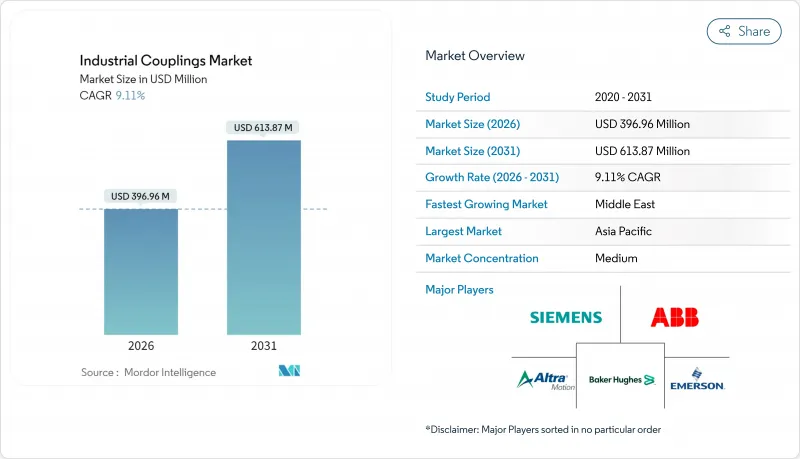
本報告按類型(軟性聯軸器、剛性聯軸器等)、材質(不銹鋼、鋁、複合材料等)、扭矩範圍(低扭矩(小於 500 Nm)、中扭矩(500-5,000 Nm)、高扭矩(大於 5,000 Nm))、分銷用戶行業(汽車、醫療、其他地區)、市場進行市場市場細分市場進行細分市場(OEM、醫療、其他地區)。市場預測以美元(USD)計價。
全球工業聯軸器市場趨勢與洞察
在精密運動控制系統中得到更廣泛的應用
在半導體微影術、機器人手術和坐標測量機等領域,需要能夠承受超過 1000 Nm 的扭矩峰值,同時將角位移控制在 0.5° 以內的聯軸器。波紋管式和盤式聯軸器現在已成為標準配置,因為它們能夠吸收軸向和徑向位移而不會產生反沖,並保持微米級的定位精度。例如,極紫外線 (EUV) 設備採用多級組件,將晶圓台的振動與光罩托架隔離,從而保持每小時超過 170 片晶圓的處理能力。在電子組裝中使用的協作機器人中,免維護聯軸器更受歡迎,因為它們可以在五年內將總擁有成本降低四分之一。隨著 ISO 9409 法蘭的全球標準化,供應商將能夠為多個行業儲備單一 SKU,從而減少庫存並快速推出客製化產品。
高速電動動力傳動系統應用範圍擴大
電池驅動系統的轉速為 12,000 至 20,000 轉/分,是傳統內燃機最高轉速的兩倍,這迫使聯軸器供應商將平衡等級提升至 G2.5 或更高。衝擊負荷可能超過額定扭力的三倍,為了應對這個問題,人們正在研發彈性體嵌件方面的技術創新,使其在負載下剛度逐漸增加。混合動力卡車中使用的雙輸入聯軸器可以調節柴油和電力動力源之間的扭力分配,同時補償整個長軸上幾毫米的熱膨脹。美國能源局證明,效率提升 1.2 個百分點,相當於每次充電循環可增加 4 至 6 公里的續航里程。諸如歐盟 7 排放標準等監管趨勢也在推動這項技術的應用,用於動力傳動系統重新設計的預算正被重新分配到速度更快的聯軸器解決方案上。
鍛造鋼和特殊合金的價格波動
受鐵礦石供應緊張的影響,2025年初鍛鋼坯價格飆升18%,但隨著中國鋼廠增產,年中價格回落12%。鎳合金附加費在每公斤4.20美元至6.80美元之間波動,擠壓了未採取避險措施的供應商的利潤空間。年銷售額低於5000萬美元的中小型製造商的服務中心定價權大幅下降,迫使他們採用季度轉嫁條款。這種做法延長了採購週期,並加劇了客戶關係緊張。用於扭力超過5000牛頓米的接頭所需的真空電弧重熔合金,使鋼材基礎成本每公斤增加8至12美元,進一步加大了特種產品線的壓力。
細分市場分析
預計到2025年,軟性聯軸器將佔銷售額的49.13%,充分展現了其在壓縮機、暖通空調鼓風機和汽車組裝等應用中的多功能性。同時,磁性聯軸器在製藥和半導體工廠中以10.22%的複合年成長率快速成長,因為這些工廠對密封洩漏的要求極高。隨著氫電解和濕蝕刻設備在全球的普及,採用磁性設計的工業聯軸器的市場規模預計將顯著擴大。剛性聯軸器在軸向偏差限制在0.02毫米以內的研磨上仍然佔據主導地位,而液力聯軸器則廣泛應用於礦用運輸卡車,因為這些車輛需要在啟動時放大扭力。萬向節系統用於農業和施工機械,這些機械需要適應超過10°的角度偏差。波紋管聯軸器應用於高階醫療市場,例如MRI機架,在這些應用中,零背隙可維持亞微米級的精度,而彈性體嵌件則可抑制變頻暖通空調驅動器中的扭轉振動。
採用碳纖維輪轂的輕量化盤式聯軸器可將轉動慣量降低35%,從而提高機器人加速度並縮短取放週期。結合彈性體阻尼器和金屬組件的混合設計正開始應用於風力發電機變驅動裝置中,以應對超過50,000牛頓米的緊急扭力負載。為符合歐盟機械法規2023/1230的要求,供應商必須在協作機器人聯軸器中整合故障安全機械熔斷器。雖然這項要求可能會增加認證成本,但它將保護現有企業免受專注於價格競爭的新進入者的衝擊。總而言之,產品類型的多樣化將有助於在工業聯軸器市場應對終端用戶需求波動時,維持更具韌性的收入來源。
預計到2025年,碳鋼的銷售量將佔總銷售量的37.28%。這主要得益於其在500-5000牛頓米扭力範圍內實現了每公斤低於2.50美元的成本目標。雖然不銹鋼符合食品和製藥行業嚴格的衛生標準,但由於拋光和鈍化工藝,其每件產品需額外增加12-18美元的成本,因此在腐蝕風險可接受的領域,其他材料仍有發展空間。複合材料輪轂的複合年成長率高達10.29%,是航太執行器和手術機器人的理想選擇,因為這些設備需要減輕幾克的重量以延長任務壽命並減輕外科醫生的疲勞。由於碳纖維增強PEEK和鈦合金在提供相當剛度的同時還能顯著減輕重量,碳鋼在工業聯軸器市場的佔有率可能會逐漸下降。鋁材由於其低轉動慣量和高加速度,在扭矩低於1000牛頓米的織布機和貼標機中仍運作重要作用。
積層製造技術能夠製造出最佳化剛度重量比的晶格結構,同時還能嵌入感測器腔,而無需模具成本。剩下的挑戰在於價格。複合材料單元的零售價為 150 至 300 美元,而鋼製單元的成本僅為 30 至 60 美元,這限制了它們的應用範圍,使其僅限於性能遠超資本投入的應用領域。然而,隨著高速馬達驅動的日益普及,透過降低轉動慣量可以顯著節省能源,從而比鋼鐵製造商降低原料價格更快地縮小經濟差距。
區域分析
預計到2025年,亞太地區將佔全球銷售額的42.76%。這主要得益於中國預計新增3,000萬輛汽車產量,以及印度斥資260億美元刺激電子、醫藥和先進材料產業發展。在日本,扭力超過1000牛頓米、同心度達到亞微米級的半導體微影術聯軸器仍保持著高階市場需求;韓國造船廠則訂購了額定扭矩超過50000牛頓米的重型船用聯軸器。澳洲的採礦業,包括預計2025年將生產的9億噸鐵礦石,持續推動運輸卡車和輸送機用高扭矩減震器的訂單。政府主導的基礎設施投資每年超過1.5兆美元,正在刺激地鐵、海水淡化廠和石化中心的建設,而這些項目都需要種類繁多的聯軸器。
預計中東地區將以10.17%的複合年成長率成長,沙烏地阿拉伯投資5,000億美元的NEOM工業園區和阿拉伯聯合大公國下游石化產業的擴張正推動著該地區的發展。 2025年,阿拉伯聯合大公國下游石化產業將新增400萬噸聚乙烯產能。卡達的諾斯菲爾德液化天然氣擴建計畫指定使用符合API 610標準的低溫應用泵接頭,而埃及的蘇伊士運河經濟特區則吸引了許多紡織和食品加工企業,這些企業對軟性或彈性體裝置進行了標準化。讓當地法規與ISO標準接軌,可以縮短審核時間,並降低跨國供應商的在地化成本。
預計到2025年,北美和歐洲合計將佔全球銷售額的約45%,主要驅動力是老舊工廠的替換購置和為提高能源效率維修。美國的《晶片科學法案》(CHIPS Science Act)正在加速亞利桑那州、德克薩斯州和俄亥俄州半導體製造廠的建設,這些工廠的晶圓處理和氣體供應模組均採用精密耦合器。德國的能源轉型(Energiewende)政策正在加速風力發電機的安裝,這些渦輪機需要經認證可使用20年的變槳驅動阻尼器。加拿大的發電工程和挪威的離岸風力發電叢集進一步擴大了高扭矩產品的潛在市場。在南美洲,預計將實現中等個位數的成長,主要成長動力來自巴西的甘蔗加工廠和阿根廷的頁岩氣鑽探設施。另一方面,由於基礎設施不足和外匯波動,非洲市場仍處於起步階段,目前僅限於南非的採礦業和埃及的工業走廊。
其他好處:
- Excel格式的市場預測(ME)表
- 3個月的分析師支持
目錄
第1章:引言
- 研究假設和市場定義
- 調查範圍
第2章:調查方法
第3章執行摘要
第4章 市場狀況
- 市場概覽
- 市場促進因素
- 在精密運動控制系統中得到更廣泛的應用
- 擴大高速電動動力傳動系統的應用
- 綠氫電解設備需求增加
- 增加對自動化物流設備的投資
- 人工智慧驅動的預測性維護平台的出現。
- 政府對國內製造地的優惠待遇
- 市場限制因素
- 鍛造鋼和特殊合金的價格波動
- 來自直驅馬達架構的競爭威脅
- 流程工業的更新周期較長
- 新興國家熟練安裝人員短缺
- 產業價值鏈分析
- 宏觀經濟因素對市場的影響
- 監理情勢
- 技術展望
- 波特五力分析
- 投資分析
第5章 市場規模與成長預測
- 按類型
- 軟性聯軸器
- 剛性耦合
- 流體耦合
- 磁耦合
- 萬向節聯軸器
- 材料
- 碳鋼
- 不銹鋼
- 鋁
- 複合材料
- 其他材料
- 扭力範圍
- 低(小於 500 牛頓米)
- 中(500-5,000 牛頓米)
- 高(超過 5,000 牛頓米)
- 按最終用戶行業分類
- 車
- 航太/國防
- 石油和天然氣
- 衛生保健
- 金屬和採礦
- 發電
- 食品/飲料
- 其他終端用戶產業
- 透過分銷管道
- OEM
- 售後市場
- 按地區
- 北美洲
- 美國
- 加拿大
- 墨西哥
- 歐洲
- 德國
- 英國
- 法國
- 俄羅斯
- 其他歐洲國家
- 亞太地區
- 中國
- 日本
- 印度
- 韓國
- 澳洲
- 其他亞太國家
- 中東和非洲
- 中東
- 沙烏地阿拉伯
- 阿拉伯聯合大公國
- 其他中東國家
- 非洲
- 南非
- 埃及
- 其他非洲國家
- 中東
- 南美洲
- 巴西
- 阿根廷
- 其他南美國家
- 北美洲
第6章 競爭情勢
- 市場集中度
- 策略趨勢
- 市佔率分析
- 公司簡介
- Altra Industrial Motion Corp.
- Regal Rexnord Corporation
- KTR Systems GmbH
- Siemens AG
- ABB Ltd
- Emerson Electric Co.
- Baker Hughes Company
- SKF AB
- Lovejoy Inc.
- John Crane Ltd.
- Voith GmbH and Co. KGaA
- Renold PLC
- Ruland Manufacturing Co.
- Coupling Corporation of America
- Dodge Industrial Inc.
- Tsubakimoto Chain Co.
- VULKAN Group
- Lord Corporation
- Ringfeder Power Transmission
- Industrial Clutch Parts Ltd.
- Rexnord Kette GmbH
- Hauri Couplings
第7章 市場機會與未來展望
According to Mordor Intelligence, the industrial couplings market size stood at USD 396.96 million in 2026 and, with a 9.11% CAGR, is projected to reach USD 613.87 million by 2031.
This report is Segmented by Type (Flexible Coupling, Rigid Coupling, and More), Material (Stainless Steel, Aluminum, Composite Materials, and More), Torque Range (Low (Below 500 Nm), Medium (500-5, 000 Nm), and High (Above 5, 000 Nm)), End-User Industry (Automotive, Healthcare, and More), Distribution Channel (OEM, and Aftermarket), and Geography. Market Forecasts are Provided in Terms of Value (USD).
Global Industrial Couplings Market Trends and Insights
Expanding Use in Precision Motion-Control Systems
Semiconductor lithography, robotic surgery, and coordinate measuring machines demand couplings that maintain angular misalignment below 0.5° while withstanding torque spikes above 1,000 Nm. Bellows and disc formats are now the default because they absorb axial and radial displacement without introducing backlash, preserving micron-level positioning accuracy. Extreme-ultraviolet tools, for instance, rely on multi-stage assemblies that decouple wafer-stage vibration from the reticle carriage, sustaining throughput above 170 wafers per hour. Collaborative robots used in electronics assembly further favor zero-maintenance couplings that reduce total ownership cost by a quarter over five years. As ISO 9409 flanges converge globally, suppliers can stock a single SKU for multiple verticals, cutting inventory and accelerating custom releases.
Growing Adoption in High-Speed Electric Powertrains
Battery-electric drivetrains operate at 12,000-20,000 rpm, twice the ceiling of legacy combustion units, compelling coupling vendors to tighten balance grades to G2.5 or finer. Shock loads can exceed nominal torque by a factor of 3, prompting elastomeric insert innovations that stiffen progressively under load. Dual-input couplings in hybrid trucks moderate torque blending between diesel and electric sources while compensating for multi-millimeter thermal expansion across long shafts. Efficiency gains of 1.2 percentage points, documented by the United States Department of Energy, translate into 4-6 km of extra range per charge cycle. Regulatory momentum, such as Euro 7 tailpipe limits, also nudges adoption, channeling drivetrain redesign budgets toward higher-speed coupling solutions.
Volatility in Forged Steel and Specialty Alloy Prices
Forged-steel billet values spiked 18% early in 2025 due to iron-ore supply constraints, then fell 12% by mid-year as Chinese mills lifted output. Nickel-alloy surcharges fluctuated between USD 4.20 and USD 6.80 per kilogram, squeezing suppliers' margins for those without hedging programs. Smaller manufacturers with revenue below USD 50 million face steep pricing power deficits at service centers and must adopt quarterly pass-through clauses, a practice that elongates purchase cycles and strains client relationships. Vacuum-arc-remelted alloys, required for couplings above 5,000 Nm, add USD 8-12 per kilogram to base steel cost, intensifying the pressure on specialty product lines.
Other drivers and restraints analyzed in the detailed report include:
- Rising Demand from Green Hydrogen Electrolyzers
- Increased Investments in Automated Intralogistics Equipment
- Competitive Threat from Direct-Drive Motor Architectures
For complete list of drivers and restraints, kindly check the Table Of Contents.
Segment Analysis
Flexible couplings retained 49.13% of revenue in 2025, underscoring their versatility across compressors, HVAC blowers, and automotive assembly lines. Magnetic units, however, are surging ahead at a 10.22% CAGR because pharmaceutical and semiconductor plants cannot afford seal leakage. The industrial couplings market size for magnetic designs is projected to widen substantially as hydrogen electrolyzers and wet-etch tools roll out worldwide. Rigid formats persist in grinding machines where shafts stay aligned within 0.02 mm, while fluid couplings dominate mining haul trucks that crave torque multiplication during startup. Universal-joint styles are used in agricultural and construction equipment that must accommodate more than 10° of angular misalignment. Bellows couplings occupy premium healthcare niches such as MRI gantries, where zero backlash sustains sub-micron accuracy, and elastomeric inserts damp torsional vibration in variable-frequency HVAC drives.
Lightweight disc couplings with carbon-fiber hubs, which cut inertia by 35%, help robots achieve faster acceleration and shorten pick-and-place cycle times. Hybrid designs combining elastomeric dampers with metallic packs now appear in wind-turbine pitch drives that face emergency torque loads above 50,000 Nm. Compliance pressure from the European Union's Machinery Regulation 2023/1230 obliges suppliers to integrate fail-safe mechanical fuses on collaborative-robot couplings, a requirement that may swell certification spending but shields incumbents from price-led entrants. Taken together, type diversification supports more resilient revenue streams as the industrial couplings market navigates end-user volatility.
Carbon steel accounted for 37.28% of volume in 2025 because it met cost targets below USD 2.50 per kilogram in the 500-5,000 Nm segment. Stainless steel meets stringent hygienic codes in food and pharma, yet polishing and passivation add USD 12-18 per unit, leaving room for substitution wherever corrosion risks are acceptable. Composite hubs, climbing at a 10.29% CAGR, resonate with aerospace actuators and surgical robots that shave grams to extend mission life or minimize surgeon fatigue. The industrial couplings market share for carbon steel may erode gradually as carbon-fiber-reinforced PEEK and titanium alloys demonstrate comparable stiffness at dramatic weight reductions. Aluminum retains a role in textile looms and labelers that run below 1,000 Nm because its low inertia fosters high acceleration.
Additive manufacturing unlocks latticed geometries that optimize stiffness-to-weight ratios while embedding sensor cavities at no tooling cost. The trade-off remains price: composite units retail at USD 150-300, compared with USD 30-60 for steel, limiting adoption to applications where performance trumps capex. As high-speed electric drives proliferate, however, inertia reduction delivers measurable energy savings, closing the economic gap faster than steel producers can discount raw stock.
Complete Report Scope:
- By Type
- Flexible Coupling
- Rigid Coupling
- Fluid Coupling
- Magnetic Coupling
- Universal Joint Coupling
- By Material
- Carbon Steel
- Stainless Steel
- Aluminum
- Composite Materials
- Other Materials
- By Torque Range
- Low (Below 500 Nm)
- Medium (500-5,000 Nm)
- High (Above 5,000 Nm)
- By End-user Industry
- Automotive
- Aerospace and Defence
- Oil and Gas
- Healthcare
- Metal and Mining
- Power Generation
- Food and Beverage
- Other End-user Industries
- By Distribution Channel
- OEM
- Aftermarket
- By Geography
- North America
- United States
- Canada
- Mexico
- Europe
- Germany
- United Kingdom
- France
- Russia
- Rest of Europe
- Asia-Pacific
- China
- Japan
- India
- South Korea
- Australia
- Rest of Asia-Pacific
- Middle East and Africa
- Middle East
- Saudi Arabia
- United Arab Emirates
- Rest of Middle East
- Africa
- South Africa
- Egypt
- Rest of Africa
- Middle East
- South America
- Brazil
- Argentina
- Rest of South America
- North America
Geography Analysis
Asia-Pacific supplied 42.76% of global revenue in 2025, buoyed by China's 30-million-unit vehicle output and India's USD 26 billion incentive packages for electronics, pharmaceuticals, and advanced materials. Japan maintains premium demand for semiconductor lithography couplings that run beyond 1,000 Nm with sub-micron concentricity, while South Korean shipyards order heavy-duty marine couplings rated above 50,000 Nm. Australia's mining output, including 900 million t of iron ore in 2025, supports continuous orders for high-torque dampers in haul trucks and conveyors. Government-backed infrastructure spending above USD 1.5 trillion per year stimulates pipelines of metro rails, desalination plants, and petrochemical hubs, each requiring diverse coupling families.
The Middle East, forecast to grow at a 10.17% CAGR, benefits from Saudi Arabia's USD 500 billion NEOM industrial zone and the United Arab Emirates' downstream petrochemical expansion, which added 4 million t of polyethylene capacity in 2025. Qatar's North Field LNG expansion specifies API 610 pump couplings for cryogenic service, while Egypt's Suez Canal Economic Zone draws textile and food processors that standardize on flexible or elastomeric units. Harmonizing local regulations with ISO standards shortens approval timelines and lowers localization costs for multinational suppliers.
North America and Europe together represented roughly 45% of 2025 turnover, mainly replacement purchases in older factories and energy-efficiency retrofits. The United States CHIPS and Science Act unlocks semiconductor fabs in Arizona, Texas, and Ohio, each of which consumes precision couplings for wafer handling and gas-delivery modules. Germany's Energiewende is accelerating wind-turbine installations that require pitch-drive dampers certified for 20-year life. Canada's hydro projects and Norway's offshore wind clusters further expand the high-torque addressable base. South America registers mid-single-digit growth, concentrated in Brazil's sugarcane mills and Argentina's shale rigs, while Africa remains an early-stage play confined to South African mining and Egyptian industrial corridors due to infrastructure gaps and currency volatility.
- Altra Industrial Motion Corp.
- Regal Rexnord Corporation
- KTR Systems GmbH
- Siemens AG
- ABB Ltd
- Emerson Electric Co.
- Baker Hughes Company
- SKF AB
- Lovejoy Inc.
- John Crane Ltd.
- Voith GmbH and Co. KGaA
- Renold PLC
- Ruland Manufacturing Co.
- Coupling Corporation of America
- Dodge Industrial Inc.
- Tsubakimoto Chain Co.
- VULKAN Group
- Lord Corporation
- Ringfeder Power Transmission
- Industrial Clutch Parts Ltd.
- Rexnord Kette GmbH
- Hauri Couplings
Additional Benefits:
- The market estimate (ME) sheet in Excel format
- 3 months of analyst support
TABLE OF CONTENTS
1 INTRODUCTION
- 1.1 Study Assumptions and Market Definition
- 1.2 Scope of the Study
2 RESEARCH METHODOLOGY
3 EXECUTIVE SUMMARY
4 MARKET LANDSCAPE
- 4.1 Market Overview
- 4.2 Market Drivers
- 4.2.1 Expanding Use In Precision Motion-Control Systems
- 4.2.2 Growing Adoption In High-Speed Electric Powertrains
- 4.2.3 Rising Demand From Green Hydrogen Electrolyzers
- 4.2.4 Increased Investments In Automated Intralogistics Equipment
- 4.2.5 Emergence Of AI-Enabled Predictive Maintenance Platforms
- 4.2.6 Government Incentives For Domestic Manufacturing Hubs
- 4.3 Market Restraints
- 4.3.1 Volatility In Forged Steel And Specialty Alloy Prices
- 4.3.2 Competitive Threat From Direct-Drive Motor Architectures
- 4.3.3 Long Replacement Cycles In Process Industries
- 4.3.4 Lack Of Skilled Installers In Emerging Economies
- 4.4 Industry Value Chain Analysis
- 4.5 Impact of Macroeconomic Factors on the Market
- 4.6 Regulatory Landscape
- 4.7 Technological Outlook
- 4.8 Porter's Five Forces Analysis
- 4.8.1 Bargaining Power of Suppliers
- 4.8.2 Bargaining Power of Buyers
- 4.8.3 Threat of New Entrants
- 4.8.4 Threat of Substitutes
- 4.8.5 Intensity of Competitive Rivalry
- 4.9 Investment Analysis
5 MARKET SIZE AND GROWTH FORECASTS (VALUE)
- 5.1 By Type
- 5.1.1 Flexible Coupling
- 5.1.2 Rigid Coupling
- 5.1.3 Fluid Coupling
- 5.1.4 Magnetic Coupling
- 5.1.5 Universal Joint Coupling
- 5.2 By Material
- 5.2.1 Carbon Steel
- 5.2.2 Stainless Steel
- 5.2.3 Aluminum
- 5.2.4 Composite Materials
- 5.2.5 Other Materials
- 5.3 By Torque Range
- 5.3.1 Low (Below 500 Nm)
- 5.3.2 Medium (500-5,000 Nm)
- 5.3.3 High (Above 5,000 Nm)
- 5.4 By End-user Industry
- 5.4.1 Automotive
- 5.4.2 Aerospace and Defence
- 5.4.3 Oil and Gas
- 5.4.4 Healthcare
- 5.4.5 Metal and Mining
- 5.4.6 Power Generation
- 5.4.7 Food and Beverage
- 5.4.8 Other End-user Industries
- 5.5 By Distribution Channel
- 5.5.1 OEM
- 5.5.2 Aftermarket
- 5.6 By Geography
- 5.6.1 North America
- 5.6.1.1 United States
- 5.6.1.2 Canada
- 5.6.1.3 Mexico
- 5.6.2 Europe
- 5.6.2.1 Germany
- 5.6.2.2 United Kingdom
- 5.6.2.3 France
- 5.6.2.4 Russia
- 5.6.2.5 Rest of Europe
- 5.6.3 Asia-Pacific
- 5.6.3.1 China
- 5.6.3.2 Japan
- 5.6.3.3 India
- 5.6.3.4 South Korea
- 5.6.3.5 Australia
- 5.6.3.6 Rest of Asia-Pacific
- 5.6.4 Middle East and Africa
- 5.6.4.1 Middle East
- 5.6.4.1.1 Saudi Arabia
- 5.6.4.1.2 United Arab Emirates
- 5.6.4.1.3 Rest of Middle East
- 5.6.4.2 Africa
- 5.6.4.2.1 South Africa
- 5.6.4.2.2 Egypt
- 5.6.4.2.3 Rest of Africa
- 5.6.4.1 Middle East
- 5.6.5 South America
- 5.6.5.1 Brazil
- 5.6.5.2 Argentina
- 5.6.5.3 Rest of South America
- 5.6.1 North America
6 COMPETITIVE LANDSCAPE
- 6.1 Market Concentration
- 6.2 Strategic Moves
- 6.3 Market Share Analysis
- 6.4 Company Profiles (includes Global Level Overview, Market Level Overview, Core Segments, Financials as available, Strategic Information, Market Rank/Share for key companies, Products and Services, and Recent Developments)
- 6.4.1 Altra Industrial Motion Corp.
- 6.4.2 Regal Rexnord Corporation
- 6.4.3 KTR Systems GmbH
- 6.4.4 Siemens AG
- 6.4.5 ABB Ltd
- 6.4.6 Emerson Electric Co.
- 6.4.7 Baker Hughes Company
- 6.4.8 SKF AB
- 6.4.9 Lovejoy Inc.
- 6.4.10 John Crane Ltd.
- 6.4.11 Voith GmbH and Co. KGaA
- 6.4.12 Renold PLC
- 6.4.13 Ruland Manufacturing Co.
- 6.4.14 Coupling Corporation of America
- 6.4.15 Dodge Industrial Inc.
- 6.4.16 Tsubakimoto Chain Co.
- 6.4.17 VULKAN Group
- 6.4.18 Lord Corporation
- 6.4.19 Ringfeder Power Transmission
- 6.4.20 Industrial Clutch Parts Ltd.
- 6.4.21 Rexnord Kette GmbH
- 6.4.22 Hauri Couplings
7 MARKET OPPORTUNITIES AND FUTURE OUTLOOK
- 7.1 White-space and Unmet-need Assessment

 整體軸磁粉離合器市場:全球市場預測,2026-2032年管道疏通機市場:全球市場預測(2026-2032年)
 金屬波紋管聯軸器市場規模、佔有率和成長分析:按聯軸器類型、材質、應用、最終用戶、內徑和地區分類-2026-2033年產業預測聯軸器維修和翻新服務市場:全球市場預測(2026-2032)高速蛇形彈簧聯軸器市場:全球市場預測,2026-2032年
 奧爾德漢姆聯軸器市場規模、佔有率和成長分析:按產品類型、材料、應用、最終用戶產業、扭力容量、分銷管道和地區分類-2026-2033年產業預測
 冗餘關節裝置市場規模、佔有率和成長分析:按產品類型、應用、最終用戶、自由度、驅動系統和地區分類 - 產業預測,2026-2033 年
 離子耦合試劑:市佔率分析、產業趨勢與統計、成長預測(2026-2031)
 排氣軟性聯軸器市場規模、佔有率和成長分析:按產品類型、車輛類型、材質、應用、銷售管道、最終用戶和地區分類-2026-2033年產業預測工業聯軸器市場:2026-2032年全球市場預測(依產品類型、材質、扭力容許量、價格範圍、通路、最終用途設備及最終用戶分類)