


 |
市場調查報告書
商品編碼
2118168
主權金鑰管理系統軟體:市場佔有率分析、產業趨勢與統計、成長預測(2026-2031)Sovereign Key Management Systems Software - Market Share Analysis, Industry Trends & Statistics, Growth Forecasts (2026 - 2031) |
||||||

※ 本網頁內容可能與最新版本有所差異。詳細情況請與我們聯繫。
根據 Mordor Intelligence 預測,主權金鑰管理系統軟體市場規模將從 2025 年的 89.2 億美元和 2026 年的 103.6 億美元成長到 2031 年的 268.4 億美元,2026 年至 2031 年的年複合成長率(CAGR)為 20.97%。
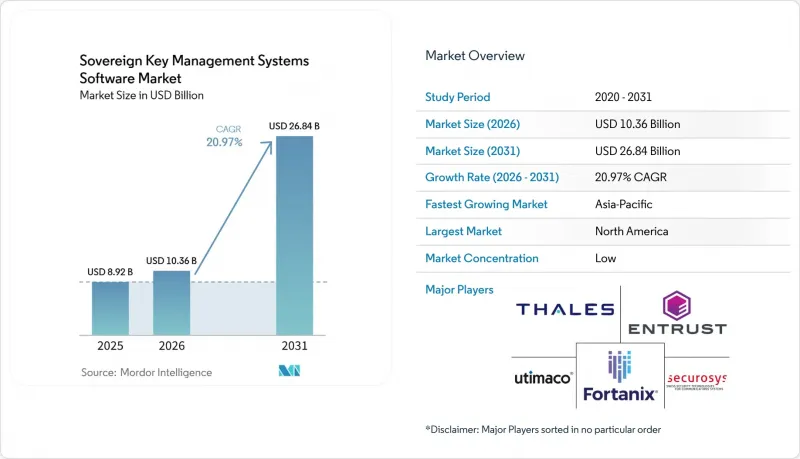
本報告按組件(軟體和服務)、部署模式(雲端、混合、本地部署)、企業規模(大型企業和中小企業)、最終用戶(IT與電信、銀行、金融服務和保險、汽車與運輸、醫療保健與生命科學等)以及地區進行細分。市場預測以美元計價。
全球主權金鑰管理系統軟體市場趨勢及洞察
關於資料主權和加密的監管要求
2026年4月,法國將其主權雲端託管和金鑰管理義務擴展至國有實體及其分包商。該法令要求加密金鑰不得落入歐盟以外的雲端服務提供者的控制之下。此外,法國國家網路安全戰略承諾投資維護對加密技術在整個資料生命週期內的國內控制。 2026年3月,法國國家資訊安全局(ANSSI)發布了其加密規則3.00版,為受NIS2法規約束的法國營業單位提供了技術合規標準。這些措施使得主權管理能力成為尋求在主權金鑰管理系統軟體市場獲得公共部門和關鍵基礎設施合約的供應商的一項重要要求。法國的SecNumCloud框架以及德國的C5和C3A要求也為不具備「自有金鑰」(Hold Your Own Key)或外部金鑰管理能力的供應商設定了市場准入障礙。這是因為在參與採購流程之前,供應商可能會被審查其合格證明、法律管轄權、營運控制以及雲端服務提供者與客戶金鑰環境的分離情況。
資料外洩導致成本增加和經營團隊受到影響
根據IBM的報告,到2025年,美國資料外洩的平均成本將達到1,022萬美元,而全球平均成本為444萬美元。該報告將全球平均成本較低的原因歸結於人工智慧工具的快速遏製作用。未經授權使用基於網際網路的人工智慧工具使全球資料外洩的平均成本增加了67萬美元。雖然識別和遏制洩漏所需的平均天數減少到241天,但97%報告了與人工智慧相關的洩漏事件的組織缺乏足夠的人工智慧存取控制。這些發現表明,在主權金鑰管理系統軟體市場中,存取管治和金鑰管理與偵測一樣,都是董事會層面的優先事項。由於監管執法更嚴格的司法管轄區的成本更高,因此投資密鑰治理比僅僅將其視為合規支出更有意義,尤其是在董事會需要權衡獨立管治的成本與事件的潛在遵循成本、通知義務、客戶影響、法律風險以及長期恢復工作的成本時。
關鍵管理生態系之間互通性的局限性
在「主權金鑰管理系統軟體市場」中,企業團隊在使用多個雲端服務供應商和本地硬體時,經常會面臨應用程式介面、金鑰格式和稽核日誌不相容的問題。雖然「金鑰管理互通性協定 (KMIP)」提供了一種基於標準的解決方案,但其在傳統平台和現代平台上的應用仍然不一致。擁有多個專有系統的組織可能需要客製化整合層,這可能會增加營運成本和審計風險。類似的碎片化也使向後量子演算法的過渡變得複雜,需要在每個環境中分別進行密鑰輪換和遷移。此外,密鑰儲存層也可能出現鎖定問題,因為在移動受保護資料時可能需要使用新密鑰重新加密。這些限制可能會減緩主權金鑰管理系統軟體在市場的廣泛應用。對於擁有龐大且分散式資料資產的組織而言,這種趨勢尤其明顯,因為不同的業務部門可能使用不同的服務提供商,支援不同的應用程式,並維護不同的審計日誌,而且缺乏一個負責協調金鑰所有權和加密策略變更的單一團隊。
細分市場分析
2025年,軟體將佔據主權金鑰管理系統軟體市場72.41%的佔有率。這一地位反映了在CI/CD管線、Kubernetes環境和無伺服器工作負載中以程式碼形式表達加密策略的需求。企業金鑰管理軟體、雲端金鑰管理和KMaaS、硬體安全模組(HSM)管理軟體、金鑰和憑證生命週期管理軟體以及加密態勢管理軟體構成了主要產品類型。加密態勢管理可協助組織識別混合環境中的金鑰材料。這種可視性為量子遷移後的規劃提供了一個切實可行的起點。 2026年3月,Fortanix透過與Qrypt和Quantum Dice的合作,為資料安全管理器增加了多源量子熵功能。此次部署表明,量子抗性已擴展到熵層和密鑰生命週期,因為熵源、產生的密鑰、儲存的密鑰、輪換規則和審計證據都會影響部署是否滿足受監管客戶設定的保證要求。
預計2026年至2031年,服務市場將以22.84%的複合年成長率成長。 「主權金鑰管理系統軟體」服務市場規模的成長主要受熟練密碼學家短缺的驅動。密鑰輪換計劃、審計日誌檢驗和後量子評估等方面對外部支援的需求日益成長。在「雲端優先」時代已建立金鑰管理最佳實務的組織,如今面臨著「自持金鑰」(Hold Your Own Key)部署更為嚴格的要求。諮詢、整合和託管營運可以減輕企業內部維護這些功能的負擔。服務供應商還可以協助客戶記錄監管機構和審計人員所需的控制措施。這為那些需要在不更換現有硬體和軟體的情況下獲得支援的組織創造了成長機會,尤其是在這些組織必須跨多個司法管轄區和業務部門維護審計證據、金鑰所有權記錄、職責分離和已記錄的輪調程序時。
到2025年,雲端部署將佔總收入的68.19%。雲端原生解決方案透過託管和客戶管理的金鑰選項,可輕鬆與供應商的基礎架構整合。其可擴展性和易部署性使其在企業工作負載中廣泛應用。然而,純雲端設計可能與將密鑰材料置於提供者存取範圍之外的要求相衝突。政府、國防和金融機構仍在繼續使用本地硬體安全模組 (HSM),因為在這些領域,實體和法律控制至關重要。因此,雖然採用雲端很重要,但它並不足以滿足所有受監管的工作負載的需求。 「主權金鑰管理系統軟體市場」持續需要能夠使雲端操作與更嚴格的儲存要求一致的模型。當合規團隊需要證明誰有權授權金鑰使用、根金鑰儲存在哪裡以及基礎設施提供者是否可以在日常服務作業期間存取這些金鑰時,這種需求尤其迫切。
混合部署預計將在 2026 年至 2031 年間以 21.63% 的複合年成長率 (CAGR) 成長。這種方法利用基於雲端的應用程式介面進行生命週期管理操作,同時將根密鑰儲存在本地硬體安全模組中。這種設計既滿足了資料保留要求,又不會犧牲雲端規模的操作。根據 Utimaco 引用的倫敦證券交易所集團 (LSEG) 的數據,即使到了 2025 年,仍有 44% 的金融服務公司傾向於將私有雲端作為儲存敏感數據的位置。因此,混合使用模式適用於那些既需要可信任的本地基礎架構又需要更廣泛的雲端連接的機構。 Fortanix 將混合金鑰管理描述為一種企業標準,它要求統一的可見性和一致的策略執行。該模型解決了主權要求和操作便利性之間的實際差距,使團隊能夠利用雲端介面進行應用層級加密、金鑰輪換、存取授權和報告,同時保持合法可控的信任來源。
區域分析
2025年,北美佔據了主權金鑰管理系統軟體市場34.62%的佔有率。美國聯邦政府的要求、雲端服務提供者的集中以及大規模的銀行、金融服務和保險(BFSI)產業支撐了該地區的需求。美國管理和預算辦公室(OMB)於2026年6月發布的一份備忘錄要求聯邦機構在120天內提交後量子加密過渡計劃,這催生了對一個能夠整合和管理傳統密鑰和後量子密鑰、存儲密鑰歷史記錄、協調證書變更、維護工作負載之間的戰略隔離,並為聯邦團隊提供評估跨機構、應用程式、數據分類和共用平台的進展。在北美,加拿大和墨西哥與美國形成互補,而巴西、阿根廷和其他南美國家則處於早期階段,數位銀行、本地化法規和新的雲端基礎設施推動了需求。
歐洲擁有最完善的資料主權區域框架,GDPR 第 44 條、NIS2、SecNumCloud 以及德國的 C5 和 C3A 要求共同構成了公共部門供應商的技術要求。 2026 年 5 月,泰雷茲和Google雲端宣佈為德國提供主權雲端服務,旨在滿足 C5 和新制定的 C3A 要求。隨著 NIS2 在德國的實施,德國金融機構面臨 2026 年 4 月的註冊截止日期。同時,法國在同月發布了 2026-272 號法令,在監管澄清後加快了採購流程。英國、西班牙、俄羅斯和其他歐洲國家構成了繼德國和法國之後的第二梯隊,其中英國的需求受到加密指南和脫歐後資料充分性考量的影響。
預計亞太地區在2026年至2031年間將以22.91%的複合年成長率成長。這項預測得益於日本的主權雲端計畫、印度《數位個人資料保護法》的實施,以及韓國和新加坡正式推出的後量子密碼學指導方針。 2025年7月,KDDI面向Google雲端推出了“加密金鑰管理服務”,將日本企業的國內金鑰儲存與Google雲端的基礎設施分開。 NTT Data於2026年4月在日本啟動了其抗量子加密服務的試點運營,並計劃於2026年10月正式商用。隨著在地化需求的逐步完善,預計中國、日本、印度、韓國、東南亞以及亞太地區其他地區將出現潛在需求。同時,中東和非洲地區包括沙烏地阿拉伯、阿拉伯聯合大公國、其他中東國家、南非、奈及利亞等非洲國家。
其他好處:
- Excel格式的市場預測(ME)表
- 3個月的分析師支持
目錄
第1章:引言
- 研究假設和市場定義
- 調查範圍
第2章:調查方法
第3章執行摘要
第4章 市場狀況
- 市場概覽
- 市場促進因素
- 關於資料主權和加密的監管義務。
- 混合雲端和多重雲端的擴展
- 成本上升和資料外洩對董事會的影響
- 後量子密碼學相容程序
- 對人工智慧和敏感計算工作負載的主權控制要求
- 跨境SaaS和數位基礎設施的加密管理要求
- 市場限制因素
- 主要管理生態系之間互通性的局限性
- 缺乏密碼學和密鑰管治方面的技能
- 主權與雲端運算的便利性:一種權衡
- 主權自毀開關和多方控制的運作複雜性
- 宏觀經濟因素對市場的影響
- 產業價值鏈分析
- 科技趨勢
- 監理情勢
- 波特五力分析
第5章 市場規模與成長預測
- 按組件
- 軟體
- 企業密鑰管理軟體
- 雲端金鑰管理與知識管理即服務 (KMaaS)
- 硬體安全模組 (HSM) 管理軟體
- 私鑰和憑證生命週期管理軟體
- 密碼姿態管理軟體
- 其他軟體
- 服務
- 軟體
- 按部署模式
- 雲
- 混合
- 現場
- 按公司規模
- 大公司
- 小型企業
- 最終用戶
- 資訊科技/通訊
- BFSI
- 汽車和運輸業
- 醫療保健和生命科學
- 零售與電子商務
- 工業製造
- 其他最終用戶
- 按地區
- 北美洲
- 美國
- 加拿大
- 墨西哥
- 南美洲
- 巴西
- 阿根廷
- 其他南美國家
- 歐洲
- 德國
- 英國
- 法國
- 俄羅斯
- 西班牙
- 其他歐洲國家
- 亞太地區
- 中國
- 日本
- 印度
- 韓國
- 東南亞
- 其他亞太國家
- 中東和非洲
- 中東
- 沙烏地阿拉伯
- 阿拉伯聯合大公國
- 其他中東國家
- 非洲
- 南非
- 奈及利亞
- 其他非洲國家
- 中東
- 北美洲
第6章 競爭情勢
- 市場集中度
- 策略趨勢
- 市佔率分析
- 公司簡介
- Thales SA
- Entrust Corporation
- Fortanix, Inc.
- Utimaco IS GmbH
- Securosys SA
- Keyfactor, Inc.
- WinMagic Corp.
- DuoKey SA
- Akeyless Security Ltd.
- Cryptomathic A/S
- Sepior ApS
- Unbound Security Ltd.
- Townsend Security Corporation
- SSH Communications Security Corporation
- Kryptus Seguranca da Informacao SA
- Atakama, Inc.
- Virgil Security, Inc.
- Voltage Security, Inc.
- eperi GmbH
- Cosmian SAS
第7章 市場機會與未來展望
According to Mordor Intelligence, the sovereign key management systems software market size is projected to expand from USD 8.92 billion in 2025 and USD 10.36 billion in 2026 to USD 26.84 billion by 2031, registering a CAGR of 20.97% between 2026 and 2031.
This report is Segmented by Component (Software, and Services), Deployment Model (Cloud, Hybrid, and On-Premises), Enterprise Size (Large Enterprises, and Small and Medium-Sized Enterprises), End User (IT and Telecommunication, BFSI, Automotive and Transportation, Healthcare and Life Sciences, and More), and Geography. The Market Forecasts are Provided in Terms of Value (USD).
Global Sovereign Key Management Systems Software Market Trends and Insights
Regulatory Mandates for Data Sovereignty and Encryption
France extended sovereign cloud hosting and key management obligations in April 2026 to state-administered groupings and their subcontractors. The decree requires encryption keys to remain outside the control of non-EU cloud providers. France's national cybersecurity strategy also committed investment to retain domestic control of cryptographic technologies across the data lifecycle. ANSSI issued version 3.00 of its cryptographic rules in March 2026, giving NIS2-regulated French entities a technical compliance baseline. These measures make sovereignty capabilities a practical requirement for vendors seeking public-sector and critical-infrastructure contracts in the Sovereign Key Management Systems Software Market. France's SecNumCloud framework and Germany's C5 and C3A requirements also create market-access barriers for providers without Hold Your Own Key or external key management capabilities, because qualification evidence, legal jurisdiction, operational controls, and the separation between a cloud provider and a customer key environment can all be examined before a supplier enters a procurement process.
Rising Cost and Board-Level Impact of Data Breaches
IBM reported that the average cost of a data breach in the United States reached USD 10.22 million in 2025, while the global average was USD 4.44 million. The report linked the lower global average to faster containment supported by AI tools. Unapproved use of internet-based AI tools added USD 670,000 to the global average cost of a breach. The mean time to identify and contain a breach fell to 241 days, yet 97% of organizations reporting AI-related breaches lacked proper AI access controls. These findings place access governance and key control alongside detection as board-level priorities for the Sovereign Key Management Systems Software Market. Higher costs in jurisdictions with stronger regulatory enforcement can make investment in key governance more defensible than treating it as a narrow compliance expense, particularly when a board must weigh the cost of an isolated security control against the potential cost of a breach, notification obligations, customer disruption, legal exposure, and prolonged recovery work.
Limited Interoperability Across Key Management Ecosystems
Enterprise teams in the Sovereign Key Management Systems Software Market often encounter incompatible application interfaces, key formats, and audit logs when using multiple cloud providers and on-premises hardware. The Key Management Interoperability Protocol provides a standards-based option, but its adoption remains uneven across older and newer platforms. Organizations with several proprietary systems may need custom integration layers, which add operating cost and audit risk. The same fragmentation complicates a move to post-quantum algorithms because each environment needs separate rotation and migration work. It can also create lock-in at the key-custody layer, because moving protected data can require re-encryption with new keys. This constraint can delay broader deployment in the Sovereign Key Management Systems Software Market, especially for organizations with large, dispersed data estates, where separate business units may use different providers, support different applications, retain different audit records, and lack a single accountable team to coordinate changes to key ownership and encryption policy.
Other drivers and restraints analyzed in the detailed report include:
- Hybrid and Multicloud Expansion
- Post-Quantum Cryptography Readiness Programs
- Shortage of Cryptographic Engineering and Key Governance Skills
For complete list of drivers and restraints, kindly check the Table Of Contents.
Segment Analysis
Software held 72.41% of the Sovereign Key Management Systems Software Market share in 2025. Its position reflects the need to express cryptographic policy as code across CI/CD pipelines, Kubernetes environments, and serverless workloads. Enterprise key management software, cloud key management and KMaaS, hardware security module management software, secrets and certificate lifecycle management software, and cryptographic posture management software form the principal product categories. Cryptographic posture management helps organizations discover key material across mixed environments. That visibility is a practical starting point for a post-quantum migration plan. In March 2026, Fortanix added multi-sourced quantum entropy to its Data Security Manager through partnerships with Qrypt and Quantum Dice. The development shows that quantum resilience is reaching the entropy layer and the key lifecycle, as entropy sources, generated keys, stored keys, rotation rules, and audit evidence can all influence whether a deployment meets a regulated customer's stated assurance requirements.
Services are projected to expand at a 22.84% CAGR from 2026 to 2031. The Sovereign Key Management Systems Software Market size for services benefits from the shortage of specialized cryptographic staff. Key rotation scheduling, audit log verification, and post-quantum assessments increasingly require external assistance. Organizations that built key practices during the cloud-first period now face more demanding requirements for Hold Your Own Key deployments. Advisory, integration, and managed operations can reduce the burden of maintaining those capabilities in-house. Service providers can also help clients document controls for regulators and auditors. This creates growth opportunities where organizations need support without replacing existing hardware or software, especially where audit evidence, key ownership records, separation of duties, and documented rotation procedures must be maintained across several jurisdictions and business units.
Cloud deployment accounted for 68.19% of 2025 revenue. Cloud-native offerings integrate readily with provider infrastructure through managed and customer-managed key options. Their scale and ease of deployment have supported widespread adoption across enterprise workloads. However, cloud-only designs can conflict with requirements that key material remain outside a provider's access perimeter. Government, defense, and financial institutions continue to use on-premises hardware security modules when physical and legal control is essential. This leaves cloud deployments important but insufficient for every regulated workload. The Sovereign Key Management Systems Software Market continues to require models that align cloud operations with stricter custody requirements, particularly where compliance teams need to demonstrate who can authorize use of a key, where the root material is stored, and whether an infrastructure provider can gain access during routine service operations.
Hybrid deployment is projected to expand at a 21.63% CAGR from 2026 to 2031. It keeps root keys in an on-premises hardware security module while using cloud-based application interfaces for lifecycle activities. This design can meet residency requirements without giving up cloud-scale operations. In 2025, 44% of financial services firms still prioritized private cloud for sensitive data, according to LSEG data cited by Utimaco. Hybrid use, therefore, fits institutions that need a trusted local anchor and broader cloud connectivity. Fortanix described hybrid key management as an enterprise standard that requires unified visibility and consistent policy enforcement. The model addresses a practical divide between sovereignty needs and operational convenience, allowing teams to retain a legally controlled root of trust while using cloud interfaces for application-level encryption, key rotation, access approval, and reporting.
Complete Report Scope:
- By Component
- Software
- Enterprise Key Management Software
- Cloud Key Management and KMaaS
- Hardware Security Module (HSM) Management Software
- Secrets and Certificate Lifecycle Management Software
- Cryptographic Posture Management Software
- Other Softwares
- Services
- Software
- By Deployment Model
- Cloud
- Hybrid
- On-Premises
- By Enterprise Size
- Large Enterprises
- Small and Medium-Sized Enterprises
- By End-User
- IT and Telecommunication
- BFSI
- Automotive and Transportation
- Healthcare and Life Sciences
- Retail and E-Commerce
- Industrial Manufacturing
- Other End Users
- By Geography
- North America
- United States
- Canada
- Mexico
- South America
- Brazil
- Argentina
- Rest of South America
- Europe
- Germany
- United Kingdom
- France
- Russia
- Spain
- Rest of Europe
- Asia-Pacific
- China
- Japan
- India
- South Korea
- Southeast Asia
- Rest of Asia-Pacific
- Middle East and Africa
- Middle East
- Saudi Arabia
- United Arab Emirates
- Rest of Middle East
- Africa
- South Africa
- Nigeria
- Rest of Africa
- Middle East
- North America
Geography Analysis
North America held 34.62% of the Sovereign Key Management Systems Software Market share in 2025. United States federal requirements, a concentration of cloud providers, and a large BFSI sector supported regional demand. The June 2026 Office of Management and Budget memorandum requires federal agencies to submit post-quantum migration plans within 120 days, creating near-term demand for platforms that manage classical and post-quantum keys together, preserve key history, coordinate certificate changes, maintain policy separation between workloads, and give federal teams a documented basis for assessing progress across agencies, applications, data classifications, and shared service environments. Canada and Mexico complement the United States in North America, while Brazil, Argentina, and the rest of South America are at an earlier stage, where digital banking, localization rules, and new cloud infrastructure are driving demand.
Europe has the most prescriptive regional framework for data sovereignty, with GDPR Article 44, NIS2, SecNumCloud, and Germany's C5 and C3A requirements shaping technical expectations for public-sector suppliers. In May 2026, Thales and Google Cloud announced a sovereign cloud offering in Germany designed to meet C5 and emerging C3A requirements. German financial entities faced an April 2026 registration deadline under national NIS2 implementation, while France published Decree n° 2026-272 that month and accelerated procurement after regulatory clarification. The United Kingdom, Spain, Russia, and the rest of Europe form a secondary tier alongside Germany and France, with UK demand shaped by cryptographic guidance and post-Brexit data adequacy considerations.
Asia-Pacific is projected to expand at a 22.91% CAGR from 2026 to 2031. Japan's sovereign cloud programs, India's enforcement of the Digital Personal Data Protection Act, and formal post-quantum guidance in South Korea and Singapore support this outlook. KDDI launched its Encryption Key Management Service for Google Cloud in July 2025, separating domestic key custody from Google Cloud infrastructure for Japanese organizations. NTT Data began trial availability of a quantum-resistant domestic service in Japan in April 2026, with commercial availability planned for October 2026. China, Japan, India, South Korea, Southeast Asia, and the rest of Asia-Pacific add potential demand as localization requirements develop, while the Middle East and Africa include Saudi Arabia, the United Arab Emirates, the rest of the Middle East, South Africa, Nigeria, and the rest of Africa.
- Thales S.A.
- Entrust Corporation
- Fortanix, Inc.
- Utimaco IS GmbH
- Securosys SA
- Keyfactor, Inc.
- WinMagic Corp.
- DuoKey SA
- Akeyless Security Ltd.
- Cryptomathic A/S
- Sepior ApS
- Unbound Security Ltd.
- Townsend Security Corporation
- SSH Communications Security Corporation
- Kryptus Seguranca da Informacao S.A.
- Atakama, Inc.
- Virgil Security, Inc.
- Voltage Security, Inc.
- eperi GmbH
- Cosmian SAS
Additional Benefits:
- The market estimate (ME) sheet in Excel format
- 3 months of analyst support
TABLE OF CONTENTS
1 INTRODUCTION
- 1.1 Study Assumptions and Market Definition
- 1.2 Scope of the Study
2 RESEARCH METHODOLOGY
3 EXECUTIVE SUMMARY
4 MARKET LANDSCAPE
- 4.1 Market Overview
- 4.2 Market Drivers
- 4.2.1 Regulatory Mandates for Data Sovereignty and Encryption
- 4.2.2 Hybrid and Multicloud Expansion
- 4.2.3 Rising Cost and Board-Level Impact of Data Breaches
- 4.2.4 Post-Quantum Cryptography Readiness Programs
- 4.2.5 Sovereign Control Requirements for AI and Confidential Computing Workloads
- 4.2.6 Cryptographic Control Requirements for Cross-Border SaaS and Digital Infrastructure
- 4.3 Market Restraints
- 4.3.1 Limited Interoperability Across Key Management Ecosystems
- 4.3.2 Shortage of Cryptographic Engineering and Key Governance Skills
- 4.3.3 Sovereignty Versus Cloud Convenience Trade-Offs
- 4.3.4 Operational Complexity of Sovereign Kill-Switches and Multi-Party Control
- 4.4 Impact of Macroeconomic Factors on the Market
- 4.5 Industry Value-Chain Analysis
- 4.6 Technology Outlook
- 4.7 Regulatory Landscape
- 4.8 Porter's Five Forces Analysis
- 4.8.1 Threat of New Entrants
- 4.8.2 Bargaining Power of Suppliers
- 4.8.3 Bargaining Power of Buyers
- 4.8.4 Threat of Substitutes
- 4.8.5 Intensity of Competitive Rivalry
5 MARKET SIZE AND GROWTH FORECASTS (VALUE)
- 5.1 By Component
- 5.1.1 Software
- 5.1.1.1 Enterprise Key Management Software
- 5.1.1.2 Cloud Key Management and KMaaS
- 5.1.1.3 Hardware Security Module (HSM) Management Software
- 5.1.1.4 Secrets and Certificate Lifecycle Management Software
- 5.1.1.5 Cryptographic Posture Management Software
- 5.1.1.6 Other Softwares
- 5.1.2 Services
- 5.1.1 Software
- 5.2 By Deployment Model
- 5.2.1 Cloud
- 5.2.2 Hybrid
- 5.2.3 On-Premises
- 5.3 By Enterprise Size
- 5.3.1 Large Enterprises
- 5.3.2 Small and Medium-Sized Enterprises
- 5.4 By End-User
- 5.4.1 IT and Telecommunication
- 5.4.2 BFSI
- 5.4.3 Automotive and Transportation
- 5.4.4 Healthcare and Life Sciences
- 5.4.5 Retail and E-Commerce
- 5.4.6 Industrial Manufacturing
- 5.4.7 Other End Users
- 5.5 By Geography
- 5.5.1 North America
- 5.5.1.1 United States
- 5.5.1.2 Canada
- 5.5.1.3 Mexico
- 5.5.2 South America
- 5.5.2.1 Brazil
- 5.5.2.2 Argentina
- 5.5.2.3 Rest of South America
- 5.5.3 Europe
- 5.5.3.1 Germany
- 5.5.3.2 United Kingdom
- 5.5.3.3 France
- 5.5.3.4 Russia
- 5.5.3.5 Spain
- 5.5.3.6 Rest of Europe
- 5.5.4 Asia-Pacific
- 5.5.4.1 China
- 5.5.4.2 Japan
- 5.5.4.3 India
- 5.5.4.4 South Korea
- 5.5.4.5 Southeast Asia
- 5.5.4.6 Rest of Asia-Pacific
- 5.5.5 Middle East and Africa
- 5.5.5.1 Middle East
- 5.5.5.1.1 Saudi Arabia
- 5.5.5.1.2 United Arab Emirates
- 5.5.5.1.3 Rest of Middle East
- 5.5.5.2 Africa
- 5.5.5.2.1 South Africa
- 5.5.5.2.2 Nigeria
- 5.5.5.2.3 Rest of Africa
- 5.5.5.1 Middle East
- 5.5.1 North America
6 COMPETITIVE LANDSCAPE
- 6.1 Market Concentration
- 6.2 Strategic Moves
- 6.3 Market Share Analysis
- 6.4 Company Profiles (includes Global Level Overview, Market Level Overview, Core Segments, Financials as available, Strategic Information, Market Rank/Share, Products and Services, Recent Developments)
- 6.4.1 Thales S.A.
- 6.4.2 Entrust Corporation
- 6.4.3 Fortanix, Inc.
- 6.4.4 Utimaco IS GmbH
- 6.4.5 Securosys SA
- 6.4.6 Keyfactor, Inc.
- 6.4.7 WinMagic Corp.
- 6.4.8 DuoKey SA
- 6.4.9 Akeyless Security Ltd.
- 6.4.10 Cryptomathic A/S
- 6.4.11 Sepior ApS
- 6.4.12 Unbound Security Ltd.
- 6.4.13 Townsend Security Corporation
- 6.4.14 SSH Communications Security Corporation
- 6.4.15 Kryptus Seguranca da Informacao S.A.
- 6.4.16 Atakama, Inc.
- 6.4.17 Virgil Security, Inc.
- 6.4.18 Voltage Security, Inc.
- 6.4.19 eperi GmbH
- 6.4.20 Cosmian SAS
7 MARKET OPPORTUNITIES AND FUTURE OUTLOOK
- 7.1 White-Space and Unmet-Need Assessment

 電子烘乾櫃市場報告:趨勢、預測及競爭分析(至2035年)
 企業金鑰管理(EKM):市場佔有率分析、產業趨勢與統計及成長預測(2026-2031)
 加密金鑰管理服務市場:全球市場預測,2026-2032年企業金鑰管理市場-2026-2032年全球市場預測
 IT管理服務市場:按應用程式、最終用戶和地區分類(2026-2034年)企業金鑰管理市場規模、佔有率、趨勢和預測:按組件、部署類型、企業規模、應用、最終用戶行業和地區分類,2026-2034 年
 2026年全球密鑰管理軟體市場報告KMaaS(金鑰管理即服務)全球市場報告(2026 年)2026年全球企業密鑰管理市場報告電子鎖箱市場按類型、控制機制、材料、功能、應用和銷售管道,全球預測(2026-2032年)