


 |
市場調查報告書
商品編碼
2118144
數位溯源平台:市場佔有率分析、產業趨勢與統計、成長預測(2026-2031)Digital Provenance Platform - Market Share Analysis, Industry Trends & Statistics, Growth Forecasts (2026 - 2031) |
||||||

※ 本網頁內容可能與最新版本有所差異。詳細情況請與我們聯繫。
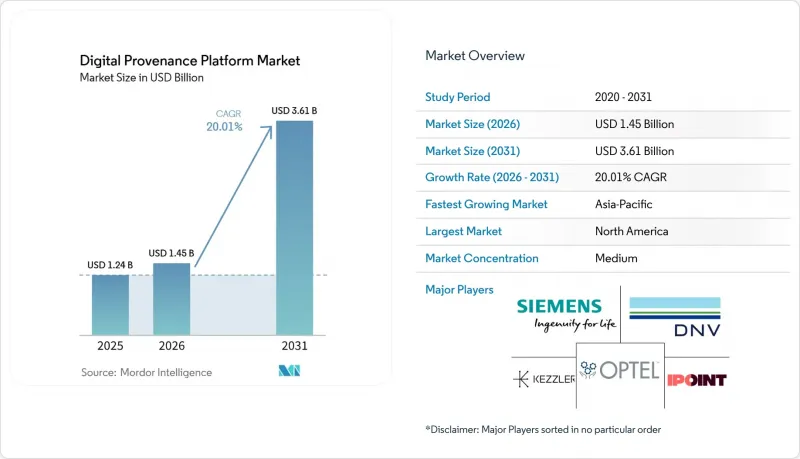
根據 Mordor Intelligence 預測,數位溯源平台市場規模將從 2025 年的 12.4 億美元和 2026 年的 14.5 億美元成長到 2031 年的 36.1 億美元,2026 年至 2031 年的年複合成長率(CAGR)為 20.01%。
本報告按組件(軟體和服務)、部署模式(雲端、混合、本地部署)、企業規模(大型企業和中小企業)、最終用戶(IT與電信、汽車與運輸、醫療保健與生命科學、零售與電子商務等)以及地區進行細分。市場預測以美元計價。
全球數位溯源平台市場趨勢與洞察
歐盟生態設計和電池護照合規性要求
根據歐盟委員會實施條例 (EU) 2026/1778,歐盟數位產品護照註冊系統於 2026 年 7 月 20 日正式啟用。該系統為經濟運營商提供了一個基礎設施,用於註冊受監管類別(例如大型電池、建築材料、玩具和清潔劑)的唯一產品識別碼。六項協調一致的 CEN 標準同時發布,涵蓋識別碼、資料載體、應用程式介面 (API)、資料交換和儲存。電池護照的有效期至 2027 年 2 月 18 日,屆時,目標產品必須提供可靠的來源資料才能繼續在歐盟境內銷售。由於鋼鐵、紡織品、電子產品和家具的截止日期較晚,因此可以透過實施電池數位溯源平台來建立涵蓋多個產品類型的架構。類似的義務也適用於歐盟以外的出口商,這使得該系統對於歐洲以外的供應鏈至關重要。
供應鏈透明度和產品標籤的檢驗
買家和監管機構越來越要求提供回收材料含量、無毀林採購和低碳生產的證據,而不僅僅依賴供應商的聲明。聯合國透明度議定書定義了產品護照、可追溯性事件和合規記錄的可互通數位認證資訊。這些認證資訊旨在支援跨複雜供應鏈的檢驗,而無需依賴單一的中央機構。該議定書為數位溯源平台市場建立了一個通用的技術基礎,在該市場中,組織必須與眾多供應商和客戶交換資料。 ISO 32120(2024版)也透過「誰、什麼、何時、何地、為什麼」的資料模型,為電子商務供應鏈中品質保證的可追溯性資訊共用提供了指南。這些標準的共同方向支持了相關平台,在這些平台上,證據可以一次性收集,並在產品、貿易和永續性記錄中重複使用。
高昂的實施成本和資料擷取成本
實施成本和供應商入駐成本仍然是推廣應用的一大障礙。對於面臨與大型原始設備製造商 (OEM) 類似資訊需求的中小型企業 (SME) 而言,這種影響尤其顯著。在 2026 年歐洲資訊系統大會 (ECIS 2026) 上發表的一項研究描述了中小型企業如何經歷評估階段,暫時退出限制性供應鏈,然後逐步採用數位技術。這種模式表明,資金、專業知識和人員的匱乏不僅會延緩技術選擇,還會延緩技術本身的採用。因此,數位溯源平台市場必須支援能夠減少昂貴內部開發需求的模式。歐盟資助的 CIRPASS-2 計畫正在紡織、電子、輪胎和建築業試點數位產品護照服務模式。這些試點計畫認知到,在監管期限影響更多供應商之前,提供價格合理的訂閱服務和共用的實施資源至關重要。
細分市場分析
到2025年,軟體將佔據數位化認證平台市場71.24%的佔有率。軟體將提供身分頒發、憑證管理、可追溯性事件記錄和數位產品護照發布等核心功能。此軟體佔有率反映了大多數部署方案都採用了以平台為中心的設計,無論產品類型是受監管的還是自願性的。預計2026年至2031年,服務板塊的複合年成長率將達到23.82%。此服務類別包括系統整合、資料導入、實施支援和合規營運管理。
收集供應商資料需要流程設計、與供應商協作以及資料品管,而這些僅靠許可無法實現。正因如此,企業在平台選擇後才會投入大量精力進行實施和資料管治。 Gaia-X 的 COMPLIANCE4DPP舉措正在開發將合規性檢驗整合到追溯基礎架構中的方法。該舉措表明,在預測期內,軟體和託管服務之間的聯繫將更加緊密。能夠同時提供這兩種服務的供應商,隨著報告需求的成長,在客戶留存方面可能更具優勢。
到2025年,雲端部署將佔數位溯源平台市場的68.41%。各組織機構正在使用雲端系統來處理可擴展應用程式介面 (API) 和物品等級序列化所產生的大量資料。混合部署預計將在2026年至2031年間以22.69%的複合年成長率成長。歐盟委員會實施條例(EU) 2026/1778規定,詳細的產品資料應由負責任的經濟運營商掌握,而不是儲存在中央註冊機構中。
這種機制支援混合設計,其中企業管理的資料儲存與可透過雲端存取的身份和註冊層相連。在國防供應鏈、受監管的公共產業以及某些醫療保健機構中,本地部署系統仍然發揮著至關重要的作用,因為這些領域的資料居住法規和採購政策限制了雲端的使用。這種監管設計將資料託管與註冊登記分開。純粹的雲端或純粹的本地部署設計可能無法滿足所有營運需求。隨著合規決策變得日益緊迫,能夠簡化這些整合管理的供應商的出現預計將有利於數位採購平台市場的發展。
區域分析
到2025年,北美將佔據數位溯源平台市場34.62%的佔有率。藥品供應鏈安全法案(DSCSA)下的藥品序列化、食品安全現代化法案(FSMA)第204條下的食品溯源以及金融文件檢驗等需求,正在推動多個產業的需求成長。從區域來看,美國主導市場應用,而加拿大和墨西哥將透過整合供應鏈提升其重要性。該地區受益於平台供應商同時服務國內和國際市場的客戶。這種多元化的需求基礎將為北美提供超越單一產品法規的支援。
歐洲是實施數位產品護照的關鍵監管中心。歐盟註冊系統將於2026年7月開始運行,為受監管類別建立產品級註冊基礎設施。德國、英國和法國正積極推動該系統的實施,尤其是在德國,電池相關製造業的需求更為迫切。西班牙、法國和比荷盧經濟聯盟地區的試點計畫涵蓋時尚、食品和製藥業。歐洲數位溯源平台市場正從關注合規性轉向關注產品、供應商和應用案例。
預計2026年至2031年,亞太地區的複合年成長率將達到24.19%。中國、印度、韓國和東南亞的製造地需要向受歐盟法規約束的供應鏈提供資料。中國的GB/T 46881-2025標準為數位化供應鏈可追溯性制定了框架。印度的Bharat-Tex標準在2026年的實施情況顯示,出口企業正在利用數位產品護照提供產品層面的材料和環境資訊。南美洲、中東和非洲仍處於起步階段,但一些特定領域的數據需求正在湧現,例如沙烏地阿拉伯的工業數位化和南非的電池礦物供應鏈。
其他好處
- Excel格式的市場預測(ME)表
- 3個月的分析師支持
目錄
第1章:引言
- 研究假設和市場定義
- 調查範圍
第2章:調查方法
第3章執行摘要
第4章 市場狀況
- 市場概覽
- 市場促進因素
- 歐盟生態設計和電池護照合規性要求
- 供應鏈透明度和產品標籤的檢驗
- 促進循環經濟:維修、轉售和回收。
- 消費者對產品真實性與永續性數據的需求
- 項目級序列化和數位 ID 的經濟學
- 跨境資料空間和檢驗認證訊息
- 市場限制因素
- 高昂的實施成本和資料擷取成本
- 標準碎片化和舊有系統整合
- 供應商數據品質和證據檢驗的差距
- 詳細的產品和供應商資料帶來的保密風險
- 宏觀經濟因素對市場的影響
- 產業價值鏈分析
- 科技趨勢
- 監理情勢
- 波特五力分析
第5章 市場規模與成長預測
- 按組件
- 軟體
- 服務
- 按部署模式
- 雲
- 混合
- 現場
- 按公司規模
- 大公司
- 小型企業
- 最終用戶
- 資訊科技/通訊
- BFSI
- 汽車和運輸業
- 醫療保健和生命科學
- 零售與電子商務
- 工業製造
- 教育和研究機構
- 政府/行政部門
- 能源與公共產業
- 其他
- 按地區
- 北美洲
- 美國
- 加拿大
- 墨西哥
- 南美洲
- 巴西
- 阿根廷
- 其他南美國家
- 歐洲
- 德國
- 英國
- 法國
- 俄羅斯
- 西班牙
- 其他歐洲國家
- 亞太地區
- 中國
- 日本
- 印度
- 韓國
- 東南亞
- 其他亞太國家
- 中東和非洲
- 中東
- 沙烏地阿拉伯
- 阿拉伯聯合大公國
- 其他中東國家
- 非洲
- 南非
- 奈及利亞
- 其他非洲國家
- 中東
- 北美洲
第6章 競爭情勢
- 市場集中度
- 策略趨勢
- 市佔率分析
- 公司簡介
- Arianee SAS
- Billion Group Limited
- Circularise BV
- Circulor Limited
- Det Norske Veritas Group AS
- EON Group Holding Inc.
- Everledger Limited
- iPoint-systems GmbH
- Kezzler AS
- Minespider GmbH
- Narravero GmbH
- OPTEL GROUP
- Protokol Group BV
- Qliktag Software Inc.
- Scantrust SA
- Spherity GmbH
- THE ID FACTORY SRL
- TrusTrace Technologies AB
- ubloquity Ltd.
- Weafs Ltd.
第7章 市場機會與未來展望
According to Mordor Intelligence, the digital provenance platform market size is projected to expand from USD 1.24 billion in 2025 and USD 1.45 billion in 2026 to USD 3.61 billion by 2031, registering a CAGR of 20.01% between 2026 and 2031.
This report is Segmented by Component (Software, and Services), Deployment Model (Cloud, Hybrid, and On-Premises), Enterprise Size (Large Enterprises, and Small and Medium-Sized Enterprises), End User (IT and Telecommunication, Automotive and Transportation, Healthcare and Life Sciences, Retail and E-Commerce, and More), and Geography. The Market Forecasts are Provided in Terms of Value (USD).
Global Digital Provenance Platform Market Trends and Insights
EU Ecodesign and Battery Passport Compliance Mandates
The EU Digital Product Passport Registry became operational on July 20, 2026, under Commission Implementing Regulation (EU) 2026/1778. It gives economic operators an infrastructure for registering unique product identifiers in regulated categories, including large batteries, construction products, toys, and detergents. Six harmonized CEN standards issued simultaneously cover identifiers, data carriers, application programming interfaces, data exchange, and storage. The February 18, 2027, battery passport deadline makes reliable provenance data a condition of continued access to the European Union for affected products. The later schedules for iron and steel, textiles, electronics, and furniture mean that a Digital provenance platform market purchase for batteries can establish the architecture for several product categories. The same obligations apply to non-European Union exporters, making the regime important to supply chains well beyond Europe.
Supply Chain Transparency and Product Claims Verification
Buyers and regulators increasingly require evidence of recycled content, deforestation-free sourcing, and lower-carbon production, rather than relying solely on supplier declarations. The United Nations Transparency Protocol defines interoperable digital credentials for product passports, traceability events, and conformity records. These credentials are designed to support verification across complex supply chains without relying on one central authority. The protocol establishes a common technical foundation for the Digital provenance platform market, where organizations must exchange data with many suppliers and customers. ISO 32120:2024 also provides guidance on sharing quality-assurance traceability information in e-commerce supply chains through a who, what, when, where, and why data model. The combined direction of these standards supports platforms that collect evidence once and reuse it across product, trade, and sustainability records.
High Implementation and Data Onboarding Costs
Implementation and supplier onboarding costs remain a major limit on adoption, especially for smaller companies that face the same information requests as large original equipment manufacturers. Research presented at ECIS 2026 described how small and medium-sized enterprises may move through assessment, temporary withdrawal from constrained supply chains, and later digital adoption. This pattern shows that limited funding, expertise, and staff can delay participation rather than merely slow technology selection. The Digital provenance platform market must therefore support service models that reduce the need for costly internal development. The European Union-funded CIRPASS-2 project is testing Digital Product Passport service models in textiles, electronics, tires, and construction. These pilots recognize that accessible subscriptions and shared implementation resources are important before regulatory deadlines affect more suppliers.
Other drivers and restraints analyzed in the detailed report include:
- Item-Level Serialization and Digital Identity Economics
- Consumer Demand for Product Authenticity and Sustainability Data
- Fragmented Standards and Legacy-System Integration
For complete list of drivers and restraints, kindly check the Table Of Contents.
Segment Analysis
Software held 71.24% of the Digital provenance platform market in 2025. It provides the core functions for identity issuance, credential management, traceability-event recording, and Digital Product Passport publication. The software position reflects the platform-centered design of most deployments across regulated and voluntary product categories. Services are projected to grow at a 23.82% CAGR from 2026 to 2031. This service category includes system integration, data onboarding, implementation support, and managed compliance operations.
Supplier data collection requires process design, supplier engagement, and data-quality controls that software licensing alone does not provide. This requirement explains why companies are allocating material effort to implementation and data governance after selecting a platform. Gaia-X's COMPLIANCE4DPP initiative is developing ways to integrate compliance verification into provenance infrastructure. The initiative points to a closer connection between software and managed services over the forecast period. Providers that can deliver both parts of the work may be better placed to retain customers as reporting needs widen.
Cloud deployment held 68.41% of the Digital provenance platform market in 2025. Organizations use cloud systems for scalable application programming interfaces and for the high data volumes generated by item-level serialization. Hybrid deployment is projected to grow at a 22.69% CAGR from 2026 to 2031. Commission Implementing Regulation (EU) 2026/1778 requires detailed product data to remain with the responsible economic operator rather than in the central registry.
This arrangement supports a hybrid design where company-controlled data stores connect to a cloud-accessible identity and registry layer. On-premises systems retain a role in defense supply chains, regulated utilities, and some healthcare settings where data residency rules or procurement policies limit cloud use. The regulatory design means that data hosting and registry identification are separate responsibilities. A purely cloud-based or purely on-premises design may not meet every operating need. The Digital provenance platform market can benefit from providers that make these connections easier to manage as compliance decisions become urgent.
Complete Report Scope:
- By Component
- Software
- Services
- By Deployment Model
- Cloud
- Hybrid
- On-Premises
- By Enterprise Size
- Large Enterprises
- Small and Medium-Sized Enterprises
- By End-User
- IT and Telecommunication
- BFSI
- Automotive and Transportation
- Healthcare and Life Sciences
- Retail and E-Commerce
- Industrial Manufacturing
- Education and Research Institutions
- Government and Administration
- Energy and Utilities
- Other End Users
- By Geography
- North America
- United States
- Canada
- Mexico
- South America
- Brazil
- Argentina
- Rest of South America
- Europe
- Germany
- United Kingdom
- France
- Russia
- Spain
- Rest of Europe
- Asia-Pacific
- China
- Japan
- India
- South Korea
- Southeast Asia
- Rest of Asia-Pacific
- Middle East and Africa
- Middle East
- Saudi Arabia
- United Arab Emirates
- Rest of Middle East
- Africa
- South Africa
- Nigeria
- Rest of Africa
- Middle East
- North America
Geography Analysis
North America accounted for 34.62% of the Digital provenance platform market in 2025. Pharmaceutical serialization under the Drug Supply Chain Security Act, food traceability under FSMA 204, and financial document verification created demand in several sectors. The United States led regional adoption, while Canada and Mexico became more relevant through integrated supply chains. The region benefits from platform vendors that serve customers in domestic and international markets. This diverse demand base gives North America support beyond any single product regulation.
Europe is the leading regulatory center for Digital Product Passport adoption. The EU registry became operational in July 2026 and created a product-level registration infrastructure for regulated categories. Germany, the United Kingdom, and France have active adoption, with Germany facing particular urgency in battery-related manufacturing. Pilot activity in Spain, France, and the Benelux region covers fashion, food, and pharmaceuticals. The Digital provenance platform market in Europe is moving from compliance preparation toward product, supplier, and commercial use cases.
Asia-Pacific is projected to grow at a 24.19% CAGR from 2026 to 2031. China, India, South Korea, and Southeast Asian manufacturing hubs must provide data to European Union-regulated supply chains. China's GB/T 46881-2025 standard sets out a framework for digital supply chain traceability. India's 2026 Bharat-Tex deployment showed that export companies are using Digital Product Passports to provide product-level material and environmental information. South America, the Middle East, and Africa remain at an earlier stage, although industrial digitalization in Saudi Arabia and battery-mineral supply chains in South Africa are creating specific data needs.
- Arianee SAS
- Billon Group Limited
- Circularise B.V.
- Circulor Limited
- Det Norske Veritas Group AS
- EON Group Holding Inc.
- Everledger Limited
- iPoint-systems GmbH
- Kezzler AS
- Minespider GmbH
- Narravero GmbH
- OPTEL GROUP
- Protokol Group B.V.
- Qliktag Software Inc.
- Scantrust SA
- Spherity GmbH
- THE ID FACTORY S.R.L.
- TrusTrace Technologies AB
- ubloquity Ltd.
- Weafs Ltd.
Additional Benefits:
- The market estimate (ME) sheet in Excel format
- 3 months of analyst support
TABLE OF CONTENTS
1 INTRODUCTION
- 1.1 Study Assumptions and Market Definition
- 1.2 Scope of the Study
2 RESEARCH METHODOLOGY
3 EXECUTIVE SUMMARY
4 MARKET LANDSCAPE
- 4.1 Market Overview
- 4.2 Market Drivers
- 4.2.1 EU Ecodesign and Battery Passport Compliance Mandates
- 4.2.2 Supply Chain Transparency and Product Claims Verification
- 4.2.3 Circular Economy, Repair, Resale, and Recycling Enablement
- 4.2.4 Consumer Demand for Product Authenticity and Sustainability Data
- 4.2.5 Item-Level Serialization and Digital Identity Economics
- 4.2.6 Cross-Border Provenance Data Spaces and Verifiable Credentials
- 4.3 Market Restraints
- 4.3.1 High Implementation and Data Onboarding Costs
- 4.3.2 Fragmented Standards and Legacy-System Integration
- 4.3.3 Supplier Data Quality and Evidence-Verification Gaps
- 4.3.4 Confidentiality Risks from Granular Product and Supplier Data
- 4.4 Impact of Macroeconomic Factors on the Market
- 4.5 Industry Value-Chain Analysis
- 4.6 Technology Outlook
- 4.7 Regulatory Landscape
- 4.8 Porter's Five Forces Analysis
- 4.8.1 Threat of New Entrants
- 4.8.2 Bargaining Power of Suppliers
- 4.8.3 Bargaining Power of Buyers
- 4.8.4 Threat of Substitutes
- 4.8.5 Intensity of Competitive Rivalry
5 MARKET SIZE AND GROWTH FORECASTS (VALUE)
- 5.1 By Component
- 5.1.1 Software
- 5.1.2 Services
- 5.2 By Deployment Model
- 5.2.1 Cloud
- 5.2.2 Hybrid
- 5.2.3 On-Premises
- 5.3 By Enterprise Size
- 5.3.1 Large Enterprises
- 5.3.2 Small and Medium-Sized Enterprises
- 5.4 By End-User
- 5.4.1 IT and Telecommunication
- 5.4.2 BFSI
- 5.4.3 Automotive and Transportation
- 5.4.4 Healthcare and Life Sciences
- 5.4.5 Retail and E-Commerce
- 5.4.6 Industrial Manufacturing
- 5.4.7 Education and Research Institutions
- 5.4.8 Government and Administration
- 5.4.9 Energy and Utilities
- 5.4.10 Other End Users
- 5.5 By Geography
- 5.5.1 North America
- 5.5.1.1 United States
- 5.5.1.2 Canada
- 5.5.1.3 Mexico
- 5.5.2 South America
- 5.5.2.1 Brazil
- 5.5.2.2 Argentina
- 5.5.2.3 Rest of South America
- 5.5.3 Europe
- 5.5.3.1 Germany
- 5.5.3.2 United Kingdom
- 5.5.3.3 France
- 5.5.3.4 Russia
- 5.5.3.5 Spain
- 5.5.3.6 Rest of Europe
- 5.5.4 Asia-Pacific
- 5.5.4.1 China
- 5.5.4.2 Japan
- 5.5.4.3 India
- 5.5.4.4 South Korea
- 5.5.4.5 Southeast Asia
- 5.5.4.6 Rest of Asia-Pacific
- 5.5.5 Middle East and Africa
- 5.5.5.1 Middle East
- 5.5.5.1.1 Saudi Arabia
- 5.5.5.1.2 United Arab Emirates
- 5.5.5.1.3 Rest of Middle East
- 5.5.5.2 Africa
- 5.5.5.2.1 South Africa
- 5.5.5.2.2 Nigeria
- 5.5.5.2.3 Rest of Africa
- 5.5.5.1 Middle East
- 5.5.1 North America
6 COMPETITIVE LANDSCAPE
- 6.1 Market Concentration
- 6.2 Strategic Moves
- 6.3 Market Share Analysis
- 6.4 Company Profiles (includes Global Level Overview, Market Level Overview, Core Segments, Financials as available, Strategic Information, Market Rank/Share, Products and Services, Recent Developments)
- 6.4.1 Arianee SAS
- 6.4.2 Billion Group Limited
- 6.4.3 Circularise B.V.
- 6.4.4 Circulor Limited
- 6.4.5 Det Norske Veritas Group AS
- 6.4.6 EON Group Holding Inc.
- 6.4.7 Everledger Limited
- 6.4.8 iPoint-systems GmbH
- 6.4.9 Kezzler AS
- 6.4.10 Minespider GmbH
- 6.4.11 Narravero GmbH
- 6.4.12 OPTEL GROUP
- 6.4.13 Protokol Group B.V.
- 6.4.14 Qliktag Software Inc.
- 6.4.15 Scantrust SA
- 6.4.16 Spherity GmbH
- 6.4.17 THE ID FACTORY S.R.L.
- 6.4.18 TrusTrace Technologies AB
- 6.4.19 ubloquity Ltd.
- 6.4.20 Weafs Ltd.
7 MARKET OPPORTUNITIES AND FUTURE OUTLOOK
- 7.1 White-Space and Unmet-Need Assessment

 Frost Radar™:數位資產管理平台,2026 年
 數位資產管理市場:按組件類型、資產類型、整合能力、部署模式、組織規模、應用和產業分類-2026-2032年全球市場預測全球數位資產管理軟體市場規模、佔有率、趨勢和成長分析報告(2026-2034年)
 數位驗證市場規模、佔有率和趨勢分析報告:按組件、部署模式、技術、最終用途、地區和細分市場分類(2026-2033 年)
 全球數位資產管理市場(至2031年):依產品(解決方案與服務)、應用(品牌與行銷資產管理、媒體製作與廣播資產管理)、資產類型、組織規模、產業及地區分類
 2026年全球數位密鑰雲認證管理員市場報告2026年全球數位資產管理市場報告2026年全球數位資產管理(DAM)軟體市場報告
 數位資產管理市場分析及預測(至2035年):按類型、產品類型、服務、技術、組件、應用、部署類型、最終用戶和功能分類
 數位資產管理(DAM):市場佔有率分析、產業趨勢與統計數據、成長預測(2026-2031)