


 |
市場調查報告書
商品編碼
2118142
AI訓練資料處理歷程軟體:市場佔有率分析、產業趨勢與統計、成長預測(2026-2031)AI Training Data Lineage Software - Market Share Analysis, Industry Trends & Statistics, Growth Forecasts (2026 - 2031) |
||||||

※ 本網頁內容可能與最新版本有所差異。詳細情況請與我們聯繫。
根據 Mordor Intelligence 預測,人工智慧訓練資料處理歷程軟體市場規模將從 2025 年的 28.6 億美元和 2026 年的 34.8 億美元成長到 2031 年的 108.4 億美元,2026 年至 2031 年的複合年成長率為 25.51%。
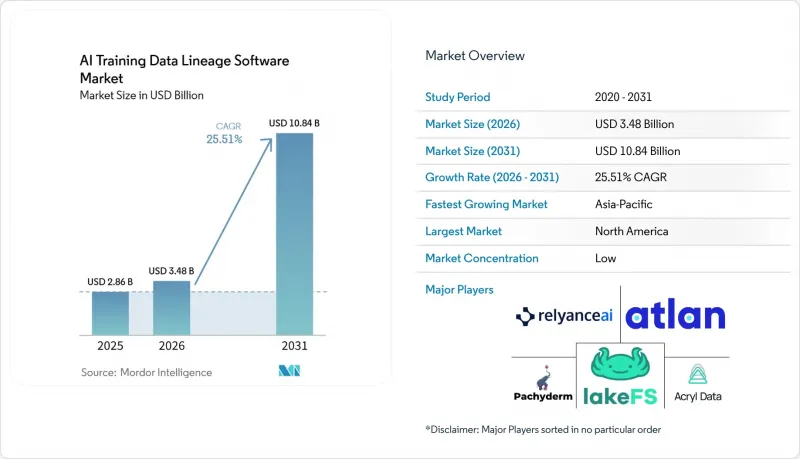
本報告按元件(軟體和服務)、部署模式(雲端、混合、本地部署)、企業規模(大型企業、其他)、應用(模型開發和實驗復現、其他)、資料模態(文字和程式碼、其他)、最終用戶(能源和公共產業、其他)以及地區進行細分。市場預測以美元計價。
全球人工智慧訓練資料處理歷程軟體市場趨勢及洞察
監管機構對可追溯的人工智慧訓練資料的需求日益成長
歐盟人工智慧法案已將訓練資料來源的要求從建議做法轉變為高風險系統的合規義務。第10條要求管治措施,涵蓋訓練集、檢驗和測試集的來源、收集方法、處理、標註和偏差檢驗。此外,EUR-LEX第53條規定,通用人工智慧提供者必須根據歐盟人工智慧辦公室的範本記錄訓練內容。這些要求促使買方在開發階段就確保資料來源資訊已被記錄,而不是在審計期間匆忙整理記錄。類似的需求正在歐洲以外蔓延,美國各州的法律和行業特定義務也日益重視訓練資料的透明度。因此,當合規團隊和技術團隊需要一份單一且可操作的資料處理記錄時,人工智慧訓練資料處理歷程軟體市場將從中受益。
多模態和基於代理的人工智慧管道的成長
機器人、自動駕駛汽車和工業自動化產生的感測器數據遠比傳統的表格形式數據複雜得多。這些工作流程結合了影片、雷射雷達、遙測和其他輸入數據,這些數據必須始終與其各自的轉換過程和標籤保持關聯。 Encord 報告稱,其多模態平台上的數據量在一年內從 1 Petabyte成長到 5 Petabyte,來自人工智慧相關客戶的收入成長了十倍。基於代理的系統也面臨類似的挑戰,因為自主代理可以在每一步讀取、寫入和修改數據,而無需人工干預。 2026 年 6 月,LakeFS 發布了其「代理 AI」解決方案,該方案具有資料分支隔離、受控合併以及將代理 ID 和執行詳情與資料操作關聯起來的記錄等特點。這增加了對不僅在資料集級別,而且在每個代理的執行級別記錄工作的工具的需求。
碎片化工具鏈的整合複雜性很高
人工智慧訓練環境通常包含資料湖、編配工具、特徵儲存、實驗追蹤軟體和模型註冊表。將這些系統整合到單一、可追溯的記錄中可能需要客製化,尤其是在企業使用傳統或專用應用程式的情況下。根據 ISG 2025 年的一項調查,38% 的企業認為資料管理整合的成本將超過潛在效益。該調查還發現,43% 的企業已在其組織內建構了一致的資料結構。如果供應商停止提供傳統資料集或更改其平台與客戶系統的連接方式,則現有部署可能需要額外的工作。 Collibra 已宣布其傳統 CLI 血統採集器將於 2026 年 7 月 31 日停止支持,屆時自託管客戶需要遷移到基於邊緣的架構。
細分市場分析
預計到2025年,軟體將佔據人工智慧訓練資料處理歷程資料處理歷程市場74.18%的佔有率,而目前該市場主要由平台主導。買家傾向於選擇能夠將血緣追蹤、元資料管理、審計記錄和合規性功能整合到現有人工智慧開發環境中的平台。此類平台包括溯源工具、目錄產品、管道監控系統和管治應用程式。當需要在整個生命週期中實現可追溯性時,企業越來越傾向於盡可能減少不同系統之間的連接數量。這一趨勢推動了對能夠將技術元資料與策略資訊關聯起來的平台的需求。這也反映出,企業需要在不將記錄在不同應用程式之間移動的情況下,維護從原始資料到預處理、標註、測試、核准和後續審查的完整通道。
預計2026年至2031年,服務市場將以28.41%的複合年成長率成長。由於企業環境中存在自訂SQL、獨特的資料處理流程和多樣化的存取規則,部署工作仍然不可或缺。服務供應商協助業務和技術團隊進行連接配置、現有記錄映射和運維部署。 Collibra的OpenLineage對AWS Glue和Apache Airflow的支持,透過實現開放式整合,減少了與連接器相關的工作量。當買家需要覆蓋多個雲端平台和舊有系統時,客製化部署工作可能仍然至關重要。
預計到2025年,雲端部署將佔據AI訓練資料處理歷程軟體市場71.24%的佔有率,凸顯了AI訓練資料處理歷程軟體市場與託管訓練環境之間的密切關聯。基於雲端的訓練管道會產生元資料事件,託管平台可以以極低的延遲檢索這些事件。這種模式簡化了更新操作,並支援擁有分散式團隊的組織進行集中管理。隨著企業採用率的提高,Collibra和Atlan正在將血緣收集遷移到雲端連接的邊緣架構。雲端部署尤其適合已經使用超大規模資料中心業者服務進行訓練和資料儲存的AI團隊。這使得分散式團隊能夠共用和了解管道活動,並應用平台更新,而無需每個客戶維護單獨的本地安裝。
預計從 2026 年到 2031 年,混合部署將以 27.69% 的複合年成長率成長。銀行、國防和醫療保健機構通常需要跨雲端系統以及空氣間隙或本地環境的記錄。 Collibra 於 2026 年發布了面向自託管部署的資料沿襲解決方案,以滿足客戶在這些環境中實現端到端可見性的需求。當國家法規限制培訓資料的雲端處理時,本地部署仍然至關重要。能夠在這些環境中維護一致記錄的供應商可以減少管治工作的重複。
區域分析
到2025年,北美將佔據人工智慧訓練資料處理歷程軟體市場34.62%的佔有率。該地區聚集了眾多專注於人工智慧的公司、雲端服務供應商以及擁有完善管治體系的企業客戶。美國透過醫療保健、金融服務、公共部門專案和領先的科技公司,推動了大部分需求。 2025年的指導草案提高了對人工智慧醫療設備生命週期相關文件的需求,各州的要求也強調了負責任的使用和文件記錄的重要性。加拿大和墨西哥的市場基數小規模,但金融服務和公共部門的應用也推動了需求成長。
預計2026年至2031年,亞太地區的複合年成長率將達到29.74%。人工智慧訓練活動在中國、印度、日本、韓國和東南亞國家蓬勃發展,同時資料保護條例也不斷改進。在日本的汽車和機器人產業,對能夠記錄感測器融合數據並執行標註任務的工具的需求日益成長。 Encord公司也提到豐田的「Woven」就是一個具備資料管理能力的實體人工智慧用戶。中國和韓國也擁有大規模的國內人工智慧研發項目,而該地區法律法規的差異也凸顯了在用戶許可、位置數據、安全和課責等方面建立靈活管理系統的重要性。
由於歐盟人工智慧立法強制要求對高風險人工智慧系統進行詳細的資料管治,歐洲在該領域佔據著舉足輕重的地位。法國、德國和英國是重要的國內市場,其中德國的工業部門支撐著與自動化相關的需求。南美洲的銷售額仍然小規模,但巴西的《大型資料保護法》(LGPD)為資料處理相關的文件記錄提供了法律依據。同時,中東和非洲是新興市場,沙烏地阿拉伯和阿拉伯聯合大公國正在投資人工智慧和數據基礎設施。南非和奈及利亞已初步展現出對金融服務應用的需求。在本地資料法規和人工智慧投資日益成熟的地區,人工智慧訓練資料處理歷程軟體市場蘊藏更廣闊的商業機會。
其他好處
- Excel格式的市場預測(ME)表
- 3個月的分析師支持
目錄
第1章:引言
- 研究假設和市場定義
- 調查範圍
第2章:調查方法
第3章執行摘要
第4章 市場狀況
- 市場概覽
- 市場促進因素
- 監管機構對可追溯的人工智慧訓練資料的需求日益成長
- 多模態和基於代理的人工智慧管道的成長
- 擴展雲端和混合人工智慧基礎設施
- 數據品質是影響模型表現的一個區分因素
- 合成和模擬資料來源
- 考慮基於代理的人工智慧的數據契約
- 市場限制因素
- 碎片化工具鏈的整合複雜性很高
- 隱私、主權和同意的限制
- 缺乏資料管治和 MLOps 技能
- 合成資料和網路衍生資料的來源不明
- 宏觀經濟因素對市場的影響
- 產業價值鏈分析
- 科技趨勢
- 監理情勢
- 波特五力分析
第5章 市場規模與成長預測
- 按組件
- 軟體
- 資料處理歷程及溯源軟體
- 元資料和目錄管理軟體
- 數據轉換和管道可觀測性軟體
- 管治、審計和合規軟體
- 服務
- 軟體
- 按部署模式
- 雲
- 混合
- 現場
- 按公司規模
- 大公司
- 小型企業
- 透過使用
- 模型開發和實驗可重複性
- 資料集版本控制與發布管理
- 資料管治與元資料管理
- 監理合規與人工智慧審計
- 數據品質和數據漂移分析
- 按數據模態
- 文字和程式碼
- 圖片和影片
- 語音和言語
- 多模態數據和富含感測器的數據
- 結構化資料和表格形式數據
- 最終用戶
- 資訊科技/通訊
- BFSI
- 汽車和運輸業
- 醫療保健和生命科學
- 零售與電子商務
- 工業製造
- 教育和研究機構
- 政府/行政部門
- 能源與公共產業
- 其他
- 按地區
- 北美洲
- 美國
- 加拿大
- 墨西哥
- 南美洲
- 巴西
- 阿根廷
- 其他南美國家
- 歐洲
- 德國
- 英國
- 法國
- 俄羅斯
- 西班牙
- 其他歐洲國家
- 亞太地區
- 中國
- 日本
- 印度
- 韓國
- 東南亞
- 其他亞太國家
- 中東和非洲
- 中東
- 沙烏地阿拉伯
- 阿拉伯聯合大公國
- 其他中東國家
- 非洲
- 南非
- 奈及利亞
- 其他非洲地區
- 中東
- 北美洲
第6章 競爭情勢
- 市場集中度
- 策略趨勢
- 市佔率分析
- 公司簡介
- Acryl Data, Inc.
- Alation, Inc.
- Ataccama Corporation
- Atlan Pte. Ltd.
- Bigeye, Inc.
- Collibra NV
- Data.World, Inc.
- Dataloop Ltd.
- Encord, Inc.
- Informatica Inc.
- lakeFS Ltd.
- Monte Carlo Data, Inc.
- Octopai Ltd.
- Pachyderm, Inc.
- Relyance AI, Inc.
- Secoda, Inc.
- Sifflet, Inc.
- Snorkel AI, Inc.
- Solidatus Limited
- SuperAnnotate AI, Inc.
- V7 Labs Limited
- WhyLabs, Inc.
第7章 市場機會與未來展望
According to Mordor Intelligence, the AI training data lineage software market size is projected to expand from USD 2.86 billion in 2025, USD 3.48 billion in 2026 to USD 10.84 billion by 2031, registering a CAGR of 25.51% between 2026 and 2031.
This report is Segmented by Component (Software, and Services), Deployment Model (Cloud, Hybrid, and On-Premises), Enterprise Size (Large Enterprises, and More), Application (Model Development and Experiment Reproducibility, and More), Data Modality (Text and Code, and More), End User (Energy and Utilities, and More), and Geography. The Market Forecasts are Provided in Terms of Value (USD).
Global AI Training Data Lineage Software Market Trends and Insights
Rising Regulatory Demand for Traceable AI Training Data
The EU AI Act has shifted the provenance of training data from a recommended practice to a compliance obligation for high-risk systems. Article 10 requires governance measures covering data origin, collection methods, processing, labeling, and bias examination for training, validation, and testing datasets. EUR-LEX Article 53 also requires general-purpose AI providers to prepare training content documentation under an EU AI Office template. These requirements encourage buyers to capture provenance during development instead of trying to assemble records during an audit. The same need extends beyond Europe, as U.S. state rules and sector-specific obligations increase attention to transparency in training data. The AI Training Data Lineage Software Market therefore benefits when compliance and technical teams need a single, usable record of data handling.
Growth of Multimodal and Agentic AI Pipelines
Robotics, autonomous vehicles, and industrial automation generate sensor data that is more complex than conventional tabular data. These workflows combine video, LiDAR, telemetry, and other inputs that must remain connected to their transformations and labels. Encord reported that data volumes on its multimodal platform increased from 1 petabyte to 5 petabytes over 1 year, with physical AI customer revenue increasing 10-fold. Agentic systems pose a related challenge because autonomous agents can read, write, and modify data without human intervention at each step. LakeFS introduced its Agentic AI offering in June 2026 with isolated data branches, controlled merges, and records that link agent identity and execution details to data actions. This raises demand for tools that record work at the level of each agent run as well as at the dataset level.
High Integration Complexity Across Fragmented Toolchains
AI training environments often include data lakes, orchestration tools, feature stores, experiment tracking software, and model registries. Connecting these systems into a single, traceable record can require custom work, especially when firms use older or specialized applications. The 2025 ISG study reported that 38% of enterprises believed the cost of harmonizing data management outweighed the likely benefit. The study also found that 43% had created a consistent data structure across their organizations. Existing deployments can require additional work when vendors retire older collectors or change how a platform connects to customer systems. Collibra stated that its legacy CLI lineage harvester would reach end of life on July 31, 2026, requiring self-hosted customers to move to its Edge-based architecture.
Other drivers and restraints analyzed in the detailed report include:
- Expansion of Cloud and Hybrid AI Infrastructure
- Data Quality as a Model Performance Differentiator
- Privacy, Sovereignty, and Consent Constraints
For complete list of drivers and restraints, kindly check the Table Of Contents.
Segment Analysis
Software held 74.18% of the AI Training Data Lineage Software Market share in 2025, making the AI Training Data Lineage Software Market primarily platform-led at this stage. Buyers favor platforms that bring lineage, metadata management, audit records, and compliance functions into existing AI development environments. The category includes provenance tools, catalog products, pipeline monitoring systems, and governance applications. Organizations increasingly prefer fewer connections between separate systems when they need traceability across the full lifecycle. This preference supports platforms that can connect technical metadata with policy information. It also reflects the need to preserve the path from raw material through preparation, labeling, testing, approval, and later review without moving records between separate applications.
Services are projected to grow at a 28.41% CAGR from 2026 to 2031. Implementation work remains necessary because enterprise environments contain custom SQL, proprietary data processes, and varied access rules. Service providers help configure connections, map existing records, and support operational adoption across business and technical teams. Collibra's OpenLineage support for AWS Glue and Apache Airflow reduced connector work by enabling open integration. Even so, tailored implementation work is likely to remain important where buyers need coverage across multiple clouds and older systems.
Cloud deployment accounted for 71.24% of the AI Training Data Lineage Software Market share in 2025, underscoring the strong link between the AI Training Data Lineage Software Market and hosted training environments. Cloud-based training pipelines create metadata events that a hosted platform can capture with limited delay. This model can simplify updates and support centralized administration for organizations with distributed teams. Collibra and Atlan have moved lineage collection toward cloud-connected edge architectures as enterprise use has expanded. Cloud deployment is especially suited to AI groups that already use hyperscaler services for training and data storage. It gives distributed teams a shared view of pipeline activity, while platform updates can be applied without each customer having to maintain a separate local installation.
Hybrid deployment is projected to expand at a 27.69% CAGR from 2026 to 2031. Banking, defense, and healthcare organizations often need records across cloud systems and air-gapped or local environments. Collibra released Data Lineage for self-hosted deployments in 2026 for customers who need end-to-end visibility in such settings. Local deployment also remains relevant where national rules limit cloud processing of training data. Vendors that maintain consistent records across these locations can reduce the need for duplicate governance work.
Complete Report Scope:
- By Component
- Software
- Data Lineage and Provenance Software
- Metadata and Catalog Management Software
- Data Transformation and Pipeline Observability Software
- Governance, Audit and Compliance Software
- Services
- Software
- By Deployment Model
- Cloud
- Hybrid
- On-Premises
- By Enterprise Size
- Large Enterprises
- Small and Medium-Sized Enterprises
- By Application
- Model Development and Experiment Reproducibility
- Dataset Versioning and Release Management
- Data Governance and Metadata Management
- Regulatory Compliance and AI Audit
- Data Quality and Data Drift Analysis
- By Data Modality
- Text and Code
- Image and Video
- Audio and Speech
- Multimodal and Sensor-Rich Data
- Structured and Tabular Data
- By End User
- IT and Telecommunication
- BFSI
- Automotive and Transportation
- Healthcare and Life Sciences
- Retail and E-Commerce
- Industrial Manufacturing
- Education and Research Institutions
- Government and Administration
- Energy and Utilities
- Other End Users
- By Geography
- North America
- United States
- Canada
- Mexico
- South America
- Brazil
- Argentina
- Rest of South America
- Europe
- Germany
- United Kingdom
- France
- Russia
- Spain
- Rest of Europe
- Asia-Pacific
- China
- Japan
- India
- South Korea
- Southeast Asia
- Rest of Asia-Pacific
- Middle East and Africa
- Middle East
- Saudi Arabia
- United Arab Emirates
- Rest of Middle East
- Africa
- South Africa
- Nigeria
- Rest of Africa
- Middle East
- North America
Geography Analysis
North America held 34.62% of the AI Training Data Lineage Software Market share in 2025. The region has a large concentration of AI-focused businesses, cloud providers, and enterprise buyers with established governance programs. The United States drives much of the demand through healthcare, financial services, public-sector programs, and large technology firms. The 2025 draft guidance increased the need for lifecycle documentation for AI-enabled medical devices, while state-level requirements also emphasize responsible use and documentation. Canada and Mexico are developing from a smaller base, with financial services and public-sector uses contributing to demand.
Asia-Pacific is projected to expand at a 29.74% CAGR from 2026 to 2031. China, India, Japan, South Korea, and Southeast Asian countries are expanding AI training activity alongside data-protection rules. Japan's automotive and robotics sectors create demand for tools that can record sensor-fusion data and perform labeling work, and Encord identified Woven by Toyota as a physical AI user with data curation capabilities. China and South Korea also have large domestic AI development programs, and the region's differing legal requirements increase the value of flexible controls for consent, location, safety, and accountability.
Europe holds a significant position because the EU AI Act requires detailed data governance for high-risk AI systems. France, Germany, and the United Kingdom are important national markets, while Germany's industrial sector supports demand related to automation. South America remains smaller in revenue, although Brazil's LGPD provides a related basis for data-processing documentation, while the Middle East and Africa are emerging, with Saudi Arabia and the UAE investing in AI and data infrastructure. South Africa and Nigeria show early demand for financial services applications. The AI Training Data Lineage Software Market offers broader regional opportunities where local data rules and AI investment mature together.
- Acryl Data, Inc.
- Alation, Inc.
- Ataccama Corporation
- Atlan Pte. Ltd.
- Bigeye, Inc.
- Collibra NV
- Data.World, Inc.
- Dataloop Ltd.
- Encord, Inc.
- Informatica Inc.
- lakeFS Ltd.
- Monte Carlo Data, Inc.
- Octopai Ltd.
- Pachyderm, Inc.
- Relyance AI, Inc.
- Secoda, Inc.
- Sifflet, Inc.
- Snorkel AI, Inc.
- Solidatus Limited
- SuperAnnotate AI, Inc.
- V7 Labs Limited
- WhyLabs, Inc.
Additional Benefits:
- The market estimate (ME) sheet in Excel format
- 3 months of analyst support
TABLE OF CONTENTS
1 INTRODUCTION
- 1.1 Study Assumptions and Market Definition
- 1.2 Scope of the Study
2 RESEARCH METHODOLOGY
3 EXECUTIVE SUMMARY
4 MARKET LANDSCAPE
- 4.1 Market Overview
- 4.2 Market Drivers
- 4.2.1 Rising Regulatory Demand for Traceable AI Training Data
- 4.2.2 Growth of Multimodal and Agentic AI Pipelines
- 4.2.3 Expansion of Cloud and Hybrid AI Infrastructure
- 4.2.4 Data Quality as a Model-Performance Differentiator
- 4.2.5 Synthetic and Simulation Data Provenance
- 4.2.6 Lineage-Aware Data Contracts for Agentic AI
- 4.3 Market Restraints
- 4.3.1 High Integration Complexity Across Fragmented Toolchains
- 4.3.2 Privacy, Sovereignty, and Consent Constraints
- 4.3.3 Shortage of Data Governance and MLOps Skills
- 4.3.4 Provenance Gaps in Synthetic and Web-Sourced Data
- 4.4 Impact of Macroeconomic Factors on the Market
- 4.5 Industry Value-Chain Analysis
- 4.6 Technology Outlook
- 4.7 Regulatory Landscape
- 4.8 Porter's Five Forces Analysis
- 4.8.1 Threat of New Entrants
- 4.8.2 Bargaining Power of Suppliers
- 4.8.3 Bargaining Power of Buyers
- 4.8.4 Threat of Substitutes
- 4.8.5 Intensity of Competitive Rivalry
5 MARKET SIZE AND GROWTH FORECASTS (VALUE)
- 5.1 By Component
- 5.1.1 Software
- 5.1.1.1 Data Lineage and Provenance Software
- 5.1.1.2 Metadata and Catalog Management Software
- 5.1.1.3 Data Transformation and Pipeline Observability Software
- 5.1.1.4 Governance, Audit and Compliance Software
- 5.1.2 Services
- 5.1.1 Software
- 5.2 By Deployment Model
- 5.2.1 Cloud
- 5.2.2 Hybrid
- 5.2.3 On-Premises
- 5.3 By Enterprise Size
- 5.3.1 Large Enterprises
- 5.3.2 Small and Medium-Sized Enterprises
- 5.4 By Application
- 5.4.1 Model Development and Experiment Reproducibility
- 5.4.2 Dataset Versioning and Release Management
- 5.4.3 Data Governance and Metadata Management
- 5.4.4 Regulatory Compliance and AI Audit
- 5.4.5 Data Quality and Data Drift Analysis
- 5.5 By Data Modality
- 5.5.1 Text and Code
- 5.5.2 Image and Video
- 5.5.3 Audio and Speech
- 5.5.4 Multimodal and Sensor-Rich Data
- 5.5.5 Structured and Tabular Data
- 5.6 By End User
- 5.6.1 IT and Telecommunication
- 5.6.2 BFSI
- 5.6.3 Automotive and Transportation
- 5.6.4 Healthcare and Life Sciences
- 5.6.5 Retail and E-Commerce
- 5.6.6 Industrial Manufacturing
- 5.6.7 Education and Research Institutions
- 5.6.8 Government and Administration
- 5.6.9 Energy and Utilities
- 5.6.10 Other End Users
- 5.7 By Geography
- 5.7.1 North America
- 5.7.1.1 United States
- 5.7.1.2 Canada
- 5.7.1.3 Mexico
- 5.7.2 South America
- 5.7.2.1 Brazil
- 5.7.2.2 Argentina
- 5.7.2.3 Rest of South America
- 5.7.3 Europe
- 5.7.3.1 Germany
- 5.7.3.2 United Kingdom
- 5.7.3.3 France
- 5.7.3.4 Russia
- 5.7.3.5 Spain
- 5.7.3.6 Rest of Europe
- 5.7.4 Asia-Pacific
- 5.7.4.1 China
- 5.7.4.2 Japan
- 5.7.4.3 India
- 5.7.4.4 South Korea
- 5.7.4.5 Southeast Asia
- 5.7.4.6 Rest of Asia-Pacific
- 5.7.5 Middle East and Africa
- 5.7.5.1 Middle East
- 5.7.5.1.1 Saudi Arabia
- 5.7.5.1.2 United Arab Emirates
- 5.7.5.1.3 Rest of Middle East
- 5.7.5.2 Africa
- 5.7.5.2.1 South Africa
- 5.7.5.2.2 Nigeria
- 5.7.5.2.3 Rest of Africa
- 5.7.5.1 Middle East
- 5.7.1 North America
6 COMPETITIVE LANDSCAPE
- 6.1 Market Concentration
- 6.2 Strategic Moves
- 6.3 Market Share Analysis
- 6.4 Company Profiles (includes Global Level Overview, Market Level Overview, Core Segments, Financials as available, Strategic Information, Market Rank/Share, Products and Services, Recent Developments)
- 6.4.1 Acryl Data, Inc.
- 6.4.2 Alation, Inc.
- 6.4.3 Ataccama Corporation
- 6.4.4 Atlan Pte. Ltd.
- 6.4.5 Bigeye, Inc.
- 6.4.6 Collibra NV
- 6.4.7 Data.World, Inc.
- 6.4.8 Dataloop Ltd.
- 6.4.9 Encord, Inc.
- 6.4.10 Informatica Inc.
- 6.4.11 lakeFS Ltd.
- 6.4.12 Monte Carlo Data, Inc.
- 6.4.13 Octopai Ltd.
- 6.4.14 Pachyderm, Inc.
- 6.4.15 Relyance AI, Inc.
- 6.4.16 Secoda, Inc.
- 6.4.17 Sifflet, Inc.
- 6.4.18 Snorkel AI, Inc.
- 6.4.19 Solidatus Limited
- 6.4.20 SuperAnnotate AI, Inc.
- 6.4.21 V7 Labs Limited
- 6.4.22 WhyLabs, Inc.
7 MARKET OPPORTUNITIES AND FUTURE OUTLOOK
- 7.1 White-Space and Unmet-Need Assessment

 大規模模型訓練機市場:全球市場預測,2026-2032年
 人工智慧訓練資料市場報告:趨勢、預測和競爭分析(至2035年)
 學術研究資料庫市場規模、佔有率和成長分析:按產品/服務、內容類型、部署方式、最終用戶和地區分類-2026-2033年產業預測人工智慧訓練資料集市場-2026-2032年全球市場預測
 人工智慧訓練資料市場預測至2034年-按資料類型、資料來源、標註類型、部署模式、應用、最終使用者和地區分類的全球分析
 人工智慧訓練資料集:市場佔有率分析、產業趨勢與統計、成長預測(2026-2031)資料中心人工智慧開發市場預測至2034年-按組件、資料類型、部署模式、資料生命週期階段、應用、最終使用者和地區分類的全球分析
 2026-2030年全球人工智慧訓練資料集市場人工智慧模型訓練資料平台市場預測至2034年-全球分析(按組件、部署模式、資料類型、解決方案功能、組織規模、最終用戶和地區分類)
 2026年全球人工智慧(AI)合成數據市場報告