


 |
市場調查報告書
商品編碼
2118128
IRAC 30 殺蟲劑:市場佔有率分析、行業趨勢和統計數據、成長預測(2026-2031 年)IRAC 30 Insecticides - Market Share Analysis, Industry Trends & Statistics, Growth Forecasts (2026 - 2031) |
||||||

※ 本網頁內容可能與最新版本有所差異。詳細情況請與我們聯繫。
根據 Mordor Intelligence 預測,IRAC 30 殺蟲劑市場規模將從 2025 年的 6.124 億美元成長到 2026 年的 6.5009 億美元,到 2031 年將達到 8.7821 億美元,2026 年至 2031 年的複合年成長率為 20316.20%。
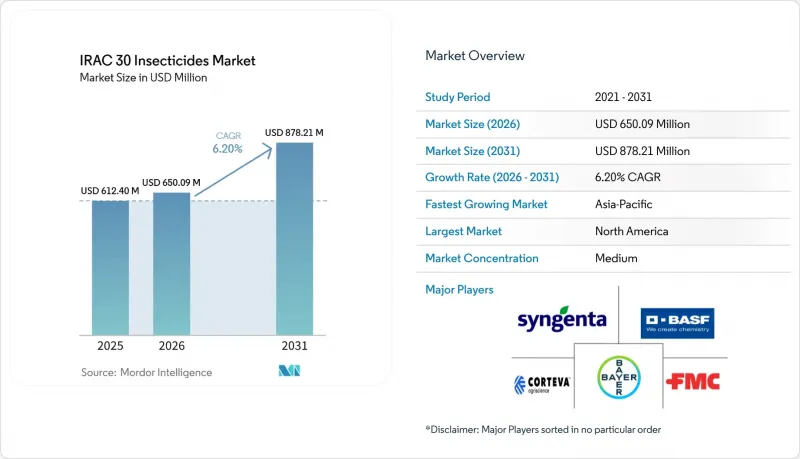
本報告依施用方法(化學灌溉、葉面噴布、燻蒸等)、作物類型(經濟作物、水果和蔬菜、穀類等)和地區(北美、歐洲等)進行分類。市場預測以價值(美元)和數量(噸)表示。
全球IRAC 30殺蟲劑市場趨勢與洞察
對用於抗藥性管理的化學品的需求日益成長。
由於主要害蟲對擬除蟲菊酯類、有機磷類和二醯胺類殺蟲劑產生了抗藥性,種植者和農藝師被迫探索作用機制不同的替代方案,這直接推動了IRAC 30類殺蟲劑市場的發展。第30組化合物,如間二醯胺類和異噁唑啉類,滿足了這項需求,因為它們作用於GABA受體的新型變構位點,而非傳統殺蟲劑所利用的結合位點。 2025年發表的一項研究表明,在對Chlorantraniliprole產生抗性的二化螟族群中,環丙醯胺不存在交叉抗性。該研究還報告稱,環丙醯胺的遺傳力較低,顯示其內在抗性風險較低。這些證據正促使IRAC 30類殺蟲劑市場從輪作中的備用方案轉變為種植季節的計劃性用藥,尤其適用於那些蟲害已經降低傳統殺蟲劑效用的作物。此外,IRAC 30 類殺蟲劑市場也受益於上述指南中未報告任何 30 類殺蟲劑的田間抗性案例。這使得該類殺蟲劑在商業化初期仍能維持較高的抗性管理價值。
更嚴格的活性成分重新註冊時間表
IRAC 30殺蟲劑市場也受益於更緩慢且嚴格的審查週期,目前正影響著歐洲和北美許多傳統殺蟲劑活性成分。歐洲的AIR 6更新計畫針對的是核准日期在2025年3月至2028年12月之間到期的物質,這意味著一些已上市的化學品將再次接受全面審查。國際作物生命協會(CropLife International)也報告稱,2025年4月農藥續約申請積壓嚴重,這使得核准日期相對較近的一類化學品擁有顯著優勢。在美國,溴氟醯胺和異環蠟醯胺近期獲得批准,與許多傳統競爭對手相比,進一步緩解了這些產品當前的重新註冊壓力。這透過提供更長的商業性緩衝期,促進了IRAC 30殺蟲劑市場的發展。這個緩衝期至關重要,因為在產品監管有效期尚處於早期階段時,企業可以證明其進行更廣泛的註冊工作、投資於產品管理和市場開發的合理性。
出口作物面臨遵守殘留物標準的壓力
對於IRAC 30殺蟲劑市場而言,殘留限量合規仍然是一個重要的限制因素。這是因為新推出的活性成分通常需要時間才能完成貿易夥伴間進口限量和殘留限量的協調。 2026年1月,明尼蘇達州農業部對異環菌胺進行了審查,並將其納入水質監測計劃,因為根據明尼蘇達州法律,該活性成分被歸類為全氟烷基和多氟烷基物質(PFAS)。雖然這項決定並未禁止其使用,但它增加了一個需要考慮的因素,可能會影響在領先法規的地區擴大標籤覆蓋範圍的速度。 IRAC 30殺蟲劑市場更容易受到出口作物的影響。這是因為生產商和出口商需要確信原產地和目的地市場的殘留限量都已協調一致,才能圍繞新化學品建立大規模項目。因此,即使某種化學品在田間表現良好,在貿易敏感型作物系統中,其推廣應用也往往會被延遲。這是因為商業性風險涉及整批的貨物,而不是單一田塊。
細分市場分析
葉面噴布是目前最主要的施用方法,預計到2025年將佔IRAC 30類殺蟲劑市佔率的55.2%。這反映了葉面噴布在蔬菜、棉花、果樹和豆類作物中的廣泛應用,在這些作物中,快速起效和殘留效果都至關重要。馬裡蘭大學推廣中心指出,新型異環陶瓷葉面噴布產品旨在防治小菜蛾、蛀果蠅和科羅拉多馬鈴薯甲蟲等害蟲,這凸顯了葉面噴布方案在IRAC 30類殺蟲劑市場中的商業性重要性。此外,葉面噴布仍是將30類化學品引入高價值作物系統的首選途徑,因為它允許種植者在同一種植季內直接比較其與傳統化學品的防治效果。BASF公司已證實溴氟醯胺在多個害蟲生長階段均有效,這也是葉面噴布方案仍佔據IRAC 30類殺蟲劑市場最大佔有率的原因之一。由於目前可用的第 30 類成熟配方數量有限,土壤處理、化學灌溉和燻蒸的規模仍然較小。
種子處理是成長最快的施用方法,預計到2031年,IRAC 30殺蟲劑市場中種子處理的市場規模將以3.6%的複合年成長率成長。這一成長趨勢在穀物和行栽作物中最為顯著,這些作物在生長季初期易受金針蟲侵害,可能阻礙作物出苗,並使種植者無法在生長季期間採取適當的防治措施。先正達集團報告稱,Equento在春小麥試驗中實現了高達97%的金針蟲根除率,這為IRAC 30殺蟲劑市場在生長季初期防治方面奠定了堅實的基礎。精準噴灑也提高了優質種子處理方案的經濟效益。此外,Atexzo公司將異環陶瓷(isocycloceramic)拓展到草坪領域,顯示IRAC 30殺蟲劑市場正開始超越其最初在田間作物中的核心應用範圍。
區域分析
北美是最大的區域市場,預計到2025年將佔IRAC 30類殺蟲劑市場的37.6%。這一地位反映了美國龐大的穀物和特種作物生產基地、種子處理在加拿大的重要作用,以及美國環保署(EPA)於2025年11月最終批准10種異環陶瓷類殺蟲劑產品所帶來的商業性成長。在加拿大,隨著菜籽和春小麥輪作種植者需要早期防治金針蟲,並尋求化學替代方案來取代嚴重依賴新菸鹼類殺蟲劑的防治方案,市場對IRAC 30類殺蟲劑的需求正在顯著成長。在美國,玉米帶支撐著種子處理的需求,而葉面噴布吸收則支撐著東南部和西南部棉花和蔬菜產區的需求。墨西哥仍然是IRAC 30類殺蟲劑市場的重要機遇,因為其出口導向蔬菜產業與30類葉面噴布產品的目標害蟲類型相符。
亞太地區是成長最快的地區,預計到2031年,該地區IRAC 30殺蟲劑市場將以3.8%的複合年成長率成長。該地區水稻、蔬菜和棉花產量大規模,因此在蟲害嚴重且輪作至關重要的領域,對新型化學成分的需求穩定。根據日本作物生命協會(CropLife Japan)預測,2025農業年度日本出貨收益預計將成長5.3%,三井化學作物與生命解決方案公司(Mitsui Chemicals Crop & Life Solutions, Inc.)已開始以「BROFREYA」品牌銷售溴苯腈製劑。 PI Industries Limited也在印度銷售“BROFREYA”,這表明IRAC 30殺蟲劑市場已透過南亞成熟的國內分銷管道滲透。
歐洲仍然是一個重要的市場,因為強力的抗藥性管理措施和對傳統活性成分的持續審查,為蔬菜和穀物領域新型化學農藥類別的引入創造了空間。隨著大豆和棉花生產商在其出口農業中尋求更多作物輪作方案,南美洲的重要性也日益提升。然而,殘留標準的統一性對於IRAC 30殺蟲劑市場在該地區更快速地擴張仍然至關重要。在中東和非洲,儘管仍處於發展初期,但世界衛生組織(世衛組織)對溴氟尼利可濕性粉劑用於病媒控制的預認證(預計於2025年生效)正在提高公眾對該化合物的認知。這種認知的提高可能為未來在撒哈拉以南非洲部分地區進行農業註冊鋪平道路,這些地區對該活性成分的認知仍在發展中。
其他好處
- Excel格式的市場預測(ME)表
- 3個月的分析師支持
目錄
第1章:引言
- 研究假設和市場定義
- 調查範圍
- 調查方法
第2章:本報告的內容
第3章:執行摘要和主要發現
第4章 主要產業趨勢
- 每公頃農藥使用量
- 活性成分價格分析
- 法律規範
- 價值鍊和通路分析
- 市場促進因素
- 對用於抗藥性管理的化學品的需求日益成長。
- 更嚴格的活性成分重新註冊時間表
- 擴大高附加價值種子加工項目
- 精準噴灑,低劑量,經濟高效
- 全新的作用機轉使其殘餘療效具有溢價。
- 利用數位病蟲害預測最佳化噴藥時間。
- 市場限制因素
- 出口作物面臨遵守殘留物標準的壓力
- 過度使用此作用機制會增加產生抗藥性交叉反應的風險。
- 保護地栽培中生物防治的替代方案
- 將新化學產品推向市場所帶來的管理負擔
第5章 市場規模與成長預測
- 應用方法
- 化學
- 葉面噴布
- 燻蒸
- 種子處理
- 土壤處理
- 作物類型
- 經濟作物
- 水果和蔬菜
- 穀物和穀類
- 豆類和油籽
- 草坪和觀賞植物
- 地區
- 北美洲
- 美國
- 加拿大
- 墨西哥
- 其他北美國家
- 南美洲
- 巴西
- 阿根廷
- 其他南美國家
- 歐洲
- 德國
- 英國
- 法國
- 義大利
- 西班牙
- 俄羅斯
- 其他歐洲國家
- 亞太地區
- 中國
- 印度
- 日本
- 韓國
- 澳洲和紐西蘭
- 其他亞太國家
- 中東
- 沙烏地阿拉伯
- 阿拉伯聯合大公國
- 其他中東國家
- 非洲
- 南非
- 埃及
- 其他非洲國家
- 北美洲
第6章 競爭情勢
- 關鍵策略趨勢
- 市佔率分析
- 企業狀況
- 公司簡介
- FMC Corporation
- Syngenta Group Co., Ltd.
- BASF SE
- Bayer AG
- Corteva, Inc.
- Helm Agro US, Inc.
- UPL Limited
- Sumitomo Chemical Co., Ltd.
- Nufarm Limited
- Rotam Global AgroSciences Ltd.
- Mitsui Chemicals, Inc.
- ISAGRO SpA
- PI Industries Limited
- Gharda Chemicals Limited
- Arysta LifeScience
第7章 作物保護化學品公司執行長面臨的關鍵策略挑戰
According to Mordor Intelligence, the IRAC 30 insecticides market size is projected to grow from USD 612.40 million in 2025 to USD 650.09 million in 2026 and is forecast to reach USD 878.21 million by 2031 at 6.20% CAGR over 2026-2031.
This report is Segmented by Application Mode (Chemigation, Foliar, Fumigation, and More), by Crop Type (Commercial Crops, Fruits and Vegetables, Grains and Cereals, and More), and Geography (North America, Europe, and More). The Market Forecasts are Provided in Terms of Value (USD) and Volume (Metric Tons).
Global IRAC 30 Insecticides Market Trends and Insights
Rising Need for Resistance-Management Chemistry
Documented resistance to pyrethroid, organophosphate, and diamide insecticides in major pests is pushing growers and agronomists to seek options with a different mode of action, which directly supports the IRAC 30 insecticides market. Group 30 compounds fit that need because meta-diamides and isoxazolines act on a novel allosteric site on the GABA receptor rather than the binding sites used by older insecticide groups. Research published in 2025 showed no cross-resistance in chlorantraniliprole-resistant Chilo suppressalis populations to cyproflanilide, and the study also reported low realized heritability, suggesting a lower intrinsic resistance risk. That evidence helps the IRAC 30 insecticides market move from a backup rotation role into a planned field-season role in crops where pest pressure is already reducing the usefulness of older products. The IRAC 30 insecticides market also benefits because there were no documented field resistance cases for Group 30 in the cited guidance, which keeps its resistance-management value high while the class is still early in its commercial life.
Tightening Active-Ingredient Re-registration Timelines
The IRAC 30 insecticides market is gaining support from the slower, stricter review cycle now affecting many older insecticide actives in Europe and North America. The AIR 6 renewal program in Europe covers substances with approvals expiring between March 2025 and December 2028, which means several established chemistries are moving through another full review stage. CropLife International also reported a backlog of pesticide renewals in April 2025, and that creates a practical advantage for newer chemistry classes with more recent approval timelines. In the United States, the recent approvals of broflanilide and isocycloseram leave these products further from the present re-registration pressure than many older competitors, which supports a longer commercial runway for the IRAC 30 insecticides market. That longer runway matters because companies can justify broader registration work, stewardship spending, and channel development when the product's regulatory life is still in an earlier phase.
Residue Compliance Pressure in Export Crops
Residue compliance remains a significant restraint for the IRAC 30 insecticides market, as newly launched actives often need time to move through import tolerance and residue alignment processes across trading partners. The Minnesota Department of Agriculture reviewed isocycloseram in January 2026 and added it to its water quality monitoring program because the active ingredient is classified as a per- and polyfluoroalkyl substance (PFAS) under Minnesota law. That decision did not block use, but it added another layer of attention that can shape how quickly label expansion moves in regulatory-forward areas. The IRAC 30 insecticides market is more exposed in export crops because growers and exporters need confidence that residue standards are aligned in both origin and destination markets before large programs are built around a newer chemistry. This makes adoption slower in trade-sensitive crop systems, even when field performance is strong, because commercial risk falls on the entire shipment rather than the individual field.
Other drivers and restraints analyzed in the detailed report include:
- Expansion of High-Value Seed Treatment Programs
- Precision Application Enabling Lower Dose Economics
- Resistance Cross-Over Risk from Overused Modes of Action
For complete list of drivers and restraints, kindly check the Table Of Contents.
Segment Analysis
Foliar was the largest application mode, accounting for 55.2% of the IRAC 30 insecticides market share in 2025, reflecting its broad use in vegetables, cotton, tree fruit, and pulses, where quick knockdown and residual activity both matter. University of Maryland Extension noted that new isocycloseram foliar products are being positioned for pests such as diamondback moth, tarnished plant bug, and Colorado potato beetle, which supports the commercial weight of foliar programs in the IRAC 30 insecticides market. Foliar use also remains the most visible route for introducing Group 30 chemistry into high-value crop systems because growers can compare its performance directly with older chemistry classes in the same season. BASF SE presents broflanilide as active across multiple life stages, which helps explain why foliar programs still hold the largest position in the IRAC 30 insecticides market. Soil treatment, chemigation, and fumigation remain smaller because fewer Group 30 formulations are currently established in those formats.
Seed treatment is the fastest application mode, and the IRAC 30 insecticides market size for seed treatment is projected to expand at a 3.6% CAGR through 2031. The growth case is strongest in cereals and row crops, where wireworm pressure can damage crop establishment before growers have a chance to respond in-season. Syngenta Group Co., Ltd. reported up to 97% wireworm kill for Equento in spring wheat trials, which gives the IRAC 30 insecticides market a strong adoption argument in early-season protection. Precision placement also improves the economics of premium seed treatment programs, while the extension of isocycloseram into turf through Atexzo shows that the IRAC 30 insecticides market is beginning to build beyond its first core field-crop uses.
Complete Report Scope:
- Application Mode
- Chemigation
- Foliar
- Fumigation
- Seed Treatment
- Soil Treatment
- Crop Type
- Commercial Crops
- Fruits and Vegetables
- Grains and Cereals
- Pulses and Oilseeds
- Turf and Ornamental
- Geography
- North America
- United States
- Canada
- Mexico
- Rest of North America
- South America
- Brazil
- Argentina
- Rest of South America
- Europe
- Germany
- United Kingdom
- France
- Italy
- Spain
- Russia
- Rest of Europe
- Asia-Pacific
- China
- India
- Japan
- South Korea
- Australia and New Zealand
- Rest of Asia-Pacific
- Middle East
- Saudi Arabia
- United Arab Emirates
- Rest of Middle East
- Africa
- South Africa
- Egypt
- Rest of Africa
- North America
Geography Analysis
North America was the largest regional segment, accounting for 37.6% of the IRAC 30 insecticides market share in 2025. This position reflects the cereal and specialty crop base of the United States, the strong role of seed treatment in Canada, and the commercial push created by the Environmental Protection Agency (EPA) final registration of 10 isocycloseram products in November 2025. Canada adds meaningful demand through canola and spring wheat rotations where growers need early-season wireworm control and a chemistry option that differs from neonicotinoid-heavy programs. Within the United States, the Corn Belt supports seed treatment demand, while cotton and vegetable corridors in the Southeast and Southwest support foliar uptake. Mexico remains an adjacent opportunity for the IRAC 30 insecticides market because its export-oriented vegetable sector aligns with the pest profile already targeted by Group 30 foliar products.
Asia-Pacific is the fastest region, and the IRAC 30 insecticides market size in Asia-Pacific is projected to expand at a 3.8% CAGR through 2031. The region offers scale in rice, vegetables, and cotton, which creates steady demand for new chemistry where pest pressure is high, and rotation options matter. CropLife Japan reported that Japan's insecticide shipment value rose 5.3% in the 2025 agricultural year, and broflanilide products are already being marketed there by Mitsui Chemicals Crop and Life Solutions, Inc. under the BROFREYA brand. PI Industries Limited also markets BROFREYA in India, which shows that the IRAC 30 insecticides market is already moving through established domestic distribution channels in South Asia.
Europe remains important because strong resistance-management practices and the continuing review of older active ingredients are creating room for newer chemistry classes in vegetables and cereals. South America is gaining relevance as soybean and cotton growers look for additional rotation tools in export agriculture, although residue alignment will remain important before the IRAC 30 insecticides market scales faster there. Middle East and Africa is still earlier in development, but the 2025 World Health Organization prequalification of broflanilide wettable powder for vector control raises the visibility of the chemistry across public health channels. That broader visibility may help future agricultural registration pathways in parts of sub-Saharan Africa where awareness of the active ingredient is still developing.
- FMC Corporation
- Syngenta Group Co., Ltd.
- BASF SE
- Bayer AG
- Corteva, Inc.
- Helm Agro US, Inc.
- UPL Limited
- Sumitomo Chemical Co., Ltd.
- Nufarm Limited
- Rotam Global AgroSciences Ltd.
- Mitsui Chemicals, Inc.
- ISAGRO S.p.A.
- PI Industries Limited
- Gharda Chemicals Limited
- Arysta LifeScience
Additional Benefits:
- The market estimate (ME) sheet in Excel format
- 3 months of analyst support
TABLE OF CONTENTS
1 INTRODUCTION
- 1.1 Study Assumptions And Market Definition
- 1.2 Scope of the Study
- 1.3 Research Methodology
2 REPORT OFFERS
3 EXECUTIVE SUMMARY AND KEY FINDINGS
4 KEY INDUSTRY TRENDS
- 4.1 Consumption Of Pesticide Per Hectare
- 4.2 Pricing Analysis For Active Ingredients
- 4.3 Regulatory Framework
- 4.4 Value Chain And Distribution Channel Analysis
- 4.5 Market Drivers
- 4.5.1 Rising need for resistance-management chemistry
- 4.5.2 Tightening active-ingredient re-registration timelines
- 4.5.3 Expansion of high-value seed treatment programs
- 4.5.4 Precision application enabling lower dose economics
- 4.5.5 Residual efficacy premium for novel modes of action
- 4.5.6 Digital pest forecasting improving spray timing
- 4.6 Market Restraints
- 4.6.1 Residue compliance pressure in export crops
- 4.6.2 Resistance cross-over risk from overused modes of action
- 4.6.3 Biocontrol substitution in protected cultivation
- 4.6.4 Stewardship burden for new chemistry launches
5 MARKET SIZE AND GROWTH FORECAST (VALUE AND VOLUME)
- 5.1 Application Mode
- 5.1.1 Chemigation
- 5.1.2 Foliar
- 5.1.3 Fumigation
- 5.1.4 Seed Treatment
- 5.1.5 Soil Treatment
- 5.2 Crop Type
- 5.2.1 Commercial Crops
- 5.2.2 Fruits and Vegetables
- 5.2.3 Grains and Cereals
- 5.2.4 Pulses and Oilseeds
- 5.2.5 Turf and Ornamental
- 5.3 Geography
- 5.3.1 North America
- 5.3.1.1 United States
- 5.3.1.2 Canada
- 5.3.1.3 Mexico
- 5.3.1.4 Rest of North America
- 5.3.2 South America
- 5.3.2.1 Brazil
- 5.3.2.2 Argentina
- 5.3.2.3 Rest of South America
- 5.3.3 Europe
- 5.3.3.1 Germany
- 5.3.3.2 United Kingdom
- 5.3.3.3 France
- 5.3.3.4 Italy
- 5.3.3.5 Spain
- 5.3.3.6 Russia
- 5.3.3.7 Rest of Europe
- 5.3.4 Asia-Pacific
- 5.3.4.1 China
- 5.3.4.2 India
- 5.3.4.3 Japan
- 5.3.4.4 South Korea
- 5.3.4.5 Australia and New Zealand
- 5.3.4.6 Rest of Asia-Pacific
- 5.3.5 Middle East
- 5.3.5.1 Saudi Arabia
- 5.3.5.2 United Arab Emirates
- 5.3.5.3 Rest of Middle East
- 5.3.6 Africa
- 5.3.6.1 South Africa
- 5.3.6.2 Egypt
- 5.3.6.3 Rest of Africa
- 5.3.1 North America
6 COMPETITIVE LANDSCAPE
- 6.1 Key Strategic Moves
- 6.2 Market Share Analysis
- 6.3 Company Landscape
- 6.4 Company Profiles (Includes Global Level Overview, Market Level Overview, Core Business Segments, Financials, Key Information, Market Rank, Market Share, Products and Services, and Analysis of Recent Developments)
- 6.4.1 FMC Corporation
- 6.4.2 Syngenta Group Co., Ltd.
- 6.4.3 BASF SE
- 6.4.4 Bayer AG
- 6.4.5 Corteva, Inc.
- 6.4.6 Helm Agro US, Inc.
- 6.4.7 UPL Limited
- 6.4.8 Sumitomo Chemical Co., Ltd.
- 6.4.9 Nufarm Limited
- 6.4.10 Rotam Global AgroSciences Ltd.
- 6.4.11 Mitsui Chemicals, Inc.
- 6.4.12 ISAGRO S.p.A.
- 6.4.13 PI Industries Limited
- 6.4.14 Gharda Chemicals Limited
- 6.4.15 Arysta LifeScience
7 KEY STRATEGIC QUESTIONS FOR CROP PROTECTION CHEMICALS CEOS

 殺蟎劑市場-2026-2032年全球市場預測
 南美洲殺蟎劑:市場佔有率分析、產業趨勢與統計及成長預測(2026-2031 年)
 殺蟎劑市場規模、佔有率和成長分析:按化學成分、適用作物/目標區域、銷售管道、分銷管道和地區分類-2026-2033年產業預測
 殺蟎劑市場-全球產業規模、佔有率、趨勢、機會與預測:按作物類型、配方、應用方法、原料來源、地區和競爭格局分類,2021-2031年
 殺蟎劑市場預測—全球按類型、作物、配方、分銷管道、應用和地區分類的分析—2034年
 全球殺蟎劑市場規模、佔有率、趨勢和成長分析報告(2026-2034年)全球異噁唑啉市場規模、佔有率、趨勢和成長分析報告(2026-2034年)氯芬特津市場:依作物類型、製劑、應用方法、最終用戶和銷售管道,全球預測,2026-2032年阿米曲唑市場:按劑型、應用、最終用戶和銷售管道分類-2026-2032年全球預測
 2026年全球蔬果殺蟎劑市場報告