


 |
市場調查報告書
商品編碼
2113547
南美洲殺蟎劑:市場佔有率分析、產業趨勢與統計及成長預測(2026-2031 年)South America Acaricides - Market Share Analysis, Industry Trends & Statistics, Growth Forecasts (2026 - 2031) |
||||||

※ 本網頁內容可能與最新版本有所差異。詳細情況請與我們聯繫。
據 Mordor Intelligence 稱,2025 年南美洲殺蟎劑市值為 3.3 億美元,預計到 2031 年將達到 4.5629 億美元,而 2026 年為 3.4832 億美元,預測期內(2026-2031 年)的複合年成長率預計為 5.55%。
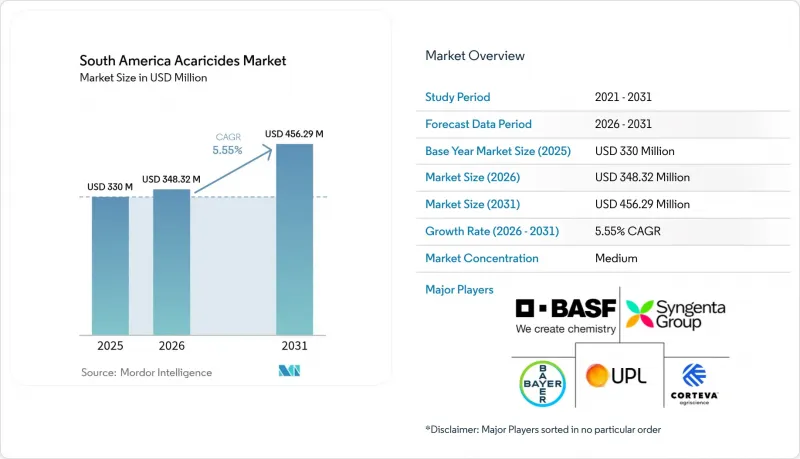
本報告依化學類型(有機磷、氨基甲酸酯、有機氯、除蟲菊酯、擬除蟲菊酯等)、應用方式(噴灑、浸泡、人工施用等)及地區(巴西、阿根廷等)進行分類。市場預測以美元計價。
南美殺蟎劑市場趨勢與洞察
精密噴霧器的引進降低了投入成本。
巴西農業研究公司(Embrapa)進行的田間試驗表明,在2023-2024種植季,馬托格羅索州引入GPS導航噴桿式噴霧器和可變噴灑速率控制設備,可使每公頃殺蟎劑用量減少15-25%。大型農場透過降低農藥和燃料成本,可在三個種植週期內收回初始投資。巴西500公頃以上農地的採用率在2024年達到38%,高於2020年的22%,其中棉花和大豆主要產區的採用率成長尤為迅速。在阿根廷,由於設備價格飆漲和補貼性機械融資的限制,採用率仍維持在18%左右。精準噴灑能夠精確調節最佳噴灑速率,因此Avermectin和螺蟎酯等高效活性成分更受歡迎。將噴霧器檢查作為產品銷售的一部分的經銷商,正在加強與生產商之間的信任關係,並透過服務而不是價格來脫穎而出。
氣候變遷導致蟎蟲向溫帶地區遷移
2019年至2023年間,阿根廷潘帕斯草原地區和巴西南部冬季平均最低氣溫上升了1.2度C,使得紅蜘蛛和柑橘銹蟎得以全年存活。發表在《應用昆蟲學雜誌》上的一項研究證實,在此期間,二斑葉蟎向南遷移了200公里,使噴藥期延長了4至6週。智利的鮮食葡萄和酪梨農場現在會在萌芽前安排預防性處理,而2020年以前這是不必要的。天敵族群數量成長速度跟不上害蟲的遷徙速度,因此化學防治正在填補這一空白。氣候變遷帶來的壓力也增加了噴藥頻率,同時,出口市場對低持久性製劑的需求也不斷增加。提供蟲害爆發預測地圖的供應商因其服務而獲得溢價,因為及時干預可以最大限度地減少蟲害爆發。
巴西對農藥重新登記實施更嚴格的規定
2023年第14785號法律和2024年12月第950號決議要求企業提供2010年之前註冊的所有活性成分的最新毒理學、生態毒理學和殘留數據。合規成本的飆升可能迫使小規模製劑生產商退出市場,並可能導致Chlorpyrifos和甲胺磷在2027年前被撤出市場。巴拉圭和烏拉圭依賴巴西的數據進行技術等效性認證,因此停止在巴西銷售可能會擾亂兩國的供應鏈。生產商可能被迫轉向成本更高的替代品,或在調整期內面臨產量下降。
細分市場分析
截至2025年,有機磷殺蟎劑將佔據南美洲37.60%的市場佔有率,並成為許多大豆和柑橘種植計畫的基礎。然而,有機磷殺蟎劑的成長軌跡受到更嚴格的重新登記要求的限制,這可能導致Chlorpyrifos在2027年被從登記冊中移除。預計Pyrethroids(如吡咯烷酮類殺蟎劑)的成長率最高,2026年至2031年的複合年成長率將達到7.35%。這是因為農民正在將Pyrethroids與內吸性活性成分結合使用,以延緩抗藥性的產生。Bifenthrin和氯氰菊酯因其在提供與傳統殺蟎劑相當的防治效果的同時,每公頃用量減少15%至20%而脫穎而出,這使得它們對投資了變數噴霧器的農民極具吸引力。
先正達集團和拜耳公司聯合開展的一項關於奈米封裝的研究表明,緩釋擬除蟲菊酯類殺蟲劑可在不超出殘留基準值的情況下,將其殘留效果延長高達60%,預計將於2026年實現商業化。氨基甲酸酯類殺蟲劑在牲畜浸泡處理中仍屬於小眾產品,其中丙氧氟沙星和西維因能提供快速擊倒效果。植物來源殺蟲劑能滿足有機生產者的需求,但其殘留效果很少超過5天,且需要頻繁補施。BASF於2025年1月推出的Efficon產品,其活性成分為二丙吡啶,是典型的雙效產品,可同時防治昆蟲和蟎蟲,以簡化施藥流程。
其他好處:
- Excel格式的市場預測(ME)表
- 3個月的分析師支持
目錄
第1章:引言
- 研究假設和市場定義
- 調查範圍
第2章:調查方法
第3章執行摘要
第4章 市場狀況
- 市場概覽
- 市場促進因素
- 精密噴霧器的引進將降低投入成本。
- 氣候變遷導致蜱蟲向溫帶遷移
- 政府振興大豆產業的措施
- 為制定符合出口標準的最大殘留基準值(MRL)而進行的工作
- 採用長效內吸性殺蟎劑。
- 電子商務在農業零售市場的滲透率
- 市場限制因素
- 巴西對化學物質重新註冊的要求更加嚴格
- 取得專利的活性成分的初始成本較高
- 註冊延誤導致新化學物質的取得也受到延誤。
- 蟎蟲對擬除蟲菊酯產生抗藥性
- 技術展望
- 監理情勢
- 波特五力分析
- 供應商的議價能力
- 買方/消費者議價能力
- 新進入者的威脅
- 替代品的威脅
- 競爭公司之間的競爭
第5章 市場規模與成長預測
- 依化學類型
- 有機磷化合物
- 卡爾瓦瑪特
- 有機氯化合物
- 除蟲菊酯
- Pyrethroids
- 其他化學類型
- 透過使用
- 噴
- 浸漬
- 手部護理
- 其他用途
- 按地區
- 巴西
- 阿根廷
- 其他南美國家
第6章 競爭情勢
- 市場集中度
- 策略趨勢
- 市佔率分析
- 公司簡介
- Bayer AG
- UPL Limited
- Syngenta Group
- BASF SE
- Corteva Agriscience
- FMC Corporation
- Sumitomo Chemical Co., Ltd.
- Nufarm Ltd.
- Gowan Company
- Koppert BV
- Sipcam Nichino(Sipcam-Oxon/Nichino JV)
- Nortox SA
- Ihara Corporation
- Alta Defensivos Agricolas Ltda.
第7章 市場機會與未來趨勢
According to Mordor Intelligence, the South America acaricides market size was valued at USD 330 million in 2025 and estimated to grow from USD 348.32 million in 2026 to reach USD 456.29 million by 2031, at a CAGR of 5.55% during the forecast period (2026-2031).
This report is Segmented by Chemical Type (Organophosphates, Carbamates, Organochlorines, Pyrethrins, Pyrethroids, and More), by Application (Spray, Dipping, Hand Dressing, and More), and by Geography (Brazil, Argentina, and More). The Market Forecasts are Provided in Terms of Value (USD).
South America Acaricides Market Trends and Insights
Precision-Sprayer Adoption Cuts Input Costs
Field trials by the Brazilian Agricultural Research Corporation (Embrapa) showed that global positioning system guided boom sprayers and variable-rate controllers reduced miticide use per hectare by 15% to 25% in Mato Grosso during the 2023-2024 season . Large farms recover capital outlays within three cycles through lower chemical spend and reduced fuel. Penetration among Brazilian properties above 500 hectares reached 38% in 2024, up from 22% in 2020, with cotton and soybean belts posting the fastest growth. Argentine uptake remains close to 18% because of higher equipment prices and limited subsidized machinery credit. Precision delivery favors high-potency actives such as abamectin and spiromesifen because optimal rates can be calibrated precisely. Dealers that bundle sprayer audits with product sales strengthen grower loyalty and differentiate on service rather than price.
Climate-Linked Mite Migration into Temperate Zones
Average winter lows in Argentina's Pampas and southern Brazil rose by 1.2 °C between 2019 and 2023, allowing two-spotted spider mites and citrus rust mites to survive year-round. Research published in the Journal of Applied Entomology traced a 200-kilometer southward shift of Tetranychus urticae during that period, extending the spray window by four to six weeks. Chilean table grape and avocado farms now schedule preventive treatments before bud break, a practice unnecessary before 2020. Natural predator populations lag behind migrating pest fronts, so chemical control fills the gap. Climate pressure also raises application frequency, expanding demand for low-residue formulas acceptable to export markets. Suppliers offering predictive pest maps earn a service premium because timely intervention minimizes flare-ups.
Stricter Chemical Re-Registration in Brazil
Law 14 785 of 2023 and Resolution 950 of December 2024 require companies to provide updated toxicology, ecotoxicology, and residue data for all active ingredients registered before 2010. The high compliance costs are likely to force smaller formulators out of the market and could lead to the removal of chlorpyrifos and methamidophos by 2027. Paraguay and Uruguay rely on Brazilian dossiers for technical equivalence, meaning any withdrawal in Brazil could disrupt their supply chains. Growers may need to transition to higher-cost substitutes or face potential yield losses during the adjustment period.
Other drivers and restraints analyzed in the detailed report include:
- Government Soybean Revitalization Programs
- Push for Export-Compliant Maximum Residue Limits (MRLs)
- High Upfront Cost of Patented Actives
For complete list of drivers and restraints, kindly check the Table Of Contents.
Segment Analysis
Organophosphates captured 37.60% of the South America acaricides market share in 2025 share in 2025, making them the bedrock of many soybean and citrus programs. The organophosphates reached their trajectory is limited by stricter re-registration requirements that could delist chlorpyrifos by 2027. Pyrethroids posted the fastest forecast growth at 7.35% CAGR from 2026 to 2031 because growers combine them with systemic actives to delay resistance. Bifenthrin and lambda-cyhalothrin stand out for delivering comparable control at 15% to 20% lower rates per hectare than legacy options, which appeals to farms investing in variable-rate sprayers.
Nano-encapsulation research from Syngenta Group and Bayer AG indicates that controlled-release pyrethroids can extend residual effectiveness by up to 60% without exceeding residue limits, with commercial launches projected in 2026. Carbamates remain niche products in livestock dipping, where propoxur and carbaryl provide rapid knockdown. Botanical pyrethrins satisfy organic producers but require frequent reapplication because their residual activity seldom exceeds five days. Dimpropyridaz, the active in BASF's Efficon, launched in January 2025, exemplifies dual-mode products that bridge insect and mite control, streamlining spray calendars.
Complete Report Scope:
- By Chemical Type
- Organophosphates
- Carbamates
- Organochlorines
- Pyrethrins
- Pyrethroids
- Other Chemical Types
- By Application
- Spray
- Dipping
- Hand Dressing
- Other Applications
- By Geography
- Brazil
- Argentina
- Rest of South America
List of Companies Covered in this Report:
- Bayer AG
- UPL Limited
- Syngenta Group
- BASF SE
- Corteva Agriscience
- FMC Corporation
- Sumitomo Chemical Co., Ltd.
- Nufarm Ltd.
- Gowan Company
- Koppert BV
- Sipcam Nichino (Sipcam-Oxon / Nichino JV)
- Nortox S.A.
- Ihara Corporation
- Alta Defensivos Agricolas Ltda.
Additional Benefits:
- The market estimate (ME) sheet in Excel format
- 3 months of analyst support
TABLE OF CONTENTS
1 INTRODUCTION
- 1.1 Study Assumptions and Market definition
- 1.2 Scope of the Study
2 RESEARCH METHODOLOGY
3 EXECUTIVE SUMMARY
4 MARKET LANDSCAPE
- 4.1 Market Overview
- 4.2 Market Drivers
- 4.2.1 Precision-sprayer adoption cuts input costs
- 4.2.2 Climate-linked mite migration into temperate zones
- 4.2.3 Government soybean revitalization programs
- 4.2.4 Push for export-compliant Maximum Residue Limits (MRLs)
- 4.2.5 Adoption of long-residual systemic miticides
- 4.2.6 E-commerce agro-retail penetration
- 4.3 Market Restraints
- 4.3.1 Stricter chemical re-registration in Brazil
- 4.3.2 High upfront cost of patented actives
- 4.3.3 Registration backlog delaying access to new chemistries
- 4.3.4 Emerging mite resistance to pyrethroids
- 4.4 Technological Outlook
- 4.5 Regulatory Landscape
- 4.6 Porter's Five Force Analysis
- 4.6.1 Bargaining Power of Suppliers
- 4.6.2 Bargaining Power of Buyers/Consumers
- 4.6.3 Threat of New Entrants
- 4.6.4 Threat of Substitute Products
- 4.6.5 Intensity of Competitive Rivalry
5 MARKET SIZE AND GROWTH FORECASTS (VALUE)
- 5.1 By Chemical Type
- 5.1.1 Organophosphates
- 5.1.2 Carbamates
- 5.1.3 Organochlorines
- 5.1.4 Pyrethrins
- 5.1.5 Pyrethroids
- 5.1.6 Other Chemical Types
- 5.2 By Application
- 5.2.1 Spray
- 5.2.2 Dipping
- 5.2.3 Hand Dressing
- 5.2.4 Other Applications
- 5.3 By Geography
- 5.3.1 Brazil
- 5.3.2 Argentina
- 5.3.3 Rest of South America
6 COMPETITIVE LANDSCAPE
- 6.1 Market Concentration
- 6.2 Strategic Moves
- 6.3 Market Share Analysis
- 6.4 Company Profiles (Includes Global Level Overview, Market Level Overview, Core Segments, Financials as Available, Strategic Information, Market Rank/Share for Key Companies, Products and Services, and Recent Developments)
- 6.4.1 Bayer AG
- 6.4.2 UPL Limited
- 6.4.3 Syngenta Group
- 6.4.4 BASF SE
- 6.4.5 Corteva Agriscience
- 6.4.6 FMC Corporation
- 6.4.7 Sumitomo Chemical Co., Ltd.
- 6.4.8 Nufarm Ltd.
- 6.4.9 Gowan Company
- 6.4.10 Koppert BV
- 6.4.11 Sipcam Nichino (Sipcam-Oxon / Nichino JV)
- 6.4.12 Nortox S.A.
- 6.4.13 Ihara Corporation
- 6.4.14 Alta Defensivos Agricolas Ltda.
7 MARKET OPPORTUNITIES AND FUTURE TRENDS

 殺蟎劑市場-2026-2032年全球市場預測
 IRAC 30 殺蟲劑:市場佔有率分析、行業趨勢和統計數據、成長預測(2026-2031 年)
 殺蟎劑市場規模、佔有率和成長分析:按化學成分、適用作物/目標區域、銷售管道、分銷管道和地區分類-2026-2033年產業預測
 殺蟎劑市場-全球產業規模、佔有率、趨勢、機會與預測:按作物類型、配方、應用方法、原料來源、地區和競爭格局分類,2021-2031年
 殺蟎劑市場預測—全球按類型、作物、配方、分銷管道、應用和地區分類的分析—2034年
 全球殺蟎劑市場規模、佔有率、趨勢和成長分析報告(2026-2034年)全球異噁唑啉市場規模、佔有率、趨勢和成長分析報告(2026-2034年)氯芬特津市場:依作物類型、製劑、應用方法、最終用戶和銷售管道,全球預測,2026-2032年阿米曲唑市場:按劑型、應用、最終用戶和銷售管道分類-2026-2032年全球預測
 2026年全球蔬果殺蟎劑市場報告