


 |
市場調查報告書
商品編碼
2118127
生物可分解螯合劑:市場佔有率分析、產業趨勢與統計、成長預測(2026-2031)Biodegradable Chelating Agents - Market Share Analysis, Industry Trends & Statistics, Growth Forecasts (2026 - 2031) |
||||||

※ 本網頁內容可能與最新版本有所差異。詳細情況請與我們聯繫。
根據 Mordor Intelligence 預測,可生物分解螯合劑的市場規模預計將從 2025 年的 51.1 億美元成長到 2026 年的 54.9 億美元,然後在 2031 年達到 79.4 億美元,2026 年至 2031 年的複合年成長率為 7.66%。
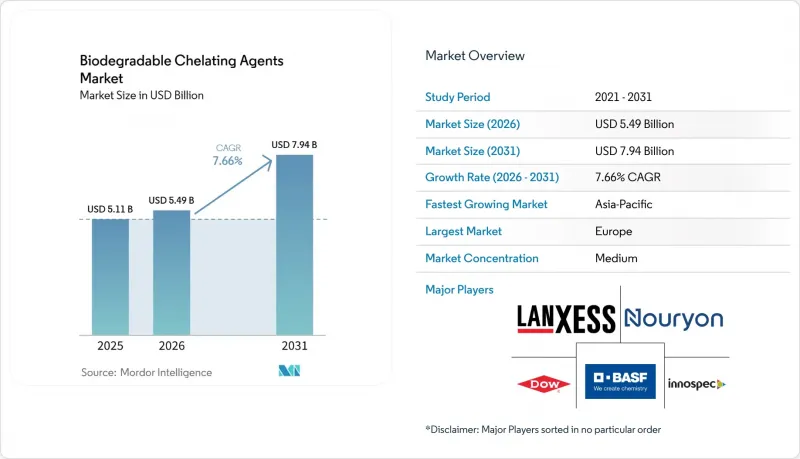
本報告按類型(氨基酸螯合物、有機酸螯合物等)、劑型(液體、粉末、顆粒)、終端用戶行業(農業、家庭和設施清潔等)以及地區(亞太地區、北美地區、歐洲地區、南美地區、中東和非洲地區)進行細分。市場預測以美元計價。
全球可生物分解螯合劑市場趨勢及洞察
嚴格的環境法規促進了可生物分解螯合劑的應用。
針對高持久性化學物質並要求提供明確生物分解證據的環境法規,為可生物分解螯合劑市場帶來了最強勁的短期動力。歐盟提案的清潔劑法規規定,清潔劑膠囊薄膜必須在實施後六年內達到生物分解要求,濃縮有機物質則必須在實施後八年內達到生物分解要求。這些時間表為歐洲配方開發人員提供了一個清晰的框架,用於審查現有的螯合劑系統、規劃配方改進工作以及評估清潔產品中已使用的原料的狀態。麩胺酸二乙酸酯 (GLDA) 在 OECD 301D 測試中已證明其能夠在 28 天內達到 60% 以上的生物分解率,這支持了其在相關清潔配方中的應用。隨著合規要求的不斷變化,採購討論的重點正從初始原料成本轉向產品合格、文件、測試記錄以及向客戶和監管機構證明其可接受的環境性能的能力。這種轉變也有利於可生物分解螯合劑市場的供應商,使他們能夠提供涵蓋多種最終用途的技術數據和認證證明。
家庭和工業領域對永續清潔產品的需求不斷成長。
清潔應用是可生物分解螯合劑的主要需求領域。這是因為配方研發人員正在尋找在硬水中性能卓越、環境記錄可靠、劑量控制實用且與現有生產流程相容的成分。麩胺酸二乙酸酯 (GLDA) 和甲基甘氨酸二乙酸酯 (MGDA) 被用作歐洲洗碗機和洗衣產品中傳統磷酸鹽基助劑體系的替代品。 2025 年 4 月,BASF推出了用於家庭和商用/工業清潔應用的「Trilon G」。該產品中 56% 的碳原子來自可再生資源。濃縮液體產品可以減少單位活性成分的包裝和運輸體積。這對零售買家至關重要,他們在評估清潔產品的功效和供應商提案時,會考慮供應鏈排放、包裝使用、分銷效率和產品性能。消費者對環保和生物基成分的偏好進一步增強了可生物分解螯合劑市場配方改進的商業性可行性,該市場主要應用於清潔領域。
與傳統螯合劑相比,生產和配製成本較高。
成本仍然是可生物分解螯合劑市場的阻礙因素,尤其是在環境法規執行不力且客戶優先考慮原料當前價格的情況下。可生物分解產品的生產成本通常是乙二胺四乙酸 (EDTA) 的 1.5 到 3 倍,具體倍數取決於等級和採購量。麩胺酸二乙酸酯 (GLDA) 的生產涉及發酵衍生的 L-麩胺酸以及額外的衍生化步驟,因此需要比現有的 EDTA 生產過程更嚴格的製程控制。南亞和東南亞的小規模製劑生產商可能缺乏資源來評估特定清潔系統中有效劑量的減少、進行性能對比測試或修訂現有產品規格。由於技術意識有限,即使使用成本更有利,表面上的成本劣勢仍然存在。雖然隨著主要生產商提高產能,這種差距可能會逐漸縮小,但預計在 2020 年代末之前不會出現顯著的價格波動。
細分市場分析
2024年,胺基酸螯合物佔銷售額的37.82%,這主要得益於農業微量元素供應和高階個人護理應用領域的成長。它們在鈣質土壤中的價值特別顯著,因為合成鐵螯合物往往因與鈣競爭而效果有限。研究表明,與未處理的對照組相比,鋅-離胺酸螯合物可使高粱籽粒產量增加39.9%。此外,大豆葉面葉面噴布研究表明,與硫酸鹽對照組相比,組胺酸和麩胺酸複合物中錳和鋅的轉運量更高。有機酸螯合物,包括檸檬酸鹽和葡萄糖酸鹽,是第二大類。它們應用於食品和製藥領域,其中發酵衍生的原料可作為EDTA的低成本替代品。
天然螯合劑,包括 GLDA 和 MGDA,預計到 2031 年將以 8.52% 的複合年成長率成長。這一成長主要得益於工業清潔劑和洗碗清潔劑應用領域對寬 pH 值範圍性能的要求。 GLDA 可支援這些應用中的產品重組,而無需對製程進行重大改造。多羧酸螯合物在紙漿和造紙漂白領域保持需求,因為螯合劑的成本可以透過提高製程效率來抵消。天然產品還可以滿足尋求 COSMOS 和歐盟生態標籤認證的製造商的需求。BASF的 Trilon G 和諾力昂的 Dissolvine GL 產品線可滿足這些應用和認證需求。
區域分析
預計到2025年,歐洲將佔總銷售額的35.44%,並將繼續成為受法規主導的配方變革的關鍵地區。德國、法國和英國在清潔、個人護理、農業化學品、紙漿和造紙等行業的需求持續成長。 REACH法規的不斷實施正在加速這些應用領域從EDTA轉向GLDA的轉變。朗盛將其Baypure系列產品定位為水處理應用領域的環保替代方案。歐洲經銷商也協助客戶獲得符合REACH和歐盟生態標籤要求的認證。此外,義大利和俄羅斯在紡織和紙漿應用領域也湧現新的需求。
預計到2031年,亞太地區將以8.42%的複合年成長率成長,成為成長最快的地區。由於關鍵土壤中微量元素缺乏,中國和印度正在推動全球對螯合肥料原料的需求。需求主要集中在硼、錳、鋅和鐵的應用領域。兩國都在實施生物強化計劃,以支持螯合鋅和螯合鐵原料的使用。日本和韓國是電子、製藥和個人護理產業對高純度、環保螯合劑的需求來源。國內供應商正在改進其文件系統,以符合國際認證的供應鏈標準。預計到2020年代後期,中國GLDA和MGDA供應商在標準級出口產品方面將面臨日益激烈的價格競爭。
在北美,在環保署「更安全選擇」計畫以及加州和華盛頓州州級法規的支持下,這項轉型正穩步推進。這些要求正在影響市場上銷售的清潔劑配方。南美洲仍處於起步階段,但巴西對大豆、水果和蔬菜的需求潛力巨大。出口市場對品質的要求推動了人們對用於高價值作物的可生物分解螯合產品的興趣。在中東和非洲,用於水處理迴路的可生物分解阻垢劑的需求旺盛。水資源短缺以及對海水淡化的投資,使得沙烏地阿拉伯和南非成為該地區值得關注的市場。
其他好處:
- Excel格式的市場預測(ME)表
- 3個月的分析師支持
目錄
第1章:引言
- 研究假設和市場定義
- 調查範圍
第2章:調查方法
第3章執行摘要
第4章 市場狀況
- 市場概覽
- 市場促進因素
- 嚴格的環境法規正在推動可生物分解螯合劑的應用。
- 家庭和工業領域對永續清潔產品的需求不斷成長。
- 擴大微量營養素供應和作物保護配方在農業領域的應用。
- 在個人護理、食品加工和製藥行業中的應用日益廣泛。
- 消費者越來越偏好環保型和生物基化學成分。
- 市場限制因素
- 與傳統螯合劑相比,其生產和配製成本更高。
- 在極端 pH 值、高溫和高硬度水條件下的性能限制。
- 中小終端用戶市場認知度低,接受度低。
- 價值鏈分析
- 波特五力分析
第5章 市場規模與成長預測
- 按類型
- 胺基酸螯合物
- 有機酸螯合物
- 多羧酸螯合物
- 天然螯合劑
- 配方
- 液體
- 粉末
- 顆粒狀
- 按最終用戶行業分類
- 農業
- 住宅和商業清潔服務
- 水處理
- 個人護理化妝品
- 食品/飲料
- 製藥
- 紡織品
- 紙漿和造紙
- 工業製造
- 其他終端用戶產業
- 按地區
- 亞太地區
- 中國
- 印度
- 日本
- 韓國
- 其他亞太國家
- 北美洲
- 美國
- 加拿大
- 墨西哥
- 歐洲
- 德國
- 英國
- 法國
- 義大利
- 俄羅斯
- 其他歐洲國家
- 南美洲
- 巴西
- 阿根廷
- 其他南美國家
- 中東和非洲
- 沙烏地阿拉伯
- 南非
- 其他中東和非洲國家
- 亞太地區
第6章 競爭情勢
- 市場集中度
- 策略趨勢
- 市佔率和排名分析
- 公司簡介
- Aquapharm Chemical Limited
- AVA Chemicals
- BASF
- Cargill, Incorporated
- Dow
- Hebei Think-Do Chemicals Co., Ltd.
- Innospec
- Jungbunzlauer Suisse AG
- Kemira
- LANXESS
- Mitsubishi Chemical Corporation
- Nippon Shokubai Co., Ltd.
- Nouryon
- Shandong IRO Chelating Chemical Co., Ltd.
- Solvay
- Zschimmer & Schwarz Chemie GmbH
第7章 市場機會與未來展望
According to Mordor Intelligence, the biodegradable chelating agents market size is expected to grow from USD 5.11 billion in 2025 to USD 5.49 billion in 2026 and is forecast to reach USD 7.94 billion by 2031 at 7.66% CAGR over 2026-2031.
This report is Segmented by Type (Amino Acid Chelates, Organic Acid Chelates, and More), Formulation (Liquid, Powder and Granular), End-User Industry (Agriculture, Household and Institutional Cleaning, and More), and Geography (Asia-Pacific, North America, Europe, South America, and Middle-East and Africa). The Market Forecasts are Provided in Terms of Value (USD).
Global Biodegradable Chelating Agents Market Trends and Insights
Stringent Environmental Regulations Promoting the Adoption of Biodegradable Chelating Agents
Environmental regulations targeting persistent chemical substances and requiring clear evidence of biodegradation provide the strongest near-term support for the biodegradable chelating agents market. The proposed EU Detergents Regulation sets biodegradability requirements for detergent-capsule films within 6 years of enactment and for concentrated organic substances within 8 years. These timelines give European formulators a clear framework for reviewing existing chelant systems, scheduling reformulation work, and assessing the status of raw materials already used in cleaning products. Glutamic acid diacetate (GLDA) can achieve more than 60% biodegradation within 28 days under OECD 301D testing, supporting its use in relevant cleaning formulations. Compliance requirements are shifting procurement discussions from initial material cost toward product eligibility, documentation, testing records, and the ability to demonstrate acceptable environmental performance to customers and regulators. This shift also benefits suppliers in the biodegradable chelating agents market by enabling them to provide technical data and certification evidence across several end uses.
Growing Demand for Sustainable Cleaning Products in Household and Industrial Applications
Cleaning applications represent a major demand base for the biodegradable chelating agents market, as formulators require strong hard-water performance, credible environmental credentials, practical dosing characteristics, and ingredients compatible with established manufacturing processes. Glutamic acid diacetic acid (GLDA) and methylglycinediacetic acid (MGDA) are used in European dishwasher and laundry products as replacements for older phosphate-based builder systems. BASF introduced Trilon G in April 2025 for home care and institutional and industrial cleaning applications, with 56% of its carbon atoms derived from renewable sources. Concentrated liquid products can reduce packaging and transport volumes per unit of active ingredient. This is relevant to retail buyers who evaluate supply chain emissions, packaging use, distribution efficiency, and product performance when reviewing cleaning product claims and supplier proposals. Consumer preference for eco-friendly and bio-based ingredients reinforces the commercial case for formulation changes in the biodegradable chelating agents market for cleaning applications.
Higher Production and Formulation Costs Compared with Conventional Chelating Agents
Cost remains a restraint for the biodegradable chelating agents market, particularly where environmental enforcement is less consistent and customers remain focused on the immediate price of raw materials. Biodegradable products typically carry a production cost premium of 1.5 to 3 times that of ethylenediaminetetraacetic acid (EDTA), depending on grade and purchase volume. Glutamic acid diacetic acid (GLDA) production uses fermentation-derived L-glutamic acid and additional derivatization steps, which require tighter process control than established EDTA routes. Small formulators in South and Southeast Asia may lack the resources to assess lower effective dosing rates in certain cleaning systems, conduct comparative performance trials, or revise existing product specifications. Limited technical awareness can sustain the apparent cost disadvantage even where the cost in use is more favorable. Capacity additions by major producers could narrow this gap over time, but substantial price changes are not expected before the late 2020s.
Other drivers and restraints analyzed in the detailed report include:
- Increasing Use in Agriculture for Micronutrient Delivery and Crop Protection Formulations
- Rising Adoption in Personal Care, Food Processing, and Pharmaceutical Applications
- Performance Limitations Under Extreme pH, High Temperature, and High-Hardness Water Conditions
For complete list of drivers and restraints, kindly check the Table Of Contents.
Segment Analysis
Amino acid chelates held 37.82% of revenue in 2024, supported by agricultural micronutrient delivery and premium personal care applications. Their value is particularly evident in calcareous soils, where calcium competition can limit the effectiveness of synthetic iron chelates. Research found that Zn-lysine chelates improved sorghum grain yield by 39.9% compared with untreated controls. Foliar research in soybean also found greater manganese and zinc translocation from histidine and glutamate complexes than from sulfate controls. Organic acid chelates, including citrates and gluconates, are the second-largest type. They are used in food and pharmaceutical applications, where fermentation-based materials offer lower-cost alternatives to EDTA.
Natural chelating agents, including GLDA and MGDA, are forecast to grow at an 8.52% CAGR through 2031. Their adoption is driven by institutional cleaning and automatic dishwashing applications that require performance across a broad pH range. GLDA can support reformulation without substantial process redesign in these applications. Polycarboxylic acid chelates retain demand in pulp and paper bleaching because process-efficiency gains can offset chelant costs. Natural products can also support manufacturers seeking COSMOS and EU Ecolabel certification. BASF's Trilon G and Nouryon's Dissolvine GL portfolio serve this application and certification demand.
Complete Report Scope:
- By Type
- Amino Acid Chelates
- Organic Acid Chelates
- Polycarboxylic Acid Chelates
- Natural Chelating Agents
- By Formulation
- Liquid
- Powder
- Granular
- By End-User Industry
- Agriculture
- Household and Institutional Cleaning
- Water Treatment
- Personal Care and Cosmetics
- Food and Beverage
- Pharmaceuticals
- Textile
- Pulp and Paper
- Industrial Manufacturing
- Other End-User Industries
- By Geography
- Asia-Pacific
- China
- India
- Japan
- South Korea
- Rest of Asia-Pacific
- North America
- United States
- Canada
- Mexico
- Europe
- Germany
- United Kingdom
- France
- Italy
- Russia
- Rest of Europe
- South America
- Brazil
- Argentina
- Rest of South America
- Middle-East and Africa
- Saudi Arabia
- South Africa
- Rest of Middle-East and Africa
- Asia-Pacific
Geography Analysis
Europe accounted for 35.44% of revenue in 2025 and remains the primary region for regulatory-driven reformulation. Germany, France, and the United Kingdom support demand through cleaning, personal care, agrochemical, pulp, and paper activities. Continued REACH enforcement has encouraged the shift from EDTA to GLDA in these applications. LANXESS positions its Baypure range as an environmentally compatible alternative for water treatment applications. European distributors are also providing certification support for customers working with REACH and EU Ecolabel requirements. Italy and Russia contribute additional demand through textile and pulp applications.
Asia-Pacific is projected to expand at an 8.42% CAGR through 2031, making it the fastest-growing region. China and India lead global demand for chelated fertilizer inputs due to micronutrient deficiencies in key soils. Demand is concentrated in boron, manganese, zinc, and iron applications. Both countries have biofortification programs that support the use of chelated zinc and iron inputs. Japan and South Korea represent demand pools for high-purity, eco-friendly chelates in electronics, pharmaceuticals, and personal care. Domestic suppliers are building documentation capabilities to serve internationally certified supply chains. Chinese GLDA and MGDA suppliers may intensify price competition in standard-grade export products through the late 2020s.
North America is transitioning at a measured pace, supported by the EPA Safer Choice program and state-level restrictions in California and Washington. These requirements affect cleaning formulations sold in those markets. South America remains at an earlier stage, with Brazil offering potential demand for soybeans, fruits, and vegetables. Export-market quality requirements are driving interest in biodegradable chelating agent products for higher-value crops. The Middle East and Africa present demand for biodegradable scale inhibitors in water treatment circuits. Water scarcity and desalination investment make Saudi Arabia and South Africa notable markets in this region.
- Aquapharm Chemical Limited
- AVA Chemicals
- BASF
- Cargill, Incorporated
- Dow
- Hebei Think-Do Chemicals Co., Ltd.
- Innospec
- Jungbunzlauer Suisse AG
- Kemira
- LANXESS
- Mitsubishi Chemical Corporation
- Nippon Shokubai Co., Ltd.
- Nouryon
- Shandong IRO Chelating Chemical Co., Ltd.
- Solvay
- Zschimmer & Schwarz Chemie GmbH
Additional Benefits:
- The market estimate (ME) sheet in Excel format
- 3 months of analyst support
TABLE OF CONTENTS
1 Introduction
- 1.1 Study Assumptions and Market Definition
- 1.2 Scope of the Study
2 Research Methodology
3 Executive Summary
4 Market Landscape
- 4.1 Market Overview
- 4.2 Market Drivers
- 4.2.1 Stringent Environmental Regulations Promoting the Adoption of Biodegradable Chelating Agents
- 4.2.2 Growing Demand for Sustainable Cleaning Products in Household and Industrial Applications
- 4.2.3 Increasing Use in Agriculture for Micronutrient Delivery and Crop Protection Formulations
- 4.2.4 Rising Adoption in Personal Care, Food Processing, and Pharmaceutical Applications
- 4.2.5 Growing Consumer Preference for Eco-Friendly and Bio-Based Chemical Ingredients
- 4.3 Market Restraints
- 4.3.1 Higher Production and Formulation Costs Compared to Conventional Chelating Agents
- 4.3.2 Performance Limitations Under Extreme pH, High Temperature, and High-Hardness Water Conditions
- 4.3.3 Limited Market Awareness and Slow Adoption Across Small and Medium-Sized End Users
- 4.4 Value Chain Analysis
- 4.5 Porter's Five Forces Analysis
- 4.5.1 Threat of New Entrants
- 4.5.2 Bargaining Power of Suppliers
- 4.5.3 Bargaining Power of Buyers
- 4.5.4 Threat of Substitutes
- 4.5.5 Competitive Rivalry
5 Market Size and Growth Forecasts (Value)
- 5.1 By Type
- 5.1.1 Amino Acid Chelates
- 5.1.2 Organic Acid Chelates
- 5.1.3 Polycarboxylic Acid Chelates
- 5.1.4 Natural Chelating Agents
- 5.2 By Formulation
- 5.2.1 Liquid
- 5.2.2 Powder
- 5.2.3 Granular
- 5.3 By End-User Industry
- 5.3.1 Agriculture
- 5.3.2 Household and Institutional Cleaning
- 5.3.3 Water Treatment
- 5.3.4 Personal Care and Cosmetics
- 5.3.5 Food and Beverage
- 5.3.6 Pharmaceuticals
- 5.3.7 Textile
- 5.3.8 Pulp and Paper
- 5.3.9 Industrial Manufacturing
- 5.3.10 Other End-User Industries
- 5.4 By Geography
- 5.4.1 Asia-Pacific
- 5.4.1.1 China
- 5.4.1.2 India
- 5.4.1.3 Japan
- 5.4.1.4 South Korea
- 5.4.1.5 Rest of Asia-Pacific
- 5.4.2 North America
- 5.4.2.1 United States
- 5.4.2.2 Canada
- 5.4.2.3 Mexico
- 5.4.3 Europe
- 5.4.3.1 Germany
- 5.4.3.2 United Kingdom
- 5.4.3.3 France
- 5.4.3.4 Italy
- 5.4.3.5 Russia
- 5.4.3.6 Rest of Europe
- 5.4.4 South America
- 5.4.4.1 Brazil
- 5.4.4.2 Argentina
- 5.4.4.3 Rest of South America
- 5.4.5 Middle-East and Africa
- 5.4.5.1 Saudi Arabia
- 5.4.5.2 South Africa
- 5.4.5.3 Rest of Middle-East and Africa
- 5.4.1 Asia-Pacific
6 Competitive Landscape
- 6.1 Market Concentration
- 6.2 Strategic Moves
- 6.3 Market Share (%)/Ranking Analysis
- 6.4 Company Profiles (includes Global Overview, Market Overview, Core Segments, Financials as available, Strategic Information, Products and Services, and Recent Developments)
- 6.4.1 Aquapharm Chemical Limited
- 6.4.2 AVA Chemicals
- 6.4.3 BASF
- 6.4.4 Cargill, Incorporated
- 6.4.5 Dow
- 6.4.6 Hebei Think-Do Chemicals Co., Ltd.
- 6.4.7 Innospec
- 6.4.8 Jungbunzlauer Suisse AG
- 6.4.9 Kemira
- 6.4.10 LANXESS
- 6.4.11 Mitsubishi Chemical Corporation
- 6.4.12 Nippon Shokubai Co., Ltd.
- 6.4.13 Nouryon
- 6.4.14 Shandong IRO Chelating Chemical Co., Ltd.
- 6.4.15 Solvay
- 6.4.16 Zschimmer & Schwarz Chemie GmbH
7 Market Opportunities and Future Outlook
- 7.1 White-Space and Unmet-Need Assessment

 生物基螯合劑市場預測至2034年:按產品類型、原料、應用、劑型、最終用戶和地區分類的全球分析
 天然螯合劑市場規模、佔有率和成長分析:按產品類型、原料、形態、應用、最終用途產業和地區分類-2026-2033年產業預測
 天然螯合劑市場:商業機會、成長要素、產業趨勢分析及2026-2035年預測
 生物可分解螯合劑市場:依產品類型、劑型、通路、應用及產業分類-2026-2032年全球市場預測檸檬醛產品市場:2026-2032年全球市場預測(依調味品、食品飲料、製藥、應用及通路分類)
 全球鋅甲硫胺酸螯合物市場規模、佔有率、趨勢和成長分析報告(2026-2034年)
 全球綠色螯合劑(天然螯合劑)市場報告,2026年
 鋅甲硫胺酸螯合物市場規模、佔有率和成長分析(按產品類型、形態、牲畜種類、應用和地區分類)-2026-2033年產業預測
 農業螯合物市場-全球產業規模、佔有率、趨勢、機會及預測,依類型、作物類型、應用、地區及競爭格局分類,2020-2030年預測螯合劑市場-全球產業規模、佔有率、趨勢、機會與預測,按產品、應用、地區和競爭細分,2020-2030 年