


 |
市場調查報告書
商品編碼
2118120
再生金屬:市場佔有率分析、產業趨勢與統計、成長預測(2026-2031)Recycled Metal - Market Share Analysis, Industry Trends & Statistics, Growth Forecasts (2026 - 2031) |
||||||

※ 本網頁內容可能與最新版本有所差異。詳細情況請與我們聯繫。
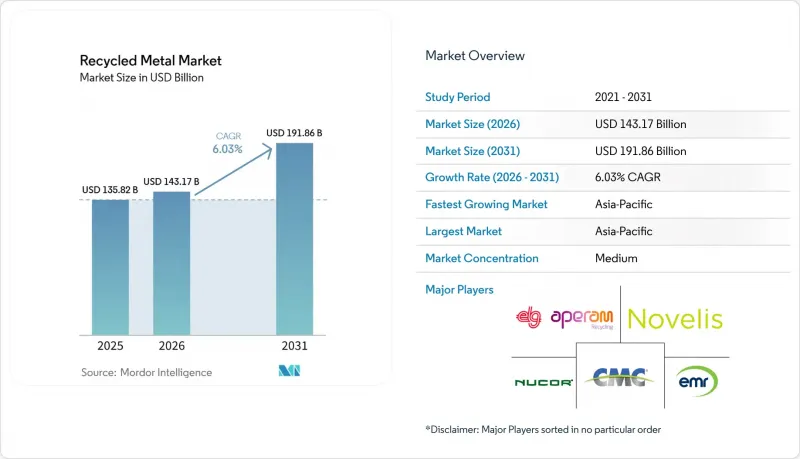
據 Mordor Intelligence 稱,2025 年再生金屬市場價值為 1358.2 億美元,預計到 2031 年將達到 1918.6 億美元,而 2026 年為 1431.7 億美元,預測期內(2026-2031 年)的複合成長率預計為 6.03%。
本報告按金屬類型(黑色金屬和非鐵金屬)、廢料來源(工業廢料等)、加工方法(機械加工等)、產品形態(錠塊等)、終端用戶行業(汽車行業等)以及地區(亞太地區、北美地區、歐洲地區、南美地區、中東和非洲地區)進行細分。市場預測以美元計價。
全球再生金屬市場趨勢與洞察
主要終端用戶產業對再生金屬的需求不斷成長
隨著成本控制、碳會計和供應來源多元化等因素同時影響採購決策,製造業買家對再生材料含量的要求也日益提高。這一趨勢在再生金屬市場的汽車和電子行業尤其明顯,這些行業的材料規格日益嚴格,供應商也被要求透過可靠的二手資訊來幫助實現生命週期減排目標。針對汽車車體鋼板通路的研究表明,到2050年,鋁和鋼的閉合迴路回收可以將生命週期排放量減少高達70%,這為汽車製造商更廣泛地採用再生材料提供了強力的理由。除了數量之外,買家還越來越重視可預測的品質、可追溯的來源以及與高價值應用的兼容性,這正在改變回收商的競爭方式和合約結構。因此,再生金屬市場不僅受益於不斷成長的需求,也受益於工業客戶採購行為逐漸轉向更標準化和基於規格的轉變。
人們越來越關注工業脫碳和減排。
隨著各產業向脫碳方向發展,以廢鋼為基礎的生產方式正變得日益重要,成為減少那些嚴重依賴熱能、礦石和大規模物料流的產業排放的有效途徑。預計到2024年,全球鋼鐵產量將達到18.86億噸,該產業將排放約41億噸二氧化碳當量。這持續迫使鋼鐵製造商盡可能拓展低排放量生產路線。電弧爐生產高度依賴廢鋼,與鋼鐵消費產業減少「隱性排放」的更廣泛努力相契合,因此再生金屬市場正直接受益於此壓力。這種影響不僅限於鋼鐵業,在非鐵金屬應用領域,尤其是在採購審查中,客戶會比較未使用材料和再生材料的碳足跡,因此選擇低碳材料變得越來越重要。因此,再生金屬市場與脫碳計畫、工廠投資決策和供應合約的連結日益緊密,這些決策和合約都更加重視回收金屬的排放特性。
廢金屬價格波動與倫敦金屬交易所(LME)套利交易中斷
價格波動仍然是阻礙因素。回收商必須在瞬息萬變的市場中管理原料採購、加工成本和銷售契約,而市場會因貿易流量和基準價差而快速變化。即使實體交易量穩定,廢料價格的劇烈波動也會擠壓利潤空間,因此這個問題影響整個再生金屬市場,包括鐵基和有色金屬。這種不穩定性也使得加工商難以規劃前置作業時間較長的技術升級或產能擴張,尤其是在貸款人和客戶要求更可預測的回報和供應記錄的情況下。當國內和出口通路之間的平衡被打破時,這項挑戰會更加突出,因為加工商可能被迫在沒有足夠的時間維持獲利能力的情況下轉移原料。儘管面臨這些壓力,再生金屬市場仍在持續成長,但價格波動可能會減緩盈利和投資的步伐。
細分市場分析
2025年,黑色金屬佔銷售額的61.72%,但預計到2031年,非鐵金屬的複合年成長率將達到6.89%,這表明在再生金屬市場中,銷量主導和成長主導已不再集中在同一細分市場。鐵基金屬的回收仍然是再生金屬市場的支柱,因為建築、基礎設施和使用電弧爐的煉鋼行業持續消耗大量廢鋼,從而支撐了對再生鋼的穩定需求。同時,對非鐵金屬的需求成長更為迅速。這是因為再生銅和再生鋁在交通電氣化、電力設備和資料基礎設施等領域的重要性日益凸顯,而這些領域對材料的性能和供應穩定性有著重要的考量。 2025年中國再生鋁產量將達到1,160萬噸,再生銅產量將達到485萬噸,這些數據清楚展現了非鐵金屬回收的規模。
再生金屬市場的顯著變化不僅體現在非鐵金屬的加速成長,也體現在再生材料與原生原料在要求嚴苛的應用領域相容性的提升。目前,濕式冶煉及相關精煉製程能夠從廢棄印刷電路基板中生產出純度高達99.64%至99.84%的再生銅,使其在電子相關應用領域作為替代材料的潛力日益增強。這意義重大,因為過去將再生非鐵金屬視為低品質替代品的買家,如今可以在對成分控制要求極高的應用中考慮使用再生銅。因此,再生金屬市場的競爭格局正在轉變,製程能力和純度保證的重要性遠勝於單純追求廢棄物數量。
預計到2025年,工業廢料將佔46.81%,而廢棄物和消費後廢料預計到2031年將以6.32%的複合年成長率成長,這表明再生金屬市場的供應基礎正在逐步擴大。工業廢料之所以繼續佔據主導地位,是因為工廠內的廢料和生產殘渣通常質量更穩定、污染更少,而且回收商更容易對其進行認證,從而滿足高標準工業買家的需求。這種穩定性推動了其在汽車供應鏈、軋延產品和鋼鐵應用領域的應用,這些領域對熔煉過程中的化學成分和加工效率都有嚴格的控制。隨著工廠外金屬供應量的增加,報廢車輛、拆解廢棄物和廢棄電子設備等廢棄金屬變得越來越重要。再生金屬市場正受益於此趨勢,因為分類和回收系統的不斷改進將拓寬可用材料的來源,並確保原料的長期穩定供應。
報廢產品衍生材料面臨的主要挑戰在於,與一般工業廢料相比,它們通常含有更高比例的混合合金、塗層、配件和污染物。換言之,為了將報廢廢料從低品質的回收循環轉化為更高價值的最終用途,再生金屬市場需要加大對拆解、分類、破碎、分離和記錄等方面的投入。在此背景下,台灣的《資源循環促進法》至關重要,因為它支持更廣泛的生命週期追蹤,並為政策制定者提供了一個正式機制,以提高報廢材料的透明度。隨著這些系統的完善,再生金屬市場將能夠將更大比例的報廢產品衍生材料轉化為可靠的原料,從而滿足客戶更嚴格的規格要求。
區域分析
預計到2025年,亞太地區將佔據全球46.36%的市場佔有率,並在2031年之前以6.78%的複合年成長率持續成長,成為再生金屬市場規模最大、成長最快的地區。中國仍是這一市場的核心,根據產業組織預測,2025年中國非鐵金屬回收量將達到1,672萬噸,預計2026年將達到1,700萬噸。該地區受惠大規模的製造地、豐富的廢棄物產生量以及各國政府日益重視將回收與工業再利用相結合的有序回收系統。台灣地區2025年《資源循環促進法》反映了亞太地區各國政府正在建立更系統化的生命週期管理和使用後回收框架的更廣泛趨勢。
北美和歐洲佔據了再生金屬市場的高階領域,產品品質、法規遵循和先進的加工能力在競爭格局中佔有更為重要的地位。 Alluvis位於美國里士滿的工廠於2025年9月投產,新增了多金屬回收能力,能夠處理複雜的原料,並支持美國國內的戰略性金屬回收。 Novelis的Bay Minette計畫於2026年開始試運行,進一步顯示了北美供應鏈如何將回收能力與下游鋁板生產緊密聯繫起來。在歐洲,2026年《循環經濟法案》的框架以及歐洲投資銀行提供的與回收相關的資金籌措正在促進再生金屬市場在政策、資金籌措和材料認證標準方面的更緊密協調。
在南美洲、中東和非洲,儘管多個國家的鋼鐵、汽車和工業領域對再生金屬的需求龐大,但再生金屬市場仍處於起步階段。各地區的進展與其說是取決於廢棄物的產生量,不如說是取決於正規的收集、分類、檢驗和記錄系統的規模化速度。在這些系統不發達的地區,材料品質和可追溯性參差不齊,信譽良好的買家管道有限,從非正式收集到工業化回收的過渡也較為緩慢。因此,儘管這些地區的再生金屬市場仍有成長空間,但基礎設施的品質是區分其潛力與短期商業性成功的關鍵因素。
其他好處:
- Excel格式的市場預測(ME)表
- 3個月的分析師支持
目錄
第1章:引言
- 研究假設和市場定義
- 調查範圍
第2章:調查方法
第3章執行摘要
第4章 市場狀況
- 市場概覽
- 市場促進因素
- 電氣化和可再生能源的廣泛應用推動了對再生金屬的需求增加。
- 人們越來越關注脫碳和循環經濟計劃。
- 鋼鐵廠和金屬鑄造廠對低碳原料的需求不斷成長。
- 政府支持相關政策和法規,以促進金屬回收。
- 提高從報廢車輛、電池和電子廢棄物。
- 市場限制因素
- 廢金屬價格和初級金屬市場的波動
- 嚴格的環境法規和高昂的合規成本
- 廢料收集基礎設施效率低下,且材料可追溯性有其限制。
- 價值鏈分析
- 波特五力分析
第5章 市場規模與成長預測
- 按金屬類型
- 鐵和金屬
- 非鐵金屬
- 按來源分類的廢料
- 工業廢料
- 廢棄物(已使用)
- 透過聚合方法
- 機械加工
- 熱冶金處理
- 濕冶金
- 按產品形式
- 錠
- 坯料
- 板材
- 桿和棒
- 其他形式
- 按最終用戶行業分類
- 車
- 建築/施工
- 包裝
- 電氣和電子設備
- 工業機械
- 消費品
- 其他終端用戶產業
- 按地區
- 亞太地區
- 中國
- 印度
- 日本
- 韓國
- 其他亞太國家
- 北美洲
- 美國
- 加拿大
- 墨西哥
- 歐洲
- 德國
- 英國
- 法國
- 義大利
- 俄羅斯
- 其他歐洲國家
- 南美洲
- 巴西
- 阿根廷
- 其他南美國家
- 中東和非洲
- 沙烏地阿拉伯
- 南非
- 其他中東和非洲國家
- 亞太地區
第6章 競爭情勢
- 市場集中度
- 策略趨勢
- 市佔率和排名分析
- 公司簡介
- ArcelorMittal
- Asahi Holdings, Inc.
- Aurubis AG
- Befesa SA
- Chiho Environmental Group Limited
- CMC
- ELG GmbH
- EMR Group Limited
- Hensel Recycling GmbH
- Kuusakoski Group
- Novelis
- Nucor Corporation
- OmniSource Corporation
- SA Recycling LLC
- Schnitzer Steel Industries, Inc.
- Sims Metal
- Toyota Tsusho Corporation
- Triple M Metal LP
第7章 市場機會與未來展望
According to Mordor Intelligence, the recycled metal market size was valued at USD 135.82 billion in 2025 and is estimated to grow from USD 143.17 billion in 2026 to reach USD 191.86 billion by 2031, at a CAGR of 6.03% during the forecast period (2026-2031).
This report is Segmented by Metal Type (Ferrous Metals and Non-Ferrous Metals), Scrap Source (Industrial Scrap and More), Processing Method (Mechanical Processing and More), Product Form (Ingots and More), End-User Industry (Automotive and More), and Geography (Asia-Pacific, North America, Europe, South America, and Middle-East and Africa). The Market Forecasts are Provided in Terms of Value (USD).
Global Recycled Metal Market Trends and Insights
Rising Demand for Recycled Metals Across Key End-User Sectors
Manufacturing buyers are raising expectations for recycled content as cost discipline, carbon accounting, and supply diversification simultaneously influence sourcing decisions. This trend is most evident in the automotive and electronics segments of the recycled metal market, where material specifications are becoming stricter, and suppliers are expected to support lifecycle emissions goals with reliable secondary inputs. Research on automotive body sheet pathways indicates that closed-loop aluminum and steel recycling can reduce lifecycle emissions by up to 70% by 2050, providing vehicle manufacturers with a strong basis for broader adoption of recycled inputs . Beyond volume, buyers increasingly require predictable quality, documented origin, and compatibility with high-value applications, which is changing how recyclers compete and how contracts are structured. The recycled metal market, therefore, benefits not only from broader demand but also from a gradual shift toward more formalized, specification-driven purchasing behavior among industrial customers.
Increasing Focus on Industrial Decarbonization and Emissions Reduction
Industrial decarbonization is increasing the importance of scrap-based production as a practical route to lower emissions in sectors that depend heavily on heat, ore, and large material flows. Global steel production reached 1,886 million tons in 2024, and the sector generated around 4.1 billion tons of CO2 equivalent, maintaining pressure on steelmakers to expand lower-emission production routes where feasible. The recycled metal market benefits directly from this pressure, as electric arc furnace production relies heavily on scrap and aligns with the broader push to reduce embedded emissions in steel-consuming industries. This effect extends beyond steel, as lower-carbon material choices are becoming increasingly relevant in non-ferrous applications, particularly during procurement reviews when customers compare the emissions footprints of virgin and recycled feedstocks. As a result, the recycled metal market is becoming more closely tied to decarbonization plans, plant investment decisions, and supply contracts that place greater value on the emissions profile of recovered metals.
Volatility in Scrap Metal Prices and London Metal Exchange (LME) Arbitrage Disruptions
Price volatility remains a constraint because recyclers must manage feedstock purchases, processing costs, and sales commitments in a market that can shift quickly with trade flows and benchmark spreads. The recycled metal market is exposed to this issue across ferrous and non-ferrous categories, as sudden changes in scrap values can compress margins even when physical volumes remain stable. This instability also makes it harder for processors to plan technology upgrades and long-lead capacity additions, particularly when lenders and customers require more predictable earnings and supply performance. The challenge becomes more pronounced when domestic and export channels become unbalanced, as processors may need to redirect material without sufficient time to preserve economics. The recycled metal market continues to grow despite this pressure, but profitability and investment pace can weaken when pricing conditions become unsettled.
Other drivers and restraints analyzed in the detailed report include:
- Growing Demand for Urban Mining and Secondary Resource Recovery
- Supportive Government Policies and Incentive Schemes for Recycling
- Stringent Environmental Processing Standards and Compliance Costs
For complete list of drivers and restraints, kindly check the Table Of Contents.
Segment Analysis
Ferrous metals accounted for 61.72% of revenue in 2025, while non-ferrous metals are projected to grow at a 6.89% CAGR through 2031, indicating that volume leadership and growth leadership are no longer concentrated in the same segment of the recycled metal market. Ferrous recovery remains the backbone of the recycled metal market because construction, infrastructure, and electric arc furnace steelmaking continue to absorb large scrap flows and support stable demand for recycled steel inputs. Non-ferrous demand is rising faster because recycled copper and aluminum are becoming more important in transport electrification, power equipment, and data infrastructure, where material performance and supply resilience are key considerations. China's 2025 output of 11.60 million tons of recycled aluminum and 4.85 million tons of recycled copper reflects the scale that non-ferrous recovery has reached.
A notable shift in the recycled metal market involves not only faster non-ferrous growth, but also better alignment between recycled and primary materials in demanding applications. Hydrometallurgical and related refining routes are now producing recycled copper from waste printed circuit boards with purities of 99.64% to 99.84%, which improves its substitution potential in electronics-related applications. This matters because buyers who previously treated recycled non-ferrous feed as a lower-grade option can now consider it for applications where composition control is critical. As a result, the recycled metal market faces a competitive shift in which process capability and purity assurance are becoming more important than simple access to scrap volume alone.
Industrial scrap accounted for 46.81% in 2025, while obsolete and post-consumer scrap is forecast to grow at a 6.32% CAGR through 2031, indicating that the recycled metal market is gradually broadening its supply base. Industrial scrap retains its lead because in-plant offcuts and production residues typically offer more consistent quality, lower contamination, and easier qualification for recyclers serving high-standard industrial buyers. That consistency supports strong use in automotive supply chains, rolled products, and steel applications where melt chemistry and processing efficiency are tightly managed. Post-consumer materials are gaining relevance as end-of-life vehicles, demolition waste, and discarded electronics increase the volume of metal available outside factory gates. The recycled metal market benefits from this trend because a wider stream of available material can support long-term feedstock security if sorting and recovery systems continue to improve.
The main challenge with post-consumer material is that it arrives with greater levels of mixed alloys, coatings, attachments, and contamination than most industrial scrap streams. This means the recycled metal market must invest more in dismantling, sorting, shredding, separation, and documentation if obsolete scrap is to move into higher-value end uses rather than lower-grade recycling loops. Taiwan's Resource Circulation Promotion Act is relevant in this context because it supports broader lifecycle tracking and gives policymakers a formal mechanism to improve end-of-life material visibility. As those systems improve, the recycled metal market will be better positioned to convert a larger share of post-consumer volume into reliable feedstock that can meet stricter customer specifications.
Complete Report Scope:
- By Metal Type
- Ferrous Metals
- Non-Ferrous Metals
- By Scrap Source
- Industrial Scrap
- Obsolete (Post-Consumer) Scrap
- By Processing Method
- Mechanical Processing
- Pyrometallurgical Processing
- Hydrometallurgical Processing
- By Product Form
- Ingots
- Billets
- Sheets and Plates
- Rods and Bars
- Other Forms
- By End-User Industry
- Automotive
- Building and Construction
- Packaging
- Electrical and Electronics
- Industrial Machinery
- Consumer Goods
- Other End-Use Industries
- By Geography
- Asia-Pacific
- China
- India
- Japan
- South Korea
- Rest of Asia-Pacific
- North America
- United States
- Canada
- Mexico
- Europe
- Germany
- United Kingdom
- France
- Italy
- Russia
- Rest of Europe
- South America
- Brazil
- Argentina
- Rest of South America
- Middle-East and Africa
- Saudi Arabia
- South Africa
- Rest of Middle-East and Africa
- Asia-Pacific
Geography Analysis
Asia-Pacific held a 46.36% share in 2025 and is forecast to expand at a 6.78% CAGR through 2031, making it the region with both the largest base and the fastest growth in the recycled metal market. China remains central to this position, with recycled non-ferrous metal recovery reaching 16.72 million metric tons in 2025 and projected by the industry association to reach 17 million metric tons in 2026. The region benefits from a large manufacturing base, strong scrap generation, and growing policy focus on organized recovery systems that connect collection with industrial reuse. Taiwan's 2025 Resource Circulation Promotion Act reflects a broader trend of Asia-Pacific governments establishing more structured frameworks for lifecycle management and post-use recovery.
North America and Europe represent higher-specification segments of the recycled metal market, where product quality, regulatory compliance, and advanced processing capabilities carry greater competitive weight. Aurubis' Richmond plant in the United States began production in September 2025, adding multimetal recycling capacity for complex feed materials that supports domestic strategic metal recovery. Novelis' Bay Minette project is commissioning in 2026, further demonstrating how North American supply chains are linking recycling capacity more closely to downstream aluminum sheet output. In Europe, the 2026 Circular Economy Act framework and the European Investment Bank's recycling-linked financing support closer alignment among policy, capital access, and material qualification in the recycled metal market.
South America, the Middle-East, and Africa remain early-stage parts of the recycled metal market, despite several countries having meaningful steel, automotive, and industrial demand. Regional progress depends less on scrap generation alone and more on how quickly formal collection, sorting, testing, and documentation systems can scale. Where these systems remain underdeveloped, material quality and traceability are uneven, limiting access to premium buyers and slowing the transition from informal recovery to industrial recycling. As a result, the recycled metal market in these regions offers room for growth, but infrastructure quality remains the key factor separating potential from near-term commercial realization.
- ArcelorMittal
- Asahi Holdings, Inc.
- Aurubis AG
- Befesa S.A.
- Chiho Environmental Group Limited
- CMC
- ELG GmbH
- EMR Group Limited
- Hensel Recycling GmbH
- Kuusakoski Group
- Novelis
- Nucor Corporation
- OmniSource Corporation
- SA Recycling LLC
- Schnitzer Steel Industries, Inc.
- Sims Metal
- Toyota Tsusho Corporation
- Triple M Metal LP
Additional Benefits:
- The market estimate (ME) sheet in Excel format
- 3 months of analyst support
TABLE OF CONTENTS
1 Introduction
- 1.1 Study Assumptions and Market Definition
- 1.2 Scope of the Study
2 Research Methodology
3 Executive Summary
4 Market Landscape
- 4.1 Market Overview
- 4.2 Market Drivers
- 4.2.1 Rising Demand for Recycled Metals Driven by Electrification and Renewable Energy Applications
- 4.2.2 Increasing Focus on Decarbonization and Circular Economy Initiatives
- 4.2.3 Growing Demand for Low-Carbon Feedstock in Steel Mills and Metal Foundries
- 4.2.4 Supportive Government Policies and Regulations Promoting Metal Recycling
- 4.2.5 Increasing Recovery of Metals from End-of-Life Vehicles, Batteries, and Electronic Waste
- 4.3 Market Restraints
- 4.3.1 Volatility in Scrap Metal Prices and Primary Metal Markets
- 4.3.2 Stringent Environmental Regulations and High Compliance Costs
- 4.3.3 Inefficient Scrap Collection Infrastructure and Limited Material Traceability
- 4.4 Value Chain Analysis
- 4.5 Porter's Five Forces Analysis
- 4.5.1 Threat of New Entrants
- 4.5.2 Bargaining Power of Suppliers
- 4.5.3 Bargaining Power of Buyers
- 4.5.4 Threat of Substitutes
- 4.5.5 Competitive Rivalry
5 Market Size and Growth Forecasts (Value)
- 5.1 By Metal Type
- 5.1.1 Ferrous Metals
- 5.1.2 Non-Ferrous Metals
- 5.2 By Scrap Source
- 5.2.1 Industrial Scrap
- 5.2.2 Obsolete (Post-Consumer) Scrap
- 5.3 By Processing Method
- 5.3.1 Mechanical Processing
- 5.3.2 Pyrometallurgical Processing
- 5.3.3 Hydrometallurgical Processing
- 5.4 By Product Form
- 5.4.1 Ingots
- 5.4.2 Billets
- 5.4.3 Sheets and Plates
- 5.4.4 Rods and Bars
- 5.4.5 Other Forms
- 5.5 By End-User Industry
- 5.5.1 Automotive
- 5.5.2 Building and Construction
- 5.5.3 Packaging
- 5.5.4 Electrical and Electronics
- 5.5.5 Industrial Machinery
- 5.5.6 Consumer Goods
- 5.5.7 Other End-Use Industries
- 5.6 By Geography
- 5.6.1 Asia-Pacific
- 5.6.1.1 China
- 5.6.1.2 India
- 5.6.1.3 Japan
- 5.6.1.4 South Korea
- 5.6.1.5 Rest of Asia-Pacific
- 5.6.2 North America
- 5.6.2.1 United States
- 5.6.2.2 Canada
- 5.6.2.3 Mexico
- 5.6.3 Europe
- 5.6.3.1 Germany
- 5.6.3.2 United Kingdom
- 5.6.3.3 France
- 5.6.3.4 Italy
- 5.6.3.5 Russia
- 5.6.3.6 Rest of Europe
- 5.6.4 South America
- 5.6.4.1 Brazil
- 5.6.4.2 Argentina
- 5.6.4.3 Rest of South America
- 5.6.5 Middle-East and Africa
- 5.6.5.1 Saudi Arabia
- 5.6.5.2 South Africa
- 5.6.5.3 Rest of Middle-East and Africa
- 5.6.1 Asia-Pacific
6 Competitive Landscape
- 6.1 Market Concentration
- 6.2 Strategic Moves
- 6.3 Market Share (%)/Ranking Analysis
- 6.4 Company Profiles (includes Global Overview, Market Overview, Core Segments, Financials as available, Strategic Information, Products and Services, and Recent Developments)
- 6.4.1 ArcelorMittal
- 6.4.2 Asahi Holdings, Inc.
- 6.4.3 Aurubis AG
- 6.4.4 Befesa S.A.
- 6.4.5 Chiho Environmental Group Limited
- 6.4.6 CMC
- 6.4.7 ELG GmbH
- 6.4.8 EMR Group Limited
- 6.4.9 Hensel Recycling GmbH
- 6.4.10 Kuusakoski Group
- 6.4.11 Novelis
- 6.4.12 Nucor Corporation
- 6.4.13 OmniSource Corporation
- 6.4.14 SA Recycling LLC
- 6.4.15 Schnitzer Steel Industries, Inc.
- 6.4.16 Sims Metal
- 6.4.17 Toyota Tsusho Corporation
- 6.4.18 Triple M Metal LP
7 Market Opportunities and Future Outlook
- 7.1 White-Space and Unmet-Need Assessment

 再生金屬市場:依金屬類型、加工方法、產品形式、廢棄物來源、最終用戶、國家及地區分類-全球產業分析、市場規模、市場佔有率及2026年至2033年預測
 金屬回收市場規模、佔有率、成長、全球產業分析、區域趨勢及2026年至2034年預測。
 全球金屬回收市場:機會與策略展望(至2035年)
 金屬回收市場:2026-2032年全球市場預測(依金屬類型、產品形態、回收來源、回收技術及最終用途產業分類)
 金屬回收市場規模、佔有率、趨勢和預測:按金屬類型、類別、最終用途行業和地區分類,2026-2034年
 再生鉛:市場佔有率分析、產業趨勢與統計、成長預測(2026-2031 年)
 再生金屬市場:依金屬類型、最終用途產業、原料來源、回收製程及地區分類
 金屬回收市場規模、佔有率和成長分析:按所用設備、廢料類型、金屬類型、最終用途產業和地區分類-2026-2033年產業預測全球金屬回收市場規模、佔有率、趨勢和成長分析報告(2026-2034)2026年全球非鐵金屬回收市場報告