


 |
市場調查報告書
商品編碼
2118105
生成式人工智慧在企業知識管理和搜尋中的應用:市場佔有率分析、行業趨勢和統計數據以及成長預測(2026-2031 年)Generative AI In Enterprise Knowledge Management and Search - Market Share Analysis, Industry Trends & Statistics, Growth Forecasts (2026 - 2031) |
||||||

※ 本網頁內容可能與最新版本有所差異。詳細情況請與我們聯繫。
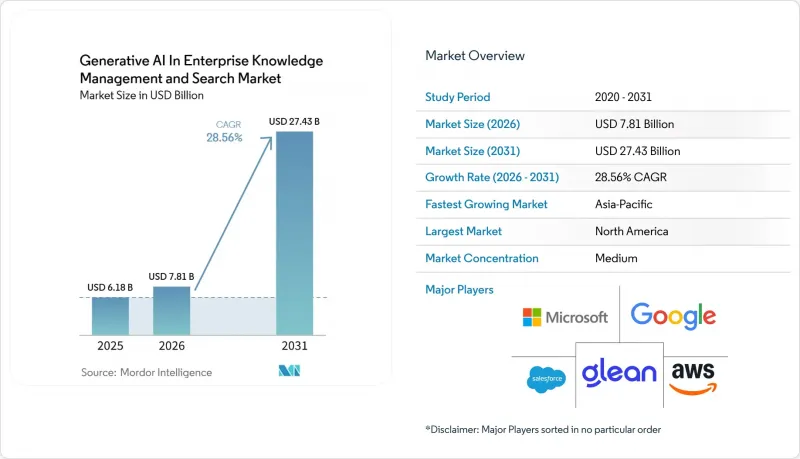
根據 Mordor Intelligence 預測,用於企業知識管理和搜尋的生成式人工智慧市場將從 2025 年的 61.8 億美元成長到 2026 年的 78.1 億美元,到 2031 年達到 274.3 億美元,2026 年至 2031 年的複合年成長率為 28.56%。
本報告按產品(軟體平台和服務)、部署模式(雲端、本地部署、混合部署)、企業規模(大型企業和中小企業)、最終用戶(IT與電信、銀行、金融服務和保險、醫療保健和生命科學、製造業、零售和電子商務、政府和公共部門、其他)以及地區進行細分。市場預測以美元計價。
企業知識管理和搜尋。
企業知識在整個 SaaS 技術堆疊中日益碎片化。
企業通常經營超過 125 個 SaaS 應用,每個應用程式都有其獨立的資料模型、存取控制和索引。這種結構使得跨系統資訊搜尋變得困難,除非有一個共用的智慧層。來自 Salesforce、Confluence、Slack、ServiceNow 等平台的資料分離,可能會隨著 AI 程式的擴展而降低迴應品質。知識工作者需要花費大量時間搜尋資訊並尋找可以提供幫助的同事。實作一個管治的知識圖譜可以提供一個通用的基礎,而不是將每個 AI 代理連接到一個孤立的儲存庫。因此,隨著企業在其架構中優先考慮知識整合,企業知識管理和搜尋領域的生成式 AI 市場將從中受益。
對具備權限感知能力的語意搜尋和基於證據的答案的需求。
語義搜尋正日益受到關注,因為未授權存取機密資訊可能導致法律風險和聲譽損害。傳統的關鍵字搜尋系統可能依賴靜態權限快取,而這些快取無法反映員工的當前角色。這種缺陷可能一直被忽視,直到透過審計發現未授權存取。 2026年6月,亞馬遜網路服務 (AWS) 正式發布了 Amazon Bedrock Managed Knowledge Base,在其託管搜尋增強生成服務中加入了即時存取控制清單 (ACL) 強制執行功能。權限強制執行正逐漸從應用程式設定轉變為基礎架構功能。金融服務、醫療保健和政府機構的採購負責人正在將搜尋期間權限的準確性作為企業知識管理和搜尋生成式人工智慧 (AI) 市場中供應商選擇的重要要求。
與不準確或檢驗的人工智慧產生的答案相關的「幻覺」風險,以及公司內部信任的限制。
在法律調查、合規報告和臨床決策支援中,幻覺反應仍然是一個值得關注的問題。底層模型是機率性的,一旦出現錯誤,檢驗其推理過程可能十分困難。麻省理工學院資訊系統研究中心(MIT CISR)指出,這種缺乏透明度的問題是結構性問題,組織應該加以管理,而不是完全消除。如果無法檢驗反應,受監管領域的採購團隊可能會推遲部署。基於引用的輸出允許員工將說明搜尋可搜尋的文件。提供來源歸屬資訊的供應商更有能力解決生成式人工智慧市場中企業知識管理和搜尋的核心信任障礙。
細分市場分析
到2025年,軟體平台將佔據企業知識管理和搜尋生成式人工智慧市場佔有率的73.64%。索引引擎、編配層和權限圖構成了知識搜尋系統的基礎。買家通常需要在部署更廣泛的用例之前獲得這種基礎設施。微軟、谷歌和亞馬遜網路服務(AWS)可以將平台功能整合到現有的企業合約中。這使得平台採購成為更廣泛基礎建設的延伸。對平台的需求也反映了在通用控制系統下協調眾多儲存庫的必要性。
預計2026年至2031年,服務市場將以29.47%的複合年成長率成長。企業在初始部署後,將需要針對特定領域的調優、搜尋管道最佳化和管治設計的支援。這些需求通常超出單一部署專案的範圍。此外,隨著系統從單一查詢處理發展到更複雜的功能,基於代理的工作流程也需要持續的調整。因此,服務收入可能會從一次性設定轉向持續性工作。 Salesforce在其2026年春季版本中推出了“Agentic Enterprise Search”,該功能利用來自200多個外部來源的上下文資訊來連接多個AI代理。這個產品方向表明,在企業知識管理和搜尋的生成式AI市場中,服務需求正成為平台架構不可或缺的一部分。
到 2025 年,雲端技術在企業知識管理和搜尋的生成式人工智慧市場中將佔據 78.21% 的佔有率。託管式資料攝取管道、彈性索引和 SaaS 連接器是推動此趨勢的主要因素。雲端服務有助於與常用企業應用程式整合,並減少企業內部管理核心搜尋基礎架構的需求。當資料來源頻繁變化時,這些優勢尤其重要。對於尋求更快部署的企業而言,雲端模式仍然是首選。
預計到 2031 年,混合部署將以 29.92% 的複合年成長率成長。受監管的文件、傳統儲存和需要高安全性的儲存庫,除了雲端編配之外,可能還需要本地索引。由於嚴格的資料居住要求,本地系統在國防、金融服務和醫療保健行業中仍然至關重要。 IBM 的 watsonx.data Context 功能支援跨混合環境的搜尋,同時對流程進行管治。混合部署使組織能夠在保持對敏感資料的存取的同時,支援現代編配工具。因此,對於在生成式人工智慧市場中擁有多樣化技術環境的組織而言,混合部署是企業知識管理和搜尋的關鍵選擇。
區域分析
到2025年,北美將佔據企業知識管理和搜尋領域生成式人工智慧40.86%的市場。該地區受益於SaaS原生企業和雲端基礎設施的高度集中。美國在整個產品鏈上的需求都在成長,這得益於財富500強企業、科技公司和成熟的供應商體系的支持。隨著企業整合其人工智慧相關支出,專用知識平台正日益受到關注。加拿大的需求也在不斷成長,而墨西哥則受益於建立人工智慧驅動的知識營運共享服務中心。
預計到2031年,亞太地區的年複合成長率將達到30.74%。中國、印度、韓國和澳洲的企業正在加速數位轉型。印度的技術服務業正滿足國內外企業的需求。多語言搜尋對於該地區多元化的勞動力至關重要。韓國的製造企業和電信業者正在利用特定領域的搜尋功能來尋找技術文件。考慮到隱私和合規的考量,日本和澳洲的數位化進程較為緩慢。經合組織報告指出,即使到了2025年,亞太地區大型企業和小型企業在人工智慧應用方面的差距仍然顯著。
歐洲是企業知識管理和搜尋領域生成式人工智慧市場的第二大區域。德國、英國和法國佔了該地區企業支出的大部分。歐盟人工智慧立法對相關人工智慧應用設定了透明度和監管要求,這有利於那些提供來源資訊和存取日誌的平台。在南美洲,市場正在興起,巴西和阿根廷的金融服務和零售業已率先採用。沙烏地阿拉伯和阿拉伯聯合大公國正透過政府數位化計畫推動需求成長。非洲仍處於起步階段,但南非和埃及已成為早期商業中心,金融服務和電信領域的應用日益普及。
其他好處
- Excel格式的市場預測(ME)表
- 3個月的分析師支持
目錄
第1章:引言
- 研究假設和市場定義
- 調查範圍
第2章:調查方法
第3章執行摘要
第4章 市場狀況
- 市場概覽
- 市場促進因素
- 企業知識在整個 SaaS 技術堆疊中日益碎片化。
- 對具備權限感知能力的語意搜尋和基於證據的答案的需求。
- 從靜態搜尋過渡到由協同駕駛主導的知識工作流程
- 在混合型和分散式團隊中快速利用部落知識
- 模型管治壓力、可審計性和基於引證的答案。
- 透過特定領域的上下文圖和基於代理的搜尋提高準確性。
- 市場限制因素
- 與不準確或檢驗的人工智慧產生的答案相關的「幻覺」風險,以及公司內部信任的限制。
- 與傳統儲存庫、企業應用程式和身分識別系統進行複雜整合。
- 與資料隱私、存取控制、資料居住要求和監管合規性相關的挑戰。
- 內容品質差、知識過時、公司分類系統不一致。
- 價值鏈分析
- 監理情勢
- 技術架構與展望
- 波特五力分析
第5章 市場規模與成長預測
- 透過提供
- 軟體平台
- 服務
- 部署模式
- 雲
- 現場
- 混合
- 按公司規模
- 大公司
- 小型企業
- 最終用戶
- 資訊科技/通訊
- BFSI
- 醫療保健和生命科學
- 製造業
- 零售與電子商務
- 政府/公共部門
- 其他
- 按地區
- 北美洲
- 美國
- 加拿大
- 墨西哥
- 南美洲
- 巴西
- 阿根廷
- 其他南美國家
- 歐洲
- 德國
- 英國
- 法國
- 義大利
- 西班牙
- 俄羅斯
- 其他歐洲國家
- 亞太地區
- 中國
- 日本
- 印度
- 韓國
- 澳洲
- 其他亞太國家
- 中東
- 沙烏地阿拉伯
- 阿拉伯聯合大公國
- 土耳其
- 其他中東國家
- 非洲
- 南非
- 埃及
- 其他非洲國家
- 北美洲
第6章 競爭情勢
- 市場集中度
- 競爭定位分析
- 策略趨勢
- 市佔率分析
- 公司簡介
- Microsoft Corporation
- Google LLC
- Amazon Web Services, Inc.
- Salesforce, Inc.
- Glean Technologies, Inc.
- ServiceNow, Inc.
- International Business Machines Corporation
- Elastic NV
- Coveo Solutions Inc.
- Lucidworks, Inc.
- Sinequa SAS
- Algolia SAS
- Open Text Corporation
- Guru Technologies, Inc.
- Atlassian Corporation Plc
- Notion Labs, Inc.
- Moveworks, Inc.
- Kore.ai, Inc.
- Vectara, Inc.
- SAP SE
第7章 市場機會與未來展望
According to Mordor Intelligence, the generative AI in enterprise knowledge management and search market size is expected to increase from USD 6.18 billion in 2025 to USD 7.81 billion in 2026 and reach USD 27.43 billion by 2031, growing at a CAGR of 28.56% over 2026-2031.
This report is Segmented by Offering (Software Platforms and Services), Deployment Mode (Cloud, On-Premises, and Hybrid), Enterprise Size (Large Enterprises and SMEs), End User (IT and Telecom, BFSI, Healthcare and Life Sciences, Manufacturing, Retail, Government, and Other End Users), and Geography. The Market Forecasts are Provided in Terms of Value (USD).
Global Generative AI In Enterprise Knowledge Management and Search Market Trends and Insights
Rising Enterprise Knowledge Fragmentation Across SaaS Stacks
Enterprises often operate more than 125 SaaS applications with separate data models, access controls, and indexes. This structure makes cross-system retrieval difficult without a shared intelligence layer. Disconnected data from Salesforce, Confluence, Slack, and ServiceNow can degrade answer quality as AI programs expand. Knowledge workers can spend substantial time locating information or identifying colleagues who can help. A governed knowledge graph can provide a common foundation instead of linking each AI agent to isolated repositories. The generative AI in enterprise knowledge management and search market therefore benefits when organizations treat knowledge unification as an architectural priority.
Demand for Permission-Aware Semantic Search and Grounded Answers
Semantic search is gaining attention because incorrect access to privileged information creates legal and reputational exposure. Older keyword systems can rely on static permission caches that do not reflect current employee roles. This weakness may remain hidden until an audit identifies unauthorized access. Amazon Web Services made Amazon Bedrock Managed Knowledge Base generally available in June 2026 with real-time access-control-list enforcement in a managed retrieval-augmented generation service. Permission enforcement is becoming an infrastructure capability rather than an application setting. Financial services, healthcare, and government buyers are making retrieval-time permission accuracy a vendor selection requirement in the generative AI in enterprise knowledge management and search market.
Hallucination Risk and Limited Enterprise Trust in Incorrect or Unverifiable AI-Generated Answers
Hallucinated answers remain a significant concern for legal research, compliance reporting, and clinical decision support. Foundation models are probabilistic, and their reasoning can be difficult to inspect when errors occur. MIT CISR identified this opacity as a structural issue that organizations must manage rather than eliminate. Procurement teams in regulated fields can delay deployment when answers cannot be verified. Citation-backed outputs allow employees to trace statements to a retrievable document. Vendors that provide source attribution are better placed to address a core trust barrier in the generative AI in enterprise knowledge management and search market.
Other drivers and restraints analyzed in the detailed report include:
- Shift From Static Search to Copilot-Led Knowledge Workflows
- Faster Retrieval of Tribal Knowledge for Hybrid and Distributed Teams
- Complex Integration With Legacy Repositories, Enterprise Applications, and Identity Systems
For complete list of drivers and restraints, kindly check the Table Of Contents.
Segment Analysis
Software platforms held 73.64% of the generative AI in enterprise knowledge management and search market share in 2025. Indexing engines, orchestration layers, and permission graphs form the foundation of knowledge retrieval systems. Buyers generally need this infrastructure before they can deploy a broader use case. Microsoft, Google, and Amazon Web Services can embed platform functions in existing enterprise agreements. This can make platform procurement an extension of wider infrastructure commitments. Platform demand also reflects the need to connect many repositories under a common set of controls.
Services are projected to grow at a CAGR of 29.47% from 2026 to 2031. Organizations need support for domain-specific tuning, retrieval-pipeline optimization, and governance design after initial implementation. These requirements often extend beyond a single deployment project. Agentic workflows also require continuing changes as systems move beyond single-turn queries. Service revenue can therefore shift toward recurring work rather than one-time configuration. Salesforce introduced Agentic Enterprise Search in its Spring 2026 release, using context from more than 200 external sources and coordinating multiple AI agents. This product direction shows how service requirements are becoming part of platform architecture in the generative AI in enterprise knowledge management and search market.
Cloud deployment held 78.21% of the generative AI in enterprise knowledge management and search market in 2025. Managed ingestion pipelines, elastic indexing, and SaaS connectors support this deployment preference. Cloud services can make it easier to connect common enterprise applications. They also reduce the need for organizations to manage core retrieval infrastructure internally. These benefits are especially relevant when data sources change frequently. The cloud model remains the main route for organizations seeking faster deployment.
Hybrid deployment is projected to grow at a CAGR of 29.92% through 2031. Regulated documents, legacy stores, and high-security repositories can require local indexing alongside cloud orchestration. On-premises systems remain relevant in defense, financial services, and healthcare due to strict data-residency requirements. IBM's watsonx.data Context capabilities support retrieval across hybrid environments with governance applied to the process. Hybrid deployments can preserve access to sensitive data while still supporting modern orchestration tools. This makes them relevant to organizations with mixed technology estates in the generative AI in enterprise knowledge management and search market.
Complete Report Scope:
- By Offering
- Software Platforms
- Services
- By Deployment Mode
- Cloud
- On-Premises
- Hybrid
- By Enterprise Size
- Large Enterprises
- Small and Medium Enterprises
- By End User
- IT and Telecom
- BFSI
- Healthcare and Life Sciences
- Manufacturing
- Retail and E-Commerce
- Government and Public Sector
- Other End Users
- By Geography
- North America
- United States
- Canada
- Mexico
- South America
- Brazil
- Argentina
- Rest of South America
- Europe
- Germany
- United Kingdom
- France
- Italy
- Spain
- Russia
- Rest of Europe
- Asia-Pacific
- China
- Japan
- India
- South Korea
- Australia
- Rest of Asia-Pacific
- Middle East
- Saudi Arabia
- United Arab Emirates
- Turkey
- Rest of Middle East
- Africa
- South Africa
- Egypt
- Rest of Africa
- North America
Geography Analysis
North America held 40.86% of the generative AI in enterprise knowledge management and search market share in 2025. The region benefits from a high concentration of SaaS-native enterprises and cloud infrastructure. The United States leads demand across the product stack. Fortune 500 buyers, technology companies, and a developed vendor base support this position. Dedicated knowledge platforms have gained traction as organizations consolidate AI spending. Canada contributes growing demand, while Mexico benefits from shared-service centers that are building AI-enabled knowledge operations.
Asia-Pacific is projected to grow at a CAGR of 30.74% through 2031. China, India, South Korea, and Australia are increasing enterprise digitalization activity. India's technology services sector supports demand from domestic enterprises and multinational clients. Multilingual retrieval is relevant for its varied regional workforce. South Korean manufacturing groups and telecom companies use domain-specific retrieval for engineering documentation. Japan and Australia are advancing more gradually, taking privacy and compliance considerations into account. The OECD reported that the gap in AI adoption between larger firms and SMEs remained pronounced across Asia-Pacific economies in 2025.
Europe is the second-largest regional area for the generative AI in enterprise knowledge management and search market. Germany, the United Kingdom, and France generate much of the region's enterprise spending. The EU AI Act creates transparency and oversight requirements for relevant AI applications. This favors platforms that provide citation provenance and access logs. South America is emerging, with early adoption in Brazilian and Argentine financial services and retail. Saudi Arabia and the United Arab Emirates are supporting demand through government digitalization programs. Africa remains at an earlier stage, with South Africa and Egypt among the initial commercial locations for financial services and telecommunications deployments.
- Microsoft Corporation
- Google LLC
- Amazon Web Services, Inc.
- Salesforce, Inc.
- Glean Technologies, Inc.
- ServiceNow, Inc.
- International Business Machines Corporation
- Elastic N.V.
- Coveo Solutions Inc.
- Lucidworks, Inc.
- Sinequa SAS
- Algolia SAS
- Open Text Corporation
- Guru Technologies, Inc.
- Atlassian Corporation Plc
- Notion Labs, Inc.
- Moveworks, Inc.
- Kore.ai, Inc.
- Vectara, Inc.
- SAP SE
Additional Benefits:
- The market estimate (ME) sheet in Excel format
- 3 months of analyst support
TABLE OF CONTENTS
1 INTRODUCTION
- 1.1 Study Assumptions and Market Definition
- 1.2 Scope of the Study
2 RESEARCH METHODOLOGY
3 EXECUTIVE SUMMARY
4 MARKET LANDSCAPE
- 4.1 Market Overview
- 4.2 Market Drivers
- 4.2.1 Rising Enterprise Knowledge Fragmentation Across SaaS Stacks
- 4.2.2 Demand for Permission-Aware Semantic Search and Grounded Answers
- 4.2.3 Shift From Static Search to Copilot-Led Knowledge Workflows
- 4.2.4 Faster Retrieval of Tribal Knowledge for Hybrid and Distributed Teams
- 4.2.5 Model Governance Pressure, Auditability, and Citation-Backed Answers
- 4.2.6 Domain-Specific Context Graphs and Agentic Retrieval Improving Accuracy
- 4.3 Market Restraints
- 4.3.1 Hallucination Risk and Limited Enterprise Trust in Incorrect or Unverifiable AI-Generated Answers
- 4.3.2 Complex Integration With Legacy Repositories, Enterprise Applications, and Identity Systems
- 4.3.3 Data Privacy, Access Control, Data Residency, and Regulatory Compliance Challenges
- 4.3.4 Poor Content Quality, Outdated Knowledge, and Inconsistent Enterprise Taxonomies
- 4.4 Value Chain Analysis
- 4.5 Regulatory Landscape
- 4.6 Technology Architecture and Outlook
- 4.7 Porter's Five Forces Analysis
- 4.7.1 Threat of New Entrants
- 4.7.2 Bargaining Power of Suppliers
- 4.7.3 Bargaining Power of Buyers
- 4.7.4 Threat of Substitutes
- 4.7.5 Industry Rivalry
5 MARKET SIZE AND GROWTH FORECASTS (VALUE)
- 5.1 By Offering
- 5.1.1 Software Platforms
- 5.1.2 Services
- 5.2 By Deployment Mode
- 5.2.1 Cloud
- 5.2.2 On-Premises
- 5.2.3 Hybrid
- 5.3 By Enterprise Size
- 5.3.1 Large Enterprises
- 5.3.2 Small and Medium Enterprises
- 5.4 By End User
- 5.4.1 IT and Telecom
- 5.4.2 BFSI
- 5.4.3 Healthcare and Life Sciences
- 5.4.4 Manufacturing
- 5.4.5 Retail and E-Commerce
- 5.4.6 Government and Public Sector
- 5.4.7 Other End Users
- 5.5 By Geography
- 5.5.1 North America
- 5.5.1.1 United States
- 5.5.1.2 Canada
- 5.5.1.3 Mexico
- 5.5.2 South America
- 5.5.2.1 Brazil
- 5.5.2.2 Argentina
- 5.5.2.3 Rest of South America
- 5.5.3 Europe
- 5.5.3.1 Germany
- 5.5.3.2 United Kingdom
- 5.5.3.3 France
- 5.5.3.4 Italy
- 5.5.3.5 Spain
- 5.5.3.6 Russia
- 5.5.3.7 Rest of Europe
- 5.5.4 Asia-Pacific
- 5.5.4.1 China
- 5.5.4.2 Japan
- 5.5.4.3 India
- 5.5.4.4 South Korea
- 5.5.4.5 Australia
- 5.5.4.6 Rest of Asia-Pacific
- 5.5.5 Middle East
- 5.5.5.1 Saudi Arabia
- 5.5.5.2 United Arab Emirates
- 5.5.5.3 Turkey
- 5.5.5.4 Rest of Middle East
- 5.5.6 Africa
- 5.5.6.1 South Africa
- 5.5.6.2 Egypt
- 5.5.6.3 Rest of Africa
- 5.5.1 North America
6 COMPETITIVE LANDSCAPE
- 6.1 Market Concentration
- 6.2 Competitive Positioning Analysis
- 6.3 Strategic Moves
- 6.4 Market Share Analysis
- 6.5 Company Profiles (includes Global Level Overview, Market Level Overview, Core Segments, Financials as available, Strategic Information, Market Rank/Share, Products and Services, Recent Developments)
- 6.5.1 Microsoft Corporation
- 6.5.2 Google LLC
- 6.5.3 Amazon Web Services, Inc.
- 6.5.4 Salesforce, Inc.
- 6.5.5 Glean Technologies, Inc.
- 6.5.6 ServiceNow, Inc.
- 6.5.7 International Business Machines Corporation
- 6.5.8 Elastic N.V.
- 6.5.9 Coveo Solutions Inc.
- 6.5.10 Lucidworks, Inc.
- 6.5.11 Sinequa SAS
- 6.5.12 Algolia SAS
- 6.5.13 Open Text Corporation
- 6.5.14 Guru Technologies, Inc.
- 6.5.15 Atlassian Corporation Plc
- 6.5.16 Notion Labs, Inc.
- 6.5.17 Moveworks, Inc.
- 6.5.18 Kore.ai, Inc.
- 6.5.19 Vectara, Inc.
- 6.5.20 SAP SE
7 MARKET OPPORTUNITIES AND FUTURE OUTLOOK
- 7.1 White-Space and Unmet-Need Assessment

 企業人工智慧:全球市場
 企業級LLM市場規模、佔有率和成長分析:按部署模式、模型類型、應用、企業規模、最終用戶產業和地區分類-2026-2033年產業預測
 企業人工智慧市場:全球市場預測,2026-2032年
 企業人工智慧:市場佔有率分析、產業趨勢與統計、成長預測(2026-2031)企業人工智慧市場-2026-2032年全球市場預測
 企業人工智慧平台市場預測至2034年-全球分析(按組件、部署模式、人工智慧技術、功能、應用、最終用戶和區域分類)循環性評估平台市場:預測至 2034 年—按部署類型、評估類型、調查方法、產業、最終用戶和地區分類的全球分析人工智慧驅動的企業搜尋市場預測至2034年-全球分析(按組件、部署模式、企業規模、技術、應用、最終用戶和地區分類)
 企業人工智慧市場-全球產業規模、佔有率、趨勢、機會和預測:按部署類型、技術、產業橫斷面、地區和競爭格局分類,2021-2031年
 2026-2030年全球人工智慧企業搜尋平台市場