


 |
市場調查報告書
商品編碼
2118102
自動化應用測試平台:市場佔有率分析、產業趨勢與統計及成長預測(2026-2031)Automated App Testing Platform - Market Share Analysis, Industry Trends & Statistics, Growth Forecasts (2026 - 2031) |
||||||

※ 本網頁內容可能與最新版本有所差異。詳細情況請與我們聯繫。
據 Mordor Intelligence 稱,2025 年自動化應用程式測試平台市值為 54.6 億美元,預計從 2026 年的 59.2 億美元成長到 2031 年的 103.7 億美元。
預計 2026 年至 2031 年的預測期內複合年成長率將達到 11.9%。
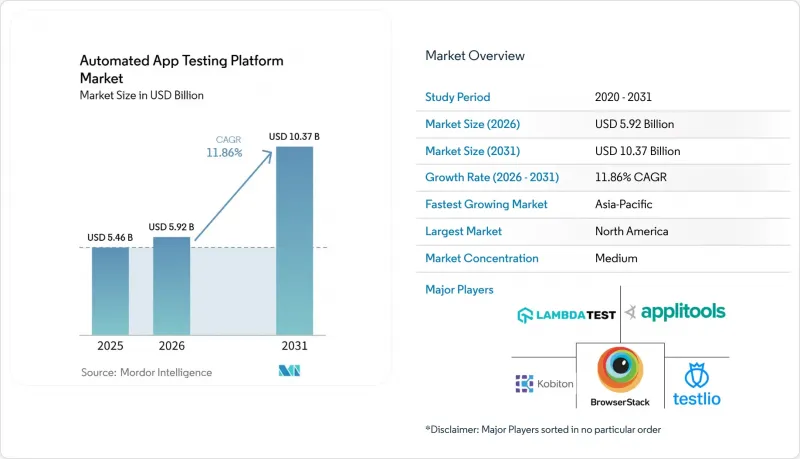
本報告按元件(軟體和服務)、受測應用(例如,網路應用程式)、部署模式(雲端、混合、本地部署)、企業規模(大型企業和中小企業)、最終用戶(例如,IT和電信、汽車和運輸)以及地區進行細分。市場預測以美元計價。
全球自動化應用測試平台市場趨勢與洞察
人工智慧驅動的測試創建和自我修復自動化功能重新定義了該平台的價值。
基於人工智慧的測試工具能夠識別應用程式介面的變化,並以最小的人工干預更新受影響的測試步驟。這一點至關重要,因為維護工作會佔用團隊資源,而這些資源本應用於提高測試覆蓋率、調查缺陷以及驗證故障是否反映了真正的產品問題。自癒功能旨在使測試持續適應介面變化,從而提高頻繁發佈軟體的團隊的自動化測試可靠性。在2026年,人工智慧成為受訪品質保證團隊的首要投資重點,61%的受訪者表示對人工智慧產生程式碼的測試需求將出現「中度至顯著」成長。因此,自動化應用程式測試平台市場正受益於程式碼產生量的成長和對發布前檢驗需求的日益成長。 Tricentis報告稱,其2025會計年度的年度經常性收入(ARR)創下5億美元的歷史新高,並將業績歸功於企業對基於代理的品質工程能力的需求不斷成長。
敏捷和DevOps發布週期的加速推動了對基準的需求。
更短的發布週期使得在軟體交付給使用者之前完成手動測試變得困難。採用持續整合 (CI) 和持續交付 (CD) 的團隊需要在程式碼變更提交後立即開始執行測試,而不是在單獨的測試階段之後。自動化檢查使開發人員能夠更早了解變更是否影響了現有功能或導致相關服務故障。截至 2026 年,只有 26% 的受訪 QA 團隊完全或幾乎完全整合到其 DevOps 管線中,這為採用管線整合測試工具留下了空間。對於那些已經採用交付工具但仍依賴獨立測試流程的組織而言,這一差距為自動化應用測試平台市場帶來了明顯的機會。根據 Mabl 的報告,採用 AI 輔助測試的團隊的程式碼部署速度比 2024 年的基準提高了 46%。
先進自動化框架的維護負擔會降低投資報酬率。
圍繞著一個脆弱的介面選擇器構建的大規模測試套件,即使底層業務功能完全正常,也可能僅僅因為螢幕發生了變化而失敗。因此,團隊必須花費時間修復測試,才能評估應用程式的變更,這會延遲向開發人員提供回饋,並可能削弱人們對測試流程的信心。當同一個介面變更影響到涵蓋相關使用者旅程的多個測試時,這個問題會變得更加複雜。到了2026年,57%的品質保證測試實現自動化,但維護工作仍佔用了品質保證團隊約五分之一的精力。這給自動化應用程式測試平台市場帶來了人才流失的風險,因為不滿意的用戶可能將自動化視為新的工作來源,而不是減少工作量的手段。 Tricentis Japan在2025年對401位企業IT經理進行的一項調查發現,64%的日本大型企業的測試自動化覆蓋率低於60%,其中整合測試和驗收測試的覆蓋率尤其低。
細分市場分析
到2025年,軟體收入將佔總收入的72.41%,成為自動化應用測試平台市場中最大的組成部分。企業將繼續使用軟體平台來創建測試腳本、與開發平臺整合以及產生報告。預計到2031年,服務板塊的複合年成長率將達到14.82%,是所有組成部分中成長率最高的。這一趨勢反映出部分買家更傾向於包含平台存取和測試專業知識的託管服務。 Testlio和Qualitest就是將平台存取與託管品質保證支援結合的供應商範例。在這種類型的合約中,客戶無需自行建立完整的系統,確保測試範圍和解決缺陷的責任都委託給了供應商。
此外,這種服務模式解決了技能短缺問題,而技能短缺正是限制自主管理工具普及的關鍵因素。無法招募足夠測試自動化工程師的組織可以選擇購買測試支援服務,而不是推遲自動化。因此,服務既是成長的源泉,也體現了對更簡單工具的未被滿足的需求。隨著人工智慧推動測試創建和維護任務的自動化,軟體和服務之間的界限可能會變得越來越模糊。平台提供者可以透過夥伴關係和收購來滿足更廣泛客戶的品質保證需求。在“自動化應用測試平台市場”,這種方法有助於供應商在測試需求變化時與客戶保持良好的關係。
到2025年,Web應用程式將佔總收入的28.19%,成為各類應用程式中佔比最大的。基於瀏覽器的應用程式仍然是企業提供服務的常用方式,瀏覽器測試工具也相當成熟。物聯網和嵌入式應用程式預計到2031年將以15.43%的複合年成長率成長,成為該領域成長最快的細分市場。互聯設備在製造業、醫療保健和物流業的應用日益廣泛。這些部署需要對設備軟體、韌體、應用程式以及與之相關的服務進行測試。行動應用程式仍然是重要的測試需求來源,因為團隊需要測試涵蓋不同裝置和作業系統版本。
桌面應用程式在銀行和政府等行業中仍然發揮著至關重要的作用,因為這些行業仍然需要獨立於瀏覽器的環境。透過連網服務交付的軟體功能日益普及,推動了 API 和微服務的重要性。 Postman 的一份報告顯示,到 2026 年,82% 的組織將採用「API 優先」的方法。一個能夠跨 Web、行動、API 和嵌入式層提供整合測試管理的單一平台,可以減少管理多個獨立工具的需求。這種能力對於自動化應用程式測試平台市場至關重要,因為企業負責人需要跨不同應用程式環境的一致報告。能夠跨這些層驗證業務行為的供應商,相比那些專注於特定測試類別的供應商,具有顯著優勢。
區域分析
2025年,北美地區的營收佔比達到34.62%,成為市佔率最大的地區。該地區雲端服務供應商、軟體即服務 (SaaS) 公司以及頻繁發布產品的企業軟體開發公司密度極高。 Tricentis 報告稱,其2025會計年度的年度經常性收入為5億美元,並表示其基本客群涵蓋超過60%的財富500強企業。這反映出該地區企業對高品質工程服務的高需求。此外,可存取性和資料隱私要求也是企業在發布前測試其數位服務的另一個原因。
在歐洲,資料保護、可訪問性以及金融服務和醫療保健行業的特定產業義務正在推動自動化應用測試平台的普及。這些要求賦予了提供合規性測試功能的平台競爭優勢。德國和英國仍然是歐洲的關鍵國家,德國工業製造業對嵌入式和物聯網測試的需求也日益成長。南美洲的自動化應用測試尚處於早期階段,調查顯示巴西和阿根廷是主要的採用國。經合組織的一項分析表明,成本壁壘和雲端基礎設施的缺乏可能是該地區中小企業採用人工智慧的限制因素。基於雲端的服務和按使用量收費模式將有助於自動化應用測試平台市場滲透到這些國家的更多企業。
預計到2031年,亞太地區將以15.18%的複合年成長率成長,成為所有地區中成長最快的地區。智慧型手機的普及、數位化優先的商業活動以及對軟體品質日益成長的關注,正在推動該地區的成長。在日本,一項針對401位企業IT管理員的調查顯示,在2025年下半年,97.5%的受訪者表示他們意識到軟體品質風險,而64%的受訪者表示他們的測試自動化採用率低於60%。印度正透過全球能力中心和測試交付服務成為早期採用者。在中東,沙烏地阿拉伯和阿拉伯聯合大公國的政府相關數位化計畫尤其推動了需求。非洲仍然受到基礎設施的限制,但透過雲端平台提供了進入市場的機會。
其他好處:
- Excel格式的市場預測(ME)表
- 3個月的分析師支持
目錄
第1章:引言
- 研究假設和市場定義
- 調查範圍
第2章:調查方法
第3章執行摘要
第4章 市場狀況
- 市場概覽
- 市場促進因素
- 利用敏捷和DevOps加速發布週期
- 行動應用程式的增加和裝置作業系統的碎片化。
- 人工智慧驅動的測試創建和自癒自動化
- 雲端設備實驗室降低了實際測試的成本。
- 無障礙存取和隱私檢驗正成為產品發布的門檻。
- API 和微服務的擴展正在擴大回歸測試的範圍。
- 市場限制因素
- 高階自動化框架的維護負擔
- 設備和作業系統生態系統碎片化
- 雲端和人工智慧測試中的資料隱私限制
- 舊有系統自動化和整合的技能差距
- 宏觀經濟因素對市場的影響
- 產業價值鏈分析
- 科技趨勢
- 監理情勢
- 波特五力分析
第5章 市場規模與成長預測
- 按組件
- 軟體
- 服務
- 透過申請
- Web應用程式
- 行動應用
- 桌面應用程式
- API 和微服務
- 物聯網與嵌入式應用
- 按部署模式
- 雲
- 混合
- 現場
- 按公司規模
- 大公司
- 小型企業
- 最終用戶
- 資訊科技/通訊
- BFSI
- 汽車和運輸業
- 醫療保健和生命科學
- 零售與電子商務
- 工業製造
- 教育和研究機構
- 政府/行政部門
- 能源公用事業
- 其他最終用戶
- 按地區
- 北美洲
- 美國
- 加拿大
- 墨西哥
- 南美洲
- 巴西
- 阿根廷
- 其他南美國家
- 歐洲
- 德國
- 英國
- 法國
- 俄羅斯
- 西班牙
- 其他歐洲國家
- 亞太地區
- 中國
- 日本
- 印度
- 韓國
- 東南亞
- 其他亞太國家
- 中東和非洲
- 中東
- 沙烏地阿拉伯
- 阿拉伯聯合大公國
- 其他中東國家
- 非洲
- 南非
- 奈及利亞
- 其他非洲國家
- 中東
- 北美洲
第6章 競爭情勢
- 市場集中度
- 策略趨勢
- 市佔率分析
- 公司簡介
- Applause App Quality, Inc.
- Applitools Ltd.
- BrowserStack Limited
- Cigniti Technologies Limited
- Global App Testing Ltd.
- HeadSpin, Inc.
- International Business Machines Corporation
- Katalon, Inc.
- Kobiton, Inc.
- LambdaTest, Inc.
- Leapwork A/S
- mabl Inc.
- OpenText Corporation
- Parasoft Corporation
- Perfecto Mobile Ltd.(Perforce Software)
- Qualitest Group Ltd.
- QA Wolf, LLC
- Rainforest QA, Inc.
- Ranorex GmbH
- Sauce Labs Inc.
- SmartBear Software, Inc.
- Testlio Inc.
- TestMu AI, Inc.(formerly LambdaTest)
- Tricentis GmbH
- Worksoft, Inc.
第7章 市場機會與未來展望
According to Mordor Intelligence, the automated app testing platform market size was valued at USD 5.46 billion in 2025 and is estimated to grow from USD 5.92 billion in 2026 to reach USD 10.37 billion by 2031, at a CAGR of 11.9% during the forecast period from 2026 to 2031.
This report is Segmented by Component (Software, and Services), Application Under Test (Web Applications, and More), Deployment Model (Cloud, Hybrid, and On-Premises), Enterprise Size (Large Enterprises, and Small and Medium-Sized Enterprises), End User (IT and Telecommunication, Automotive and Transportation, and More), and Geography. The Market Forecasts are Provided in Terms of Value (USD).
Global Automated App Testing Platform Market Trends and Insights
AI Driven Test Creation and Self Healing Automation Redefine Platform Value
AI-based testing tools can identify changes to an application interface and update affected test steps with less manual intervention. This matters because maintenance work can consume capacity that teams would otherwise use to improve coverage, investigate defects, and review whether a failure reflects a genuine product issue. Self-healing functions are intended to keep tests aligned with interface changes, thereby making automated testing more reliable for teams that frequently release software. In 2026, AI was the leading investment priority for surveyed QA teams, and 61% of respondents reported a moderate to significant increase in testing demand for AI-generated code. The Automated App Testing Platform Market is therefore benefiting from both increased code production and a greater need to validate it before release. Tricentis reported record annual recurring revenue of USD 500 million for fiscal 2025 and linked its performance to enterprise demand for agentic quality engineering capabilities.
Accelerating Agile and DevOps Release Cadence Sustains Baseline Demand
Shorter release cycles make manual testing difficult to complete before the software reaches users. Teams using continuous integration and continuous delivery need test execution to begin when code changes are submitted rather than after a separate testing phase. Automated checks can provide developers with earlier information on whether a change affected an existing function or introduced a failure in a connected service. Only 26% of surveyed QA teams were fully or mostly integrated with their DevOps pipelines in 2026, leaving room for more pipeline-connected testing tools. This gap presents the Automated App Testing Platform Market with a clear opportunity for organizations that have adopted delivery tools but still rely on disconnected testing processes. Mabl reported that teams using AI assisted testing increased code deployment speed by 46% compared with 2024 baselines.
High Automation Framework Maintenance Burden Erodes Return on Investment
Large test suites built around fragile interface selectors can fail when a screen changes, even if the underlying business function still works. Teams must then spend time fixing tests before they can assess the application change, which can delay feedback for developers and reduce confidence in the testing process. The problem becomes more difficult when the same interface change affects several tests that cover related user journeys. In 2026, 57% of QA tests were automated, while maintenance accounted for around 1/5 of the QA team's capacity. This creates a retention risk for the Automated App Testing Platform Market because dissatisfied users may see automation as another source of work rather than a way to reduce it. A 2025 Tricentis Japan survey of 401 enterprise IT managers found that 64% of major Japanese companies had test automation coverage below 60%, with integration and acceptance testing lagging the most.
Other drivers and restraints analyzed in the detailed report include:
- API and Microservices Expansion Widening Regression Scope
- Cloud Device Labs Democratizing Real Device Coverage
- Automation Skills Gaps and Legacy System Integration Slow Enterprise Adoption
For complete list of drivers and restraints, kindly check the Table Of Contents.
Segment Analysis
Software accounted for 72.41% of revenue in 2025, making it the largest component of the Automated App Testing Platform Market. Enterprises continue to use software platforms for test scripting, development pipeline integration, and reporting. Services are projected to grow at a 14.82% CAGR through 2031, the highest rate among component types. This pattern reflects a preference among some buyers for managed engagements that include platform access and testing expertise. Testlio and Qualitest are examples of providers that combine platform access with managed QA support. Such arrangements can place responsibility for coverage and defect handling with the provider, rather than requiring the customer to build the full capability internally.
The service model also addresses the skills shortage that limits the adoption of self-managed tools. Organizations that cannot hire enough test automation engineers may purchase testing support rather than postpone automation. That makes services both a source of growth and evidence of unmet demand for simpler tools. The boundary between software and services may become less distinct as AI automates more test creation and maintenance work. Platform providers can pursue partnerships or acquisitions to serve a broader set of customers' QA needs. In the Automated App Testing Platform Market, this approach may help vendors retain customer relationships as testing needs change.
Web applications accounted for 28.19% of 2025 revenue, the largest share across application types. Browser-based applications remain a common way for enterprises to deliver services, and browser testing tools are well established. IoT and embedded applications are forecast to grow at a 15.43% CAGR through 2031, the fastest rate in this segmentation. Connected devices are expanding across manufacturing, healthcare, and logistics. These deployments require testing of device software, firmware, applications, and their connected services. Mobile applications also remain an important source of demand because teams need coverage across devices and operating system versions.
Desktop applications remain relevant in banking and public administration, where browser independence can still be required. APIs and microservices have become more important because software functions are increasingly delivered through connected services. Postman reported that 82% of organizations used an API-first approach in 2026. A single platform that coordinates testing across web, mobile, APIs, and embedded layers can reduce the need to manage separate tools. This capability is relevant to the Automated App Testing Platform Market because enterprise buyers are seeking consistent reporting across different application environments. Vendors that can check business behavior across these layers have an advantage over providers focused on one test category.
Complete Report Scope:
- By Component
- Software
- Services
- By Application Under Test
- Web Applications
- Mobile Applications
- Desktop Applications
- APIs and Microservices
- IoT and Embedded Applications
- By Deployment Model
- Cloud
- Hybrid
- On-Premises
- By Enterprise Size
- Large Enterprises
- Small and Medium-Sized Enterprises
- By End User
- IT and Telecommunication
- BFSI
- Automotive and Transportation
- Healthcare and Life Sciences
- Retail and E-Commerce
- Industrial Manufacturing
- Education and Research Institutions
- Government and Administration
- Energy and Utilities
- Other End Users
- By Geography
- North America
- United States
- Canada
- Mexico
- South America
- Brazil
- Argentina
- Rest of South America
- Europe
- Germany
- United Kingdom
- France
- Russia
- Spain
- Rest of Europe
- Asia-Pacific
- China
- Japan
- India
- South Korea
- Southeast Asia
- Rest of Asia-Pacific
- Middle East and Africa
- Middle East
- Saudi Arabia
- United Arab Emirates
- Rest of Middle East
- Africa
- South Africa
- Nigeria
- Rest of Africa
- Middle East
- North America
Geography Analysis
North America held 34.62% of 2025 revenue, the largest regional share. The region has a high concentration of cloud providers, software-as-a-service companies, and enterprise software developers with frequent release schedules. Tricentis reported USD 500 million in annual recurring revenue for fiscal 2025 and stated that more than 60% of Fortune 500 companies were in its customer base. This reflects the depth of enterprise demand for quality engineering in the region. Accessibility and data privacy requirements add another reason for companies to test digital services before release.
Europe is driven by data protection, accessibility, and sector-specific obligations in financial services and healthcare. These requirements favor platforms that provide compliance-related testing capabilities. Germany and the United Kingdom remain important European countries, with Germany also generating demand for embedded and IoT testing through industrial manufacturing. South America is at an earlier stage of adoption, with Brazil and Argentina identified as leading adopters in the supplied research. OECD analysis found that cost barriers and limited cloud infrastructure can constrain SME AI adoption in the region. Cloud-delivered and use-based offerings can help the Automated App Testing Platform Market reach more organizations in these countries.
Asia-Pacific is forecast to grow at a 15.18% CAGR through 2031, the fastest regional rate. Smartphone use, digital-first business activity, and a growing focus on software quality support the region's expansion. In Japan, 97.5% of 401 enterprise IT managers surveyed in late 2025 recognized software quality risk, while 64% reported test automation coverage below 60%. India is becoming an early adopter location through its global capability centers and testing delivery work. The Middle East is seeing demand from government-linked digital programs, particularly in Saudi Arabia and the United Arab Emirates. Africa remains constrained by infrastructure, but can gain access through cloud-delivered platforms.
- Applause App Quality, Inc.
- Applitools Ltd.
- BrowserStack Limited
- Cigniti Technologies Limited
- Global App Testing Ltd.
- HeadSpin, Inc.
- International Business Machines Corporation
- Katalon, Inc.
- Kobiton, Inc.
- LambdaTest, Inc.
- Leapwork A/S
- mabl Inc.
- OpenText Corporation
- Parasoft Corporation
- Perfecto Mobile Ltd. (Perforce Software)
- Qualitest Group Ltd.
- QA Wolf, LLC
- Rainforest QA, Inc.
- Ranorex GmbH
- Sauce Labs Inc.
- SmartBear Software, Inc.
- Testlio Inc.
- TestMu AI, Inc. (formerly LambdaTest)
- Tricentis GmbH
- Worksoft, Inc.
Additional Benefits:
- The market estimate (ME) sheet in Excel format
- 3 months of analyst support
TABLE OF CONTENTS
1 INTRODUCTION
- 1.1 Study Assumptions and Market Definition
- 1.2 Scope of the Study
2 RESEARCH METHODOLOGY
3 EXECUTIVE SUMMARY
4 MARKET LANDSCAPE
- 4.1 Market Overview
- 4.2 Market Drivers
- 4.2.1 Accelerating Agile and DevOps Release Cadence
- 4.2.2 Rising Mobile Application and Device-OS Fragmentation
- 4.2.3 AI-Driven Test Creation and Self-Healing Automation
- 4.2.4 Cloud Device Labs Lowering the Cost of Real-Device Coverage
- 4.2.5 Accessibility and Privacy Validation Becoming Release Gates
- 4.2.6 API and Microservices Expansion Increasing Regression Scope
- 4.3 Market Restraints
- 4.3.1 High Automation Framework Maintenance Burden
- 4.3.2 Fragmented Device and Operating-System Ecosystems
- 4.3.3 Data Privacy Constraints in Cloud and AI Testing
- 4.3.4 Automation Skills Gaps and Legacy-System Integration
- 4.4 Impact of Macroeconomic Factors on the Market
- 4.5 Industry Value-Chain Analysis
- 4.6 Technology Outlook
- 4.7 Regulatory Landscape
- 4.8 Porter's Five Forces Analysis
- 4.8.1 Threat of New Entrants
- 4.8.2 Bargaining Power of Suppliers
- 4.8.3 Bargaining Power of Buyers
- 4.8.4 Threat of Substitutes
- 4.8.5 Intensity of Competitive Rivalry
5 MARKET SIZE AND GROWTH FORECASTS (VALUE)
- 5.1 By Component
- 5.1.1 Software
- 5.1.2 Services
- 5.2 By Application Under Test
- 5.2.1 Web Applications
- 5.2.2 Mobile Applications
- 5.2.3 Desktop Applications
- 5.2.4 APIs and Microservices
- 5.2.5 IoT and Embedded Applications
- 5.3 By Deployment Model
- 5.3.1 Cloud
- 5.3.2 Hybrid
- 5.3.3 On-Premises
- 5.4 By Enterprise Size
- 5.4.1 Large Enterprises
- 5.4.2 Small and Medium-Sized Enterprises
- 5.5 By End User
- 5.5.1 IT and Telecommunication
- 5.5.2 BFSI
- 5.5.3 Automotive and Transportation
- 5.5.4 Healthcare and Life Sciences
- 5.5.5 Retail and E-Commerce
- 5.5.6 Industrial Manufacturing
- 5.5.7 Education and Research Institutions
- 5.5.8 Government and Administration
- 5.5.9 Energy and Utilities
- 5.5.10 Other End Users
- 5.6 By Geography
- 5.6.1 North America
- 5.6.1.1 United States
- 5.6.1.2 Canada
- 5.6.1.3 Mexico
- 5.6.2 South America
- 5.6.2.1 Brazil
- 5.6.2.2 Argentina
- 5.6.2.3 Rest of South America
- 5.6.3 Europe
- 5.6.3.1 Germany
- 5.6.3.2 United Kingdom
- 5.6.3.3 France
- 5.6.3.4 Russia
- 5.6.3.5 Spain
- 5.6.3.6 Rest of Europe
- 5.6.4 Asia-Pacific
- 5.6.4.1 China
- 5.6.4.2 Japan
- 5.6.4.3 India
- 5.6.4.4 South Korea
- 5.6.4.5 Southeast Asia
- 5.6.4.6 Rest of Asia-Pacific
- 5.6.5 Middle East and Africa
- 5.6.5.1 Middle East
- 5.6.5.1.1 Saudi Arabia
- 5.6.5.1.2 United Arab Emirates
- 5.6.5.1.3 Rest of Middle East
- 5.6.5.2 Africa
- 5.6.5.2.1 South Africa
- 5.6.5.2.2 Nigeria
- 5.6.5.2.3 Rest of Africa
- 5.6.5.1 Middle East
- 5.6.1 North America
6 COMPETITIVE LANDSCAPE
- 6.1 Market Concentration
- 6.2 Strategic Moves
- 6.3 Market Share Analysis
- 6.4 Company Profiles (includes Global Level Overview, Market Level Overview, Core Segments, Financials as available, Strategic Information, Market Rank/Share, Products and Services, Recent Developments)
- 6.4.1 Applause App Quality, Inc.
- 6.4.2 Applitools Ltd.
- 6.4.3 BrowserStack Limited
- 6.4.4 Cigniti Technologies Limited
- 6.4.5 Global App Testing Ltd.
- 6.4.6 HeadSpin, Inc.
- 6.4.7 International Business Machines Corporation
- 6.4.8 Katalon, Inc.
- 6.4.9 Kobiton, Inc.
- 6.4.10 LambdaTest, Inc.
- 6.4.11 Leapwork A/S
- 6.4.12 mabl Inc.
- 6.4.13 OpenText Corporation
- 6.4.14 Parasoft Corporation
- 6.4.15 Perfecto Mobile Ltd. (Perforce Software)
- 6.4.16 Qualitest Group Ltd.
- 6.4.17 QA Wolf, LLC
- 6.4.18 Rainforest QA, Inc.
- 6.4.19 Ranorex GmbH
- 6.4.20 Sauce Labs Inc.
- 6.4.21 SmartBear Software, Inc.
- 6.4.22 Testlio Inc.
- 6.4.23 TestMu AI, Inc. (formerly LambdaTest)
- 6.4.24 Tricentis GmbH
- 6.4.25 Worksoft, Inc.
7 MARKET OPPORTUNITIES AND FUTURE OUTLOOK
- 7.1 White-Space and Unmet-Need Assessment

 機器人編碼器市場分析與預測(至2035年):類型、產品類型、技術、組件、應用、最終用戶、功能、安裝配置、解決方案
 自動化測試設備市場-全球市場預測(2026-2032年)
 自動化測試設備:市場佔有率分析、產業趨勢與統計、成長預測(2026-2031)
 2026-2030年全球自動化測試設備(ATE)市場
 2026-2036年全球INS自動化測試設備市場
 自動化測試設備市場規模、佔有率和趨勢分析報告:按產品、產品類型、產業、地區和細分市場分類(2026-2033 年)
 滾筒式測功機市場規模、佔有率和成長分析:按產品類型、車輛類型、應用、最終用戶和地區分類-2026-2033年產業預測
 2026年全球應用測試自動化市場報告2026年全球自動化測試設備市場報告航太自動化測試設備市場:按設備類型、測試類型、平台、技術和最終用戶分類,全球預測,2026-2032年