


 |
市場調查報告書
商品編碼
2118045
領域特定語言模型:市場佔有率分析、產業趨勢與統計、成長預測(2026-2031)Domain-Specific Language Models - Market Share Analysis, Industry Trends & Statistics, Growth Forecasts (2026 - 2031) |
||||||

※ 本網頁內容可能與最新版本有所差異。詳細情況請與我們聯繫。
據 Mordor Intelligence 稱,2025 年特定領域語言模型市值為 38.5 億美元,預計到 2031 年將達到 182.5 億美元,而 2026 年為 47.8 億美元,預測期內(2026-2031 年)的複合年成長率為 30.73%。
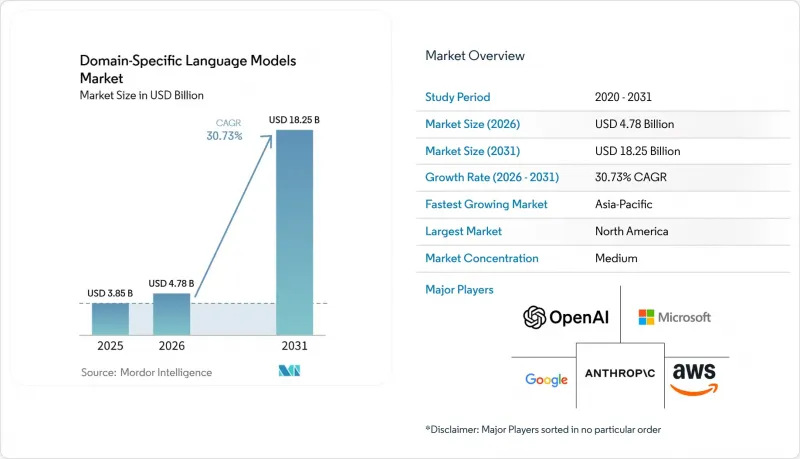
本報告按產品(框架和服務)、部署方式(雲端和本地部署)、應用領域(聊天機器人和虛擬助理、程式碼產生和審查、內容和媒體生成、客戶服務自動化、語言翻譯和在地化等)以及地區進行細分。市場預測以美元計價。
全球領域特定語言模型市場趨勢與洞察
由於企業對特定領域精度的要求,該專案正在從試點運行過渡到全面運行。
2025年,隨著金融服務、醫療保健和法律等行業的部署從試點階段過渡到全面運營,領域特定語言模型(DSL)市場的企業採用率將加速成長。在監管嚴格要求、必須保持準確性且無法廣泛處理領域特定術語的嚴格定義工作流程中,效能差異將更加明顯。 2026年,隨著更多公司實現框架、資料集和評估流程的標準化,最初的全面部署將產生轉換成本,這將有助於提升領域特定語言模型市場的長期客戶留存率。
對模型可追溯性的監管壓力正在重塑人工智慧採購標準。
監管壓力正促使可追溯性成為特定領域語言模型(IDLM)市場的一項強制性採購要求,尤其是在金融服務、醫療保健和其他受監管的環境中。買家現在更加重視受控資料集、可審計的輸出和訓練文檔,因為這些特性可以減少內部審查和外部合規性檢查所需的工作量。在 IEEE IJCNN 2025 會議上發表的研究表明,特定領域模型在文件合規性檢查方面優於 GPT-4 和 Mistral-7B,凸顯了針對受監管任務開發專用架構的必要性。 Aveni 的 FinLLM 套件就是一個供應商調整其產品以適應金融監管要求的例子,這些要求包括與 FCA、PRA 和歐盟人工智慧法案相關的要求。這正在改變特定領域語言模型市場的採購趨勢,因為選擇標準不再那麼依賴模型的廣泛流行度,而是更注重輸出的可控性、可記錄性和可審查性。能夠提前提供這些特性的供應商在特定領域語言模型市場中贏得新的企業專案方面具有顯著優勢。
獲取高品質領域數據的成本給開發進度帶來了壓力。
隱私、保密和法律限制限制了可收集和重複使用的資料量,使得取得高品質的領域資料成為領域特定語言模型市場的主要阻礙因素。醫療機構無法自由共用病患記錄,金融機構面臨嚴格的保密義務,律師事務所則擁有難以用於模型訓練的特權資訊文件。野村綜合研究所透過在其保險合規運作中利用合成資料來應對這項挑戰,因為在隱私限制下收集真實世界的對話資料十分困難。然而,即使是合成數據,也仍然需要專業知識、嚴格的檢驗規則和全面的審查才能用於生產級調優。這增加了領域特定語言模型市場中缺乏成熟資料工程團隊和合規資料管道的小規模組織的成本和前置作業時間。因此,大型企業和基礎設施供應商在市場上比那些需求相似但內部資源有限的公司更具優勢。
細分市場分析
到2025年,框架將佔據領域特定語言模型市場57.74%的佔有率。這反映出大多數企業專案仍從建構、調優、評估和管治模型所需的核心基礎架構著手。在這個基礎架構中,通用語言模型框架通常作為起點,而領域特定框架則透過整合獨特的語料庫、特定任務結構和專家評估邏輯,發揮更具增值作用。這種差異在領域特定語言模型市場至關重要,因為隨著企業需要針對受監管的、特定業務任務進行可復現的效能測試,而非僅僅進行實驗,其價值也隨之提升。建立託管訓練資源、標註方法和內部基準的框架供應商,往往會在領域特定語言模型市場中設置更強大的轉換壁壘。
在領域特定語言模型市場,服務預計到2031年將以29.12%的複合年成長率成長。這是因為買家尋求的是可操作的部署支持,而不僅僅是獨立的模型。諮詢和系統整合仍然至關重要,因為大多數公司仍然需要幫助,才能將領域模型與內部流程、資料資產、審查層和策略控制相匹配。微調和自訂構成了最高價值的服務層級,因為組織希望根據內部術語、監管術語和已定義其工作方式的輸出格式來調整模型行為。隨著越來越多的公司尋求將權重、提示和日誌保存在已批准環境中的基礎設施方案,託管推理和託管服務也變得越來越重要。這使得領域特定語言模型產業的服務部分對於那些希望在不建立完整的內部模型操作堆疊的情況下將其部署到生產環境的公司而言尤其重要。
區域分析
到2025年,北美將佔據41.55%的市場佔有率,成為領域特定語言建模市場最大的區域市場。該地區受益於金融服務、醫療保健、法律科技和企業軟體等領域成熟的基本客群,以及強大的超大規模資料中心業者基礎設施和眾多人工智慧新創公司。這些因素使北美成為最成熟的生產部署環境,企業可以在同一平台上取得工具、運算資源、合規服務和整合合作夥伴。此外,許多大型買家已經擁有雲端合約、安全管治團隊和內部資料管理程序,從而加快部署週期,確保該地區在領域特定語言建模市場保持重要地位。即使部分工作負載遷移到管理完善的私有雲和本地部署環境,這些因素也能支援業務的穩定擴展。
預計到2031年,亞太地區將以30.98%的複合年成長率成長,成為領域特定語言模型市場成長最快的地區。這一成長與各國主導的人工智慧計劃、對本地語言的強勁需求以及企業應用場景對適應性的要求密切相關,而許多現成的西方模型無法滿足這些需求。 2026年5月,NTT更新了“tsuzumi 2”,顯示其持續投資於日本商業文件處理和部署模式,以適應高度機密的企業環境。 Stockmark也在2026年4月發布了一份名為「AI基礎」的文件,最佳化了實際部署,並反映了圍繞企業文件工作流程的積極本地化開發。在中國,截至2026年5月,中油的「崑崙」領域模型已部署在152個應用情境中,涵蓋油氣探勘、煉油營運和資本融資等領域,並支援七種語言。這些趨勢表明,亞太地區的領域特定語言模型市場不僅受到進口通用工具的影響,而且受到特定產業用例和語言要求的影響。
歐洲、南美洲以及中東和非洲正在構成領域特定語言模型市場的下一個需求細分市場,但每個地區的採用路徑各不相同。在歐洲,人工智慧合規義務和資料駐留要求正在塑造市場格局,推動對自主基礎設施和更易於管理的企業部署方案的投資。 2026年3月,德國電信宣布其T-Systems工業人工智慧雲將運作1萬個GPU用於訓練其自主語言模式SOOFI,凸顯了該地區基礎設施建設的規模。同樣在2026年4月,Cohere和Aleph Alpha宣布合併,旨在為具有嚴格資料管理要求的企業和政府建立一個自主人工智慧平台。在中東和非洲,自主人工智慧和阿拉伯語支援的採用已在機構層面取得早期進展,而南美洲則處於引進週期的早期階段,其中巴西在金融服務和農業技術領域主導領先。這些地區加在一起,正在將特定領域語言模型市場擴展到最初的核心領域之外,這表明法規、語言和計算資源的獲取方式正在以不同的方式塑造每個地區的發展軌跡。
其他好處:
- Excel格式的市場預測(ME)表
- 3個月的分析師支持
目錄
第1章:引言
- 研究假設和市場定義
- 調查範圍
第2章:調查方法
第3章執行摘要
第4章 市場狀況
- 市場概覽
- 市場促進因素
- 企業對特定領域準確性的需求
- 對模型可追溯性和受控輸出的監管壓力
- 搜尋增強型微調在受監管工作流程中的興起
- 透過小型化和專用模型降低成本
- 政府人工智慧採購和本地資料居住要求
- 將特定領域模型整合到垂直 SaaS 中
- 市場限制因素
- 獲取高品質領域數據的成本
- 任務關鍵型應用評估的難度以及幻覺的風險。
- 領域特定微調和模型運行的人員短缺。
- 跨境合規的碎片化
- 產業價值鏈分析
- 技術展望
- 監理情勢
- 波特五力分析
- 宏觀經濟因素對市場的影響
第5章 市場規模與成長預測
- 報價
- 框架(包括通用和領域特定語言模型框架)
- 服務(包括諮詢和系統整合、微調和客製化、託管推理和主機託管)
- 不同的發展
- 雲
- 現場
- 透過使用
- 聊天機器人和虛擬助手
- 程式碼產生與審查
- 內容和媒體製作
- 客戶服務自動化
- 語言翻譯和在地化
- 其他用途
- 按地區
- 北美洲
- 美國
- 加拿大
- 南美洲
- 巴西
- 其他南美國家
- 歐洲
- 德國
- 英國
- 法國
- 義大利
- 西班牙
- 其他歐洲國家
- 亞太地區
- 中國
- 印度
- 日本
- 韓國
- 澳洲
- 其他亞太國家
- 中東和非洲
- 中東
- 阿拉伯聯合大公國
- 沙烏地阿拉伯
- 土耳其
- 其他中東國家
- 非洲
- 南非
- 其他非洲國家
- 中東
- 北美洲
第6章 競爭情勢
- 市場集中度
- 策略趨勢
- 市佔率分析
- 公司簡介
- OpenAI, LLC
- Microsoft Corporation
- Google LLC
- Amazon Web Services, Inc.
- Anthropic PBC
- Meta Platforms, Inc.
- IBM Corporation
- NVIDIA Corporation
- Alibaba Cloud(Alibaba Group Holding Limited)
- Baidu, Inc.
- Tencent Holdings Limited
- Huawei Technologies Co., Ltd.
- Cohere Inc.
- AI21 Labs Ltd.
- Mistral AI SAS
- Databricks, Inc.
- Writer, Inc.
- Abridge AI, Inc.
- Harvey AI, Inc.
- Salesforce, Inc.
第7章 市場機會與未來展望
According to Mordor Intelligence, the domain-Specific language models market size was valued at USD 3.85 billion in 2025 and is estimated to grow from USD 4.78 billion in 2026 to reach USD 18.25 billion by 2031, at a CAGR of 30.73% during the forecast period (2026-2031).
This report is Segmented by Offering (Frameworks and Services), Deployment (Cloud and On-Premise), Application (Chatbots and Virtual Assistants, Code Generation and Review, Content and Media Generation, Customer Service Automation, Language Translation and Localization, and More), and Geography. The Market Forecasts are in Terms of Value (USD).
Global Domain-Specific Language Models Market Trends and Insights
Enterprise Demand For Domain-Tuned Accuracy Converts Pilots to Production
Enterprise adoption in the domain-specific language models market accelerated in 2025 as deployments moved out of pilot mode and into production across financial services, healthcare, and legal work. The performance gap is clearer in tightly defined workflows where accuracy must hold under regulatory review, and domain-specific terminology cannot be handled loosely. As more enterprises standardize their frameworks, datasets, and evaluation routines in 2026, early production deployments are creating switching costs that support longer customer retention in the domain-specific language models market.
Regulatory Pressure For Model Traceability Reshapes AI Procurement Criteria
Regulatory pressure is driving traceability to become a required purchase condition in the domain-specific language models market, especially in financial services, healthcare, and other supervised environments. Buyers now place more value on controlled datasets, auditable outputs, and training documentation because these features reduce the effort needed for internal review and external compliance checks. Research presented at IEEE IJCNN 2025 found that domain-tuned models outperformed GPT-4 and Mistral-7B in documentation compliance checks, supporting the case for specialized architectures for regulated tasks. Aveni's FinLLM suite also illustrates how vendors are aligning products with financial regulatory expectations, including those tied to the FCA, PRA, and the EU AI Act. This is changing procurement in the domain-specific language models market because qualification now depends less on broad model popularity and more on evidence that outputs can be controlled, documented, and reviewed. Vendors that can show those features up front are better positioned to win new enterprise programs in the domain-specific language models market.
High-Quality Domain Data Acquisition Cost Pressures Development Timelines
Access to high-quality domain data remains a major restraint in the domain-specific language models market, as privacy, confidentiality, and legal-use restrictions limit what can be collected and reused. Healthcare providers cannot freely pool patient records, financial institutions face strict confidentiality duties, and legal firms hold privileged matter files that are difficult to repurpose for model training. Nomura Research Institute addressed this challenge in insurance compliance work by using synthetic data, as real conversational material was difficult to collect within privacy constraints. Even so, synthetic data still requires subject-matter expertise, strong validation rules, and careful review before it can support production-grade tuning. This raises costs and lead times for smaller organizations in the domain-specific language models market that lack mature data engineering teams or access to compliant data pipelines. The result is a market where larger enterprises and infrastructure-adjacent providers can move faster than firms with similar needs but weaker internal resources.
Other drivers and restraints analyzed in the detailed report include:
- Rising Retrieval-Augmented Fine-Tuning Extends Domain Precision In Regulated Workflows
- Cost Compression Through Smaller, Specialized Models Changes The Build-Versus-Buy Calculus
- Evaluation Difficulty and Hallucination Risk Limit Adoption in Mission-Critical Applications
For complete list of drivers and restraints, kindly check the Table Of Contents.
Segment Analysis
Frameworks held a 57.74% share of the domain-specific language models market in 2025, reflecting the fact that most enterprise programs still start with the core scaffolding needed to build, tune, evaluate, and govern models. Within that base, general-purpose language model frameworks often serve as the starting layer, while domain-specific frameworks play a higher-value role by integrating proprietary corpora, task-specific structures, and specialized evaluation logic. That distinction matters in the domain-specific language models market because value shifts upward once enterprises need repeatable performance in regulated, business-specific tasks rather than simple experimentation. Framework vendors that accumulate controlled training assets, annotation methods, and internal benchmarks tend to build stronger switching barriers over time in the domain-specific language models market.
Services are projected to expand at 29.12% CAGR through 2031 in the domain-specific language models market as buyers seek practical deployment support rather than isolated model access. Consulting and systems integration remain important because most enterprises still need help connecting domain models to internal processes, data estates, review layers, and policy controls. Fine-tuning and customization form the highest-value service layer because organizations want model behavior aligned with internal vocabulary, regulatory language, and output formats that already define how work gets done. Managed inference and hosting are also gaining importance as more enterprises require infrastructure choices that keep weights, prompts, and logs inside approved environments. This makes the services side of the domain-specific language models industry especially relevant for firms that want to deploy to production without building a full in-house model operations stack.
Complete Report Scope:
- By offering
- Frameworks (Including General-Purpose and Domain-Specific Language Model Frameworks)
- Services (Including Consulting and Systems Integration, Fine-Tuning and Customization, Managed Inference and Hosting)
- By Deployment
- Cloud
- On-Premise
- By Application
- Chatbots and Virtual Assistants
- Code Generation and Review
- Content and Media Generation
- Customer Service Automation
- Language Translation and Localization
- Other Applications
- By Geography
- North America
- United States
- Canada
- South America
- Brazil
- Rest of South America
- Europe
- Germany
- United Kingdom
- France
- Italy
- Spain
- Rest of Europe
- Asia-Pacific
- China
- India
- Japan
- South Korea
- Australia
- Rest of Asia-Pacific
- Middle East and Africa
- Middle East
- United Arab Emirates
- Saudi Arabia
- Turkey
- Rest of Middle East
- Africa
- South Africa
- Rest of Africa
- Middle East
- North America
Geography Analysis
North America held a 41.55% share in 2025, making it the largest regional market for domain-specific language models. The region benefits from a mature buyer base in financial services, healthcare, legal technology, and enterprise software, along with deep hyperscaler infrastructure and a broad pool of AI startups. These conditions make North America the most established environment for production deployment because enterprises can access tooling, compute, compliance services, and integration partners in one place. The region also remains important in the domain-specific language models market because many large buyers already have cloud contracts, security governance teams, and internal data programs that shorten deployment time. That combination supports steady scaling even as some workloads shift toward more controlled private and on-premises setups.
Asia-Pacific is projected to expand at 30.98% CAGR through 2031, making it the fastest-growing region in the domain-specific language models market. Growth is tied to sovereign AI efforts, strong local-language demand, and enterprise use cases that require better adaptation than many off-the-shelf Western models can provide. NTT's May 2026 update to tsuzumi 2 showed continued product investment in Japanese business document handling and in deployment modes suited to sensitive enterprise environments. Stockmark also released a document titled "AI foundation" in April 2026, optimized for practical deployment and reflecting active local development around enterprise document workflows. In China, CNPC's Kunlun domain model had been deployed across 152 application scenarios by May 2026, spanning oil and gas exploration, refinery operations, and capital finance, with multilingual support across 7 languages. These developments show that the domain-specific language models market in Asia-Pacific is being shaped by sector-specific use cases and language requirements rather than by imported generic tooling alone.
Europe, South America, the Middle East, and Africa form the next layer of demand in the domain-specific language models market, though each follows a different adoption path. Europe is being shaped by AI compliance obligations and data residency needs, which are encouraging investment in sovereign infrastructure and more controlled enterprise deployment choices. Deutsche Telekom stated in March 2026 that its T-Systems Industrial AI Cloud was operating 10,000 GPUs to train the SOOFI sovereign LLM, underscoring the scale of regional infrastructure commitments. Cohere and Aleph Alpha also announced a merger in April 2026 to build a sovereign AI platform for enterprises and governments with strict data control requirements. The Middle East and Africa are seeing early institutional adoption of sovereign AI and Arabic-language deployments, while South America is earlier in its cycle, with Brazil leading initial activity in financial services and agri-tech. Together, these regions broaden the domain-specific language models market beyond the early core and show that regulation, language, and compute access are shaping regional trajectories in different ways.
- OpenAI, LLC
- Microsoft Corporation
- Google LLC
- Amazon Web Services, Inc.
- Anthropic PBC
- Meta Platforms, Inc.
- IBM Corporation
- NVIDIA Corporation
- Alibaba Cloud (Alibaba Group Holding Limited)
- Baidu, Inc.
- Tencent Holdings Limited
- Huawei Technologies Co., Ltd.
- Cohere Inc.
- AI21 Labs Ltd.
- Mistral AI SAS
- Databricks, Inc.
- Writer, Inc.
- Abridge AI, Inc.
- Harvey AI, Inc.
- Salesforce, Inc.
Additional Benefits:
- The market estimate (ME) sheet in Excel format
- 3 months of analyst support
TABLE OF CONTENTS
1 INTRODUCTION
- 1.1 Study Assumptions and Market Definition
- 1.2 Scope of the Study
2 RESEARCH METHODOLOGY
3 EXECUTIVE SUMMARY
4 MARKET LANDSCAPE
- 4.1 Market Overview
- 4.2 Market Drivers
- 4.2.1 Enterprise Demand for Domain-Tuned Accuracy
- 4.2.2 Regulatory Pressure for Model Traceability and Controlled Outputs
- 4.2.3 Rising Retrieval-Augmented Fine-Tuning in Regulated Workflows
- 4.2.4 Cost Compression Through Smaller, Specialized Models
- 4.2.5 Sovereign AI Procurement and Local Data Residency Mandates
- 4.2.6 Vertical SaaS Embedding of Domain-Specific Models
- 4.3 Market Restraints
- 4.3.1 High-Quality Domain Data Acquisition Cost
- 4.3.2 Evaluation Difficulty and Hallucination Risk in Mission-Critical Use
- 4.3.3 Restricted Talent Pool for Domain Fine-Tuning and Model Ops
- 4.3.4 Fragmented Compliance Across Borders
- 4.4 Industry Value Chain Analysis
- 4.5 Technological Outlook
- 4.6 Regulatory Landscape
- 4.7 Porter's Five Forces Analysis
- 4.7.1 Bargaining Power of Suppliers
- 4.7.2 Bargaining Power of Buyers
- 4.7.3 Threat of New Entrants
- 4.7.4 Threat of Substitutes
- 4.7.5 Competitive Rivalry
- 4.8 Impact of Macroeconomic Factors on the Market
5 MARKET SIZE AND GROWTH FORECASTS (VALUE)
- 5.1 By offering
- 5.1.1 Frameworks (Including General-Purpose and Domain-Specific Language Model Frameworks)
- 5.1.2 Services (Including Consulting and Systems Integration, Fine-Tuning and Customization, Managed Inference and Hosting)
- 5.2 By Deployment
- 5.2.1 Cloud
- 5.2.2 On-Premise
- 5.3 By Application
- 5.3.1 Chatbots and Virtual Assistants
- 5.3.2 Code Generation and Review
- 5.3.3 Content and Media Generation
- 5.3.4 Customer Service Automation
- 5.3.5 Language Translation and Localization
- 5.3.6 Other Applications
- 5.4 By Geography
- 5.4.1 North America
- 5.4.1.1 United States
- 5.4.1.2 Canada
- 5.4.2 South America
- 5.4.2.1 Brazil
- 5.4.2.2 Rest of South America
- 5.4.3 Europe
- 5.4.3.1 Germany
- 5.4.3.2 United Kingdom
- 5.4.3.3 France
- 5.4.3.4 Italy
- 5.4.3.5 Spain
- 5.4.3.6 Rest of Europe
- 5.4.4 Asia-Pacific
- 5.4.4.1 China
- 5.4.4.2 India
- 5.4.4.3 Japan
- 5.4.4.4 South Korea
- 5.4.4.5 Australia
- 5.4.4.6 Rest of Asia-Pacific
- 5.4.5 Middle East and Africa
- 5.4.5.1 Middle East
- 5.4.5.1.1 United Arab Emirates
- 5.4.5.1.2 Saudi Arabia
- 5.4.5.1.3 Turkey
- 5.4.5.1.4 Rest of Middle East
- 5.4.5.2 Africa
- 5.4.5.2.1 South Africa
- 5.4.5.2.2 Rest of Africa
- 5.4.5.1 Middle East
- 5.4.1 North America
6 COMPETITIVE LANDSCAPE
- 6.1 Market Concentration
- 6.2 Strategic Moves
- 6.3 Market Share Analysis
- 6.4 Company Profiles (includes Global Level Overview, Market Level Overview, Core Segments, Financials as available, Strategic Information, Market Rank/Share, Products and Services, Recent Developments)
- 6.4.1 OpenAI, LLC
- 6.4.2 Microsoft Corporation
- 6.4.3 Google LLC
- 6.4.4 Amazon Web Services, Inc.
- 6.4.5 Anthropic PBC
- 6.4.6 Meta Platforms, Inc.
- 6.4.7 IBM Corporation
- 6.4.8 NVIDIA Corporation
- 6.4.9 Alibaba Cloud (Alibaba Group Holding Limited)
- 6.4.10 Baidu, Inc.
- 6.4.11 Tencent Holdings Limited
- 6.4.12 Huawei Technologies Co., Ltd.
- 6.4.13 Cohere Inc.
- 6.4.14 AI21 Labs Ltd.
- 6.4.15 Mistral AI SAS
- 6.4.16 Databricks, Inc.
- 6.4.17 Writer, Inc.
- 6.4.18 Abridge AI, Inc.
- 6.4.19 Harvey AI, Inc.
- 6.4.20 Salesforce, Inc.
7 MARKET OPPORTUNITIES AND FUTURE OUTLOOK
- 7.1 White-Space and Unmet-Need Assessment

 Kimi K3 在全球開放原始碼模型領域佔據主導地位:核心技術與不斷演變的中美人工智慧競爭
 大規模語言模型市場預測至2034年-按模型類型、部署模式、模型規模、架構、應用、最終使用者和地區分類的全球分析
 LLM 和基礎模型安全:市場佔有率分析、行業趨勢和統計數據、成長預測(2026-2031 年)
 領域特定學習領導管理平台市場:市場規模、佔有率和趨勢分析(按組件、部署方法、公司規模、行業和地區分類),基於細分市場的預測(2026-2033 年)
 全球大規模語言模型(LLM)基因組市場報告(2026 年報告草擬)2026年全球智慧語言模型市場報告
 全球大規模語言模型(LLM)市場(至2040年):產業趨勢與預測2026年企業級大規模語言模型(LLM)全球市場報告2026年全球大規模語言模式人工智慧(AI)對話系統市場報告2026年全球法律實務中大規模語言模型(LLM)市場報告