


 |
市場調查報告書
商品編碼
2098505
LLM 和基礎模型安全:市場佔有率分析、行業趨勢和統計數據、成長預測(2026-2031 年)LLM and Foundation Model Security - Market Share Analysis, Industry Trends & Statistics, Growth Forecasts (2026 - 2031) |
||||||

※ 本網頁內容可能與最新版本有所差異。詳細情況請與我們聯繫。
據 Mordor Intelligence 稱,LLM 和基礎模型安全市場預計將從 2025 年的 22.7 億美元成長到 2026 年的 28.8 億美元,到 2031 年達到 82.6 億美元,預計 2026 年至 2031 年的複合年成長率為 23.5%。
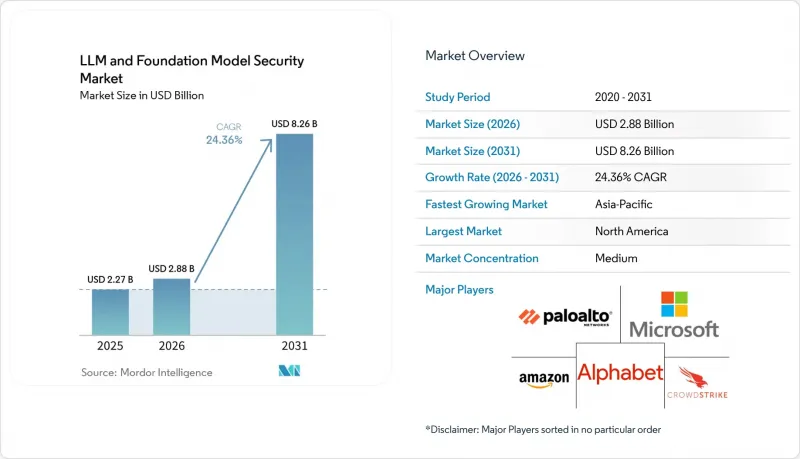
本報告按組件(解決方案和服務)、安全類型(模型安全、資料安全、應用安全等)、部署方式(雲端、本地部署、混合部署)、企業規模(大型企業和中小企業)、最終用戶行業(銀行、金融服務和保險等)以及地區進行細分。市場預測以美元計價。
全球LLM與基礎模型安全市場趨勢與洞察
企業面臨更高的風險,可能導致注入和資料洩露
隨著提示注入不再是理論上的問題,LLM 和基礎模型安全市場正在迅速擴張。 OWASP 已將間接提示注入列為“LLM01:2025”,顯示其在生產系統中的重要性日益凸顯。微軟報告稱,「EchoLeak」是一種針對 Microsoft 365 Copilot 的零點擊攻擊載體,這表明攻擊者無需用戶直接互動即可攻擊企業助手。此外,雲端安全聯盟 (CSA) 的研究表明,許多與提示軟體相關的事件跨越多個攻擊階段,這表明模型利用不再是孤立的提示,而是類似於更廣泛的多階段安全宣傳活動。因此,LLM 和基礎模型安全市場對能夠與模型層和應用層緊密協作的提示檢查、運行時防護和輸出檢驗的需求不斷成長。
對模型管治和人工智慧風險管理的監管力度正在加大。
層級管理模型 (LLM) 和基礎模型安全市場的發展也受到人工智慧管治從隨意性轉向正式管理框架的廣泛推動。美國國家標準與技術研究院 (NIST) 的人工智慧指南為企業提供了一個實用的框架,用於在營運環境中繪製、衡量、管理和管治人工智慧風險。在醫療保健領域,美國食品藥物管理局 (FDA) 關於自適應人工智慧設備的指南以及美國衛生與公眾服務部 (HHS) 對《健康保險流通與責任法案》(HIPAA) 安全法規的修訂,已將人工智慧相關的監控和控制需求納入主動合規工作流程。這也改變了採購趨勢,因為買家現在需要能夠產生記錄、政策合規性證據、工作流程控制和稽核追蹤的安全工具,而不僅僅是警報。因此,隨著各組織將人工智慧監控功能整合到其常規審計和供應商審查流程中,層級管理模型和基礎模型安全市場正因治理、風險和合規 (GRC)主導的採用而獲得持續的需求。
法學碩士(LLM)安全工程人員短缺
層級模型(LLM)和基礎模型安全市場持續面臨明顯的人才短缺,這導致部署的品質和速度下降。人工智慧安全工作需要模型理解、紅隊方法論、應用安全和行為分析等多種技能,但即使到了2026年,要找到具備這些綜合技能的人才仍然十分困難。國際金融協會(IIF)和安永會計師事務所(EY)共同進行的一項金融服務業調查顯示,人工智慧監控和管治對許多金融機構而言仍然充滿挑戰,這表明它們內部資源有限,難以檢驗供應商的說法並實施全面的保障計劃。因此,許多買家被迫選擇供應商主導的部署和託管支持,這可能導致部署週期延長和內部控制結構削弱。因此,儘管層級模型和基礎模型安全市場的需求不斷成長,但並非所有買家都能以相同的速度部署這些工具。
細分市場分析
到 2025 年,解決方案將佔總收入的 61.3%,成為 LLM 和基礎模型安全市場中最大的組成部分。採購公司通常更傾向於平台,因為與諮詢服務密集型合約相比,基於訂閱的軟體更容易在各個模型團隊之間實現標準化。在運作中人工智慧中,需要主動檢查輸入、輸出和模型行為,因此,及時部署安全工具和模型監控是部署計畫中的重中之重。此外,由於許多企業助理會存取內部內容庫、文件和通訊工具,因此多層資料遺失防護和管治也至關重要。鑑於這些原因,軟體平台在大型客戶實施 LLM 和基礎模型安全市場中繼續發揮核心作用。
預計到2031年,服務業將以24.6%的複合年成長率成長,成為LLM和基礎安全市場中成長最快的組成部分。其直接原因是人才短缺,因為許多組織無法快速建立內部紅隊演練、對抗性測試和人工智慧事件回應的能力。隨著買家努力滿足不斷變化的提示、新型代理和部署後策略調整需求,託管監控也正在蓬勃發展。因此,服務正逐漸成為軟體部署的實用延伸,而不再是一次性的附加功能。這擴大了LLM和基礎安全產業的潛在市場,尤其對於那些從一開始就需要營運支援的客戶而言更是如此。
到2025年,模型安全將佔據28.1%的最大市場佔有率,成為LLM和基礎模型安全市場的核心。經過微調的模型、權重和推理路徑如今具有直接的商業價值,也可能成為資訊擷取和篡改的目標,因此成為企業的首要任務。資料安全和應用安全性緊隨其後,因為上下文管道和提示介面已成為敏感資訊外洩和不安全互動的常見入口。身分和存取安全性也日益受到重視,因為基於代理的系統擴大被授予權限、令牌以及代表使用者執行操作的能力。這意味著LLM和基礎模型安全市場正在從純粹的模型防禦擴展到圍繞它的更廣泛的控制堆疊。
預計到2031年,GRC(治理、風險和合規)將以24.7%的複合年成長率成長,成為LLM(生命週期管理)和基礎模型安全市場中成長最快的安全細分領域。這一成長主要由人工智慧風險文件、控制措施分配、證據保存以及對內部審查和外部審計的支援需求所驅動。到2026年,醫療保健相關法規和企業人工智慧管治計畫將使這種文件需求更加迫切。買家也意識到,與依賴可見事件的純粹被動式安全措施相比,GRC方面的支出更具合理性。因此,隨著人工智慧應用轉向受控業務流程,管治軟體將在LLM和基礎模型安全市場中持續保持成長。
區域分析
到2025年,北美將佔據LLM和基礎模型安全市場32.2%的佔有率,成為最大的區域市場。該地區受益於受監管金融機構、雲端AI基礎設施和成熟企業的高度集中的安全預算。此外,該地區還擁有許多積極透過新產品和整合功能引領產業發展的供應商。 NIST的AI指南為該地區尋求AI管治方案的公司提供了重要的指南,特別是針對模型監控和維運管理的系統化架構。微軟和CrowdStrike的產品部署也表明,北美仍然是LLM和基礎模型安全市場中集中式代理和閘道器控制的主要部署中心。
到2025年,歐洲將成為LLM和基礎模型安全市場第二大區域市場。越來越多的組織將人工智慧管治視為一項強制性營運規範,而非僅僅是一個可選層,這推動了市場需求的成長。在金融服務、公共機構和其他受監管行業,採購活動仍然強勁,重點關注政策控制、文件和供應商保障。歐洲市場之所以持續保持重要地位,是因為該地區的買家往往重視可追溯性、管治的深度以及安全控制措施能夠經受正式審查的證據。這些趨勢支撐著LLM和基礎模型安全市場對能夠整合模型保護和管治工作流程的平台的穩定需求。
預計到2031年,亞太地區將以25.2%的複合年成長率成長,成為LLM和基礎模型安全市場成長最快的區域市場。除了大規模的企業級人工智慧部署外,該地區在中國、印度、日本和韓國也呈現多樣化的部署路徑。此外,公共和企業部門日益規範的管治活動也推動了對模型、資料和應用程式控制的需求。由於亞太地區許多部署中專用人工智慧安全工具的採用率仍然低於北美,因此LLM和基礎模型安全市場在其較低的部署基數基礎上仍有巨大的成長空間。
其他好處:
- Excel格式的市場預測(ME)表
- 3個月的分析師支持
目錄
第1章:引言
- 研究假設和市場定義
- 調查範圍
第2章:調查方法
第3章執行摘要
第4章 市場狀況
- 市場概覽
- 市場促進因素
- 隨著企業漏洞增多,注入攻擊和資料外洩事件激增。
- 加強對模型管治和人工智慧風險管理的監管
- 需要集中式安全的多模型企業級人工智慧堆疊的擴展。
- 將面向客戶的LLM應用程式納入主流
- 向受監管產業的安全人工智慧開發生命週期轉型
- 對幻覺和危險輸出的運行時監控需求日益成長。
- 市場限制因素
- 法學碩士(LLM)安全工程人員短缺
- 碎片化的威脅分類系統延緩了標準化採購決策的做出。
- 在發生重大安全事件之前證明投資報酬率的難度很高。
- 模型存取限制和供應商黑盒限制
- 宏觀經濟因素對市場的影響
- 產業價值鏈分析
- 監理情勢
- 技術展望
- 波特五力分析
第5章 市場規模與成長預測
- 按組件
- 解決方案
- 快速安全解決方案
- 輸出安全和內容審核
- 模型監控和運行時保護
- 資料遺失預防和資料管治
- AI紅隊演練與檢驗平台
- 其他解決方案
- 服務
- 解決方案
- 按安全類型
- 模型安全
- 資料安全
- 應用程式安全
- 身份和存取安全
- 管治、風險和合規 (GRC)
- 不同的發展
- 雲
- 現場
- 混合
- 按公司規模
- 大公司
- 小型企業
- 按最終用戶行業分類
- BFSI
- 醫療保健和生命科學
- IT/通訊
- 零售與電子商務
- 工業製造
- 政府/公共部門
- 其他終端用戶產業
- 按地區
- 北美洲
- 美國
- 加拿大
- 墨西哥
- 南美洲
- 巴西
- 阿根廷
- 其他南美國家
- 歐洲
- 德國
- 英國
- 法國
- 義大利
- 西班牙
- 俄羅斯
- 其他歐洲國家
- 亞太地區
- 中國
- 印度
- 日本
- 韓國
- 澳洲
- 其他亞太國家
- 中東和非洲
- 中東
- 沙烏地阿拉伯
- 阿拉伯聯合大公國
- 其他中東國家
- 非洲
- 南非
- 奈及利亞
- 其他非洲國家
- 中東
- 北美洲
第6章 競爭情勢
- 市場集中度
- 策略趨勢
- 市佔率分析
- 公司簡介
- Palo Alto Networks, Inc.
- Microsoft Corporation
- Alphabet Inc.
- Amazon.com, Inc.
- IBM Corporation
- Cisco Systems, Inc.
- CrowdStrike Holdings, Inc.
- Check Point Software Technologies Ltd.
- Fortinet, Inc.
- Zscaler, Inc.
- SentinelOne, Inc.
- HiddenLayer
- Darktrace plc
- Trend Micro Incorporated
- Elastic NV
- Securonix, Inc.
- Nightfall AI
- Protect AI, Inc.
- Lakera AG
- SplxAI Inc.
第7章 市場機會與未來展望
According to Mordor Intelligence, the LLM and Foundation Model Security Market size is expected to increase from USD 2.27 billion in 2025 to USD 2.88 billion in 2026 and reach USD 8.26 billion by 2031, growing at a CAGR of 23.5% over 2026-2031.
This report is Segmented by Component (Solutions, and Services), Security Type (Model Security, Data Security, Application Security, and More), Deployment (Cloud, On-Premises, and Hybrid), Enterprise Size (Large Enterprises, and Small and Medium Enterprises), End-User Industry (BFSI, and More), and Geography. The Market Forecasts are Provided in Terms of Value (USD).
Global LLM and Foundation Model Security Market Trends and Insights
Rising Enterprise Exposure to Prompt Injection and Data Exfiltration
The LLM and Foundation Model Security Market is moving faster because prompt injection is no longer a theoretical issue. OWASP ranked indirect prompt injection as LLM01:2025, indicating its growing centrality in production systems. Microsoft documented EchoLeak as a zero-click attack path against Microsoft 365 Copilot, demonstrating that attackers can target enterprise assistants without requiring direct user action. Cloud Security Alliance research also showed that many promptware incidents span multiple attack stages, indicating that model abuse now resembles broader multi-step security campaigns rather than isolated prompts. As a result, the LLM and Foundation Model Security Market is seeing stronger demand for prompt inspection, runtime guardrails, and output validation that can sit close to the model and the application layer.
Accelerating Regulatory Scrutiny on Model Governance and AI Risk Controls
The LLM and Foundation Model Security Market is also supported by a broader shift away from optional AI governance toward formal control frameworks. NIST AI guidance provides enterprises with a practical framework for mapping, measuring, managing, and governing AI risk in operational settings. In healthcare, the FDA guidance for adaptive AI devices and the HHS HIPAA Security Rule changes have pushed AI-specific monitoring and control needs into active compliance workstreams. This is changing procurement because buyers now want security tools that can produce records, policy evidence, workflow controls, and audit trails, rather than just alerts. The LLM and Foundation Model Security Market is therefore gaining recurring demand from GRC-led deployments as organizations build AI oversight into normal audit and supplier review processes.
Limited Availability of LLM Security Engineering Talent
The LLM and Foundation Model Security Market still faces a clear talent gap that slows deployment quality and speed. AI security work needs a mix of model understanding, red teaming discipline, application security, and prompt behavior analysis, and that mix remains hard to find in 2026. The IIF-EY survey in financial services found that AI oversight and governance remain difficult for many institutions, suggesting limited internal capacity to test vendor claims or run deep assurance programs. This pushes many buyers toward vendor-led implementation and managed support, which can stretch rollout timelines and reduce the amount of control they build internally. The LLM and Foundation Model Security Market therefore grows alongside demand, but not every buyer can operationalize tools at the same pace.
Other drivers and restraints analyzed in the detailed report include:
- Expansion of Multi-Model Enterprise AI Stacks Requiring Centralized Security
- Mainstream Commercialization of Customer-Facing LLM Applications
- Fragmented Threat Taxonomy Slows Standardized Buying Decisions
For complete list of drivers and restraints, kindly check the Table Of Contents.
Segment Analysis
Solutions accounted for 61.3% of revenue in 2025, making them the largest component of the LLM and Foundation Model Security Market. Buyers have generally preferred platforms because subscription software is easier to standardize across model teams than consulting-heavy engagements. Prompt security tools and model monitoring have moved to the front of deployment plans because production AI now needs active checks on inputs, outputs, and model behavior. Data leakage prevention and governance layers also matter because many enterprise assistants touch internal content repositories, documents, and communication tools. This keeps software platforms central to how the LLM and Foundation Model Security Market is being implemented in large accounts.
Services are projected to grow at a 24.6% CAGR through 2031, making them the fastest-expanding component of the LLM and Foundation Model Security Market. The talent shortage is a direct reason, as many organizations cannot build in-house red teaming, adversarial testing, and AI incident response capabilities quickly enough. Managed monitoring is also gaining ground as buyers try to keep pace with evolving prompts, new agents, and post-deployment policy tuning needs. Services are therefore becoming a practical extension of software adoption rather than a one-time implementation add-on. This is expanding the addressable market for the LLM and Foundation Model Security industries, especially among buyers who need operational support from the start.
Model Security held the largest share at 28.1% in 2025, which placed it at the center of the LLM and Foundation Model Security Market. Enterprises are prioritizing it because fine-tuned models, weights, and inference pathways now hold direct business value and can become targets for extraction or manipulation. Data Security and Application Security remain close behind because the context pipeline and the prompt interface are frequent entry points for sensitive information exposure and unsafe interactions. Identity and Access Security is also rising because agentic systems increasingly receive permissions, tokens, and the ability to take actions on behalf of users. This means the LLM and Foundation Model Security Market is broadening from pure model defense into a wider stack of surrounding controls.
GRC is projected to expand at a 24.7% CAGR through 2031, making it the fastest-growing security type in the LLM and Foundation Model Security Market. The growth is being driven by the need to document AI risks, assign controls, preserve evidence, and support internal reviews or external audits. Healthcare rules and enterprise AI governance programs are making those documentation needs more immediate in 2026. Buyers also value GRC spending because it gives a clearer budget case than purely reactive categories that depend on visible incidents. That makes governance software a durable growth layer within the LLM and Foundation Model Security Market as AI use moves into controlled business processes.
Complete Report Scope:
- By Component
- Solutions
- Prompt Security Solutions
- Output Security and Content Moderation
- Model Monitoring and Runtime Protection
- Data Leakage Prevention and Data Governance
- AI Red Teaming and Validation Platforms
- Other Solutions
- Services
- Solutions
- By Security Type
- Model Security
- Data Security
- Application Security
- Identity and Access Security
- Governance, Risk and Compliance (GRC)
- By Deployment
- Cloud
- On-Premises
- Hybrid
- By Enterprise Size
- Large Enterprises
- Small and Medium Enterprises
- By End-user Industry
- BFSI
- Healthcare and Life Sciences
- Information Technology and Telecom
- Retail and E-commerce
- Industrial Manufacturing
- Government and Public Sector
- Other End-user Industries
- By Geography
- North America
- United States
- Canada
- Mexico
- South America
- Brazil
- Argentina
- Rest of South America
- Europe
- Germany
- United Kingdom
- France
- Italy
- Spain
- Russia
- Rest of Europe
- Asia-Pacific
- China
- India
- Japan
- South Korea
- Australia
- Rest of Asia-Pacific
- Middle East and Africa
- Middle East
- Saudi Arabia
- United Arab Emirates
- Rest of Middle East
- Africa
- South Africa
- Nigeria
- Rest of Africa
- Middle East
- North America
Geography Analysis
North America held 32.2% of the LLM and Foundation Model Security Market share in 2025, which made it the largest regional market. The region benefits from a high concentration of regulated financial institutions, cloud AI infrastructure, and mature enterprise security budgets. It also has a strong base of vendors that are actively shaping the category with new products and integrations. NIST AI guidance has become an important anchor for AI governance programs in the region, especially for enterprises that want a structured framework for model oversight and operational controls. Product moves from Microsoft and CrowdStrike also show that North America remains the main launch ground for centralized agent and gateway controls in the LLM and Foundation Model Security Market.
Europe was the second-largest regional market in 2025 within the LLM and Foundation Model Security Market. Demand is being shaped by organizations that increasingly treat AI governance as a required operating discipline rather than a discretionary layer. Financial services, public institutions, and other regulated sectors continue to support buying activity focused on policy controls, documentation, and supplier assurance. Europe also remains important because buyers there tend to place heavy weight on traceability, depth of governance, and evidence that security controls can withstand formal review. That preference supports steady demand for platforms that can connect model protection with governance workflows across the LLM and Foundation Model Security Market.
Asia-Pacific is projected to expand at a 25.2% CAGR, making it the fastest-growing regional segment of the LLM and Foundation Model Security Market through 2031. The region combines large-scale enterprise AI adoption with a wide range of domestic implementation paths across China, India, Japan, and South Korea. Public sector and enterprise governance activity is also becoming more structured, which supports demand for model, data, and application controls. Since dedicated AI security tooling still has lower penetration in many Asia-Pacific deployments than in North America, the LLM and Foundation Model Security Market has more room to expand from a lower installed base.
- Palo Alto Networks, Inc.
- Microsoft Corporation
- Alphabet Inc.
- Amazon.com, Inc.
- IBM Corporation
- Cisco Systems, Inc.
- CrowdStrike Holdings, Inc.
- Check Point Software Technologies Ltd.
- Fortinet, Inc.
- Zscaler, Inc.
- SentinelOne, Inc.
- HiddenLayer
- Darktrace plc
- Trend Micro Incorporated
- Elastic N.V.
- Securonix, Inc.
- Nightfall AI
- Protect AI, Inc.
- Lakera AG
- SplxAI Inc.
Additional Benefits:
- The market estimate (ME) sheet in Excel format
- 3 months of analyst support
TABLE OF CONTENTS
1 INTRODUCTION
- 1.1 Study Assumptions and Market Definition
- 1.2 Scope of the Study
2 RESEARCH METHODOLOGY
3 EXECUTIVE SUMMARY
4 MARKET LANDSCAPE
- 4.1 Market Overview
- 4.2 Market Drivers
- 4.2.1 Rising Enterprise Exposure to Prompt Injection and Data Exfiltration
- 4.2.2 Accelerating Regulatory Scrutiny on Model Governance and AI Risk Controls
- 4.2.3 Expansion of Multi-Model Enterprise AI Stacks Requiring Centralized Security
- 4.2.4 Mainstream Commercialization of Customer-Facing LLM Applications
- 4.2.5 Shift Toward Secure AI Development Lifecycles in Regulated Industries
- 4.2.6 Growing Demand for Runtime Monitoring of Hallucinations and Unsafe Outputs
- 4.3 Market Restraints
- 4.3.1 Limited Availability of LLM Security Engineering Talent
- 4.3.2 Fragmented Threat Taxonomy Slows Standardized Buying Decisions
- 4.3.3 Difficulty Proving ROI Before a Material Security Incident
- 4.3.4 Model Access Constraints and Vendor Black-Box Limitations
- 4.4 Impact of Macroeconomic Factors on the Market
- 4.5 Industry Value-Chain Analysis
- 4.6 Regulatory Landscape
- 4.7 Technological Outlook
- 4.8 Porter's Five Forces Analysis
- 4.8.1 Bargaining Power of Buyers
- 4.8.2 Bargaining Power of Suppliers
- 4.8.3 Threat of New Entrants
- 4.8.4 Threat of Substitutes
- 4.8.5 Intensity of Competitive Rivalry
5 MARKET SIZE AND GROWTH FORECASTS (VALUE)
- 5.1 By Component
- 5.1.1 Solutions
- 5.1.1.1 Prompt Security Solutions
- 5.1.1.2 Output Security and Content Moderation
- 5.1.1.3 Model Monitoring and Runtime Protection
- 5.1.1.4 Data Leakage Prevention and Data Governance
- 5.1.1.5 AI Red Teaming and Validation Platforms
- 5.1.1.6 Other Solutions
- 5.1.2 Services
- 5.1.1 Solutions
- 5.2 By Security Type
- 5.2.1 Model Security
- 5.2.2 Data Security
- 5.2.3 Application Security
- 5.2.4 Identity and Access Security
- 5.2.5 Governance, Risk and Compliance (GRC)
- 5.3 By Deployment
- 5.3.1 Cloud
- 5.3.2 On-Premises
- 5.3.3 Hybrid
- 5.4 By Enterprise Size
- 5.4.1 Large Enterprises
- 5.4.2 Small and Medium Enterprises
- 5.5 By End-user Industry
- 5.5.1 BFSI
- 5.5.2 Healthcare and Life Sciences
- 5.5.3 Information Technology and Telecom
- 5.5.4 Retail and E-commerce
- 5.5.5 Industrial Manufacturing
- 5.5.6 Government and Public Sector
- 5.5.7 Other End-user Industries
- 5.6 By Geography
- 5.6.1 North America
- 5.6.1.1 United States
- 5.6.1.2 Canada
- 5.6.1.3 Mexico
- 5.6.2 South America
- 5.6.2.1 Brazil
- 5.6.2.2 Argentina
- 5.6.2.3 Rest of South America
- 5.6.3 Europe
- 5.6.3.1 Germany
- 5.6.3.2 United Kingdom
- 5.6.3.3 France
- 5.6.3.4 Italy
- 5.6.3.5 Spain
- 5.6.3.6 Russia
- 5.6.3.7 Rest of Europe
- 5.6.4 Asia-Pacific
- 5.6.4.1 China
- 5.6.4.2 India
- 5.6.4.3 Japan
- 5.6.4.4 South Korea
- 5.6.4.5 Australia
- 5.6.4.6 Rest of Asia-Pacific
- 5.6.5 Middle East and Africa
- 5.6.5.1 Middle East
- 5.6.5.1.1 Saudi Arabia
- 5.6.5.1.2 United Arab Emirates
- 5.6.5.1.3 Rest of Middle East
- 5.6.5.2 Africa
- 5.6.5.2.1 South Africa
- 5.6.5.2.2 Nigeria
- 5.6.5.2.3 Rest of Africa
- 5.6.5.1 Middle East
- 5.6.1 North America
6 COMPETITIVE LANDSCAPE
- 6.1 Market Concentration
- 6.2 Strategic Moves
- 6.3 Market Share Analysis
- 6.4 Company Profiles (includes Global Level Overview, Market Level Overview, Core Segments, Financials as available, Strategic Information, Market Rank/Share, Products and Services, Recent Developments)
- 6.4.1 Palo Alto Networks, Inc.
- 6.4.2 Microsoft Corporation
- 6.4.3 Alphabet Inc.
- 6.4.4 Amazon.com, Inc.
- 6.4.5 IBM Corporation
- 6.4.6 Cisco Systems, Inc.
- 6.4.7 CrowdStrike Holdings, Inc.
- 6.4.8 Check Point Software Technologies Ltd.
- 6.4.9 Fortinet, Inc.
- 6.4.10 Zscaler, Inc.
- 6.4.11 SentinelOne, Inc.
- 6.4.12 HiddenLayer
- 6.4.13 Darktrace plc
- 6.4.14 Trend Micro Incorporated
- 6.4.15 Elastic N.V.
- 6.4.16 Securonix, Inc.
- 6.4.17 Nightfall AI
- 6.4.18 Protect AI, Inc.
- 6.4.19 Lakera AG
- 6.4.20 SplxAI Inc.
7 MARKET OPPORTUNITIES AND FUTURE OUTLOOK
- 7.1 White-Space and Unmet-Need Assessment

 Kimi K3 在全球開放原始碼模型領域佔據主導地位:核心技術與不斷演變的中美人工智慧競爭
 領域特定語言模型:市場佔有率分析、產業趨勢與統計、成長預測(2026-2031)
 大規模語言模型市場預測至2034年-按模型類型、部署模式、模型規模、架構、應用、最終使用者和地區分類的全球分析
 領域特定學習領導管理平台市場:市場規模、佔有率和趨勢分析(按組件、部署方法、公司規模、行業和地區分類),基於細分市場的預測(2026-2033 年)
 全球大規模語言模型(LLM)基因組市場報告(2026 年報告草擬)2026年全球智慧語言模型市場報告
 全球大規模語言模型(LLM)市場(至2040年):產業趨勢與預測2026年企業級大規模語言模型(LLM)全球市場報告2026年全球大規模語言模式人工智慧(AI)對話系統市場報告2026年全球法律實務中大規模語言模型(LLM)市場報告