

 |
市場調查報告書
商品編碼
2118017
人工智慧在人力人才招聘和勞動力規劃中的應用:市場佔有率分析、行業趨勢和統計數據以及成長預測(2026-2031 年)Generative AI In HR Talent Acquisition and Workforce Planning - Market Share Analysis, Industry Trends & Statistics, Growth Forecasts (2026 - 2031) |
||||||

※ 本網頁內容可能與最新版本有所差異。詳細情況請與我們聯繫。
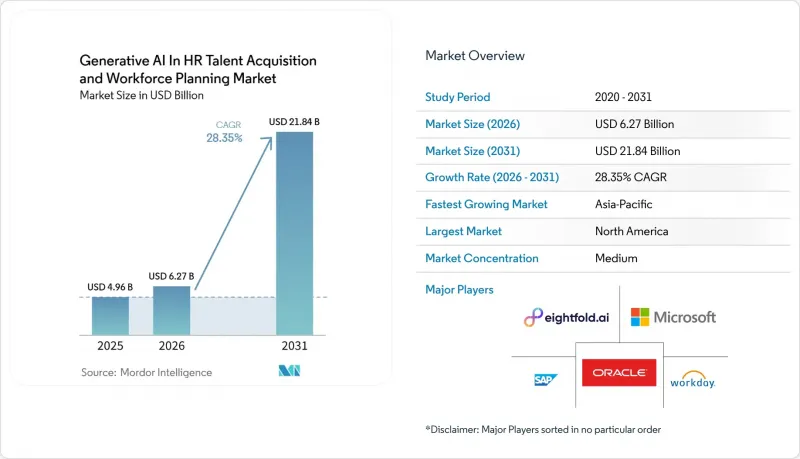
據 Mordor Intelligence 稱,2025 年人力資源、人才招聘和勞動力規劃領域的生成式人工智慧市場規模為 49.6 億美元,預計到 2031 年將從 2026 年的 62.7 億美元成長至 218.4 億美元,預測期(2026-2031 年)的複合年成長率為 28.35%。
本報告按部署模式(雲端、混合、其他)、人力資源職能(招募、人才獲取、學習與發展、績效管理、其他)、組織規模(大型企業、中小企業)、最終用途(IT和電信、其他)以及地區進行細分。市場預測以美元計價。
人力資源、人才招聘和勞動力規劃領域生成式人工智慧的全球趨勢與洞察
在企業人力資源SaaS中引入大規模語言模型
大規模語言模型正從試點階段過渡到人力資源軟體的核心工作流程。 2026年3月,Workday發布了“Sana from Workday”,其中包含300多項用於人力資源和財務運營的代理功能。 Burner Group報告稱,該軟體在部署後40天內實現了90%的採用率,並在部署後停用了400個ChatGPT許可證。 2026年4月, Oracle推出了八款“Fusion Agentic Applications for HR”,旨在支援Oracle Fusion Cloud HCM工作流程中的作業。這些版本將人工智慧功能整合到關鍵的人力資源系統中,而不是將其作為獨立工具。採購團隊也越來越重視管治和人工智慧管理實務。
大規模招募工作流程自動化
大規模招聘為雇主提供了一個清晰的框架,用於評估人工智慧的營運價值。 2026年7月,Eightfold宣布,其「AI面試官」的早期用戶已將招募週期從42天縮短至不到一周。該公司還報告稱,面試所需時間最多可減少90%,負責人80%的手動任務實現了自動化。當企業密切監控結果時,結構化篩檢可以提高對候選人初步評估的一致性。 SAP正在其全球營運中部署“SmartRecruiters for SAP SuccessFactors”,計劃於2026年9月全面投入全球運作。在人力資源、人才招聘和勞動力規劃領域的生成式人工智慧市場,生成式人工智慧透過幫助雇主將快速篩檢與透明的評估管理相結合,從而使雇主受益。
對資料隱私、偏見和公平性的擔憂
對偏見和公平性的擔憂給使用人工智慧進行招募的雇主帶來了法律和聲譽風險。 2026年發表在《科學報告》上的一項研究表明,人工智慧招募系統可能存在跨種族、性別和年齡的交叉偏見。因此,簡單的單類別篩選對於許多招募模式而言是不夠的。雇主要求對模型結果進行有據可查的測試、監督和審查流程。對於小規模的供應商而言,持續滿足這些要求可能頗具挑戰性。這也凸顯了管治的重要性,它是為人力資源、人才招聘和勞動力規劃提供產生式人工智慧解決方案的核心要素。
細分市場分析
到2025年,雲端運算在人力資源、人才招聘和勞動力規劃領域的生成式人工智慧市場將佔據76.48%的佔有率。這反映了核心人力資本管理系統向SaaS(軟體即服務)平台的長期轉型。領先的供應商正在利用雲端架構在其整個人力資源套件中提供人工智慧功能。因此,對於能夠滿足雲端資料管治要求的組織而言,採用雲端運算仍然至關重要。
預計到 2031 年,混合部署將以 29.47% 的複合年成長率成長。金融服務、醫療保健和政府機構等行業可能會將薪資和候選人資料保留在受控環境中。然而,雲端服務仍然可以用於特定的分析和推理工作負載。 2026 年 7 月, Oracle為 Fusion Applications 推出了 AI 原生建構器體驗,包括無程式碼、低程式碼和專業程式碼選項。在存在舊有系統整合要求和嚴格的資料主權法規的情況下,本地部署系統仍然至關重要。對於服務受監管企業客戶的供應商而言,混合能力正變得越來越重要。
2025年,用於人力資源、人才招聘和勞動力規劃的生成式人工智慧市場規模將佔招募和人才獲取領域的35.82%。招募活動透過招募時間、面試完成和錄用結果等指標,產生可衡量的、迭代的工作流程。這些資料點有助於向人力資源和財務經理解釋應用案例。此外,企業招募的人員越多,就越有機會不斷改善其流程。
預計到2031年,人力資源分析和勞動力規劃將以30.82%的複合年成長率成長。這項能力正從靜態報告轉向情境規劃、技能映射和內部調動支援。雇主可以利用人工智慧在招募需求變得迫切之前識別潛在的技能缺口。此外,學習與發展、員工敬業度和績效管理方面對相關人才數據的需求也在不斷成長。因此,招募、人才發展和留任之間的協調性日益增強。能夠將這些功能整合到單一體驗的供應商更有能力服務大型企業買家。
區域分析
到2025年,北美將佔據人力資源、人才招聘和勞動力規劃領域生成式人工智慧市場40.27%的佔有率。該地區聚集了許多企業級人力資源軟體供應商和基於雲端的人力資本管理(HCM)用戶。雖然美國是該地區的主要需求來源,但加拿大和墨西哥也受益於跨境平台的採用。 Workday於2026年5月將其Sana自助服務代理程式整合到Microsoft 365 Copilot。將人力資源功能整合到現有的生產力軟體中,降低了使用者的進入門檻。
預計到2031年,亞太地區的複合年成長率將達到30.71%。印度、中國和東南亞的雇主正在推動招募活動和員工服務的數位轉型。在印度和中國,企業正在開發針對當地語言和勞動市場情況量身定做的產品。行動優先的候選人互動方式正在推動對多語言互動式人工智慧和高效招募流程的需求。
歐洲仍然是至關重要的需求中心,但合規性是推動需求的關鍵因素。歐盟人工智慧法將許多人工智慧在就業領域的應用視為高風險,因此需要加強評估、文件記錄和人工監督。 2026年,Leapsome推出了一套符合GDPR(一般資料保護規範)的人工智慧招募和人才管理套件,該套件強調可解釋的人工智慧代理。南美洲的人工智慧市場基數小規模,但巴西和阿根廷的需求十分活躍。在中東,勞動力在地化計畫正在凸顯潛在市場,尤其是在沙烏地阿拉伯和阿拉伯聯合大公國。非洲仍處於起步階段,南非和埃及在人工智慧應用方面處於領先地位。
其他好處:
- Excel格式的市場預測(ME)表
- 3個月的分析師支持
目錄
第1章:引言
- 研究假設和市場定義
- 調查範圍
第2章:調查方法
第3章執行摘要
第4章 市場狀況
- 市場概覽
- 市場促進因素
- 在企業人力資源SaaS中引入大規模語言模型
- 大規模招募工作流程自動化
- 員工和求職者的自助式對話人工智慧
- 基於技能的人才規劃與內部調動
- 與低程式碼人力資源技術堆疊整合
- 為求職者和員工產生高度個人化的內容
- 市場限制因素
- 對資料隱私、偏見和公平性的擔憂
- 專門針對人力資源領域的高品質培訓數據有限。
- 精細化調整與管治的高昂成本
- 智慧財產權和內容所有權方面缺乏透明度
- 價值鏈分析
- 監理情勢
- 技術展望
- 波特五力分析
第5章 市場規模與成長預測
- 按部署模式
- 雲
- 現場
- 混合
- 按人力資源職能
- 招募和人才獲取
- 學習與技能發展
- 員工敬業度與體驗
- 績效管理
- 人力資源分析與勞動規劃
- 其他人力資源職能
- 按組織規模
- 大公司
- 小型企業
- 按最終用途
- 資訊科技/通訊
- BFSI
- 醫療保健和生命科學
- 製造業
- 零售與電子商務
- 其他最終用途
- 按地區
- 北美洲
- 美國
- 加拿大
- 墨西哥
- 南美洲
- 巴西
- 阿根廷
- 其他南美國家
- 歐洲
- 德國
- 英國
- 法國
- 義大利
- 西班牙
- 俄羅斯
- 其他歐洲國家
- 亞太地區
- 中國
- 日本
- 印度
- 韓國
- 澳洲
- 其他亞太國家
- 中東
- 沙烏地阿拉伯
- 阿拉伯聯合大公國
- 土耳其
- 其他中東國家
- 非洲
- 南非
- 埃及
- 其他非洲國家
- 北美洲
第6章 競爭情勢
- 市場集中度
- 策略趨勢
- 市佔率分析
- 公司簡介
- Workday, Inc.
- Oracle Corporation
- SAP SE
- Microsoft Corporation
- Eightfold AI, Inc.
- Phenom People, Inc.
- iCIMS, Inc.
- Beamery Ltd.
- Gloat, Inc.
- HireVue, Inc.
- Paradox.ai, Inc.
- Greenhouse Software, Inc.
- Lever, Inc.
- Textio, Inc.
- SeekOut Inc.
- Retain.ai Ltd.
- Lattice, Inc.
- ADP, Inc.
- IBM Corporation
- ServiceNow, Inc.
第7章 市場機會與未來展望
According to Mordor Intelligence, the generative AI in HR Talent Acquisition and Workforce Planning market size was valued at USD 4.96 billion in 2025 and estimated to grow from USD 6.27 billion in 2026 to reach USD 21.84 billion by 2031, at a CAGR of 28.35% during the forecast period (2026-2031).
This report is Segmented by Deployment Model (Cloud, Hybrid, and More), HR Function (Recruitment and Talent Acquisition, Learning and Development, Performance Management, and More), Organization Size (Large Enterprises, and Small and Medium Enterprises), End-Use (IT and Telecom, and More), and Geography. The Market Forecasts are Provided in Terms of Value (USD).
Global Generative AI In HR Talent Acquisition and Workforce Planning Market Trends and Insights
Large Language Model Adoption in Enterprise HR SaaS
Large language models are moving from trials into core HR software workflows. Workday launched Sana from Workday in March 2026 with more than 300 agentic skills for HR and finance work. Berner Group reported 90% adoption within 40 days and retired 400 ChatGPT licenses after the rollout. Oracle introduced 8 Fusion Agentic Applications for HR in April 2026, designed to support actions within Oracle Fusion Cloud HCM workflows. These releases integrate AI functions into the main HR system rather than treating them as separate tools. Procurement teams are also giving more weight to governance controls and AI management practices.
Automation of High-Volume Hiring Workflows
High-volume recruiting provides employers with a clear framework for assessing the operational value of AI. In July 2026, Eightfold stated that early users of its AI Interviewer reduced hiring cycles from 42 days to under 1 week. The company also reported time-to-interview reductions of up to 90% and automation of 80% of manual recruiter tasks. Structured screening can improve consistency in early candidate evaluation when organizations closely monitor outcomes. SAP is implementing SmartRecruiters for SAP SuccessFactors across its global operations, with a worldwide go-live scheduled for September 2026. The generative AI in HR talent acquisition and workforce planning market benefits where employers can link faster screening with transparent evaluation controls.
Data Privacy, Bias, and Fairness Concerns
Bias and fairness concerns create legal and reputational risks for employers using AI in hiring. A 2026 study in Scientific Reports found that intersectional bias can manifest across race, gender, and age in AI recruitment systems. This makes simple, single-category reviews insufficient for many hiring models. Employers need documented testing, oversight, and a process for reviewing model outcomes. These requirements may be harder for smaller suppliers to meet consistently. They also make governance capability a central part of the generative AI in HR talent acquisition and workforce planning market offering.
Other drivers and restraints analyzed in the detailed report include:
- Conversational AI for Employee and Candidate Self-Service
- Skills-Based Workforce Planning and Internal Mobility
- Limited HR-Specific Training Data Quality
For complete list of drivers and restraints, kindly check the Table Of Contents.
Segment Analysis
Cloud held 76.48% of the generative AI in HR talent acquisition and workforce planning market share in 2025. The position reflects the long-running migration of core human capital systems to software-as-a-service platforms. Major suppliers use cloud architectures to deliver AI functions across their HR suites. This keeps cloud deployment central for organizations that can meet cloud data governance requirements.
Hybrid deployment is projected to grow at a 29.47% CAGR through 2031. Financial services, healthcare, and government organizations may retain payroll or candidate data in controlled environments. They can still use cloud services for selected analytics and inference workloads. Oracle introduced an AI-native builder experience for Fusion Applications in July 2026, including no-code, low-code, and pro-code options. On-premises systems remain relevant where legacy integration requirements or strict data sovereignty rules are in place. Hybrid capability is becoming important for suppliers serving regulated enterprise accounts.
Recruitment and talent acquisition accounted for 35.82% of the generative AI in HR talent acquisition and workforce planning market size in 2025. Recruiting produces recurring workflows that can be measured through time-to-fill, interview completion, and offer outcomes. These data points make the use case easier to explain to HR and finance leaders. High hiring volumes also give organizations repeated opportunities to refine their processes.
HR analytics and workforce planning are projected to expand at a 30.82% CAGR through 2031. The function is shifting from static reporting toward scenario planning, skills mapping, and internal mobility support. Employers can use AI to identify likely skills gaps before a hiring requirement becomes urgent. Learning and development, engagement, and performance management also add demand for connected people data. The result is a closer relationship between recruiting, development, and retention. Suppliers that integrate these functions into a single experience may be better positioned to serve enterprise buyers.
Complete Report Scope:
- By Deployment Model
- Cloud
- On-Premises
- Hybrid
- By HR Function
- Recruitment and Talent Acquisition
- Learning and Development
- Employee Engagement and Experience
- Performance Management
- HR Analytics and Workforce Planning
- Other HR Functions
- By Organization Size
- Large Enterprises
- Small and Medium Enterprises
- By End-Use Industry
- IT and Telecom
- BFSI
- Healthcare and Life Sciences
- Manufacturing
- Retail and E-commerce
- Other End-Use Industries
- By Geography
- North America
- United States
- Canada
- Mexico
- South America
- Brazil
- Argentina
- Rest of South America
- Europe
- Germany
- United Kingdom
- France
- Italy
- Spain
- Russia
- Rest of Europe
- Asia-Pacific
- China
- Japan
- India
- South Korea
- Australia
- Rest of Asia-Pacific
- Middle East
- Saudi Arabia
- United Arab Emirates
- Turkey
- Rest of Middle East
- Africa
- South Africa
- Egypt
- Rest of Africa
- North America
Geography Analysis
North America held 40.27% of the generative AI in HR talent acquisition and workforce planning market share in 2025. The region has a concentrated base of enterprise HR software suppliers and cloud HCM users. The United States drives most regional demand, while Canada and Mexico benefit from cross-border platform deployments. Workday brought Sana Self-Service Agent to Microsoft 365 Copilot in May 2026. Placing HR functions within established productivity software can reduce user adoption barriers.
Asia-Pacific is projected to grow at a 30.71% CAGR through 2031. Employers across India, China, and Southeast Asia are digitizing recruiting and employee services. India and China are developing products that reflect local languages and labor market conditions. Mobile-first candidate interactions support demand for multilingual conversational AI and efficient recruiting workflows.
Europe remains an important but compliance-shaped demand center. The EU AI Act treats many employment AI uses as high-risk, which increases the need for assessment, documentation, and human oversight. Leapsome introduced an AI recruiting and people management suite in 2026 that emphasizes GDPR-compliant and explainable AI agents. South America is developing from a smaller base, with Brazil and Argentina showing active demand. The Middle East has targeted potential through workforce nationalization programs, especially in Saudi Arabia and the UAE. Africa remains at an early stage, with South Africa and Egypt leading initial adoption.
- Workday, Inc.
- Oracle Corporation
- SAP SE
- Microsoft Corporation
- Eightfold AI, Inc.
- Phenom People, Inc.
- iCIMS, Inc.
- Beamery Ltd.
- Gloat, Inc.
- HireVue, Inc.
- Paradox.ai, Inc.
- Greenhouse Software, Inc.
- Lever, Inc.
- Textio, Inc.
- SeekOut Inc.
- Retain.ai Ltd.
- Lattice, Inc.
- ADP, Inc.
- IBM Corporation
- ServiceNow, Inc.
Additional Benefits:
- The market estimate (ME) sheet in Excel format
- 3 months of analyst support
TABLE OF CONTENTS
1 INTRODUCTION
- 1.1 Study Assumptions and Market Definition
- 1.2 Scope of the Study
2 RESEARCH METHODOLOGY
3 EXECUTIVE SUMMARY
4 MARKET LANDSCAPE
- 4.1 Market Overview
- 4.2 Market Drivers
- 4.2.1 Large Language Model Adoption in Enterprise HR SaaS
- 4.2.2 Automation of High-Volume Hiring Workflows
- 4.2.3 Conversational AI for Employee and Candidate Self-Service
- 4.2.4 Skills-Based Workforce Planning and Internal Mobility
- 4.2.5 Integration With Low-Code HR Tech Stacks
- 4.2.6 Hyper-Personalized Candidate and Employee Content Generation
- 4.3 Market Restraints
- 4.3.1 Data Privacy, Bias, and Fairness Concerns
- 4.3.2 Limited HR-Specific Training Data Quality
- 4.3.3 High Fine-Tuning and Governance Costs
- 4.3.4 Intellectual Property and Content Ownership Ambiguity
- 4.4 Value Chain Analysis
- 4.5 Regulatory Landscape
- 4.6 Technological Outlook
- 4.7 Porter's Five Forces Analysis
- 4.7.1 Threat of New Entrants
- 4.7.2 Bargaining Power of Suppliers
- 4.7.3 Bargaining Power of Buyers
- 4.7.4 Threat of Substitutes
- 4.7.5 Competitive Rivalry
5 MARKET SIZE AND GROWTH FORECASTS (VALUE)
- 5.1 By Deployment Model
- 5.1.1 Cloud
- 5.1.2 On-Premises
- 5.1.3 Hybrid
- 5.2 By HR Function
- 5.2.1 Recruitment and Talent Acquisition
- 5.2.2 Learning and Development
- 5.2.3 Employee Engagement and Experience
- 5.2.4 Performance Management
- 5.2.5 HR Analytics and Workforce Planning
- 5.2.6 Other HR Functions
- 5.3 By Organization Size
- 5.3.1 Large Enterprises
- 5.3.2 Small and Medium Enterprises
- 5.4 By End-Use Industry
- 5.4.1 IT and Telecom
- 5.4.2 BFSI
- 5.4.3 Healthcare and Life Sciences
- 5.4.4 Manufacturing
- 5.4.5 Retail and E-commerce
- 5.4.6 Other End-Use Industries
- 5.5 By Geography
- 5.5.1 North America
- 5.5.1.1 United States
- 5.5.1.2 Canada
- 5.5.1.3 Mexico
- 5.5.2 South America
- 5.5.2.1 Brazil
- 5.5.2.2 Argentina
- 5.5.2.3 Rest of South America
- 5.5.3 Europe
- 5.5.3.1 Germany
- 5.5.3.2 United Kingdom
- 5.5.3.3 France
- 5.5.3.4 Italy
- 5.5.3.5 Spain
- 5.5.3.6 Russia
- 5.5.3.7 Rest of Europe
- 5.5.4 Asia-Pacific
- 5.5.4.1 China
- 5.5.4.2 Japan
- 5.5.4.3 India
- 5.5.4.4 South Korea
- 5.5.4.5 Australia
- 5.5.4.6 Rest of Asia-Pacific
- 5.5.5 Middle East
- 5.5.5.1 Saudi Arabia
- 5.5.5.2 United Arab Emirates
- 5.5.5.3 Turkey
- 5.5.5.4 Rest of Middle East
- 5.5.6 Africa
- 5.5.6.1 South Africa
- 5.5.6.2 Egypt
- 5.5.6.3 Rest of Africa
- 5.5.1 North America
6 COMPETITIVE LANDSCAPE
- 6.1 Market Concentration
- 6.2 Strategic Moves
- 6.3 Market Share Analysis
- 6.4 Company Profiles (includes Global Level Overview, Market Level Overview, Core Segments, Financials as available, Strategic Information, Market Rank/Share, Products and Services, Recent Developments)
- 6.4.1 Workday, Inc.
- 6.4.2 Oracle Corporation
- 6.4.3 SAP SE
- 6.4.4 Microsoft Corporation
- 6.4.5 Eightfold AI, Inc.
- 6.4.6 Phenom People, Inc.
- 6.4.7 iCIMS, Inc.
- 6.4.8 Beamery Ltd.
- 6.4.9 Gloat, Inc.
- 6.4.10 HireVue, Inc.
- 6.4.11 Paradox.ai, Inc.
- 6.4.12 Greenhouse Software, Inc.
- 6.4.13 Lever, Inc.
- 6.4.14 Textio, Inc.
- 6.4.15 SeekOut Inc.
- 6.4.16 Retain.ai Ltd.
- 6.4.17 Lattice, Inc.
- 6.4.18 ADP, Inc.
- 6.4.19 IBM Corporation
- 6.4.20 ServiceNow, Inc.
7 MARKET OPPORTUNITIES AND FUTURE OUTLOOK
- 7.1 White-Space and Unmet-Need Assessment

 2026-2030年全球生成式人工智慧(AI)市場
 全球生成式人工智慧市場(至 2033 年):按交付類型(基礎模型、生成式人工智慧副駕駛、生成式人工智慧加速器、生成式人工智慧記憶體)、資料模態(文字、影片、多模態)和應用(內容生成、自主任務執行、程式碼生成)分類
 生成式人工智慧市場:全球市場預測,2026-2032年
 生成式AI市場報告:趨勢、預測與競爭分析(至2035年)生成式人工智慧晶片組市場:全球產業分析、市場規模、市場佔有率及2026年至2033年預測(按晶片組類型、應用、最終用途、國家和地區分類)
 人力資源領域生成式人工智慧市場規模、佔有率和成長分析:按應用、部署、組織規模、最終用戶產業和地區分類-2026-2033年產業預測
 旅遊業生成式人工智慧市場規模、佔有率和成長分析:按應用、部署、技術、最終用戶和地區分類-2026-2033年產業預測
 人力資源領域的生成式人工智慧:市場佔有率分析、產業趨勢與統計數據以及成長預測(2026-2031 年)生成式人工智慧:市場佔有率分析、產業趨勢和統計數據、成長預測(2026-2031 年)
 臨床試驗中的生成式人工智慧市場:按組件、部署方法、應用、最終用戶和地區分類