


 |
市場調查報告書
商品編碼
2117997
供應鏈執行(SCE):市場佔有率分析、產業趨勢與統計數據、成長預測(2026-2031)Supply Chain Execution (SCE) - Market Share Analysis, Industry Trends & Statistics, Growth Forecasts (2026 - 2031) |
||||||

※ 本網頁內容可能與最新版本有所差異。詳細情況請與我們聯繫。
根據 Mordor Intelligence 預測,供應鏈執行 (SCE) 市場規模將從 2025 年的 121 億美元和 2026 年的 136 億美元成長到 2031 年的 243 億美元,2026 年至 2031 年的年複合成長率(CAGR)為 12.31%。
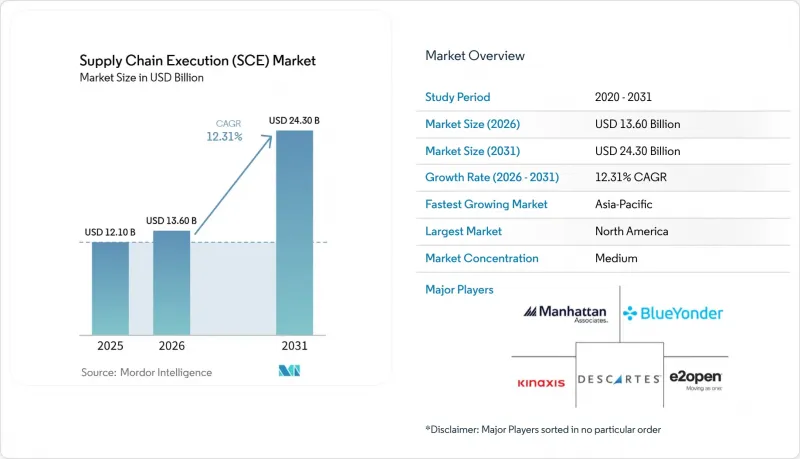
本報告按組件(軟體[例如倉庫管理系統 (WMS) 和運輸管理系統 (TMS)] 和服務)、部署類型(例如本地部署)、企業規模(大型企業和中小企業)、最終用戶行業(例如工業製造業)和地區進行細分。市場預測以美元計價。
全球供應鏈執行 (SCE) 市場趨勢與洞察
電子商務履約的複雜性以及對即時可見性的需求
電子商務不再只是一個額外的銷售管道,它已成為供應鏈設計的核心要素。在受訪的647位供應鏈經理中,約80%表示電子商務將持續成長,另有相當比例的受訪者表示,他們正在實施或計劃在2026年前實施全通路分銷策略。與前一年相比,全通路計畫的實施率提高了10個百分點。在同一項調查中,分銷和物流、庫存管理以及訂單履約被列為三大營運重點。這推動了對倉儲、訂單和視覺化應用的需求,這些應用程式能夠近乎即時地協調跨多個管道的履約。隨著交付可靠性和庫存準確性對物流績效和客戶維繫的影響日益增強,供應鏈執行(SCE)市場也從中受益。
實施人工智慧驅動的預測性執行和自主工作流程。
人工智慧 (AI) 在供應鏈執行市場中的作用日益增強,其應用範圍已從規劃工具擴展到日常執行營運。截至 2026 年,71% 的供應鏈企業計劃在未來 3-5 年內投資生成式 AI,60% 的企業計劃投資預測式 AI。與 2025 年相比,這兩個數字分別增加了 12 和 17 個百分點。供應鏈執行 (SCE) 市場的這些應用趨勢凸顯了對能夠識別異常情況、提案應對措施並協調倉庫和運輸網路決策的系統的需求。利用整合代理的平台可以減少將新的 AI 工具與營運資料整合所需的工作量。由於實驗階段和全面部署之間仍然存在差距,整合、管治和實施支援服務對於供應商和使用者仍然至關重要。
將傳統ERP系統與倉庫自動化系統整合的複雜性。
將現代雲端平台與傳統企業資源計畫 (ERP) 系統整合仍然是一項重大的部署挑戰。許多舊有系統是為批量處理而設計的,無法以當前倉庫和運輸平台所需的速度交換庫存、出貨或異常資料。一份 2025 年的產業報告強調,取得準確的即時數據仍然是供應鏈數位化的一大障礙。 OPEX 也指出,在整合過程中,現代 JSON 和 XML 介面與專有的傳統檔案結構之間可能會出現資料格式不一致的情況。倉庫和 ERP 記錄匹配的延遲會導致分配和發票錯誤。這些問題會延長專案工期,減少實際收入,並減緩對供應鏈執行 (SCE) 市場的進一步投資,尤其是在中型製造商和零售商中。
細分市場分析
按類型分析,預計到2025年,軟體將佔收入佔有率的73.34%,而服務領域預計到2031年將以13.58%的複合年成長率成長。在軟體領域,倉庫管理系統(WMS)在2025年佔據了供應鏈執行(SCE)軟體市場佔有率的20.24%。倉庫營運是一個集中執行中心,勞動力調度、庫存記錄、機器人系統協調和訂單處理等功能在此交匯。零售和製造業用戶往往特別重視揀貨路線最佳化和貨位分配等功能,因為這些功能會影響履約的成本和速度。預計從2026年到2031年,供應鏈視覺性和控制塔解決方案在供應鏈執行軟體市場將以13.77%的複合年成長率成長。這一成長反映了從獨立系統轉向整合倉庫、承運商和供應商之間交接資訊的轉變。
運輸管理系統 (TMS)、訂單管理系統 (OMS)、勞動力管理系統、堆場管理系統、貨運審計和支付以及逆向物流工具,各自滿足特定的營運需求。供應鏈執行 (SCE) 市場的買家越來越重視這些應用,不再將其視為孤立的產品,而是將其視為更廣泛平台的一部分。服務仍然至關重要,因為現代化專案需要實施支援、管理服務和流程變更。高品質的資料基礎設施對於企業充分利用高階自動化帶來的優勢也至關重要。這使得供應商能夠將 WMS 許可證與視覺化功能和服務捆綁銷售,從而提高合約價值,同時減少對獨立許可證的依賴。
預計到2025年,本地部署將佔總收入的42.48%,這反映了大型企業的採用率。這些用戶通常在客製化的倉儲和運輸系統上投入巨資,這些系統與其自身的自動化設備整合。轉型可能涉及高昂的成本、業務連續性風險以及漫長的引進週期。預計從2026年到2031年,雲端部署將以13.52%的複合年成長率成長。雲端部署供應鏈執行市場的規模成長得益於SaaS定價模式、中小企業的新採用以及供應商對雲端原生產品計畫的投資。
2026年5月,Blue Yonder宣布只會銷售其雲端原生認知產品系列。這項決定反映出雲端架構在SCE市場平台選擇中的重要性日益凸顯。對於因設施限制而無法完全遷移到雲端服務的公司而言,混合系統仍然可行。混合系統還有助於滿足不同國家/地區的各種法律和數據要求。歐洲的資料主權法規和亞太地區的金融服務要求持續推動著本地部署和混合部署的發展,許多混合部署方案在分階段遷移完成之前都會保留一些本地部署元件。
區域分析
到2025年,北美將佔據供應鏈執行(SCE)市場33.39%的佔有率。該地區的SCE市場受益於成熟的第三方物流(3PL)業務、雲端基礎設施的高利用率以及許多成熟的供應商和專業廠商。雖然需求主要集中在美國,但加拿大和墨西哥也受益於近岸外包。到2025年,33%的受訪公司計劃進行近岸外包或在岸外包,43%的公司計劃在未來三年內將更多供應鏈環節轉移到美國。
歐洲是全球第二大區域市場,其中德國、英國和法國是工業和零售需求的主要中心。該地區也擁有完善的監管體系,能夠滿足新的可追溯性要求。 2026年7月20日,歐盟委員會根據《永續產品生態設計條例》推出了“數位產品護照登記系統”,該系統強制要求在產品實際生產過程中收集和傳輸可追溯性資訊。此外,《企業永續性實質審查指示》將供應商資訊揭露義務擴展至企業的供應鏈工作流程。這些法規使得可追溯性準備成為歐洲買家在供應鏈執行(SCE)市場選擇平台時的關鍵因素。
預計2026年至2031年,亞太地區將以13.41%的複合年成長率成長。中國和印度正透過不斷擴大的電子商務規模和製造業活動推動SCE市場的成長,而東南亞的供應商網路也日益複雜。日本和韓國的汽車和電子產業對精準的倉儲和堆場營運提出了更高的需求。澳洲、紐西蘭和東南亞的零售、消費品以及食品飲料用戶也帶來了新增需求。南美洲的食品、飲料和農業供應鏈蘊藏著商機,而中東和非洲則由於基礎設施投資和跨境電商的擴張,對基於雲端的物流和視覺化工具的需求日益成長。
其他好處:
- Excel格式的市場預測(ME)表
- 3個月的分析師支持
目錄
第1章:引言
- 研究假設和市場定義
- 調查範圍
第2章:調查方法
第3章執行摘要
第4章 市場狀況
- 市場概覽
- 市場促進因素
- 電子商務履約的複雜性以及對即時可見性的需求
- 實施人工智慧驅動的預測性執行和自主工作流程。
- 中小企業「雲端優先」方法的現代化
- 供應鏈韌性與多層風險監控的要求
- 永續性數據的強制性可追溯性和數位化
- 票價波動及動態最佳化 API 的引入
- 市場限制因素
- 將傳統ERP系統與倉庫自動化系統整合的複雜性。
- 網路安全與網實整合風險
- 數位營運人員短缺,尤其注重執行技能
- 人工智慧管治、資料基礎設施現況以及人機互動的限制
- 宏觀經濟因素對市場的影響
- 產業價值鏈分析
- 監理情勢
- 技術展望
- 波特五力分析
第5章 市場規模與成長預測
- 按組件
- 軟體
- 倉庫管理系統(WMS)
- 運輸管理系統(TMS)
- 訂單管理系統(OMS)
- 勞動力管理系統(LMS)
- 堆場管理系統(YMS)
- 貨物審核和付款
- 供應鏈可視性和控制塔
- 逆向物流執行
- 服務
- 軟體
- 部署模式
- 基於雲端的
- 現場
- 混合
- 按最終用途/公司規模分類
- 大公司
- 小型企業
- 按最終用戶行業分類
- 工業製造
- 零售與電子商務
- 運輸/物流
- 醫療保健和生命科學
- 車
- 食品/飲料
- 化工和加工工業
- 面向消費者的包裝商品
- 能源公用事業
- 政府/國防
- 其他終端用戶產業
- 按地區
- 北美洲
- 美國
- 加拿大
- 墨西哥
- 南美洲
- 巴西
- 阿根廷
- 智利
- 其他南美國家
- 歐洲
- 德國
- 英國
- 法國
- 義大利
- 西班牙
- 俄羅斯
- 其他歐洲國家
- 亞太地區
- 中國
- 日本
- 印度
- 韓國
- 澳洲和紐西蘭
- 東南亞
- 其他亞太國家
- 中東
- 土耳其
- 阿拉伯聯合大公國
- 沙烏地阿拉伯
- 以色列
- 其他中東國家
- 非洲
- 南非
- 埃及
- 奈及利亞
- 其他非洲國家
- 北美洲
第6章 競爭情勢
- 市場集中度
- 策略趨勢
- 市佔率分析
- 公司簡介
- EPG(Ehrhardt Partner Group)
- Infios(formerly Korber SC Software)
- Softeon
- Made4net
- Tecsys
- Manhattan Associates
- Blue Yonder
- Infor
- Generix Group
- Aptean
- Oracle
- SAP
- WiseTech Global
- The Descartes Systems Group
- QAD
- Transporeon
- project44
- Shipsy
- FarEye Technologies
- FreightPOP
- Overhaul
第7章 市場機會與未來展望
According to Mordor Intelligence, the supply chain execution (SCE) market size is projected to expand from USD 12.10 billion in 2025 and USD 13.60 billion in 2026 to USD 24.30 billion by 2031, registering a CAGR of 12.31% between 2026 to 2031.
This report is Segmented by Component (Software [Warehouse Management Systems (WMS), Transportation Management Systems (TMS), and More], and Services), Deployment Mode (On-Premises, and More), Enterprise Size (Large Enterprises, and Small and Medium-Sized Enterprises), End-User Industry (Industrial Manufacturing, and More), and Geography. The Market Forecasts are Provided in Terms of Value (USD).
Global Supply Chain Execution (SCE) Market Trends and Insights
E-Commerce Fulfillment Complexity and Real-Time Visibility Demand
E-commerce has become a core part of supply chain design, rather than an added sales channel. Nearly 80% of 647 supply chain leaders reported continued e-commerce growth, and a similar share were implementing or planning omnichannel distribution strategies in 2026. The reported level of omnichannel planning was 10 percentage points higher than in the prior year. Distribution and logistics, inventory management, and order fulfillment were the 3 leading operating priorities in the same research. This places greater demand on warehouse, order, and visibility applications that can coordinate fulfillment across several channels in near real time. The supply chain execution (SCE) market benefits because delivery reliability and inventory accuracy increasingly affect customer retention as well as logistics performance.
AI-Enabled Predictive Execution and Autonomous Workflow Adoption
Artificial intelligence is moving from planning tools into daily execution work across the supply chain execution market. In 2026, 71% of supply chain organizations planned to invest in generative AI during the following 3 to 5 years, and 60% planned to invest in predictive AI. These figures were 12 percentage points and 17 percentage points higher than the respective 2025 results. This supply chain execution (SCE) market adoption pattern supports demand for systems that can identify exceptions, recommend actions, and coordinate decisions across warehouses and transportation networks. Platforms with embedded agents can reduce the work needed to connect new AI tools with operational data. The remaining gap between experimentation and broad deployment keeps integration, governance, and implementation services important for vendors and users.
Legacy ERP and Warehouse Automation Integration Complexity
The connection between modern cloud platforms and older enterprise resource planning systems remains a major deployment issue. Many legacy systems were designed for batch processing and do not exchange inventory, shipment, or exception data at the speed required by current warehouse and transportation platforms. A 2025 industry report identified access to accurate, real-time data as a continuing barrier to supply chain digitalization. OPEX also noted that integration can involve incompatible data formats between modern JSON or XML interfaces and proprietary legacy file structures. Delays in reconciling warehouse and ERP records can lead to allocation and invoicing errors. These issues extend project timelines, weaken visible returns, and slow further investment in the supply chain execution (SCE) market, particularly among mid-sized manufacturers and retailers.
Other drivers and restraints analyzed in the detailed report include:
- Cloud-First Modernization Among Small and Medium-Sized Enterprises
- Supply Chain Resilience and Multi-Tier Risk Monitoring Requirements
- Cybersecurity and Cyber-Physical Risk Exposure
For complete list of drivers and restraints, kindly check the Table Of Contents.
Segment Analysis
By component, software held 73.34% revenue share in 2025, services segment is expected to grow at 13.58% CAGR through 2031 in the supply chain execution (SCE) market. Within Software segment, Warehouse Management Systems accounted for 20.24% of supply chain execution software market share in 2025. Warehousing is a concentrated execution point where labor scheduling, inventory records, robotics coordination, and order sequencing meet. Retail and industrial users often place high value on functions such as pick-path optimization and slotting because these functions affect fulfillment cost and speed. Supply Chain Visibility and Control Tower solutions are projected to grow at a 13.77% CAGR from 2026 to 2031 in the supply chain execution software market. Their growth reflects the move from separate systems toward connected information across warehouse, carrier, and supplier handoffs.
Transportation Management Systems, Order Management Systems, Labor Management Systems, Yard Management Systems, freight audit and payment, and reverse logistics tools each address a specific operating need. Supply chain execution (SCE) market buyers increasingly assess these applications as part of a broader platform rather than as isolated products. Services remain important because modernization projects require implementation support, managed services, and process change. High-quality data infrastructure is also needed before organizations can realize the full benefits of advanced automation. This encourages vendors to bundle WMS licenses with visibility and services, which can increase contract value while reducing reliance on standalone licenses.
On-premises deployment held 42.48% of revenue in 2025, reflecting the installed base at large organizations. These users have often invested heavily in customized warehouse and transportation systems that connect with proprietary automation equipment. Migration can involve material cost, operational continuity risks, and long implementation cycles. Cloud-based deployment is projected to advance at a 13.52% CAGR from 2026 to 2031. The supply chain execution market size for cloud-based deployment is supported by SaaS pricing, greenfield adoption by SMEs, and vendor investment in cloud-native product plans.
Blue Yonder stated in May 2026 that it would sell only its cloud-native cognitive portfolio. The decision shows how cloud architecture is becoming a key consideration during SCE market platform selection. Hybrid systems remain relevant for companies with facilities that cannot move to cloud services at the same time. They can also help organizations manage varied legal and data requirements across countries. Data sovereignty rules in Europe and financial services requirements in Asia-Pacific continue to support both on-premises and hybrid deployment, while many hybrid installations retain an on-premises element until a phased migration is complete.
Complete Report Scope:
- By Component
- Software
- Warehouse Management Systems (WMS)
- Transportation Management Systems (TMS)
- Order Management Systems (OMS)
- Labor Management Systems (LMS)
- Yard Management Systems (YMS)
- Freight Audit and Payment
- Supply Chain Visibility and Control Tower
- Reverse Logistics Execution
- Services
- Software
- By Deployment Mode
- Cloud-Based
- On-Premises
- Hybrid
- By End Use Enterprise Size
- Large Enterprises
- Small and Medium-Sized Enterprises
- By End-User Industry
- Industrial Manufacturing
- Retail and E-Commerce
- Transportation and Logistics
- Healthcare and Life Sciences
- Automotive
- Food and Beverage
- Chemicals and Process Industries
- Consumer Packaged Goods
- Energy and Utilities
- Government and Defense
- Other End-User Industries
- By Geography
- North America
- United States
- Canada
- Mexico
- South America
- Brazil
- Argentina
- Chile
- Rest of South America
- Europe
- Germany
- United Kingdom
- France
- Italy
- Spain
- Russia
- Rest of Europe
- Asia-Pacific
- China
- Japan
- India
- South Korea
- Australia and New Zealand
- Southeast Asia
- Rest of Asia-Pacific
- Middle East
- Turkiye
- United Arab Emirates
- Saudi Arabia
- Israel
- Rest of Middle East
- Africa
- South Africa
- Egypt
- Nigeria
- Rest of Africa
- North America
Geography Analysis
North America held 33.39% of supply chain execution (SCE) market share in 2025. The SCE market in the region benefits from established third-party logistics activity, high cloud infrastructure use, and a broad base of established providers and specialist vendors. Demand is concentrated in the United States, while Canada and Mexico benefit from nearshoring activity. In 2025, 33% of surveyed enterprises were developing nearshoring or onshoring plans and 43% planned to shift more of their supply chain footprint to the United States during the next 3 years.
Europe is the second-largest regional market, with Germany, the United Kingdom, and France acting as important centers for industrial and retail demand. The region also has a regulatory basis for new traceability requirements. The European Commission launched the Digital Product Passport Registry on July 20, 2026, under the Ecodesign for Sustainable Products Regulation. The registry requires product traceability information to be captured and transmitted within physical execution processes. The Corporate Sustainability Due Diligence Directive has also extended supplier-data obligations into corporate supply chain workflows. These rules make traceability readiness a relevant supply chain execution (SCE) market platform qualification factor for European buyers.
Asia-Pacific is projected to grow at a 13.41% CAGR from 2026 to 2031. China and India support SCE market growth through expanding e-commerce volumes and manufacturing activity, while Southeast Asian supplier networks are becoming more complex. Japan and South Korea provide demand through automotive and electronics operations that require precise warehouse and yard execution. Australia, New Zealand, and Southeast Asia add demand from retail, consumer packaged goods, and food and beverage users. South America offers opportunities in food, beverage, and agricultural supply chains, while the Middle East and African markets are adopting cloud transportation and visibility tools as infrastructure investment and cross-border e-commerce expand.
- EPG (Ehrhardt Partner Group)
- Infios (formerly Korber SC Software)
- Softeon
- Made4net
- Tecsys
- Manhattan Associates
- Blue Yonder
- Infor
- Generix Group
- Aptean
- Oracle
- SAP
- WiseTech Global
- The Descartes Systems Group
- QAD
- Transporeon
- project44
- Shipsy
- FarEye Technologies
- FreightPOP
- Overhaul
Additional Benefits:
- The market estimate (ME) sheet in Excel format
- 3 months of analyst support
TABLE OF CONTENTS
1 INTRODUCTION
- 1.1 Study Assumptions and Market Definition
- 1.2 Scope of the Study
2 RESEARCH METHODOLOGY
3 EXECUTIVE SUMMARY
4 MARKET LANDSCAPE
- 4.1 Market Overview
- 4.2 Market Drivers
- 4.2.1 E-commerce Fulfillment Complexity and Real-Time Visibility Demand
- 4.2.2 AI-Enabled Predictive Execution and Autonomous Workflow Adoption
- 4.2.3 Cloud-First Modernization Among Small and Medium-Sized Enterprises
- 4.2.4 Supply Chain Resilience and Multi-Tier Risk Monitoring Requirements
- 4.2.5 Mandatory Traceability and Sustainability Data Digitalization
- 4.2.6 Freight Volatility and Dynamic Optimization API Adoption
- 4.3 Market Restraints
- 4.3.1 Legacy ERP and Warehouse Automation Integration Complexity
- 4.3.2 Cybersecurity and Cyber-Physical Risk Exposure
- 4.3.3 Shortage of Execution-Focused Digital Operations Talent
- 4.3.4 AI Governance, Data Readiness, and Human-in-the-Loop Constraints
- 4.4 Impact of Macroeconomic Factors on the Market
- 4.5 Industry Value Chain Analysis
- 4.6 Regulatory Landscape
- 4.7 Technological Outlook
- 4.8 Porter's Five Forces Analysis
- 4.8.1 Threat of New Entrants
- 4.8.2 Bargaining Power of Suppliers
- 4.8.3 Bargaining Power of Buyers
- 4.8.4 Threat of Substitutes
- 4.8.5 Rivalry Among Existing Competitors
5 MARKET SIZE AND GROWTH FORECASTS (VALUE)
- 5.1 By Component
- 5.1.1 Software
- 5.1.1.1 Warehouse Management Systems (WMS)
- 5.1.1.2 Transportation Management Systems (TMS)
- 5.1.1.3 Order Management Systems (OMS)
- 5.1.1.4 Labor Management Systems (LMS)
- 5.1.1.5 Yard Management Systems (YMS)
- 5.1.1.6 Freight Audit and Payment
- 5.1.1.7 Supply Chain Visibility and Control Tower
- 5.1.1.8 Reverse Logistics Execution
- 5.1.2 Services
- 5.1.1 Software
- 5.2 By Deployment Mode
- 5.2.1 Cloud-Based
- 5.2.2 On-Premises
- 5.2.3 Hybrid
- 5.3 By End Use Enterprise Size
- 5.3.1 Large Enterprises
- 5.3.2 Small and Medium-Sized Enterprises
- 5.4 By End-User Industry
- 5.4.1 Industrial Manufacturing
- 5.4.2 Retail and E-Commerce
- 5.4.3 Transportation and Logistics
- 5.4.4 Healthcare and Life Sciences
- 5.4.5 Automotive
- 5.4.6 Food and Beverage
- 5.4.7 Chemicals and Process Industries
- 5.4.8 Consumer Packaged Goods
- 5.4.9 Energy and Utilities
- 5.4.10 Government and Defense
- 5.4.11 Other End-User Industries
- 5.5 By Geography
- 5.5.1 North America
- 5.5.1.1 United States
- 5.5.1.2 Canada
- 5.5.1.3 Mexico
- 5.5.2 South America
- 5.5.2.1 Brazil
- 5.5.2.2 Argentina
- 5.5.2.3 Chile
- 5.5.2.4 Rest of South America
- 5.5.3 Europe
- 5.5.3.1 Germany
- 5.5.3.2 United Kingdom
- 5.5.3.3 France
- 5.5.3.4 Italy
- 5.5.3.5 Spain
- 5.5.3.6 Russia
- 5.5.3.7 Rest of Europe
- 5.5.4 Asia-Pacific
- 5.5.4.1 China
- 5.5.4.2 Japan
- 5.5.4.3 India
- 5.5.4.4 South Korea
- 5.5.4.5 Australia and New Zealand
- 5.5.4.6 Southeast Asia
- 5.5.4.7 Rest of Asia-Pacific
- 5.5.5 Middle East
- 5.5.5.1 Turkiye
- 5.5.5.2 United Arab Emirates
- 5.5.5.3 Saudi Arabia
- 5.5.5.4 Israel
- 5.5.5.5 Rest of Middle East
- 5.5.6 Africa
- 5.5.6.1 South Africa
- 5.5.6.2 Egypt
- 5.5.6.3 Nigeria
- 5.5.6.4 Rest of Africa
- 5.5.1 North America
6 COMPETITIVE LANDSCAPE
- 6.1 Market Concentration
- 6.2 Strategic Moves
- 6.3 Market Share Analysis
- 6.4 Company Profiles (includes Global Level Overview, Market Level Overview, Core Segments, Financials as available, Strategic Information, Market Rank/Share, Products and Services, Recent Developments)
- 6.4.1 EPG (Ehrhardt Partner Group)
- 6.4.2 Infios (formerly Korber SC Software)
- 6.4.3 Softeon
- 6.4.4 Made4net
- 6.4.5 Tecsys
- 6.4.6 Manhattan Associates
- 6.4.7 Blue Yonder
- 6.4.8 Infor
- 6.4.9 Generix Group
- 6.4.10 Aptean
- 6.4.11 Oracle
- 6.4.12 SAP
- 6.4.13 WiseTech Global
- 6.4.14 The Descartes Systems Group
- 6.4.15 QAD
- 6.4.16 Transporeon
- 6.4.17 project44
- 6.4.18 Shipsy
- 6.4.19 FarEye Technologies
- 6.4.20 FreightPOP
- 6.4.21 Overhaul
7 MARKET OPPORTUNITIES AND FUTURE OUTLOOK
- 7.1 White-Space and Unmet-Need Assessment

 自動化倉庫管理系統市場預測至2034年-按部署類型、產品/服務、服務類型、技術、倉庫類型、應用、最終使用者和地區分類的全球分析
 物聯網分析:市場佔有率分析、產業趨勢與統計、成長預測(2026-2031 年)
 物聯網分析市場-2026-2032年全球市場預測
 物聯網 (AoT) 市場規模、佔有率和成長分析:按組件、組織規模、技術、部署模式、應用類型、行業和地區分類 - 2026-2033 年行業預測
 物聯網分析市場規模、佔有率、成長及全球產業分析:按類型、應用和地區分類的洞察,2026-2034 年預測智慧數位貨架分析平台市場:按組件、部署模式、組織規模、分析類型和最終用戶產業分類,全球預測(2026-2032年)
 物聯網分析市場規模、佔有率和成長分析(按類型、組件、組織規模、部署模式、應用、最終用戶產業和地區分類)-2026-2033年產業預測
 物聯網分析市場-全球產業規模、佔有率、趨勢、機會和預測,按分析類型、服務類型、最終用戶、地區和競爭細分,2020-2030 年預測
 全球物聯網分析市場規模研究與預測,依組件、部署、類型、應用和區域預測,2025-2035
 全球物聯網分析市場,2024-2028