


 |
市場調查報告書
商品編碼
2117987
中國與歐洲之間的滾裝海運:市場佔有率分析、行業趨勢和統計數據以及成長預測(2026-2031年)China-Europe Ro-Ro Ocean Freight Transport - Market Share Analysis, Industry Trends & Statistics, Growth Forecasts (2026 - 2031) |
||||||

※ 本網頁內容可能與最新版本有所差異。詳細情況請與我們聯繫。
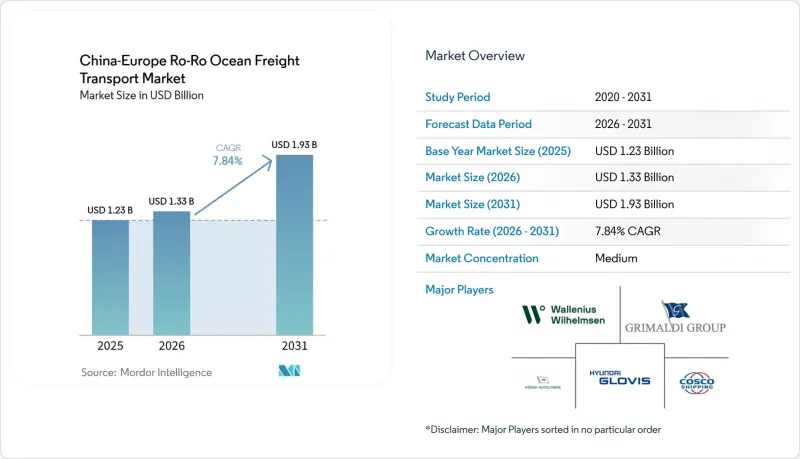
據 Mordor Intelligence 稱,2025 年中國與歐洲之間的滾裝海運市場價值為 12.3 億美元,預計 2026 年將達到 13.3 億美元,到 2031 年將達到 19.3 億美元,2026 年至 2031 年的複合年成長率為 7.84%。
受中國汽車出口激增的推動,中歐之間的滾裝海運市場正在擴張,其中乘用車貨運仍佔據主導地位,並主導運輸路線的規劃。本報告按貨物類型(乘用車、商用車、越野車)、船舶尺寸(小型、中型和大型船舶)、終端用戶行業(整車製造商、經銷商及其他(租賃公司、貨運租賃公司等))以及貨運量/路線叢集(中國出口分析、歐洲出口分析)進行細分。市場預測以美元計價。
中國與歐洲之間滾裝海運市場的趨勢與洞察
轉向使用專用滾裝船運輸能力出口中國製造的電動車。
預計到2025年,中國電動車出口量將成長一倍以上,超過250萬輛,其中電動車將佔中國汽車出口總量的35%以上。這一比例高於2024年的20%。出口量的成長持續對中歐之間的滾裝海運市場帶來壓力,因為該航線目前仍嚴重依賴專用汽車裝運船隻來運輸大部分高價值出口貨物。中國十大汽車製造商已宣布,到2026年,其海外銷量總合目標將超過700萬輛,即使新船投入使用,訂艙需求依然強勁。此外,汽車製造商正透過自身的車隊策略直接確保運輸能力;比亞迪目前營運8艘個人汽車運輸船(PCTC),每年運輸30萬輛汽車。這意味著,在中歐之間的滾裝海運市場,不僅貨運量在增加,而且整體市場可用運輸能力的柔軟性下降幅度遠超名義出口數據所顯示的水平。
中歐航線汽車運輸船運力短缺
中歐之間的海運市場依然緊張,船舶供應只是問題的一部分;碼頭通行、週轉時間和船期安排同樣重要。隨著中國汽車製造商爭相搶佔船位,預計到2026年中期,中歐滾裝船的現貨運費將達到每立方公尺150美元,是2025年第四季平均價格的兩倍。報告指出,由於滾裝船運力無法滿足尖峰時段的需求,有100萬輛汽車改用貨櫃船運輸,這表明如果供應狀況改善,部分貨物可能會重新回到專用汽車運輸船的運輸方式。雖然繞開紅海導致部分航程耗時延長10至14天,減少了每艘船舶每年可完成的航次數量,但中歐之間滾裝船海運市場的整體運轉率依然保持強勁。此外,歐盟排放交易體系 (EU ETS) 的成本和國際海事組織 (IMO) 2030 的合規要求降低了老舊船舶的競爭力,這鼓勵了船隊現代化,但也導致服務於歐洲港口的營運商的營運成本持續居高不下。
由於新船供應增加,貨運價格壓力可望緩解。
中歐之間的滾裝海運市場正面臨嚴峻挑戰,新船供應不再是遙遠的未來風險。克拉克森預測,到2026年,中歐航線滾裝船船隊將成長8%,而需求預計僅成長1%至2%,這意味著如果出口成長放緩,運價的支撐空間將更加有限。這項週期已促成創紀錄的交付量:2025年將交付75艘中歐航線滾裝船,而到2025年之前的三年內,將交付133艘滾裝船,相當於約100萬個標準箱(CEU)。在2023年至2028年間交付或計畫交付的276艘中歐航線滾裝船中,有80%來自中國船廠,顯示該航線的供應正集中成長。如果由於關稅和汽車銷售放緩導致出口需求疲軟,從 2027 年開始,中國和歐洲之間的滾裝海運市場的運轉率可能會下降,預計中小船東以及擁有老舊船舶的船東將面臨最大的壓力。
細分市場分析
2025年,乘用車佔中歐滾裝海運市場規模的62.04%,反映了中國製造的電池式電動車(BEV)和插電式混合動力車(PHEV)對歐出口量的成長。 2025年,中國製造的電動車在歐盟的銷量達到94萬輛,較2024年成長近50%。這表明,乘用車的裝載能力仍然是車隊部署決策的核心因素。 2025年,中國品牌車在歐盟從中國進口車的佔比超過70%,高於2023年的50%。這表明,成品車的流通很大程度上與中國品牌的成長密切相關。乘用車市場不僅限於中國本土品牌;大眾、寶馬、日產、現代和Stellantis等公司也在中國生產汽車用於海外出口。
商用車輛是中歐滾裝海運市場成長最快的貨物類別,預計到2031年將以9.53%的複合年成長率成長,儘管其體積仍小於乘用車。這一成長與比亞迪、宇通、海格等中國卡車和客車製造商在歐洲穩步擴張分銷網路密切相關。非公路車輛仍然是重要的貨物類別,因為建築、農業和採礦設備非常適合滾裝運輸模式,並支援在長途航線上使用混合船舶。到2026年,歐盟將強制要求所有電動車電池進口持有電池護照,營運商正在調整甲板佈局和文件程序,以滿足整個中歐滾裝海運產業的可追溯性要求。
到2025年,載箱量超過4,000標準箱的大型船舶將佔據中歐滾裝海運市場58%的佔有率,凸顯了遠洋船舶在長途汽車運輸航線上的強勁需求。 2026年4月,現代格羅唯視推出全球首艘10800標準箱級PCTC「Globis Leader」號,顯示其正朝著提高歐洲航線艙位密度和降低單位成本的方向邁進。此外,這些船舶採用的LNG雙燃料推進系統為停靠歐洲港口的營運商提供了成本優勢,因為歐洲港口的排放法規合規成本正在上升。格里馬爾迪公司建造載箱量超過9000標準箱的氨燃料相容型船舶的計畫也基於類似的邏輯。這表明,在中歐滾裝海運市場,船舶尺寸和燃料柔軟性如今已緊密相連。
中型船舶是成長最快的船型,預計到2031年將以9.90%的複合年成長率成長。這反映了市場對支線運輸服務和進入次要港口的需求,而大型船舶並非總是滿足這些需求。這種兩極化意味著中歐海運市場正沿著兩條不同的發展路徑成長:超大型船舶承擔主要航線,而中型船舶則負責為小規模碼頭提供支線運輸服務。 2026年6月,川崎汽船為其子公司KESS訂購了四艘1380標準箱的LNG雙燃料PCTC(小型汽車運輸船),這些船舶專為歐洲小規模進口汽車碼頭(尺寸有限制)而設計。 2000標準箱以下的小型船舶也面臨著船齡較長的挑戰,目前6,000標準箱以下的PCTC中,70%的船齡超過15年,這顯示中歐滾裝海運業正持續進行船舶更新換代。
其他好處
- Excel格式的市場預測(ME)表
- 3個月的分析師支持
目錄
第1章:引言
- 研究假設和市場定義
- 調查範圍
第2章:調查方法
第3章執行摘要
第4章 市場狀況
- 市場概況及滾裝海運市場的重要性
- 市場促進因素
- 轉向使用專用滾裝船運輸能力出口中國製造的電動車。
- 中歐航線汽車運輸船運力短缺
- 從東亞到歐洲的噸英里運輸需求增加
- 為了最大限度地減少損壞,原始設備製造商 (OEM) 更傾向於選擇滾裝船和貨櫃運輸方案。
- 車隊升級為更大、更節能的PCTC。
- 歐洲港口與內陸地區之間的汽車互聯互通
- 市場限制因素
- 新船供應增加,可望緩解貨運價格壓力。
- 歐洲主要門戶港口擁塞和泊位限制
- 與中國汽車出口相關的貿易政策和關稅變化
- 歐洲二級貨物卸貨港口缺乏滾裝船基礎設施
- 法律規範
- 價值鍊和分銷管道的結構分析
- 技術創新前景
- 波特五力分析
- 港口和碼頭基礎設施分析
- 永續性和ESG分析
- 中國與歐洲之間低空海運的變化
- 地緣政治事件對供應鏈變化的影響
第5章 市場規模及成長預測(價值,2026-2031 年)
- 按貨物類型
- 乘用車(包括二輪車和三輪車)
- 商用車輛
- 越野車
- 按船舶尺寸
- 小型船舶(小於 2,000 CEU)
- 中型船舶(2,000-4,000CEU)
- 大型船舶(超過 4,000 個標準箱)
- 按最終用戶行業分類
- OEM
- 經銷商
- 其他(租賃公司、貨運租賃公司、政府/國防車輛等)
- 按貨運量/航線叢集
- 中國出口分析
- 英國
- 德國
- 荷蘭
- 比利時
- 西班牙
- 義大利
- 其他歐洲國家
- 歐洲出口分析
- 英國
- 德國
- 荷蘭
- 比利時
- 西班牙
- 義大利
- 其他歐洲國家
- 中國出口分析
第6章 競爭情勢
- 市場集中度
- 關鍵策略趨勢
- 市佔率分析
- 公司簡介
- Wallenius Wilhelmsen
- Hoegh Autoliners
- Grimaldi Group
- COSCO SHIPPING Specialized Carriers
- Hyundai Glovis
- EUKOR Car Carriers
- Nippon Yusen Kabushiki Kaisha(NYK)
- Kawasaki Kisen Kaisha("K" Line)
- Mitsui OSK Lines(MOL)
- DFDS A/S(Europe-focused Ro-Ro operator)
- Sallaum Lines
- China Merchants Shenzhen RoRo Shipping Co., Ltd.
- SAIC Anji Logistics
- BYD Shipping
- China Merchants Energy Shipping(CMES)
- HMM Co., Ltd.
- Eastern Pacific Shipping
- Ray Car Carriers
- Neptune Lines
- Siem Car Carriers
- NMT International Shipping BV
- Chery International Logistics
第7章 市場機會與未來展望
According to Mordor Intelligence, the China-Europe ro-Ro ocean freight transport market size was valued at USD 1.23 billion in 2025 and is projected to reach USD 1.33 billion in 2026, and reach USD 1.93 billion by 2031, growing at a CAGR of 7.84% from 2026 to 2031.
The China-Europe Ro-Ro ocean freight transport market is expanding on the back of a sharp rise in vehicle exports from China, with passenger vehicle volumes still setting the pace for fleet use and route planning. This report is Segmented by Cargo Type (Passenger Vehicles, Commercial Vehicles, and Off-Road Vehicles), by Vessel Size (Small Vessels, Mid-Size Vessels, and Large Vessels), by End-User (OEMs, Dealers, and Others (Rental Companies, Fleet Leasing Companies, and More)), and by Flows (China Export Analysis, and Europe Export Analysis). The Market Forecasts are Provided in Terms of Value (USD).
China-Europe Ro-Ro Ocean Freight Transport Market Trends and Insights
China EV Exports Are Overflowing Available Ro-Ro Capacity
China's electric car exports doubled to more than 2.5 million units in 2025, and electric models accounted for more than 35% of all Chinese car exports, up from 20% in 2024. That volume has kept the China-Europe Ro-Ro ocean freight transport market under pressure, as the route still relies on dedicated car carriers for the bulk of high-value exports. The ten largest Chinese OEMs have announced combined overseas sales targets of more than 7 million units for 2026, keeping booking demand elevated even as new vessels arrive. OEMs are also absorbing capacity directly through captive fleet strategies, with BYD now operating 8 owned PCTCs that move 300,000 vehicles per year. This means the China-Europe Ro-Ro ocean freight transport market is not only seeing more cargo, but also less flexible open-market capacity than headline export figures suggest.
Vehicle Carrier Slot Tightness On China-Europe Lanes
The China-Europe Ro-Ro ocean freight transport market remains tight because vessel supply is only one part of the problem; berth access, turnaround time, and sailing schedules are equally important. Spot freight rates from China to Europe reached USD 150 per m3 by mid-2026, double the Q4 2025 average, as Chinese OEMs tried to secure available slots. The same report noted that 1 million vehicles were moving on container ships because Ro-Ro capacity could not absorb peak demand, indicating the extent of latent cargo that could return to pure car carriers when supply improves. Red Sea avoidance has added 10 to 14 days to some voyages, reducing the number of annual sailings each ship can complete and keeping utilization firm across the China-Europe Ro-Ro ocean freight transport market. EU ETS costs and IMO 2030 compliance requirements are also making older tonnage less competitive, supporting renewal but keeping operating costs high for operators serving European ports.
A Newbuilding Surge Threatens To Tip The Supply-Demand Balance
The China-Europe Ro-Ro ocean freight transport market is entering a phase where new vessel supply can no longer be treated as a distant risk. Clarksons projected PCTC fleet growth of 8% in 2026, against demand growth of 1% to 2%, narrowing the room for continued rate support if export momentum eases. The same cycle has already produced record deliveries, with 75 PCTCs handed over in 2025 and 133 vessels with nearly 1 million CEU delivered in the 3 years to 2025. Chinese yards account for 80% of the 276 PCTCs delivered or due between 2023 and 2028, indicating a concentrated supply build visible across the trade. If export demand softens due to tariffs or slower vehicle sales, the China-Europe Ro-Ro ocean freight transport market could see weaker utilization from 2027, with smaller and older owners facing the most pressure.
Other drivers and restraints analyzed in the detailed report include:
- Ton-Mile Demand Growth Supports Above-Average PCTC Earnings
- OEM Preference For Ro-Ro Underpins Structural Volume Stability
- Trade Policy Volatility Creates A Structural Freight Planning Overhang
For complete list of drivers and restraints, kindly check the Table Of Contents.
Segment Analysis
Passenger vehicles accounted for 62.04% of the China-Europe Ro-Ro ocean freight transport market size in 2025, reflecting the scale of Chinese battery-electric and plug-in hybrid exports to Europe. EU sales of Chinese-made EVs reached 940,000 units in 2025, up close to 50% from 2024, which kept passenger vehicle stowage at the center of fleet deployment decisions. In 2025, Chinese brands also moved above 70% share of EU imports from China, up from 50% in 2023, indicating how much of the finished vehicle flow is now tied to Chinese marque growth. The passenger base is broader than just Chinese domestic brands, as Volkswagen, BMW, Nissan, Hyundai, and Stellantis also use Chinese production for overseas vehicle exports.
Commercial vehicles are the fastest-growing cargo type in the China-Europe Ro-Ro ocean freight transport market with a 9.53% CAGR through 2031, even though the base remains smaller than that of passenger vehicles. That growth is linked to the steady build-out of European distribution by Chinese truck and bus makers such as BYD, Yutong, and Higer. Off-road vehicles still add meaningful cargo density because construction, agricultural, and mining equipment fit well with Ro-Ro loading patterns and support mixed-vessel utilization on longer routes. The EU battery passport requirement becomes mandatory for all EV battery imports by 2026, and operators are adjusting deck layouts and paperwork processes to meet traceability needs across the China-Europe Ro-Ro ocean freight transport industry.
Large vessels above 4,000 CEU accounted for 58% of the China-Europe Ro-Ro ocean freight transport market share in 2025, underscoring the strong preference for deep-sea scale on long-haul vehicle routes. Hyundai Glovis deployed the Glovis Leader in April 2026 as the world's first 10,800 CEU PCTC, which marked a clear move toward higher slot density and lower unit costs on Europe-bound services. Dual-fuel LNG propulsion on these vessels also improves the cost profile for operators calling at European ports where emissions compliance is becoming more expensive. Grimaldi's ammonia-ready 9,000+ CEU vessel program follows the same logic. It shows that scale and fuel flexibility are now closely linked in the China-Europe Ro-Ro ocean freight transport market.
Mid-size vessels are the fastest-growing class, with a 9.90% CAGR through 2031, reflecting the need for feeder work and secondary port access that mega-carriers cannot always provide. This split means the China-Europe Ro-Ro ocean freight transport market is growing on 2 tracks, with very large ships handling trunk routes and mid-size vessels feeding smaller terminals. "K" LINE ordered four 1,380 CEU LNG dual-fuel PCTCs in June 2026 for its KESS subsidiary, and those ships were specifically designed for smaller European imported-car terminals with size restrictions. Smaller ships below 2,000 CEU also face the oldest fleet profile, with 70% of sub-6,000 CEU PCTCs now over 15 years old, keeping the replacement cycle active across the China-Europe Ro-Ro ocean freight transport industry.
Complete Report Scope:
- By Cargo Type
- Passenger Vehicles (incl. 2 and 3-wheeler vehicles)
- Commercial Vehicles
- Off-road Vehicles
- By Vessel-size
- Small-size Vessels (Less than 2,000 CEU)
- Mid-size Vessels (2,000 - 4,000 CEU)
- Large vessels (More than 4,000 CEU)
- By End-user Industry
- OEMs
- Dealers
- Others (Rental Companies, Fleet leasing companies, Government & Defense Fleets, etc.)
- By Flows/Route Clusters
- China Export Analysis
- United Kingdom
- Germany
- Netherlands
- Belgium
- Spain
- Italy
- Rest of Europe
- Europe Export Analysis
- United Kingdom
- Germany
- Netherlands
- Belgium
- Spain
- Italy
- Rest of Europe
- China Export Analysis
List of Companies Covered in this Report:
- Wallenius Wilhelmsen
- Hoegh Autoliners
- Grimaldi Group
- COSCO SHIPPING Specialized Carriers
- Hyundai Glovis
- EUKOR Car Carriers
- Nippon Yusen Kabushiki Kaisha (NYK)
- Kawasaki Kisen Kaisha ("K" Line)
- Mitsui O.S.K. Lines (MOL)
- DFDS A/S (Europe-focused Ro-Ro operator)
- Sallaum Lines
- China Merchants Shenzhen RoRo Shipping Co., Ltd.
- SAIC Anji Logistics
- BYD Shipping
- China Merchants Energy Shipping (CMES)
- HMM Co., Ltd.
- Eastern Pacific Shipping
- Ray Car Carriers
- Neptune Lines
- Siem Car Carriers
- NMT International Shipping B.V.
- Chery International Logistics
Additional Benefits:
- The market estimate (ME) sheet in Excel format
- 3 months of analyst support
TABLE OF CONTENTS
1 Introduction
- 1.1 Study Assumptions and Market Definition
- 1.2 Scope of the Study
2 Research Methodology
3 Executive Summary
4 Market Landscape
- 4.1 Market Overview and Importance of Ro-Ro Ocean Freight Transport Market
- 4.2 Market Drivers
- 4.2.1 China EV Export Diversion Into Dedicated Ro-Ro Capacity
- 4.2.2 Vehicle Carrier Slot Tightness on China-Europe Lanes
- 4.2.3 Longer Tonne-Mile Demand From East Asia to Europe
- 4.2.4 OEM Preference For Damage-Minimizing Ro-Ro Versus Container Substitution
- 4.2.5 Fleet Renewal Toward Larger, Fuel-Efficient PCTCs
- 4.2.6 European Port And Hinterland Automotive Connectivity
- 4.3 Market Restraints
- 4.3.1 Newbuilding Wave Could Ease Rate Tension
- 4.3.2 Port Congestion And Berth Constraints At Core European Gateways
- 4.3.3 Trade Policy And Tariff Volatility Around Chinese Vehicle Exports
- 4.3.4 Limited Ro-Ro Infrastructure At Secondary European Discharge Ports
- 4.4 Regulatory Framework
- 4.5 Value Chain and Distribution Channel Architecture Analysis
- 4.6 Technology Innovations Outlook
- 4.7 Porter's Five Forces Analysis
- 4.7.1 Threat of New Entrants
- 4.7.2 Bargaining Power of Suppliers
- 4.7.3 Bargaining Power of Buyers
- 4.7.4 Threat of Substitutes
- 4.7.5 Rivalry Among Competitors
- 4.8 Port and Terminal Infrastructure Analysis
- 4.9 Sustainability and ESG Analysis
- 4.10 Evolution of China-Europe Ro-Ro Ocean Freight Transport
- 4.11 Impact of Geo-Political Events on Supply Chain Shifts
5 Market Size and Growth Forecasts (Value, 2026-2031)
- 5.1 By Cargo Type
- 5.1.1 Passenger Vehicles (incl. 2 and 3-wheeler vehicles)
- 5.1.2 Commercial Vehicles
- 5.1.3 Off-road Vehicles
- 5.2 By Vessel-size
- 5.2.1 Small-size Vessels (Less than 2,000 CEU)
- 5.2.2 Mid-size Vessels (2,000 - 4,000 CEU)
- 5.2.3 Large vessels (More than 4,000 CEU)
- 5.3 By End-user Industry
- 5.3.1 OEMs
- 5.3.2 Dealers
- 5.3.3 Others (Rental Companies, Fleet leasing companies, Government & Defense Fleets, etc.)
- 5.4 By Flows/Route Clusters
- 5.4.1 China Export Analysis
- 5.4.1.1 United Kingdom
- 5.4.1.2 Germany
- 5.4.1.3 Netherlands
- 5.4.1.4 Belgium
- 5.4.1.5 Spain
- 5.4.1.6 Italy
- 5.4.1.7 Rest of Europe
- 5.4.2 Europe Export Analysis
- 5.4.2.1 United Kingdom
- 5.4.2.2 Germany
- 5.4.2.3 Netherlands
- 5.4.2.4 Belgium
- 5.4.2.5 Spain
- 5.4.2.6 Italy
- 5.4.2.7 Rest of Europe
- 5.4.1 China Export Analysis
6 Competitive Landscape
- 6.1 Market Concentration
- 6.2 Key Strategic Moves
- 6.3 Market Share Analysis
- 6.4 Company Profiles (includes Global level Overview, Market level overview, Core Segments, Financials as available, Strategic Information, Market Rank/Share for key companies, Products & Services, and Recent Developments)
- 6.4.1 Wallenius Wilhelmsen
- 6.4.2 Hoegh Autoliners
- 6.4.3 Grimaldi Group
- 6.4.4 COSCO SHIPPING Specialized Carriers
- 6.4.5 Hyundai Glovis
- 6.4.6 EUKOR Car Carriers
- 6.4.7 Nippon Yusen Kabushiki Kaisha (NYK)
- 6.4.8 Kawasaki Kisen Kaisha ("K" Line)
- 6.4.9 Mitsui O.S.K. Lines (MOL)
- 6.4.10 DFDS A/S (Europe-focused Ro-Ro operator)
- 6.4.11 Sallaum Lines
- 6.4.12 China Merchants Shenzhen RoRo Shipping Co., Ltd.
- 6.4.13 SAIC Anji Logistics
- 6.4.14 BYD Shipping
- 6.4.15 China Merchants Energy Shipping (CMES)
- 6.4.16 HMM Co., Ltd.
- 6.4.17 Eastern Pacific Shipping
- 6.4.18 Ray Car Carriers
- 6.4.19 Neptune Lines
- 6.4.20 Siem Car Carriers
- 6.4.21 NMT International Shipping B.V.
- 6.4.22 Chery International Logistics
7 Market Opportunities and Future Outlook
- 7.1 White-space and Unmet-Need Assessment


