

 |
市場調查報告書
商品編碼
2117984
東非飼料種子:市場佔有率分析、產業趨勢與統計及成長預測(2026-2031 年)East Africa Forage Seed - Market Share Analysis, Industry Trends & Statistics, Growth Forecasts (2026 - 2031) |
||||||

※ 本網頁內容可能與最新版本有所差異。詳細情況請與我們聯繫。
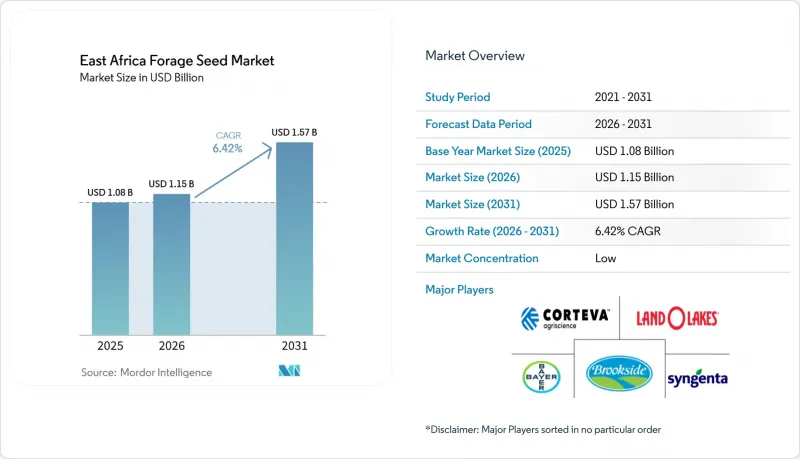
根據 Mordor Intelligence 預測,東非飼料種子市場規模將從 2025 年的 10.8 億美元成長到 2026 年的 11.5 億美元,到 2031 年將達到 15.7 億美元,2026 年至 2031 年的複合年預計成長率為 6.42%。
本報告按育種技術(雜交種、自交品種和雜交衍生品種)、飼料類型(苜蓿、飼用玉米、飼料高粱和其他飼料作物)和地區(肯亞、衣索比亞、坦尚尼亞、烏干達和東非其他地區)進行細分。市場預測以價值(美元)和數量(噸)表示。
東非飼料種子市場的趨勢與洞察
肯亞和衣索比亞普遍有乳牛飼料短缺問題
由於畜牧系統仍面臨嚴重的結構性飼料短缺,東非飼料種子市場持續成長。根據國際畜牧研究所(ILRI)(2024)預測,該地區每年的飼料需求量將達到3.53億噸(以乾物質計),而目前的供應量僅能滿足此需求的60%。在衣索比亞,每年種植飼料的缺口超過880萬噸(以乾物質計),飼料種子系統依然脆弱。約70%的種子仍透過非正規管道交易。這種缺口意味著飼料需求與實際營運需求而非隨意支出掛鉤,這為東非飼料種子市場奠定了堅實的基礎。這種短缺也提升了那些能夠在有限土地上產出更多生物量和更穩定飼料的品種的價值。
擴大抗氣候變遷飼料種子體系
氣候變遷正促使農民和種子供應商傾向於選擇能夠耐受缺水、土地利用壓力和不可預測的生長條件的品種。東非飼料種子市場正積極響應這一轉變,對改良型禾本科牧草和豆科牧草的興趣日益濃厚,這些品種適合間作,並且在田間脅迫下也能保持更穩定的產量。對烏干達和撒哈拉以南非洲地區改良飼料作物的研究表明,氣候適應型飼料作物,如果輔以適當的推廣和市場支持,能夠提高飼料供應的穩定性,並提升牲畜生產力。這意味著東非飼料種子市場的擴張不僅體現在種子銷售的成長,也體現在對能夠降低生產風險的品種和形式的逐步轉向。從長遠來看,這將有助於提高新品種的推廣一致性,並使供應商在當地加大生產和分銷投入的合理性得到體現。
改良飼料作物種子成本和種植成本高昂
種子成本高昂仍是阻礙快速推廣的最主要障礙之一。據報道,肯亞的烏羅卡羅種子價格為每公斤40至50美元,而南美供應市場的價格為每公斤15至30美元,這表明當地繁殖能力有限是東非飼料種子市場價格上漲的主要促進因素。農民的行為也反映了類似的壓力,梅魯縣農民購買改良飼料品種的意願仍然低於大多數產品的市場價格。肯亞的種子生產成本也大幅上漲,種子生產用地的土地成本從每英畝4,000肯亞先令(約26美元)漲到2025年3月播種季前的20,000肯亞先令(約130美元)。這種成本負擔是小規模農業系統推廣推廣的最大阻礙,儘管改良飼料作物具有顯著的農藝效益,但承擔最初的現金負擔仍然十分困難。
細分市場分析
到2025年,雜交種子將佔據東非飼料種子市場46%的佔有率,並繼續保持在該國市場中的最大佔有率。這一主導地位得益於其在商業玉米青貯系統中的廣泛應用,以及肯亞和衣索比亞主要種子供應商建立的成熟分銷網路。雜交種子還能滿足酪農和商業青貯業者對更高生物量產量、更強抗病性和更可預測的田間生長表現的需求。這些特性在東非飼料產業至關重要,因為飼料成本的評估不僅取決於種子價格,還取決於牲畜產量。因此,在那些優先考慮穩定產量而非種子重複利用的高價值酪農區,雜交品種繼續保持有利地位。
開放授粉品種及其雜交衍生品種是成長最快的細分市場,預計2026年至2031年間的複合年成長率將達到7.6%。這一成長歸功於其單位成本低、易於繁殖以及與小規模農業系統的高度親和性,而小型農業系統目前仍是該地區畜牧業的主導力量。根據國際農業研究諮詢組織(CGIAR)2024年的報告,烏羅克洛亞(Urochloa)和巨型大葉豆(Megathyrsus maximus)是肯亞交易最廣泛的改良飼料品種之一,預計未來十年將保持其重要地位。因此,東非飼料種子市場正沿著兩條軸線同步發展:雜交品種支撐著商業性銷售量,而開放授粉品種則不斷擴大其市場覆蓋範圍。這種平衡至關重要,因為東非飼料種子市場的廣泛應用既取決於高產品種,也取決於可透過當地繁殖系統分銷的價格適中的種子。
其他好處
- Excel格式的市場預測(ME)表
- 3個月的分析師支持
目錄
第1章:引言
- 研究假設和市場定義
- 調查範圍
- 調查方法
第2章:本報告的內容
第3章:執行摘要和主要發現
第4章 主要產業趨勢
- 面積
- 農作物
- 最受歡迎的功能
- 苜蓿
- 育種技術
- 田間作物
- 法律規範
- 價值鍊和通路分析
- 市場促進因素
- 肯亞和衣索比亞普遍有乳牛飼料短缺問題
- 擴大抗氣候變遷飼料種子體系
- 商業青貯飼料和飼料合約模式
- 公共機構和捐助者在市場早期發展階段的風險緩解措施
- 酪農和飼料廠認證飼料的優質化
- 高地飼料過剩的跨境貿易
- 市場限制因素
- 改良飼料作物種子成本和種植成本高昂
- 種子品質保證與品種登記制度之間的脫節
- 高成長潛力酪農走廊面臨土地和水資源限制。
- 旱季期間物流損失,冷藏和室內儲存設施短缺。
第5章 市場規模與成長預測
- 育種技術
- 混合
- 非基因改造雜交種
- 基因改造雜交種
- 抗除草劑雜交品種
- 其他特徵
- 開放授粉品種和雜交衍生品種
- 混合
- 作物類型
- 苜蓿
- 玉米用作動物飼料
- 高粱用作飼料
- 其他飼料作物
- 國家
- 肯亞
- 衣索比亞
- 坦尚尼亞
- 烏干達
- 東非其他地區國家
第6章 競爭情勢
- 關鍵策略趨勢
- 市佔率分析
- 企業狀況
- 公司簡介
- Advanta Seeds(UPL Ltd.)
- Bayer AG
- Land O'Lakes Inc.
- East African Seed Company Limited
- Groupe Limagrain
- Seed Co International Limited
- Brookside Dairy Limited(Brookside Holdings)
- Gatiko Company Ltd(Gatiko Company Ltd)
- Corteva Inc.
- Syngenta Limited
- Kenya Nut Company Limited
- New Kenya Co-operative Creameries Limited
- Balton CP Limited
- Shayashone PLC
第7章:執行長面臨的關鍵策略挑戰
According to Mordor Intelligence, the East Africa forage seed market size is projected to increase from USD 1.08 billion in 2025 to USD 1.15 billion in 2026 and reach USD 1.57 billion by 2031, growing at a CAGR of 6.42% over 2026-2031.
This report is Segmented by Breeding Technology (Hybrids and Open Pollinated Varieties and Hybrid Derivatives), by Crop Type (Alfalfa, Forage Corn, Forage Sorghum, and Other Forage Crops), and by Geography (Kenya, Ethiopia, Tanzania, Uganda, and the Rest of East Africa). The Market Forecasts are Provided in Terms of Value (USD) and Volume (Metric Tons).
East Africa Forage Seed Market Trends and Insights
Rising Dairy Feed Deficit in Kenya and Ethiopia
The East Africa forage seed market continues to grow because livestock systems still face a major structural feed shortage. According to the International Livestock Research Institute (ILRI) (2024), the regional annual feed demand reaches 353 million metric tons of dry matter, while current supply covers only 60% of this demand. In Ethiopia, cultivated forage deficit exceeds 8.8 million metric tons of dry matter each year, and the forage seed system remains weak, with nearly 70% of seeds still moving through informal channels. This gap keeps forage demand tied to a real operating need rather than discretionary spending, which gives the East Africa forage seed market a durable base. The same shortage also raises the value of varieties that can deliver more biomass and more stable feed output from limited land.
Expansion of Climate-Resilient Forage Seed Systems
Climate variability is pushing farmers and seed suppliers to favor varieties that can withstand moisture stress, land pressure, and less-predictable growing conditions. The East Africa forage seed market is responding through greater interest in improved grasses and legumes that fit mixed farming systems and can perform more reliably under field stress. Research on improved forages in Uganda and broader Sub-Saharan Africa also shows that feed security and livestock productivity improve when resilient forage options are matched with the right extension and market support. This means the East Africa forage seed market is expanding not only through more seed sales but also through a gradual shift toward species and formats that reduce production risk. Over time, that improves adoption consistency and helps suppliers justify local multiplication and distribution investments.
High Seed and Establishment Costs for Improved Forages
High seed cost remains one of the clearest barriers to faster adoption. In Kenya, Urochloa seed prices were reported at USD 40 to USD 50 per kg, compared with USD 15 to USD 30 per kg in South American supplier markets, which shows how limited local multiplication still raises costs in the East Africa forage seed market. The same pressure is visible in farmer behavior, since willingness to pay for improved forage varieties in Meru County remained below market prices for most products. Seed production costs also rose sharply in Kenya, with land cost for seed production plots moving from KES 4,000 (USD 26) to KES 20,000 (USD 130) per acre before the March 2025 planting season. This cost burden slows adoption most in smallholder systems, where the agronomic case for improved forage may be strong, but the upfront cash requirement remains difficult to absorb.
Other drivers and restraints analyzed in the detailed report include:
- Commercial Silage and Fodder Contracting Models
- Public and Donor De-Risking of Early Market Development
- Fragmented Seed Quality Assurance and Variety Registration
For complete list of drivers and restraints, kindly check the Table Of Contents.
Segment Analysis
Hybrids held the largest country segment, with a 46% share of the East Africa forage seed market in 2025. Their lead came from strong use in commercial maize silage systems and from the established distribution presence of large seed suppliers in Kenya and Ethiopia. Hybrids also meet the needs of dairy farms and commercial silage operators seeking higher biomass output, better disease tolerance, and more predictable field performance. In the East Africa forage industry, these traits matter because feed costs are judged against livestock output, not only seed price. That keeps hybrids well-positioned in higher-value dairy corridors, where consistent yield matters more than seed recycling.
Open Pollinated Varieties and Hybrid Derivatives are the fastest segment with a 7.6% CAGR from 2026 to 2031. Their growth is tied to lower unit cost, easier multiplication, and a better fit with smallholder systems that still dominate regional livestock production. In 2024, a Consultative Group on International Agricultural Research (CGIAR) publication found that Urochloa and Megathyrsus maximus are among the most widely traded improved forage varieties in Kenya and are projected to remain important over the next decade. The East Africa forage seed market is therefore developing along 2 lines at once, with hybrids anchoring commercial volume and open-pollinated options expanding reach. That balance matters because broad adoption in the East Africa forage seed market will depend on both premium yield segments and affordable seed formats that can move through local multiplication systems.
Complete Report Scope:
- Breeding Technology
- Hybrids
- Non-Transgenic Hybrids
- Transgenic Hybrids
- Herbicide Tolerant Hybrids
- Other Traits
- Open Pollinated Varieties and Hybrid Derivatives
- Hybrids
- Crop Type
- Alfalfa
- Forage Corn
- Forage Sorghum
- Other Forage Crops
- By Country
- Kenya
- Ethiopia
- Tanzania
- Uganda
- Rest of East Africa
List of Companies Covered in this Report:
- Advanta Seeds (UPL Ltd.)
- Bayer AG
- Land O'Lakes Inc.
- East African Seed Company Limited
- Groupe Limagrain
- Seed Co International Limited
- Brookside Dairy Limited (Brookside Holdings)
- Gatiko Company Ltd (Gatiko Company Ltd)
- Corteva Inc.
- Syngenta Limited
- Kenya Nut Company Limited
- New Kenya Co-operative Creameries Limited
- Balton CP Limited
- Shayashone PLC
Additional Benefits:
- The market estimate (ME) sheet in Excel format
- 3 months of analyst support
TABLE OF CONTENTS
1 INTRODUCTION
- 1.1 Study Assumptions and Market Definition
- 1.2 Scope of the Study
- 1.3 Research Methodology
2 REPORT OFFERS
3 EXECUTIVE SUMMARY AND KEY FINDINGS
4 KEY INDUSTRY TRENDS
- 4.1 Area Under Cultivation
- 4.1.1 Row Crops
- 4.2 Most Popular Traits
- 4.2.1 Alfalfa
- 4.3 Breeding Techniques
- 4.3.1 Row Crops
- 4.4 Regulatory Framework
- 4.5 Value Chain And Distribution Channel Analysis
- 4.6 Market Drivers
- 4.6.1 Rising dairy feed deficit in Kenya and Ethiopia
- 4.6.2 Expansion of climate-resilient forage seed systems
- 4.6.3 Commercial silage and fodder contracting models
- 4.6.4 Public and donor de-risking of early market development
- 4.6.5 Premiumization of certified forage for dairy and feed mills
- 4.6.6 Cross-border fodder trade from surplus highland zones
- 4.7 Market Restraints
- 4.7.1 High seed and establishment costs for improved forages
- 4.7.2 Fragmented seed quality assurance and variety registration
- 4.7.3 Land and water constraints in high-potential dairy corridors
- 4.7.4 Dry-season logistics losses and weak cold or covered storage
5 MARKET SIZE AND GROWTH FORECAST (VALUE AND VOLUME)
- 5.1 Breeding Technology
- 5.1.1 Hybrids
- 5.1.1.1 Non-Transgenic Hybrids
- 5.1.1.2 Transgenic Hybrids
- 5.1.1.2.1 Herbicide Tolerant Hybrids
- 5.1.1.3 Other Traits
- 5.1.2 Open Pollinated Varieties and Hybrid Derivatives
- 5.1.1 Hybrids
- 5.2 Crop Type
- 5.2.1 Alfalfa
- 5.2.2 Forage Corn
- 5.2.3 Forage Sorghum
- 5.2.4 Other Forage Crops
- 5.3 By Country
- 5.3.1 Kenya
- 5.3.2 Ethiopia
- 5.3.3 Tanzania
- 5.3.4 Uganda
- 5.3.5 Rest of East Africa
6 COMPETITIVE LANDSCAPE
- 6.1 Key Strategic Moves
- 6.2 Market Share Analysis
- 6.3 Company Landscape
- 6.4 Company Profiles (Includes Global Level Overview, Market Level Overview, Core Business Segments, Financials, Key Information, Market Rank, Market Share, Products and Services, and Analysis of Recent Developments).
- 6.4.1 Advanta Seeds (UPL Ltd.)
- 6.4.2 Bayer AG
- 6.4.3 Land O'Lakes Inc.
- 6.4.4 East African Seed Company Limited
- 6.4.5 Groupe Limagrain
- 6.4.6 Seed Co International Limited
- 6.4.7 Brookside Dairy Limited (Brookside Holdings)
- 6.4.8 Gatiko Company Ltd (Gatiko Company Ltd)
- 6.4.9 Corteva Inc.
- 6.4.10 Syngenta Limited
- 6.4.11 Kenya Nut Company Limited
- 6.4.12 New Kenya Co-operative Creameries Limited
- 6.4.13 Balton CP Limited
- 6.4.14 Shayashone PLC
7 KEY STRATEGIC QUESTIONS FOR CEOS

 印度飼料種子:市場佔有率分析、產業趨勢與統計、成長預測(2026-2031)
 飼料種子市場:2026-2032年全球市場預測(依產品類型、形態、牲畜類型、應用及通路分類)
 全球飼料種子市場預測至2032年:按類型、種子品種、形態、銷售管道、應用、最終用戶和地區分類
 飼料種子市場規模、佔有率和成長分析(按作物類型、農業、畜牧業、應用、最終用戶和地區分類)-2026-2033年產業預測
 牧草種子市場 - 全球產業規模、佔有率、趨勢、機會和預測,按類型、按牲畜、按產地、按形式、按地區和競爭進行細分,2020-2030 年
 歐洲牧草種子市場規模及預測 2021-2031、區域佔有率、趨勢及成長機會分析報告範圍:依品種及國家