


 |
市場調查報告書
商品編碼
2113597
印度飼料種子:市場佔有率分析、產業趨勢與統計、成長預測(2026-2031)India Forage Seed - Market Share Analysis, Industry Trends & Statistics, Growth Forecasts (2026 - 2031) |
||||||

※ 本網頁內容可能與最新版本有所差異。詳細情況請與我們聯繫。
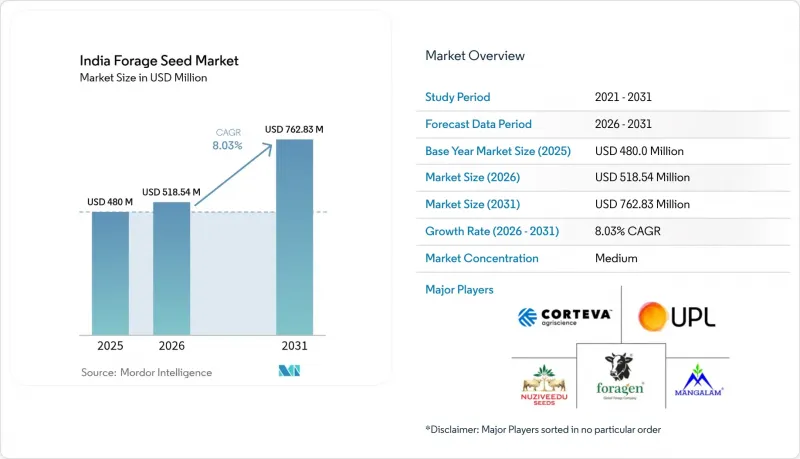
印度飼料種子市場預計將從 2025 年的 4.8 億美元成長到 2026 年的 5.1854 億美元,到 2031 年將達到 7.6283 億美元,2026 年至 2031 年的複合年成長率為 8.03%。
本報告依育種技術(雜交種、自交品種、雜交衍生品種)和作物(苜蓿、飼料玉米、飼料高粱和其他飼料作物)進行分類。市場預測以美元計價。
印度飼料種子市場的趨勢和洞察
牲畜數量增加
預計到2025年,印度牛的數量將達到3.075億頭,這主要得益於產犢率的提高以及永續動物健康計劃帶來的日乾物質攝入量的增加,從而擴大了印度飼料種子市場。每增加乳牛,每天大約需要15公斤乾物質,因此,能夠平衡能量和蛋白質需求的多種作物混合飼料(如高粱和豆類)的需求即時。僅北方邦就佔全國牛奶產量的16.21%,使其成為認證飼料種子需求中心。國家畜牧業發展計畫的品種改良津貼正在促進農場種植飼料作物,並進一步鞏固高品質種子的使用。國家畜牧業發展計劃對品種改良和飼料供應的重視,透過其認證飼料種子生產舉措,直接推動了這個市場擴張。
對乳製品和肉品的需求不斷成長
受收入成長和健康意識提高的推動,預計到2030年,人均牛奶消費量將達到每天550克。光是原奶的消費量預計到2025年就將達到9,100萬噸,迫使乳製品企業加強以高消化率飼料為主導的飼養方案。向乳酪和優格等加工乳製品的轉變對牛奶品質提出了更高的要求,而這又需要更優質的飼料營養。同時,隨著乳酪和優格生產線的擴張,加工用乳量也增加至1.255億噸,這促使人們採用富含豆類的青貯飼料混合物,以確保更高的乳脂肪含量。都市區肉類消費量的成長,尤其是肉雞需求的成長,也促使生產者採用新鮮飼料來提高胴體品質。這一趨勢要求系統性地提高飼料品質和供應,以支持糧食生產的永續。
與糧食作物爭奪面積
最低支持價格(MSP)的獎勵促使農民繼續專注於水稻和小麥種植,預計到2024年,這兩種作物的種植面積將佔耕地面積的60%以上,這將給飼料地帶來壓力。在旁遮普邦,夏季玉米青貯飼料的利潤率頗具吸引力,但地下水抽取量已超過其補給能力1066萬英畝英尺,威脅著長期永續性。乙醇摻混目標進一步加劇了競爭,因為甘蔗、米和玉米正轉移到燃料生產。由於產量下降,政府對糖和米實施出口限制,也影響土地分配決策。據估計,為所有作物提供最低支持價格(MSP)的成本高達23.8億美元(21000印度盧比),因此短期內擴大對飼料作物的支持力度可能資金有限。
細分市場分析
至2025年,雜交品種將佔印度飼料種子市場的68.40%。強大的雜交優勢可使生物量增加25-40%,為尋求最佳化飼料轉換率的專業酪農帶來決定性優勢。這種優異的性能確保了每年穩定的採購量,雜交品種市場正成為印度飼料種子市場中成長最快的細分市場。大部分需求集中在旁遮普邦、哈里亞納邦和古吉拉突邦,這些地區的灌溉條件使農民能夠多次收穫雜交像草和飼料玉米。拜耳和先正達等公司提供的除草劑套裝可簡化雜草管理,並可與種子配套使用,進一步鞏固了消費者對雜交品種的忠誠度。
剩餘市場由開放授粉品種及其雜交衍生品種組成,這些品種目前成長最快,預計到2031年將以10.35%的複合年成長率成長。對於雨水豐沛地區資源匱乏的農民來說,種子保存技術具有優勢,因為它允許全年使用並減少現金支出。印度農業研究理事會(ICAR)正在開發的品種價格實惠,開放授粉,蛋白質含量提高了1-2個百分點,有助於解決家庭菜園酪農中的營養不足問題。這些品種與社區種子庫相結合,正在擴大其在常規市場的滲透率,並平衡不同農民群體獲得技術的途徑。
其他好處:
- Excel格式的市場預測(ME)表
- 3個月的分析師支持
目錄
第1章:引言
- 研究假設和市場定義
- 調查範圍
第2章:調查方法
第3章執行摘要
第4章 市場狀況
- 市場促進因素
- 牲畜數量增加
- 對乳製品和肉品的需求不斷成長
- 飼料遺傳學進展
- 政府飼料安全措施
- 種子分銷網路的數位化
- 引進抗氣候變遷飼料品種
- 市場限制因素
- 與糧食作物爭奪種植面積
- 混合子投入成本高
- 種子運輸最後一公里低溫運輸鏈斷裂
- 小規模農戶種子更新率低。
- 監理情勢
- 技術展望
- 波特五力分析
第5章 市場規模與成長預測
- 透過育種技術
- 混合
- 非基因改造雜交種
- 基因改造雜交種
- 抗除草劑雜交品種
- 其他特徵
- 開放授粉品種和雜交衍生品種
- 混合
- 按作物
- 苜蓿
- 玉米用作動物飼料
- 高粱用作飼料
- 其他飼料作物
第6章 競爭情勢
- 市場集中度
- 策略趨勢
- 市佔率分析
- 公司簡介
- Advanta Seeds International(UPL Limited)
- Corteva Agriscience
- Bayer AG
- Nuziveedu Seeds Limited
- Mahyco Private Limited
- Mangalam Seeds Ltd
- Syngenta AG
- Bioseed Research India Pvt Ltd
- Kaveri Seed Company Ltd
- Foragen Seeds Pvt Ltd
- JK Agri Genetics Ltd
- Rasi Seed Pvt Ltd
- Proline Seeds Company Ltd
- Shriram Seeds Pvt Ltd
- Vibha Agrotech Ltd
第7章 市場機會與未來展望
According to Mordor Intelligence, the India forage seed market size is expected to grow from USD 480.0 million in 2025 to USD 518.54 million in 2026 and is forecast to reach USD 762.83 million by 2031 at 8.03% CAGR over 2026-2031.
This report is Segmented by Breeding Technology (Hybrids, Open-Pollinated Varieties, and Hybrid Derivatives) and by Crop (Alfalfa, Forage Corn, Forage Sorghum, and Other Forage Crops). The Market Forecasts are Provided in Terms of Value (USD).
India Forage Seed Market Trends and Insights
Growing Livestock Population
India's cattle herd climbs to 307.5 million head in 2025 as sustained animal health programs improve calving rates, lifting daily dry-matter requirements and enlarging the Indian forage seed market . Each additional dairy animal requires approximately 15 kg of dry matter daily, creating an immediate demand for multi-cut sorghum and legume mixes that balance energy and protein needs. Uttar Pradesh alone contributes 16.21% of national milk output, forming a concentrated demand hub for certified forage seed . Breed-improvement grants within the National Livestock Mission stimulate on-farm fodder plots, further embedding quality seed use. The National Livestock Mission's focus on breed development and feed availability directly supports this expansion through certified fodder seed production initiatives.
Rising Demand for Dairy and Meat Products
Per-capita milk intake is projected to reach 550 g per day by 2030, underpinned by income growth and health awareness. Fluid milk alone is forecast to reach 91 million metric tons in 2025, forcing dairies to intensify their feeding programs, which hinge on high-digestibility forages. The shift toward processed dairy products, including cheese and yogurt, requires higher milk quality standards that depend on superior forage nutrition. Meanwhile, factory-use milk climbs toward 125.5 million metric tons as cheese and yogurt lines expand, spurring uptake of legume-rich silage blends for superior butterfat levels. Urban meat consumption also rises, particularly broiler demand, encouraging growers to incorporate fresh forage to enhance carcass quality. This trajectory necessitates systematic improvements in forage quality and availability to support the sustainable productivity of grains.
Competition with Food Crops for Acreage
Minimum Support Price (MSP) incentives keep farmers centered on rice and wheat together, they captured more than 60% of field acreage in 2024, crowding out dedicated fodder plots. Summer maize for silage shows attractive margins in Punjab, yet groundwater extraction surpasses recharge by 10.66 MAF (Million Acre Feet), jeopardizing long-term viability. Ethanol blending targets create additional competition as sugarcane, rice, and maize are diverted for fuel production, with government restrictions on sugar and rice exports due to lower yields affecting land allocation decisions. The estimated cost of guaranteeing MSP (Minimum Support Price) across all crops at USD 2.38 billion (INR 21,000 crore ) suggests limited fiscal space for expanding support to forage crops in the near term.
Other drivers and restraints analyzed in the detailed report include:
- Advancements in Forage-Crop Genetics
- Government Fodder-Security Schemes
- Digitization of Seed Distribution Networks
- High Input Costs of Hybrid Seeds
For complete list of drivers and restraints, kindly check the Table Of Contents.
Segment Analysis
Hybrid varieties contributed 68.40% of the India forage seed market share in 2025. Robust heterosis yields an additional 25-40% biomass, providing a decisive edge for professional dairies optimizing feed conversion. Strong performance secures repeated annual purchases, ensuring the India forage seed market size for hybrids climbs at the fastest-growing segment. Most demand concentrates in Punjab, Haryana, and Gujarat, where irrigation lets farmers exploit multi-cut cycles for hybrid Napier and forage corn. Firms such as Bayer and Syngenta complement seed with herbicide packages that simplify weed management, embedding hybrid loyalty.
Open-pollinated varieties and hybrid derivatives captured the remainder and are now exhibiting the swiftest expansion at a 10.35% CAGR through 2031. Seed-saving potential resonates with resource-constrained farmers in rain-fed areas, extending utility across seasons and reducing cash expenditures. The Indian Council of Agricultural Research (ICAR) pipeline supplies affordable, open-pollinated lines with protein gains of 1-2 percentage points, helping to close nutrition gaps in backyard dairies. Coupled with community seed banks, these varieties expand formal market penetration and balance access to technology across farm segments.
Complete Report Scope:
- By Breeding Technology
- Hybrids
- Non-Transgenic Hybrids
- Transgenic Hybrids
- Herbicide-Tolerant Hybrids
- Other Traits
- Open-Pollinated Varieties and Hybrid Derivatives
- Hybrids
- By Crop
- Alfalfa
- Forage Corn
- Forage Sorghum
- Other Forage Crops
List of Companies Covered in this Report:
- Advanta Seeds International (UPL Limited)
- Corteva Agriscience
- Bayer AG
- Nuziveedu Seeds Limited
- Mahyco Private Limited
- Mangalam Seeds Ltd
- Syngenta AG
- Bioseed Research India Pvt Ltd
- Kaveri Seed Company Ltd
- Foragen Seeds Pvt Ltd
- JK Agri Genetics Ltd
- Rasi Seed Pvt Ltd
- Proline Seeds Company Ltd
- Shriram Seeds Pvt Ltd
- Vibha Agrotech Ltd
Additional Benefits:
- The market estimate (ME) sheet in Excel format
- 3 months of analyst support
TABLE OF CONTENTS
1 Introduction
- 1.1 Study Assumptions and Market Definition
- 1.2 Scope of the Study
2 Research Methodology
3 Executive Summary
4 Market Landscape
- 4.1 Market Drivers
- 4.1.1 Growing livestock population
- 4.1.2 Rising demand for dairy and meat products
- 4.1.3 Advancements in forage-crop genetics
- 4.1.4 Government fodder-security schemes
- 4.1.5 Digitization of seed distribution networks
- 4.1.6 Climate-resilient forage varieties uptake
- 4.2 Market Restraints
- 4.2.1 Competition with food crops for acreage
- 4.2.2 High input costs of hybrid seeds
- 4.2.3 Fragmented last-mile cold-chain for seeds
- 4.2.4 Low seed-replacement rate among smallholders
- 4.3 Regulatory Landscape
- 4.4 Technological Outlook
- 4.5 Porter's Five Forces Analysis
- 4.5.1 Bargaining Power of Suppliers
- 4.5.2 Bargaining Power of Buyers
- 4.5.3 Threat of New Entrants
- 4.5.4 Threat of Substitutes
- 4.5.5 Intensity of Competitive Rivalry
5 Market Size and Growth Forecasts (Value)
- 5.1 By Breeding Technology
- 5.1.1 Hybrids
- 5.1.1.1 Non-Transgenic Hybrids
- 5.1.1.2 Transgenic Hybrids
- 5.1.1.2.1 Herbicide-Tolerant Hybrids
- 5.1.1.2.2 Other Traits
- 5.1.2 Open-Pollinated Varieties and Hybrid Derivatives
- 5.1.1 Hybrids
- 5.2 By Crop
- 5.2.1 Alfalfa
- 5.2.2 Forage Corn
- 5.2.3 Forage Sorghum
- 5.2.4 Other Forage Crops
6 Competitive Landscape
- 6.1 Market Concentration
- 6.2 Strategic Moves
- 6.3 Market Share Analysis
- 6.4 Company Profiles (Includes Global Level Overview, Market Level Overview, Core Segments, Financials as Available, Strategic Information, Market Rank/Share for Key Companies, Products and Services, and Recent Developments)
- 6.4.1 Advanta Seeds International (UPL Limited)
- 6.4.2 Corteva Agriscience
- 6.4.3 Bayer AG
- 6.4.4 Nuziveedu Seeds Limited
- 6.4.5 Mahyco Private Limited
- 6.4.6 Mangalam Seeds Ltd
- 6.4.7 Syngenta AG
- 6.4.8 Bioseed Research India Pvt Ltd
- 6.4.9 Kaveri Seed Company Ltd
- 6.4.10 Foragen Seeds Pvt Ltd
- 6.4.11 JK Agri Genetics Ltd
- 6.4.12 Rasi Seed Pvt Ltd
- 6.4.13 Proline Seeds Company Ltd
- 6.4.14 Shriram Seeds Pvt Ltd
- 6.4.15 Vibha Agrotech Ltd
7 Market Opportunities and Future Outlook

 東非飼料種子:市場佔有率分析、產業趨勢與統計及成長預測(2026-2031 年)
 飼料種子市場:2026-2032年全球市場預測(依產品類型、形態、牲畜類型、應用及通路分類)
 全球飼料種子市場預測至2032年:按類型、種子品種、形態、銷售管道、應用、最終用戶和地區分類
 飼料種子市場規模、佔有率和成長分析(按作物類型、農業、畜牧業、應用、最終用戶和地區分類)-2026-2033年產業預測
 牧草種子市場 - 全球產業規模、佔有率、趨勢、機會和預測,按類型、按牲畜、按產地、按形式、按地區和競爭進行細分,2020-2030 年
 歐洲牧草種子市場規模及預測 2021-2031、區域佔有率、趨勢及成長機會分析報告範圍:依品種及國家