


 |
市場調查報告書
商品編碼
2117597
數位孿生模擬和情境建模中的生成式人工智慧:市場佔有率分析、產業趨勢和統計數據以及成長預測(2026-2031 年)Generative AI In Digital Twin Simulation and Scenario Modeling - Market Share Analysis, Industry Trends & Statistics, Growth Forecasts (2026 - 2031) |
||||||

※ 本網頁內容可能與最新版本有所差異。詳細情況請與我們聯繫。
據 Mordor Intelligence 稱,用於數位孿生模擬和場景建模的生成式人工智慧市場預計將從 2025 年的 62.3 億美元成長到 2026 年的 98 億美元,到 2031 年達到 324.5 億美元,2026 年至 2031 年的複合年成長率為 27.06%。
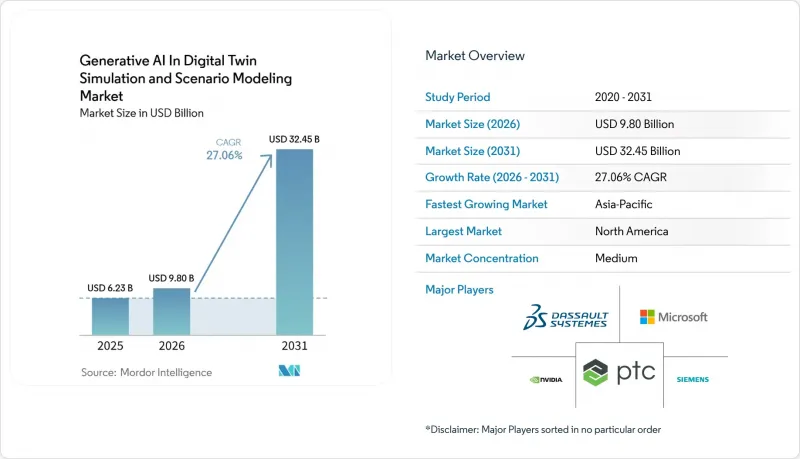
本報告按元件(軟體和服務)、部署模式(雲端、本地部署及其他)、企業規模(中小企業和大型企業)、應用程式(預測性維護、最佳化及其他)、最終用戶(製造業、汽車業及其他)和地區進行細分。市場預測以美元計價。
數位孿生模擬和場景建模中生成式人工智慧的全球市場趨勢和洞察
企業在工業平台上快速採用生成式人工智慧功能
隨著工業軟體供應商將生成模型添加到企業已大規模使用的模擬環境中,數位孿生模擬和場景建模領域的生成式人工智慧市場正在迅速擴張。這種轉變縮短了檢驗設計方案和運行場景所需的時間,使模擬不僅對專業工程師有用,而且對更廣泛的團隊也同樣適用。 2026年1月,西門子宣布,數位孿生Composer幫助百事公司在初始部署階段將設計檢驗率提高到接近100%,吞吐量提高了20%,資本支出降低了10-15%。這種轉變提升了專有運行資料的價值,因為人工智慧生成場景的品質取決於用於訓練和更新模型的資料的深度和相關性。因此,能夠將實體模型、工業數據和高效能運算整合到單一解決方案中的供應商,正日益關注數位孿生模擬和場景建模領域的生成式人工智慧市場。
對可擴展的、基於場景的決策和風險模擬工具的需求日益成長。
數位孿生模擬和情境建模領域的生成式人工智慧市場也受益於評估供應鏈中斷、維護風險、能源成本波動和生產權衡等問題的需求,這些問題比靜態模擬工具所能應對的更為頻繁。如今,企業尋求的數位孿生模型不僅要反映現狀,還要產生可與業務目標進行比較的合理運作場景。 2025年4月,空中巴士宣布其數位孿生環境將供超過5萬名工程師使用,以協助預測磨損、最佳化維修計畫並減少飛機整個生命週期內的意外停機時間。同樣在2025年4月,達梭系統和空中巴士擴大了戰略夥伴關係,將3DEXPERIENCE平台部署到未來民用和軍用飛機及直升機項目的2萬多名用戶。這使得生成式人工智慧在數位孿生模擬和場景建模市場中的作用從工程團隊擴展到更廣泛的規劃、風險管理和營運決策職能。
模型檢驗成本高和技術精度障礙。
在數位孿生模擬和場景建模領域,生成式人工智慧市場仍面臨許多挑戰,例如如何證明人工智慧生成的模型能夠在各種條件下準確反映物理現實。高品質的檢驗需要感測器數據、物理檢驗、迭代測試以及與實際運行行為的對比,即便模型生成速度加快,成本和時間仍然居高不下。 2025年發表於《智慧製造雜誌》(Journal of Intelligent Manufacturing)的一項同行評審研究表明,即使生成式人工智慧加速了數位孿生設計週期,檢驗仍然是企業級應用的主要瓶頸。這帶來了一個艱難的權衡:跳過檢驗環節的公司將面臨營運和法律責任風險,而進行全面驗證的公司則可能難以證明大規模部署的投資報酬率(ROI)。因此,在用於數位孿生模擬和場景建模的生成式人工智慧市場中,能夠更有效率地自動化檢驗流程並以更可靠的證據支持受監管用例的供應商更具優勢。
細分市場分析
到2025年,軟體將佔據數位孿生模擬和場景建模領域生成式人工智慧市場佔有率的65.43%。這反映了模擬引擎、人工智慧編配層和生命週期資料管理工具在企業部署中的核心角色。軟體仍然是收入的重要支柱,因為客戶通常從核心平台開始部署,然後擴展到更高價值的場景庫、模型管理和工作流程整合。隨著越來越多的資產、生產線和設計歷史遷移到同一環境,底層平台的替換難度越來越大,其效用也隨之提升。儘管價值組成有所變化,但這一趨勢確保了軟體在整個數位孿生模擬和場景建模生成式人工智慧市場中保持主導地位。
預計到2031年,服務業務將以27.62%的複合年成長率成長,這表明買家對微調、持續模型運行和系統級整合的支援需求正在迅速成長。這項轉變意義重大,因為競爭優勢正從一次性部署轉向在運作環境中持續改善模型。 PTC於2026年6月發表了PTC Orbit,進一步強化了這個發展方向。 PTC Orbit是一款雲端原生資產智慧解決方案,整合了PLM、ERP、CRM、IoT、EAM和FSM系統,並將它們連接到由人工智慧驅動的統一資產記錄。此類產品的發布表明,數位孿生模擬和場景建模中的生成式人工智慧正在擴大經常性業務收益的潛力,因為客戶不僅需要在初始部署期間獲得支持,而且在後續部署期間也需要支援。
到2025年,雲端將佔據62.45%的市場佔有率,這反映出企業對可擴展GPU存取、更低的預付成本以及與AI模型執行環境更便捷整合的偏好。雲端模型尤其適用於生成式仿真,因為在生成式仿真中,團隊需要大量處理大量場景、比較設計方案並並行測試多種運行條件,因此雲端模型的使用量通常會激增。此外,雲端模型也減少了企業建置和維護自身高階模擬基礎設施的需求。這些成本和存取優勢意味著,隨著雲端技術在各行業的應用不斷擴展,它仍然是數位孿生模擬和場景建模中生成式AI的核心。
混合部署模式是成長最快的部署模式,預計在2026年至2031年間將以27.92%的複合年成長率成長。這是因為許多用戶需要在靠近其物理資產的位置進行即時推理,同時仍依賴雲端進行大規模模型訓練和渲染。 2026年1月,西門子和英偉達擴大了合作,共同建構“工業人工智慧作業系統”,該系統將GPU加速與跨工業環境的模擬和推理結合。當企業面臨延遲限制、資料居住規則或現場級控制要求時,此模式尤其有效。因此,儘管雲端仍將是生成式人工智慧市場中用於數位孿生模擬和場景建模的最大部署模式,但混合架構有望成為更複雜工業營運的首選架構。
區域分析
到2025年,北美將佔據數位孿生模擬和場景建模領域生成式人工智慧市場36.78%的佔有率,成為最大的區域市場。該地區受益於先進的企業軟體應用、強大的GPU和雲端基礎設施,以及工業軟體供應商與大型企業用戶之間的緊密合作。美國在該領域仍處於核心地位,這得益於西門子、英偉達、PTC和其他平台生態系統的積極發展。 2026年1月,西門子和英偉達宣布,百事可樂等客戶已經開始使用與「工業人工智慧作業系統」方向相關的整合功能。這反映出與生產相關的用例正在迅速轉化為實際部署。
預計到2031年,亞太地區將以28.34%的複合年成長率成長,成為生成式人工智慧(AI)數位孿生模擬和場景建模市場中成長最快的區域市場。中國、日本、韓國和印度是這成長軸心的核心,每個國家在製造業、工程人才和技術服務方面都擁有獨特的優勢。中國正在推動其主要製造業的數位轉型,而日本則利用先進的模擬和自動化技術來彌補勞動力短缺並保持出口競爭力。韓國在半導體和造船行業擁有強大的應用案例,這些行業對工藝品質和場景測試的要求非常高。印度正崛起為生成式人工智慧(AI)數位孿生模擬和場景建模的關鍵服務中心,其IT服務生態系統能夠為全球客戶提供託管式模擬服務。
到2025年,歐洲仍將佔據相當大的市場佔有率,其中德國、法國、英國、義大利和西班牙主導這一趨勢。在這些國家,精密製造和流程工業持續推動對先進模擬環境的需求。此外,在該地區,部署模式的選擇正受到GDPR(一般資料保護規則)和歐盟人工智慧法合規性要求的影響,使得混合雲端和主權雲模式比其他市場更為重要。 2025年11月,施耐德電機、AVEVA和ETAP加入了OpenUSD聯盟,這清楚地表明了歐洲工業軟體基礎設施在互通性標準方面取得突破性進展的決心。雖然南美洲的採用仍處於早期階段,但巴西的石油天然氣和農業機械製造業的需求趨勢最為明顯。儘管在中東和非洲的滲透率仍然很低,但沙烏地阿拉伯、阿拉伯聯合大公國、土耳其、南非和埃及正在透過基礎設施、能源和工業現代化計劃來培育長期需求,生成式人工智慧在數位孿生模擬和情境建模中的重要性在這些地區仍然存在,儘管規模較小。
其他好處
- Excel格式的市場預測(ME)表
- 3個月的分析師支持
目錄
第1章:引言
- 研究假設和市場定義
- 調查範圍
第2章:調查方法
第3章執行摘要
第4章 市場狀況
- 市場概覽
- 市場促進因素
- 企業快速採用人工智慧驅動的模擬工作流程
- 對複雜系統進行場景測試的需求日益成長。
- 雲端原生數位孿生平台降低了採用門檻。
- 需要加快有關產品、流程和資產的決策週期。
- 來自物聯網、產品生命週期管理 (PLM) 和營運系統的數位孿生資料輸出
- 自動駕駛和封閉回路型最佳化的進展
- 市場限制因素
- 在對安全至關重要的應用案例中,模型檢驗的負擔。
- 資料架構分段且互通性差
- 高精度生成式模擬中計算成本增加
- 圍繞可追溯性、智慧財產權和人工智慧課責的管治挑戰
- 價值鏈分析
- 監理情勢
- 技術展望
- 波特五力分析
第5章 市場規模與成長預測
- 按組件
- 軟體
- 服務
- 部署模式
- 雲
- 現場
- 混合
- 按公司規模
- 小型企業
- 大公司
- 透過使用
- 預測性保護
- 設計與仿真
- 情境/“假設”建模
- 最佳化
- 最終用戶
- 製造業
- 車
- 航太/國防
- 能源與公共產業
- 醫療保健和生命科學
- 通訊/IT
- 智慧城市和基礎設施
- 零售與電子商務
- 其他
- 按地區
- 北美洲
- 美國
- 加拿大
- 墨西哥
- 南美洲
- 巴西
- 阿根廷
- 其他南美國家
- 歐洲
- 德國
- 英國
- 法國
- 義大利
- 西班牙
- 俄羅斯
- 其他歐洲國家
- 亞太地區
- 中國
- 日本
- 印度
- 韓國
- 澳洲
- 其他亞太國家
- 中東
- 沙烏地阿拉伯
- 阿拉伯聯合大公國
- 土耳其
- 其他中東國家
- 非洲
- 南非
- 埃及
- 其他非洲地區
- 北美洲
第6章 競爭情勢
- 市場集中度
- Strategic Initiatives and Partnerships
- 市佔率分析
- 公司簡介
- Siemens AG
- NVIDIA Corporation
- Microsoft Corporation
- PTC Inc.
- Dassault Systemes SE
- ANSYS, Inc.
- IBM Corporation
- SAP SE
- Autodesk, Inc.
- Amazon Web Services, Inc.
- Rockwell Automation, Inc.
- Schneider Electric SE
- Bentley Systems, Incorporated
- Hexagon AB
- General Electric Company
- Oracle Corporation
- Honeywell International Inc.
- Emerson Electric Co.
- Altair Engineering Inc.
- AVEVA Group Limited
第7章 市場機會與未來展望
According to Mordor Intelligence, the generative AI in digital twin simulation and scenario modeling market size is expected to increase from USD 6.23 billion in 2025 to USD 9.80 billion in 2026 and reach USD 32.45 billion by 2031, growing at a CAGR of 27.06% over 2026-2031.
This report is Segmented by Component (Software, and Services), Deployment Mode (Cloud, On-Premises, and More), Enterprise Size (Large Enterprises, and Small and Medium Enterprises), Application (Predictive Maintenance, Optimization, and More), End User (Manufacturing, Automotive, and More), and Geography. The Market Forecasts are Provided in Terms of Value (USD).
Global Generative AI In Digital Twin Simulation and Scenario Modeling Market Trends and Insights
Rapid Enterprise Adoption of Generative AI Capabilities Across Industrial Platforms
The generative AI in digital twin simulation and scenario modeling market is moving faster because industrial software vendors are adding generative models to simulation environments that enterprises already use at scale. This change reduces the time needed to test design options and operating scenarios, making simulation useful to a wider group of teams beyond specialist engineers. Siemens stated in January 2026 that Digital Twin Composer helped PepsiCo reach near-100% design validation, improve throughput by 20%, and reduce capital expenditure by 10-15% in early deployments. That shift makes proprietary operating data more valuable because the quality of AI-generated scenarios depends on the depth and relevance of the data that trains and updates the models. As a result, the generative AI in digital twin simulation and scenario modeling market is rewarding vendors that can combine physics models, industrial data, and high-performance computing into a single offering.
Rising Demand for Scalable, Scenario-Based Decision-Making and Risk Simulation Tools
The generative AI in digital twin simulation and scenario modeling market is also benefiting from the need to evaluate supply chain disruptions, maintenance risks, energy cost swings, and production tradeoffs far more often than static simulation tools can support. Companies now want digital twins that do not just reflect current conditions, but also generate plausible operating paths and compare them against business objectives. Airbus stated in April 2025 that its digital twin environment is used by more than 50,000 engineers to predict wear, optimize maintenance schedules, and reduce unplanned downtime across the aircraft lifecycle. Dassault Systemes and Airbus also extended their strategic partnership in April 2025 to deploy the 3DEXPERIENCE platform across more than 20,000 users for future civil and military aircraft and helicopter programs. This is widening the role of the generative AI in digital twin simulation and scenario modeling market beyond engineering teams and into broader planning, risk, and operational decision functions.
High Model Validation Costs and Technical Accuracy Barriers
The generative AI in digital twin simulation and scenario modeling market still faces a major barrier in proving that AI-generated models reflect physical reality across a wide range of conditions. High-quality validation requires sensor data, physics checks, repeated testing, and review against real operating behavior, which keeps cost and time high even when model generation becomes faster. A 2025 peer-reviewed study in the Journal of Intelligent Manufacturing found that validation remained the main bottleneck to broader enterprise adoption even when generative AI accelerated digital twin design cycles. This creates a difficult trade-off: firms that skip validation face operational and liability risks, while firms that perform full checks can struggle to justify the return on investment at scale. Because of that, the generative AI in digital twin simulation and scenario modeling market favors vendors that can automate more of the checking process and support regulated use cases with stronger evidence.
Other drivers and restraints analyzed in the detailed report include:
- Cloud-Native Digital Transformation and Platform-as-a-Service Deployment Models
- Need for Accelerated Product Development and Compressed Time-to-Market
- Fragmented Data Architecture and Cross-System Integration Gaps
For complete list of drivers and restraints, kindly check the Table Of Contents.
Segment Analysis
Software held 65.43% of the generative AI in digital twin simulation and scenario modeling market share in 2025, which reflected the central role of simulation engines, AI orchestration layers, and lifecycle data management tools in enterprise deployments. Software remains the revenue anchor because customers usually start with the core platform before expanding into higher-value scenario libraries, model management, and workflow integration. As more assets, production lines, and design histories move into the same environment, the underlying platform becomes harder to replace and more useful over time. This dynamic keeps software in a leading position across the generative AI in digital twin simulation and scenario modeling market, even as the mix of value is changing.
Services are projected to grow at a 27.62% CAGR through 2031, which shows how quickly buyers are asking for help with fine-tuning, ongoing model operations, and system-level integration. The shift is important because competitive advantage is moving away from one-time deployment work toward continuous model improvement in live operating settings. PTC reinforced that direction in June 2026 with PTC Orbit, a cloud-native asset intelligence solution that connected PLM, ERP, CRM, IoT, EAM, and FSM systems into a unified AI-powered asset record. That kind of release shows why the generative AI in digital twin simulation and scenario modeling market is creating more room for recurring service revenue, because customers need support after deployment, not just during initial installation.
Cloud accounted for a 62.45% share in 2025, reflecting enterprise preference for scalable GPU access, lower upfront costs, and easier links to AI model-serving environments. The cloud model fits well with generative simulation because usage often occurs in bursts when teams run large batches of scenarios, compare design alternatives, or test multiple operating conditions in parallel. It also reduces the need for organizations to build and maintain their own high-end simulation infrastructure. That cost and access advantage keeps cloud at the center of the generative AI in digital twin simulation and scenario modeling market as adoption widens across industries.
Hybrid is the fastest-growing deployment mode, with a 27.92% CAGR for 2026-2031, because many users need real-time inference near physical assets while still relying on the cloud for large-scale model training and rendering. Siemens and NVIDIA expanded their partnership in January 2026 to build an Industrial AI Operating System that combined GPU acceleration with simulation and inference across industrial environments. This model is especially relevant when firms face latency constraints, data residency rules, or site-level control requirements. For that reason, the generative AI in digital twin simulation and scenario modeling market is likely to keep cloud as the largest mode while hybrid becomes the preferred architecture for more complex industrial operations.
Complete Report Scope:
- By Component
- Software
- Services
- By Deployment Mode
- Cloud
- On-Premises
- Hybrid
- By Enterprise Size
- Small and Medium Enterprises
- Large Enterprises
- By Application
- Predictive Maintenance
- Design and Simulation
- Scenario/"What-If" Modeling
- Optimization
- By End User
- Manufacturing
- Automotive
- Aerospace and Defense
- Energy and Utilities
- Healthcare and Life Sciences
- Telecommunications and IT
- Smart Cities and Infrastructure
- Retail and E-Commerce
- Other End Users
- By Geography
- North America
- United States
- Canada
- Mexico
- South America
- Brazil
- Argentina
- Rest of South America
- Europe
- Germany
- United Kingdom
- France
- Italy
- Spain
- Russia
- Rest of Europe
- Asia-Pacific
- China
- Japan
- India
- South Korea
- Australia
- Rest of Asia-Pacific
- Middle East
- Saudi Arabia
- United Arab Emirates
- Turkey
- Rest of Middle East
- Africa
- South Africa
- Egypt
- Rest of Africa
- North America
Geography Analysis
North America held 36.78% of the generative AI in digital twin simulation and scenario modeling in 2025, making it the largest regional contributor. The region benefits from strong enterprise software adoption, deep access to GPU and cloud infrastructure, and close ties between industrial software vendors and large corporate users. The United States remains the center of this position, supported by active development work around Siemens, NVIDIA, PTC, and other platform ecosystems. Siemens and NVIDIA stated in January 2026 that customers such as PepsiCo were already using combined capabilities tied to the Industrial AI Operating System direction, which reflects how quickly production-linked use cases are moving into real deployments.
Asia-Pacific is projected to expand at a 28.34% CAGR through 2031, which makes it the fastest-growing regional segment in the generative AI in digital twin simulation and scenario modeling market. China, Japan, South Korea, and India form the core of this growth corridor, each with different strengths in manufacturing, engineering talent, or technology services. China is pushing industrial digitalization across major manufacturing sectors, while Japan is using advanced simulation and automation to offset labor constraints and protect export competitiveness. South Korea brings strong use cases in semiconductors and shipbuilding, where process quality and scenario testing carry high value. India is emerging as an important services-layer base for the generative AI in digital twin simulation and scenario modeling market, because its IT services ecosystem can support managed simulation delivery for global clients.
Europe held a significant share in 2025, led by Germany, France, the United Kingdom, Italy, and Spain, where precision manufacturing and process industries continue to support demand for advanced simulation environments. The region is also shaping deployment choices through GDPR and EU AI Act compliance needs, which makes hybrid and sovereign cloud models more relevant than in some other markets. Schneider Electric, AVEVA, and ETAP joined the Alliance for OpenUSD in November 2025, which signaled a clear push toward interoperability standards across the European industrial software base. South America remains earlier in adoption, with Brazil showing the clearest demand path through oil and gas and agricultural equipment manufacturing. The Middle East and Africa are still less penetrated, but Saudi Arabia, the UAE, Turkey, South Africa, and Egypt are building longer-term demand through infrastructure, energy, and industrial modernization programs, which keeps the generative AI in digital twin simulation and scenario modeling market relevant in these regions even from a smaller base.
- Siemens AG
- NVIDIA Corporation
- Microsoft Corporation
- PTC Inc.
- Dassault Systemes SE
- ANSYS, Inc.
- IBM Corporation
- SAP SE
- Autodesk, Inc.
- Amazon Web Services, Inc.
- Rockwell Automation, Inc.
- Schneider Electric SE
- Bentley Systems, Incorporated
- Hexagon AB
- General Electric Company
- Oracle Corporation
- Honeywell International Inc.
- Emerson Electric Co.
- Altair Engineering Inc.
- AVEVA Group Limited
Additional Benefits:
- The market estimate (ME) sheet in Excel format
- 3 months of analyst support
TABLE OF CONTENTS
1 INTRODUCTION
- 1.1 Study Assumptions and Market Definition
- 1.2 Scope of the Study
2 RESEARCH METHODOLOGY
3 EXECUTIVE SUMMARY
4 MARKET LANDSCAPE
- 4.1 Market Overview
- 4.2 Market Drivers
- 4.2.1 Rapid Enterprise Adoption of AI-Enhanced Simulation Workflows
- 4.2.2 Rising Demand for Scenario Testing Across Complex Systems
- 4.2.3 Cloud-Native Digital Twin Platforms Lowering Deployment Friction
- 4.2.4 Need for Faster Product, Process, and Asset Decision Cycles
- 4.2.5 Twin Data Exhaust from IoT, PLM, and Operational Systems
- 4.2.6 Growth in Autonomous Operations and Closed-Loop Optimization
- 4.3 Market Restraints
- 4.3.1 High Model Validation Burden for Safety-Critical Use Cases
- 4.3.2 Fragmented Data Architecture and Poor Interoperability
- 4.3.3 Rising Compute Cost for High-Fidelity Generative Simulation
- 4.3.4 Governance Gaps Around Traceability, IP, and AI Accountability
- 4.4 Value Chain Analysis
- 4.5 Regulatory Landscape
- 4.6 Technological Outlook
- 4.7 Porter's Five Forces Analysis
- 4.7.1 Bargaining Power of Suppliers
- 4.7.2 Bargaining Power of Buyers
- 4.7.3 Threat of New Entrants
- 4.7.4 Threat of Substitutes
- 4.7.5 Industry Rivalry
5 MARKET SIZE AND GROWTH FORECASTS (VALUE)
- 5.1 By Component
- 5.1.1 Software
- 5.1.2 Services
- 5.2 By Deployment Mode
- 5.2.1 Cloud
- 5.2.2 On-Premises
- 5.2.3 Hybrid
- 5.3 By Enterprise Size
- 5.3.1 Small and Medium Enterprises
- 5.3.2 Large Enterprises
- 5.4 By Application
- 5.4.1 Predictive Maintenance
- 5.4.2 Design and Simulation
- 5.4.3 Scenario/"What-If" Modeling
- 5.4.4 Optimization
- 5.5 By End User
- 5.5.1 Manufacturing
- 5.5.2 Automotive
- 5.5.3 Aerospace and Defense
- 5.5.4 Energy and Utilities
- 5.5.5 Healthcare and Life Sciences
- 5.5.6 Telecommunications and IT
- 5.5.7 Smart Cities and Infrastructure
- 5.5.8 Retail and E-Commerce
- 5.5.9 Other End Users
- 5.6 By Geography
- 5.6.1 North America
- 5.6.1.1 United States
- 5.6.1.2 Canada
- 5.6.1.3 Mexico
- 5.6.2 South America
- 5.6.2.1 Brazil
- 5.6.2.2 Argentina
- 5.6.2.3 Rest of South America
- 5.6.3 Europe
- 5.6.3.1 Germany
- 5.6.3.2 United Kingdom
- 5.6.3.3 France
- 5.6.3.4 Italy
- 5.6.3.5 Spain
- 5.6.3.6 Russia
- 5.6.3.7 Rest of Europe
- 5.6.4 Asia-Pacific
- 5.6.4.1 China
- 5.6.4.2 Japan
- 5.6.4.3 India
- 5.6.4.4 South Korea
- 5.6.4.5 Australia
- 5.6.4.6 Rest of Asia-Pacific
- 5.6.5 Middle East
- 5.6.5.1 Saudi Arabia
- 5.6.5.2 United Arab Emirates
- 5.6.5.3 Turkey
- 5.6.5.4 Rest of Middle East
- 5.6.6 Africa
- 5.6.6.1 South Africa
- 5.6.6.2 Egypt
- 5.6.6.3 Rest of Africa
- 5.6.1 North America
6 COMPETITIVE LANDSCAPE
- 6.1 Market Concentration
- 6.2 Strategic Initiatives and Partnerships
- 6.3 Market Share Analysis
- 6.4 Company Profiles (includes Global Level Overview, Market Level Overview, Core Segments, Financials as available, Strategic Information, Market Rank/Share, Products and Services, Recent Developments)
- 6.4.1 Siemens AG
- 6.4.2 NVIDIA Corporation
- 6.4.3 Microsoft Corporation
- 6.4.4 PTC Inc.
- 6.4.5 Dassault Systemes SE
- 6.4.6 ANSYS, Inc.
- 6.4.7 IBM Corporation
- 6.4.8 SAP SE
- 6.4.9 Autodesk, Inc.
- 6.4.10 Amazon Web Services, Inc.
- 6.4.11 Rockwell Automation, Inc.
- 6.4.12 Schneider Electric SE
- 6.4.13 Bentley Systems, Incorporated
- 6.4.14 Hexagon AB
- 6.4.15 General Electric Company
- 6.4.16 Oracle Corporation
- 6.4.17 Honeywell International Inc.
- 6.4.18 Emerson Electric Co.
- 6.4.19 Altair Engineering Inc.
- 6.4.20 AVEVA Group Limited
7 MARKET OPPORTUNITIES AND FUTURE OUTLOOK
- 7.1 White-Space and Unmet-Need Assessment

 2034年交通運輸業數位孿生市場預測-全球分析(依孿生範圍、實體資產、生命週期階段、同步等級、最終用戶及地區分類)
 全球數位孿生市場規模、佔有率、趨勢和成長分析報告(2026-2034)
 數位孿生市場:按應用程式、最終用戶產業和地區分類2034年能源產業數位孿生市場預測-全球分析(按孿生類型、組件、部署模式、能源基礎設施、技術、企業規模、數位孿生生命週期階段、應用、最終用戶和地區分類)面向智慧製造的數位孿生市場預測(至2034年)—按組件、數位孿生類型、技術、應用、最終用戶和地區分類的全球分析
 數位孿生(DT):市場佔有率分析、產業趨勢與統計資料、成長預測(2026-2031 年)2026-2034年全球航太航太數位訊號處理器市場規模、佔有率、趨勢與成長分析報告工業數位孿生解決方案市場:預測至 2034 年 - 按組件、孿生類型、部署模式、應用、最終用戶和地區分類的全球分析數位孿生市場預測至2034年—按組件、部署模式、應用、最終用戶和地區分類的全球分析數位孿生平台市場:預測至 2034 年 - 按平台類型、部署模式、組件、技術、應用、最終用戶和地區分類的全球分析