


 |
市場調查報告書
商品編碼
2117558
聯盟行銷軟體:市場佔有率分析、產業趨勢與統計、成長預測(2026-2031)Affiliate Marketing Software Market - Market Share Analysis, Industry Trends & Statistics, Growth Forecasts (2026 - 2031) |
||||||

※ 本網頁內容可能與最新版本有所差異。詳細情況請與我們聯繫。
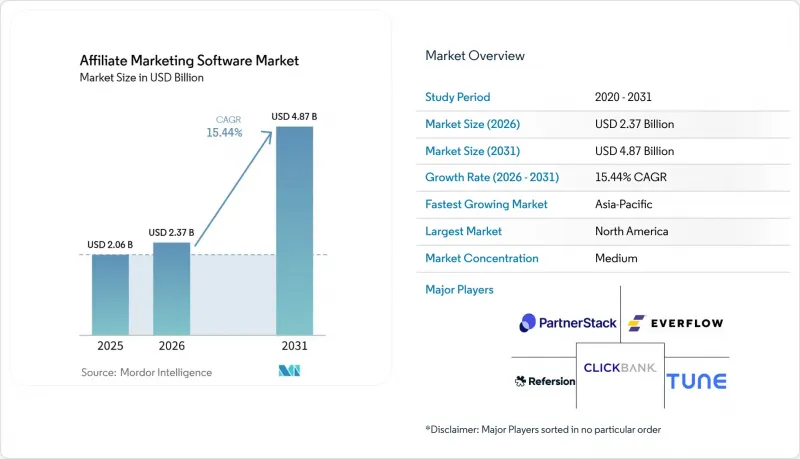
根據 Mordor Intelligence 預測,聯盟行銷軟體市場將從 2025 年的 20.6 億美元成長到 2026 年的 23.7 億美元,然後在 2031 年達到 48.7 億美元,2026 年至 2031 年的複合年成長率為 15.44%。
本報告按部署類型(雲端、本地部署、混合部署)、企業規模(大型企業、中小企業)、應用領域(聯盟行銷計畫管理、績效追蹤和歸因分析等)、最終用戶產業(資訊科技和電信等)以及地區進行細分。市場預測以美元計價。
全球聯盟行銷軟體市場趨勢與洞察
擴大電商領域內容創作者和影響者的招募。
在聯盟行銷軟體市場,創作者主導的商業模式正從小規模宣傳活動轉變為許多品牌的永久性客戶獲取管道。根據IAB於2026年4月發布的數據,創作者廣告支出預計將在2025年達到370億美元,並在2026年達到440億美元。這一趨勢導致聯盟計劃需要容納的合作夥伴數量和類型不斷增加。企業經常需要追蹤創作者、折扣發布者、品牌大使、推薦合作夥伴以及其他合作夥伴,而每個合作夥伴的薪酬結構都不盡相同。因此,在聯盟行銷軟體市場,一個能夠在同一計劃中管理固定薪酬和績效薪酬的平台具有顯著優勢。在2026年6月的iPX大會上,impact.com宣布推出創作者店鋪功能和自主招募工具,展現了其致力於將發現、入駐和效果衡量整合到一個統一平台的決心。
對人工智慧驅動的詐欺檢測和歸因準確性的需求
聯盟行銷軟體市場的大規模聯盟計畫需要強大的控制措施,以防止無效流量、點擊垃圾和歸因劫持等可能扭曲佣金計算的行為。這種需求使得詐欺偵測和歸因透明度在企業平台選擇中日益重要。聯盟行銷軟體市場開始出現一些工具,這些工具能夠在佣金批准前評估合作夥伴的行為並識別可疑活動。 2026年6月18日,Everflow正式發布了其AI Shield產品,將行為分析定位為基於規則閾值的替代方案。 Partnerize發布的《2026年零點擊商務指數》發現,透過人工智慧驅動的發現方式,發行商對購買行為的可衡量影響是傳統末次點擊追蹤的3.84倍。這些趨勢凸顯了能夠檢驗整個更長客戶旅程影響的平台日益成長的價值,而不僅僅是將其歸因於最後一點點擊。
聯盟詐騙和無效流量洩露
如果管理員無法解釋流量品質或佣金計算依據,詐騙活動可能會損害人們對聯盟行銷軟體市場的信心。這是一個營運問題,因為不準確的數據會導致支付糾紛和決策延誤。如果財務部門質疑專案的管理結構是否合理,也會減緩平台的擴張速度。因此,聯盟行銷軟體市場需要持續監控,而不是一次性的詐欺調查。針對諸如 cookie人員編制、點擊垃圾郵件和歸因劫持等詐欺手段,需要不斷更新偵測模型。 Everflow 2026 年的產品版本體現了其在專案和網路層面識別可疑活動的更廣泛努力。
細分市場分析
預計到 2025 年,雲端技術將佔聯盟行銷軟體市場的 70.14%,並將在 2031 年前以 17.89% 的複合年成長率成長。雲端技術透過共用的線上環境實現報告產生、合作夥伴存取和專案管理。現代聯盟行銷專案通常需要在宣傳活動期間更新轉換數據,而不是在報告週期結束時才更新。雲端系統允許將這些更新提供給專案團隊和已通過核准的合作夥伴,而無需單獨的本地安裝。雲端系統也非常適合依賴大量資料的功能,例如即時詐欺評分和動態歸因重新運算。
部署模式的選擇反映了營運需求,而不僅僅是便利性。雲端服務供應商可以為所有基本客群添加功能,而無需強制每位客戶進行大規模軟體升級。這使得品牌能夠在多個地區和合作夥伴群體中保持流程的一致性。當有關資料儲存位置的法規和內部政策限制了完全雲端遷移時,混合模式仍然可行。對於正在逐步淘汰傳統技術環境的公司而言,本地部署系統也持續發揮至關重要的作用。 2026 年 6 月,impact.com 在 iPX 展會上擴展了其整合中心,展示了雲端平台如何擴展對整合工具和資訊服務的存取。
在2025年的聯盟行銷軟體市場中,大型企業佔了72.89%的佔有率。這些企業通常擁有成熟的合作夥伴網路、專業的團隊,以及關於報告和支付管理的正式要求。他們的項目可能同時涉及多個品牌、市場和佣金結構。這催生了對包含反詐欺措施、合規功能和多種歸因方法的全平台系統的需求。大型企業的支出也反映了旨在支援複雜合作夥伴營運的平台的高昂價格。
預計到2031年,中小企業(SME)將以18.22%的複合年成長率(CAGR)實現最高成長率。這項成長機會得益於低門檻的產品,這些產品無需企業級部署即可實現可操作的合作夥伴管理。小規模企業可以利用這些工具系統化以往透過電子表格和獨立應用程式管理的推薦和聯盟行銷活動。因此,聯盟行銷軟體產業正在拓展其服務範圍,不再局限於最初的知名品牌。 2026年5月,PartnerStack與AppDirect的整合,使PartnerStack的合作夥伴功能與一個服務於技術提供者、顧問和用戶的訂閱制市場平台實現了同步。此類整合使小規模軟體公司能夠透過現有的商業生態系統連接到合作夥伴網路。
區域分析
到2025年,北美將佔據聯盟行銷軟體市場36.21%的佔有率。該地區受益於成熟的企業聯盟生態系統和平台供應商的集中。美國的聯盟行銷專案正從單一的解決方案轉向涵蓋合作夥伴發現、效果評估和營運管理的更全面的平台。根據impact.com報道,沃爾瑪和聯想等客戶的專案每年創造的商品交易總額(GMV)總合超過1,100億美元。隨著數位商務的蓬勃發展,加拿大和墨西哥仍然是小規模的區域市場。
歐洲是第二大區域市場。該地區的同意和隱私要求可能會限制追蹤方法,從而增加對內建合規功能的平台的需求。德國、英國和法國是重要的市場,這得益於其先進的數位商務活動和健全的資料管治框架。聯盟行銷軟體市場需要支援既滿足專案要求又不損害用戶隱私期望的追蹤解決方案。
預計到2031年,亞太地區將以17.04%的複合年成長率成為所有地區中成長最快的地區。中國擁有發展社交電商和直播購物的良好環境,需要對整個封閉式應用生態系統進行衡量。數位廣告和聯盟行銷活動在印度蓬勃發展,而創作者主導電商在東南亞也逐漸興起。南美洲受益於電子商務和數位支付的普及。同時,中東地區的計畫主要集中在波灣合作理事會(GCC)成員國的市場。非洲的軟體應用仍處於起步階段,但南非和奈及利亞在金融服務和行動商務領域系統化早期應用方面取得了進展。
其他好處:
- Excel格式的市場預測(ME)表
- 3個月的分析師支持
目錄
第1章:引言
- 研究假設和市場定義
- 調查範圍
第2章:調查方法
第3章執行摘要
第4章 市場狀況
- 市場概覽
- 市場促進因素
- 由創作者和網紅驅動的商業模式正變得越來越流行。
- 對人工智慧驅動的詐欺檢測和根本原因識別準確性的需求
- 轉向以效果為基礎的行銷支出
- 刪除 Cookie 後使用第一方數據
- 微型合作夥伴和垂直領域出版商的獲利成長
- 協調跨境合作夥伴計劃的要求
- 市場限制因素
- 聯盟詐騙和無效流量洩露
- 不同司法管轄區隱私合規的複雜性
- Martec堆疊整合中的摩擦
- 企業平台更換的銷售週期較長
- 產業價值鏈分析
- 監理情勢
- 技術展望
- 宏觀經濟因素對市場的影響
- 波特五力分析
第5章 市場規模與成長預測
- 部署模式
- 雲
- 現場
- 混合
- 按公司規模
- 大公司
- 小型企業
- 透過使用
- 聯盟計畫管理
- 合作夥伴關係管理
- 管理與網紅和內容創作者的合作關係
- 績效追蹤與歸因分析
- 按最終用戶行業分類
- 零售與電子商務
- 媒體與娛樂
- 旅遊與飯店
- 銀行、金融服務和保險(BFSI)
- 資訊科技和通訊
- 其他終端用戶產業
- 按地區
- 北美洲
- 美國
- 加拿大
- 墨西哥
- 南美洲
- 巴西
- 阿根廷
- 其他南美國家
- 歐洲
- 德國
- 英國
- 法國
- 義大利
- 西班牙
- 俄羅斯
- 其他歐洲國家
- 亞太地區
- 中國
- 日本
- 印度
- 韓國
- 澳洲和紐西蘭
- 其他亞太國家
- 中東
- 沙烏地阿拉伯
- 阿拉伯聯合大公國
- 土耳其
- 其他中東國家
- 非洲
- 南非
- 奈及利亞
- 其他非洲國家
- 北美洲
第6章 競爭情勢
- 市場集中度
- 策略趨勢
- 市佔率分析
- 公司簡介
- impact.com, Inc.
- Awin Global Limited
- CJ Affiliate, Inc.
- Rakuten Marketing LLC
- Partnerize Limited
- PartnerStack Inc.
- Everflow Technologies, Inc.
- Affise Group Limited
- Post Affiliate Pro, sro
- Tune, Inc.
- scaleo, sro
- Tapfiliate BV
- Refersion, Inc.
- LeadDyno, LLC
- ClickBank, LLC
- Admitad GmbH
- Cellxpert, Inc.
- HasOffers, Inc.
- Osiaffiliate, Inc.
- Tradedoubler AB
第7章 市場機會與未來展望
According to Mordor Intelligence, the affiliate marketing software market size is expected to grow from USD 2.06 billion in 2025 to USD 2.37 billion in 2026 and is forecast to reach USD 4.87 billion by 2031 at 15.44% CAGR over 2026-2031.
This report is Segmented by Deployment Mode (Cloud, On-Premises, and Hybrid), Enterprise Size (Large Enterprises, and Small and Medium Enterprises), Application (Affiliate Program Management, Performance Tracking and Attribution Analytics, and More), End-User Industry (Information Technology and Telecommunication, and More), and Geography. The Market Forecasts are Provided in Terms of Value (USD).
Global Affiliate Marketing Software Market Trends and Insights
Rising Creator and Influencer Commerce Adoption
Creator-led commerce is moving from a small-campaign format to a regular customer-acquisition channel for many brands in the Affiliate marketing software market. Creator advertising spend reached USD 37 billion in 2025 and is expected to reach USD 44 billion in 2026, according to IAB data reported in April 2026. This activity expands the number and type of partners that an affiliate program must support. Companies often need to track creators, discount publishers, ambassadors, and referral partners under different payout structures. The Affiliate marketing software market, therefore, benefits when platforms can manage both fixed fees and outcome-based commissions within the same program. impact.com introduced creator storefront capabilities and an autonomous recruitment tool at its June 2026 iPX event, showing the effort to bring discovery, onboarding, and measurement into a connected platform.
AI-Enabled Fraud Detection and Attribution Accuracy Demand
Large affiliate programs in the Affiliate marketing software market need robust controls to prevent invalid traffic, click spamming, and attribution hijacking, which can distort commissions. This need has made fraud detection and transparency in attribution more important in enterprise platform selection. The Affiliate marketing software market is responding with tools that evaluate partner behavior and identify suspicious activity before commissions are approved. Everflow made its AI Shield product generally available on June 18, 2026, positioning behavioral analysis as an alternative to rules-based thresholds. Partnerize reported that its 2026 Zero-Click Commerce Index found that publishers generated 3.84 times more measurable purchase influence through AI-mediated discovery than through conventional last-click records. These developments place greater value on platforms that can test influence across a longer customer journey instead of simply assigning credit to the final click.
Affiliate Fraud and Invalid Traffic Leakage
Fraud can erode confidence in the Affiliate marketing software market when managers cannot explain the quality of traffic or the basis for commissions. The issue is operational because inaccurate data can lead to disputed payouts and delayed decisions. It can also slow platform expansion when finance teams question whether program controls are adequate. The Affiliate marketing software market must therefore provide ongoing monitoring instead of a one-time fraud review. Fraud methods such as cookie stuffing, click spamming, and attribution hijacking continue to require updates to detection models. Everflow's 2026 product release reflects the wider push to identify suspicious behavior at both the program and network levels.
Other drivers and restraints analyzed in the detailed report include:
- Shift Toward Performance-Based Marketing Spend
- First-Party Data Activation After Cookie Deprecation
- Privacy Compliance Complexity Across Jurisdictions
For complete list of drivers and restraints, kindly check the Table Of Contents.
Segment Analysis
Cloud deployment accounted for 70.14% of the Affiliate marketing software market in 2025 and is projected to grow at a 17.89% CAGR through 2031. It supports the delivery of reporting, partner access, and program controls through a shared online environment. Modern affiliate programs often need updated conversion data during a campaign rather than at the end of a reporting cycle. Cloud systems can make those updates available to program teams and approved partners without separate local installations. They are also suited to features that depend on large data volumes, including real-time fraud scoring and dynamic attribution recalculation.
The deployment preference reflects operating needs rather than convenience alone. Cloud providers can add functionality across their customer base without requiring each customer to undergo a major software upgrade. This helps brands maintain consistent processes across multiple regions and partner groups. Hybrid models remain relevant where data residency rules or internal policies limit a full cloud move. On-premises systems also retain a role for companies with older technology environments that are being retired gradually. impact.com expanded its Integrations Hub at iPX in June 2026, illustrating how cloud platforms are extending access to connected tools and data services.
Large enterprises accounted for 72.89% of the Affiliate marketing software market in 2025. These organizations often have established partner networks, specialized teams, and formal requirements for reporting and payment administration. Their programs can involve multiple brands, markets, and commission structures simultaneously. This creates demand for full-platform systems that include fraud controls, compliance features, and multiple attribution methods. Large enterprise spending also reflects the higher pricing of platforms designed to support complex partner operations.
SMEs are projected to record the highest growth at an 18.22% CAGR through 2031. The opportunity comes from lower-barrier products that offer practical partner management without the need for an enterprise-scale implementation. Smaller companies can use these tools to formalize referral and affiliate activity that may previously have been managed through spreadsheets or separate applications. The Affiliate marketing software industry is therefore expanding beyond its early focus on large brands. In May 2026, PartnerStack's integration with AppDirect connected its partner capabilities to a subscription marketplace serving technology providers, advisors, and subscribers. This kind of connection can help smaller software businesses reach partner networks through existing commercial ecosystems.
Complete Report Scope:
- By Deployment Mode
- Cloud
- On-Premises
- Hybrid
- By Enterprise Size
- Large Enterprises
- Small and Medium Enterprises
- By Application
- Affiliate Program Management
- Partner Relationship Management
- Influencer and Creator Partnership Management
- Performance Tracking and Attribution Analytics
- By End-User Industry
- Retail and E-Commerce
- Media and Entertainment
- Travel and Hospitality
- Banking, Financial Services, and Insurance (BFSI)
- Information Technology and Telecommunication
- Other End-User Industries
- By Geography
- North America
- United States
- Canada
- Mexico
- South America
- Brazil
- Argentina
- Rest of South America
- Europe
- Germany
- United Kingdom
- France
- Italy
- Spain
- Russia
- Rest of Europe
- Asia-Pacific
- China
- Japan
- India
- South Korea
- Australia and New Zealand
- Rest of Asia-Pacific
- Middle East
- Saudi Arabia
- United Arab Emirates
- Turkey
- Rest of Middle East
- Africa
- South Africa
- Nigeria
- Rest of Africa
- North America
Geography Analysis
North America accounted for 36.21% of the Affiliate marketing software market in 2025. The region benefits from a mature enterprise affiliate ecosystem and a concentration of platform vendors. United States programs have moved from separate point solutions toward broader platforms that cover partner discovery, measurement, and operational controls. impact.com reported that Walmart and Lenovo were among clients with programs generating more than USD 110 billion in combined annual gross merchandise value. Canada and Mexico remain smaller regional markets that follow wider digital commerce development.
Europe is the second-largest regional market. Its consent and privacy requirements can restrict tracking methods and raise demand for platforms with embedded compliance functions. Germany, the United Kingdom, and France are important markets due to their advanced digital commerce activity and robust data governance frameworks. The Affiliate marketing software market must support tracking solutions that meet program requirements without compromising privacy expectations.
Asia-Pacific is projected to record the highest regional CAGR of 17.04% through 2031. China has a social commerce and live-stream shopping environment that needs measurement across closed application ecosystems. India is expanding its digital advertising and affiliate activity, while Southeast Asia is seeing greater adoption of creator-led commerce. South America benefits from e-commerce and digital payment adoption, while Middle East programs are concentrated in Gulf Cooperation Council markets. Africa is still early in software adoption, though South Africa and Nigeria are seeing initial formalization in financial services and mobile commerce.
- impact.com, Inc.
- Awin Global Limited
- CJ Affiliate, Inc.
- Rakuten Marketing LLC
- Partnerize Limited
- PartnerStack Inc.
- Everflow Technologies, Inc.
- Affise Group Limited
- Post Affiliate Pro, s.r.o.
- Tune, Inc.
- scaleo, s.r.o.
- Tapfiliate B.V.
- Refersion, Inc.
- LeadDyno, LLC
- ClickBank, LLC
- Admitad GmbH
- Cellxpert, Inc.
- HasOffers, Inc.
- Osiaffiliate, Inc.
- Tradedoubler AB
Additional Benefits:
- The market estimate (ME) sheet in Excel format
- 3 months of analyst support
TABLE OF CONTENTS
1 INTRODUCTION
- 1.1 Study Assumptions and Market Definition
- 1.2 Scope of the Study
2 RESEARCH METHODOLOGY
3 EXECUTIVE SUMMARY
4 MARKET LANDSCAPE
- 4.1 Market Overview
- 4.2 Market Drivers
- 4.2.1 Rising Creator and Influencer Commerce Adoption
- 4.2.2 AI-Enabled Fraud Detection and Attribution Accuracy Demand
- 4.2.3 Shift Toward Performance-Based Marketing Spend
- 4.2.4 First-Party Data Activation After Cookie Deprecation
- 4.2.5 Micro-Partner and Niche Publisher Monetization Growth
- 4.2.6 Cross-Border Partner Program Orchestration Needs
- 4.3 Market Restraints
- 4.3.1 Affiliate Fraud and Invalid Traffic Leakage
- 4.3.2 Privacy Compliance Complexity Across Jurisdictions
- 4.3.3 Martech Stack Integration Friction
- 4.3.4 Long Sales Cycles for Enterprise Platform Replacement
- 4.4 Industry Value Chain Analysis
- 4.5 Regulatory Landscape
- 4.6 Technological Outlook
- 4.7 Impact of Macroeconomic Factors on the Market
- 4.8 Porter's Five Forces Analysis
- 4.8.1 Threat of New Entrants
- 4.8.2 Bargaining Power of Suppliers
- 4.8.3 Bargaining Power of Buyers
- 4.8.4 Threat of Substitutes
- 4.8.5 Intensity of Competitive Rivalry
5 MARKET SIZE AND GROWTH FORECASTS (VALUE)
- 5.1 By Deployment Mode
- 5.1.1 Cloud
- 5.1.2 On-Premises
- 5.1.3 Hybrid
- 5.2 By Enterprise Size
- 5.2.1 Large Enterprises
- 5.2.2 Small and Medium Enterprises
- 5.3 By Application
- 5.3.1 Affiliate Program Management
- 5.3.2 Partner Relationship Management
- 5.3.3 Influencer and Creator Partnership Management
- 5.3.4 Performance Tracking and Attribution Analytics
- 5.4 By End-User Industry
- 5.4.1 Retail and E-Commerce
- 5.4.2 Media and Entertainment
- 5.4.3 Travel and Hospitality
- 5.4.4 Banking, Financial Services, and Insurance (BFSI)
- 5.4.5 Information Technology and Telecommunication
- 5.4.6 Other End-User Industries
- 5.5 By Geography
- 5.5.1 North America
- 5.5.1.1 United States
- 5.5.1.2 Canada
- 5.5.1.3 Mexico
- 5.5.2 South America
- 5.5.2.1 Brazil
- 5.5.2.2 Argentina
- 5.5.2.3 Rest of South America
- 5.5.3 Europe
- 5.5.3.1 Germany
- 5.5.3.2 United Kingdom
- 5.5.3.3 France
- 5.5.3.4 Italy
- 5.5.3.5 Spain
- 5.5.3.6 Russia
- 5.5.3.7 Rest of Europe
- 5.5.4 Asia-Pacific
- 5.5.4.1 China
- 5.5.4.2 Japan
- 5.5.4.3 India
- 5.5.4.4 South Korea
- 5.5.4.5 Australia and New Zealand
- 5.5.4.6 Rest of Asia-Pacific
- 5.5.5 Middle East
- 5.5.5.1 Saudi Arabia
- 5.5.5.2 United Arab Emirates
- 5.5.5.3 Turkey
- 5.5.5.4 Rest of Middle East
- 5.5.6 Africa
- 5.5.6.1 South Africa
- 5.5.6.2 Nigeria
- 5.5.6.3 Rest of Africa
- 5.5.1 North America
6 COMPETITIVE LANDSCAPE
- 6.1 Market Concentration
- 6.2 Strategic Moves
- 6.3 Market Share Analysis
- 6.4 Company Profiles (includes Global Level Overview, Market Level Overview, Core Segments, Financials as available, Strategic Information, Market Rank/Share, Products and Services, Recent Developments)
- 6.4.1 impact.com, Inc.
- 6.4.2 Awin Global Limited
- 6.4.3 CJ Affiliate, Inc.
- 6.4.4 Rakuten Marketing LLC
- 6.4.5 Partnerize Limited
- 6.4.6 PartnerStack Inc.
- 6.4.7 Everflow Technologies, Inc.
- 6.4.8 Affise Group Limited
- 6.4.9 Post Affiliate Pro, s.r.o.
- 6.4.10 Tune, Inc.
- 6.4.11 scaleo, s.r.o.
- 6.4.12 Tapfiliate B.V.
- 6.4.13 Refersion, Inc.
- 6.4.14 LeadDyno, LLC
- 6.4.15 ClickBank, LLC
- 6.4.16 Admitad GmbH
- 6.4.17 Cellxpert, Inc.
- 6.4.18 HasOffers, Inc.
- 6.4.19 Osiaffiliate, Inc.
- 6.4.20 Tradedoubler AB
7 MARKET OPPORTUNITIES AND FUTURE OUTLOOK
- 7.1 White-Space and Unmet-Need Assessment

 聯盟行銷代理服務市場:全球市場預測,2026-2032年
 聯盟行銷服務:市場佔有率分析、產業趨勢與統計、成長預測(2026-2031)
 聯盟行銷市場規模、佔有率和成長分析:按平台類型、補償模式、聯盟類型、廣告主類型、產業、實施模式和地區分類-2026-2033年產業預測
 全球聯盟行銷軟體市場規模、佔有率、趨勢和成長分析報告(2026-2034)聯盟行銷平台市場:依通路類型、經營模式、部署方式、組織規模與產業分類-2026-2032年全球市場預測
 2026年全球聯盟行銷軟體市場報告2026年全球聯盟行銷追蹤軟體市場報告2026年全球聯盟行銷創作者網路市場報告
 聯盟行銷平台市場規模、佔有率和趨勢分析報告:按定價模式、應用、最終用途、地區和細分市場預測(2026-2033 年)聯盟行銷解決方案市場按產品類型、發布商類型、部署模式、應用和最終用戶行業分類 - 全球預測,2026-2032 年