


 |
市場調查報告書
商品編碼
2117538
低程式碼行動應用開發平台:市場佔有率分析、產業趨勢和統計數據以及成長預測(2026-2031 年)Low-Code Mobile App Development Platform - Market Share Analysis, Industry Trends & Statistics, Growth Forecasts (2026 - 2031) |
||||||

※ 本網頁內容可能與最新版本有所差異。詳細情況請與我們聯繫。
據 Mordor Intelligence 稱,低程式碼行動應用開發平台的市場規模預計將從 2025 年的 68.1 億美元成長到 2026 年的 79.3 億美元,到 2031 年達到 188.5 億美元,預計 2026 年至 2031 年的複合成長率91%。
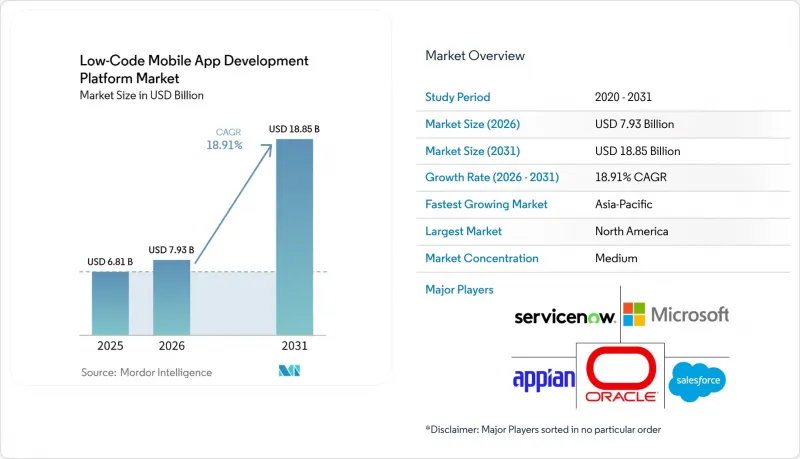
本報告按解決方案(軟體和服務)、部署類型(雲端、混合等)、應用類型(面向消費者的行動應用等)、企業規模(大型企業和中小企業)、最終用戶產業(IT與電信、能源與公共產業等)以及地區進行細分。市場預測以美元計價。
全球低程式碼行動應用開發平台市場趨勢及洞察
快速過渡到行動優先的內部工作流程
低程式碼行動應用開發平台市場正受到許多企業的強勁需求,這些企業希望透過行動裝置改善內部工作流程。這種轉變在現場服務、核准流程、人力資源、物流和日常業務流程中尤其顯著,因為這些流程對桌面端的依賴會降低營運效率。隨著業務團隊在應用需求方面扮演越來越重要的角色,低程式碼平台正在幫助減少傳統行動開發團隊常常難以解決的積壓工作。微軟以荷蘭合作銀行(Rabobank)為例,該銀行利用超過2500個Power Apps和Power Automate解決方案為遍布38個國家的4萬名員工提供支持,並將組織架構重組流程從三週縮短至三分鐘。低程式碼行動應用開發平台市場的這些成果正鼓勵企業將平台的應用範圍從單一業務流程擴展到更多其他工作流程。
人工智慧驅動的應用創建與測試
人工智慧 (AI) 的出現正在重塑低程式碼行動應用開發平台市場,大幅縮短了行動應用的設計、建置、測試和最佳化時間。最初的視覺化拖放式開發模式正逐漸轉變為基於提示的生成和貫穿整個軟體生命週期的引導式自動化。 OutSystems 將於 2025 年 2 月正式發布其“Mentor”產品,將其定位為“數位員工”,能夠根據單一需求文件生成應用,並實現更廣泛的生命週期自動化。這種轉變使得該平台對那些需要快速獲得即用型行動應用框架且無法承受漫長開發週期的企業更具吸引力。在低程式碼行動應用開發平台市場,人工智慧不再是附加功能,而是正在成為核心產品定義的一部分。
安全、隱私和資料居住限制
在低程式碼行動應用開發平台市場,行動應用處理敏感資料或受嚴格區域法規約束的產業仍存在諸多障礙。在這些環境中,採購團隊在擴展規模之前,通常會尋求關於託管模式、資料隔離、存取控制和區域部署選項的明確答案。這些要求可能會延緩決策,並使擁有更廣泛的基礎設施網路和更靈活部署模式的供應商更具優勢。 OutSystems 在 2026 年 6 月的平台公告中強調了運行時隔離和自託管功能,這表明企業買家強烈要求供應商滿足其主權和管理需求。在低程式碼行動應用開發平台市場,這種限制與其說是阻礙需求,不如說是導致全面部署延遲,直到管治和託管問題得到解決。
細分市場分析
預計到2025年,低程式碼行動應用開發平台市場中,軟體收入將佔71.24%,這意味著授權和平台訂閱仍將是主流的經營模式。許多企業仍會先購買平台,然後再決定是自行部署、透過合作夥伴部署或外包給供應商。由於平台是所有部署的基礎,這種模式確保了軟體收入在支出組成中仍然佔據核心地位。在低程式碼行動應用開發平台市場,這也意味著擁有強大核心功能和廣泛開發者生態系統的供應商將繼續保持主導地位。
預計到2031年,服務業將以21.82%的複合年成長率成長,反映出企業部署的複雜性日益增加。隨著客戶不斷增加人工智慧功能、與舊有系統整合、管治管理以及多環境維,專家支援變得至關重要。 Appian在2026年4月的產品更新中,將人工智慧驅動的規範主導開發與更廣泛的合作夥伴和整合能力相結合,以加強服務在快速交付給企業客戶方面的作用。因此,低程式碼行動應用開發平台產業正朝著更全面的生命週期模型轉變,與部署初期階段相比,諮詢、實施和託管支援的重要性日益凸顯。
預計到2025年,低程式碼行動應用程式開發平台市場中,基於雲端的部署將佔68.41%,這表明買家仍然偏好靈活的容量和廠商管理的更新。對於許多企業而言,雲端仍然是啟動開發、部署更新以及在整個團隊中擴展新的行動工作流程的最快捷方式。這種模式也減輕了不願維護複雜內部環境的客戶的基礎設施管理負擔。雲端之所以能在低程式碼行動應用開發平台市場保持主導地位,是因為便利性和速度對眾多買家而言仍然至關重要。
混合部署預計將以 20.43% 的複合年成長率成長至 2031 年,這凸顯了在受監管和資料敏感型用例中控制的重要性日益增加。金融服務、醫療保健和政府機構的使用者通常希望利用基於雲端的開發和編配層,同時將部分資料和運行時元素保留在靠近其本地系統的位置。 OutSystems 在 2026 年平台公告中強調的自架和運行時隔離,與此類企業的需求完美契合。雖然本地部署仍然適用於特定環境,但低程式碼行動應用開發平台市場的大部分實際轉變是轉向混合模式,而不是回歸完全本地模式。
區域分析
2025年,北美將佔據低程式碼行動應用開發平台市場34.62%的佔有率。該地區受益於企業在技術方面的大量投資、成熟的雲端生態系以及人工智慧應用交付的強勁勢頭。美國大型企業率先採用系統化的低程式碼方案,用於內部和麵向客戶的行動應用場景。微軟報告稱,截至2025年4月,Power Platform的月有效用戶已達5,600萬,這充分展現了企業採用該平台的規模。雖然加拿大和墨西哥的市佔率較小,但兩國在金融服務、製造業和跨國商業活動中仍扮演著重要角色。
預計到2031年,亞太地區將以23.48%的複合年成長率成長,成為低程式碼行動應用開發平台市場成長最快的地區。與北美相比,亞太地區的成長促進因素有所不同,開發人員短缺、數位轉型(DX)計劃以及中小企業(SME)的採用在推動這一成長方面發揮了更大的作用。印度、中國、日本、韓國和東南亞的買家正在尋求無需組建大規模的專業開發團隊即可更快交付應用程式的方法。因此,人工智慧驅動的開發和可重複使用模板在該地區的應用模式中尤其重要。此外,亞太地區多個國家的本土整合商也積極推動低程式碼行動應用開發平台市場的發展,他們正在該平台上建立客戶參與和營運工具。
到2025年,歐洲將佔據低程式碼行動應用開發平台市場的重要佔有率,其中德國、英國和法國將引領市場成長。儘管該地區的需求主要受企業現代化需求所驅動,但由於隱私和資料管理要求仍然是採購決策的核心,因此成長速度通常較為謹慎。因此,混合模式和託管模式對於該地區的買家評估部署方案至關重要。南美、中東和非洲的市場規模仍然小規模,但它們透過金融服務、公共部門數位化、製造業和企業行動現代化等因素持續推動市場需求。在低程式碼行動應用開發平台市場,這些地區預計將在下一波市場浪潮中發揮關鍵作用,這並非主要取決於它們目前的市場規模,而是因為平台成本的降低和部署模式的日益靈活。
其他好處:
- Excel格式的市場預測(ME)表
- 3個月的分析師支持
目錄
第1章:引言
- 研究假設和市場定義
- 調查範圍
第2章:調查方法
第3章執行摘要
第4章 市場狀況
- 市場概覽
- 市場促進因素
- 公司內部工作流程迅速轉向「行動優先」模式
- 人工智慧驅動的應用開發與測試
- 對維護負擔低的跨平台分發方案的需求日益成長。
- 透過視覺化開發實現舊有系統的現代化
- 與 ERP、CRM 和資料平台進行雲端原生整合。
- 受監管產業的行動管治需求
- 市場限制因素
- 安全、隱私和資料儲存位置限制
- 供應商鎖定和對專有運行時的依賴
- 與舊有系統整合的複雜性
- 公民開發人員的無序擴張及其管治風險
- 宏觀經濟因素對市場的影響
- 產業價值鏈分析
- 科技趨勢
- 監理情勢
- 波特五力分析
第5章 市場規模與成長預測
- 透過解決方案
- 軟體
- 服務
- 不同的發展
- 基於雲端的
- 混合
- 現場
- 按應用程式類型
- 企業勞動力申請
- 面向客戶的行動應用程式
- 現場服務和營運應用
- 消費者行動應用
- 按公司規模
- 大公司
- 小型企業
- 按最終用戶行業分類
- IT/通訊
- BFSI
- 醫療保健和生命科學
- 零售與電子商務
- 工業製造
- 教育和研究機構
- 媒體與娛樂
- 政府/行政部門
- 能源公用事業
- 其他終端用戶產業
- 按地區
- 北美洲
- 美國
- 加拿大
- 墨西哥
- 南美洲
- 巴西
- 阿根廷
- 其他南美國家
- 歐洲
- 德國
- 英國
- 法國
- 俄羅斯
- 西班牙
- 其他歐洲國家
- 亞太地區
- 中國
- 日本
- 印度
- 韓國
- 東南亞
- 其他亞太國家
- 中東和非洲
- 中東
- 沙烏地阿拉伯
- 阿拉伯聯合大公國
- 其他中東國家
- 非洲
- 南非
- 奈及利亞
- 其他非洲國家
- 中東
- 北美洲
第6章 競爭情勢
- 市場集中度
- 策略趨勢
- 市佔率分析
- 公司簡介
- Microsoft Corporation
- Salesforce, Inc.
- Oracle Corporation
- ServiceNow, Inc.
- Appian Corporation
- Mendix Technology BV
- OutSystems, SA
- Zoho Corporation Pvt. Ltd.
- Pegasystems Inc.
- Betty Blocks BV
- Quickbase, Inc.
- Nintex Software, Inc.
- Bizagi Limited
- FlutterFlow
- Caspio, Inc.
- Creatio, Inc.
- WaveMake
- SAP SE
- Google LLC
- Amazon Web Services, Inc.
- FlutterFlow, Inc.
- TrackVia, Inc.
第7章 市場機會與未來展望
According to Mordor Intelligence, the low-code mobile app development platform market size is expected to increase from USD 6.81 billion in 2025 to USD 7.93 billion in 2026 and reach USD 18.85 billion by 2031, growing at a CAGR of 18.91% over 2026-2031.
This report is Segmented by Solution (Software, and Services), Deployment (Cloud-Based, Hybrid, and More), Application Type (Consumer Mobile Applications, and More), Enterprise Size (Large Enterprises, and Small and Medium Enterprises), End-User Industry (IT and Telecommunication, Energy and Utilities, and More), and Geography. The Market Forecasts are Provided in Terms of Value (USD).
Global Low-Code Mobile App Development Platform Market Trends and Insights
Rapid Enterprise Shift to Mobile-First Internal Workflows
The low-code mobile app development platform market is seeing strong demand from enterprises seeking to improve internal workflows on mobile devices. This shift is especially visible in field service, approvals, HR tasks, logistics, and day-to-day operating processes, where desktop dependence slows execution. As business teams take a larger role in application requests, low-code platforms help reduce the backlog that traditional mobile development teams often struggle to clear. Microsoft highlighted Rabobank as an example of a company that used more than 2,500 Power Apps and Power Automate solutions to support 40,000 employees across 38 countries and reduce a three-week reorganization process to 3 minutes. In the low-code mobile app development platform market, results like that encourage organizations to expand platform use from a single operational workflow to many others.
AI-Assisted App Generation And Testing
The low-code mobile app development platform market is being reshaped by AI features that reduce the time needed to design, build, test, and refine mobile applications. What started as visual drag-and-drop development is moving toward prompt-based generation and guided automation across the software lifecycle. OutSystems made Mentor generally available in February 2025, positioning it as a digital worker that can support application generation and broader lifecycle automation from a single requirements document. That shift makes platform procurement more attractive for organizations that need usable mobile scaffolds quickly and cannot wait for long development cycles. In the low-code mobile app development platform market, AI is no longer an add-on feature because it is becoming part of the core product definition.
Security, Privacy, And Data Residency Constraints
The low-code mobile app development platform market still faces friction in industries where mobile applications handle sensitive data or operate under strict regional controls. Procurement teams in those environments often want clear answers on hosting models, data separation, access controls, and regional deployment options before they scale usage. Those requirements can slow decision-making and can favor vendors with broader infrastructure reach or more flexible deployment models. OutSystems emphasized runtime isolation and self-hosting capabilities in its June 2026 platform announcement, which shows how strongly enterprise buyers are pushing vendors to address sovereignty and control needs. In the low-code mobile app development platform market, this restraint is less about blocking demand and more about delaying broader rollouts until governance and hosting concerns are resolved.
Other drivers and restraints analyzed in the detailed report include:
- Demand for Cross-Platform Delivery with Lower Maintenance Burden
- Legacy Modernization Through Visual Development
- Vendor Lock-In and Proprietary Runtime Dependency
For complete list of drivers and restraints, kindly check the Table Of Contents.
Segment Analysis
Software accounted for 71.24% of the low-code mobile app development platform market in 2025, indicating that licensing and platform subscriptions remained the main commercial model. Most organizations still buy the platform first and then decide whether implementation work will be handled internally, through partners, or through the vendor. This pattern keeps software revenue at the center of the spending mix because the platform is the foundation for every deployment. In the low-code mobile app development platform market, that also means vendors with strong core functionality and a broad developer ecosystem still hold an advantage.
Services are projected to grow at a 21.82% CAGR through 2031, which reflects the rising complexity of enterprise deployments. As customers add AI functionality, legacy integration, governance controls, and multi-environment operations, professional support becomes harder to avoid. Appian's April 2026 product update paired AI-assisted spec-driven development with broader partner and integration capabilities, reinforcing the role of services in speeding delivery for enterprise customers. The low-code mobile app development platform industry is therefore moving toward a fuller lifecycle model where advisory, implementation, and managed support matter more than they did in earlier adoption stages.
Cloud-based deployment accounted for 68.41% of the low-code mobile app development platform market in 2025, underscoring that buyers still prefer elastic capacity and vendor-managed updates. For many organizations, cloud remains the fastest way to start development, roll out updates, and scale new mobile workflows across teams. This model also lowers infrastructure management demands for customers who do not want to maintain complex environments on their own. In the low-code mobile app development platform market, cloud keeps its lead because convenience and speed still matter to a wide range of buyers.
Hybrid deployment is projected to expand at a 20.43% CAGR through 2031, underscoring the growing importance of control in regulated and data-sensitive use cases. Financial services, healthcare, and government users often want some data and runtime elements kept closer to internal systems while still using cloud-based development and orchestration layers. OutSystems highlighted self-hosting and runtime isolation in its 2026 platform announcement, directly aligning with that enterprise demand pattern. On-premises deployment still serves specialized environments, but much of the practical shift in the low-code mobile app development platform market is now moving toward hybrid rather than back to fully local models.
Complete Report Scope:
- By Solution
- Software
- Services
- By Deployment
- Cloud-Based
- Hybrid
- On-Premises
- By Application Type
- Enterprise Workforce Applications
- Customer-Facing Mobile Applications
- Field Service and Operational Applications
- Consumer Mobile Applications
- By Enterprise Size
- Large Enterprises
- Small and Medium Enterprises
- By End-user Industry
- IT and Telecommunication
- BFSI
- Healthcare and Life Sciences
- Retail and E-Commerce
- Industrial Manufacturing
- Education and Research Institutions
- Media and Entertainment
- Government and Administration
- Energy and Utilities
- Other End-user Industries
- By Geography
- North America
- United States
- Canada
- Mexico
- South America
- Brazil
- Argentina
- Rest of South America
- Europe
- Germany
- United Kingdom
- France
- Russia
- Spain
- Rest of Europe
- Asia-Pacific
- China
- Japan
- India
- South Korea
- Southeast Asia
- Rest of Asia-Pacific
- Middle East and Africa
- Middle East
- Saudi Arabia
- United Arab Emirates
- Rest of Middle East
- Africa
- South Africa
- Nigeria
- Rest of Africa
- Middle East
- North America
Geography Analysis
North America accounted for 34.62% of the low-code mobile app development platform market in 2025. The region benefits from deep enterprise technology spending, mature cloud ecosystems, and a strong push toward AI-enabled application delivery. Large organizations in the United States have been among the earliest adopters of structured low-code programs for both internal and customer-facing mobile use cases. Microsoft reported 56 million monthly active users on Power Platform in April 2025, underscoring the scale of enterprise adoption already achieved. Canada and Mexico contribute smaller shares, but both remain relevant in financial services, manufacturing, and cross-border enterprise operations.
Asia-Pacific is projected to grow at a 23.48% CAGR through 2031, making it the fastest-growing region in the low-code mobile app development platform market. Growth in this region comes from a different mix than in North America because developer shortages, digital transformation programs, and SME adoption all play a stronger role. Buyers across India, China, Japan, South Korea, and Southeast Asia are looking for faster app delivery without building very large specialist development teams. That makes AI-assisted development and reusable templates especially valuable in regional adoption patterns. The low-code mobile app development platform market is also benefiting from domestic integrator activity in several Asia-Pacific countries, where firms are building customer engagement and operational tools on top of these platforms.
Europe held a significant share of the low-code mobile app development platform market in 2025, with Germany, the United Kingdom, and France leading adoption. The region's demand is shaped by enterprise modernization needs, but growth often moves more carefully because privacy and data control requirements remain central to procurement decisions. Hybrid and controlled hosting models are therefore important when buyers evaluate deployment choices in the region. South America, the Middle East, and Africa remain smaller markets, yet they continue to drive demand through financial services, public-sector digitization, manufacturing, and enterprise mobile modernization. In the low-code mobile app development platform market, these regions matter less for current scale than for the next wave of adoption as platform costs fall and deployment models become more flexible.
- Microsoft Corporation
- Salesforce, Inc.
- Oracle Corporation
- ServiceNow, Inc.
- Appian Corporation
- Mendix Technology B.V.
- OutSystems, S.A.
- Zoho Corporation Pvt. Ltd.
- Pegasystems Inc.
- Betty Blocks B.V.
- Quickbase, Inc.
- Nintex Software, Inc.
- Bizagi Limited
- FlutterFlow
- Caspio, Inc.
- Creatio, Inc.
- WaveMake
- SAP SE
- Google LLC
- Amazon Web Services, Inc.
- FlutterFlow, Inc.
- TrackVia, Inc.
Additional Benefits:
- The market estimate (ME) sheet in Excel format
- 3 months of analyst support
TABLE OF CONTENTS
1 INTRODUCTION
- 1.1 Study Assumptions and Market Definition
- 1.2 Scope of the Study
2 RESEARCH METHODOLOGY
3 EXECUTIVE SUMMARY
4 MARKET LANDSCAPE
- 4.1 Market Overview
- 4.2 Market Drivers
- 4.2.1 Rapid Enterprise Shift to Mobile-First Internal Workflows
- 4.2.2 AI-Assisted App Generation and Testing
- 4.2.3 Demand for Cross-Platform Delivery With Lower Maintenance Burden
- 4.2.4 Legacy Modernization Through Visual Development
- 4.2.5 Cloud-Native Integration With ERP, CRM, and Data Platforms
- 4.2.6 Mobile Governance Needs in Regulated Industries
- 4.3 Market Restraints
- 4.3.1 Security, Privacy, and Data Residency Constraints
- 4.3.2 Vendor Lock-In and Proprietary Runtime Dependency
- 4.3.3 Integration Complexity With Legacy Systems
- 4.3.4 Citizen Developer Sprawl and Governance Risk
- 4.4 Impact of Macroeconomic Factors on the Market
- 4.5 Industry Value-Chain Analysis
- 4.6 Technology Outlook
- 4.7 Regulatory Landscape
- 4.8 Porter's Five Forces Analysis
- 4.8.1 Threat of New Entrants
- 4.8.2 Bargaining Power of Suppliers
- 4.8.3 Bargaining Power of Buyers
- 4.8.4 Threat of Substitutes
- 4.8.5 Intensity of Competitive Rivalry
5 MARKET SIZE AND GROWTH FORECASTS (VALUE)
- 5.1 By Solution
- 5.1.1 Software
- 5.1.2 Services
- 5.2 By Deployment
- 5.2.1 Cloud-Based
- 5.2.2 Hybrid
- 5.2.3 On-Premises
- 5.3 By Application Type
- 5.3.1 Enterprise Workforce Applications
- 5.3.2 Customer-Facing Mobile Applications
- 5.3.3 Field Service and Operational Applications
- 5.3.4 Consumer Mobile Applications
- 5.4 By Enterprise Size
- 5.4.1 Large Enterprises
- 5.4.2 Small and Medium Enterprises
- 5.5 By End-user Industry
- 5.5.1 IT and Telecommunication
- 5.5.2 BFSI
- 5.5.3 Healthcare and Life Sciences
- 5.5.4 Retail and E-Commerce
- 5.5.5 Industrial Manufacturing
- 5.5.6 Education and Research Institutions
- 5.5.7 Media and Entertainment
- 5.5.8 Government and Administration
- 5.5.9 Energy and Utilities
- 5.5.10 Other End-user Industries
- 5.6 By Geography
- 5.6.1 North America
- 5.6.1.1 United States
- 5.6.1.2 Canada
- 5.6.1.3 Mexico
- 5.6.2 South America
- 5.6.2.1 Brazil
- 5.6.2.2 Argentina
- 5.6.2.3 Rest of South America
- 5.6.3 Europe
- 5.6.3.1 Germany
- 5.6.3.2 United Kingdom
- 5.6.3.3 France
- 5.6.3.4 Russia
- 5.6.3.5 Spain
- 5.6.3.6 Rest of Europe
- 5.6.4 Asia-Pacific
- 5.6.4.1 China
- 5.6.4.2 Japan
- 5.6.4.3 India
- 5.6.4.4 South Korea
- 5.6.4.5 Southeast Asia
- 5.6.4.6 Rest of Asia-Pacific
- 5.6.5 Middle East and Africa
- 5.6.5.1 Middle East
- 5.6.5.1.1 Saudi Arabia
- 5.6.5.1.2 United Arab Emirates
- 5.6.5.1.3 Rest of Middle East
- 5.6.5.2 Africa
- 5.6.5.2.1 South Africa
- 5.6.5.2.2 Nigeria
- 5.6.5.2.3 Rest of Africa
- 5.6.5.1 Middle East
- 5.6.1 North America
6 COMPETITIVE LANDSCAPE
- 6.1 Market Concentration
- 6.2 Strategic Moves
- 6.3 Market Share Analysis
- 6.4 Company Profiles (includes Global Level Overview, Market Level Overview, Core Segments, Financials as available, Strategic Information, Market Rank/Share, Products and Services, Recent Developments)
- 6.4.1 Microsoft Corporation
- 6.4.2 Salesforce, Inc.
- 6.4.3 Oracle Corporation
- 6.4.4 ServiceNow, Inc.
- 6.4.5 Appian Corporation
- 6.4.6 Mendix Technology B.V.
- 6.4.7 OutSystems, S.A.
- 6.4.8 Zoho Corporation Pvt. Ltd.
- 6.4.9 Pegasystems Inc.
- 6.4.10 Betty Blocks B.V.
- 6.4.11 Quickbase, Inc.
- 6.4.12 Nintex Software, Inc.
- 6.4.13 Bizagi Limited
- 6.4.14 FlutterFlow
- 6.4.15 Caspio, Inc.
- 6.4.16 Creatio, Inc.
- 6.4.17 WaveMake
- 6.4.18 SAP SE
- 6.4.19 Google LLC
- 6.4.20 Amazon Web Services, Inc.
- 6.4.21 FlutterFlow, Inc.
- 6.4.22 TrackVia, Inc.
7 MARKET OPPORTUNITIES AND FUTURE OUTLOOK
- 7.1 White-Space and Unmet-Need Assessment

 全球低程式應用開發平台市場規模、佔有率、趨勢和成長分析報告(2026-2034)
 低程式碼開發平台:市場佔有率分析、產業趨勢與統計及成長預測(2026-2031)
 低程式碼開發平台市場-2026-2032年全球市場預測
 無程式碼開發平台市場預測至 2034 年—按組件、部署類型、企業規模、應用程式、最終用戶和地區分類的全球分析低程式碼應用開發平台市場:2026-2032年全球市場預測(按組件、開發方法、定價模式、用例、最終用戶產業、部署模式和組織規模分類)
 全球低程式碼人工智慧平台市場:按組件、人工智慧功能、部署、應用、企業規模和最終用戶產業分類-市場規模、產業動態、機會分析和預測(2026-2035 年)
 低程式碼應用開發平台市場規模、佔有率和成長分析:按組件、部署模式、應用、企業規模、最終用戶產業和地區分類-2026-2033年產業預測
 無程式碼人工智慧平台市場規模、佔有率和成長分析:按組件、部署類型、應用、產業和地區分類-2026-2033年產業預測低程式碼人工智慧開發平台市場預測至2034年:按組件、部署類型、企業規模、技術、應用、最終用戶和地區分類的全球分析
 2026-2030年全球低程式碼人工智慧平台市場