


 |
市場調查報告書
商品編碼
2117501
顏料分散:市場佔有率分析、產業趨勢與統計、成長預測(2026-2031)Pigment Dispersion - Market Share Analysis, Industry Trends & Statistics, Growth Forecasts (2026 - 2031) |
||||||

※ 本網頁內容可能與最新版本有所差異。詳細情況請與我們聯繫。
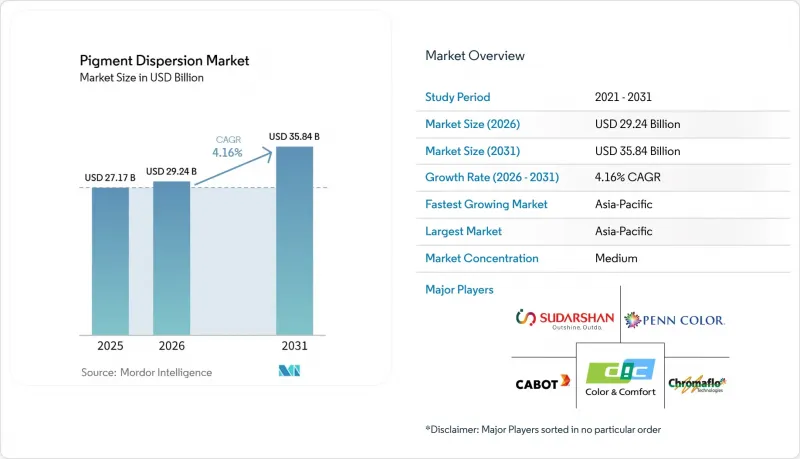
根據 Mordor Intelligence 預測,顏料分散體市場規模將從 2025 年的 271.7 億美元和 2026 年的 292.4 億美元成長到 2031 年的 358.4 億美元,2026 年至 2031 年的複合年成長率為 4.16%。
本報告按顏料類型(無機顏料和有機顏料)、分散劑類型(水性分散劑和溶劑型分散劑)、應用領域(印刷油墨、塑膠等)、終端用戶行業(汽車、包裝等)以及地區(亞太地區、北美地區、歐洲地區、南美地區、中東和非洲地區)進行細分。市場預測以美元計價。
全球顏料分散市場趨勢與洞察
對水性顏料分散體系的需求日益成長
顏料分散體市場最顯著的變化是建築、汽車和工業塗料應用領域正從溶劑型系統轉向水性系統的持續轉型。歐盟委員會於2025年12月決定修訂歐盟生態標籤,收緊了裝飾塗料及相關產品的標準,並降低了某些室內應用的揮發性有機化合物(VOC)和半揮發性有機化合物(SVOC)閾值。這項變化的影響遠不止於歐洲,供應商通常會使其全球產品平台與最嚴格的主要標準保持一致。贏創的TEGO Dispers 780 W展示了為滿足這些法規要求而進行的技術基礎演進。本產品不含溶劑且無毒,專為高品質水性顏料濃縮液而設計,適用於有機和無機顏料,包括在相關合規框架下用於食品相關應用。隨著水性系統和溶劑型系統之間的性能差距不斷縮小,能夠透過配方調整、測試和生產線改造為客戶提供支援的製造商有望在顏料分散體市場中佔據競爭優勢。依賴傳統溶劑化學的中小型化合物生產商在設備和技能方面將面臨更艱難的轉型。
來自建築和施工行業的需求不斷成長
建築業是顏料分散體市場成長的主要驅動力。建築塗料和建築材料對顏料分散體的需求主要來自二氧化鈦和氧化鐵,這些材料能夠實現內外表面的遮蓋力、耐久性、耐候性和均勻外觀。亞太地區和中東部分地區的需求最為旺盛,這些地區的都市化、基礎設施投資和住宅開發推動了塗料的廣泛和持續消費。除這些地區外,不斷提高的綠色建築標準和對低排放量塗料的偏好也提高了規範標準,使得高附加價值的水性、技術先進的分散體比溶劑型產品更受青睞。因此,顏料分散體市場從建設活動中受益匪淺,體現在兩個方面:首先是塗料的直接需求;其次是配方逐漸向更先進的技術和更嚴格的品管方向發展。
原物料價格波動
在無機顏料體系中,二氧化鈦和其他礦物原料佔生產成本的很大一部分,因此顏料分散體市場仍然容易受到原料價格波動的影響。二氧化鈦可佔無機顏料生產成本的50%至70%,這意味著即使原料價格出現適度波動,也會對顏料生產商、分散體生產商和下游混配商的利潤率造成壓力。根據Tinox Chemie的一份報告預測,到2026年中期,金紅石型二氧化鈦的價格預計將在每噸1821美元至1959美元之間。同時,硫相關成本的上漲持續影響硫酸鹽製程的獲利能力,顯示成本波動在2026年仍將是營運挑戰。這對顏料分散體市場也至關重要,因為無機產品在建築和工業應用領域佔據了很大的銷售佔有率,而且製造商很難在不影響性能、遮蓋力和耐候性的情況下替換這些原料。擁有完善的採購體系、廣泛的供應商網路或與上游工程深度整合的公司,在維持利潤率方面更具優勢。然而,小規模企業更容易受到利潤率下降和成本轉嫁延遲等風險的影響。
細分市場分析
2024年,無機顏料佔了57.42%的市場佔有率,成為顏料分散體市場的主導板塊。二氧化鈦和氧化鐵的實用特性支撐了這一地位,它們不僅經濟高效,還能在建築和工業塗料應用中提供抗紫外線、熱穩定性、耐化學性和遮蓋力。這些特性使得無機顏料分散體在建築外牆塗料、防護系統和PVC基建築材料中得到持續廣泛的應用,而耐候性和使用壽命是這些應用的關鍵採購指標。顏料分散體市場高度依賴無機化學,尤其是在建築和工業塗料年消費量龐大的地區。這種高度集中也解釋了為什麼二氧化鈦原料價格的波動會直接影響整個價值鏈的價格和利潤率趨勢。
截至2025年,有機顏料將佔據剩餘的市場佔有率,預計到2031年將以5.13%的複合年成長率成長,成為該細分市場中成長率最高的顏料。有機顏料在終端應用的應用最為廣泛,尤其是在那些對飽和度、亮度和設計柔軟性要求較高,且需要避免重金屬污染的配方領域,例如印刷油墨、特種纖維和某些化妝品系統。 2025年3月,蘇達山化學工業有限公司完成了對赫巴赫集團的收購,將其業務拓展至全球19個地點,並增強了產品系列組合。此次收購反映了全球終端市場對特種顏料的持續需求。在顏料分散體市場,此交易結合了規模和產品組合的廣度,使大規模供應商能夠透過單一平台提供從通用產品到高價值色彩體系的各種產品。因此,雖然預計無機顏料仍將是主要的收入來源,但預計有機顏料將繼續影響產品組合和利潤率。
預計到2025年,水性分散體將佔據55.76%的市場佔有率,並在2031年之前以4.82%的複合年成長率成長,成為顏料分散體市場中規模最大且成長最快的類別。這一成長主要得益於日益嚴格的環境合規要求、不斷擴大的永續採購標準以及顏料潤濕性、穩定性、顯色性和耐腐蝕性等方面的技術進步。向水性體系的轉變在建築塗料、包裝油墨以及其他客戶要求低排放系統且不影響顯色性和加工一致性的應用領域尤其重要。這項轉變需要新型添加劑的化學特性、更精準的研磨控制以及更完善的配方支援。如果獲得客戶的認可,水性體係有望擁有更長的商業性生命週期,因為它們更符合未來的監管趨勢。
BASF將Dispex Ultra PX 4290定位為無溶劑、高分子量分散劑,適用於水性塗料、印刷油墨和黏合劑,其優勢包括提高顏料堆積密度、降低黏度、增強聚集穩定性以及提升光澤度。贏創同樣將TEGO Dispers 780 W定位為高品質水性顏料濃縮液的無溶劑解決方案。本產品適用於含黏合劑和不含黏合劑的著色劑,並符合食品應用的相關要求。溶劑型分散體在一些要求苛刻的工業和特種應用中仍然發揮作用,在這些應用中,由於其附著力、耐化學性或常規製程條件等原因,溶劑型分散體更受青睞。然而,隨著客戶偏好和法規不斷轉向更易於實施的選擇,例如揮發性有機化合物(VOC)含量更低且符合相關法規的選擇,這些系統在顏料分散體行業的市場佔有率正在穩步下降。因此,儘管溶劑型產品在特定應用中仍然具有戰略意義,但它們已失去了曾經廣泛的市場地位。
區域分析
預計到2025年,亞太地區將佔全球顏料分散體銷售額的37.55%,並在2031年之前以5.42%的複合年成長率成長,成為顏料分散體市場規模最大、成長最快的地區。中國憑藉其一體化的顏料生產、廣泛的塗料需求、強大的生產規模以及在包裝、塑膠和工業應用領域大規模的基本客群,繼續保持這一市場的核心地位。隨著住宅建設、城市發展和國內製造業活動的擴張,印度也日益重要,這些因素推動了對塗料和著色劑的需求。亞太市場也受惠於主要消費領域逐步轉向更高規格的水性塗料和特殊塗料系統。在東南亞,與電子商務和消費品分銷相關的包裝需求正在推動多個市場對油墨及相關分散系統的需求,為該地區的進一步成長奠定了基礎。
日本和韓國在顏料分散體市場扮演著截然不同的角色。日本的貢獻更多來自於其高規格需求,而非其龐大的區域產量。汽車OEM塗料、電子應用、先進工業塗料和精密印刷等領域的需求支撐著日本市場的重要性,這些領域都要求穩定的顆粒控制和一致的配方性能。北美和歐洲仍然是重要的價值來源,其成長主要來自維修、包裝改造、汽車修補和工業塗料,而非新建建築的顯著成長。歐洲也是一個重要的監管標桿,因為受揮發性有機化合物(VOC)和更廣泛的化學品合規框架影響的產品要求,經常影響全球供應商的標準和出口配方策略。在美國和加拿大,建築和維修活動支撐著對建築塗料的需求,而對包裝品質日益成長的期望則推動了對可靠、低排放分散技術的需求。
DIC集團旗下子公司Sun Chemical在2025年歐洲塗料展上重點展示了其在歐洲和北美供應鏈中對高品質配方的關注,並著重介紹了水性乳液、水性聚氨酯分散體、VOC減排解決方案和低單體材料。南美洲透過農產品包裝、消費品和住宅塗料領域做出貢獻,其中巴西尤其突出,是二氧化鈦和氧化鐵基建築系統的重要需求中心。儘管中東和非洲地區高附加價值本地生產規模仍然較小,但建築項目和工業發展持續支撐著對進口顏料分散體和濃縮液的需求。在這些市場,技術服務和與分銷商的關係與價格同等重要,因為客戶經常需要支持,以使進口系統適應當地的基材、氣候條件和應用方法。整體而言,顏料分散體市場仍呈現區域多元化,亞太地區是成長中心,而歐洲和北美則持續引領技術標準和合規性的發展方向。
其他好處:
- Excel格式的市場預測(ME)表
- 3個月的分析師支持
目錄
第1章:引言
- 研究假設和市場定義
- 調查範圍
第2章:調查方法
第3章執行摘要
第4章 市場狀況
- 市場概覽
- 市場促進因素
- 對水性及低VOC顏料分散體的需求日益成長
- 油漆和塗料行業的需求不斷成長
- 包裝和印刷油墨產業的擴張
- 顏料分散體在塑膠和聚合物應用中的廣泛應用
- 高性能和特種顏料技術的進步
- 市場限制因素
- 二氧化鈦及特殊原料價格的波動
- 遵守有關揮發性有機化合物、REACH法規和廢棄物處理法規的負擔。
- 顏料和石油化學原料價格波動
- 價值鏈分析
- 波特五力分析
第5章 市場規模與成長預測
- 依顏料類型
- 無機顏料
- 有機顏料
- 按分佈類型
- 水溶液
- 溶劑型
- 透過使用
- 油漆和塗料
- 印刷油墨
- 塑膠
- 紡織品
- 紙
- 化妝品
- 其他用途
- 按最終用途行業分類
- 建築/施工
- 車
- 包裝
- 紙張/印刷
- 紡織品
- 消費品
- 其他終端用戶產業
- 按地區
- 亞太地區
- 中國
- 印度
- 日本
- 韓國
- 其他亞太國家
- 北美洲
- 美國
- 加拿大
- 墨西哥
- 歐洲
- 德國
- 英國
- 法國
- 義大利
- 俄羅斯
- 其他歐洲國家
- 南美洲
- 巴西
- 阿根廷
- 其他南美國家
- 中東和非洲
- 沙烏地阿拉伯
- 南非
- 其他中東和非洲國家
- 亞太地區
第6章 競爭情勢
- 市場集中度
- 策略趨勢
- 市佔率和排名分析
- 公司簡介
- AArbor Colorants Corporation
- AUM Farbenchem Pvt. Ltd.
- Cabot Corporation
- Chromaflo Technologies
- Chromatech Inc.
- DCL Corporation
- Decorative Color and Chemical, Inc.
- DIC Corporation
- ECKART GmbH
- Flint Group
- Penn Colors Inc.
- Sudarshan Chemical Industries Limited
- Toyo Ink SC Holdings Co., Ltd.
- Trust Chem Co., Ltd.
- Vipul Organics Limited
第7章 市場機會與未來展望
According to Mordor Intelligence, the pigment dispersion market size is projected to expand from USD 27.17 billion in 2025 and USD 29.24 billion in 2026 to USD 35.84 billion by 2031, and is expected to register a CAGR of 4.16% between 2026 and 2031.
This report is Segmented by Pigment Type (Inorganic Pigments and Organic Pigments), Dispersion Type (Water-Based and Solvent-Based), Application (Printing Inks, Plastics, and More), End-Use Industry (Automotive, Packaging, and More), and Geography (Asia-Pacific, North America, Europe, South America, and Middle-East and Africa). The Market Forecasts are Provided in Terms of Value (USD).
Global Pigment Dispersion Market Trends and Insights
Growing Demand for Waterborne Pigment Dispersion Systems
The most notable shift in the pigment dispersion market is the ongoing replacement of solvent-based systems with waterborne alternatives across architectural, automotive, and industrial coating applications. The European Commission's December 2025 EU Ecolabel decision tightened criteria for decorative paints and related products, including lower VOC and semi-volatile organic compound (SVOC) thresholds for certain interior applications. This change is influencing formulation choices well beyond Europe, as suppliers often align global product platforms to the strictest major standard. Evonik's TEGO Dispers 780 W illustrates how the technology base is evolving alongside regulations. The product is solvent-free, non-hazardous, designed for high-quality waterborne pigment concentrates, and suitable for both organic and inorganic pigments, including food-related uses under relevant compliance frameworks. As the performance gap between waterborne and solvent-based systems continues to narrow, the pigment dispersion market is likely to favor producers that can support customers through reformulation, testing, and line conversion. Smaller formulators that depend on legacy solvent chemistry will face a more demanding transition in terms of equipment and skills.
Rising Demand from the Building and Construction Sector
The building and construction segment supports growth in the pigment dispersion market. This demand is driven by architectural coatings and construction materials that use titanium dioxide and iron oxides for opacity, durability, weather resistance, and consistent appearance across interior and exterior surfaces. Demand is highest in Asia-Pacific and select Middle East markets, where urbanization, infrastructure spending, and residential development sustain broad and recurring coatings consumption. Beyond these regions, green building standards and low-emission coating preferences are raising specification levels, supporting higher-value water-based and technically refined dispersions over solvent-heavy alternatives. As a result, the pigment dispersion market benefits from construction activity in two ways: through direct coating demand, and through a gradual shift toward formulations that require greater technical input and more consistent quality control.
Raw Material Price Volatility
The pigment dispersion market remains exposed to raw material price volatility, as titanium dioxide and other mineral inputs account for a significant share of production costs in inorganic pigment systems. Titanium dioxide can account for 50% to 70% of inorganic pigment production costs, meaning even moderate input price fluctuations can pressure margins across pigment producers, dispersion manufacturers, and downstream formulators. Tinox Chemie reported rutile titanium dioxide prices in the range of USD 1,821 to USD 1,959 per ton through mid-2026, while elevated sulfur-related cost pressure continues to affect sulfate-process economics, reflecting ongoing cost instability as an operating challenge in 2026. This is relevant to the pigment dispersion market because inorganic systems account for a large share of revenue in construction and industrial applications, making it difficult for producers to substitute these inputs without affecting performance, opacity, or weather resistance. Companies with stronger procurement discipline, broader supplier networks, or upstream integration are better positioned to protect margins, while smaller participants face a greater risk of margin erosion or delayed cost pass-through to customers.
Other drivers and restraints analyzed in the detailed report include:
- Expansion of the Packaging Sector and E-commerce-Driven Demand
- Advancements in High-Performance Dispersion Technologies
- Compliance Burden from Environmental Regulations
For complete list of drivers and restraints, kindly check the Table Of Contents.
Segment Analysis
Inorganic pigments held a 57.42% share in 2024, making them the dominant segment in the pigment dispersion market. This position was supported by the practical performance of titanium dioxide and iron oxides, which offered cost efficiency alongside UV resistance, thermal stability, chemical resistance, and opacity in construction-grade and industrial coating applications. These properties kept inorganic dispersions widely used in exterior architectural coatings, protective systems, and PVC-based building materials, where weather exposure and service life were key purchasing criteria. The pigment dispersion market relied heavily on inorganic chemistry, particularly in regions where construction and industrial coatings consumed large quantities each year. This concentration also explained why raw material volatility in titanium dioxide directly affected pricing and margin performance across much of the value chain.
Organic pigments accounted for the remaining market share in 2025 and are projected to grow at a 5.13% CAGR through 2031, the fastest growth rate within this segment. Their adoption is strongest in end uses that prioritize chroma, brightness, design flexibility, and formulations that avoid heavy-metal-related concerns, particularly in printing inks, specialty textiles, and selected cosmetic systems. In March 2025, Sudarshan Chemical Industries Ltd completed the acquisition of Heubach Group, expanding its operations to 19 sites worldwide and strengthening its portfolio across organic, inorganic, pearlescent pigments, and liquid dispersions. This acquisition reflects continued demand for specialty pigments across global end markets. Within the pigment dispersion market, the transaction combined scale with portfolio breadth, enabling a larger supplier to serve both commodity and higher-value color systems through a single platform. Inorganic pigments are therefore likely to remain the primary revenue contributor, while organic pigments continue to influence product mix and margin development.
Water-based dispersions held a 55.76% share in 2025 and are forecast to grow at a 4.82% CAGR through 2031, making them both the largest and fastest-growing category within the pigment dispersion market. Their growth is driven by stricter environmental compliance requirements, broader sustainability procurement standards, and technical advances in pigment wetting, stabilization, color development, and corrosion performance. The shift toward waterborne systems is particularly relevant in architectural coatings, packaging inks, and other applications where customers require lower-emission systems without compromising color strength or process consistency. This transition requires new additive chemistry, improved milling control, and closer formulation support. Once approved by customers, water-based systems can benefit from longer commercial lifespans due to their closer alignment with future regulatory direction.
BASF describes Dispex Ultra PX 4290 as a solvent-free, high-molecular-weight dispersing agent for organic and inorganic pigments in aqueous coatings, printing inks, and adhesives, with benefits including higher pigment loading, reduced viscosity, improved flocculation stability, and improved gloss. Evonik similarly positions TEGO Dispers 780 W as a solvent-free solution for high-quality waterborne pigment concentrates, suitable across binder-containing and binder-free colorants, and compliant with claims relevant to food applications. Solvent-based dispersions retain a role in demanding industrial or specialty applications where adhesion, chemical resistance, or legacy process conditions favor solvent chemistry. Even so, the pigment dispersion industry is steadily reducing the broad-market role of these systems as customer preferences and regulations continue to shift toward lower volatile organic compound (VOC), more compliance-ready options. This leaves solvent-based products with strategic relevance in specific applications, but without the same broad market position they previously held.
Complete Report Scope:
- By Pigment Type
- Inorganic Pigments
- Organic Pigments
- By Dispersion Type
- Water-Based
- Solvent-Based
- By Application
- Paints and Coatings
- Printing Inks
- Plastics
- Textiles
- Paper
- Cosmetics
- Other Applications
- By End-Use Industry
- Building and Construction
- Automotive
- Packaging
- Paper and Printing
- Textile
- Consumer Goods
- Other End-Use Industries
- By Geography
- Asia-Pacific
- China
- India
- Japan
- South Korea
- Rest of Asia-Pacific
- North America
- United States
- Canada
- Mexico
- Europe
- Germany
- United Kingdom
- France
- Italy
- Russia
- Rest of Europe
- South America
- Brazil
- Argentina
- Rest of South America
- Middle-East and Africa
- Saudi Arabia
- South Africa
- Rest of Middle-East and Africa
- Asia-Pacific
Geography Analysis
Asia-Pacific accounted for 37.55% of global revenue in 2025 and grew at a 5.42% CAGR through 2031, making it the largest and fastest-growing region in the pigment dispersion market. China remained central to this position, supported by integrated pigment production, broad coatings demand, manufacturing scale, and a large customer base across packaging, plastics, and industrial applications. India also gained importance, as housing expansion, urban development, and domestic manufacturing activity sustained demand for coatings and colorants. The market in Asia-Pacific was further supported by a gradual shift toward higher-specification water-based and specialty systems across major consuming sectors. In Southeast Asia, packaging demand linked to e-commerce and consumer goods distribution drove the need for inks and associated dispersion systems across several markets, positioning the region for further growth.
Japan and South Korea play distinct roles in the pigment dispersion market. Japan contributes more through higher-specification demand than through the largest regional tonnage, with its importance driven by automotive OEM coatings, electronics-related applications, advanced industrial finishes, and precision printing needs that require stable particle control and consistent formulation performance. North America and Europe continue to represent substantial value pools, supported by renovation activity, packaging conversion, automotive refinishing, and industrial coatings rather than by high levels of new construction growth. Europe also serves as an important regulatory benchmark, as product requirements shaped by volatile organic compound (VOC) and broader chemical compliance frameworks frequently influence global supplier standards and export-facing formulation strategies. In the United States and Canada, construction and refurbishment activity supports architectural coatings demand, while packaging quality expectations are increasing the need for reliable, lower-emission dispersion technologies.
Sun Chemical, a DIC Corporation subsidiary, highlighted water-based emulsions, water-based polyurethane dispersions, VOC-reducing solutions, and low-monomer materials at the European Coatings Show 2025, reflecting the premium formulation focus in the European and North American supply chain. South America contributes through agribusiness packaging, consumer goods, and residential construction coatings, with Brazil standing out as a significant demand center for titanium dioxide and iron oxide-based architectural systems. The Middle East and Africa remain smaller in terms of value-added local production, but construction programs and industrial development continue to support demand for imported pigment dispersions and concentrates. In these markets, technical service and distributor relationships can be as important as price, as customers often require support in adapting imported systems to local substrates, climate conditions, and application practices. Overall, the pigment dispersion market remains regionally diverse, with its growth center in Asia-Pacific, while Europe and North America continue to shape technical standards and compliance direction.
- AArbor Colorants Corporation
- AUM Farbenchem Pvt. Ltd.
- Cabot Corporation
- Chromaflo Technologies
- Chromatech Inc.
- DCL Corporation
- Decorative Color and Chemical, Inc.
- DIC Corporation
- ECKART GmbH
- Flint Group
- Penn Colors Inc.
- Sudarshan Chemical Industries Limited
- Toyo Ink SC Holdings Co., Ltd.
- Trust Chem Co., Ltd.
- Vipul Organics Limited
Additional Benefits:
- The market estimate (ME) sheet in Excel format
- 3 months of analyst support
TABLE OF CONTENTS
1 Introduction
- 1.1 Study Assumptions and Market Definition
- 1.2 Scope of the Study
2 Research Methodology
3 Executive Summary
4 Market Landscape
- 4.1 Market Overview
- 4.2 Market Drivers
- 4.2.1 Growing Demand for Water-Based and Low-VOC Pigment Dispersions
- 4.2.2 Rising Demand from the Paints and Coatings Industry
- 4.2.3 Expansion of the Packaging and Printing Inks Industry
- 4.2.4 Increasing Use of Pigment Dispersions in Plastics and Polymer Applications
- 4.2.5 Advancements in High-Performance and Specialty Pigment Technologies
- 4.3 Market Restraints
- 4.3.1 Raw Material Price Volatility for Titanium Dioxide and Specialty Feedstocks
- 4.3.2 Compliance Burden From VOC, REACH, and Waste Handling Requirements
- 4.3.3 Volatility in Prices of Pigments and Petrochemical-Based Raw Materials
- 4.4 Value Chain Analysis
- 4.5 Porter's Five Forces Analysis
- 4.5.1 Threat of New Entrants
- 4.5.2 Bargaining Power of Suppliers
- 4.5.3 Bargaining Power of Buyers
- 4.5.4 Threat of Substitutes
- 4.5.5 Competitive Rivalry
5 Market Size and Growth Forecasts (Value)
- 5.1 By Pigment Type
- 5.1.1 Inorganic Pigments
- 5.1.2 Organic Pigments
- 5.2 By Dispersion Type
- 5.2.1 Water-Based
- 5.2.2 Solvent-Based
- 5.3 By Application
- 5.3.1 Paints and Coatings
- 5.3.2 Printing Inks
- 5.3.3 Plastics
- 5.3.4 Textiles
- 5.3.5 Paper
- 5.3.6 Cosmetics
- 5.3.7 Other Applications
- 5.4 By End-Use Industry
- 5.4.1 Building and Construction
- 5.4.2 Automotive
- 5.4.3 Packaging
- 5.4.4 Paper and Printing
- 5.4.5 Textile
- 5.4.6 Consumer Goods
- 5.4.7 Other End-Use Industries
- 5.5 By Geography
- 5.5.1 Asia-Pacific
- 5.5.1.1 China
- 5.5.1.2 India
- 5.5.1.3 Japan
- 5.5.1.4 South Korea
- 5.5.1.5 Rest of Asia-Pacific
- 5.5.2 North America
- 5.5.2.1 United States
- 5.5.2.2 Canada
- 5.5.2.3 Mexico
- 5.5.3 Europe
- 5.5.3.1 Germany
- 5.5.3.2 United Kingdom
- 5.5.3.3 France
- 5.5.3.4 Italy
- 5.5.3.5 Russia
- 5.5.3.6 Rest of Europe
- 5.5.4 South America
- 5.5.4.1 Brazil
- 5.5.4.2 Argentina
- 5.5.4.3 Rest of South America
- 5.5.5 Middle-East and Africa
- 5.5.5.1 Saudi Arabia
- 5.5.5.2 South Africa
- 5.5.5.3 Rest of Middle-East and Africa
- 5.5.1 Asia-Pacific
6 Competitive Landscape
- 6.1 Market Concentration
- 6.2 Strategic Moves
- 6.3 Market Share (%)/Ranking Analysis
- 6.4 Company Profiles (includes Global Overview, Market Overview, Core Segments, Financials as available, Strategic Information, Products and Services, and Recent Developments)
- 6.4.1 AArbor Colorants Corporation
- 6.4.2 AUM Farbenchem Pvt. Ltd.
- 6.4.3 Cabot Corporation
- 6.4.4 Chromaflo Technologies
- 6.4.5 Chromatech Inc.
- 6.4.6 DCL Corporation
- 6.4.7 Decorative Color and Chemical, Inc.
- 6.4.8 DIC Corporation
- 6.4.9 ECKART GmbH
- 6.4.10 Flint Group
- 6.4.11 Penn Colors Inc.
- 6.4.12 Sudarshan Chemical Industries Limited
- 6.4.13 Toyo Ink SC Holdings Co., Ltd.
- 6.4.14 Trust Chem Co., Ltd.
- 6.4.15 Vipul Organics Limited
7 Market Opportunities and Future Outlook
- 7.1 White-Space and Unmet-Need Assessment

 水性顏料分散體市場:全球市場預測(2026-2032年)顏料分散市場:全球預測,2026-2032年
 顏料分散市場規模、佔有率和成長分析:按顏料類型、介質、應用、最終用途產業和地區分類-2026-2033年產業預測
 美國顏料分散體市場規模、佔有率和趨勢分析報告:按類型、配方、應用和細分市場分類(2026-2033 年)顏料分散市場規模、佔有率和趨勢分析報告:按產品、應用、地區和細分市場預測(2026-2033 年)
 全球顏料分散體市場規模、佔有率、趨勢和成長分析報告(2026-2034)
 2026年全球顏料分散體市場報告
 顏料分散劑市場:按顏料類型、分散劑類型、應用、最終用途行業和地區分類的全球市場 - 預測至 2030 年