

 |
市場調查報告書
商品編碼
2117494
合成石膏:市場佔有率分析、產業趨勢與統計、成長預測(2026-2031)Synthetic Gypsum - Market Share Analysis, Industry Trends & Statistics, Growth Forecasts (2026 - 2031) |
||||||

※ 本網頁內容可能與最新版本有所差異。詳細情況請與我們聯繫。
根據 Mordor Intelligence 預測,合成石膏市場規模將從 2025 年的 19.8 億美元成長到 2026 年的 20.5 億美元,到 2031 年將達到 24.6 億美元,2026 年至 2031 年的複合年成長率為 3.73%。
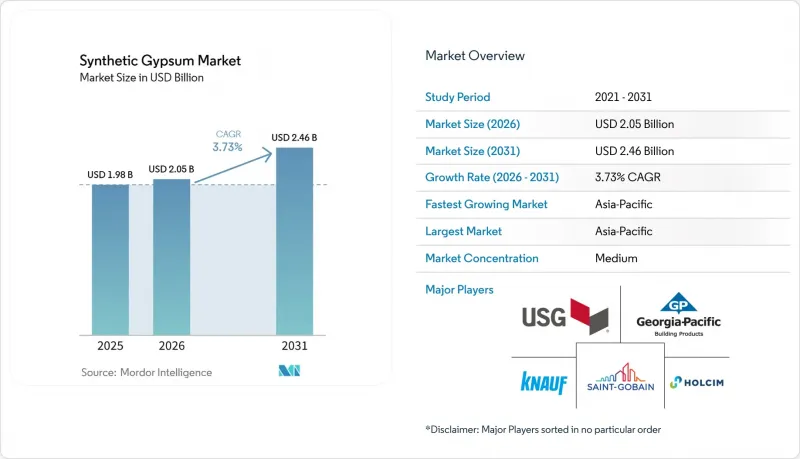
本報告按類型(例如,磷酸鹽石膏、氟石膏)、應用(例如,石膏板、水泥)和地區(亞太地區、北美地區、歐洲地區、南美地區、中東和非洲地區)進行細分。市場預測以貨幣價值(美元)表示。
全球合成石膏市場趨勢及洞察
人們越來越傾向於選擇永續建材
在合成石膏市場,採購趨勢表明,建材越來越注重再生材料含量、可追溯性和減少掩埋量。 LEED 和 BREEAM 等認證專案對再生材料含量經過檢驗的材料進行評估,這使得合成石膏對需要環境績效證明的開發商和公共部門買家更具吸引力。美國地質調查局 (USGS) 預計,到 2025 年,合成石膏將占美國國內石膏總供應量的 39%,這表明該材料在永續性方面發揮著重要的作用,而不僅僅是輔助作用。這一發展趨勢意義重大,因為它使主要的牆板製造商和建設產業買家能夠在不重新設計最終產品或改變核心規格的情況下擴大再生石膏的使用。採購決策越來越與合規性、報告要求和投資組合標準掛鉤,而不再僅基於短期原料價格差異,這有助於提高合成石膏市場低階需求的穩定性。
燃煤發電廠的排煙脫硫(FGD)系統正在產生穩定的供應。
合成石膏市場仍然高度依賴排煙脫硫(FGD)系統,在燃煤發電產能仍在運作且脫硫裝置監管合規範圍不斷擴大的地區,這種依賴性仍然是一個積極的供應因素。預計2024年和2025年美國合成石膏產量將維持在1700萬噸的水平,顯示北美在此期間保持了成熟且穩定的供應基礎。在亞洲,新建或維修的脫硫裝置系統仍然可以增加石膏的供應,以滿足不斷成長的建築需求。區域差異導致合成石膏市場持續呈現異質性,因為同樣的發電技術正在支撐南亞和東南亞的擴張,而已開發國家的電力系統僅能透過升級現有設施來支持供應。隨著區域供應模式的持續分化,能夠以最低成本將下游工廠連接到符合監管標準的FGD來源的生產商將維持物流和利潤率優勢。
燃煤電廠逐步減少發電量,為煙氣脫硫石膏的供應帶來了壓力。
已開發國家燃煤發電量的下降對合成石膏市場構成了重大的結構性挑戰。這是因為煙氣脫硫石膏的供應與脫硫燃煤發電廠的數量和運轉率直接相關。在上游電力基礎設施萎縮速度超過替代石膏來源擴張速度,而下游牆體和水泥生產能力仍然相當可觀的地區,這一問題尤其嚴重。隨著燃煤發電廠的關閉,買家失去了多年來一直提供穩定純度、合約確定性和優惠運輸成本的本地來源。這對合成石膏市場的影響包括本地供應減少,以及對長途採購、進口材料或使用前需要額外檢驗的高成本再生材料的依賴性增加。這種供應結構的轉變可能會縮小某些地區合成石膏和天然石膏之間的成本差異,從而削弱煙氣脫硫石膏廣泛應用所依賴的成本優勢之一。
細分市場分析
到2025年,煙氣脫硫石膏(FGD石膏)將佔據59.17%的市場佔有率,成為合成石膏市場中最大的細分市場。這一地位得益於其穩定的顆粒特性、從發電廠到石膏板和水泥廠的成熟供應鏈,以及在大型建築應用中的長期成功經驗。在美國,2024年和2025年的合成石膏產量預計均為1,700萬噸,凸顯了北美煙氣脫硫衍生材料供應基地的龐大規模。氟石膏和香櫞石膏的產量仍然小規模,主要用於對雜質控制要求高於總用量的特殊應用領域。儘管規模有限,但這些類型的石膏表明,合成石膏市場涵蓋的材料範圍遠不止於以牆板為主的煙氣脫硫石膏。
預計到2031年,磷酸鹽石膏將以4.55%的複合年成長率成長,成為合成石膏市場中成長最快的類型。這種材料先前大量儲存,如今作為一種有用的原料,在農業、建築和某些工業應用中的價值日益凸顯。根據國際肥料協會(IFA)統計,每年產生超過3億噸磷酸鹽石膏,但僅有14%再利用,這意味著如果滿足品質和監管要求,其資源基礎將十分豐富。此外,洗滌、浮選和生物處理等加工技術的改進,提高了高附加價值應用的商業性可行性,尤其是在買家對污染物控制要求更高的領域。因此,該類型石膏市場呈現出明顯的轉型趨勢:最大的原料來源與成熟的公共產業基礎相關,而成長最快的原料來源則與加工能力的提高以及在整個合成石膏市場中日益擴大的市場接受度相關。
區域分析
預計到2025年,亞太地區將佔合成石膏銷售額的39.51%,並在2031年之前以4.82%的複合年成長率成長,成為該地區規模最大且成長最快的合成石膏市場。中國仍然是該地區最大的需求中心,其龐大的建築相關製造網路能夠消化大量的合成石膏,這得益於其牆板和水泥價值鏈。印度的供需組合值得關注:燃煤發電廠的排煙脫硫(FGD)設施為特定產品的生產提供了支持,而水泥和牆板製造商則需要可靠的石膏原料來拓展終端市場。日本和韓國是該地區市場中較為成熟的細分市場,其完善的技術加工標準能夠滿足高附加價值板材製造的品質要求。越南、印尼和孟加拉正在提升中期市場前景,因為更嚴格的排放法規和強勁的建築需求預計將推動合成石膏在全部區域的應用擴張。
北美仍然是合成石膏市場技術一體化程度最高的地區之一,煙氣脫硫石膏(FGD)生產商和板材生產商之間有著長期的合作關係。美國地質調查局(USGS)預計,到2025年,合成石膏將占美國國內石膏總供應量的39%,證實了其在該國石膏體系中的核心地位。報告也指出,牆板銷售量為260億平方英尺,而牆板年產能為340億平方英尺,反映了下游市場對合格材料的龐大需求。 2026年6月,克瑙夫集團(Knauff Group)旗下子公司USG公司透過CGC在亞伯達惠特蘭縣開設了一家投資2.1億加元(約1.4885億美元)的牆板工廠。該工廠旨在減少碳排放和用水量,並實現生產廢棄物的零掩埋處理。雖然加拿大和墨西哥正在為區域市場增加深度,但美國仍然是北美最大的合成石膏市場。
在歐洲,合成石膏市場環境更為複雜,下游需求強勁,長期煙氣脫硫(FGD)供應緊張,人們越來越重視回收。奧地利在政策方面引領潮流。繼該國制定2025年再生石膏框架和2026年掩埋禁令之後,GzG Gipsrecycling GmbH在斯托克勞開設了一家工廠。該廠年產能為6萬噸,可為聖戈班的石膏板生產提供高達40%的再生材料。南美洲的重要性也日益凸顯,巴西豐富的磷酸鹽石膏資源可同時滿足農業和建築業的需求。同時,Etex公司決定在2026年至2027年間投資6,500萬歐元,以拓展在秘魯、智利和阿根廷的石膏板業務。儘管中東和非洲的銷售額仍然相對小規模,但建築項目、水泥產能的提升以及排放氣體控制系統的日益普及,正持續推動市場逐步擴張。
其他好處:
- Excel格式的市場預測(ME)表
- 3個月的分析師支持
目錄
第1章:引言
- 研究假設和市場定義
- 調查範圍
第2章:調查方法
第3章執行摘要
第4章 市場狀況
- 市場概覽
- 市場促進因素
- 對工業產品製成的建材的需求不斷成長。
- 燃煤發電廠排煙脫硫過程中產生的石膏的供應對許多製造地來說仍然是一個重大挑戰。
- 水泥生產商正在尋求穩定的凝固控制和減少對水泥熟料的依賴。
- 在遭受鹽害的農業地區,對土壤改良劑的需求正在擴大。
- 建築業和農業領域應採用更嚴格的循環經濟採購標準。
- 磷酸石膏和氟石膏廢棄物有效利用的新途徑
- 市場限制因素
- 煤炭使用量的逐步減少導致排煙脫硫用石膏的供應量長期下降。
- 污染和放射性法規限制了磷酸石膏的再利用。
- 低附加價值應用的搬運、乾燥和物流成本正在給利潤率帶來壓力。
- 與天然石膏相比,產品品質的差異延緩了終端用戶的轉換過程。
- 價值鏈分析
- 波特五力分析
第5章 市場規模與成長預測
- 按類型
- 排煙脫硫
- 磷酸石膏
- 氟石膏
- 檸檬石膏
- 其他類型
- 透過使用
- 石膏板
- 水泥
- 農業(土壤改良劑)
- 水處理
- 其他用途
- 按地區
- 亞太地區
- 中國
- 印度
- 日本
- 韓國
- 其他亞太國家
- 北美洲
- 美國
- 加拿大
- 墨西哥
- 歐洲
- 德國
- 英國
- 法國
- 義大利
- 俄羅斯
- 其他歐洲國家
- 南美洲
- 巴西
- 阿根廷
- 其他南美國家
- 中東和非洲
- 沙烏地阿拉伯
- 南非
- 其他中東和非洲國家
- 亞太地區
第6章 競爭情勢
- 市場集中度
- 策略趨勢
- 市佔率和排名分析
- 公司簡介
- American Gypsum Company, LLC
- BauMineral
- BNBM Group
- Dolina Nidy Sp. z oo
- Drax Group PLC
- Etex Group
- Georgia-Pacific Gypsum LLC
- Gypsemna Co. LLC
- Gyptec Iberica
- HOLCIM
- Knauf Group
- LafargeHolcim
- National Company Gypsum Services
- PABCO Gypsum
- Saint-Gobain
- STEAG GmbH
- Synthetic Materials
- Travancore Titanium Products Limited
- USG Corporation
- Valmet
- Yoshino Gypsum Co., Ltd.
第7章 市場機會與未來展望
According to Mordor Intelligence, the synthetic gypsum market size is expected to grow from USD 1.98 billion in 2025 to USD 2.05 billion in 2026 and is forecast to reach USD 2.46 billion by 2031 at 3.73% CAGR over 2026-2031.
This report is Segmented by Type (Phosphogypsum, Fluorogypsum and More), Application (Drywall, Cement, and More), and Geography (Asia-Pacific, North America, Europe, South America, and Middle-East and Africa). The Market Forecasts are Provided in Terms of Value (USD).
Global Synthetic Gypsum Market Trends and Insights
Rising Preference for Sustainable Building Materials
The synthetic gypsum market is seeing a procurement shift that places greater weight on recycled content, traceability, and reduced landfill exposure in building materials. Certification systems such as Leadership in Energy and Environmental Design (LEED) and BREEAM reward materials with validated recycled content, making synthetic gypsum more attractive to developers and public buyers who must document environmental performance. In 2025, the United States Geological Survey (USGS) estimated synthetic gypsum at 39% of total US domestic gypsum supply, indicating that the material holds a substantial operational role rather than a marginal sustainability position. This installed base is significant because large wallboard producers and construction buyers can expand secondary gypsum use without redesigning end products or changing core specifications. Buying decisions are increasingly tied to compliance, reporting, and portfolio standards rather than short-term raw material price spreads alone, which supports a more stable demand floor for the synthetic gypsum market.
Coal Plant Flue Gas Desulfurization (FGD) Systems Generating Consistent Supply
The synthetic gypsum market remains heavily dependent on flue gas desulfurization (FGD) systems, and this link continues to be a positive supply factor in regions where coal capacity remains active or where scrubber compliance is expanding. US synthetic gypsum production held steady at an estimated 17 million metric tons in both 2024 and 2025, indicating that North America retained a mature but stable supply base during that period. In Asia, new or retrofitted scrubber systems can still add usable gypsum volumes to markets with growing construction demand. That regional split keeps the synthetic gypsum market uneven, as the same utility technology supports expansion in South and Southeast Asia while offering only replacement-level support in developed power systems. Producers that can connect downstream plants to the lowest-cost compliant FGD supply will retain a logistical and margin advantage as regional supply patterns continue to diverge.
Coal Phase-Down Eroding FGD Gypsum Supply
The decline of coal-fired power generation in developed economies presents a significant structural challenge to the synthetic gypsum market, as FGD gypsum supply is directly tied to the presence and operating rates of scrubbed coal plants. This issue is most acute in regions where downstream wallboard and cement capacity remains large, but the upstream utility base is shrinking faster than alternative gypsum streams can scale. As coal plants close, buyers lose a nearby source that had long offered predictable purity, contract visibility, and favorable transport economics. The impact on the synthetic gypsum market includes reduced local availability and greater reliance on longer-haul sourcing, imported material, or higher-cost recycled streams that require additional verification before use. This supply shift can narrow the cost gap between synthetic and mined gypsum in some locations, weakening one of the cost advantages that supported broad FGD adoption.
Other drivers and restraints analyzed in the detailed report include:
- Soil Amendment Demand from Agricultural Producers
- Tightening Circular Economy Regulations
- Contaminant and Radioactivity Concerns in Phosphogypsum
For complete list of drivers and restraints, kindly check the Table Of Contents.
Segment Analysis
FGD gypsum held 59.17% of the market in 2025, making it the largest type segment in the synthetic gypsum market. This position reflects consistent particle characteristics, established supply chains from utility sites to board and cement plants, and a long track record in high-volume construction applications. In the United States, synthetic gypsum production was estimated at 17 million metric tons in both 2024 and 2025, underlining the scale that FGD-derived material contributes to the North American supply base. Fluorogypsum and citrogypsum remained much smaller streams, serving specialized applications where impurity control is more important than total volume. Although limited in scale, these types indicate that the synthetic gypsum market encompasses a broader range of materials than the wallboard-centered FGD segment alone.
Phosphogypsum is projected to grow at a 4.55% CAGR through 2031, making it the fastest-growing type in the synthetic gypsum market. Material that was previously stockpiled in stacks is increasingly being evaluated as a usable feedstock for agriculture, construction, and selected industrial applications. The International Fertilizer Association reported that more than 300 million tons of phosphogypsum are generated every year and that only 14% is reused, leaving a large resource base available if quality and regulatory requirements are met. Treatment methods such as washing, flotation, and biological approaches are also improving the commercial case for higher-value applications, particularly where buyers require greater confidence in contaminant control. The type segment therefore reflects a clear transition, with the largest feedstock tied to a maturing utility base and the fastest-growing feedstock tied to improving treatment capability and broader acceptance across the synthetic gypsum market.
Complete Report Scope:
- By Type
- Flue Gas Desulfurization Gypsum
- Phosphogypsum
- Fluorogypsum
- Citrogypsum
- Other Types
- By Application
- Drywall
- Cement
- Agriculture (Soil Amendments)
- Water Treatment
- Other Applications
- By Geography
- Asia-Pacific
- China
- India
- Japan
- South Korea
- Rest of Asia-Pacific
- North America
- United States
- Canada
- Mexico
- Europe
- Germany
- United Kingdom
- France
- Italy
- Russia
- Rest of Europe
- South America
- Brazil
- Argentina
- Rest of South America
- Middle-East and Africa
- Saudi Arabia
- South Africa
- Rest of Middle-East and Africa
- Asia-Pacific
Geography Analysis
Asia-Pacific accounted for 39.51% of revenue in 2025 and is projected to grow at a 4.82% CAGR through 2031, making it the largest and fastest-growing regional market for synthetic gypsum. China remains the region's largest demand center, as its wallboard and cement value chains can absorb substantial synthetic gypsum volumes within large construction-linked manufacturing networks. India presents a notable supply-and-demand combination, as flue gas desulfurization (FGD) installations at coal plants support byproduct generation, while cement and wallboard producers require reliable gypsum inputs to expand end markets. Japan and South Korea represent a more mature segment of the regional market, with technically disciplined processing standards that support quality requirements in higher-value board manufacturing. Vietnam, Indonesia, and Bangladesh strengthen the medium-term outlook, as tightening emissions controls and steady construction demand are expected to support wider use of synthetic gypsum across the region.
North America remains one of the most technically integrated regions in the synthetic gypsum market, with long-standing links between FGD producers and board manufacturers. In 2025, the United States Geological Survey (USGS) estimated synthetic gypsum at 39% of the total US domestic gypsum supply, confirming the central role of synthetic gypsum in the country's broader gypsum system. The same publication reported wallboard sales of 26 billion square feet against panel manufacturing capacity of 34 billion square feet per year, reflecting the scale of installed downstream demand capable of absorbing qualified material. In June 2026, Knauf Group's USG Corporation, through CGC Inc., opened a CAD 210 million (~USD 148.85 million) wallboard plant in Wheatland County, Alberta, targeting lower carbon emissions, lower water use, and zero manufacturing waste to landfill. Canada and Mexico add depth to the regional market, but the United States remains the largest operating benchmark for synthetic gypsum in North America.
Europe presents a more complex environment for the synthetic gypsum market, as strong downstream demand coincides with a tightening long-term FGD supply base and a growing emphasis on recycling. Austria illustrates the policy direction: its 2025 recycled gypsum framework and 2026 landfill ban were followed by the opening of the GzG Gipsrecycling GmbH plant in Stockerau, which has an annual capacity of 60,000 tons and can supply Saint-Gobain plasterboard production with up to 40% recycled material. South America is gaining relevance as Brazil's phosphogypsum base supports both agricultural and construction applications, while Etex has committed EUR 65 million to gypsum board expansion across Peru, Chile, and Argentina through 2026 and 2027. The Middle East and Africa remain smaller in revenue terms, though construction programs, cement capacity additions, and wider adoption of emissions control systems continue to support gradual market expansion.
- American Gypsum Company, LLC
- BauMineral
- BNBM Group
- Dolina Nidy Sp. z o.o.
- Drax Group PLC
- Etex Group
- Georgia-Pacific Gypsum LLC
- Gypsemna Co. LLC
- Gyptec Iberica
- HOLCIM
- Knauf Group
- LafargeHolcim
- National Company Gypsum Services
- PABCO Gypsum
- Saint-Gobain
- STEAG GmbH
- Synthetic Materials
- Travancore Titanium Products Limited
- USG Corporation
- Valmet
- Yoshino Gypsum Co., Ltd.
Additional Benefits:
- The market estimate (ME) sheet in Excel format
- 3 months of analyst support
TABLE OF CONTENTS
1 Introduction
- 1.1 Study Assumptions and Market Definition
- 1.2 Scope of the Study
2 Research Methodology
3 Executive Summary
4 Market Landscape
- 4.1 Market Overview
- 4.2 Market Drivers
- 4.2.1 Rising Preference for Industrial By-Product Based Building Materials
- 4.2.2 Coal Plant Flue Gas Desulfurization Gypsum Availability Remains Material in Several Manufacturing Hubs
- 4.2.3 Cement Producers Seeking Consistent Set Control and Lower Clinker Dependency
- 4.2.4 Soil Amendment Demand Expands in Salinity-Stressed Agricultural Zones
- 4.2.5 Tightening Circular Economy Procurement Standards in Construction and Agriculture
- 4.2.6 Emerging Waste Valorization Pathways for Phosphogypsum and Fluorogypsum
- 4.3 Market Restraints
- 4.3.1 Coal Phase-Down Erodes Long-Term Flue Gas Desulfurization Gypsum Supply
- 4.3.2 Contaminant and Radioactivity Compliance Limits Restrict Phosphogypsum Reuse
- 4.3.3 Handling, Drying, and Logistics Costs Reduce Margin in Low-Value Applications
- 4.3.4 Quality Variability Versus Natural Gypsum Slows End-User Conversion
- 4.4 Value Chain Analysis
- 4.5 Porter's Five Forces Analysis
- 4.5.1 Threat of New Entrants
- 4.5.2 Bargaining Power of Suppliers
- 4.5.3 Bargaining Power of Buyers
- 4.5.4 Threat of Substitutes
- 4.5.5 Competitive Rivalry
5 Market Size and Growth Forecasts (Value)
- 5.1 By Type
- 5.1.1 Flue Gas Desulfurization Gypsum
- 5.1.2 Phosphogypsum
- 5.1.3 Fluorogypsum
- 5.1.4 Citrogypsum
- 5.1.5 Other Types
- 5.2 By Application
- 5.2.1 Drywall
- 5.2.2 Cement
- 5.2.3 Agriculture (Soil Amendments)
- 5.2.4 Water Treatment
- 5.2.5 Other Applications
- 5.3 By Geography
- 5.3.1 Asia-Pacific
- 5.3.1.1 China
- 5.3.1.2 India
- 5.3.1.3 Japan
- 5.3.1.4 South Korea
- 5.3.1.5 Rest of Asia-Pacific
- 5.3.2 North America
- 5.3.2.1 United States
- 5.3.2.2 Canada
- 5.3.2.3 Mexico
- 5.3.3 Europe
- 5.3.3.1 Germany
- 5.3.3.2 United Kingdom
- 5.3.3.3 France
- 5.3.3.4 Italy
- 5.3.3.5 Russia
- 5.3.3.6 Rest of Europe
- 5.3.4 South America
- 5.3.4.1 Brazil
- 5.3.4.2 Argentina
- 5.3.4.3 Rest of South America
- 5.3.5 Middle-East and Africa
- 5.3.5.1 Saudi Arabia
- 5.3.5.2 South Africa
- 5.3.5.3 Rest of Middle-East and Africa
- 5.3.1 Asia-Pacific
6 Competitive Landscape
- 6.1 Market Concentration
- 6.2 Strategic Moves
- 6.3 Market Share (%)/Ranking Analysis
- 6.4 Company Profiles (includes Global Overview, Market Overview, Core Segments, Financials as available, Strategic Information, Products and Services, and Recent Developments)
- 6.4.1 American Gypsum Company, LLC
- 6.4.2 BauMineral
- 6.4.3 BNBM Group
- 6.4.4 Dolina Nidy Sp. z o.o.
- 6.4.5 Drax Group PLC
- 6.4.6 Etex Group
- 6.4.7 Georgia-Pacific Gypsum LLC
- 6.4.8 Gypsemna Co. LLC
- 6.4.9 Gyptec Iberica
- 6.4.10 HOLCIM
- 6.4.11 Knauf Group
- 6.4.12 LafargeHolcim
- 6.4.13 National Company Gypsum Services
- 6.4.14 PABCO Gypsum
- 6.4.15 Saint-Gobain
- 6.4.16 STEAG GmbH
- 6.4.17 Synthetic Materials
- 6.4.18 Travancore Titanium Products Limited
- 6.4.19 USG Corporation
- 6.4.20 Valmet
- 6.4.21 Yoshino Gypsum Co., Ltd.
7 Market Opportunities and Future Outlook
- 7.1 White-Space and Unmet-Need Assessment

 玻璃纖維增強石膏:市場佔有率分析、行業趨勢和統計數據、成長預測(2026-2031)
 合成石膏市場:依原料、純度、產品形態、製造流程、產品類型及終端用戶產業分類-2026-2032年全球市場預測
 全球合成石膏市場規模、佔有率、趨勢和成長分析報告(2026-2034年)玻璃纖維增強石膏市場:按產品形式、應用、分銷管道和最終用戶分類-2026-2032年全球市場預測
 2026年全球合成石膏市場報告
 玻璃纖維增強石膏市場規模、佔有率和成長分析(按應用、形態、最終用途領域、關鍵特性和地區分類)—2026-2033年產業預測
 合成石膏市場規模、佔有率及成長分析(按類型、應用和地區分類)-2026-2033年產業預測
 合成石膏市場:全球產業分析、規模、佔有率、成長、趨勢與預測,2025-2032
 合成石膏市場規模、佔有率和趨勢分析報告:按產品類型、應用、地區和細分市場預測,2025 年至 2030 年
 合成石膏市場-全球產業規模、佔有率、趨勢、機會和預測,細分,按產品類型(煙氣脫硫石膏、氟石膏、磷石膏)、按應用、按地區、按競爭,2020-2030 年預測