

 |
市場調查報告書
商品編碼
2114659
玻璃纖維增強石膏:市場佔有率分析、行業趨勢和統計數據、成長預測(2026-2031)Glass Fiber Reinforced Gypsum - Market Share Analysis, Industry Trends & Statistics, Growth Forecasts (2026 - 2031) |
||||||

※ 本網頁內容可能與最新版本有所差異。詳細情況請與我們聯繫。
據 Mordor Intelligence 稱,2025 年玻璃纖維增強石膏市場價值為 45.3 億美元,預計到 2031 年將從 2026 年的 47 億美元成長至 56.4 億美元,預測期(2026-2031 年)複合年成長率為 3.70%。
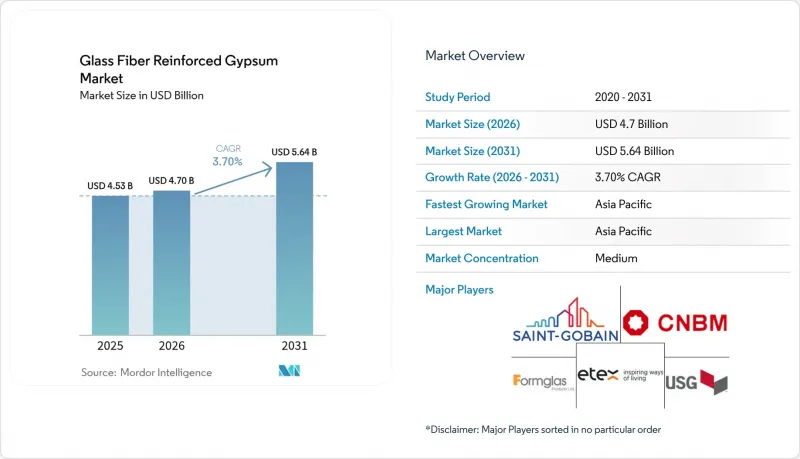
本報告按最終用戶產業(住宅、非住宅)、應用領域(室內、室外)、產品類型(標準型、防火型、高強度型、超輕/特種型、客製化建築構件和套件)以及地區(亞太地區、北美地區、歐洲地區、南美地區、中東和非洲地區)進行細分。市場預測以美元計價。
全球玻璃纖維增強石膏市場趨勢及洞察
優點包括降低安裝成本和生命週期成本。
玻璃纖維增強石膏板比傳統石膏板更輕,可降低結構荷載並加快安裝速度,從而降低人事費用並縮短工期。這種輕質板材具有顯著優勢,尤其是在維修工程中,因為它們可以直接安裝在現有基材上,而無需進行大規模的加固工作。此外,此板材耐衝擊、耐磨損且防黴,可減少維護頻率並延長維修週期。在人事費用不斷上漲的亞太地區,開發商越來越關注總體擁有成本 (TCO),這促使人們對這種材料的興趣日益濃厚。製造商強調,由於碳含量降低,還能進一步節省成本,有助於建築業主達到綠建築認證標準。這些綜合優勢正在推動這種材料在新建築和維修市場中得到越來越廣泛的應用。
對高階室內設計美學的需求日益成長
在豪華住宅大樓、飯店和企業辦公大樓中,複雜的天花板格柵、弧形牆面和一體式柱罩——這些傳統石膏板難以實現的複雜造型——正日益受到青睞。 GFRG(玻璃纖維增強石膏)能夠實現這些複雜造型,同時保持光滑的表面,可直接用於裝飾。此外,該板材甲醛和揮發性有機化合物(VOC)排放量低,符合WELL和LEED室內空氣品質認證的要求,而WELL和LEED尤其重視醫療和教育設施。阿姆斯壯世界工業公司(Armstrong World Industries)報告稱,其建築特種產品2024年的銷售額年增40.8%,顯示高品質石膏解決方案正被迅速接受。紐約、倫敦、上海和杜拜等以設計為導向的都市市場正在推動這一趨勢,而隨著數位化製造技術降低客製化模具的成本,美學價值的滲透速度也正在加速。
新興地區消費者和承包商的意識程度較低。
在中國省會城市、印度農村地區以及撒哈拉以南非洲,由於缺乏玻璃纖維增強石膏板(GFRG)的培訓資料,木工和石膏板施工團隊往往依賴木材和磚石等傳統材料。不規範的施工,例如未在板材接縫處塗抹密封劑,會導致開裂,進一步加劇人們對GFRG的負面印象。儘管製造商提供現場培訓和數位化學習模組以彌合技能差距,但在大都市以外的地區,GFRG的普及速度仍然緩慢。這種知識匱乏限制了新興市場建築市場中占主導地位的小規模住宅項目的訂單,儘管GFRG具有成本和性能優勢,但其成長速度仍然放緩。
細分市場分析
至2025年,非住宅項目將佔玻璃纖維增強石膏(GFRG)市場的60.42%,預計到2031年,該細分市場將以4.26%的複合年成長率成長。由於GFRG符合防火標準且設計靈活,商業高層建築、醫院、機場和學校擴大採用GFRG,這進一步鞏固了該細分市場的主導地位。在北美醫療機構的維修計畫中,低揮發性內牆是優先考慮的因素,而獲得GREENGUARD Gold認證的板材則更受青睞。政府為建設韌性基礎設施而提供的獎勵策略也促進了公共機構的需求。雖然住宅領域的市場佔有率仍然較小,但隨著印度和馬來西亞的經濟適用住宅供給機構試點使用承重GFRG牆板,凸顯了其成本優勢,住宅領域的成長勢頭正在增強。在美國,隨著大型零售商開始銷售無需起重設備即可由兩名工人搬運的輕質板材,DIY安裝的需求也不斷成長。儘管工業應用仍屬於小眾領域,但它們主要用於對防火和耐化學腐蝕要求極高的化工廠和資料中心,這也凸顯了該材料的技術限制。總體而言,鑑於全球基礎設施項目訂單以及日益嚴格的建築性能法規,預計該材料在非住宅領域的主導地位將繼續保持。
尤其值得一提的是,商業設施的室內裝修工程會產生重複需求,並為高品質產品提供持續的商機,因為與結構構件相比,隔間牆和天花板的改造頻率更高。在教育設施中,為了因應高人流環境,通常會選用抗衝擊表面材料,進一步提升了產品線的價值。相較之下,住宅領域則更注重成本,但中國和越南中產階級收入的成長正在推動GFRG裝飾天花板和嵌入式照明壁龕的需求增加。隨著習慣於傳統灰泥飾面的承包商轉向工廠預製GFRG,縮短了現場施工時間,交叉銷售的機會也隨之湧現。這些細分市場的差異凸顯了這種材料在不同性能標準和預算限制下的多功能性。
區域分析
在亞太地區, 主導地位得益於政府基礎設施發展計畫、快速的都市區化進程以及消費者對輕質高性能材料的偏好轉變。在中國,鐵路、機場和保障性住宅項目在經濟獎勵策略的支持下,即使房地產市場低迷,也保證了牆板生產線的滿載運作。同時,在印度的智慧城市計畫中,GFRG正被整合到多模態樞紐。在東南亞國家,特別是泰國和菲律賓,港口和物流園區的建設蓬勃發展,催生了對符合美國國家消防協會(NFPA)標準的高品質防火板材的在局部需求。製造商正在部署行動培訓單位來提升安裝人員的技能,這正在消除該地區推廣應用的主要障礙之一。穩定的外匯和具競爭力的人事費用使得GFRG能夠採取比進口水泥板更低的積極定價策略,從而維持其市場佔有率。
在北美,維修、資料中心激增以及聯邦政府對低碳材料的激勵措施等堅實的基礎條件正在推動低碳材料市場的發展。美國總務管理局 (GSA) 的「嵌入式低碳」採購計畫正在刺激聯邦計畫對先進玻璃纖維增強橡膠複合材料 (GFRG) 的需求,而美國環保署 (EPA) 提供的 1800 萬美元清潔製造津貼則正在推動工廠維修,以減少範圍 1 的排放。邊境關稅正在重塑供應鏈,迫使經銷商在中西部和阿巴拉契亞地區尋找替代貨源。加拿大各省正在修訂建築規範,允許建造更高的木造建築,間接增加了對防火層(例如 X 型 GFRG)的需求。
歐洲已將脫碳置於其戰略的核心。開發商通常要求提供環境產品聲明 (EPD),並優先選擇能夠證明其低能耗的供應商。德國和法國對節能維修的補貼正在推動對室內板材覆蓋層的需求,這種覆蓋層能夠在不犧牲空間的情況下提高隔熱性能,使其成為超輕型玻璃纖維增強混凝土 (GFRG) 的理想選擇。在波蘭和羅馬尼亞等新興歐洲經濟體,隨著近岸外包的擴張,需求也在成長,導致倉庫和輕工業設施的增加,這些設施都需要符合建築規範的防火隔間牆。在南美洲,巴西的公共住宅計畫「我的家,我的生活」(Minha Casa Minha Vida) 已開始接受 GFRG 夾芯牆板作為磚石結構的替代方案,智利的沿海度假勝地也正在採用能夠抵禦含鹽空氣的耐候板材。在中東,GFRG 被用於快速重現傳統的伊斯蘭圖案,同時減少人力成本,並滿足國際活動前緊張的專案工期。這些詳細的趨勢表明,區域動態與政策、宏觀經濟變化和區域特定的氣候需求密切相關。
其他好處:
- Excel格式的市場預測(ME)表
- 3個月的分析師支持
目錄
第1章:引言
- 研究假設和市場定義
- 調查範圍
第2章:調查方法
第3章執行摘要
第4章 市場狀況
- 市場概覽
- 市場促進因素
- 優點包括實施成本低和生命週期成本低。
- 對豪華室內設計的需求日益成長。
- 嚴格的消防安全建築標準
- 透過排煙脫硫(FGD)有效利用石膏廢棄物
- 政府主導的經濟適用住宅試點項目,採用玻璃纖維增強石膏材料。
- 市場限制因素
- 新興地區消費者和安裝人員的認知度較低。
- 對高濕度氣候下濕度影響的擔憂
- 複雜玻璃纖維增強橡膠(GFRG)模塑件生產領域技術純熟勞工短缺
- 價值鏈分析
- 波特五力分析
第5章 市場規模與成長預測
- 按最終用戶行業分類
- 住宅
- 非住宅
- 商業
- 對機構而言
- 產業
- 透過使用
- 內部的
- 外部的
- 依產品類型
- 標準型(S型)
- 耐火規格(X型)
- 高強度(C型)
- 超輕型/特種型
- 客製化建築構件和套件
- 按地區
- 亞太地區
- 中國
- 日本
- 印度
- 韓國
- 東南亞國協
- 其他亞太國家
- 北美洲
- 美國
- 加拿大
- 墨西哥
- 歐洲
- 德國
- 英國
- 法國
- 義大利
- 西班牙
- 俄羅斯
- 北歐國家
- 其他歐洲國家
- 南美洲
- 巴西
- 阿根廷
- 其他南美國家
- 中東和非洲
- 沙烏地阿拉伯
- 南非
- 其他中東和非洲國家
- 亞太地區
第6章 競爭情勢
- 市場集中度
- 策略趨勢
- 市佔率和排名分析
- 公司簡介
- AWI Licensing LLC
- China National Building Material Group Corporation
- CHIYODA UTE CO.,LTD.
- Etex Group
- Formglas Products Ltd.
- GC Products LLC
- GP Industrial Plasters LLC
- Hyde Park Mouldings, Inc.
- Saint-Gobain
- Stromberg Architectural
- USG Corporation
第7章 市場機會與未來展望
According to Mordor Intelligence, the glass fiber reinforced gypsum market size was valued at USD 4.53 billion in 2025 and estimated to grow from USD 4.70 billion in 2026 to reach USD 5.64 billion by 2031, at a CAGR of 3.70% during the forecast period (2026-2031).
This report is Segmented by End-User Industry (Residential, Non-Residential), Application (Interior, Exterior), Product Type (Standard, Fire-Rated, High-Strength, Ultra-Lightweight/Specialty, Custom Architectural Elements & Kits), and Geography (Asia-Pacific, North America, Europe, South America, Middle East and Africa). The Market Forecasts are Provided in Terms of Value (USD).
Global Glass Fiber Reinforced Gypsum Market Trends and Insights
Lower Installation & Life-Cycle Cost Advantage
Glass fiber reinforced gypsum weighs less than traditional gypsum board, trims structural loads, and accelerates installation, thereby cutting labor outlays and project schedules. Retrofit projects benefit most because lighter panels allow direct attachment over existing substrates without extensive reinforcement. The boards also resist impact, abrasion, and mold growth, reducing maintenance frequency and extending refurbishment cycles. Developer focus on total cost of ownership in Asia-Pacific, where labor costs are rising, is intensifying interest in the material. Manufacturers highlight additional savings tied to lower embodied carbon, which can help building owners meet green-building certification thresholds. These combined advantages lift specification rates in both new-build and renovation markets.
Rising Demand for Premium Interior Aesthetics
High-end residential towers, hospitality venues, and corporate offices increasingly specify intricate ceiling coffers, curved walls, and monolithic column enclosures that conventional gypsum cannot deliver economically. GFRG enables such complex geometries while maintaining a smooth finish suitable for direct decoration. The boards achieve low formaldehyde and VOC emissions, aligning with WELL and LEED interior air-quality credits, a priority in healthcare and education facilities. Armstrong World Industries reported a 40.8% year-on-year jump in architectural specialties revenue in 2024, illustrating fast adoption of premium gypsum solutions. Design-laden urban markets such as New York, London, Shanghai, and Dubai are fueling the trend, and the aesthetic pull-through accelerates as digital fabrication techniques make custom molds more economical.
Low Consumer & Installer Awareness in Emerging Regions
Carpenters and drywall crews in secondary Chinese cities, rural India, and sub-Saharan Africa often default to wood or masonry because training materials for GFRG are scarce. Misapplication-such as omitting sealant on panel joints-can lead to cracking, reinforcing negative perceptions. Manufacturers sponsor on-site clinics and digital modules to bridge the skills gap, yet uptake outside capital cities is gradual. The knowledge deficit limits order volumes in small-scale residential projects that dominate emerging-market construction, tempering growth despite favorable cost and performance metrics.
Other drivers and restraints analyzed in the detailed report include:
- Valorization of Flue-Gas-Desulfurization (FGD) Gypsum Waste
- Government-Led Affordable-Housing Pilots Adopting GFRG
- Moisture-Susceptibility Concerns in High-Humidity Climates
For complete list of drivers and restraints, kindly check the Table Of Contents.
Segment Analysis
Non-residential projects captured 60.42% of the glass fiber reinforced gypsum market share in 2025, and the segment is forecast to advance at 4.26% CAGR through 2031. Commercial towers, hospitals, airports, and schools increasingly specify GFRG for its fire-rating compliance and design freedom, strengthening the segment's lead. Renovation programs across North American healthcare facilities emphasize low-emission interiors, favoring GREENGUARD Gold-certified boards. Institutional demand also benefits from government stimulus allocations focused on resilient infrastructure. The residential slice remains smaller but is gathering pace as affordable-housing agencies in India and Malaysia pilot load-bearing GFRG wall panels, highlighting cost advantages. DIY adoption in the United States is rising as big-box retailers stock lightweight panels that can be handled by two workers without lifting equipment. Industrial applications remain niche-predominantly chemical plants and data centers where fire and chemical stability are paramount-but serve as proof points for the material's technical ceiling. Overall, non-residential leadership is likely to persist given the backlog of global infrastructure projects and stricter building-performance mandates.
Commercial interiors in particular drive repeat volume because partition walls and ceilings undergo more frequent reconfiguration than structural elements, opening recurring opportunities for premium products. Educational facilities specify impact-resistant faces to withstand high foot traffic, expanding the value mix. In contrast, the residential segment prioritizes cost, but rising middle-class incomes in China and Vietnam are unlocking demand for decorative ceiling roses and recessed lighting niches made from GFRG. Cross-selling opportunities emerge as contractors accustomed to classical plaster ornaments pivot toward factory-finished GFRG, shortening on-site schedules. The segment split underscores the versatility of the material across divergent performance thresholds and budget constraints.
Complete Report Scope:
- By End-user Industry
- Residential
- Non-Residential
- Commercial
- Institutional
- Industrial
- By Application
- Interior
- Exterior
- By Product Type
- Standard (Type S)
- Fire-Rated (Type X)
- High-Strength (Type C)
- Ultra-Lightweight/Specialty
- Custom Architectural Elements and Kits
- By Geography
- Asia-Pacific
- China
- Japan
- India
- South Korea
- ASEAN Countries
- Rest of Asia-Pacific
- North America
- United States
- Canada
- Mexico
- Europe
- Germany
- United Kingdom
- France
- Italy
- Spain
- Russia
- NORDIC Countries
- Rest of Europe
- South America
- Brazil
- Argentina
- Rest of South America
- Middle East and Africa
- Saudi Arabia
- South Africa
- Rest of Middle East and Africa
- Asia-Pacific
Geography Analysis
Asia-Pacific's leadership rests on government infrastructure pipelines, rapid urban migration, and an evolving preference for lightweight, high-performance materials. China's stimulus-backed rail, airport, and social-housing projects keep wallboard lines busy despite real-estate softness, while India's smart-city initiatives integrate GFRG into multi-modal transit hubs. Southeast Asian nations, notably Thailand and the Philippines, intensify port and logistics-park construction, creating pockets of premium board demand to satisfy NFPA-aligned fire codes. Manufacturers deploy mobile training units to raise installer proficiency, thereby easing one of the region's principal adoption constraints. Exchange-rate stability and competitive labor costs permit aggressive pricing strategies that undercut imported cement panels, preserving share gains.
North America follows with strong fundamentals rooted in renovation spending, data-center proliferation, and federal incentives for low-carbon materials. The U.S. General Services Administration's low embodied-carbon procurement program unlocks federal project demand for advanced GFRG formulations, while the EPA's USD 18 million clean-manufacturing grants catalyze factory upgrades to lower Scope 1 emissions. Border tariffs reshape supply chains, prompting distributors to secure alternate sources within the Midwest and Appalachia. Canadian provinces update building codes to allow taller wood-frame structures, indirectly increasing demand for fire-barrier layers such as Type X GFRG.
Europe centers its strategy on decarbonization. Developers routinely request Environmental Product Declarations, rewarding suppliers that can document lower embodied energy. Energy-retrofit subsidies in Germany and France push demand for interior board overlays that improve thermal resistance without sacrificing space, an ideal fit for ultra-lightweight GFRG. Emerging European economies-Poland, Romania-also climb as nearshoring expands warehousing and light-industrial stock, each requiring code-compliant fire partitions. In South America, Brazil's Minha Casa Minha Vida subsidized-housing program begins to accept GFRG sandwich wall panels as a substitute for masonry, and Chilean coastal resorts use weather-resistant boards to withstand saline air. The Middle East leans on GFRG ornamentation to replicate traditional Islamic motifs quickly, trimming artisan labor while hitting tight project timelines ahead of international events. Collectively, these nuances illustrate that regional dynamics intertwine policy, macroeconomic shifts, and localized climatic demands.
- AWI Licensing LLC
- China National Building Material Group Corporation
- CHIYODA UTE CO.,LTD.
- Etex Group
- Formglas Products Ltd.
- GC Products LLC
- GP Industrial Plasters LLC
- Hyde Park Mouldings, Inc.
- Saint-Gobain
- Stromberg Architectural
- USG Corporation
Additional Benefits:
- The market estimate (ME) sheet in Excel format
- 3 months of analyst support
TABLE OF CONTENTS
1 Introduction
- 1.1 Study Assumptions and Market Definition
- 1.2 Scope of the Study
2 Research Methodology
3 Executive Summary
4 Market Landscape
- 4.1 Market Overview
- 4.2 Market Drivers
- 4.2.1 Lower installation and life-cycle cost advantage
- 4.2.2 Rising demand for premium interior aesthetics
- 4.2.3 Stringent fire-safety building codes
- 4.2.4 Valorization of flue-gas-desulfurization (FGD) gypsum waste
- 4.2.5 Government-led affordable-housing pilots adopting glass fiber reinforced gypsum
- 4.3 Market Restraints
- 4.3.1 Low consumer and installer awareness in emerging regions
- 4.3.2 Moisture-susceptibility concerns in high-humidity climates
- 4.3.3 Shortage of skilled labour for complex GFRG mouldings
- 4.4 Value Chain Analysis
- 4.5 Porter's Five Forces Analysis
- 4.5.1 Threat of New Entrants
- 4.5.2 Bargaining Power of Buyers
- 4.5.3 Bargaining Power of Suppliers
- 4.5.4 Threat of Substitute Products
- 4.5.5 Degree of Competition
5 Market Size and Growth Forecasts (Value)
- 5.1 By End-user Industry
- 5.1.1 Residential
- 5.1.2 Non-Residential
- 5.1.2.1 Commercial
- 5.1.2.2 Institutional
- 5.1.2.3 Industrial
- 5.2 By Application
- 5.2.1 Interior
- 5.2.2 Exterior
- 5.3 By Product Type
- 5.3.1 Standard (Type S)
- 5.3.2 Fire-Rated (Type X)
- 5.3.3 High-Strength (Type C)
- 5.3.4 Ultra-Lightweight/Specialty
- 5.3.5 Custom Architectural Elements and Kits
- 5.4 By Geography
- 5.4.1 Asia-Pacific
- 5.4.1.1 China
- 5.4.1.2 Japan
- 5.4.1.3 India
- 5.4.1.4 South Korea
- 5.4.1.5 ASEAN Countries
- 5.4.1.6 Rest of Asia-Pacific
- 5.4.2 North America
- 5.4.2.1 United States
- 5.4.2.2 Canada
- 5.4.2.3 Mexico
- 5.4.3 Europe
- 5.4.3.1 Germany
- 5.4.3.2 United Kingdom
- 5.4.3.3 France
- 5.4.3.4 Italy
- 5.4.3.5 Spain
- 5.4.3.6 Russia
- 5.4.3.7 NORDIC Countries
- 5.4.3.8 Rest of Europe
- 5.4.4 South America
- 5.4.4.1 Brazil
- 5.4.4.2 Argentina
- 5.4.4.3 Rest of South America
- 5.4.5 Middle East and Africa
- 5.4.5.1 Saudi Arabia
- 5.4.5.2 South Africa
- 5.4.5.3 Rest of Middle East and Africa
- 5.4.1 Asia-Pacific
6 Competitive Landscape
- 6.1 Market Concentration
- 6.2 Strategic Moves
- 6.3 Market Share(%)/Ranking Analysis
- 6.4 Company Profiles (includes Global level Overview, Market level overview, Core Segments, Financials as available, Strategic Information, Market Rank/Share for key companies, Products and Services, and Recent Developments)
- 6.4.1 AWI Licensing LLC
- 6.4.2 China National Building Material Group Corporation
- 6.4.3 CHIYODA UTE CO.,LTD.
- 6.4.4 Etex Group
- 6.4.5 Formglas Products Ltd.
- 6.4.6 GC Products LLC
- 6.4.7 GP Industrial Plasters LLC
- 6.4.8 Hyde Park Mouldings, Inc.
- 6.4.9 Saint-Gobain
- 6.4.10 Stromberg Architectural
- 6.4.11 USG Corporation
7 Market Opportunities and Future Outlook
- 7.1 White-space and Unmet-need Assessment

 合成石膏市場:依原料、純度、產品形態、製造流程、產品類型及終端用戶產業分類-2026-2032年全球市場預測
 全球合成石膏市場規模、佔有率、趨勢和成長分析報告(2026-2034年)玻璃纖維增強石膏市場:按產品形式、應用、分銷管道和最終用戶分類-2026-2032年全球市場預測
 2026年全球合成石膏市場報告
 玻璃纖維增強石膏市場規模、佔有率和成長分析(按應用、形態、最終用途領域、關鍵特性和地區分類)—2026-2033年產業預測
 合成石膏市場規模、佔有率及成長分析(按類型、應用和地區分類)-2026-2033年產業預測
 合成石膏市場:全球產業分析、規模、佔有率、成長、趨勢與預測,2025-2032
 合成石膏市場規模、佔有率和趨勢分析報告:按產品類型、應用、地區和細分市場預測,2025 年至 2030 年
 合成石膏市場-全球產業規模、佔有率、趨勢、機會和預測,細分,按產品類型(煙氣脫硫石膏、氟石膏、磷石膏)、按應用、按地區、按競爭,2020-2030 年預測
 合成石膏市場報告:趨勢、預測和競爭分析(至 2031 年)