


 |
市場調查報告書
商品編碼
2117487
合成皮革:市場佔有率分析、產業趨勢與統計、成長預測(2026-2031)Synthetic Leather - Market Share Analysis, Industry Trends & Statistics, Growth Forecasts (2026 - 2031) |
||||||

※ 本網頁內容可能與最新版本有所差異。詳細情況請與我們聯繫。
根據 Mordor Intelligence 預測,合成皮革市場規模將從 2025 年的 452.2 億美元和 2026 年的 488.4 億美元成長到 2031 年的 718.6 億美元,2026 年至 2031 年的複合年成長率為 8.03%。
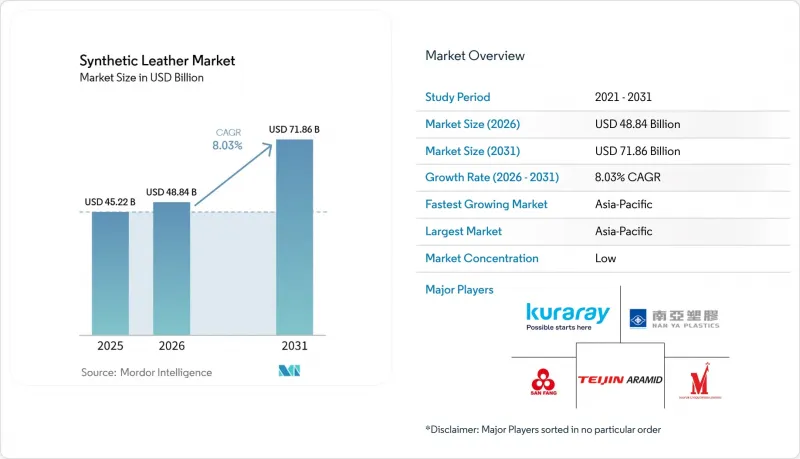
本報告按皮革類型(例如,PU合成皮革、PVC合成皮革)、製造流程(例如,水性PU塗層、無溶劑PU系統)、應用領域(例如,鞋類、汽車內裝)和地區(亞太地區、北美地區、歐洲地區、南美地區、中東和非洲地區)進行細分。市場預測以美元(USD)計價。
全球合成皮革市場趨勢及洞察
PU 作為 PVC 的替代品:經濟的配方正在改變基材。
在合成革市場,聚氨酯(PU)正穩步佔據主導地位。與聚氯乙烯(PVC)相比,PU在合規性、外觀品質和高階應用適用性方面實現了更好的平衡。成品中二甲基甲醯胺殘留量的限制,加重了嚴重依賴傳統溶劑的生產線的營運負擔。為了滿足更嚴格的標準,可能需要多次熱水清洗,這會增加製程成本和能源消耗。在大批量供應鏈中,這種壓力尤其顯著,因為買家希望在不犧牲表面紋理、柔軟度和均勻性的前提下,減少溶劑的使用。擁有先進塗層能力的大規模工商在合成皮革市場中處於有利地位,因為他們可以承擔維修成本,並更快地回應買家的認證要求。因此,基材成分的轉變正在加速,鞏固了PU在那些需要綜合評估外觀、合規性和耐久性的類別中的地位。
對純素原料的需求:OEM公司在採購規範中的努力正日益具體化。
時尚界和汽車內裝領域對無動物成分材料的廣泛需求,正推動合成皮革市場的發展。梅賽德斯-奔馳發布了一款獲得純素認證的電動車(EV)內飾,其關鍵接觸區域採用了ARTICO合成革,這表明「無動物成分」不再只是一句行銷口號,而是產品規格的一部分。現代汽車旗下的Cradle公司也於2025年8月與UNCAGED Innovations公司合作,開發一種用於汽車應用的粒面皮革替代品,這表明汽車製造商正在投資上游工程材料研發,而不是等待標準的商業供應。這些變化提高了合成皮革市場的品質要求,因為生產商需要提供可追溯、技術穩定且符合更嚴格採購要求的產品。這也為那些旨在減少環境影響,同時又不犧牲觸感或視覺一致性的品牌提供了更大的溢價空間。
PFAS、DMF 和乙烯基化學品的相關法規:合規成本正在重塑市場
對 PFAS、DMF 和乙烯基配方的更嚴格監管顯然正在限制合成皮革市場的發展。這是因為合規性如今會影響化學品的選擇和出口準備。歐盟的全氟己酸 (PFHxA) 法規進一步增加了對目標產品類別(包括服裝、配件和相關塗層材料)的壓力,縮小了傳統加工方法在歐洲市場的適用範圍。法國也將於 2026 年 1 月起對含 PFAS 的紡織品和鞋類實施監管,這使得處理這些產品線的供應商迫切需要審查配方並進行測試。對於中型出口商而言,挑戰不僅限於化學品替代,還包括與文件編制、批次間測試和召回預防相關的成本,尤其是在一條生產線供應多個終端市場的情況下。這正在減緩部分合成皮革市場的發展,因為小規模製造商可能會推遲設備升級,失去進入高階市場的機會,或轉向合規要求相對較低的低規格應用。
細分市場分析
2025年,聚氨酯(PU)佔總需求的51.36%,在合成皮革市場中保持對其他皮革類型的明顯主導地位。這一地位反映了PU比聚氯乙烯(PVC)更能滿足更廣泛的性能和外觀要求,尤其是在高階鞋履、家具裝飾和汽車內裝領域。生物基合成皮革是成長最快的皮革類型,預計到2031年將以9.80%的複合年成長率成長。這表明,即使在成本完全持平之前,需求也已經開始轉變。憑藉大規模的生產基地和成本優勢,PVC在價格敏感型應用領域(例如入門鞋履和低價家具)仍然佔有一席之地。矽酮和TPO/TPU基產品雖然在合成革市場中所佔佔有率較小,但在那些優先考慮耐熱性、耐候性或特殊表面性能而非價格的應用領域,它們正受到越來越多的關注。
皮革類型的組成也反映了合成皮革產業技術發展的進展。根據2025年發表在《ACS永續化學與工程》期刊上的一項研究,一種由1,4-丁二醇和己二酸製成的生物基聚酯醯胺塗層,其拉伸強度是組成均聚物的八倍,並且在堆肥條件下,一個月內其生物分解率比纖維素高出60%以上。這些進步正在推動高品質生物基材料的應用,縮小永續性和實用性能之間的差距。因此,儘管預計聚氨酯(PU)在整個預測期內仍將保持主導地位,但在那些優先考慮品牌、合規性和供應商合作而非最低成本生產的項目中,生物基皮革可能會率先擴張。
區域分析
預計到2025年,亞太地區將佔全球合成皮革需求的45.71%,並在2031年之前以8.81%的複合年成長率成長,成為合成皮革市場規模最大、成長最快的地區。該地區受益於中國龐大的加工基地、印度不斷擴張的鞋類製造業以及連接原料、塗層能力和出口管道的緊密供應鏈。這些因素共同推動亞太地區逐步轉型為生產更高品質的聚氨酯(PU)產品,同時在主流品類中維持規模經濟效益。日本在高階市場仍然佔據重要地位,東麗、KURARAY CO. LTD.和旭化成等公司在超細纖維和高性能材料領域,尤其是在汽車和時尚應用領域,建立了強大的市場地位。憑藉該地區強大的工業基礎,合成皮革市場的許多技術創新和成本轉型都源自亞太地區,並持續向其他地區推廣。
北美和歐洲是合成皮革市場附加價值最高的區域市場,這主要得益於嚴格的監管合規要求以及比其他大多數地區更嚴苛的內裝品質標準。這兩個地區的需求均由符合低排放、高性能產品規格的優質水性無溶劑聚氨酯產品支撐。順應這一趨勢,Vulcaflex SpA於2026年6月宣布計劃投資約7,000萬美元,在阿拉巴馬州奧本市建造其在北美的首家工廠。該工廠將為美國、加拿大和墨西哥的汽車產業客戶供應產品。在歐洲,更嚴格的化學品法規和更嚴苛的買家要求持續推動對升級版聚氨酯系統的需求,但與亞洲相比,其整體產量成長速度仍然較慢。
南美、中東和非洲為合成皮革市場提供了更多長期成長機遇,其需求與鞋類生產、家具消費以及汽車組裝的逐步本地化密切相關。巴西和阿根廷仍然是南美的主要需求中心,該地區的鞋類製造業構成了一個對價格具有競爭力的塗層材料的重要市場。沙烏地阿拉伯和阿拉伯聯合大公國(阿拉伯聯合大公國)是中東的主要消費中心,這得益於飯店家具和時尚零售業的需求。由於加工基礎設施不發達以及品質和永續性標準執行不力,這些地區的成長率仍然低於全球平均。因此,低成本、聚氯乙烯(PVC)含量高的產品在這些市場的主導地位可能會比在歐洲或北美市場持續更長時間。
其他好處:
- Excel格式的市場預測(ME)表
- 3個月的分析師支持
目錄
第1章:引言
- 研究假設和市場定義
- 調查範圍
第2章:調查方法
第3章執行摘要
第4章 市場狀況
- 市場概覽
- 市場促進因素
- 在大眾市場和高階應用中,PU 正在取代 PVC 和真皮。
- 鞋履和時尚品牌對純素材料的需求
- 汽車座艙優質化及電動車內裝需求
- 水性無溶劑聚氨酯的商業化
- 採用隱藏式人機介面和半透明內表面
- 市場限制因素
- PFAS、DMF 和聚氯乙烯合規壓力
- 低成本等級產品中水解和熱老化的局限性
- 生物基合成革的成本溢價與規模限制
- 價值鏈分析
- 波特五力分析
第5章 市場規模與成長預測
- 按皮革類型
- PU合成皮革
- PVC合成革
- 生物基合成皮革
- 矽膠合成皮革
- TPO/TPU合成皮革
- 透過製造技術
- 溶劑型固化和塗層
- 水性聚氨酯塗料
- 無溶劑聚氨酯體系
- 透過使用
- 鞋類
- 家具
- 椅子
- 沙發
- 其他裝飾
- 汽車內裝
- 座位
- 門飾條和麵板
- 儀表板和儀錶板表面
- 方向盤和主機表面
- 其他內表面
- 包包、皮夾、行李箱
- 錢包
- 包包
- 手提包
- 服裝和時尚配件
- 夾克
- 腰帶
- 其他服裝配件
- 運動和休閒用品
- 船舶和特殊用途
- 按地區
- 亞太地區
- 中國
- 日本
- 印度
- 韓國
- 其他亞太國家
- 北美洲
- 美國
- 加拿大
- 墨西哥
- 歐洲
- 德國
- 英國
- 法國
- 義大利
- 西班牙
- 俄羅斯
- 其他歐洲國家
- 南美洲
- 巴西
- 阿根廷
- 其他南美國家
- 中東和非洲
- 沙烏地阿拉伯
- 阿拉伯聯合大公國
- 南非
- 其他中東和非洲國家
- 亞太地區
第6章 競爭情勢
- 市場集中度
- 策略趨勢
- 市佔率和排名分析
- 公司簡介
- Anhui Anli Material Technology Co., Ltd.
- Asahi Kasei Corporation
- Baiksan Co., Ltd.
- BASF SE
- Continental AG
- Covestro AG
- Dow Inc.
- FILWEL Co., Ltd.
- Fujian Polytech Technology Corp., Ltd.
- HR Polycoats Pvt. Ltd.
- Jasch Industries Limited
- Kolon Industries, Inc.
- KURARAY CO., LTD.
- Mayur Uniquoters Limited
- NAN YA PLASTICS CORPORATION
- Responsive Industries Limited
- San Fang Chemical Industry Co., Ltd.
- Seiren Co., Ltd.
- TEIJIN LIMITED
- Toray Industries, Inc.
- Wanhua Chemical Group Co., Ltd.
第7章 市場機會與未來展望
According to Mordor Intelligence, the synthetic leather market size is projected to expand from USD 45.22 billion in 2025 and USD 48.84 billion in 2026 to USD 71.86 billion by 2031, registering a CAGR of 8.03% between 2026 to 2031.
This report is Segmented by Leather Type (PU Synthetic Leather, PVC Synthetic Leather, and More), Manufacturing Technology (Water-Based PU Coating, Solvent-Free PU Systems, and More), Application (Footwear, Automotive Interiors, and More), and Geography (Asia-Pacific, North America, Europe, South America, and Middle-East and Africa). The Market Forecasts are Provided in Terms of Value (USD).
Global Synthetic Leather Market Trends and Insights
PU Replacing PVC: Formulation Economics Shift the Base Material
The synthetic leather market is seeing a steady shift toward PU, as it offers a more favorable balance of compliance readiness, visual quality, and suitability for premium applications than PVC. Residual dimethylformamide limits in finished articles increase the operating burden on conventional solvent-heavy lines, as multiple hot-water washes may be required to meet stricter thresholds, raising both process costs and energy use. This pressure is most significant in high-volume supply chains where buyers want lower solvent exposure without sacrificing grain finish, softness, or consistency. Larger converters with upgraded coating capacity are better positioned in the synthetic leather market, as they can absorb retrofit costs and respond more quickly to buyer qualification requirements. The result is a faster transition in the base material mix, with PU strengthening its position in categories where appearance, compliance, and durability are evaluated together.
Vegan-Material Demand: OEM Commitments are Hardening into Procurement Specs
The synthetic leather market is gaining support from a broader shift toward animal-free materials in both fashion and vehicle interiors. Mercedes-Benz introduced a vegan-certified electric vehicle interior featuring ARTICO synthetic leather across major touchpoints, demonstrating that animal-free content is now part of product specification rather than marketing language. Hyundai CRADLE also partnered with UNCAGED Innovations in August 2025 to develop grain-based leather alternatives for vehicles, indicating that automakers are investing upstream in material development rather than waiting for standard commercial supply. These changes raise quality requirements in the synthetic leather market, as producers now need to offer traceable, technically stable variants that can meet stricter procurement requirements. This also widens the path for premium pricing where brands want lower environmental impact without compromising tactile quality or visual consistency.
PFAS, DMF, and Vinyl-Based Chemical Regulations: Compliance Cost as a Market Reshaper
Tighter regulations on PFAS, DMF, and vinyl-linked formulations present a clear restraint for the synthetic leather market, as compliance now affects both chemical choices and export readiness. The EU perfluorohexanoic acid (PFHxA) regulation adds pressure on affected product categories, including clothing, accessories, and related coated materials, narrowing the scope for legacy treatments in European channels. France has also introduced restrictions on PFAS-containing textiles and footwear effective January 2026, increasing the urgency for reformulation and testing among suppliers that serve those product lines. For mid-tier exporters, the challenge extends beyond chemical substitution to include the costs of documentation, batch testing, and recall prevention when a single production line serves multiple end markets. This slows parts of the synthetic leather market, as smaller manufacturers may delay upgrades, lose access to premium channels, or shift toward lower-specification applications where compliance requirements are less stringent.
Other drivers and restraints analyzed in the detailed report include:
- Automotive Cabin Premiumization: EV Architecture Redefines the Substrate
- Waterborne and Solvent-Free Technology: The New Production Baseline
- Hydrolysis and Heat-Aging Durability: A Hidden Barrier to Market Expansion
For complete list of drivers and restraints, kindly check the Table Of Contents.
Segment Analysis
PU accounted for 51.36% of total demand in 2025, maintaining a clear lead over other leather types in the synthetic leather market. This position reflects its ability to meet a wider range of performance and appearance requirements than PVC, particularly in premium footwear, upholstery, and vehicle interiors. Bio-based synthetic leather is the fastest-growing leather type, projected to expand at a 9.80% CAGR through 2031, indicating a demand shift even before full cost parity is achieved. PVC retains a presence in price-sensitive applications such as entry-level footwear and lower-end furnishings, supported by a large installed process base and cost advantages. Silicone and TPO/TPU variants hold smaller shares in the synthetic leather market but are gaining traction in applications where heat stability, weather resistance, or specialized surface performance take priority over price.
The leather type mix also reflects the pace of technical development in the synthetic leather industry. A 2025 study in ACS Sustainable Chemistry & Engineering found that bio-based poly(ester amide) coatings derived from 1,4-butanediol and adipic acid achieved tensile strength 8 times higher than constituent homopolymers and delivered more than 60% biodegradation relative to cellulose under composting conditions within one month. This progress supports the case for premium bio-based materials by narrowing the gap between sustainability and usable performance. PU is therefore likely to retain its lead through the forecast period, while bio-based grades expand first in programs where branding, compliance, and supplier collaboration carry more weight than lowest-cost output.
Complete Report Scope:
- By Leather Type
- PU Synthetic Leather
- PVC Synthetic Leather
- Bio-based Synthetic Leather
- Silicone Synthetic Leather
- TPO/TPU Synthetic Leather
- By Manufacturing Technology
- Solvent-based Coagulation and Coating
- Water-based PU Coating
- Solvent-free PU Systems
- By Application
- Footwear
- Furnishing
- Chairs
- Sofas
- Other Upholstery
- Automotive Interiors
- Seats
- Door Trims and Panels
- Dashboard and Instrument Panel Surfaces
- Steering Wheel and Console Surfaces
- Other Interior Surfaces
- Bags, Wallets and Luggage
- Wallets
- Bags
- Purses
- Clothing and Fashion Accessories
- Jackets
- Belts
- Other Apparel Accessories
- Sports and Leisure Goods
- Marine and Specialty Uses
- By Geography
- Asia-Pacific
- China
- Japan
- India
- South Korea
- Rest of Asia-Pacific
- North America
- United States
- Canada
- Mexico
- Europe
- Germany
- United Kingdom
- France
- Italy
- Spain
- Russia
- Rest of Europe
- South America
- Brazil
- Argentina
- Rest of South America
- Middle-East and Africa
- Saudi Arabia
- United Arab Emirates
- South Africa
- Rest of Middle-East and Africa
- Asia-Pacific
Geography Analysis
Asia-Pacific accounted for 45.71% of global demand in 2025 and is forecast to grow at a 8.81% CAGR through 2031, making it both the largest and fastest-growing region in the synthetic leather market. The region benefits from China's large converting base, India's expanding footwear manufacturing position, and a dense supply chain linking raw materials, coating capacity, and export channels. This combination gives Asia-Pacific a scale advantage in mainstream categories while supporting a gradual shift toward higher-grade PU output. Japan remains relevant in the premium tier, with companies such as Toray Industries, Kuraray, and Asahi Kasei holding established positions in microfiber and high-performance materials for automotive and fashion applications. Given the region's depth, many technology and cost transitions in the broader synthetic leather market continue to originate in Asia-Pacific before spreading to other regions.
North America and Europe represent the highest-value regional pair in the synthetic leather market, driven by regulatory compliance requirements and interior quality expectations that are more stringent than in most other regions. Demand in both regions is supported by premium waterborne and solvent-free PU grades that meet lower-emission and higher-performance product specifications. Vulcaflex S.p.A. reflected this trend in June 2026 with its plan to invest almost USD 70 million in its first North American plant in Auburn, Alabama, to supply automotive customers across the United States, Canada, and Mexico. In Europe, tighter chemical regulations and stricter buyer requirements continue to support demand for upgraded PU systems, even as total volume growth remains slower than in Asia.
South America, the Middle East, and Africa represent a longer-cycle opportunity for the synthetic leather market, with demand tied to footwear output, furnishing consumption, and the gradual localization of automotive assembly. Brazil and Argentina remain the primary South American demand centers, where regional footwear manufacturing creates a meaningful market for coated materials at competitive prices. Saudi Arabia and the UAE serve as the main consumption hubs in the Middle East, supported by demand for hospitality furnishings and fashion retail. Growth across these regions remains below the global average due to less developed converter infrastructure and inconsistent enforcement of quality and sustainability standards. As a result, lower-cost polyvinyl chloride (PVC)-heavy products are likely to remain prevalent in these markets for longer than in Europe or North America.
- Anhui Anli Material Technology Co., Ltd.
- Asahi Kasei Corporation
- Baiksan Co., Ltd.
- BASF SE
- Continental AG
- Covestro AG
- Dow Inc.
- FILWEL Co., Ltd.
- Fujian Polytech Technology Corp., Ltd.
- H.R. Polycoats Pvt. Ltd.
- Jasch Industries Limited
- Kolon Industries, Inc.
- KURARAY CO., LTD.
- Mayur Uniquoters Limited
- NAN YA PLASTICS CORPORATION
- Responsive Industries Limited
- San Fang Chemical Industry Co., Ltd.
- Seiren Co., Ltd.
- TEIJIN LIMITED
- Toray Industries, Inc.
- Wanhua Chemical Group Co., Ltd.
Additional Benefits:
- The market estimate (ME) sheet in Excel format
- 3 months of analyst support
TABLE OF CONTENTS
1 Introduction
- 1.1 Study Assumptions & Market Definition
- 1.2 Scope of the Study
2 Research Methodology
3 Executive Summary
4 Market Landscape
- 4.1 Market Overview
- 4.2 Market Drivers
- 4.2.1 PU replacing PVC and genuine leather in mass-premium uses
- 4.2.2 Vegan-material demand from footwear and fashion brands
- 4.2.3 Automotive cabin premiumization and EV interior demand
- 4.2.4 Waterborne and solvent-free PU commercialization
- 4.2.5 Hidden-HMI and translucent interior surface adoption
- 4.3 Market Restraints
- 4.3.1 PFAS, DMF and vinyl-chloride compliance pressure
- 4.3.2 Hydrolysis and heat-aging limits in low-cost grades
- 4.3.3 Bio-based synthetic leather cost premium and scale constraints
- 4.4 Value Chain Analysis
- 4.5 Porter's Five Forces Analysis
- 4.5.1 Supplier Power
- 4.5.2 Buyer Power
- 4.5.3 Threat of Substitutes
- 4.5.4 Threat of New Entrants
- 4.5.5 Competitive Rivalry
5 Market Size & Growth Forecasts (Value and Volume)
- 5.1 By Leather Type
- 5.1.1 PU Synthetic Leather
- 5.1.2 PVC Synthetic Leather
- 5.1.3 Bio-based Synthetic Leather
- 5.1.4 Silicone Synthetic Leather
- 5.1.5 TPO/TPU Synthetic Leather
- 5.2 By Manufacturing Technology
- 5.2.1 Solvent-based Coagulation and Coating
- 5.2.2 Water-based PU Coating
- 5.2.3 Solvent-free PU Systems
- 5.3 By Application
- 5.3.1 Footwear
- 5.3.2 Furnishing
- 5.3.2.1 Chairs
- 5.3.2.2 Sofas
- 5.3.2.3 Other Upholstery
- 5.3.3 Automotive Interiors
- 5.3.3.1 Seats
- 5.3.3.2 Door Trims and Panels
- 5.3.3.3 Dashboard and Instrument Panel Surfaces
- 5.3.3.4 Steering Wheel and Console Surfaces
- 5.3.3.5 Other Interior Surfaces
- 5.3.4 Bags, Wallets and Luggage
- 5.3.4.1 Wallets
- 5.3.4.2 Bags
- 5.3.4.3 Purses
- 5.3.5 Clothing and Fashion Accessories
- 5.3.5.1 Jackets
- 5.3.5.2 Belts
- 5.3.5.3 Other Apparel Accessories
- 5.3.6 Sports and Leisure Goods
- 5.3.7 Marine and Specialty Uses
- 5.4 By Geography
- 5.4.1 Asia-Pacific
- 5.4.1.1 China
- 5.4.1.2 Japan
- 5.4.1.3 India
- 5.4.1.4 South Korea
- 5.4.1.5 Rest of Asia-Pacific
- 5.4.2 North America
- 5.4.2.1 United States
- 5.4.2.2 Canada
- 5.4.2.3 Mexico
- 5.4.3 Europe
- 5.4.3.1 Germany
- 5.4.3.2 United Kingdom
- 5.4.3.3 France
- 5.4.3.4 Italy
- 5.4.3.5 Spain
- 5.4.3.6 Russia
- 5.4.3.7 Rest of Europe
- 5.4.4 South America
- 5.4.4.1 Brazil
- 5.4.4.2 Argentina
- 5.4.4.3 Rest of South America
- 5.4.5 Middle-East and Africa
- 5.4.5.1 Saudi Arabia
- 5.4.5.2 United Arab Emirates
- 5.4.5.3 South Africa
- 5.4.5.4 Rest of Middle-East and Africa
- 5.4.1 Asia-Pacific
6 Competitive Landscape
- 6.1 Market Concentration
- 6.2 Strategic Moves
- 6.3 Market Share/Ranking Analysis
- 6.4 Company Profiles (includes Global level Overview, Market level overview, Core Segments, Financials as available, Strategic Information, Products & Services, and Recent Developments)
- 6.4.1 Anhui Anli Material Technology Co., Ltd.
- 6.4.2 Asahi Kasei Corporation
- 6.4.3 Baiksan Co., Ltd.
- 6.4.4 BASF SE
- 6.4.5 Continental AG
- 6.4.6 Covestro AG
- 6.4.7 Dow Inc.
- 6.4.8 FILWEL Co., Ltd.
- 6.4.9 Fujian Polytech Technology Corp., Ltd.
- 6.4.10 H.R. Polycoats Pvt. Ltd.
- 6.4.11 Jasch Industries Limited
- 6.4.12 Kolon Industries, Inc.
- 6.4.13 KURARAY CO., LTD.
- 6.4.14 Mayur Uniquoters Limited
- 6.4.15 NAN YA PLASTICS CORPORATION
- 6.4.16 Responsive Industries Limited
- 6.4.17 San Fang Chemical Industry Co., Ltd.
- 6.4.18 Seiren Co., Ltd.
- 6.4.19 TEIJIN LIMITED
- 6.4.20 Toray Industries, Inc.
- 6.4.21 Wanhua Chemical Group Co., Ltd.
7 Market Opportunities & Future Outlook
- 7.1 White-space and Unmet-Need Assessment

 2026年全球交通運輸用合成皮革表面材料市場報告
 交通運輸用合成皮革表面材料市場-全球及區域分析:依應用、產業、材料、製造流程、銷售管道及地區分類-分析與預測(2026-2035年)
 合成皮革市場:依材料、基材、終端應用產業、分銷管道及地區分類
 合成皮革市場:按類型、產品、產品形式、應用、用途和分銷管道分類-2026-2032年全球市場預測
 合成皮革市場規模、佔有率和趨勢分析報告:按皮革類型、應用、地區和細分市場預測(2026-2033 年)
 超細纖維皮革市場規模、佔有率和成長分析:按產品類型、應用、最終用途和地區分類-2026-2033年產業預測
 合成皮革市場規模、佔有率和成長分析:按類型、最終用途產業和地區分類-2026-2033年產業預測超細纖維合成皮革市場:按產品類型、應用和地區分類
 超細纖維合成皮革:市場佔有率分析、產業趨勢與統計、成長預測(2026-2031)
 合成皮革市場規模、佔有率、趨勢和預測:按類型、應用、最終用途行業和地區分類,2026-2034年