


 |
市場調查報告書
商品編碼
2062218
超細纖維合成皮革:市場佔有率分析、產業趨勢與統計、成長預測(2026-2031)Microfiber Synthetic Leather - Market Share Analysis, Industry Trends & Statistics, Growth Forecasts (2026 - 2031) |
||||||

※ 本網頁內容可能與最新版本有所差異。詳細情況請與我們聯繫。
據 Mordor Intelligence 稱,2025 年超細纖維合成皮革市值為 26.8 億美元,預計到 2031 年將達到 35 億美元,而 2026 年為 28 億美元,預測期(2026-2031 年)的複合年成長率為 4.56%。
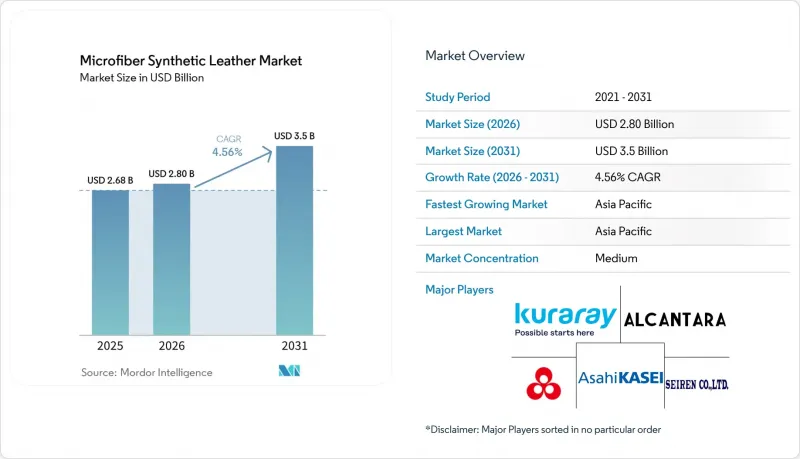
本報告按材料類型(例如聚氨酯)、紋理/表面處理類型(例如絨面革、納帕革、二層革)、終端用戶行業(例如時尚/服裝、汽車/交通運輸、家具/室內裝飾)和地區(例如亞太地區、北美、歐洲、南美、中東和非洲)進行細分。市場預測以美元計價。
全球超細纖維合成皮革市場趨勢及洞察
純素和永續時尚在各地區的成長
2026年春季,H&M和Stella McCartney等領導品牌成立了聯合洞察委員會,旨在加速下一代合成材料的研發,凸顯超細纖維的全新品牌潛力。包括Hugo Boss在內的奢侈品牌承諾在2030年前逐步淘汰原生聚酯和聚醯胺,因此對專為化學解聚設計的超細纖維配方越來越感興趣。東麗公司生產的「Ultrasuede BX」含有30%的植物來源聚酯,被廣泛應用於高階電動車,這表明生物基成分能夠帶來溢價。由於加州SB 707法案對溶劑的限制以及歐盟對PFAS的禁令,加工商被迫轉向水性聚氨酯,而水性聚氨酯目前已佔全球超細纖維產量的約四分之一。同時,環保非政府組織對超細纖維的脫落問題表示擔憂,經測量,洗滌過程中超細纖維的脫落量高達68.5毫克/公斤,而生物分解性仍然是一個關鍵的政策議題。
與PU/PVC複合材料相比,具有性能優勢(耐磨性和透氣性)
實驗室測試表明,超細纖維合成皮革的爆破強度可達 374 牛頓,撕裂強度可達 139 牛頓,顯著優於天然皮革。這使其適用於高磨損座椅。日產汽車於 2026 年 3 月推出的「TailorFit」座椅套,可承受超過 10 萬次的磨損循環,並且比真皮座椅套的成本低 40% 至 60%。 SEIREN 將超細纖維基材與 Viscotec 的數位印刷技術結合。這種小批量生產模式滿足了汽車製造商對客製化內裝的需求,同時避免了增加庫存風險。然而,在極端寒冷和炎熱的氣候條件下,超細纖維合成皮革仍面臨挑戰,天然皮革的熱穩定性仍然是首選。 Spiber 的「Brewed Protein」纖維等創新技術,是一種無需聚氨酯即可複製膠原蛋白結構的發酵衍生材料,預示著未來競爭的加劇。
生物分解性極限及與天然皮革的比較
由於聚氨酯和聚醯胺結構能夠抵抗酵素分解,超細纖維廢棄物會在掩埋停留很長時間,而天然皮革則可在40年內分解。歐盟的《永續產品生態設計法規》(ESPR)將於2026年7月生效,該法規禁止處置未售出的紡織品,並強制要求採用可生物分解的設計,但複合材料的剝離處理成本是PET回收的兩倍。BASF的Haptex 4.0技術通過去除聚醯胺層實現了PET的閉合迴路回收,但其商業性應用僅限於一家電動車OEM製造商。如果擴大生產者責任(EPR)計畫的成本增加,品牌或許能夠縮小目前與皮革相比40-60%的成本差距。
細分市場分析
聚氨酯基產品憑藉其超過10萬次的耐磨性和與現有皮革加工設備的高度相容性,預計到2025年將以68.12%的市佔率引領超細纖維合成革市場。其他材料類型(混合超細纖維基材)預計在預測期(2026-2031年)內將以4.96%的複合年成長率實現最高成長,這主要得益於豪華汽車製造商對循環材料的追求。聚醯胺超細纖維正在運動用品和高耐用性座椅等細分市場中佔據一席之地,這些市場更注重抗撕裂強度而非成本。由於對二甲基甲醯胺(DMF)使用的限制日益嚴格,水性聚氨酯目前已佔全球產量的約四分之一,而生物基聚氨酯的產能預計在2024年將達到52萬噸。
投資重點在於研發,旨在提高生物基含量,同時又不影響其物理性能。法拉利「Puro Sangue」系列中使用的68%再生聚酯Alcantara混紡布料,體現了消費者對優質環保麂皮的強勁需求。旭化成和Aquafile公司共同開發的纖維素增強型PA6材料,旨在實現閉合迴路策略;而ECOLORICA公司的滾筒染色全粒面超細纖維,則確保了奢侈品配件市場的利潤空間,同時避免了與大眾市場PVC材料的價格趨同。符合加州65號提案及REACH標準的複合材料設計,能夠加速OEM廠商的審核流程。
區域分析
預計亞太地區將在2025年佔據主導地位,銷售額佔比達54.44%,並維持5.32%的複合年成長率直至2031年。光是中國就供應了全球36%的聚氨酯,這主要得益於萬華化學年產150萬噸的MDI生產設施,該設施已於2026年運作。華豐集團2026年投資36億元人民幣的擴建計畫預計將使氨綸和聚氨酯液體的產量增加20萬噸,這標誌著中國正式進軍先前由日本主導的高階麂皮市場。此外,印度對合成革原料的關稅豁免政策,以及SEIREN在印度的後整理廠的運作,也正在提振南亞地區的需求。
歐洲和北美正朝著循環經濟發展。蔚來汽車採用BASF的Haptex 4.0技術,凸顯了其無溶劑特性。同時,將於2026年7月生效的《歐洲永續消費和生產法規》(ESPR)將禁止處置未售庫存,並強制要求產品設計考慮回收。儘管能源和人事費用不斷上漲,導致歐洲天然氣價格較2019年上漲120%,但與亞洲的價格差距依然存在,促使科思創在2026年2月將其MDI合約價格每噸上調200美元。義大利Ecolorica公司則受惠於願意為可追溯性支付溢價的高階買家。
拉丁美洲和中東及非洲地區仍處於發展階段。巴西鞋類製造商正在試驗使用超細纖維鞋面,而三方集團計劃在2025年投資3億新台幣(約945萬美元)進行擴張,目標市場正是這個中等收入國家。然而,該地區異氰酸酯生產工廠的短缺以及海運成本的波動,將阻礙利潤成長,直到供應鏈實現本地化。
其他好處:
- Excel格式的市場預測(ME)表
- 3個月的分析師支持
目錄
第1章:引言
- 研究假設和市場定義
- 調查範圍
第2章:調查方法
第3章執行摘要
第4章 市場狀況
- 市場概覽
- 市場促進因素
- 素食主義和永續時尚的區域發展
- 與PU/PVC複合材料相比,性能更優(耐磨性和透氣性)
- 拓展應用領域,包括汽車內裝和豪華家具。
- 政府對真皮進口實施禁令和限制。
- 高階消費性電子產品機殼中的應用
- 市場限制因素
- 與天然皮革相比,生物分解性低
- 東亞供應鏈的集中造成了依賴風險。
- 微纖維複合材料缺乏直接回收管道
- 價值鏈分析
- 波特五力模型
第5章 市場規模與成長預測
- 材料類型
- 聚氨酯基超細纖維合成革
- 聚醯胺超細纖維合成革
- 其他材料類型(混合超細纖維基材)
- 質地/顆粒大小
- 絨面革和超細纖維皮革
- 納帕超細纖維皮革
- 分離式超細纖維皮革
- 壓紋印花超細纖維皮革
- 按最終用戶行業分類
- 時尚與服裝
- 汽車和運輸業
- 家具和室內設計
- 商業室內設計(零售、辦公室、飯店)
- 體育器材和機械
- 其他終端用戶產業(工業、國防、海事)
- 按地區
- 亞太地區
- 中國
- 印度
- 日本
- 韓國
- 東南亞國協
- 其他亞太國家
- 北美洲
- 美國
- 加拿大
- 墨西哥
- 歐洲
- 德國
- 英國
- 法國
- 義大利
- 西班牙
- 俄羅斯
- 北歐國家
- 其他歐洲國家
- 南美洲
- 巴西
- 阿根廷
- 其他南美國家
- 中東和非洲
- 沙烏地阿拉伯
- 南非
- 其他中東和非洲國家
- 亞太地區
第6章 競爭情勢
- 市場集中度
- 策略趨勢
- 市佔率和排名分析
- 公司簡介
- Alcantara SpA
- Asahi Kasei Corporation
- Dongguan Kaiyue
- ECOLORICA MICROFIBER Srl
- FUJIAN POLYTECH TECHNOLOGY CO., LTD.
- Kuraray Co., Ltd.
- San Fang Chemical Industry Co., Ltd.
- SEIREN CO., LTD.
- Wanhua
- ZHEJIANG HEXIN HOLDINGS LTD.
- Filwel Co., Ltd.
- HUAFENG GROUP
第7章 市場機會與未來展望
According to Mordor Intelligence, the microfiber synthetic leather market size was valued at USD 2.68 billion in 2025 and is estimated to grow from USD 2.80 billion in 2026 to reach USD 3.5 billion by 2031, at a CAGR of 4.56% during the forecast period (2026-2031).
This report is Segmented by Material Type (Polyurethane-Based, and More), Texture/Grain Type (Suede, Nappa, Split, and More), End-User Industry (Fashion and Apparel, Automotive and Transportation, Furniture and Home Decor, and More), and Geography (Asia-Pacific, North America, Europe, South America, and Middle East and Africa). The Market Forecasts are Provided in Terms of Value (USD).
Global Microfiber Synthetic Leather Market Trends and Insights
Growth of Vegan and Sustainable Fashion Across Regions
Mainstream labels such as H&M and Stella McCartney formed a joint Insight Board in spring 2026 to fast-track next-generation synthetics, underscoring microfiber's new branding power. Luxury houses, including Hugo Boss, are committed to phasing out virgin polyester and polyamide by 2030, spurring interest in microfiber formulas engineered for chemical depolymerization. Toray's Ultrasuede BX, built on 30% plant-based polyester, has been adopted across premium EV models, proving bio-content can command pricing premiums. Solvent regulations from California SB 707 and EU PFAS prohibitions are pushing converters toward waterborne polyurethane, which already accounts for roughly a quarter of global microfiber output. Meanwhile, environmental NGOs spotlight microfiber shedding, measured at 68.5 mg kg during washing, keeping biodegradability on the policy agenda.
Performance Advantages Versus PU/PVC Synthetics (Abrasion and Breathability)
Laboratory tests show microfiber synthetic leather achieves burst force of 374 N and tear strength of 139 N, sharply higher than natural hides, justifying its use in high-wear seating. Nissan's TailorFit seat coverings introduced in March 2026 boast more than 100,000 abrasion cycles and a 40-60% cost edge over genuine leather. SEIREN couples microfiber substrates with Viscotec's digital printing; this small-lot model satisfies automakers seeking bespoke interiors without raising inventory risk. Limitations persist in very cold or hot climates, where natural leather's thermal stability still wins adoption. Breakthroughs such as Spiber's Brewed Protein fiber point to future competition from fermentation-derived materials that replicate collagen architecture without polyurethane.
Limited Biodegradability Versus Natural Hides
Polyurethane-polyamide architecture resists enzymatic breakdown, leaving microfiber waste persistent in landfills, whereas natural hides degrade within four decades. The EU ESPR (Ecodesign for Sustainable Products Regulation) prohibition on destroying unsold textiles from July 2026 compels design for disassembly, yet composite delamination adds double the processing cost relative to PET recycling. BASF's Haptex 4.0 removes polyamide layers to allow closed-loop PET recovery, but commercial roll-out remains limited to one Electric Vehicle Original Equipment Manufacturer. If extended-producer-responsibility fees expand, brands could lose the current 40-60% cost gap over leather.
Other drivers and restraints analyzed in the detailed report include:
- Expanding Use in Automotive Interiors and Luxury Upholstery
- Government Bans/Restrictions on Genuine-Leather Imports
- Supply-Chain Concentration in East Asia Creating Dependency Risks
For complete list of drivers and restraints, kindly check the Table Of Contents.
Segment Analysis
Polyurethane grades led the microfiber synthetic leather market with 68.12% revenue share in 2025, owing to 100,000+ abrasion-cycle durability and ready compatibility with existing tannery equipment. Other material types (blended microfiber bases) are forecast to post the fastest 4.96% CAGR during the forecast period (2026-2031) as luxury OEMs chase circular content. Polyamide microfiber captures niche athletic and heavy-duty seating that values tear strength over cost. Waterborne polyurethane already comprises about one-quarter of global output after regulations clamped down on DMF usage, and bio-based polyurethane capacity reached 520,000 tons in 2024.
Investment centers on research and development that elevates bio-content without compromising physical performance. Alcantara's 68% recycled-polyester formulation in Ferrari's Purosangue demonstrates consumer appetite for premium green suede. Asahi Kasei and Aquafil's cellulose-reinforced PA6 targets closed-loop ambitions, while ECOLORICA's drum-dyed full-grain microfiber commands luxury accessory margins without price convergence to mass-market PVC. Composite designs able to meet both California Prop 65 and REACH standards enjoy quicker OEM approval cycles.
Geography Analysis
Asia-Pacific dominated with a 54.44% revenue share in 2025 and is projected to log a 5.32% CAGR through 2031. China alone supplies 36% of global polyurethane, backed by Wanhua Chemical's 1.5 million tpa MDI facility that came online in 2026. Huafeng's CNY 3.6 billion 2026 upgrade will add 200,000 tons of spandex and polyurethane liquids, signaling China's push into premium suede previously cornered by Japan. India's duty waivers on synthetic footwear inputs plus SEIREN's localized finishing plant are catalyzing demand growth in South Asia.
Europe and North America pivot on circularity. BASF's Haptex 4.0 approval by NIO underscores solvent-free credentials, while the ESPR ban on destroying unsold stock from July 2026 forces design-for-recycling. High energy and labor costs sustain an Asia price gap even as European gas tariffs remain 120% above 2019 levels, prompting Covestro to lift MDI contract prices by USD 200 per ton in February 2026. Italy's ECOLORICA benefits from luxury buyers willing to pay traceability premiums.
Latin America and MEA remain embryonic. Brazilian footwear OEMs trial microfiber uppers, and San Fang's NTD300 million (USD 9.45 million) 2025 expansion targets these mid-income markets. Lack of regional isocyanate plants and ocean-freight volatility, however, inhibit profit pools until supply bases localize.
- Alcantara S.p.A.
- Asahi Kasei Corporation
- Dongguan Kaiyue
- ECOLORICA MICROFIBER S.r.l.
- FUJIAN POLYTECH TECHNOLOGY CO., LTD.
- Kuraray Co., Ltd.
- San Fang Chemical Industry Co., Ltd.
- SEIREN CO., LTD.
- Wanhua
- ZHEJIANG HEXIN HOLDINGS LTD.
- Filwel Co., Ltd.
- HUAFENG GROUP
Additional Benefits:
- The market estimate (ME) sheet in Excel format
- 3 months of analyst support
TABLE OF CONTENTS
1 Introduction
- 1.1 Study Assumptions and Market Definition
- 1.2 Scope of the Study
2 Research Methodology
3 Executive Summary
4 Market Landscape
- 4.1 Market Overview
- 4.2 Market Drivers
- 4.2.1 Growth of vegan and sustainable fashion across regions
- 4.2.2 Performance advantages vs PU/PVC synthetics (abrasion and breathability)
- 4.2.3 Expanding use in automotive interiors and luxury upholstery
- 4.2.4 Government bans/restrictions on genuine-leather imports
- 4.2.5 Adoption in high-end consumer electronics casings
- 4.3 Market Restraints
- 4.3.1 Limited biodegradability vs natural hides
- 4.3.2 Supply-chain concentration in East Asia creating dependency risks
- 4.3.3 Lack of drop-in recycling streams for microfiber composites
- 4.4 Value Chain Analysis
- 4.5 Porter's Five Forces
- 4.5.1 Threat of New Entrants
- 4.5.2 Bargaining Power of Buyers
- 4.5.3 Bargaining Power of Suppliers
- 4.5.4 Threat of Substitutes
- 4.5.5 Competitive Rivalry
5 Market Size and Growth Forecasts (Value)
- 5.1 By Material Type
- 5.1.1 Polyurethane-based Microfiber Synthetic Leather
- 5.1.2 Polyamide-based Microfiber Synthetic Leather
- 5.1.3 Other Material Types (Blended Microfiber Bases)
- 5.2 By Texture/Grain Type
- 5.2.1 Suede Microfiber Leather
- 5.2.2 Nappa Microfiber Leather
- 5.2.3 Split Microfiber Leather
- 5.2.4 Embossed/Printed Microfiber Leather
- 5.3 By End-user Industry
- 5.3.1 Fashion and Apparel
- 5.3.2 Automotive and Transportation
- 5.3.3 Furniture and Home Decor
- 5.3.4 Commercial Interiors (Retail, Offices, and Hospitality)
- 5.3.5 Sporting Goods and Equipment
- 5.3.6 Other End-user Industries (Industrial, Defense, and Marine)
- 5.4 By Geography
- 5.4.1 Asia-Pacific
- 5.4.1.1 China
- 5.4.1.2 India
- 5.4.1.3 Japan
- 5.4.1.4 South Korea
- 5.4.1.5 ASEAN Countries
- 5.4.1.6 Rest of Asia-Pacific
- 5.4.2 North America
- 5.4.2.1 United States
- 5.4.2.2 Canada
- 5.4.2.3 Mexico
- 5.4.3 Europe
- 5.4.3.1 Germany
- 5.4.3.2 United Kingdom
- 5.4.3.3 France
- 5.4.3.4 Italy
- 5.4.3.5 Spain
- 5.4.3.6 Russia
- 5.4.3.7 NORDIC Countries
- 5.4.3.8 Rest of Europe
- 5.4.4 South America
- 5.4.4.1 Brazil
- 5.4.4.2 Argentina
- 5.4.4.3 Rest of South America
- 5.4.5 Middle-East and Africa
- 5.4.5.1 Saudi Arabia
- 5.4.5.2 South Africa
- 5.4.5.3 Rest of Middle-East and Africa
- 5.4.1 Asia-Pacific
6 Competitive Landscape
- 6.1 Market Concentration
- 6.2 Strategic Moves
- 6.3 Market Share(%)/Ranking Analysis
- 6.4 Company Profiles (includes Global Overview, Market Overview, Core Segments, Financials, Strategic Information, Products and Services, and Recent Developments)
- 6.4.1 Alcantara S.p.A.
- 6.4.2 Asahi Kasei Corporation
- 6.4.3 Dongguan Kaiyue
- 6.4.4 ECOLORICA MICROFIBER S.r.l.
- 6.4.5 FUJIAN POLYTECH TECHNOLOGY CO., LTD.
- 6.4.6 Kuraray Co., Ltd.
- 6.4.7 San Fang Chemical Industry Co., Ltd.
- 6.4.8 SEIREN CO., LTD.
- 6.4.9 Wanhua
- 6.4.10 ZHEJIANG HEXIN HOLDINGS LTD.
- 6.4.11 Filwel Co., Ltd.
- 6.4.12 HUAFENG GROUP
7 Market Opportunities and Future Outlook
- 7.1 White-space and Unmet-Need Assessment

 2026年全球交通運輸用合成皮革表面材料市場報告
 交通運輸用合成皮革表面材料市場-全球及區域分析:依應用、產業、材料、製造流程、銷售管道及地區分類-分析與預測(2026-2035年)
 合成皮革市場:依材料、基材、終端應用產業、分銷管道及地區分類
 合成皮革:市場佔有率分析、產業趨勢與統計、成長預測(2026-2031)
 合成皮革市場:按類型、產品、產品形式、應用、用途和分銷管道分類-2026-2032年全球市場預測
 合成皮革市場規模、佔有率和趨勢分析報告:按皮革類型、應用、地區和細分市場預測(2026-2033 年)
 超細纖維皮革市場規模、佔有率和成長分析:按產品類型、應用、最終用途和地區分類-2026-2033年產業預測
 合成皮革市場規模、佔有率和成長分析:按類型、最終用途產業和地區分類-2026-2033年產業預測超細纖維合成皮革市場:按產品類型、應用和地區分類
 合成皮革市場規模、佔有率、趨勢和預測:按類型、應用、最終用途行業和地區分類,2026-2034年