


 |
市場調查報告書
商品編碼
2117472
車載資訊娛樂系統:市場佔有率分析、產業趨勢與統計、成長預測(2026-2031)In-Vehicle Infotainment System - Market Share Analysis, Industry Trends & Statistics, Growth Forecasts (2026 - 2031) |
||||||

※ 本網頁內容可能與最新版本有所差異。詳細情況請與我們聯繫。
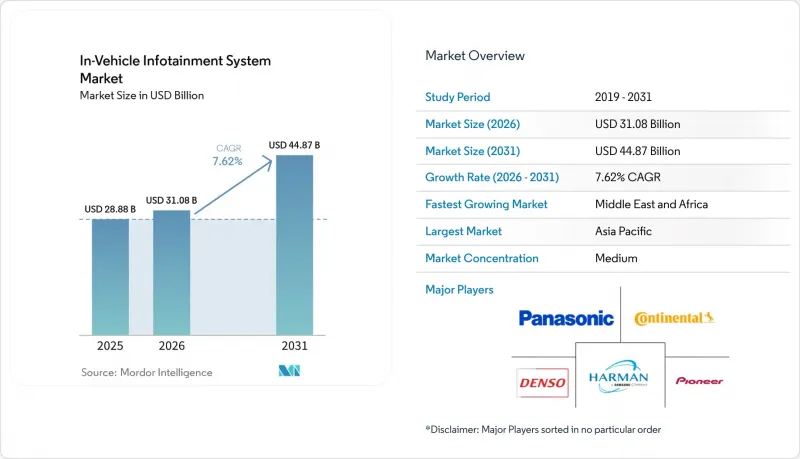
據 Mordor Intelligence 稱,2025 年車載資訊娛樂系統市值為 288.8 億美元,預計將從 2026 年的 310.8 億美元成長到 2031 年的 448.7 億美元,2026 年至 2031 年的複合年成長率為 7.62%。
本報告按組件(音訊單元、顯示單元、導航單元、通訊單元)、作業系統(Android、Linux、QNX 及其他)、安裝類型(儀錶板整合式資訊娛樂系統和後座資訊娛樂系統)、車輛類型(乘用車、輕型商用車、中型和重型商用車)以及地區進行細分。市場預測以美元(USD)為單位。
全球車載資訊娛樂系統市場趨勢與洞察
生成式人工智慧語音助理的興起
生成式人工智慧語音系統正在改變汽車製造商對車載資訊娛樂系統市場中產品角色的定位。這些工具能夠回應自然語音指令,並將車輛操作與導航、媒體和其他數位服務整合起來。 BMW宣布將在即將於2026年上市的iX3車型中引入生成式人工智慧助手,並表示該技術將在2026年全年逐步推廣至其他特定車型。這一發展趨勢將使語音控制成為車內體驗的核心要素,尤其是在駕駛者需要專注於路況的情況下。開發自有人工智慧體驗的汽車製造商將擁有對客戶數據和產品設計的更大主導,同時也將承擔更大的軟體開發、測試和後續支援責任。
對先進車輛的需求不斷成長
隨著電動車和高階車型的普及,更大螢幕和更先進的數位功能正被引入更廣泛的車型。這使得車載資訊娛樂系統的需求不再局限於高階車型。在軟體定義車輛設計中,駕駛座成為更關鍵的整合點,因為資訊娛樂系統需要與其他車輛軟體互動。Panasonic Automotive Systems宣布,其資訊娛樂系統已被豐田新款RAV4採用,並將與「Arene」軟體平台協同工作,實現軟體更新。這使得供應商必須提供能夠支援汽車製造商所選軟體架構的系統,這也提高了僅提供獨立硬體的競爭對手的門檻。
聯網汽車的網路安全漏洞
隨著車載資訊娛樂系統逐漸成為聯網汽車功能的入口,網路安全正成為設計要求。安全漏洞會影響客戶信任、軟體發布計畫和核准流程。車載資訊娛樂系統市場需要支援安全的軟體更新、存取控制以及娛樂功能與安全相關系統的分離。歐洲車輛網路安全法規要求製造商管理適用車型和電子系統中的網路風險。這些要求可能會增加供應商和汽車製造商的研發工作量,但也可能使那些已經建立安全工程和測試流程的公司受益。
細分市場分析
至2025年,顯示單元將佔據車載資訊娛樂系統42.98%的市場。這一地位反映了螢幕作為導航、媒體和車輛設置主要控制點的核心作用。目前,大型觸控顯示器正被越來越多的乘用車採用。供應商也在將顯示功能與音訊和照明功能整合,以簡化儀錶板設計。更簡潔的儀錶板佈局使汽車製造商能夠圍繞統一的數位介面更自由地設計車內空間。音訊單元在車內體驗中仍然至關重要,但嵌入式導航正面臨來自雲端路線導航的挑戰。組件配置正朝著能夠處理更進階資料、媒體和連線功能的系統方向發展。汽車製造商還要求顯示系統能夠在各種駕駛條件下確保可視性和可操作性。
預計到2031年,通訊單元細分市場將以13.12%的複合年成長率成長,成為所有組件中成長最快的細分市場。此細分市場隸屬於車載資訊娛樂系統市場,支援蜂窩通訊、V2X(車聯網)通訊和互聯服務。向新型緊急呼叫(eCall)網路的過渡也推動了對滿足當前需求的通訊硬體的需求成長。借助合適的通訊單元,汽車製造商可以從通用平台管理更新、緊急功能和服務連接。它還支援車輛、使用者和授權外部服務之間穩定的資訊交流。在調變解調器整合方面擁有良好業績記錄的供應商在車輛設計週期中具有顯著優勢。網路覆蓋品質和汽車製造商部署互聯功能的速度也會影響市場需求。
到2025年,Android將佔據車載資訊娛樂系統市場67.08%的佔有率。這一地位反映了其在消費者中的知名度以及其豐富的應用程式、語音服務和互聯內容。 Android Automotive OS為汽車製造商提供嵌入式作業系統,而Android Auto則支援基於智慧型手機的鏡像功能。谷歌表示,其汽車軟體產品正被更廣泛地應用於各種車型項目中。這為那些希望獲得高度可識別的用戶體驗,而無需自行開發所有服務的汽車製造商提供了一條切實可行的途徑。它還有助於與數位地圖、媒體和應用程式生態系統整合。通用軟體平台簡化了車型更新換代時的使用者訓練和支援工作。因此,操作系統選擇在車輛項目規劃中扮演越來越重要的角色。
預計到2031年,Android的複合年成長率將達到15.84%,成為作業系統類別中成長最快的作業系統。這一成長與軟體定義汽車平臺和空中下載(OTA)更新的普及密切相關。車載資訊娛樂系統市場受益於能夠容納更多應用程式和定期功能更新的作業系統。這些系統還允許汽車製造商在車輛交付給客戶後根據需要調整特定功能。 Linux在客製化和技術控制至關重要的領域繼續發揮重要作用。 QNX在需要完善的安全支援和功能分離的架構中也依然佔有重要地位。
區域分析
到2025年,亞太地區將佔據車載資訊娛樂系統市場37.78%的佔有率。該地區的需求主要得益於中國龐大的汽車保有量以及數位化駕駛座功能的快速普及。在日本和韓國,成熟的汽車零件供應商以及與本土汽車製造商的緊密合作關係也促進了這一成長。在印度,乘用車數量的不斷成長推動了對注重成本效益的駕駛座設計的需求。此外,當地汽車製造商和供應商也透過縮短開發週期和滿足不同的客戶偏好來影響產品設計。因此,對於全球供應商而言,根據各國的具體需求調整介面、內容和連接選項至關重要。由Panasonic汽車系統公司和豐田汽車公司共同開發的全新RAV4就是一個很好的例子,它展示了區域供應商如何利用國際推廣的專案。
北美市場仍然至關重要,這得益於其高比例的高階汽車、成熟的互聯基礎設施以及強大的技術供應商網路。該地區的汽車製造商正在尋求能夠支援互聯服務並提供熟悉的數位化體驗的系統。歐洲的需求基礎與北美類似,但法規要求為車載資訊系統現代化帶來了獨特的動力。歐洲的eCall框架正在推動最新互聯技術的應用以及相關的車輛整合工作。德國、英國和法國憑藉其成熟的汽車製造基地和高階品牌,持續支撐著市場需求。其他歐洲市場則透過通用汽車專案和更換需求做出貢獻。
預計到2031年,中東和非洲地區的複合年成長率將達到10.34%,是所有地區中最高的。汽車進口量的增加以及對配置齊全的車輛需求的成長,正在推動部分國家車載資訊娛樂系統市場的發展。海灣市場尤其在豪華車功能和連網車廂服務方面扮演著重要角色。南非、土耳其和埃及也是周邊市場的製造或分銷中心。由於收入水準、車輛擁有量和網路基礎設施方面的顯著差異,該地區的需求模式並不統一。南美洲仍然對價格較為敏感,巴西和阿根廷是該地區汽車需求的主要來源。互聯性、本地服務的可近性和車輛的可負擔性將影響這兩個地區的普及速度。
其他好處:
- Excel格式的市場預測(ME)表
- 3個月的分析師支持
目錄
第1章:引言
- 研究假設和市場定義
- 調查範圍
第2章:調查方法
第3章執行摘要
第4章 市場狀況
- 市場概覽
- 市場促進因素
- 生成式人工智慧語音助理的興起
- 對先進車輛的需求日益成長
- 關於緊急呼叫和遠端資訊處理的監管義務
- 聯網汽車資訊服務。
- 智慧型手機鏡像(CarPlay、Android Auto)的整合正在逐步推進。
- 駕駛座數據和車內商業的商業化
- 市場限制因素
- 聯網汽車的網路安全漏洞
- 系統整合中的複雜性
- 新興市場初始成本高且價格敏感
- 高解析度OLED顯示器的熱管理和電源管理限制
- 價值供應鏈分析
- 監理情勢
- 技術展望
- 波特五力分析
第5章 市場規模與成長預測
- 按組件
- 音訊單元
- 整個單元
- 導航單元
- 通訊單元
- 透過作業系統
- Android
- Linux
- QNX
- 其他
- 按安裝類型
- 儀錶板整合式資訊娛樂系統
- 後座資訊娛樂系統
- 按車輛類型
- 搭乘用車
- 輕型商用車
- 中型和重型商用車輛
- 按地區
- 北美洲
- 美國
- 加拿大
- 其他北美國家
- 南美洲
- 巴西
- 阿根廷
- 其他南美國家
- 歐洲
- 德國
- 英國
- 法國
- 義大利
- 西班牙
- 俄羅斯
- 其他歐洲國家
- 亞太地區
- 中國
- 日本
- 印度
- 韓國
- 印尼
- 越南
- 菲律賓
- 澳洲
- 其他亞太國家
- 中東和非洲
- 沙烏地阿拉伯
- 阿拉伯聯合大公國
- 埃及
- 土耳其
- 南非
- 其他中東和非洲國家
- 北美洲
第6章 競爭情勢
- 市場集中度
- 市佔率分析
- 公司簡介
- Continental AG
- Denso Corporation
- Harman International
- Pioneer Corporation
- Panasonic Automotive Systems Co., Ltd.
- Robert Bosch GmbH
- Visteon Corporation
- Alpine Electronics Inc.
- Aptiv Plc
- Desay SV
- LG Electronics Inc.
- Garmin Ltd.
- TomTom International NV
- Mitsubishi Electric Corporation
- Nvidia Corporation
- Qualcomm Technologies Inc.
第7章 市場機會與未來展望
According to Mordor Intelligence, the in-vehicle infotainment system market size was valued at USD 28.88 billion in 2025 and is expected to increase from USD 31.08 billion in 2026 to USD 44.87 billion by 2031, growing at a CAGR of 7.62% over 2026-2031.
This report is Segmented by Component (Audio Unit, Display Unit, Navigation Unit, Communication Unit), Operating System (Android, Linux, QNX, Others), Installation Type (In-Dash Infotainment and Rear-Seat Infotainment), Vehicle Type (Passenger Cars, Light Commercial Vehicles, and Medium and Heavy Commercial Vehicles), and Geography. The Market Forecasts are Provided in Terms of Value (USD).
Global In-Vehicle Infotainment System Market Trends and Insights
Emergence of Generative-AI Voice Assistants
Generative AI voice systems are changing how automakers define the role of an in-vehicle infotainment system market product. These tools can support natural requests and connect vehicle controls with navigation, media, and other digital services. BMW stated that its 2026 iX3 introduced a generative AI assistant and that the technology will expand across specified vehicle programs during 2026. This direction makes voice control a more central part of the cabin experience, particularly when drivers need to keep their attention on the road. Automakers that develop their own AI experience can retain greater control over customer data and product design. They also take on more responsibility for software development, testing, and ongoing support.
Increasing Demand for Advanced Vehicles
Electric vehicles and higher-trim models are bringing larger screens and richer digital functions into more vehicle classes. This broadens demand in the in-vehicle infotainment system market beyond premium models. Software-defined vehicle designs connect infotainment with other vehicle software, making the cockpit a more important integration point. Panasonic Automotive Systems said its infotainment system was selected for the new Toyota RAV4 and works with the Arene software platform for software updates. Such arrangements make it important for suppliers to provide systems that can work with an automaker's chosen software architecture. They also raise the competitive threshold for suppliers that offer only standalone hardware.
Cybersecurity Vulnerabilities in Connected Vehicles
As infotainment systems become a gateway to connected vehicle functions, cybersecurity becomes a design requirement. A security weakness can affect customer trust, software launch schedules, and approval processes. The in-vehicle infotainment system market must support secure software updates, access controls, and separation between entertainment functions and safety-related systems. European vehicle cybersecurity rules require manufacturers to manage cyber risks across applicable vehicle types and electronic systems. These obligations can increase development work for suppliers and automakers. They can also favor firms that already have established security engineering and testing processes.
Other drivers and restraints analyzed in the detailed report include:
- Regulatory Mandates for eCall and Telematics
- Growing Adoption of Connected-Car Data Services
- Complexity in System Integration
For complete list of drivers and restraints, kindly check the Table Of Contents.
Segment Analysis
Display units held 42.98% of the in-vehicle infotainment system market share in 2025. Their position reflects the central role of the screen as the main point of interaction for navigation, media, and vehicle settings. Large touch displays are now used across a wider range of passenger vehicles. Suppliers are also combining display functions with audio and lighting features to simplify dashboard design. A cleaner dashboard layout can give automakers more freedom to shape the cabin around a consistent digital interface. Audio units remain important for cabin experience, while embedded navigation is facing pressure from cloud-based route guidance. The component mix is shifting toward systems that can handle higher levels of data, media, and connectivity. Automakers also need display systems that remain easy to read and operate in varied driving conditions.
Communication units are forecast to grow at a 13.12% CAGR through 2031, the fastest rate among components. This part of the in-vehicle infotainment system market supports cellular links, vehicle-to-everything communication, and connected services. The move toward newer eCall networks also increases the need for communication hardware that meets current requirements. A suitable communication unit helps an automaker manage updates, emergency functions, and service connections from a common platform. It also supports the steady exchange of information between the vehicle, the user, and approved external services. Suppliers with proven modem integration can be better positioned during vehicle design cycles. Demand also depends on the quality of network coverage and the pace at which automakers introduce connected features.
Android held 67.08% of the in-vehicle infotainment system market share in 2025. Its position reflects consumer familiarity and the availability of applications, voice services, and connected content. Android Automotive OS gives automakers an embedded operating system, while Android Auto supports phone-based mirroring. Google has described the wider use of its automotive software offerings across vehicle programs. This creates a practical route for automakers that want a recognizable user experience without building every service internally. It also makes integration with digital maps, media, and app ecosystems easier. A common software foundation can simplify user training and support as models are updated. The result is a stronger role for operating-system decisions in vehicle program planning.
Android is forecast to grow at a 15.84% CAGR through 2031, the fastest rate within the operating-system category. This expansion is tied to the wider use of software-defined vehicle platforms and over-the-air updates. The in-vehicle infotainment system market gains from operating systems that can support more applications and regular feature updates. These systems also allow automakers to adapt selected functions after the vehicle reaches the customer. Linux continues to have a role where customization and technical control are important. QNX also remains relevant in architectures that need established safety support or separation between functions.
Complete Report Scope:
- By Component
- Audio Unit
- Display Unit
- Navigation Unit
- Communication Unit
- By Operating System
- Android
- Linux
- QNX
- Others
- By Installation Type
- In-dash Infotainment
- Rear-seat Infotainment
- By Vehicle Type
- Passenger Cars
- Light Commercial Vehicles
- Medium and Heavy Commercial Vehicles
- By Geography
- North America
- United States
- Canada
- Rest of North America
- South America
- Brazil
- Argentina
- Rest of South America
- Europe
- Germany
- United Kingdom
- France
- Italy
- Spain
- Russia
- Rest of Europe
- Asia-Pacific
- China
- Japan
- India
- South Korea
- Indonesia
- Vietnam
- Philippines
- Australia
- Rest of Asia-Pacific
- Middle East and Africa
- Saudi Arabia
- United Arab Emirates
- Egypt
- Turkey
- South Africa
- Rest of Middle East and Africa
- North America
Geography Analysis
Asia-Pacific held 37.78% of the in-vehicle infotainment system market share in 2025. China's large vehicle base and rapid adoption of digital cockpit features support regional demand. Japan and South Korea add established automotive suppliers and strong domestic automaker relationships. India offers demand for more cost-conscious cockpit designs as its passenger-vehicle base expands. Local automakers and suppliers are also influencing product design through faster development cycles and different customer preferences. This makes it important for global suppliers to adapt interfaces, content, and connectivity choices to each country. Panasonic Automotive Systems' work with Toyota on the new RAV4 shows how regional suppliers can secure programs intended for wide international distribution.
North America remains important because of its premium vehicle mix, mature connectivity infrastructure, and strong presence of technology providers. Automakers in the region are looking for systems that support connected services and familiar digital experiences. Europe has a related demand base, but regulatory requirements add a distinct reason to refresh telematics-capable vehicle systems. The European eCall framework supports the adoption of newer connectivity technologies and related vehicle integration work. Germany, the United Kingdom, and France continue to support demand through established vehicle manufacturing and premium brands. Other European markets contribute through mainstream vehicle programs and replacement demand.
The Middle East and Africa is forecast to grow at a 10.34% CAGR through 2031, the fastest regional rate. Rising vehicle imports and demand for well-equipped vehicles support the in-vehicle infotainment system market across selected countries. Gulf markets are particularly relevant for premium vehicle features and connected cabin services. South Africa, Turkey, and Egypt also provide manufacturing or distribution links to nearby markets. The region does not have one uniform demand pattern because income levels, vehicle fleets, and network conditions vary widely. South America remains more price sensitive, with Brazil and Argentina serving as the main sources of regional vehicle demand. Connectivity conditions, local service availability, and vehicle affordability will shape the pace of adoption across both regions.
- Continental AG
- Denso Corporation
- Harman International
- Pioneer Corporation
- Panasonic Automotive Systems Co., Ltd.
- Robert Bosch GmbH
- Visteon Corporation
- Alpine Electronics Inc.
- Aptiv Plc
- Desay SV
- LG Electronics Inc.
- Garmin Ltd.
- TomTom International NV
- Mitsubishi Electric Corporation
- Nvidia Corporation
- Qualcomm Technologies Inc.
Additional Benefits:
- The market estimate (ME) sheet in Excel format
- 3 months of analyst support
TABLE OF CONTENTS
1 Introduction
- 1.1 Study Assumptions & Market Definition
- 1.2 Scope of the Study
2 Research Methodology
3 Executive Summary
4 Market Landscape
- 4.1 Market Overview
- 4.2 Market Drivers
- 4.2.1 Emergence of Generative-AI Voice Assistants
- 4.2.2 Increasing Demand for Advanced Vehicles
- 4.2.3 Regulatory Mandates for eCall and Telematics
- 4.2.4 Growing Adoption of Connected-Car Data Services
- 4.2.5 Rising Integration of Smartphone Mirroring (CarPlay, Android Auto)
- 4.2.6 Monetization of Cockpit Data and In-Car Commerce
- 4.3 Market Restraints
- 4.3.1 Cybersecurity Vulnerabilities in Connected Vehicles
- 4.3.2 Complexity in System Integration
- 4.3.3 High Upfront Cost and Price Sensitivity in Emerging Markets
- 4.3.4 Thermal and Power-Management Limits of High-Resolution OLED Displays
- 4.4 Value / Supply-Chain Analysis
- 4.5 Regulatory Landscape
- 4.6 Technological Outlook
- 4.7 Porter's Five Forces Analysis
- 4.7.1 Threat of New Entrants
- 4.7.2 Bargaining Power of Buyers/Consumers
- 4.7.3 Bargaining Power of Suppliers
- 4.7.4 Threat of Substitute Products
- 4.7.5 Intensity of Competitive Rivalry
5 Market Size & Growth Forecasts (Value (USD))
- 5.1 By Component
- 5.1.1 Audio Unit
- 5.1.2 Display Unit
- 5.1.3 Navigation Unit
- 5.1.4 Communication Unit
- 5.2 By Operating System
- 5.2.1 Android
- 5.2.2 Linux
- 5.2.3 QNX
- 5.2.4 Others
- 5.3 By Installation Type
- 5.3.1 In-dash Infotainment
- 5.3.2 Rear-seat Infotainment
- 5.4 By Vehicle Type
- 5.4.1 Passenger Cars
- 5.4.2 Light Commercial Vehicles
- 5.4.3 Medium and Heavy Commercial Vehicles
- 5.5 By Geography
- 5.5.1 North America
- 5.5.1.1 United States
- 5.5.1.2 Canada
- 5.5.1.3 Rest of North America
- 5.5.2 South America
- 5.5.2.1 Brazil
- 5.5.2.2 Argentina
- 5.5.2.3 Rest of South America
- 5.5.3 Europe
- 5.5.3.1 Germany
- 5.5.3.2 United Kingdom
- 5.5.3.3 France
- 5.5.3.4 Italy
- 5.5.3.5 Spain
- 5.5.3.6 Russia
- 5.5.3.7 Rest of Europe
- 5.5.4 Asia-Pacific
- 5.5.4.1 China
- 5.5.4.2 Japan
- 5.5.4.3 India
- 5.5.4.4 South Korea
- 5.5.4.5 Indonesia
- 5.5.4.6 Vietnam
- 5.5.4.7 Philippines
- 5.5.4.8 Australia
- 5.5.4.9 Rest of Asia-Pacific
- 5.5.5 Middle East and Africa
- 5.5.5.1 Saudi Arabia
- 5.5.5.2 United Arab Emirates
- 5.5.5.3 Egypt
- 5.5.5.4 Turkey
- 5.5.5.5 South Africa
- 5.5.5.6 Rest of Middle East and Africa
- 5.5.1 North America
6 Competitive Landscape
- 6.1 Market Concentration
- 6.2 Market Share Analysis
- 6.3 Company Profiles (Includes Global Level Overview, Market Level Overview, Core Segments, Financials as Available, Strategic Information, Market Rank/Share for Key Companies, Products and Services, SWOT Analysis, and Recent Developments)
- 6.3.1 Continental AG
- 6.3.2 Denso Corporation
- 6.3.3 Harman International
- 6.3.4 Pioneer Corporation
- 6.3.5 Panasonic Automotive Systems Co., Ltd.
- 6.3.6 Robert Bosch GmbH
- 6.3.7 Visteon Corporation
- 6.3.8 Alpine Electronics Inc.
- 6.3.9 Aptiv Plc
- 6.3.10 Desay SV
- 6.3.11 LG Electronics Inc.
- 6.3.12 Garmin Ltd.
- 6.3.13 TomTom International NV
- 6.3.14 Mitsubishi Electric Corporation
- 6.3.15 Nvidia Corporation
- 6.3.16 Qualcomm Technologies Inc.
7 Market Opportunities & Future Outlook
- 7.1 White-space & Unmet-need Assessment

 汽車資訊娛樂市場-2026-2032年全球市場預測
 車載資訊娛樂市場分析及預測(至2035年):按類型、產品、服務、技術、組件、應用、設備、部署、最終用戶和功能分類
 汽車資訊娛樂市場預測至2034年-按組件、車輛類型、連接方式、作業系統、應用、最終用戶和地區分類的全球分析
 汽車資訊娛樂市場規模、佔有率和成長分析:按組件、連接技術、作業系統、車輛類型、銷售管道和地區分類-2026-2033年產業預測
 2026年全球車載資訊娛樂系統節能模式路線提案市場報告
 車載資訊娛樂市場:依設備類型、車輛類型、銷售管道、技術類型及地區分類
 汽車空中下載 (OTA) 更新市場:策略性洞察與預測 (2026–2031)下一代汽車資訊娛樂市場:按輸入方式、作業系統、連接方式、顯示方式、處理器類型和應用分類-2026-2032年全球市場預測2026年全球車載資訊娛樂市場報告
 全球車載資訊娛樂市場按組件、應用、作業系統、性別、外形規格、顯示器尺寸、地理位置、燃油/電動車和地區分類-預測至2032年