


 |
市場調查報告書
商品編碼
2117470
熱成像/紅外線缺陷檢測:市場佔有率分析、行業趨勢與統計數據、成長預測(2025-2030 年)Thermography / Infrared Testing - Market Share Analysis, Industry Trends & Statistics, Growth Forecasts (2025 - 2030) |
||||||

※ 本網頁內容可能與最新版本有所差異。詳細情況請與我們聯繫。
預計到 2025 年,熱成像/紅外線缺陷檢測市場將達到 4.113 億美元,到 2030 年將達到 5.021 億美元,複合年成長率為 4.07%,顯示市場規模和盈利均穩定成長。
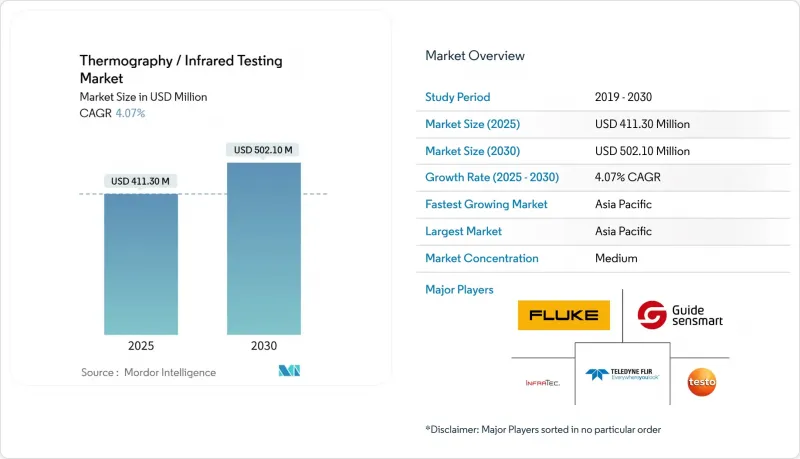
本報告按組件(硬體等)、技術(被動式熱成像測試、主動式熱成像測試)、便攜性(可攜式/手持式等)、終端用戶產業(石油天然氣、發電、航太等)以及地區(北美、南美、歐洲、亞太、中東和非洲)進行細分。市場預測以美元計價。
全球熱成像/紅外線缺陷檢測市場趨勢及洞察
關鍵基礎設施預測性維護需求激增
電力公司、煉油廠和化工廠正在轉向數據驅動的維護策略,利用熱成像測試在故障發生前識別熱點,從而取代被動維修。意外停機平均每小時會對工業設施造成 5 萬美元的損失,但熱成像測試可以幫助營運商在設備運作期間檢測異常情況,從而避免這些損失。隨著再生能源的普及,Exelon 和 Duke Energy 等大型電力公司正在變電站巡檢中部署熱成像攝影機,以獲得可操作的洞察,從而提高電網穩定性。如今,機器學習工具能夠以 85% 的準確率預測故障發生時間,使維修團隊能夠在計劃停電期間進行維護,而不是在緊急停機期間進行。雲端儀表板的廣泛應用進一步提高了可再生成像洞察的獲取途徑,從而進一步推動了熱成像市場的發展。
加強能源和製造業領域的工業安全法規
監管機構已將熱成像檢測納入安全標準,將自願性最佳實踐轉化為法律要求。歐盟的《工業排放指令》強制要求對石化廠的壓力容器、熔爐和電氣開關設備進行定期熱成像檢測。在美國,職業安全與健康管理局 (OSHA) 的指南建議對高風險設施的帶電配電盤進行季度紅外線掃描。合規義務也延伸至保險公司,透過向記錄持續熱成像監測的公司提供保費折扣,將安全合規與經濟獎勵掛鉤。隨著越來越多的司法管轄區採用類似規定,對校準成像器、認證操作人員和用於證明符合檢測計劃的數位化審計追蹤的需求激增。
高解析度或冷卻成像器的初始成本較高
解析度低於 20 mK 的高階冷凍檢測器售價超過 10 萬美元,因此不適合中小企業 (SME) 使用。頂級冷凍設備和入門級非製冷相機之間的價格差異通常超過 10 倍,導致客戶群兩極化。投資高性能設備的服務公司面臨漫長的投資回收期,迫使許多公司租賃設備,導致季節性檢測高峰期設備運轉率下降。因此,諸如航太複合材料和石油化工產品裂紋擴展分析等先進應用仍然僅限於資金雄厚的企業,這限制了熱成像檢測市場在中期內的整體成長潛力。
細分市場分析
2024年,硬體銷售額佔總銷售額的73.4%,反映了構成精度指標基礎的相機、光學元件和感測器等產品的資本密集特性。分析平台以9.8%的複合年成長率成長,其擴張速度超過了實體組件,顯示市場正向以數據為中心的價值創造模式轉變。隨著相機成為標準周邊設備,差異化重點轉向即時模式識別、多感測器融合和故障預測演算法,熱成像測試市場的軟體部分預計將會擴張。製造商目前正將終身雲端訂閱服務與設備捆綁銷售,以確保持續收入並抵消硬體商品化的影響。測試服務依然蓬勃發展,為專業顧問公司提供穩定的利潤率,因為受監管行業強制要求第三方認證。
未來,開放的API和互通性標準將使營運商能夠將振動、超音波和電氣指標疊加到熱成像資料上,從而建立更詳細的資產狀態模型。即使硬體利潤率會因此降低,能夠實現無縫整合的供應商也將獲得主導市場佔有率。相反,那些堅持使用專有文件格式的供應商則可能面臨被淘汰的風險,因為企業客戶需要統一的儀表板來進行跨類別、全車隊的監控。
由於其簡便性和廣泛的適用性,被動成像技術仍佔據67.8%的市場佔有率,但隨著行業對更詳細診斷資訊的需求不斷成長,主動成像技術正以9.2%的複合年成長率快速擴張。主動閃光和鎖相成像技術透過照射可控的熱脈衝,能夠可視化被動掃描無法檢測到的缺陷,滿足航太安全規程中對複合材料缺陷尺寸進行定量測量的要求。在重型設備維護領域,振動熱成像正不斷擴大市場佔有率,因為它能夠在疲勞裂紋因機械激勵而擴展之前,在其早期階段就檢測到這些裂紋。
主動式熱成像系統價格昂貴且需要專業操作人員,但其卓越的靈敏度正在開闢一個利潤豐厚的細分市場。汽車和航太產業的原始設備製造商 (OEM) 正在採用線上主動式熱成像工作站,以在製造過程中驗證黏合區域的完整性。隨著人工智慧分析降低解讀門檻,主動式系統可望滲透到中型企業,在不影響被動式系統應用的前提下,擴大熱成像市場的潛在規模。
區域分析
預計到2024年,亞太地區將佔全球銷售額的35.7%,年複合成長率達6.4%。在中國,熱成像檢測技術正被引入電子產品、汽車和可再生能源的品質檢測領域。政府推行的智慧製造和碳中和計畫強制要求對高能耗設備進行持續的熱監測,這推動了市場需求。在印度,由於電網現代化和智慧城市建設的推進,市場機會不斷擴大;而日本和韓國則分別專注於半導體製造和造船業的檢測應用。
在北美,成熟而強勁的需求正受到石油管線、電力線路和飛機機隊等資產完整性法規嚴格監管的推動。公共產業迫使公用事業公司增加紅外線掃描的頻率,而甲烷排放法規則促使企業投資遠端氣體洩漏檢測設備。加拿大的水力發電和油砂計畫帶來了穩定的需求,而墨西哥汽車產業叢集也擴大採用熱成像測試和審核來驗證組裝品質。
在歐洲,合規至關重要,工業排放法規強制要求化學和石化設施進行熱監測。德國對精密製造的投入推動了複合材料黏接製程中主動熱成像技術的應用,而英國離岸風力發電電場則利用高可靠性成像器監測葉片侵蝕情況。法國核能發電廠需要高解析度冷卻相機來偵測核子反應爐堆芯,其在北歐國家區域供熱網路的應用也不斷擴展。所有這些應用共同為供應商帶來了穩定的收入來源。
其他好處:
- Excel格式的市場預測(ME)表
- 3個月的分析師支持
目錄
第1章:引言
- 研究假設和市場定義
- 調查範圍
第2章:調查方法
第3章執行摘要
第4章 市場狀況
- 市場概覽
- 市場促進因素
- 關鍵基礎設施領域對預測性維護的需求正在激增。
- 加強能源和製造業整體的職業安全健康法規。
- 攜帶式設備中非製冷微測輻射熱計相機的應用日益廣泛
- 結合邊緣人工智慧的嵌入式熱成像分析技術可實現自主偵測。
- 紅外線和超音波混合技術提高了缺陷檢測精度。
- 在甲烷收費法規下將碳洩漏貨幣化
- 市場限制因素
- 高解析度或冷卻成像器的高昂購置成本
- 具備無損檢測(NDT)專業資格的熱成像師短缺
- 雲端熱成像分析中的資料主權問題
- 感測器用鎵基材料供應鏈的波動性
- 產業價值鏈分析
- 宏觀經濟因素的影響
- 監理情勢
- 技術展望
- 波特五力分析
第5章 市場規模與成長預測
- 按組件
- 硬體(攝影機、感測器、光學元件)
- 軟體和分析
- 服務(檢驗、訓練、諮詢)
- 透過技術
- 被動式熱成像測試
- 主動式熱成像(閃光式、鎖相式、振動式)
- 透過便攜性
- 可攜式/手持式
- 固定式/桌上型
- 自動化/機器人
- 按最終用戶行業分類
- 石油和天然氣
- 發電
- 航太
- 防禦
- 汽車和運輸業
- 製造業和重工業
- 建築和基礎設施
- 化工/石油化工
- 海洋/造船
- 電子和半導體
- 礦業
- 醫療器材
- 其他
- 按地區
- 北美洲
- 美國
- 加拿大
- 墨西哥
- 南美洲
- 巴西
- 阿根廷
- 其他南美國家
- 歐洲
- 德國
- 英國
- 法國
- 義大利
- 西班牙
- 其他歐洲國家
- 亞太地區
- 中國
- 日本
- 印度
- 韓國
- 東南亞
- 其他亞太國家
- 中東和非洲
- 中東
- 沙烏地阿拉伯
- 阿拉伯聯合大公國
- 土耳其
- 其他中東國家
- 非洲
- 南非
- 奈及利亞
- 其他非洲國家
- 中東
- 北美洲
第6章 競爭情勢
- 市場集中度
- 策略趨勢
- 市佔率分析
- 公司簡介{包括全球概覽、市場概覽、主要細分市場、現有財務資訊、策略資訊、主要公司的市場排名/佔有率、產品和服務以及近期發展動態}
- Teledyne FLIR LLC
- Fluke Corporation
- InfraTec GmbH
- Testo SE and Co. KGaA
- Guide Sensmart Tech Co. Ltd.
- Keysight Technologies Inc.
- AMETEK Land(AMETEK Inc.)
- Opgal Optronic Industries Ltd.
- DIAS Infrared GmbH
- Leonardo SpA
- Seek Thermal Inc.
- HIKMICRO(Subsidiary of Hikvision)
- Infrared Cameras Inc.
- Workswell sro
- Handheld Group AB
- Advanced Energy Industries Inc.
- MoviTHERM-Advanced Thermography Solutions
- Infrared Training Center(ITC)
- Monroe Infrared Technology Inc.
- Snell Infrared
- Mobius Institute-Thermal Training
- Axis Communications AB
- ULIRVISION Technology Co. Ltd.
第7章 市場機會與未來展望
According to Mordor Intelligence, the thermography market reached USD 411.3 million in 2025 and is forecast to register a 4.07% CAGR, achieving USD 502.1 million by 2030, underscoring steady expansion in both market size and profitability.
This report is Segmented by Component (Hardware, and More), Technology (Passive Thermography, and Active Thermography), Portability (Portable / Handheld, and More), End-User Industry (Oil and Gas, Power Generation, Aerospace, and More), and Geography (North America, South America, Europe, Asia Pacific, and Middle East and Africa). The Market Forecasts are Provided in Terms of Value (USD).
Global Thermography / Infrared Testing Market Trends and Insights
Surging Demand for Predictive Maintenance in Critical Infrastructure
Utilities, refineries, and chemical plants are replacing reactive repairs with data-driven maintenance strategies that rely on thermal imaging to find hot spots before failures occur. Unplanned outages cost industrial sites an average of USD 50,000 per hour, and thermography helps operators avoid these losses by flagging anomalies while equipment remains online. Large utilities, such as Exelon and Duke Energy, have integrated thermal cameras into their routine substation patrols, capturing actionable insights that improve grid stability amid rising renewable energy penetration. Machine-learning tools now forecast failure timelines with 85% accuracy, letting maintenance teams schedule interventions during planned shutdowns instead of emergency stoppages. The widespread rollout of cloud dashboards is further democratizing access to thermal insights, reinforcing momentum in the thermography market.
Stricter Industrial-Safety Mandates Across Energy and Manufacturing
Regulators have incorporated thermal inspections into safety codes, transforming voluntary best practices into a legal necessity. The European Union's Industrial Emissions Directive instructs petrochemical sites to conduct periodic thermographic surveys of pressure vessels, furnaces, and electrical switchgear. In the United States, OSHA guidance now recommends quarterly infrared scans of energized panels in high-risk facilities. Compliance obligations extend to insurance carriers that offer reduced premiums to companies that document continuous thermal monitoring, thereby aligning safety compliance with financial incentives. As more jurisdictions adopt similar rules, demand surges for calibrated imagers, certified operators, and digital audit trails that prove adherence to inspection schedules.
High Capital Cost of High-Resolution or Cooled Imagers
Premium cooled detectors with sub-20 mK resolution cost above USD 100,000, deterring small enterprises from purchasing advanced systems. The price gulf between top-end cooled units and entry-level uncooled cameras often exceeds 10 times, creating a bifurcated customer base. Service firms investing in high-spec equipment face long payback cycles, pushing many to lease gear, which reduces availability during seasonal inspection peaks. Consequently, sophisticated applications in aerospace composites and petrochemical crack growth analysis remain limited to well-capitalized operators, capping the upside for the overall thermography market in the medium term.
Other drivers and restraints analyzed in the detailed report include:
- Growing Adoption of Uncooled Micro-Bolometer Cameras in Portable Devices
- Edge-AI Embedded Thermal Analytics Enabling Autonomous Inspections
- Shortage of Certified Thermographers for Specialized NDT
For complete list of drivers and restraints, kindly check the Table Of Contents.
Segment Analysis
Hardware supplied 73.4% of 2024 revenue, reflecting the capital-intensive nature of cameras, optics, and sensors that underpin accuracy metrics. At a 9.8% CAGR, analytics platforms are outpacing physical components, signaling a pivot toward data-centric value creation. The thermography market size for software is projected to expand as cameras become standardized peripherals, and differentiation shifts to real-time pattern recognition, multi-sensor fusion, and predictive failure algorithms. Manufacturers now bundle lifetime cloud subscriptions with devices to secure recurring revenue and offset the commoditization of hardware. Inspection services continue to thrive because regulated sectors require third-party certification, ensuring stable margins for specialized consultancies.
In the future, open APIs and interoperability standards will enable operators to overlay thermal data with vibration, ultrasound, and electrical metrics, generating richer asset health models. Vendors that master seamless integration stand to capture disproportionate share even if hardware profits compress. Conversely, suppliers that cling to proprietary file formats risk being sidelined as enterprise customers demand unified dashboards for fleet-wide monitoring across equipment classes.
Passive imaging still accounts for 67.8% of sales, thanks to its simplicity and broad applicability; however, active techniques are accelerating at a 9.2% CAGR as industries seek deeper diagnostic insights. Active flash and lock-in methods introduce controlled heat pulses to reveal defects that are invisible to passive scans, thereby satisfying aerospace safety protocols that mandate quantitative flaw sizing for composites. The thermography market share for vibro-thermography is increasing in heavy machinery maintenance, where mechanical excitation detects early-stage fatigue cracks before they propagate.
While active systems cost more and require specialist operators, their superior sensitivity opens premium revenue niches. OEMs in automotive and aviation incorporate in-line active thermography stations to certify bond integrity during manufacturing. As AI-powered analysis lowers interpretation barriers, active modalities are likely to permeate mid-tier industries, expanding the addressable thermography market size without cannibalizing passive deployments.
Complete Report Scope:
- By Component
- Hardware (Cameras, Sensors, Optics)
- Software and Analytics
- Services (Inspection, Training, Consulting)
- By Technology
- Passive Thermography
- Active Thermography (Flash, Lock-in, Vibro)
- By Portability
- Portable / Handheld
- Stationary / Benchtop
- Automated / Robotic
- By End-user Industry
- Oil and Gas
- Power Generation
- Aerospace
- Defense
- Automotive and Transportation
- Manufacturing and Heavy Engineering
- Construction and Infrastructure
- Chemical and Petrochemical
- Marine and Ship Building
- Electronics and Semiconductor
- Mining
- Medical Devices
- Others
- By Geography
- North America
- United States
- Canada
- Mexico
- South America
- Brazil
- Argentina
- Rest of South America
- Europe
- Germany
- United Kingdom
- France
- Italy
- Spain
- Rest of Europe
- Asia Pacific
- China
- Japan
- India
- South Korea
- South-East Asia
- Rest of Asia Pacific
- Middle East and Africa
- Middle East
- Saudi Arabia
- United Arab Emirates
- Turkey
- Rest of Middle East
- Africa
- South Africa
- Nigeria
- Rest of Africa
- Middle East
- North America
Geography Analysis
Asia-Pacific controlled 35.7% of global revenue in 2024 and is advancing at a 6.4% CAGR, with China integrating thermography into electronics, automotive, and renewable-energy quality checks. Government programs on smart manufacturing and carbon neutrality dictate continuous thermal monitoring of high-energy equipment, sustaining demand. India's push to modernize transmission grids and smart cities widens opportunities, while Japan and South Korea focus on semiconductor fabrication and shipbuilding inspections, respectively.
North America exhibits mature but resilient demand, rooted in stringent asset-integrity regulations across oil pipelines, power lines, and aerospace fleets. Aging infrastructure compels utilities to intensify infrared scanning frequencies, and methane fee legislation propels investment in long-range gas leak imagers. Canada's hydro and oil-sands operations generate steady volumes, and Mexico's automotive corridors increasingly adopt thermal audits for assembly quality.
Europe hinges on regulatory compliance-Industrial Emissions rules enforce thermal surveillance in chemical and petrochemical sites. Germany's precision-manufacturing ethos drives the adoption of active thermography for composite bonding, and the United Kingdom's offshore wind farms apply ruggedized imagers for blade erosion monitoring. France's nuclear fleet requires high-resolution cooled cameras for reactor-core inspections, and Nordic nations extend usage to district-heating networks, collectively cementing a predictable revenue stream for vendors.
- Teledyne FLIR LLC
- Fluke Corporation
- InfraTec GmbH
- Testo SE and Co. KGaA
- Guide Sensmart Tech Co. Ltd.
- Keysight Technologies Inc.
- AMETEK Land (AMETEK Inc.)
- Opgal Optronic Industries Ltd.
- DIAS Infrared GmbH
- Leonardo S.p.A.
- Seek Thermal Inc.
- HIKMICRO (Subsidiary of Hikvision)
- Infrared Cameras Inc.
- Workswell s.r.o.
- Handheld Group AB
- Advanced Energy Industries Inc.
- MoviTHERM - Advanced Thermography Solutions
- Infrared Training Center (ITC)
- Monroe Infrared Technology Inc.
- Snell Infrared
- Mobius Institute - Thermal Training
- Axis Communications AB
- ULIRVISION Technology Co. Ltd.
Additional Benefits:
- The market estimate (ME) sheet in Excel format
- 3 months of analyst support
TABLE OF CONTENTS
1 INTRODUCTION
- 1.1 Study Assumptions and Market Definition
- 1.2 Scope of the Study
2 RESEARCH METHODOLOGY
3 EXECUTIVE SUMMARY
4 MARKET LANDSCAPE
- 4.1 Market Overview
- 4.2 Market Drivers
- 4.2.1 Surging demand for predictive maintenance in critical infrastructure
- 4.2.2 Stricter industrial-safety mandates across energy and manufacturing
- 4.2.3 Growing adoption of uncooled micro-bolometer cameras in portable devices
- 4.2.4 Edge-AI embedded thermal analytics enabling autonomous inspections
- 4.2.5 Hybrid IR-ultrasound techniques boosting defect-detection accuracy
- 4.2.6 Carbon-leak monetization under methane-fee regulations
- 4.3 Market Restraints
- 4.3.1 High capital cost of high-resolution or cooled imagers
- 4.3.2 Shortage of certified thermographers for specialised NDT
- 4.3.3 Data-sovereignty concerns for cloud-based thermal analytics
- 4.3.4 Sensor grade gallium-based supply-chain volatility
- 4.4 Industry Value Chain Analysis
- 4.5 Impact of Macroeconomic Factors
- 4.6 Regulatory Landscape
- 4.7 Technological Outlook
- 4.8 Porter's Five Forces Analysis
- 4.8.1 Threat of New Entrants
- 4.8.2 Bargaining Power of Suppliers
- 4.8.3 Bargaining Power of Buyers
- 4.8.4 Threat of Substitute Products
- 4.8.5 Intensity of Competitive Rivalry
5 MARKET SIZE AND GROWTH FORECASTS (VALUE)
- 5.1 By Component
- 5.1.1 Hardware (Cameras, Sensors, Optics)
- 5.1.2 Software and Analytics
- 5.1.3 Services (Inspection, Training, Consulting)
- 5.2 By Technology
- 5.2.1 Passive Thermography
- 5.2.2 Active Thermography (Flash, Lock-in, Vibro)
- 5.3 By Portability
- 5.3.1 Portable / Handheld
- 5.3.2 Stationary / Benchtop
- 5.3.3 Automated / Robotic
- 5.4 By End-user Industry
- 5.4.1 Oil and Gas
- 5.4.2 Power Generation
- 5.4.3 Aerospace
- 5.4.4 Defense
- 5.4.5 Automotive and Transportation
- 5.4.6 Manufacturing and Heavy Engineering
- 5.4.7 Construction and Infrastructure
- 5.4.8 Chemical and Petrochemical
- 5.4.9 Marine and Ship Building
- 5.4.10 Electronics and Semiconductor
- 5.4.11 Mining
- 5.4.12 Medical Devices
- 5.4.13 Others
- 5.5 By Geography
- 5.5.1 North America
- 5.5.1.1 United States
- 5.5.1.2 Canada
- 5.5.1.3 Mexico
- 5.5.2 South America
- 5.5.2.1 Brazil
- 5.5.2.2 Argentina
- 5.5.2.3 Rest of South America
- 5.5.3 Europe
- 5.5.3.1 Germany
- 5.5.3.2 United Kingdom
- 5.5.3.3 France
- 5.5.3.4 Italy
- 5.5.3.5 Spain
- 5.5.3.6 Rest of Europe
- 5.5.4 Asia Pacific
- 5.5.4.1 China
- 5.5.4.2 Japan
- 5.5.4.3 India
- 5.5.4.4 South Korea
- 5.5.4.5 South-East Asia
- 5.5.4.6 Rest of Asia Pacific
- 5.5.5 Middle East and Africa
- 5.5.5.1 Middle East
- 5.5.5.1.1 Saudi Arabia
- 5.5.5.1.2 United Arab Emirates
- 5.5.5.1.3 Turkey
- 5.5.5.1.4 Rest of Middle East
- 5.5.5.2 Africa
- 5.5.5.2.1 South Africa
- 5.5.5.2.2 Nigeria
- 5.5.5.2.3 Rest of Africa
- 5.5.5.1 Middle East
- 5.5.1 North America
6 COMPETITIVE LANDSCAPE
- 6.1 Market Concentration
- 6.2 Strategic Moves
- 6.3 Market Share Analysis
- 6.4 Company Profiles {includes Global level Overview, Market level overview, Core Segments, Financials as available, Strategic Information, Market Rank/Share for key companies, Products and Services, and Recent Developments}
- 6.4.1 Teledyne FLIR LLC
- 6.4.2 Fluke Corporation
- 6.4.3 InfraTec GmbH
- 6.4.4 Testo SE and Co. KGaA
- 6.4.5 Guide Sensmart Tech Co. Ltd.
- 6.4.6 Keysight Technologies Inc.
- 6.4.7 AMETEK Land (AMETEK Inc.)
- 6.4.8 Opgal Optronic Industries Ltd.
- 6.4.9 DIAS Infrared GmbH
- 6.4.10 Leonardo S.p.A.
- 6.4.11 Seek Thermal Inc.
- 6.4.12 HIKMICRO (Subsidiary of Hikvision)
- 6.4.13 Infrared Cameras Inc.
- 6.4.14 Workswell s.r.o.
- 6.4.15 Handheld Group AB
- 6.4.16 Advanced Energy Industries Inc.
- 6.4.17 MoviTHERM - Advanced Thermography Solutions
- 6.4.18 Infrared Training Center (ITC)
- 6.4.19 Monroe Infrared Technology Inc.
- 6.4.20 Snell Infrared
- 6.4.21 Mobius Institute - Thermal Training
- 6.4.22 Axis Communications AB
- 6.4.23 ULIRVISION Technology Co. Ltd.
7 MARKET OPPORTUNITIES AND FUTURE OUTLOOK
- 7.1 White-space and Unmet-need Assessment

 非製冷紅外線成像:市場佔有率分析、行業趨勢和統計數據、成長預測(2026-2031)
 紅外線成像市場:2026-2032年全球市場預測(依產品、技術、波長、應用及通路分類)
 紅外線和熱成像系統市場報告:趨勢、預測和競爭分析(至2035年)
 紅外線成像市場預測至2034年—按組件、波長、技術、應用、最終用戶和地區分類的全球分析
 2026年全球紅外線成像市場報告
 紅外線成像市場規模、佔有率、趨勢和預測:按技術、組件、波長、應用、產業和地區分類,2026-2034年紅外線成像軟體市場:2026-2032年全球市場預測(按產品類型、技術類型、波段、部署模式、應用和最終用戶產業分類)
 紅外線成像市場規模、佔有率、成長率及全球產業分析:按類型、應用和地區的洞察,2026-2034年的預測紅外線成像氣體檢測器市場:按產品類型、技術、波長、應用、終端用戶產業和分銷管道分類,全球預測,2026-2032年
 熱成像建築檢測市場分析及預測(至2035年):依類型、產品類型、服務、技術、組件、應用、最終用戶、流程、安裝類型、設備分類