


 |
市場調查報告書
商品編碼
2117466
自主施工機械:市場佔有率分析、產業趨勢及統計、成長預測(2025-2030)Autonomous Construction Equipment - Market Share Analysis, Industry Trends & Statistics, Growth Forecasts (2025 - 2030) |
||||||

※ 本網頁內容可能與最新版本有所差異。詳細情況請與我們聯繫。
根據 Mordor Intelligence 預測,到 2025 年,自主施工機械的市場規模將達到 53.1 億美元,到 2030 年將達到 94.9 億美元,年複合成長率為 12.32%。
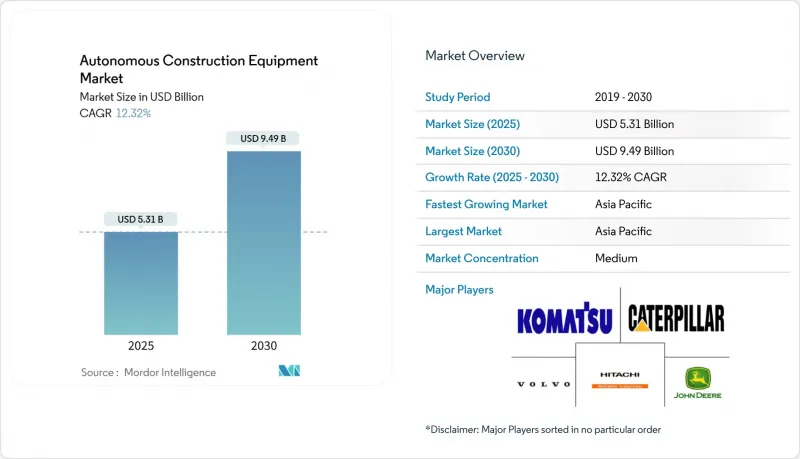
本報告按自動化程度(半自動、全自動)、機器類型(土木工程機具等)、驅動系統(內燃機等)、機器尺寸(大型(11噸及以上)等)、功率輸出(250馬力及以下等)、應用領域、銷售管道和地區進行細分。市場預測以貨幣價值(美元)和銷售(台)兩種形式呈現。
全球自主施工機械市場趨勢與洞察
受人手不足影響,企業正轉向透過自動化提高投資報酬率。
預計到2026年,北美建設產業將面臨220萬工人的勞動力缺口,使得自動化系統不再只是可有可無的升級選項,而是成為保障業務永續營運的必要組成部分。採用自主挖土機的建築公司可以減少每班次對2-3名操作員的依賴,從而避免支付加班費。全天候運作提高了資產運轉率,縮短了專案工期,增強了公司在競標的競爭力。工地事故風險的降低也意味著保險費的降低。符合修訂後的ANSI B11和UL 4600標準,能夠增強規避風險的專案業主的信心。
透過原廠維修套件大幅降低資本投入。
與購買新設備相比,自動駕駛維修套件可將部署成本降低 40% 至 60%。利勃海爾 PR 776 推土機搭載的 Trimble 硬體在出廠時就已整合安裝點,可在不影響保固的前提下加快現場運作。租賃業者對獨立於機器的 3D 控制系統讚賞有加,該系統避免了廠商鎖定,且不受品牌限制。較低的初始成本鼓勵小規模承包商嘗試這項技術。此外,維修部署可延長各類車隊的使用壽命,並促進自動駕駛施工機械市場向完全自動駕駛部署的過渡。
該地點的複雜地形限制了 GNSS/LiDAR 的可靠性。
城市改造和多層挖掘會干擾訊號,降低自主定位的精確度。利勃海爾的無GPS輪式裝載機利用3D環境感知技術,即使在衛星通訊無法覆蓋的隧道中也能進行導航。地形的動態變化需要即時更新地圖,這對車載處理器提出了很高的要求。軍用級感測器融合技術提供了一種解決方案,但其高昂的系統成本限制了其在高階專案之外的應用。
細分市場分析
2024年,半自動化機械的銷售額佔比達69.75%。這主要是因為承包商傾向於選擇具備操作員輔助功能的設備,以便在最大限度降低風險的同時,迅速提高生產效率。同時,隨著相關法規日趨清晰,且其可靠性在早期先導計畫中得到驗證,預計全自動系統將實現17.83%的最高複合年成長率。整合指揮平台使得一名主管能夠管理多個無人值守設備,從而降低人事費用。這些優勢與業主對縮短專案工期和提高成本可預測性的需求不謀而合。
全自動系統受益於感測感測器和故障安全架構的進步,這些技術符合 ANSI B11 安全標準。Caterpillar的「MineStar Command」系統展現了可擴展的自主性,其應用範圍涵蓋鐵礦石和骨材採石場。早期用戶報告稱,該系統延長了運作週期,並降低了怠速時的燃料消耗。推廣應用的主要障礙在於初始整合較為複雜,以及遠端監控人員(而非設備操作員)需要接受訓練。
2024年,土木工程機具市佔率維持在47.18%,這主要得益於採礦和公路工程中自動駕駛運輸系統和平土機的廣泛應用。同時,隨著滑移裝載機、平板夯和物料搬運機等小型工具(這些工具在都市區和公共產業很常見)的自動化程度不斷提高,小型工具預計將以13.42%的複合年成長率成長。這些小型機械擅長在大型機械無法運作的狹小空間內工作,從而減少返工和交通中斷。主要原始設備製造商(OEM)不斷擴充產品線,降低了初始投資成本,吸引了大型企劃有限的中型承包商的注意。
儘管小型工具市場在自主施工機械市場中仍處於相對較小的小規模,但隨著各廠商提供售後套件以及資金籌措的日益便捷,其成長速度正在加快。小型挖土機、履帶式裝載機和自動壓路機協同作業的「多機作業現場」概念已得到驗證。為了更廣泛地推廣應用,簡化安全認證流程以及能夠維護多樣化車輛車隊的經銷商支援至關重要。此外,包含維修、軟體更新和操作員培訓的租賃服務也進一步降低了進入門檻。
儘管內燃機在2024年仍佔據74.36%的市場佔有率,但受排放氣體法規和降低總擁有成本需求的推動,電池電子機械預計將以19.26%的複合年成長率快速成長。隨著公共和私人充電基礎設施的日益普及以及電池價格降至每千瓦時70美元以下,電池電動自動施工機械的市場佔有率正在逐年擴大。電動系統與自動駕駛高度相容,因為它們能夠提供瞬時扭矩和精確的速度控制,並簡化演算法控制迴路。柴油燃料成本的上漲以及企業為實現脫碳所做的努力,為轉型專案提供了經濟動力。
瞬時扭力可實現更平穩的路徑追蹤,而再生煞車則可延長運作並縮短維護週期,優於柴油液壓系統。氫燃料電池正在大型輪式裝載機中進行測試,因為電池重量是其主要限制因素,但實用化仍需數年時間。混合動力液壓系統可作為過渡方案,在基礎設施改造期間實現燃料和電力混合運作。總而言之,這些推進方案擴展了車隊規劃人員在面對各種運作週期和場地限制時可用的技術工具。
區域分析
2024年,亞太地區引領自動施工機械市場,佔全球45.13%的市場。這主要得益於中國可換電池挖土機、日本高精度感測器以及韓國電子元件供應鏈的強勁發展。亞太地區各國政府都在大力投資智慧城市和高速鐵路項目,這些項目旨在提高生產效率並減少排放氣體。然而,由於成熟子部門的應用迅速趨於飽和,該地區12.51%的複合年成長率低於全部區域。此外,各國不同的標準也增加了合規負擔,並減緩了跨區域車輛共用。
北美市場12.42%的複合年成長率主要歸功於熟練勞動力嚴重短缺和更清晰的安全框架。內華達州等美國州允許進行實地測試,加速了商業化進程。聯邦基礎設施建設資金已納入碳減排評分,鼓勵公共工程承包商採用結合電動車和自動駕駛的解決方案。在加拿大,無人駕駛設備在競標評估中已獲得加分,自動駕駛正成為大型專案的差異化因素。此外,提高供應鏈韌性的措施也推動了電池組和感測器模組的在地化生產。
在歐洲,受「綠色政府採購」法規的推動,預計將實現強勁的複合年成長率。這些法規將生命週期碳排放納入競標評估。荷蘭等國正在使用名為「二氧化碳績效階梯」的獎勵機制來鼓勵低排放作業,這反過來又促使承包商採用電動和自動駕駛車輛。由於歐盟成員國之間缺乏統一的安全認證,跨境部署較為複雜,但在製定符合ISO標準的指南方面正在取得進展。埃因霍溫等城市的早期電氣化試點計畫已經證明了零排放自動駕駛挖土機在公共工程中的有效性,並為更廣泛的應用樹立了典範。
其他好處:
- Excel格式的市場預測(ME)表
- 3個月的分析師支持
目錄
第1章:引言
- 市場分析與定義的前提條件
- 分析範圍
第2章 分析方法
第3章執行摘要
第4章 市場狀況
- 市場概覽
- 市場促進因素
- 受人手不足影響,企業正轉向透過自動化提高投資報酬率。
- 與新購置相比,OEM維修套件可顯著降低資本投入(售後市場自主性)。
- 電池成本的快速下降使得重型機械的電氣化成為可能。
- 在歐洲和加拿大,零排放營運項目在碳相關項目的競標評估中更受青睞。
- 利用人工智慧技術對多台機器編配,可以將生產力提高 25-30%。
- 由國防部門資助的感測器融合技術現在正向建築設備原始設備製造商推廣。
- 市場限制因素
- 該地點地形崎嶇,限制了GNSS/LiDAR的可靠性。
- 美國各州和歐盟 27 個國家在安全法規方面缺乏統一性,導致批准延誤。
- EPC、OEM和技術供應商之間的資料所有權糾紛
- 預計高容量、耐環境腐蝕的電池組(600 kWh 或以上)供不應求將持續到 2026 年。
- 價值鍊和供應鏈分析
- 監理情勢
- 技術展望
- 波特五力分析
第5章:預測市場規模與成長率
- 按自動化級別
- 半自動
- 全自動
- 按機器類型
- 土木機械
- 物料輸送
- 混凝土及道路施工機械
- 小型/緊湊型工具
- 透過驅動系統
- 內燃機
- 油壓
- 電池供電
- 氫燃料電池
- 按機器尺寸
- 大型(超過 11 噸)
- 中型(6-11噸)
- 小型(6噸以下)
- 依輸出類型
- 最高可達 250 匹馬力
- 250~500 HP
- 500馬力或以上
- 透過使用
- 基礎設施
- 住宅/商業建築
- 採礦和採石
- 石油和天然氣管道
- 工業和製造業
- 按銷售管道
- 新設備
- 租賃
- 二手/翻新
- 按地區
- 北美洲
- 美國
- 加拿大
- 其他北美國家
- 南美洲
- 巴西
- 阿根廷
- 其他南美國家
- 歐洲
- 德國
- 英國
- 法國
- 義大利
- 西班牙
- 瑞典
- 其他歐洲國家
- 亞太地區
- 中國
- 印度
- 日本
- 韓國
- 印尼
- 其他亞太國家
- 中東和非洲
- 沙烏地阿拉伯
- 阿拉伯聯合大公國
- 土耳其
- 南非
- 奈及利亞
- 埃及
- 其他中東和非洲國家
- 北美洲
第6章 競爭情勢
- 市場集中度
- 策略趨勢
- 市佔率分析
- 公司簡介
- Caterpillar Inc.
- Komatsu Ltd.
- Deere & Company
- Volvo Construction Equipment
- Hitachi Construction Machinery
- Liebherr Group
- CNH Industrial
- JCB Ltd.
- DEVELON(HD Hyundai Infracore)
- Hyundai Construction Equipment
- Wirtgen Group
- Bobcat Company
- Sandvik AB
- Epiroc AB
- Trimble Inc.
- Topcon Corp.
- Built Robotics
- SafeAI
- Autonomous Solutions Inc.(ASI)
- XCMG
- Sany Heavy Industry
第7章 市場機會與未來展望
According to Mordor Intelligence, the autonomous construction equipment market size stood at USD 5.31 billion in 2025 and is forecast to climb to USD 9.49 billion by 2030, advancing at a 12.32% CAGR.
This report is Segmented by Level of Automation (Semi-Autonomous and Fully Autonomous), Equipment Type (Earthmoving and More), Propulsion Type (Internal Combustion and More), Equipment Size (Heavy (Above 11 T) and More), Power Output (Up To 250 HP and More), Application, Sales Channel, and Geography. The Market Forecasts are Provided in Terms of Value (USD) and Volume (Units).
Global Autonomous Construction Equipment Market Trends and Insights
Labor-shortage Driven ROI Focus on Automation
Construction faces a projected 2.2 million-worker gap by 2026 in North America, elevating unmanned systems from optional upgrades to business-continuity necessities. Contractors deploying autonomous excavators cut reliance on two to three operators per shift and avoid overtime premiums. Continuous 24/7 operation improves asset utilization and compresses project timelines, enhancing bid competitiveness. Insurance savings accrue as exposure to work-site accidents falls. Compliance with updated ANSI B11 and UL 4600 standards boosts confidence among risk-averse project owners.
OEM Retrofit Kits Slashing Capital Outlay
Retrofit autonomy packages cut implementation costs 40-60% compared with new equipment purchases. Trimble-ready hardware on Liebherr PR 776 dozers illustrates factory-integrated mounting points that preserve warranties and speed field activation. Rental fleets value machine-agnostic 3D control systems that travel across brands, avoiding vendor lock-in. Lower upfront spend hastens technology trials by small contractors. Retrofit pathways also extend the service life of mixed fleets, smoothing the transition toward fully autonomous deployments in the autonomous construction equipment market.
Fragmented Job-site Topography Limiting GNSS/LiDAR Reliability
Urban reconstruction and multi-level excavations produce obstructed signals that diminish autonomous positioning accuracy. Liebherr's GPS-independent wheel loader uses 3D environmental sensing to navigate in tunnels where satellite access fails. Dynamic terrain changes force real-time map updates that tax onboard processing. Defense-grade sensor fusion offers a workaround yet raises system cost, inhibiting widespread use beyond premium projects.
Other drivers and restraints analyzed in the detailed report include:
- Rapid Battery-cost Decline Enabling Electrification
- AI-enabled Multi-machine Orchestration
- Unharmonized Safety Regulations Across Jurisdictions Delaying Approvals
For complete list of drivers and restraints, kindly check the Table Of Contents.
Segment Analysis
Semi-autonomous machines delivered 69.75% of 2024 revenue as contractors favored operator-assisted functions for immediate productivity gains with limited risk. Fully autonomous systems, however, are forecast to capture the fastest 17.83% CAGR as regulatory clarity improves and early pilots prove reliability. Integrated command platforms now let a single supervisor oversee multiple unmanned assets, compressing labor budgets. These gains align with owner demands for shorter schedules and predictable costs.
The fully autonomous cohort benefits from advances in perception sensors and fail-safe architectures that meet ANSI B11 safety requirements. Caterpillar's MineStar Command demonstrates scalable autonomy migrating from iron-ore mines to aggregates quarries. Early adopters report extended duty cycles and reduced idle fuel burn. Adoption barriers center on upfront integration complexity and the training required for remote supervisors rather than equipment operators.
Earthmoving equipment retained 47.18% market share in 2024 owing to entrenched autonomous haulage systems and motor graders across mining and highway projects. Compact tools, conversely, will post a 13.42% CAGR as autonomy penetrates skid steers, plate compactors, and material handlers popular on urban and utilities work sites. These smaller assets excel in confined areas where large machinery cannot maneuver, reducing rework and traffic disruption. Expanding model availability from mainstream OEMs keeps upfront prices in check, drawing interest from midsized contractors that lack mega-project budgets.
The autonomous construction equipment market size for compact tools remains modest yet accelerates as retrofit kits become brand-agnostic and easier to finance. Multi-machine site concepts already showcase coordinated tasks among mini-excavators, robotic track loaders, and automated compactors. Broader accessibility rests on streamlined safety certification and dealer support capable of servicing mixed fleets. Increased rental availability further lowers entry barriers by bundling maintenance, software updates, and operator onboarding.
Internal-combustion engines held 74.36% share in 2024, but battery-electric units are projected to surge at a 19.26% CAGR on the back of emissions mandates and total-cost savings. The autonomous construction equipment market share attributable to battery-electric machines improves yearly as public-private charging infrastructure spreads and batteries hit sub-USD 70/kWh pricing. Electric drivetrains deliver instant torque and precise speed modulation that simplify algorithmic control loops, making them a natural partner for autonomy. Rising diesel costs and corporate decarbonization pledges add financial impetus to conversion programs.
Instant torque enables smoother path-following, while regenerative braking extends runtime and trims maintenance cycles compared with diesel hydraulics. Hydrogen fuel-cell trials progress in heavy wheel loaders where battery mass proves restrictive, though commercialization remains several years away. Hybrid hydraulic systems serve as an interim step, allowing mixed fuel and electric operation during the infrastructure transition. Collectively, these propulsion options widen the technology toolkit available to fleet planners facing varied duty cycles and site constraints.
Complete Report Scope:
- By Level of Automation
- Semi-Autonomous
- Fully Autonomous
- By Equipment Type
- Earthmoving
- Material Handling
- Concrete and Road Machinery
- Light / Compact Tools
- By Propulsion Type
- Internal Combustion
- Hybrid Hydraulic
- Battery-Electric
- Hydrogen Fuel-Cell
- By Equipment Size
- Heavy (Above 11 t)
- Medium (6 to 11 t)
- Compact (Below 6 t)
- By Power Output
- Up to 250 HP
- 250 to 500 HP
- Above 500 HP
- By Application
- Infrastructure
- Residential and Commercial Construction
- Mining and Quarrying
- Oil and Gas / Pipelines
- Industrial and Manufacturing
- By Sales Channel
- New Equipment
- Rental
- Used / Refurbished
- By Geography
- North America
- United States
- Canada
- Rest of North America
- South America
- Brazil
- Argentina
- Rest of South America
- Europe
- Germany
- United Kingdom
- France
- Italy
- Spain
- Sweden
- Rest of Europe
- Asia-Pacific
- China
- India
- Japan
- South Korea
- Indonesia
- Rest of Asia-Pacific
- Middle East and Africa
- Saudi Arabia
- United Arab Emirates
- Turkey
- South Africa
- Nigeria
- Egypt
- Rest of Middle East and Africa
- North America
Geography Analysis
Asia-Pacific dominated the autonomous construction equipment market with 45.13% revenue in 2024, anchored by China's battery-swap excavators, Japan's precision sensors, and South Korea's electronics supply chain. Regional governments finance smart-city and high-speed rail projects that mandate productivity gains and emissions cuts. However, the 12.51% regional CAGR trails the region's pace because adoption saturates quickly in mature sub-sectors. Divergent national standards add compliance overhead and slow pan-regional fleet sharing.
North America's 12.42% CAGR arises from critical skilled-labor shortages and clearer safety frameworks. U.S. states such as Nevada permit live site testing, accelerating commercialization cycles. Federal infrastructure funding includes carbon-reduction scoring, nudging public contractors toward electric-autonomous packages. Canada's tender evaluations already award points for zero-operator equipment, making autonomy a differentiator on mega-projects. Supply-chain resilience initiatives also drive local manufacturing of battery packs and sensor modules.
Europe is projected to post a robust CAGR, driven by Green Public Procurement rules that factor whole-life carbon into bid scoring. Nations like the Netherlands use CO2 Performance Ladder incentives to reward low-emission job sites, pushing contractors to integrate electric-autonomous fleets. Fragmented safety certification across EU states complicates cross-border deployments, but ISO-aligned guidance is tightening. Early electrification pilots in cities such as Eindhoven validate emission-free autonomous diggers on municipal works, setting templates for broader rollouts.
- Caterpillar Inc.
- Komatsu Ltd.
- Deere & Company
- Volvo Construction Equipment
- Hitachi Construction Machinery
- Liebherr Group
- CNH Industrial
- JCB Ltd.
- DEVELON (HD Hyundai Infracore)
- Hyundai Construction Equipment
- Wirtgen Group
- Bobcat Company
- Sandvik AB
- Epiroc AB
- Trimble Inc.
- Topcon Corp.
- Built Robotics
- SafeAI
- Autonomous Solutions Inc. (ASI)
- XCMG
- Sany Heavy Industry
Additional Benefits:
- The market estimate (ME) sheet in Excel format
- 3 months of analyst support
TABLE OF CONTENTS
1 Introduction
- 1.1 Study Assumptions and Market Definition
- 1.2 Scope of the Study
2 Research Methodology
3 Executive Summary
4 Market Landscape
- 4.1 Market Overview
- 4.2 Market Drivers
- 4.2.1 Labor-shortage Driven ROI Focus on Automation
- 4.2.2 OEM Retrofit Kits Slashing Cap-ex vs. New Buys (After-market Autonomy)
- 4.2.3 Rapid Battery-cost Decline Enabling Heavy Equipment Electrification
- 4.2.4 Carbon-linked Project Tender Scores in Europe and Canada Favouring Zero-operator Sites
- 4.2.5 AI-enabled Multi-machine Fleet Orchestration Boosts Productivity 25 to 30%
- 4.2.6 Defence-funded Sensor Fusion Spilling Over to Construction OEMs
- 4.3 Market Restraints
- 4.3.1 Fragmented Job-site Topography Limiting GNSS/LiDAR Reliability
- 4.3.2 Unharmonized Safety Regulations Across US-States/EU-27 Delaying Approvals
- 4.3.3 Data-ownership Disputes Between EPCs, OEMs and Tech Suppliers
- 4.3.4 Scarcity of High-capacity, Ruggedised Battery Packs (Over 600 kWh) Until 2026
- 4.4 Value / Supply-Chain Analysis
- 4.5 Regulatory Landscape
- 4.6 Technological Outlook
- 4.7 Porter's Five Forces Analysis
- 4.7.1 Threat of New Entrants
- 4.7.2 Bargaining Power of Suppliers
- 4.7.3 Bargaining Power of Buyers
- 4.7.4 Threat of Substitutes
- 4.7.5 Intensity of Competitive Rivalry
5 Market Size and Growth Forecasts (Value (USD) and Volume (Units))
- 5.1 By Level of Automation
- 5.1.1 Semi-Autonomous
- 5.1.2 Fully Autonomous
- 5.2 By Equipment Type
- 5.2.1 Earthmoving
- 5.2.2 Material Handling
- 5.2.3 Concrete and Road Machinery
- 5.2.4 Light / Compact Tools
- 5.3 By Propulsion Type
- 5.3.1 Internal Combustion
- 5.3.2 Hybrid Hydraulic
- 5.3.3 Battery-Electric
- 5.3.4 Hydrogen Fuel-Cell
- 5.4 By Equipment Size
- 5.4.1 Heavy (Above 11 t)
- 5.4.2 Medium (6 to 11 t)
- 5.4.3 Compact (Below 6 t)
- 5.5 By Power Output
- 5.5.1 Up to 250 HP
- 5.5.2 250 to 500 HP
- 5.5.3 Above 500 HP
- 5.6 By Application
- 5.6.1 Infrastructure
- 5.6.2 Residential and Commercial Construction
- 5.6.3 Mining and Quarrying
- 5.6.4 Oil and Gas / Pipelines
- 5.6.5 Industrial and Manufacturing
- 5.7 By Sales Channel
- 5.7.1 New Equipment
- 5.7.2 Rental
- 5.7.3 Used / Refurbished
- 5.8 By Geography
- 5.8.1 North America
- 5.8.1.1 United States
- 5.8.1.2 Canada
- 5.8.1.3 Rest of North America
- 5.8.2 South America
- 5.8.2.1 Brazil
- 5.8.2.2 Argentina
- 5.8.2.3 Rest of South America
- 5.8.3 Europe
- 5.8.3.1 Germany
- 5.8.3.2 United Kingdom
- 5.8.3.3 France
- 5.8.3.4 Italy
- 5.8.3.5 Spain
- 5.8.3.6 Sweden
- 5.8.3.7 Rest of Europe
- 5.8.4 Asia-Pacific
- 5.8.4.1 China
- 5.8.4.2 India
- 5.8.4.3 Japan
- 5.8.4.4 South Korea
- 5.8.4.5 Indonesia
- 5.8.4.6 Rest of Asia-Pacific
- 5.8.5 Middle East and Africa
- 5.8.5.1 Saudi Arabia
- 5.8.5.2 United Arab Emirates
- 5.8.5.3 Turkey
- 5.8.5.4 South Africa
- 5.8.5.5 Nigeria
- 5.8.5.6 Egypt
- 5.8.5.7 Rest of Middle East and Africa
- 5.8.1 North America
6 Competitive Landscape
- 6.1 Market Concentration
- 6.2 Strategic Moves
- 6.3 Market Share Analysis
- 6.4 Company Profiles (Includes Global Level Overview, Market Level Overview, Core Segments, Financials as Available, Strategic Information, Market Rank/Share, Products and Services, Recent Developments)
- 6.4.1 Caterpillar Inc.
- 6.4.2 Komatsu Ltd.
- 6.4.3 Deere & Company
- 6.4.4 Volvo Construction Equipment
- 6.4.5 Hitachi Construction Machinery
- 6.4.6 Liebherr Group
- 6.4.7 CNH Industrial
- 6.4.8 JCB Ltd.
- 6.4.9 DEVELON (HD Hyundai Infracore)
- 6.4.10 Hyundai Construction Equipment
- 6.4.11 Wirtgen Group
- 6.4.12 Bobcat Company
- 6.4.13 Sandvik AB
- 6.4.14 Epiroc AB
- 6.4.15 Trimble Inc.
- 6.4.16 Topcon Corp.
- 6.4.17 Built Robotics
- 6.4.18 SafeAI
- 6.4.19 Autonomous Solutions Inc. (ASI)
- 6.4.20 XCMG
- 6.4.21 Sany Heavy Industry
7 Market Opportunities and Future Outlook
- 7.1 White-space and Unmet-Need Assessment

 無人駕駛工程機械市場分析及預測(至2035年):類型、產品、技術、組件、應用、最終用戶、功能、安裝類型、設備、解決方案自主施工無人機市場分析及預測(至2035年):按類型、產品、服務、技術、組件、應用、流程、最終用戶、功能和解決方案分類自動駕駛礦車市場分析與預測(至2035年):類型、產品類型、服務、技術、組件、應用、部署狀態、最終用戶、功能
 全球自主施工機械市場規模、佔有率、趨勢及成長分析報告(2026-2034)
 建築自動化市場預測至2034年-全球分析(按組件、自動化程度、設備類型、應用、最終用戶和地區分類)全球自主重型設備市場預測(至2034年)-按設備類型、系統、自動化程度、應用、最終用戶和地區分類的分析
 2026年全球機器人自卸卡車市場報告全球自主施工機械市場預測至2034年-按型號、自動化程度、技術、應用、最終用戶和地區分類的分析全球自主礦用車輛市場預測(至2034年)-按車輛類型、採礦方法、應用、最終用戶和地區分類的分析自主施工機械市場規模、佔有率、成長及全球產業分析:按類型、應用和地區分類,並對2026-2034年進行預測