


 |
市場調查報告書
商品編碼
2117457
電動堆高機:市場佔有率分析、產業趨勢與統計、成長預測(2026-2031)Electric Forklift - Market Share Analysis, Industry Trends & Statistics, Growth Forecasts (2026 - 2031) |
||||||

※ 本網頁內容可能與最新版本有所差異。詳細情況請與我們聯繫。
據 Mordor Intelligence 稱,2025 年電動堆高機市場價值為 499.8 億美元,預計將從 2026 年的 525.4 億美元成長到 2031 年的 674.4 億美元,2026 年至 2031 年的複合年成長率為 5.12%。
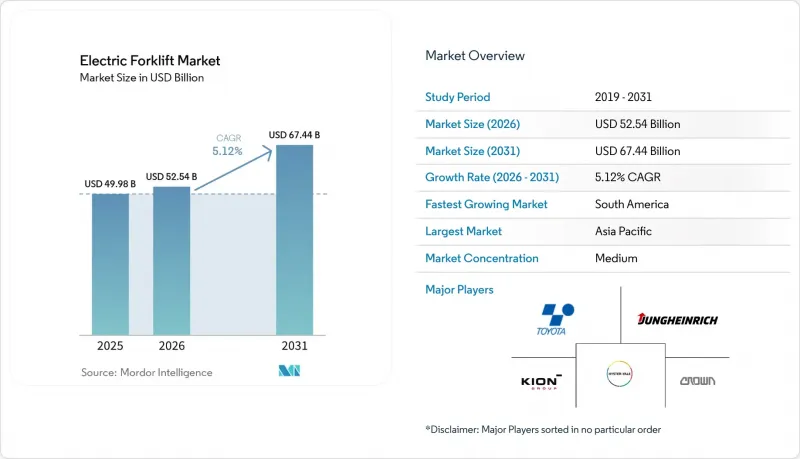
本報告按動力傳動系統類型(電動車和氫燃料電池汽車)、車輛類別(I類(搭乘用電動堆高機)、有效載重能力(5噸以下、5-15噸、15噸以上)、終端機種(製造業、物流倉儲等)及地區細分。市場預測以貨幣價值(美元)及數量(使用者產業)兩種形式呈現。
全球電動堆高機市場趨勢與洞察
電子商務推動倉庫快速擴張
為了兌現當日送達的承諾,需要能夠在封閉設施內連續運作的高容量、零排放設備。沃爾瑪在2026年投資路易斯安那州物流中心,清楚展現了自動化投資的規模,並推動採購轉向小型鋰離子堆高機。在日本、新加坡和西歐的多層城市倉庫中,窄巷道堆高機被用於最大限度地提高吞吐量,從而增加了對高機動性電動車型的需求。車輛操作員欣賞其無柴油排放、低噪音水平以及無需離開建築物即可在短暫休息期間充電的優勢。這些營運優勢,加上飆升的地價迫使垂直建設,鞏固了電子商務作為市場成長成長要素的正面影響。
關於零排放物料搬運設備的法規
加州的「零排放堆高機法規」將從2026年開始逐步淘汰新型柴油和液化石油氣堆高機。歐盟的類似措施將從2027年2月起要求提交包含生命週期碳排放資料的電子電池護照,已對二手車價格和租賃條款產生影響。同樣,中國多個省份的空氣品質法規正在限制工業園區內柴油的使用,引導全國車隊轉型為電池動力。隨著合規期限的臨近,擁有大量內燃機車隊的企業正面臨加速折舊免稅額,並開始提前更換設備以避免罰款。這種監管確定性降低了原始設備製造商(OEM)在擴大電動車產品線時的資本配置風險,並為合規車型的高價定價提供了基礎。
與內燃機 (ICE) 的替代方案相比,初始成本較高
對於無法獲得優惠貸款或租賃計劃的小規模企業而言,高昂的初始購買成本仍然是一大障礙。儘管電動車具有生命週期成本優勢,但在價格敏感地區,其投資回收期可能會超出通常的計畫週期。電池即服務 (BaaS) 可以緩解這一障礙,但並不能完全消除,因為在石油產品享受補貼的市場,其月度成本仍然高於柴油燃料成本。隨著電池組價格的下降以及金融機構基於即時電池健康數據開發殘值模型,這項限制的影響將會得到緩解。
細分市場分析
預計到2025年,電動車市場將佔71.27%的佔有率,並將呈現最高的成長率,到2031年複合年成長率將達到11.79%。鋰離子電池的日益普及正在降低鉛酸電池的吸引力,因為營運商優先考慮的是快速充電和降低維護成本。重型車輛車隊的電氣化滲透正在加速,這尤其受到加州2025年禁止銷售新柴油卡車等法規的推動。原始設備製造商(OEM)正在推出垂直整合的電池組件,以增強品管並實現動態電壓管理等軟體功能。終端用戶主要將氫能試驗視為基礎設施完善前的風險對沖試點計畫。
磷酸鋰鐵化學技術的進步提高了熱安全性和成本穩定性,進一步增強了電池動力傳動系統的優勢。堆高機車型現在配備了電池健康分析功能,可以推薦最佳充電時間,從而延長電池組壽命並降低電力成本。車隊管理人員將這些分析資料整合到倉庫管理儀錶板中,以協調堆高機運作與機器人揀貨計劃。同時,燃料電池計畫依賴跨行業的氫氣需求來支持加氫站的運營,但前景仍然不明朗。因此,電動車正在鞏固其市場佔有率,而氫能更多地被視為未來的補充而非替代方案。
到2025年,III類托盤搬運車將佔據41.37%的市場佔有率,而II類窄巷道搬運車預計到2031年將以9.28%的複合年成長率成長。窄巷道搬運車能夠在寬度小於2公尺的巷道中行駛,正被廣泛應用於高密度都市區倉庫,從而最佳化單位面積的儲存容量。零售商和第三方物流(3PL)供應商正在為這些車型配備防碰撞感測器,以保護操作人員和易碎貨物的安全。語音揀選功能的整合使操作員無需離開堆高機即可控制車輛,進一步提高了處理能力。
二級堆高機的成長軌跡反映了自動化倉庫系統的普及,這些系統需要在多層貨架上進行精確的垂直定位。電池驅動系統能夠實現這種精確度所需的精細扭力控制,同時還能在對噪音敏感的都市區倉庫中保持低噪音水平。一級平衡重式堆高機在搬運重物方面仍發揮重要作用,但其資本密集的特性導致其更換週期較長。緊湊型電池設計的不斷改進可能會模糊堆高機等級的界限,並催生一種新的混合型堆高機,它將托盤搬運車的機動性和中等負載的提升能力相結合。
區域分析
預計到2025年,亞太地區將維持43.29%的市場佔有率,主要得益於中國大力推動工廠自動化以及印度A級倉庫的蓬勃發展。地方政府的排放法規正在收緊對柴油堆高機的限制,促使中國整車製造商擴大磷酸鋰鐵鋰電池的生產,並以低於進口的價格供應設備。印度物流房地產投資者正在將快速充電基礎設施融入新建物業,並將電動車隊視為吸引電商客戶的競爭優勢。日本和韓國政府正在津貼自動化以應對人手不足,加速窄巷道電動堆高機的普及。儘管成長迅速,電網基礎設施仍落後於倉庫擴張的速度,因此現場太陽能發電和儲能成為更理想的解決方案。
在南美洲,受巴西電履約競爭和阿根廷出口導向低溫運輸現代化建設的推動,預計到2031年,該地區的複合年成長率將達到8.72%。巴西聖保羅的一家物流中心對其自動化輸送機進行了維修,增設了充電站,實現了無縫的夜間庫存補貨。阿根廷的農產品和食品出口商正在引進電動堆高機,以滿足國際買家的永續審查要求,從而進入高階市場。儘管資金籌措挑戰依然存在,但包含維護的電池租賃方案正在減輕初始成本的負擔。當地組裝正在考慮進口散件套件,以避免外匯波動並縮短前置作業時間。
在北美和歐洲,在監管執法和企業脫碳目標的推動下,電氣化正步入成熟階段。加州禁止銷售新的柴油堆高機,加速了車隊現代化進程;電力公司向在離峰時段充電的倉庫提供需量反應積分。歐盟的「電池護照」框架促進了供應鏈的透明化,並獎勵那些追蹤礦物來源和可回收性的原始設備製造商。倉庫營運商正在部署人工智慧儀表板,將堆高機調度和人員輪班聯繫起來,從而進一步延長每個電池組的運作。在中東和非洲,電氣化試點計畫主要集中在沿岸地區自由貿易區和南非港口,目前正在努力使用戶熟悉鋰離子技術,並透過租賃計畫降低資本風險。
其他好處:
- Excel格式的市場預測(ME)表
- 3個月的分析師支持
目錄
第1章:引言
- 研究假設和市場定義
- 調查範圍
第2章:調查方法
第3章執行摘要
第4章 市場狀況
- 市場概覽
- 市場促進因素
- 由於電子商務的快速發展,倉庫需要擴建。
- 零排放物料搬運設備的強制性要求
- 鋰離子電池的成本曲線正在下降。
- 基於OEM的「電池即服務(BaaS)」模式
- 全固態電池商業化藍圖(2027年及以後)
- 人工智慧驅動的預測性維護推動整體擁有成本最佳化
- 市場限制因素
- 與內燃機替代方案相比,初始成本較高。
- 現有設施輸電網容量的限制
- 鉛酸電池回收的瓶頸
- 缺乏容量小於1兆瓦的氫氣加註基礎設施。
- 價值供應鏈分析
- 監理情勢
- 技術展望
- 波特五力模型
第5章 市場規模與成長預測
- 依動力傳動系統類型
- 電的
- 鉛酸
- Li-ion
- 氫燃料電池汽車(HFCV)
- 電的
- 按車輛類別
- 一級(電動騎乘卡車)
- II 類(窄巷電氣化)
- 三級(電動托盤)
- 按載重能力
- 少於5噸
- 5-15噸
- 15噸或以上
- 按最終用戶行業分類
- 製造業
- 物流和倉儲
- 建築和基礎設施
- 零售和批發
- 食品和飲料低溫運輸
- 按地區
- 北美洲
- 美國
- 加拿大
- 其他北美國家
- 南美洲
- 巴西
- 阿根廷
- 其他南美國家
- 歐洲
- 德國
- 英國
- 法國
- 義大利
- 西班牙
- 其他歐洲國家
- 亞太地區
- 中國
- 印度
- 日本
- 韓國
- 其他亞太國家
- 中東和非洲
- 阿拉伯聯合大公國
- 沙烏地阿拉伯
- 土耳其
- 南非
- 其他中東和非洲國家
- 北美洲
第6章 競爭情勢
- 市場集中度
- 策略趨勢
- 市佔率分析
- 公司簡介
- Toyota Industries Corporation
- KION Group AG
- Jungheinrich AG
- Hyster-Yale Inc.
- Crown Equipment Corporation
- Mitsubishi Logisnext Co.Ltd.
- Hangcha Group Co.Ltd.
- Anhui Heli Co.Ltd.
- Komatsu Ltd.
- Clark Material-Handling Company
- Doosan Corporation
- UniCarriers Corporation
- Hyundai Construction Equipment North America Inc.
- Lonking Holdings Limited
- EP Equipment
- Godrej & Boyce Mfg.Co.Ltd.
- BYD Motors Inc.
- Noblelift Intelligent Equipment Co., Ltd.
- Carer Electric Forklift
第7章 市場機會與未來展望
According to Mordor Intelligence, the electric forklift market size was valued at USD 49.98 billion in 2025 and is projected to expand from USD 52.54 billion in 2026 to USD 67.44 billion by 2031, registering a 5.12% CAGR between 2026 and 2031.
This report is Segmented by Power-Train Type (Electric and Hydrogen Fuel-Cell Vehicle), Vehicle Class (Class I (Electric Rider Trucks), and More), Load Capacity (Below 5 Tons, 5-15 Tons, and Above 15 Tons), End-User Industry (Manufacturing, Logistics and Warehousing, and More), and Geography. The Market Forecasts are Provided in Terms of Value (USD) and Volume (Units).
Global Electric Forklift Market Trends and Insights
Rapid E-commerce-Driven Warehouse Expansion
Same-day fulfillment commitments require high-throughput, zero-emission equipment that can operate continuously inside enclosed facilities. Walmart's 2026 Louisiana distribution center investment exemplifies the scale of automation spending that tilts procurement toward compact, lithium-ion forklifts. Multi-story urban warehouses across Japan, Singapore, and Western Europe employ narrow-aisle trucks to maximize cubic capacity, amplifying demand for maneuverable electric models. Fleet operators value the absence of diesel exhaust, lower noise, and the ability to recharge during micro-breaks without leaving the building. These operational gains, combined with rising land costs that force vertical construction, anchor the e-commerce driver's positive impact on market growth.
Mandates on Zero-Emission Material-Handling Equipment
California's Zero-Emission Forklift Regulation bans new diesel and LPG units in phases beginning in 2026. Parallel measures in the European Union require digital battery passports from February 2027, embedding lifecycle carbon data that now influences resale pricing and lease terms. Provincial air-quality rules in China likewise restrict diesel use in industrial parks, nudging domestic fleets toward battery power. As compliance deadlines tighten, operators with large internal-combustion fleets face accelerated depreciation and have begun swapping equipment ahead of schedule to avoid penalties. This regulatory certainty de-risks capital allocation for OEMs expanding electric lines and justifies premium pricing on compliant models.
High Upfront Cost vs. ICE Alternatives
The purchase premium remains a hurdle for smaller operators that lack access to concessional finance or leasing programs. Even though lifetime economics favor electrics, the payback horizon can stretch beyond planning cycles typical in price-sensitive regions. Battery-as-a-service alleviates, but does not eliminate, this barrier, as monthly fees still exceed diesel fuel costs in markets with subsidized petroleum. The restraint's influence will moderate as pack prices fall and financiers develop residual-value models based on real-time battery health data.
Other drivers and restraints analyzed in the detailed report include:
- Declining Li-Ion Battery Cost Curve
- OEM Battery-As-A-Service (Baas) Models
- Grid-Capacity Constraints at Brownfield Sites
For complete list of drivers and restraints, kindly check the Table Of Contents.
Segment Analysis
Electric variants occupied 71.27% of the 2025 market and are projected to chart the fastest 11.79% CAGR through 2031. Growing lithium-ion adoption has diminished the appeal of lead-acid units, as operators value rapid charging and lower maintenance. Legislative tailwinds, notably California's 2025 sales prohibition on new diesel trucks, propel electric penetration in heavy-duty fleets. OEMs deploy vertically integrated battery assemblies that tighten quality control and unlock software features such as dynamic voltage management. End users view hydrogen tests mainly as risk-hedging pilots until infrastructure scales.
Advances in lithium-iron-phosphate chemistry reinforce the dominance of battery power-trains by enhancing thermal safety and cost stability. Forklift models now integrate battery health analytics that recommend optimal charge windows, lengthening pack life and curbing electricity bills. Fleet managers integrate these analytics into warehouse-management dashboards, aligning forklift availability with robotic picking schedules. Conversely, fuel-cell programs depend on cross-industry hydrogen demand to underwrite refueling hubs, a scenario that remains uncertain. As a result, electrics consolidate share while hydrogen remains an aspirational complement rather than a substitute.
Class III pallet trucks led with 41.37% market share in 2025, whereas Class II narrow-aisle trucks are on pace for a 9.28% CAGR through 2031. High-density urban warehouses rely on narrow-aisle units that maneuver in sub-two-meter corridors, optimizing storage per square foot. Retailers and third-party logistics providers outfit these models with collision-avoidance sensors that protect both personnel and fragile goods. Voice-picking integration further enhances throughput by allowing operators to control lifts without dismounting.
The growth trajectory of Class II trucks reflects the proliferation of automated storage and retrieval systems, which demand precise vertical positioning across multi-level racking. Battery-electric drivetrains supply the micro-torque control necessary for such precision while maintaining low acoustic signatures in noise-sensitive urban depots. Class I counterbalance trucks remain relevant for heavier loads but experience slower replacement cycles due to their capital intensity. Continuous improvement in compact battery designs could blur class boundaries, enabling emerging hybrid categories that combine pallet-truck agility with mid-lift capability.
Complete Report Scope:
- By Power-train Type
- Electric
- Lead-acid
- Li-ion
- Hydrogen Fuel-cell Vehicle (HFCV)
- Electric
- By Vehicle Class
- Class I (Electric Rider Trucks)
- Class II (Electric Narrow-Aisle)
- Class III (Electric Pallet)
- By Load Capacity
- Below 5 Tons
- 5 - 15 Tons
- Above 15 Tons
- By End-user Industry
- Manufacturing
- Logistics and Warehousing
- Construction and Infrastructure
- Retail and Wholesale
- Food and Beverage Cold-Chain
- By Geography
- North America
- United States
- Canada
- Rest of North America
- South America
- Brazil
- Argentina
- Rest of South America
- Europe
- Germany
- United Kingdom
- France
- Italy
- Spain
- Rest of Europe
- Asia-Pacific
- China
- India
- Japan
- South Korea
- Rest of Asia-Pacific
- Middle East and Africa
- United Arab Emirates
- Saudi Arabia
- Turkey
- South Africa
- Rest of Middle East and Africa
- North America
Geography Analysis
Asia-Pacific retained 43.29% market share in 2025, buoyed by China's factory automation drive and India's Grade-A warehouse boom. Provincial pollution limits tighten the noose on diesel forklifts, prompting Chinese OEMs to scale lithium-iron-phosphate output and deliver lower-priced equipment that outflanks imports. India's logistics real estate investors embed fast-charging infrastructure in new builds, viewing electrified fleets as a competitive differentiator for e-commerce clients. Governments in Japan and South Korea subsidize automation to offset labor shortages, hastening adoption of narrow-aisle electrics. Despite rapid growth, grid upgrades still lag warehouse expansion, making on-site solar plus storage a favored mitigation strategy.
South America is forecast to post an 8.72% CAGR through 2031, underpinned by Brazil's e-commerce fulfillment race and Argentina's export-oriented cold-chain overhaul. Brazilian distribution centers in Sao Paulo retrofit charging bays alongside automated conveyors, allowing seamless overnight replenishment. Argentine agrifood exporters integrate electric forklifts to meet international buyers' sustainability audits, unlocking premium market access. Financing obstacles persist, but battery leasing packaged with maintenance softens upfront cost hurdles. Local assemblers explore knock-down kit imports to sidestep currency volatility and shorten lead times.
North America and Europe exhibit mature electrification driven by regulatory enforcement and corporate decarbonization goals. California's sales ban on new diesel forklifts compels accelerated fleet renewal, and utilities offer demand-response credits for warehouses that schedule off-peak charging. The EU's battery passport framework catalyzes transparent supply chains, rewarding OEMs that track mineral provenance and recyclability. Warehouse operators deploy AI dashboards that align forklift dispatch with labor rosters, squeezing extra cycles from each battery pack. In the Middle East and Africa, nascent electrification pilots concentrate in Gulf free-trade zones and South African ports, where rental programs reduce capital exposure and familiarize users with lithium-ion technology.
- Toyota Industries Corporation
- KION Group AG
- Jungheinrich AG
- Hyster-Yale Inc.
- Crown Equipment Corporation
- Mitsubishi Logisnext Co.Ltd.
- Hangcha Group Co.Ltd.
- Anhui Heli Co.Ltd.
- Komatsu Ltd.
- Clark Material-Handling Company
- Doosan Corporation
- UniCarriers Corporation
- Hyundai Construction Equipment North America Inc.
- Lonking Holdings Limited
- EP Equipment
- Godrej & Boyce Mfg.Co.Ltd.
- BYD Motors Inc.
- Noblelift Intelligent Equipment Co., Ltd.
- Carer Electric Forklift
Additional Benefits:
- The market estimate (ME) sheet in Excel format
- 3 months of analyst support
TABLE OF CONTENTS
1 Introduction
- 1.1 Study Assumptions & Market Definition
- 1.2 Scope of the Study
2 Research Methodology
3 Executive Summary
4 Market Landscape
- 4.1 Market Overview
- 4.2 Market Drivers
- 4.2.1 Rapid E-Commerce-Driven Warehouse Expansion
- 4.2.2 Mandates On Zero-Emission Material-Handling Equipment
- 4.2.3 Declining Li-Ion Battery Cost Curve
- 4.2.4 OEM Battery-As-A-Service (Baas) Models
- 4.2.5 Solid-State Battery Commercialization Road-Map (2027+)
- 4.2.6 AI-Enabled Predictive Maintenance Driving TCO Optimization
- 4.3 Market Restraints
- 4.3.1 High Upfront Cost Vs. ICE Alternatives
- 4.3.2 Grid-Capacity Constraints At Brown-Field Sites
- 4.3.3 Lead-Acid Battery Recycling Bottlenecks
- 4.3.4 Sub-MW Hydrogen Refueling Infra Gaps
- 4.4 Value / Supply-Chain Analysis
- 4.5 Regulatory Landscape
- 4.6 Technological Outlook
- 4.7 Porter's Five Forces
- 4.7.1 Threat of New Entrants
- 4.7.2 Bargaining Power of Suppliers
- 4.7.3 Bargaining Power of Buyers
- 4.7.4 Threat of Substitutes
- 4.7.5 Competitive Rivalry
5 Market Size & Growth Forecasts (Value (USD))
- 5.1 By Power-train Type
- 5.1.1 Electric
- 5.1.1.1 Lead-acid
- 5.1.1.2 Li-ion
- 5.1.2 Hydrogen Fuel-cell Vehicle (HFCV)
- 5.1.1 Electric
- 5.2 By Vehicle Class
- 5.2.1 Class I (Electric Rider Trucks)
- 5.2.2 Class II (Electric Narrow-Aisle)
- 5.2.3 Class III (Electric Pallet)
- 5.3 By Load Capacity
- 5.3.1 Below 5 Tons
- 5.3.2 5 - 15 Tons
- 5.3.3 Above 15 Tons
- 5.4 By End-user Industry
- 5.4.1 Manufacturing
- 5.4.2 Logistics and Warehousing
- 5.4.3 Construction and Infrastructure
- 5.4.4 Retail and Wholesale
- 5.4.5 Food and Beverage Cold-Chain
- 5.5 By Geography
- 5.5.1 North America
- 5.5.1.1 United States
- 5.5.1.2 Canada
- 5.5.1.3 Rest of North America
- 5.5.2 South America
- 5.5.2.1 Brazil
- 5.5.2.2 Argentina
- 5.5.2.3 Rest of South America
- 5.5.3 Europe
- 5.5.3.1 Germany
- 5.5.3.2 United Kingdom
- 5.5.3.3 France
- 5.5.3.4 Italy
- 5.5.3.5 Spain
- 5.5.3.6 Rest of Europe
- 5.5.4 Asia-Pacific
- 5.5.4.1 China
- 5.5.4.2 India
- 5.5.4.3 Japan
- 5.5.4.4 South Korea
- 5.5.4.5 Rest of Asia-Pacific
- 5.5.5 Middle East and Africa
- 5.5.5.1 United Arab Emirates
- 5.5.5.2 Saudi Arabia
- 5.5.5.3 Turkey
- 5.5.5.4 South Africa
- 5.5.5.5 Rest of Middle East and Africa
- 5.5.1 North America
6 Competitive Landscape
- 6.1 Market Concentration
- 6.2 Strategic Moves
- 6.3 Market Share Analysis
- 6.4 Company Profiles (Includes Global level Overview, Market level overview, Core Segments, Financials as available, Strategic Information, Market Rank/Share for key companies, Products & Services, and Recent Developments)
- 6.4.1 Toyota Industries Corporation
- 6.4.2 KION Group AG
- 6.4.3 Jungheinrich AG
- 6.4.4 Hyster-Yale Inc.
- 6.4.5 Crown Equipment Corporation
- 6.4.6 Mitsubishi Logisnext Co.Ltd.
- 6.4.7 Hangcha Group Co.Ltd.
- 6.4.8 Anhui Heli Co.Ltd.
- 6.4.9 Komatsu Ltd.
- 6.4.10 Clark Material-Handling Company
- 6.4.11 Doosan Corporation
- 6.4.12 UniCarriers Corporation
- 6.4.13 Hyundai Construction Equipment North America Inc.
- 6.4.14 Lonking Holdings Limited
- 6.4.15 EP Equipment
- 6.4.16 Godrej & Boyce Mfg.Co.Ltd.
- 6.4.17 BYD Motors Inc.
- 6.4.18 Noblelift Intelligent Equipment Co., Ltd.
- 6.4.19 Carer Electric Forklift
7 Market Opportunities & Future Outlook

 電動堆高機市場規模、佔有率和趨勢分析報告:按產品類型、電池類型、最終用途、地區和細分市場預測(2026-2033 年)
 2026年全球電動堆高機市場報告
 電動堆高機市場:2026-2032年全球市場預測(依終端用戶產業、電池類型、載重能力、應用、驅動方式及輪胎類型分類)
 電動堆高機市場-全球產業規模、佔有率、趨勢、機會和預測(按類別、最終用途、電池類型、地區和競爭細分,2020-2030 年)
 電動堆高機市場機會、成長動力、產業趨勢分析及 2025 - 2034 年預測
 電動堆高機市場分析與預測(~2033):按類型、產品、技術、應用、最終用戶、組件、功能、安裝和設備