


 |
市場調查報告書
商品編碼
2117456
電動機車:市場佔有率分析、產業趨勢與統計、成長預測(2026-2031)Electric Motorcycle - Market Share Analysis, Industry Trends & Statistics, Growth Forecasts (2026 - 2031) |
||||||

※ 本網頁內容可能與最新版本有所差異。詳細情況請與我們聯繫。
根據 Mordor Intelligence 預測,電動摩托車市場規模預計在 2025 年達到 11.5 億美元,2026 年達到 14.5 億美元,到 2031 年達到 45.4 億美元,2026 年至 2031 年的複合年成長率為 25.72%。
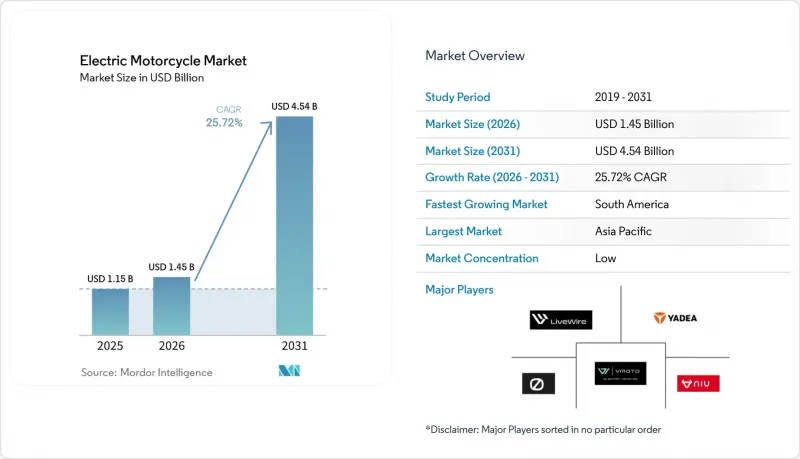
本報告按電池類型(鉛酸電池、鋰離子電池、鋰離子聚合物電池、鈉離子電池和新興化學電池)、功率輸出(小於3.6千瓦、3.6-7.2千瓦及以上)、馬達類型(輪轂式馬達、皮帶驅動馬達、鏈條驅動馬達、中置馬達)、應用領域(個人、商業等)和地區進行細分。市場預測以價值(美元)和銷售(台)兩種形式呈現。
全球電動機車市場趨勢及洞察
鋰離子電池成本更低、能量密度更高
自2024年以來,電池供應商一直在穩步降低每千瓦時的價格,因此,每公斤瓦時數也穩步提高。這使得更小的電池組成為可能,無需增加底盤尺寸即可實現更遠的續航里程。隨著保固期超過五年,二手車殘值不斷提升,與汽油車的折舊免稅額差距也縮小。此外,價值鏈正朝著富含鐵的化學成分多元化發展,從而避免使用價格波動較大的鈷,進一步穩定了成本曲線。所有這些進步使得電動動力系統成為對價格敏感的通勤者的首選。
政府採購激勵措施和零排放法規
國家和各州政府的各項計畫持續降低電動機車視為奢侈品。印度更新了其「PM E-DRIVE」計劃,並提出了「FAME-III」預算提案,該計劃將在未來兩到三年內繼續提供補貼。加州維持著銷售點返利制度,而巴西的「MOVER」框架則將稅收優惠與本地組裝激勵措施相結合。這些措施縮短了投資回收期,尤其對日行駛里程長的商用車隊而言更是如此。這些政策的進展也預示著市場需求將支撐國內製造業的擴張。
與內燃機(ICE)自行車相比,初始價格溢價較高
即使有補貼,許多入門級電動機車的價格幾乎是同級汽油摩托車的兩倍。這種價格差異仍然是一大障礙,尤其對於那些融資管道有限、預算緊張的消費者而言。拉丁美洲國家的進口關稅也推高了進口後的成本。雖然製造商正在試行按使用收費的電池計劃和租賃購買方案,但這些方案依賴信用評分和殘值保證,尚未廣泛應用。彌合這一價格差距將取決於本地組裝的進一步擴大和電池成本的持續下降。
細分市場分析
到2025年,鋰離子電池將佔據電動機車市場64.52%的佔有率,鞏固其作為標準電池技術的地位,滿足主流市場對價格和性能的預期。鈉離子電池組預計將以26.92%的複合年成長率成長,對於希望擺脫鋰供應限制和鈷價格波動的製造商而言,鈉離子電池組是一個極具吸引力的選擇。小規模的製造商正在利用鈉離子電池的深度放電耐受性,透過延長保固來提高可靠性。此外,組件標準化提高了不同型號之間的兼容性,使其能夠在固定式儲能系統中實現二次利用。
更廣泛的化學成分選擇使品牌能夠根據騎乘者的需求客製化電池特性。注重成本的通勤者可以選擇耐用、慢充的電池組,而追求性能的愛好者則可能更青睞具有嚴格溫度控管的高功率電池。這種配置多樣化降低了整個系統的供應風險,並促進了本地電芯生產,這對鈉和鐵等原料豐富的地區尤其有利。隨著化學成分的多樣化,售後服務模式也將隨之發展,以適應不同的回收流程和針對不同化學成分的診斷方案。
預計到2025年,功率低於3.6千瓦的電動機車將佔據44.21%的市場佔有率,這主要得益於都市區騎行者的需求以及監管機構將其歸類於輕型機踏車牌照管理條例。功率10千瓦及以上的電動摩托車預計將以28.39%的複合年成長率成長,這表明電動動力系統能夠滿足追求刺激的騎行者的需求,而無需做出任何妥協。高階品牌正將電動摩托車定位為中排量運動摩托車的可靠替代品,並強調其強勁的加速性能和賽道表現。
隨著能量密度的逐步提升,功率在7.2-10千瓦之間的中功率摩托車正逐漸平衡日常通勤和週末高速公路騎行的需求。騎乘者發現,其瞬時扭力使其在城市道路上爬坡輕鬆自如,並能順暢地融入車流。根據經銷商反映,一旦消費者體驗到其靜謐的加速和能量回收制動,持懷疑態度的試駕者數量就會減少。這些質的優勢與簡單的功率輸出(千瓦)同樣重要,並促使那些原本對購買電動機車猶豫不決的消費者最終做出改變。
區域分析
亞太地區主導電動機車市場,預計2025年將佔全球銷售量的73.28%。人口稠密的城市、根深蒂固的摩托車文化以及強力的財政獎勵正在加速從汽油動力轉向電池動力的轉變。中國、台灣和印尼的換電生態系統使電動摩托車的充電等待時間與汽油車相比更具競爭力;而在印度,儘管補貼逐步減少,但相關政策仍維持了電動摩托車的高速銷售成長。日本和韓國在保護國內產業和實現脫碳目標之間取得了穩步進展。目前,亞太地區的生態系統正吸引零件供應商在整車工廠附近設立電池組組裝廠。
預計到2031年,南美洲將以27.07%的複合年成長率實現最高成長,這主要得益於巴西的「MOVER」產業框架和不斷擴張的區域組裝網路。針對在地採購率的法規和稅收優惠政策鼓勵製造商進入市場,並降低了外匯風險。阿根廷的關稅結構在短期內減緩了成長勢頭,但隨著政策制定者權衡減排目標和消費者購買力,這種情況可能會有所緩解。基礎建設主要集中在聖保羅和布宜諾斯艾利斯等大都會圈,這些地區存在擁塞費和共享出行需求重疊的問題。
在歐洲和北美,由於各國獎勵和都市區清潔空氣區政策不盡相同,電動自行車的普及速度較為緩慢。在倫敦、巴黎和米蘭,城市地區對汽油動力摩托車徵收罰款,促使宅配業者轉向租賃電動機車。在美國,加州和奧勒岡州主導州級購車補貼計劃,但預計只有當符合週末休閒文化的長途旅行車型上市後,電動自行車的普及率才會更高。在中東和非洲,電動自行車的普及仍處於起步階段。肯亞和盧安達的以舊換新試點計畫展示了在電網資源有限的環境下行之有效的解決方案,而海灣國家則將強制電氣化與大規模充電基礎設施投資相結合,以配合其淨零排放藍圖。
其他好處:
- Excel格式的市場預測(ME)表
- 3個月的分析師支持
目錄
第1章:引言
- 研究假設和市場定義
- 調查範圍
第2章:調查方法
第3章執行摘要
第4章 市場狀況
- 市場概覽
- 市場促進因素
- 鋰離子電池成本更低、能量密度更高
- 政府採購激勵措施和零排放強制規定
- 擴大摩托車充電和電池更換網路
- 引進微型移動配送車輛(降低總擁有成本)
- 突破性的鈉離子電池/固態電池化學
- 收入來源包括與線上旅行社 (OTA) 的整合以及資料貨幣化。
- 市場限制因素
- 與燃油摩托車相比,初始價格溢價較高
- 實際續航里程有限,且充電功率超過 7kW 時充電速度較慢。
- 熱帶地區艦隊運作週期中的熱力學與安全問題
- 新興市場廢電池回收不足
- 價值供應鏈分析
- 監理情勢
- 技術展望
- 波特五力模型
第5章 市場規模與成長預測
- 依電池類型
- 鉛酸
- 鋰離子
- 鋰離子聚合物
- 鈉離子電池和新興化學電池
- 依輸出類型
- 小於 3.6 千瓦
- 3.6~7.2 kW
- 7.2~10 kW
- 10千瓦或以上
- 馬達/驅動系統
- 輪轂式馬達
- 皮帶傳動
- 鏈傳動
- 中置馬達
- 按最終用途
- 個人/個體
- 商用和企業車輛
- 微行程服務供應商
- 配送/物流
- 按地區
- 北美洲
- 美國
- 加拿大
- 其他北美國家
- 南美洲
- 巴西
- 阿根廷
- 其他南美國家
- 歐洲
- 英國
- 德國
- 西班牙
- 義大利
- 法國
- 俄羅斯
- 其他歐洲國家
- 亞太地區
- 印度
- 中國
- 日本
- 韓國
- 其他亞太國家
- 中東和非洲
- 阿拉伯聯合大公國
- 沙烏地阿拉伯
- 土耳其
- 埃及
- 南非
- 其他中東和非洲國家
- 北美洲
第6章 競爭情勢
- 市場集中度
- 策略趨勢
- 市佔率分析
- 公司簡介
- Yadea Group Holdings Ltd.
- NIU Technologies
- Vmoto Limited
- Zero Motorcycles Inc.
- Energica Motor Company SpA
- LiveWire EV, LLC
- HORWIN Inc.
- Revolt Intellicorp Private Limited(Revolt Motors)
- Honda Motor Co. Ltd.
- Yamaha Motor Co. Ltd.
- Oben EV SPA
- Verge Motorcycles Oconf
- Damon Inc.
- LAND Moto
第7章 市場機會與未來展望
According to Mordor Intelligence, the electric motorcycle market size is expected to be USD 1.15 billion in 2025, USD 1.45 billion in 2026, and reach USD 4.54 billion by 2031, growing at a CAGR of 25.72% from 2026 to 2031.
This report is Segmented by Battery Type (Lead-Acid, Lithium-Ion, Lithium-Ion Polymer, and Sodium-Ion and Emerging Chemistries), Power Output (Below 3. 6 KW, 3. 6 - 7. 2 KW, and More), Motor Type (Hub Motor, Belt Drive, and Chain Drive, Mid-Drive Motor), End-Use (Personal, Commercial, and More), and Geography. The Market Forecasts are Provided in Terms of Value (USD) and Volume (Units).
Global Electric Motorcycle Market Trends and Insights
Falling Lithium-Ion Battery Costs and Rising Energy Density
Cell suppliers have trimmed per-kilowatt-hour pricing consistently since 2024, a decline matched by consistent gains in watt-hours per kilogram. The result is smaller packs that carry riders farther without enlarging chassis envelopes. As warranties stretch beyond five years, resale values improve, shrinking the depreciation gap with gasoline models. Supply chains are also diversifying into iron-rich chemistries that avoid price-volatile cobalt, further stabilizing cost curves. Together, these advances make electric drivetrains the default choice for price-sensitive commuters.
Government Purchase Incentives and Zero-Emission Mandates
National and state programs continue to lower acquisition costs for buyers who once viewed electric motorcycles as premium luxuries. India renewed its PM E-DRIVE scheme and simultaneously outlined a follow-on FAME-III outlay that keeps subsidies visible for 2-3 years. California retains point-of-sale rebates, and Brazil's MOVER framework pairs tax relief with local-assembly incentives. These measures shorten payback periods, especially for commercial fleets that clock high daily mileage. The policy momentum also sends a demand signal that supports domestic manufacturing expansion.
High Upfront Price Premium vs ICE Motorcycles
Even after subsidies, many entry-level electric motorcycles still list at nearly double the sticker price of comparable gasoline models. The differential remains a hurdle where financing options are sparse, and household budgets are tight. Import tariffs in several Latin American countries keep landed costs elevated. Manufacturers are piloting pay-per-use batteries and lease-to-own plans, but these depend on credit scoring and residual-value certainty that are not yet universal. Bridging this gap hinges on deeper local assembly and continued battery cost declines.
Other drivers and restraints analyzed in the detailed report include:
- Expansion of Two-Wheeler Charging and Swap Networks
- Micromobility Delivery Fleet Adoption (Lower TCO)
- Limited Real-World Range and Slow Charge Above 7 kW
For complete list of drivers and restraints, kindly check the Table Of Contents.
Segment Analysis
Lithium-ion held 64.52% of the electric motorcycle market share in 2025, confirming its role as the default chemistry for mainstream price and performance expectations. Sodium-ion packs, projected to expand at a 26.92% CAGR, appeal to manufacturers seeking relief from lithium supply constraints and cobalt volatility. Smaller players leverage sodium's tolerance for deep discharges to extend warranty confidence. Component standardization also improves cross-model compatibility, enabling second-life deployments in stationary storage.
A broader chemistry toolkit helps brands match battery attributes to rider priorities. Cost-sensitive commuters opt for durable, slower-charging packs, while performance enthusiasts lean toward high-power variants with stringent thermal control. The emerging mosaic reduces systemic supply risk and encourages localized cell production, an advantage for regions with abundant sodium or iron feedstocks. As chemistries proliferate, after-sales models evolve to handle mixed recycling streams and chemistry-specific diagnostics.
Motorcycles below 3.6 kW captured 44.21% of the electric motorcycle market share in 2025, favored by urban riders and regulators that classify them under moped licensing rules. The above-10 kW class, forecasted to grow at a 28.39% CAGR, demonstrates that electric drivetrains can satisfy thrill seekers without compromise. Premium brands showcase brisk acceleration and track-day capability, reframing electric two-wheelers as legitimate substitutes for mid-displacement sport bikes.
As energy density inches upward, mid-range 7.2-10 kW machines bridge daily commutes and weekend highway hops. Riders discover that instant torque flattens city gradients and merges effortlessly into traffic. Dealers report fewer test-ride skeptics once buyers experience silent launches and regenerative braking. These qualitative gains matter as much as raw kilowatts, nudging fence-sitters toward electric adoption.
Complete Report Scope:
- By Battery Type
- Lead-acid
- Lithium-ion
- Lithium-ion Polymer
- Sodium-ion & Emerging Chemistries
- By Power Output
- Below 3.6 kW
- 3.6 - 7.2 kW
- 7.2 - 10 kW
- Above 10 kW
- By Motor / Drive Type
- Hub Motor
- Belt Drive
- Chain Drive
- Mid-drive Motor
- By End-use
- Personal / Individual
- Commercial & Corporate Fleets
- Micromobility Service Providers
- Delivery & Logistics
- By Region
- North America
- United States
- Canada
- Rest of North America
- South America
- Brazil
- Argentina
- Rest of South America
- Europe
- United Kingdom
- Germany
- Spain
- Italy
- France
- Russia
- Rest of Europe
- Asia-Pacific
- India
- China
- Japan
- South Korea
- Rest of Asia-Pacific
- Middle East & Africa
- United Arab Emirates
- Saudi Arabia
- Turkey
- Egypt
- South Africa
- Rest of Middle East & Africa
- North America
Geography Analysis
Asia-Pacific dominates the electric motorcycle market, holding 73.28% of global volume in 2025. Dense cities, established two-wheeler cultures, and strong fiscal incentives combine to accelerate turnover from petrol to battery power. Battery-swap ecosystems in China, Taiwan, and Indonesia keep refueling downtime competitive with gasoline, while India's policies sustain high unit growth despite subsidy tapering. Japan and South Korea progress at a measured pace, balancing domestic industry protection with decarbonization targets. The region's ecosystem now attracts component suppliers looking to colocate pack assembly near vehicle plants.
South America is poised for the fastest CAGR of 27.07% to 2031, supported by Brazil's MOVER industrial framework and a growing network of regional assembly sites. Local content rules and tax waivers entice manufacturers to plant stakes, lowering exposure to currency swings. Argentina's tariff structure tempers near-term momentum but may ease as policymakers weigh emissions goals against consumer affordability. Infrastructure rollouts cluster around megacities such as Sao Paulo and Buenos Aires, where congestion charges and rideshare demand overlap.
Europe and North America adopt at moderate speeds, shaped by a mosaic of national incentives and urban clean-air zones. London, Paris, and Milan penalize gasoline two-wheelers in central districts, pushing couriers toward electric leases. In the U.S., California and Oregon spearhead state-level rebates, while broader uptake waits on long-range touring models that fit into weekend leisure culture. Middle East and Africa remain early-stage: swap pilots in Kenya and Rwanda illustrate creative solutions in grid-constrained settings, and Gulf states couple electric mandates with large-scale charging investments to align with net-zero roadmaps.
- Yadea Group Holdings Ltd.
- NIU Technologies
- Vmoto Limited
- Zero Motorcycles Inc.
- Energica Motor Company S.p.A
- LiveWire EV, LLC
- HORWIN Inc.
- Revolt Intellicorp Private Limited (Revolt Motors)
- Honda Motor Co. Ltd.
- Yamaha Motor Co. Ltd.
- Oben EV SPA
- Verge Motorcycles Oܠ
- Damon Inc.
- LAND Moto
Additional Benefits:
- The market estimate (ME) sheet in Excel format
- 3 months of analyst support
TABLE OF CONTENTS
1 Introduction
- 1.1 Study Assumptions & Market Definition
- 1.2 Scope of the Study
2 Research Methodology
3 Executive Summary
4 Market Landscape
- 4.1 Market Overview
- 4.2 Market Drivers
- 4.2.1 Falling Lithium-ion Battery Costs and Rising Energy Density
- 4.2.2 Government Purchase Incentives and Zero-Emission Mandates
- 4.2.3 Expansion of Two-Wheeler Charging and Swap Networks
- 4.2.4 Micromobility Delivery Fleet Adoption (Lower TCO)
- 4.2.5 Breakthrough Sodium-Ion / Solid-State Chemistries
- 4.2.6 OTA Connectivity and Data-Monetization Revenue Streams
- 4.3 Market Restraints
- 4.3.1 High Upfront Price Premium Vs ICE Motorcycles
- 4.3.2 Limited Real-World Range and Slow Charge Above 7 Kw
- 4.3.3 Thermal-Safety Concerns in Tropical Fleet Duty-Cycles
- 4.3.4 Weak End-Of-Life Battery Collection in Emerging Markets
- 4.4 Value / Supply-Chain Analysis
- 4.5 Regulatory Landscape
- 4.6 Technological Outlook
- 4.7 Porter's Five Forces
- 4.7.1 Threat of New Entrants
- 4.7.2 Bargaining Power of Suppliers
- 4.7.3 Bargaining Power of Buyers
- 4.7.4 Threat of Substitutes
- 4.7.5 Competitive Rivalry
5 Market Size & Growth Forecasts (Value (USD) and Volume (Units))
- 5.1 By Battery Type
- 5.1.1 Lead-acid
- 5.1.2 Lithium-ion
- 5.1.3 Lithium-ion Polymer
- 5.1.4 Sodium-ion & Emerging Chemistries
- 5.2 By Power Output
- 5.2.1 Below 3.6 kW
- 5.2.2 3.6 - 7.2 kW
- 5.2.3 7.2 - 10 kW
- 5.2.4 Above 10 kW
- 5.3 By Motor / Drive Type
- 5.3.1 Hub Motor
- 5.3.2 Belt Drive
- 5.3.3 Chain Drive
- 5.3.4 Mid-drive Motor
- 5.4 By End-use
- 5.4.1 Personal / Individual
- 5.4.2 Commercial & Corporate Fleets
- 5.4.3 Micromobility Service Providers
- 5.4.4 Delivery & Logistics
- 5.5 By Region
- 5.5.1 North America
- 5.5.1.1 United States
- 5.5.1.2 Canada
- 5.5.1.3 Rest of North America
- 5.5.2 South America
- 5.5.2.1 Brazil
- 5.5.2.2 Argentina
- 5.5.2.3 Rest of South America
- 5.5.3 Europe
- 5.5.3.1 United Kingdom
- 5.5.3.2 Germany
- 5.5.3.3 Spain
- 5.5.3.4 Italy
- 5.5.3.5 France
- 5.5.3.6 Russia
- 5.5.3.7 Rest of Europe
- 5.5.4 Asia-Pacific
- 5.5.4.1 India
- 5.5.4.2 China
- 5.5.4.3 Japan
- 5.5.4.4 South Korea
- 5.5.4.5 Rest of Asia-Pacific
- 5.5.5 Middle East & Africa
- 5.5.5.1 United Arab Emirates
- 5.5.5.2 Saudi Arabia
- 5.5.5.3 Turkey
- 5.5.5.4 Egypt
- 5.5.5.5 South Africa
- 5.5.5.6 Rest of Middle East & Africa
- 5.5.1 North America
6 Competitive Landscape
- 6.1 Market Concentration
- 6.2 Strategic Moves
- 6.3 Market Share Analysis
- 6.4 Company Profiles (Includes Global level Overview, Market level overview, Core Segments, Financials as available, Strategic Information, Market Rank/Share for key companies, Products & Services, and Recent Developments)
- 6.4.1 Yadea Group Holdings Ltd.
- 6.4.2 NIU Technologies
- 6.4.3 Vmoto Limited
- 6.4.4 Zero Motorcycles Inc.
- 6.4.5 Energica Motor Company S.p.A
- 6.4.6 LiveWire EV, LLC
- 6.4.7 HORWIN Inc.
- 6.4.8 Revolt Intellicorp Private Limited (Revolt Motors)
- 6.4.9 Honda Motor Co. Ltd.
- 6.4.10 Yamaha Motor Co. Ltd.
- 6.4.11 Oben EV SPA
- 6.4.12 Verge Motorcycles Oܠ
- 6.4.13 Damon Inc.
- 6.4.14 LAND Moto
7 Market Opportunities & Future Outlook

 電動機車市場分析及預測(至2035年):類型、產品、技術、組件、應用、最終用戶、功能、安裝類型、模式
 2026-2030年全球電動機車市場
 電動機車市場-全球產業規模、佔有率、趨勢、機會及預測(按類型、里程、電池容量、電池類型、地區和競爭格局分類,2021-2031年)
 電動機車市場規模、佔有率和成長分析(按摩托車類型、馬達類型、馬力、電池類型、充電功率、最終用途和地區分類)-2026-2033年產業預測
 電動摩托車市場(按摩托車、電池類型、驅動類型、功率容量、技術、充電範圍、電壓、最終用戶和分銷管道分類)—2025-2030 年全球預測
 電動機車市場規模、佔有率和成長分析(按自行車類型、馬達類型、馬力、電池類型、充電功率、最終用途和地區):產業預測(2024-2031)