


 |
市場調查報告書
商品編碼
2117440
超級跑車:市場佔有率分析、產業趨勢與統計、成長預測(2026-2031)Hyper Car - Market Share Analysis, Industry Trends & Statistics, Growth Forecasts (2026 - 2031) |
||||||

※ 本網頁內容可能與最新版本有所差異。詳細情況請與我們聯繫。
根據 Mordor Intelligence 預測,超級跑車市場規模將從 2025 年的 203.5 億美元成長到 2026 年的 240.6 億美元,到 2031 年達到 556.9 億美元,在預測期(2026-2031 年)內複合年成長率為 18.27%。
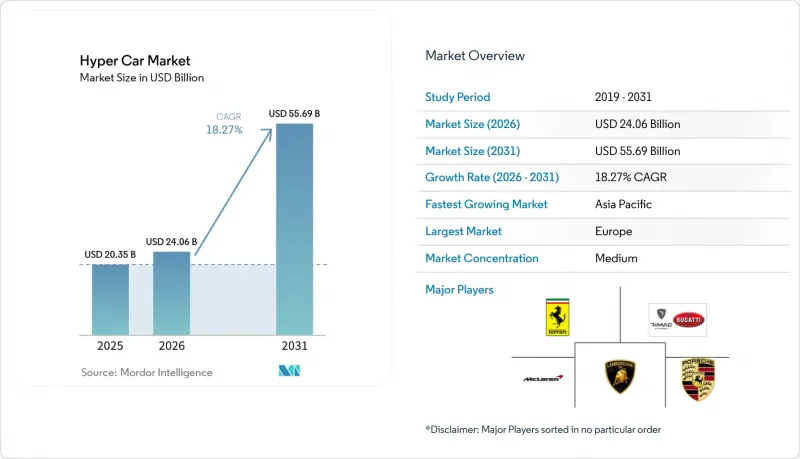
本報告按動力系統(內燃機及其他)、應用領域(個人和賽車)、車輛類型(小轎車、敞篷車、跑車)、引擎排氣量(緊湊型、中型、大型)和地區進行細分。市場預測以價值(美元)和銷售(輛)兩種形式呈現。
全球超級跑車市場趨勢及洞察
亞太和中東地區超級富豪階級的快速成長。
在海灣國家和亞洲主要金融中心,流動性正被重新評估,並調整其分配策略,以專注於限量生產的旗艦車型。阿拉伯聯合大公國(阿拉伯聯合大公國)近期新增百萬富翁數量顯著成長,使其成為未來幾十年大規模代際財富轉移的核心。為了因應這一趨勢,各大汽車品牌紛紛在杜拜和利雅德開設訂製展示室,採用鑲金包裝,並根據當地消費者的喜好量身打造內裝。阿拉伯聯合大公國的人均豪華車擁有率已超過北美,該地區的交付量超過美國便印證了這一點。此外,各大汽車品牌也在該地區的自由貿易區陸續建立組裝廠,以利用較低的進口關稅並與客戶建立更緊密的聯繫。
超級跑車的快速電氣化和混合動力化
混合動力系統已從單純的合規要求發展成為顯著提升性能的關鍵要素。法拉利F80將強勁的雙渦輪增壓V6引擎與高性能電動馬達完美結合。同時,布加迪Tourbillon則將先進的電動動力系統與其強大的V16引擎融為一體。這種協同作用能夠實現瞬時電扭矩輸出,從而減少渦輪遲滯,並實現精密的軟體控制扭矩向量分配。自2026年底起,歐盟7排放標準將強制要求在實際駕駛條件下進行顆粒物計數測量,這將迫使汽車製造商轉型為無需啟動引擎即可完成城市駕駛循環的插電式混合動力平台。儘管充電基礎設施仍顯不足,但先進電池技術的出現帶來了快速充電的誘人前景,但這目前僅限於特定的高容量充電站。
極高的研發成本與製造成本
超級跑車製造是資本密集產業,且產量有限,因此往往難以回收投資。 Czinger 的「21C」車型大量依賴手動組裝和 3D 列印零件,售價極高。布加迪的「Tourbillon」預計在 2020 年代末期之前年產量將較為保守,因此其損益表極易受到外匯和利率波動的影響。同時,保時捷因其專屬純電動車平台開發延誤,被迫在 2020 年代中期累計了巨額減損損失。這凸顯了即使是成熟品牌也面臨著固有的風險。
細分市場分析
預計到2031年,純電動車(BEV)車型將以18.29%的複合年成長率成長,成為動力傳動系統中成長最快的車型。儘管截至2025年,內燃機架構仍佔據超級跑車市場58.71%的佔有率,但市場趨勢正轉向混合動力汽車,這類汽車透過增加電動馬達扭力來縮短圈速,同時又不犧牲V8或V12引擎獨特的聲浪。法拉利和布加迪現在不僅公佈引擎輸出功率,還宣布總合總功率,這表明它們正在進行戰略調整。
雖然像Rimac的Nevera這樣的純電動車旗艦車型仍屬於小眾市場,每款僅生產150輛,但其圈速紀錄和800伏快充能力表明,靜音不再等同於速度慢。儘管基礎設施建設和碳化矽逆變器的成本在短期內阻礙了其普及,以及遵守歐7排放標準的壓力,但可以肯定的是,到2031年,所有新產品計劃都將包含雙電機或三電機配置。
2025年,私人收藏家佔所有汽車交付量的83.37%。他們重視車輛的來源和稀有性,促使汽車製造商將產量限制在500輛以下,並要求預付數年的訂單定金。麥克拉倫W1的配額在48小時內售罄,證明了這種策略的有效性。
同時,賽車應用預計將以18.31%的複合年成長率成長。修訂後的國際汽聯勒芒超級跑車規則要求參賽車型必須符合道路法規,這使得動力單元方面的知識能夠直接從24小時耐力賽賽道應用到勒芒城外的維修車間。世界耐力系列賽目前有14家製造商參賽,高於2023年的8家。此外,來自零件和技術升級的收入也使賽車運動成為一個自籌資金的測試平台。
區域分析
預計到2025年,歐洲將佔全球收入的36.56%,其中義大利的「汽車谷」和英國的先進複合材料中心將構成其基礎。將於2026年11月生效的歐7排放標準,除了現有的排氣管法規外,還將新增耐久性和顆粒物排放要求,這可能會使每輛車的合規成本增加高達20%。馬拉內羅和聖亞加塔的傳統汽車製造商正在積極應對,轉向插電式混合動力架構,使其能夠在城市地區實現零排放駕駛,同時在阿爾卑斯山的道路上保持其標誌性的排氣聲浪。儘管受到英國脫歐相關摩擦的影響,英國工程業仍保持強勁勢頭,並利用大學叢集為麥克拉倫和阿斯頓馬丁等公司提供技術工人。德國汽車製造商則透過在其母公司集團內共用800伏特平台來攤銷研發成本,充分利用了母公司的規模優勢。
預計到2031年,亞太地區的複合年成長率將達到18.37%,成長速度超過其他任何地區。中國、新加坡和海灣國家的新興富豪們正斥資鎖定未來幾年的超級跑車配額。上海和杜拜的專業精品店如今提供區域專屬配置,例如鍍金內飾和支援本地語言的資訊娛樂螢幕。在中國,3公升以上引擎的進口關稅約為25%,一些製造商開始考慮在保稅區組裝以減輕關稅負擔。新加坡的零成長汽車政策已將車輛登記證費用推至天文數字,但電動超級跑車免徵額外課稅,這為Rimac和Pininfarina等品牌帶來了獨特的利好。
北美仍然是最大的單一市場,其中加州、佛羅裡達州和德克薩斯州的車輛註冊量佔比最高。儘管矽谷流動性的波動會對配車計畫產生顯著影響,但成熟的收藏文化支撐著二手市場的價格穩定。南美洲市場規模仍然較小,受到高關稅和外匯波動的限制。同時,除南非以外,非洲的銷量微乎其微。中東地區的人均銷量持續高於平均水平,利雅德和杜哈的展示室擴張計劃與大型賽車賽事同期進行,旨在吸引外地買家。
其他好處:
- Excel格式的市場預測(ME)表
- 3個月的分析師支持
目錄
第1章:引言
- 研究假設和市場定義
- 調查範圍
第2章:調查方法
第3章執行摘要
第4章 市場狀況
- 市場概覽
- 市場促進因素
- 亞太和中東地區超級富豪階級的快速成長。
- 對超豪華高性能汽車的需求日益成長
- 超級跑車的快速電氣化和混合動力化
- 輕質複合材料和碳化物結構的技術突破
- 人工智慧驅動的空氣動力學分析和數位孿生最佳化縮短了開發週期。
- 與加密貨幣財富和 NFT 相關的限量版產品正在吸引新的客戶群。
- 市場限制因素
- 極高的研發成本與製造成本
- 航太複合材料和鈦的供應鏈供不應求。
- 全球更嚴格的排放氣體法規/噪音法規
- 電動車超級跑車的超快速充電基礎設施尚未成熟
- 價值供應鏈分析
- 監理情勢
- 技術展望
- 波特五力模型
第5章 市場規模與成長預測
- 依推進類型
- ICE
- 混合
- 電池式電動車
- 按最終用途
- 私人的
- 種族
- 按車輛類型
- 小轎車
- 敞篷車
- Roadster
- 按引擎排氣量
- 小型(1500cc以下)
- 中等大小(1500-2500 cc)
- 全尺寸(2500 cc 或以上)
- 按地區
- 北美洲
- 美國
- 加拿大
- 其他北美國家
- 南美洲
- 巴西
- 阿根廷
- 其他南美國家
- 歐洲
- 英國
- 德國
- 西班牙
- 義大利
- 法國
- 俄羅斯
- 其他歐洲國家
- 亞太地區
- 印度
- 中國
- 日本
- 印尼
- 馬來西亞
- 新加坡
- 越南
- 菲律賓
- 韓國
- 其他亞太國家
- 中東和非洲
- 阿拉伯聯合大公國
- 沙烏地阿拉伯
- 土耳其
- 埃及
- 南非
- 其他中東和非洲國家
- 北美洲
第6章 競爭情勢
- 市場集中度
- 策略趨勢
- 市佔率分析
- 公司簡介
- Ferrari NV
- Automobili Lamborghini SpA
- Bugatti Rimac
- McLaren Group Ltd.
- Porsche AG
- Koenigsegg Automotive AB
- Pagani Automobili SpA
- Aston Martin Lagonda Global Holdings plc
- Rimac Automobili
- Mercedes-AMG GmbH
- Lotus Cars
- Automobili Pininfarina
- Zenvo Automotive A/S
- Czinger Vehicles
- SSC North America
- W Motors
- Aspark Co. Ltd.
- Hennessey Special Vehicles
- Apollo Automobil GmbH
- Hispano-Suiza Cars
第7章 市場機會與未來展望
According to Mordor Intelligence, the hyper car market size is expected to increase from USD 20.35 billion in 2025 to USD 24.06 billion in 2026 and reach USD 55.69 billion by 2031, growing at a CAGR of 18.27% during the forecast (2026-2031).
This report is Segmented by Propulsion Type (ICE and More), End Use (Private and Racing), Vehicle Type (Coupe, Convertible, and Roadster), Engine Capacity (Compact, Mid-Size, and Full-Size), and Geography. The Market Forecasts are Provided in Terms of Value (USD) and Volume (Units).
Global Hyper Car Market Trends and Insights
Surge in Ultra-High-Net-Worth Individuals in Asia-Pacific & Middle East
In the Gulf and prominent Asian financial hubs, liquid wealth is reshaping strategies for limited-run flagship allocations. Recently, the United Arab Emirates has seen a significant influx of new millionaires and is positioned at the center of a substantial intergenerational wealth transfer projected over the coming decades. In response, brands have unveiled bespoke showrooms in Dubai and Riyadh, featuring gold inlay packages and upholstery tailored to regional tastes. Per-capita luxury car penetration in the UAE now surpasses that of North America, as evidenced by the region's higher deliveries compared to the United States. Additionally, final-assembly satellites have emerged in regional free-trade zones, capitalizing on import-duty savings and fostering closer ties with customers .
Rapid Electrification & Hybridization of Hypercars
Hybrid systems have evolved from mere compliance measures to pivotal performance enhancers. Ferrari's F80 pairs a powerful twin-turbo V6 engine with a high-performance electric motor. Meanwhile, Bugatti's Tourbillon integrates an advanced electric drivetrain with its formidable V16 engine. This synergy allows instant electric torque to mitigate turbo lag and enables sophisticated software-controlled torque vectoring. As of late 2026, Euro 7 regulations will mandate real-world particle-number testing, pushing automakers towards plug-in platforms capable of completing city cycles without activating the engine. While charging infrastructure is still catching up, the advent of advanced battery technology offers the tantalizing prospect of rapid top-ups, but only at select high-capacity charging stations .
Extremely High R&D and Manufacturing Cost Base
Crafting a hypercar is a capital-intensive endeavor, often not recouped over limited production runs. Czinger's 21C, which requires extensive hand assembly and incorporates numerous 3D-printed parts, commands a significant entry price. Bugatti's Tourbillon, with plans for modest annual production through the end of the decade, finds itself vulnerable to currency and interest-rate fluctuations on its income statement. Meanwhile, Porsche faced a substantial impairment in the mid-2020s due to setbacks with its dedicated BEV platform, highlighting the inherent risks even established brands encounter.
Other drivers and restraints analyzed in the detailed report include:
- Breakthroughs in Lightweight Composite & Carbotanium Structures
- AI-Driven Aerodynamic and Digital-Twin Optimization Shortening Development Cycles
- Supply-Chain Scarcity of Aerospace-Grade Composites & Titanium
For complete list of drivers and restraints, kindly check the Table Of Contents.
Segment Analysis
Battery-electric variants are projected to log an 18.29% CAGR to 2031, the fastest climb among powertrains. Internal-combustion architectures still held 58.71% Hypercar market share in 2025, yet momentum favors hybrids that add electric torque for lap-time gains without retiring signature V8 or V12 soundtracks. Ferrari and Bugatti now publish combined system horsepower rather than engine figures alone, signaling the strategic pivot.
Pure BEV flagships like Rimac's Nevera remain niche at 150 units each, but record laps and 800-volt fast-charge capability demonstrate that silence no longer means slower. Infrastructure coverage and silicon-carbide inverter costs moderate near-term uptake, yet Euro 7 compliance pressures ensure dual-motor or tri-motor setups appear in every new product plan through 2031.
Private collectors accounted 83.37% of 2025 deliveries. They value provenance and scarcity, prompting OEMs to cap production runs at below 500 units and to request multi-year deposits. McLaren's W1 allocation closed inside 48 hours, validating the approach.
Racing applications, however, are forecast to increase at an 18.31% CAGR. Updated FIA Le Mans Hypercar rules require road-legal counterparts, moving power-unit learning straight from the 24-hour circuit to suburban garages. Fourteen makers now contest the World Endurance grid, up from eight in 2023, and revenue streams from spare parts and technical updates turn motorsport into a self-funding laboratory.
Complete Report Scope:
- By Propulsion Type
- ICE
- Hybrid
- Battery Electric
- By End Use
- Private
- Racing
- By Vehicle Type
- Coupe
- Convertible
- Roadster
- By Engine Capacity
- Compact (Less than 1500 cc)
- Mid-size (1500-2500 cc)
- Full-size (More than 2500 cc)
- By Geography
- North America
- United States
- Canada
- Rest of North America
- South America
- Brazil
- Argentina
- Rest of South America
- Europe
- United Kingdom
- Germany
- Spain
- Italy
- France
- Russia
- Rest of Europe
- Asia-Pacific
- India
- China
- Japan
- Indonesia
- Malaysia
- Singapore
- Vietnam
- Philippines
- South Korea
- Rest of Asia-Pacific
- Middle East and Africa
- United Arab Emirates
- Saudi Arabia
- Turkey
- Egypt
- South Africa
- Rest of Middle East and Africa
- North America
Geography Analysis
Europe accounted for 36.56% of 2025 revenue, anchored by Italy's Motor Valley and the United Kingdom's advanced composite hubs. Euro 7 implementation in November 2026 adds new durability and particulate requirements on top of existing tailpipe limits, raising per-unit compliance costs by up to 20%. Heritage factories in Maranello and Sant'Agata respond by shifting to plug-in architectures that allow zero-emission city cruising while retaining trademark exhaust notes on alpine passes. British engineering remains resilient despite Brexit friction, leveraging university clusters to feed skilled labor to McLaren and Aston Martin. German OEMs exploit parent-group scale by sharing 800-volt platforms across volume models to amortize research costs.
Asia-Pacific is on track for an 18.37% CAGR to 2031, the fastest of any region. New millionaires in China, Singapore, and the Gulf funnel deposits toward hypercar allocations for years in advance. Dedicated boutiques in Shanghai and Dubai now feature region-specific configurations, including gold-leaf interiors and local language infotainment skins. Import duties in China hover at 25% for engines above 3.0 liters, nudging some makers to explore bonded-zone assembly to shave tariff exposure. Singapore's zero-growth vehicle policy forces astronomical certificate costs, yet electric hypercars escape surtax, giving Rimac and Pininfarina a unique tailwind.
North America remains the single largest country market, with California, Florida, and Texas leading registrations. Silicon Valley liquidity swings can whiplash allocation schedules, but established collector culture supports steady secondary pricing. South America remains small, constrained by high duties and currency volatility, while Africa, excluding South Africa, contributes negligible volume. The Middle East continues to over-index on a per-capita basis, and showroom expansions in Riyadh and Doha are timed to major motorsport events to attract traveling buyers.
- Ferrari N.V.
- Automobili Lamborghini S.p.A.
- Bugatti Rimac
- McLaren Group Ltd.
- Porsche AG
- Koenigsegg Automotive AB
- Pagani Automobili S.p.A.
- Aston Martin Lagonda Global Holdings plc
- Rimac Automobili
- Mercedes-AMG GmbH
- Lotus Cars
- Automobili Pininfarina
- Zenvo Automotive A/S
- Czinger Vehicles
- SSC North America
- W Motors
- Aspark Co. Ltd.
- Hennessey Special Vehicles
- Apollo Automobil GmbH
- Hispano-Suiza Cars
Additional Benefits:
- The market estimate (ME) sheet in Excel format
- 3 months of analyst support
TABLE OF CONTENTS
1 Introduction
- 1.1 Study Assumptions & Market Definition
- 1.2 Scope of the Study
2 Research Methodology
3 Executive Summary
4 Market Landscape
- 4.1 Market Overview
- 4.2 Market Drivers
- 4.2.1 Surge In Ultra-High-Net-Worth Individuals In Apac & Middle East
- 4.2.2 Rising Demand For Ultra-Luxury High-Performance Vehicles
- 4.2.3 Rapid Electrification & Hybridization Of Hypercars
- 4.2.4 Breakthroughs In Lightweight Composite & Carbotanium Structures
- 4.2.5 AI-Driven Aerodynamic / Digital-Twin Optimisation Shortening Development Cycles
- 4.2.6 Crypto-Wealth & NFT-Linked Limited Editions Unlocking New Buyer Pools
- 4.3 Market Restraints
- 4.3.1 Extremely High R&D And Manufacturing Cost Base
- 4.3.2 Supply-Chain Scarcity Of Aerospace-Grade Composites & Titanium
- 4.3.3 Stringent Global Emissions / Noise Regulations
- 4.3.4 Immature Ultra-Fast-Charging Infrastructure For BEV Hypercars
- 4.4 Value / Supply-Chain Analysis
- 4.5 Regulatory Landscape
- 4.6 Technological Outlook
- 4.7 Porter's Five Forces
- 4.7.1 Threat of New Entrants
- 4.7.2 Bargaining Power of Suppliers
- 4.7.3 Bargaining Power of Buyers
- 4.7.4 Threat of Substitutes
- 4.7.5 Competitive Rivalry
5 Market Size & Growth Forecasts (Value (USD) and Volume (Units))
- 5.1 By Propulsion Type
- 5.1.1 ICE
- 5.1.2 Hybrid
- 5.1.3 Battery Electric
- 5.2 By End Use
- 5.2.1 Private
- 5.2.2 Racing
- 5.3 By Vehicle Type
- 5.3.1 Coupe
- 5.3.2 Convertible
- 5.3.3 Roadster
- 5.4 By Engine Capacity
- 5.4.1 Compact (Less than 1500 cc)
- 5.4.2 Mid-size (1500-2500 cc)
- 5.4.3 Full-size (More than 2500 cc)
- 5.5 By Geography
- 5.5.1 North America
- 5.5.1.1 United States
- 5.5.1.2 Canada
- 5.5.1.3 Rest of North America
- 5.5.2 South America
- 5.5.2.1 Brazil
- 5.5.2.2 Argentina
- 5.5.2.3 Rest of South America
- 5.5.3 Europe
- 5.5.3.1 United Kingdom
- 5.5.3.2 Germany
- 5.5.3.3 Spain
- 5.5.3.4 Italy
- 5.5.3.5 France
- 5.5.3.6 Russia
- 5.5.3.7 Rest of Europe
- 5.5.4 Asia-Pacific
- 5.5.4.1 India
- 5.5.4.2 China
- 5.5.4.3 Japan
- 5.5.4.4 Indonesia
- 5.5.4.5 Malaysia
- 5.5.4.6 Singapore
- 5.5.4.7 Vietnam
- 5.5.4.8 Philippines
- 5.5.4.9 South Korea
- 5.5.4.10 Rest of Asia-Pacific
- 5.5.5 Middle East and Africa
- 5.5.5.1 United Arab Emirates
- 5.5.5.2 Saudi Arabia
- 5.5.5.3 Turkey
- 5.5.5.4 Egypt
- 5.5.5.5 South Africa
- 5.5.5.6 Rest of Middle East and Africa
- 5.5.1 North America
6 Competitive Landscape
- 6.1 Market Concentration
- 6.2 Strategic Moves
- 6.3 Market Share Analysis
- 6.4 Company Profiles (includes Global Level Overview, Market Level Overview, Core Segments, Financials as Available, Strategic Information, Market Rank/Share for Key Companies, Products and Services, SWOT Analysis, and Recent Developments)
- 6.4.1 Ferrari N.V.
- 6.4.2 Automobili Lamborghini S.p.A.
- 6.4.3 Bugatti Rimac
- 6.4.4 McLaren Group Ltd.
- 6.4.5 Porsche AG
- 6.4.6 Koenigsegg Automotive AB
- 6.4.7 Pagani Automobili S.p.A.
- 6.4.8 Aston Martin Lagonda Global Holdings plc
- 6.4.9 Rimac Automobili
- 6.4.10 Mercedes-AMG GmbH
- 6.4.11 Lotus Cars
- 6.4.12 Automobili Pininfarina
- 6.4.13 Zenvo Automotive A/S
- 6.4.14 Czinger Vehicles
- 6.4.15 SSC North America
- 6.4.16 W Motors
- 6.4.17 Aspark Co. Ltd.
- 6.4.18 Hennessey Special Vehicles
- 6.4.19 Apollo Automobil GmbH
- 6.4.20 Hispano-Suiza Cars
7 Market Opportunities & Future Outlook
- 7.1 White-space & Unmet-Need Assessment

 超級跑車市場機會、成長要素、產業趨勢分析及2026-2035年預測。
 2026年全球超級跑車市場報告
 2026-2034年全球超級跑車市場規模、佔有率、趨勢和成長分析報告
 2026-2030年全球超級跑車市場
 超級跑車市場 - 全球產業規模、佔有率、趨勢、機會及預測(按動力系統、應用、車輛類型、地區和競爭格局分類,2021-2031年)
 超級跑車市場規模、佔有率和成長分析(按動力系統、最終用途和地區分類)—2026-2033年產業預測
 全球超跑市場
 超級跑車市場 -;車輛尺寸:緊湊型、中型和全尺寸;推進系統:內燃機、電動 - 全球產業分析、規模、佔有率、成長、趨勢及預測(2025-2035)
 全球超級跑車市場:市場規模、市場佔有率、趨勢、行業分析(依推進方式、應用和地區)、未來預測(2025-2034年)