


 |
市場調查報告書
商品編碼
2117431
汽車馬達:市場佔有率分析、產業趨勢與統計、成長預測(2026-2031)Automotive Motors - Market Share Analysis, Industry Trends & Statistics, Growth Forecasts (2026 - 2031) |
||||||

※ 本網頁內容可能與最新版本有所差異。詳細情況請與我們聯繫。
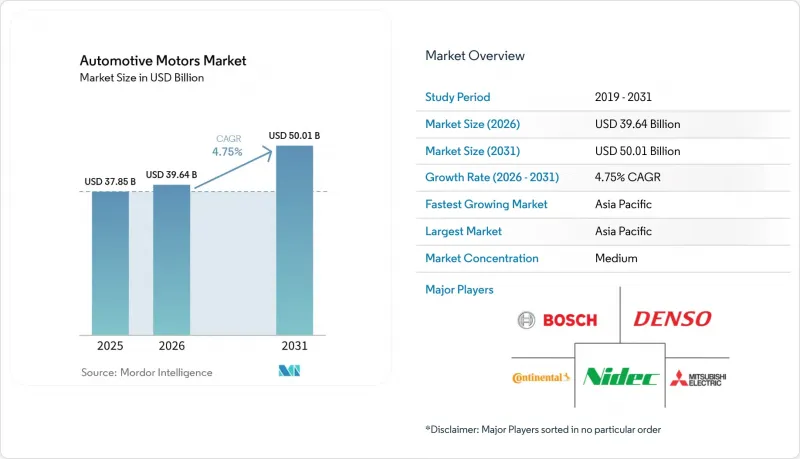
據 Mordor Intelligence 稱,2025 年汽車馬達市值為 378.5 億美元,預計到 2031 年將達到 500.1 億美元,而 2026 年為 396.4 億美元,預測期(2026-2031 年)的複合年成長率為 4.75%。
本報告按馬達類型(例如DC馬達)、應用領域(例如動力傳動系統)、車輛類型(例如摩托車)、銷售管道(OEM、售後市場)和地區進行細分。市場預測以價值(美元)和數量(單位)為單位。
全球汽車馬達市場趨勢及洞察
輔助系統電氣化(電動幫浦、電動壓縮機)
變速馬達正在取代皮帶驅動的泵浦和壓縮機,透過將輔助負載與引擎轉速解耦,它們可將內燃機動力動力傳動系統的油耗降低高達 5%,並將純電動車的續航里程延長約 6-8%。僅在 2024 年,馬勒就交付了超過 1000 萬台電動冷卻水泵,這表明即使是傳統的專案現在也傾向於採用電子驅動。採埃孚 (ZF) 的 48V 機油幫浦將於 2025 年推出,可降低滑行時的寄生電阻,並支援歐洲和日本新型混合動力汽車的閉缸功能。功率從 50W 到 500W 的緊湊型無刷直流馬達 (BLDC) 正在推動這一轉變,供應商正在整合逆變器以實現線束小型化。隨著 800V 電池組的引入,熱通量增加,高階純電動車擴大配備多個冷卻水泵、冷媒泵和機油泵,從而增加了每輛車的電機數量,預計未來十年需求將保持強勁。
ADAS級安全執行器的快速普及
法規正在加速馬達技術的應用。美國國家公路交通安全管理局 (NHTSA) 2024 年的法規強制要求所有新型輕型車輛配備自動緊急煞車 (AEB) 系統,而歐盟的通用安全法規 II (GSR II) 則要求從 2024 年中期開始配備車道維持輔助系統和智慧速度輔助系統。根據 MITRE 的 PARTS資料庫,絕大多數美國 2023 年車型已經配備了 AEB 系統,這凸顯了企業對法規的快速反應。每項高級駕駛輔助系統 (ADAS) 功能都需要多個步進馬達或伺服馬達來完成諸如攝影機定位、雷達百葉窗開啟和關閉以及轉向扭矩疊加等任務。計劃於 2025 年推出的中國新車安全評鑑協會 (C-NCAP) 鼓勵使用主動式變換車道功能,這增加了對高功率步進馬達的需求。像法雷奧 (Valeo) 這樣的供應商目前正在將雙軸馬達整合到自我調整頭燈模組中,以實現即時光束調節。隨著 LED 價格的下降,這項先進功能正逐漸在標準級車輛中普及。
銅和稀土元素的價格波動
2026年初,智利和秘魯等主要產區的供應中斷導致銅價飆升至峰值,但隨後幾個月價格有所回落。由於銅繞組在無刷直流馬達(BLDC馬達)的材料成本中佔很大比例,這些價格波動對馬達利潤率造成了顯著影響。同時,由於中國收緊出口限制,釹磁鐵和镨磁鐵的成本也大幅上漲。為因應此局面,各大公司紛紛採取了避險、垂直整合或探索不使用磁鐵的替代技術等策略。 Niron公司的氮化鐵合金就是其中一種替代方案,但目前的原型機面臨功率密度降低等挑戰。這些持續的波動略微降低了汽車馬達市場的預期成長率。
細分市場分析
儘管牽引馬達在2025年的基數相對較小,但隨著純電動車(BEV)的普及,預計其複合年成長率將達到4.77%。無刷直流馬達(BLDC)設計在2025年佔據了43.36%的需求佔有率,並在空調鼓風機、座椅驅動和冷卻液泵等領域佔據了穩固地位。 YASA的軸流式佈局採用髮夾繞組,槽填充率達到70%,目前功率密度為3.5 kW/kg,展現了其在高階混合動力汽車中可實現的性能。伺服在主動空氣動力學和多軸座椅中發揮關鍵作用,而步進馬達在自我調整照明和相機雲台中仍然不可或缺。無磁鐵原型機雖然確保了供應穩定性,但扭矩密度有所降低。總體而言,隨著汽車馬達市場的多元化發展,主導拓撲結構將取決於效率、封裝和原料的穩定供應。
在汽車馬達市場中,牽引馬達市場預計到2031年將達到X億美元,而無刷直流馬達(BLDC)雖然成長率預計會放緩,但仍可能保持相當大的市場佔有率。隨著碳化矽(SiC)逆變器尺寸的縮小和整合度的提高,原始設備製造商(OEM)將能夠最佳化整體系統成本而非峰值效率,從而實現產品系列的平衡,使經濟高效的鐵氧體單元和高密度釹鐵硼(NdFeB)型號能夠並存。能夠處理模組化定子疊層、軟性繞組和嵌入式控制軟體的供應商將獲得顯著優勢。
到2025年,動力傳動系統將佔據主導地位,市場佔有率達到47.21%,但預計到2031年,安全系統將成為成長最快的領域,這主要得益於自動緊急煞車(AEB)和車道維持法規的推動。隨著高級駕駛輔助系統(ADAS)每增加一層,用於煞車、轉向或感測的伺服馬達、步進馬達或微型無刷直流馬達(BLDC)都會被應用。馬瑞利(Marelli)的自我調整遠光燈符合聯合國R-123標準,並採用雙軸步進電機,目前已成為歐洲C級車的標準配備。由於高效率的無刷直流鼓風機能夠降低各類車輛的二氧化碳排放,並有助於獲得排放積分,因此暖通空調(HVAC)領域的需求保持穩定。舒適性馬達可能會進一步整合,因為區域控制器共用執行器,但座椅按摩和主動降噪等新功能將抵消這種減少。總而言之,功能安全性和能源效率的結合正在推動汽車馬達市場的需求成長。
對安全系統的需求正在推動汽車馬達市場的成長,即使一些舊款交流發電機正在逐步淘汰,每輛車每年仍將增加一到兩個馬達。整合感測器融合、韌體更新和自診斷功能的頂級供應商將超越那些純粹專注於硬體的競爭對手。
區域分析
亞太地區仍是最大的區域貢獻來源,預計2025年將佔全球銷售額的44.57%,並以4.87%的複合年成長率持續成長。在中國,從稀土元素開採到最終組裝的一體化模式,使得中國供應商能夠以遠低於日本和歐洲競爭對手的價格銷售牽引馬達。在印度,政府補貼正在推動兩輪和三輪車輛輪轂式馬達(BLDC)零件工廠的投資。日本產業領導企業電裝(Denso)和尼得科(Nidec)已停止對內燃機(ICE)的投資,並將資金轉向碳化矽(SiC)逆變器和電力驅動橋,從而提升了該地區的技術實力。
儘管北美在產量上落後於其他地區,但在強調區域增值生產的貿易規則的推動下,北美正經歷生產回流的浪潮。博格華納、大陸集團和德納等公司正在墨西哥和美國南部擴大產能,以滿足底特律電池式電動車(BEV)舉措的在地採購需求。此外,近期推出的法規降低了國產電池組的價格,間接促進了馬達需求。然而,中國製造的磁鐵被淘汰,使採購格局變得更加複雜,加拿大和美國的稀土元素計畫未來或許能夠緩解這項挑戰。
歐洲嚴格的二氧化碳排放法規正在推動電池式電動車(BEV)的普及,並延長售後市場的使用壽命。博斯從燃油噴射系統轉向電動機,雖然伴隨著痛苦的裁員,但也凸顯了該地區的緊迫性。在東歐,德國汽車製造商正積極吸引待開發區電機工廠,但稀土元素和碳化矽晶片的供應仍依賴亞洲。在中東,氫能是優先發展方向,因此對電池式電動車的關注有限。然而,在氣候炎熱的地區,混合動力汽車的需求正在興起,這為電機市場創造了小規模但意義重大的機會。這些區域特徵正在塑造汽車馬達市場的本土化策略。
其他好處:
- Excel格式的市場預測(ME)表
- 3個月的分析師支持
目錄
第1章:引言
- 市場分析與定義的前提條件
- 分析範圍
第2章 分析方法
第3章執行摘要
第4章 市場狀況
- 市場概覽
- 市場促進因素
- 輔助系統電氣化(電動幫浦、電動壓縮機)
- ADAS級安全執行器的快速普及
- OEM廠商對48V輕混架構的興趣日益濃厚
- 法規正在推動節能型暖通空調鼓風機的發展。
- 車輛內部舒適性和健康功能的擴展
- 豪華電動車對低噪音無刷直流馬達解決方案的需求日益成長
- 市場限制因素
- 銅和稀土元素的價格波動
- 高功率密度下溫度控管的挑戰
- 牽引馬達用磁鐵供應鏈的集中化
- 整合智慧執行器的競爭降低了馬達物料清單成本。
- 價值鍊和供應鏈分析
- 監理情勢
- 技術展望
- 波特五力分析
第5章:預測市場規模與成長率
- 依馬達類型
- DC馬達
- 無刷直流馬達(BLDC)
- 步進馬達
- 驅動馬達
- 伺服馬達
- 透過使用
- 動力傳動系統
- 舒適系統
- 安全系統
- HVAC
- 資訊娛樂
- 其他
- 按車輛類型
- 摩托車
- 搭乘用車
- 輕型商用車(LCV)
- 重型商用車(HCV)
- 非公路用車輛
- 按銷售管道
- OEM
- 售後市場
- 按地區
- 北美洲
- 美國
- 加拿大
- 其他北美國家
- 南美洲
- 巴西
- 阿根廷
- 其他南美國家
- 歐洲
- 英國
- 德國
- 西班牙
- 義大利
- 法國
- 俄羅斯
- 其他歐洲國家
- 亞太地區
- 印度
- 中國
- 日本
- 韓國
- 其他亞太國家
- 中東和非洲
- 阿拉伯聯合大公國
- 沙烏地阿拉伯
- 土耳其
- 埃及
- 南非
- 其他中東和非洲國家
- 北美洲
第6章 競爭情勢
- 市場集中度
- 策略趨勢
- 市佔率分析
- 公司簡介
- Robert Bosch GmbH
- DENSO Corporation
- Nidec Corporation
- Continental AG
- Mitsubishi Electric Corporation
- BorgWarner Inc.
- Mabuchi Motor Co., Ltd.
- Johnson Electric Holdings Ltd.
- Valeo SA
- Hitachi Astemo, Ltd.
- Brose Fahrzeugteile GmbH & Co. KG
- ZF Friedrichshafen AG
- Mahle GmbH
- Panasonic Automotive Systems
- LG Magna e-Powertrain
- Siemens AG(Traction Motors)
- Wuxi CasCadi Motor Co., Ltd.
- Shanghai Edrive Co., Ltd.
- Tesla Inc.(In-house Motor Division)
- Dana TM4
第7章 市場機會與未來展望
According to Mordor Intelligence, the automotive motors market size was valued at USD 37.85 billion in 2025 and is estimated to grow from USD 39.64 billion in 2026 to reach USD 50.01 billion by 2031, at a CAGR of 4.75% during the forecast period (2026-2031).
This report is Segmented by Motor Type (DC Motor and More), Application (Powertrain and More), Vehicle Type (Two-Wheelers and More), Sales Channel (OEM and Aftermarket), and Geography. The Market Forecasts are Provided in Terms of Value (USD) and Volume (Units).
Global Automotive Motors Market Trends and Insights
Electrification of Auxiliary Systems (E-Pumps, E-Compressors)
Variable-speed motors are replacing belt-driven pumps and compressors, cutting fuel use by up to 5% in internal-combustion powertrains and extending BEV range by roughly 6-8% because auxiliary loads are decoupled from engine speed . MAHLE shipped more than 10 million electric coolant pumps in 2024 alone, showing that even legacy programs now favor electronic actuation. ZF's 48-V oil pump, launched in 2025, removes parasitic drag during coasting and supports cylinder deactivation in new European and Japanese hybrids . Compact BLDC units rated between 50 W and 500 W dominate this transition, and suppliers are embedding inverters to shrink wiring harnesses. As 800-V battery packs raise heat flux, premium BEVs add multiple coolant, refrigerant, and oil pumps, lifting per-vehicle motor content and sustaining demand through the decade.
Rapid Adoption of ADAS-Grade Safety Actuators
Regulation is accelerating motor penetration: the U.S. National Highway Traffic Safety Administration's 2024 rule mandates AEB on all new light vehicles, and the EU's General Safety Regulation II requires lane-keeping and intelligent speed assistance from mid-2024 . According to MITRE's PARTS database, the vast majority of U.S. sales for the 2023 model year have already integrated AEB, highlighting swift compliance. Each ADAS feature requires several stepper or servo motors for tasks such as camera positioning, radar shuttering, and steering-torque overlay. China's C-NCAP, set for 2025, is incentivizing active lane-change features, leading to increased demand for more powerful steppers. Suppliers like Valeo are now pairing adaptive headlamp modules with dual-axis motors to enable real-time beam adjustments. This advanced capability is gradually making its way into mainstream trims, thanks to declining LED prices.
Copper & Rare-Earth Price Volatility
In early 2026, copper prices reached their peak due to disruptions in key producing regions like Chile and Peru, before stabilizing slightly in the following months. This price volatility has significantly impacted motor margins, as copper windings constitute a substantial portion of the material cost in BLDCs. Around the same period, the cost of neodymium-praseodymium magnets rose sharply, driven by stricter export policies from China. In response, leading companies are adopting strategies such as hedging, vertical integration, or the exploration of magnet-free alternatives. One such alternative is Niron's iron-nitride alloy, though current prototypes face challenges, including reduced power density. This ongoing volatility has led to a slight decline in the projected growth rate of the automotive motors market.
Other drivers and restraints analyzed in the detailed report include:
- Rising OEM Focus on 48-V Mild-Hybrid Architectures
- Regulatory Push for Energy-Efficient HVAC Blowers
- Thermal Management Challenges at Higher Power Densities
For complete list of drivers and restraints, kindly check the Table Of Contents.
Segment Analysis
Traction motors started from a smaller 2025 base yet are forecast to deliver a 4.77% CAGR as BEVs proliferate. BLDC designs accounted for 43.36% of 2025 demand owing to entrenched roles in HVAC blowers, seat drives, and coolant pumps. Hairpin winding lifts slot fill to 70%, and YASA's axial-flux layout, now at 3.5 kW/kg, shows what premium hybrids can achieve. Servo motors thrive in active aero and multi-axis seats, while stepper motors remain essential for adaptive lighting and camera gimbals. Magnet-free prototypes offer supply resilience but give up torque density. Overall, efficiency, packaging, and raw-material security determine which topologies win as the automotive motors market diversifies.
The automotive motors market size for traction motors is projected to command USD -X billion by 2031, while BLDC designs will still hold a sizeable slice, albeit at slower growth. As SiC inverters shrink and integrate, OEMs can optimize for total system cost rather than peak efficiency, enabling a blended portfolio in which cost-effective ferrite units coexist with high-density NdFeB models. Suppliers capable of modular stator lamination, flexible winding, and embedded control software will capture disproportionate value.
Powertrain dominated with 47.21% share in 2025, yet safety systems will grow the fastest to 2031 on the back of AEB and lane-keeping rules. Every new ADAS layer adds servo, stepper, or micro-BLDC motors for braking, steering, or sensing. Marelli's adaptive-beam lamps, compliant with UN R-123, use dual-axis steppers and are already standard on European C-segment cars. HVAC retains steady pull because efficient BLDC blowers shave fleet CO2 for credits. Comfort motors may consolidate as zone controllers share actuators, yet new seat-massage and active-noise features offset losses. Overall, functional safety and energy efficiency jointly steer demand in the automotive motors market.
Safety-system demand translates into 1-2 additional motors per car each model year, supporting expansion in the automotive motors market size even as some legacy alternators disappear. Tier-ones that bundle sensor fusion, firmware updates, and self-diagnostics will outpace pure hardware peers.
Complete Report Scope:
- By Motor Type
- DC Motor
- Brushless DC Motor (BLDC)
- Stepper Motor
- Traction Motor
- Servo Motor
- By Application
- Powertrain
- Comfort Systems
- Safety Systems
- HVAC
- Infotainment
- Others
- By Vehicle Type
- Two-Wheelers
- Passenger Cars
- Light Commercial Vehicles (LCVs)
- Heavy Commercial Vehicles (HCVs)
- Off-Highway Vehicles
- By Sales Channel
- OEM
- Aftermarket
- By Geography
- North America
- United States
- Canada
- Rest of North America
- South America
- Brazil
- Argentina
- Rest of South America
- Europe
- United Kingdom
- Germany
- Spain
- Italy
- France
- Russia
- Rest of Europe
- Asia-Pacific
- India
- China
- Japan
- South Korea
- Rest of Asia-Pacific
- Middle East and Africa
- United Arab Emirates
- Saudi Arabia
- Turkey
- Egypt
- South Africa
- Rest of Middle East and Africa
- North America
Geography Analysis
Asia-Pacific remained the largest regional contributor, accounting for 44.57% of 2025 revenue, and is projected to expand at a 4.87% CAGR. China's integrated approach-from rare-earth mining to final assembly-enables its vendors to price traction motors significantly lower than their Japanese and European counterparts. In India, government subsidies bolster demand for hub motors in two- and three-wheelers. Meanwhile, Thailand, Indonesia, and Vietnam are actively seeking investments for BLDC component plants. Japanese industry leaders, DENSO and Nidec, have halted their investments in internal combustion engines (ICE) and are redirecting funds towards SiC inverters and e-axles, enhancing the region's technological prowess.
While North America lags in volume, it is witnessing a surge in reshoring, spurred by trade rules that emphasize regional value. Companies like BorgWarner, Continental, and Dana are expanding capacity in Mexico and the southern U.S. to meet the local-content requirements for Detroit's battery-electric vehicle (BEV) initiatives. Additionally, recent legislation makes domestic battery packs more affordable, indirectly boosting motor demand. However, the exclusion of Chinese magnets complicates sourcing, a challenge that Canadian and U.S. rare-earth projects might alleviate in the future.
Europe grapples with stringent CO2 regulations, driving the adoption of battery electric vehicles (BEVs) and extending the aftermarket's longevity. Bosch's shift from fuel injectors to e-motors, albeit accompanied by painful staff reductions, underscores the region's pressing urgency. While Eastern Europe is attracting greenfield motor plants serving German OEMs, it remains reliant on Asian sources for rare earths and SiC wafers. The Middle East is prioritizing hydrogen, resulting in a limited focus on battery-electric vehicles. However, there's a budding demand for hybrids in hotter climates, presenting modest opportunities for motors. These regional distinctions are molding tailored strategies in the automotive motors landscape.
- Robert Bosch GmbH
- DENSO Corporation
- Nidec Corporation
- Continental AG
- Mitsubishi Electric Corporation
- BorgWarner Inc.
- Mabuchi Motor Co., Ltd.
- Johnson Electric Holdings Ltd.
- Valeo SA
- Hitachi Astemo, Ltd.
- Brose Fahrzeugteile GmbH & Co. KG
- ZF Friedrichshafen AG
- Mahle GmbH
- Panasonic Automotive Systems
- LG Magna e-Powertrain
- Siemens AG (Traction Motors)
- Wuxi CasCadi Motor Co., Ltd.
- Shanghai Edrive Co., Ltd.
- Tesla Inc. (In-house Motor Division)
- Dana TM4
Additional Benefits:
- The market estimate (ME) sheet in Excel format
- 3 months of analyst support
TABLE OF CONTENTS
1 Introduction
- 1.1 Study Assumptions & Market Definition
- 1.2 Scope of the Study
2 Research Methodology
3 Executive Summary
4 Market Landscape
- 4.1 Market Overview
- 4.2 Market Drivers
- 4.2.1 Electrification of Auxiliary Systems (E-Pumps, E-Compressors)
- 4.2.2 Rapid Adoption of Adas-Grade Safety Actuators
- 4.2.3 Rising Oem Focus on 48-V Mild-Hybrid Architectures
- 4.2.4 Regulatory Push For Energy-Efficient Hvac Blowers
- 4.2.5 Growth of In-Cabin Comfort & Wellness Features
- 4.2.6 Increasing Demand For Low-Noise Bldc Solutions In Premium EVs
- 4.3 Market Restraints
- 4.3.1 Copper & Rare-Earth Price Volatility
- 4.3.2 Thermal Management Challenges At Higher Power Densities
- 4.3.3 Supply-Chain Concentration of Traction-Motor Magnets
- 4.3.4 Competition From Integrated Smart Actuators Reducing Motor Bom
- 4.4 Value / Supply-Chain Analysis
- 4.5 Regulatory Landscape
- 4.6 Technological Outlook
- 4.7 Porter's Five Forces
- 4.7.1 Threat of New Entrants
- 4.7.2 Bargaining Power of Suppliers
- 4.7.3 Bargaining Power of Buyers
- 4.7.4 Threat of Substitutes
- 4.7.5 Competitive Rivalry
5 Market Size & Growth Forecasts (Value (USD) and Volume (Units))
- 5.1 By Motor Type
- 5.1.1 DC Motor
- 5.1.2 Brushless DC Motor (BLDC)
- 5.1.3 Stepper Motor
- 5.1.4 Traction Motor
- 5.1.5 Servo Motor
- 5.2 By Application
- 5.2.1 Powertrain
- 5.2.2 Comfort Systems
- 5.2.3 Safety Systems
- 5.2.4 HVAC
- 5.2.5 Infotainment
- 5.2.6 Others
- 5.3 By Vehicle Type
- 5.3.1 Two-Wheelers
- 5.3.2 Passenger Cars
- 5.3.3 Light Commercial Vehicles (LCVs)
- 5.3.4 Heavy Commercial Vehicles (HCVs)
- 5.3.5 Off-Highway Vehicles
- 5.4 By Sales Channel
- 5.4.1 OEM
- 5.4.2 Aftermarket
- 5.5 By Geography
- 5.5.1 North America
- 5.5.1.1 United States
- 5.5.1.2 Canada
- 5.5.1.3 Rest of North America
- 5.5.2 South America
- 5.5.2.1 Brazil
- 5.5.2.2 Argentina
- 5.5.2.3 Rest of South America
- 5.5.3 Europe
- 5.5.3.1 United Kingdom
- 5.5.3.2 Germany
- 5.5.3.3 Spain
- 5.5.3.4 Italy
- 5.5.3.5 France
- 5.5.3.6 Russia
- 5.5.3.7 Rest of Europe
- 5.5.4 Asia-Pacific
- 5.5.4.1 India
- 5.5.4.2 China
- 5.5.4.3 Japan
- 5.5.4.4 South Korea
- 5.5.4.5 Rest of Asia-Pacific
- 5.5.5 Middle East and Africa
- 5.5.5.1 United Arab Emirates
- 5.5.5.2 Saudi Arabia
- 5.5.5.3 Turkey
- 5.5.5.4 Egypt
- 5.5.5.5 South Africa
- 5.5.5.6 Rest of Middle East and Africa
- 5.5.1 North America
6 Competitive Landscape
- 6.1 Market Concentration
- 6.2 Strategic Moves
- 6.3 Market Share Analysis
- 6.4 Company Profiles (includes Global Level Overview, Market Level Overview, Core Segments, Financials as Available, Strategic Information, Market Rank/Share for Key Companies, Products and Services, SWOT Analysis, and Recent Developments)
- 6.4.1 Robert Bosch GmbH
- 6.4.2 DENSO Corporation
- 6.4.3 Nidec Corporation
- 6.4.4 Continental AG
- 6.4.5 Mitsubishi Electric Corporation
- 6.4.6 BorgWarner Inc.
- 6.4.7 Mabuchi Motor Co., Ltd.
- 6.4.8 Johnson Electric Holdings Ltd.
- 6.4.9 Valeo SA
- 6.4.10 Hitachi Astemo, Ltd.
- 6.4.11 Brose Fahrzeugteile GmbH & Co. KG
- 6.4.12 ZF Friedrichshafen AG
- 6.4.13 Mahle GmbH
- 6.4.14 Panasonic Automotive Systems
- 6.4.15 LG Magna e-Powertrain
- 6.4.16 Siemens AG (Traction Motors)
- 6.4.17 Wuxi CasCadi Motor Co., Ltd.
- 6.4.18 Shanghai Edrive Co., Ltd.
- 6.4.19 Tesla Inc. (In-house Motor Division)
- 6.4.20 Dana TM4
7 Market Opportunities & Future Outlook
- 7.1 White-space & Unmet-Need Assessment

 汽車電動車窗馬達市場-2026-2032年全球市場預測汽車電機市場:2026-2032年全球市場預測(按電機類型、驅動系統、應用、車輛類型和銷售管道)
 馬達製造市場規模:按馬達類型、應用、最終用戶、地區和預測分類。
 汽車馬達市場分析及預測(至2035年):類型、產品類型、技術、組件、應用、最終用戶、功能、安裝配置、解決方案
 汽車電機市場報告:按電機類型、車輛類型、銷售管道、應用和地區分類(2026-2034 年)
 汽車馬達市場:按產品類型、應用、車輛類型、電動車類型和地區分類
 全球電動車驅動馬達軸承銷售市場報告、競爭分析及區域機會(2026-2032年)全球汽車馬達市場規模、佔有率、趨勢和成長分析報告(2026-2034)
 汽車馬達市場:全球產業分析、市場規模、市場佔有率及電動汽車馬達預測(按類型、電動車類型、功能、車輛類型、應用、國家和地區分類),2025年至2032年
 汽車感應馬達市場-全球產業規模、佔有率、趨勢、機會、預測:按類型、銷售管道、地區和競爭格局分類,2021-2031年